Social Media Metrics That Drives Business Growth in 2026
Track Social Media Metrics that matter in 2026. Learn which metrics drive real ROI for Philippine brands, from engagement to conversion and retention.

Vanity metrics are dead. Follower counts and basic likes won't prove ROI in 2026, and your leadership team knows it. Social media managers face one brutal question: "What's the ROI?" If you're still reporting engagement rates without revenue data, you're bringing the wrong numbers to the boardroom. With over 5.66 billion active users worldwide spending around 2 hours and 20-40 minutes daily on social media in 2026, the opportunity is massive but only if you're tracking social media metrics that connect to revenue.
This guide shows you exactly which social media metrics matter for Philippine brands, digital marketers, and PR agencies proving business impact in 2026.
Social Media Metrics by Category
Awareness & Growth Metrics
- Reach
- Impressions
- Follower Growth Rate
- Share of Voice
Engagement Quality Metrics
- Engagement Rate
- Saves & Shares
- Meaningful Comments
- Dwell Time/Completion Rate
Conversion & ROI Metrics
- Click-Through Rate (CTR)
- Conversion Rate
- Cost Per Acquisition (CPA)
- Return on Ad Spend (ROAS)
Customer Experience Metrics
- Response Time
- Response Rate
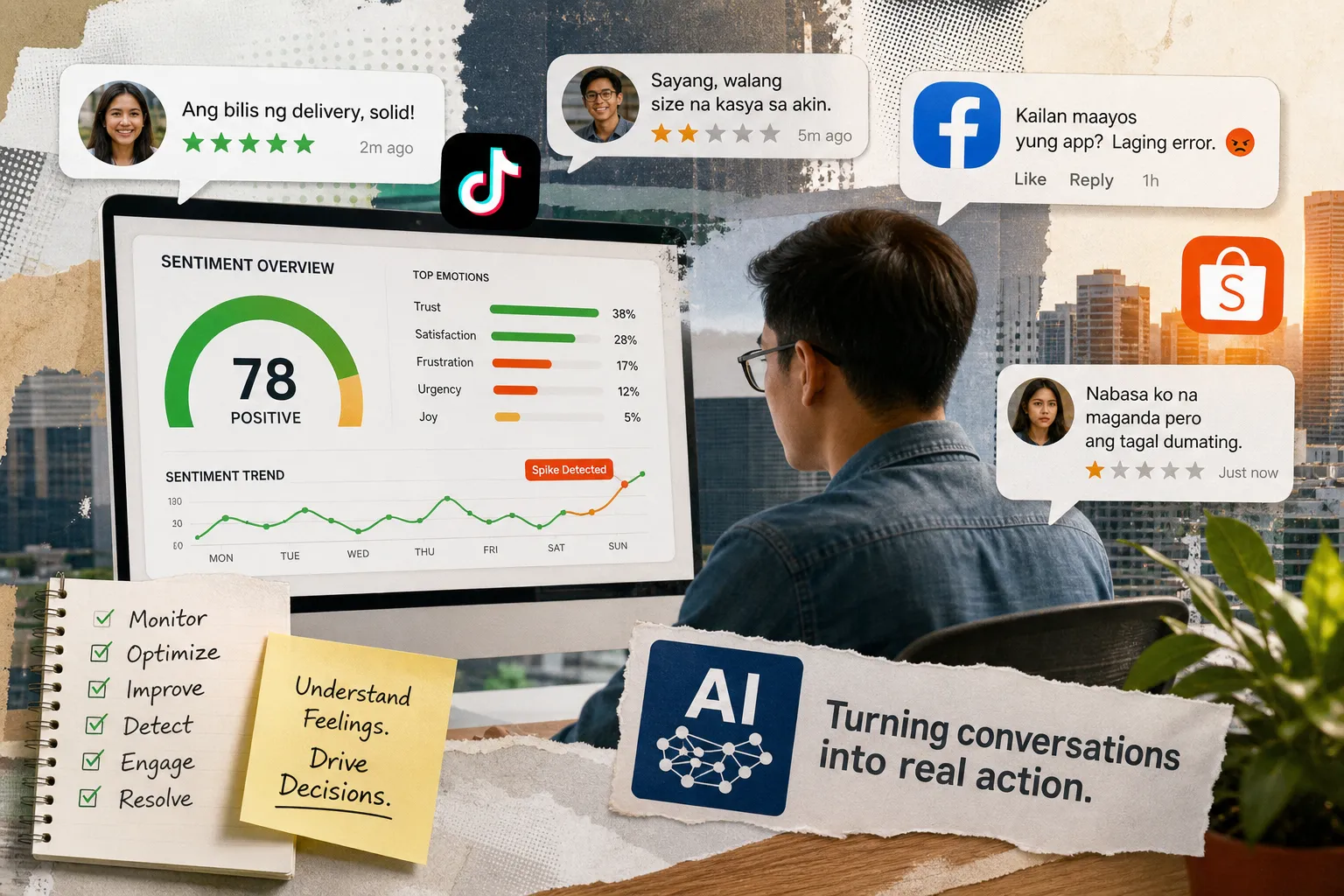
- Sentiment Analysis
The Core Problem: Wrong Metrics, Wrong Decisions
Many marketing leaders cite poor integration between social tools and the rest of their tech stack as a key barrier to understanding social's business impact. The issue isn't lack of data. It's tracking metrics that don't connect to revenue.
That 10,000-follower milestone? Meaningless if they never convert. That viral post with 50,000 likes? Irrelevant if it doesn't drive business forward. Successful teams in 2026 build a metric ladder: awareness → engagement quality → conversion → retention. They track 1-2 KPIs per stage, not dozens of disconnected numbers
1. Awareness Metrics: Building Your Foundation
Reach measures total unique users who saw your content. No reach means no opportunity for conversions. Track reach alongside engagement. Consistent reach with stable or rising engagement indicates healthy demand creation, not viral luck.
Follower growth rate shows percentage increase over time, making it far more meaningful than raw follower count. The quality of your audience matters more than the size.
Share of voice represents your portion of category conversations versus competitors. This metric shows your brand's positioning within industry conversation. Increasing your share of conversation typically signals growing market presence and eventual revenue growth.
For Philippine brands, regularly auditing audience demographics against your target ICP becomes critical. Age, location, language, and job role data validate whether you're reaching your ideal customer profile. Misalignment signals your content strategy needs adjustment to reach local markets effectively.
2. Engagement Quality: What Actually Drives Results
In 2026, the spotlight shifts dramatically to metrics like saves, private shares, and meaningful comments. These actions signal stronger intent than passive likes. Platform algorithms now reward these high-value interactions with exponentially more organic reach.
According to 2026 social media benchmarks, engagement rates vary significantly across platforms. TikTok averages 3.70% engagement (up 49% from 2025), while Instagram holds at 0.48% and Facebook declines to 0.15%. Calculate engagement rate against reach, not followers, for accurate content performance measurement.
Saves and shares represent the gold standard of 2026 engagement. Shares per post have increased significantly on both TikTok and Instagram. When users save or share content, they signal real value and intent to revisit or recommend. Far stronger signals than passive likes.
Meaningful comments show longer replies indicating genuine conversation, not emoji drops or one-word responses. Average comments per post fell by around 24% on TikTok and 16% on Instagram, suggesting a shift toward more passive engagement. This makes quality comments even more valuable. They indicate true community building. Prioritize conversation depth over comment volume.
Dwell time and completion rate measure how long users stay on your posts or videos. In 2026, algorithms on platforms like LinkedIn heavily prioritize dwell time and saves over simple likes. Longer engagement equals more algorithmic distribution and reach. If your completion rate is relatively low compared to your past posts or industry benchmarks, it suggests your content isn't resonating. Test different hooks, lengths, and formats.
3. Conversion & ROI Metrics: Proving Business Impact
These metrics connect social activity directly to revenue and pipeline, where business growth is actually measured. Click-through rate (CTR) shows how many people saw your social content and wanted to see more. Test different CTAs, link placements, and creative formats. Even 0.5% CTR improvement significantly impacts downstream conversions.
Conversion rate reveals the percentage of visitors from social who complete key actions like lead forms, purchases, or signups. This metric shows the value of your campaigns in feeding your funnel. Critical: UTM parameters are the key to making conversions trackable. Without proper UTM tagging, you're flying blind on attribution.
Cost per acquisition (CPA) measures efficiency for paid campaigns, crucial for budget allocation. Industry forecasts suggest social media ad spend will grow at high single-digit to low double-digit rates annually through the late 2020s. As competition increases, optimizing CPA becomes essential for maintaining profitable campaigns.
Return on ad spend (ROAS) shows how much revenue you're generating for every dollar spent on specific campaigns. Many practitioners treat a 3:1 ROAS as a solid baseline, with 4-5:1 considered strong in many industries, assuming healthy profit margins. Several 2026 trend reports indicate that creator-led content often matches or beats brand-produced content on revenue metrics, while typically costing less to produce. This makes influencer partnerships worth expanding when ROAS supports it.
Social commerce transactions represent the future of social media. Some forecasts suggest a significant share of global shoppers will primarily shop via social media within the next decade, especially on platforms like Instagram and TikTok. If you're in e-commerce, shoppable posts should be core strategy, not experimental features.
4. Platform Benchmarks: Where to Focus in 2026
Platform nuances matter significantly. Set realistic goals and optimize strategy based on current benchmarks rather than outdated assumptions.
Instagram serves roughly 2-2.3 billion users in 2026, driven by growth of Reels and shopping features. The platform averages around 0.48% engagement for brands and its algorithm prioritizes completion rate, watch time, and saves/collections while treating likes as low-value signals. Video performance shows 29% year-over-year growth, and Instagram now doubles TikTok in brand engagement rates.
TikTok has roughly 1.6-1.9 billion users, with users spending close to an hour per day on the platform. Engagement averages around 3.7% (up 49% from 2025). Commerce potential explodes as recent social commerce studies indicate a large share of TikTok users report buying products they discovered on the platform.
Facebook still commands around 3.1 billion users in 2026, maintaining its position as the largest social platform worldwide. However, engagement rate sits at 0.15%. The strategic shift shows Groups and private communities receiving algorithmic preference over public Page posts.
LinkedIn crosses 1 billion members globally in 2026, with strong growth in Asia-Pacific. The algorithm heavily weights dwell time and saves over simple likes. Comments are increasing and posts are getting more visibility than before. This makes LinkedIn a stronger B2B channel than ever.
5. Algorithmic Priorities: Why Certain Metrics Matter More
Algorithms determine content visibility, making algorithmic priorities a key factor in metric selection. Align your metrics with what algorithms reward to maximize organic reach and lower paid acquisition costs.
Instagram's 2026 algorithm heavily weights completion rate, watch time, saves/collections, and meaningful comments. Likes became low-value signals. Strategy: Create content specifically designed to be saved. How-to guides, resource lists, templates. Maximize watch time by hooking viewers in the first 3 seconds.
Facebook's community focus gives algorithmic preference to Groups and private communities over public Page posts. Growth opportunity: Build and nurture a branded Facebook Group where engaged customers connect. The organic reach advantage is substantial.
LinkedIn's quality filter prioritizes dwell time more than ever. The platform wants users to slow down and engage deeply rather than scroll quickly. Content approach: Write posts encouraging longer read times. Storytelling, detailed case studies, and nuanced perspectives perform better than quick hits.
Critical insight: Metrics that matter are often those algorithms themselves prioritize. They expand organic reach and lower paid acquisition costs. This makes algorithm-aligned content strategy essential for efficient growth.
6. Matching Metrics to Business Goals
Not every metric matters for every business. Choose based on your specific objectives.
Brand Awareness: Track reach, impressions, share of voice, and follower growth rate. Success indicator shows growing reach with stable or improving engagement rates. Expanding awareness without sacrificing relevance.
Engagement: Track engagement rate, saves, shares, watch time, and completion rate. Success indicator demonstrates rising engagement rate combined with increasing saves and shares. Content that resonates and has staying power.
Revenue Growth: Track CTR, conversion rate, CPA, and ROAS. Success indicator shows decreasing CPA while maintaining or improving conversion quality. Efficient scaling that protects margins.
Customer Loyalty: Track response time, sentiment, and repeat engagement. Success indicator reveals improving response times with positive sentiment scores. Strong brand loyalty that reduces churn.
What Success Looks Like in 2026
Mature social media measurement has clear characteristics that separate high-performing teams from those still struggling with vanity metrics.
Metrics align with business objectives. Every tracked metric connects directly to revenue, retention, or brand health. No measurement exists just because it's easy to track or looks impressive in reports.
Full-funnel visibility. Teams can trace customer journey from first social touch through conversion and beyond. Attribution isn't a mystery. It's a mapped process with clear touchpoints and influence patterns.
Quality over quantity. High-performing teams tend to focus on a limited set of meaningful KPIs instead of tracking dozens of vanity metrics that don't influence decisions. Less noise, more signal. Focused measurement enables faster decisions and clearer strategy.
Strategic Intelligence in Social Media Measurement
Social media metrics fundamentally transform how customers interact with brands, how competitors differentiate themselves, and how entire markets evolve. Organizations tracking these shifts through systematic measurement and media monitoring gain visibility into emerging opportunities and threats before they fully materialize.
Monitor competitor metric focus. Pay attention to which metrics competitors emphasize in their public communications, job postings, and technology investments. When competitors start reporting different numbers or investing in new measurement capabilities, they're signaling strategic shifts that will translate into competitive advantages.
Track customer expectation changes. As some brands achieve higher response rates, faster resolution times, or more personalized engagement, customer expectations for all brands in your category increase. Organizations monitoring these evolving expectations adapt service delivery before customer satisfaction declines.
Frequently Asked Questions About Social Media Metrics
Which social media metrics matter most in 2026?
The most important metrics depend on your business goals. Core priorities include engagement rate, saves and shares, conversion rate, CTR, ROAS, and customer lifetime value. In 2026, platforms heavily prioritize dwell time, completion rate, and meaningful comments over vanity metrics like likes and follower count.
How do I calculate social media ROI?
Use this formula: ROI = [(Revenue from Social - Social Media Investment) ÷ Social Media Investment] × 100. Track revenue through UTM parameters and attribution models in Google Analytics. A good benchmark in 2026 is a 3:1 ratio ($3 earned for every $1 spent), with 4-5:1 considered strong.
What's the difference between reach and impressions?
Reach measures total unique users who saw your content. Impressions count total times your content was displayed, including multiple views by the same user. Dividing reach by impressions gives you frequency, or how many times, on average, each person saw your content.
What's a good engagement rate for social media in 2026?
Engagement rates vary significantly by platform. TikTok averages 3.70%, Instagram 0.48%, Facebook 0.15% in 2026. LinkedIn shows strong growth in comments and dwell time. Benchmark against your own historical performance and industry averages rather than cross-platform comparisons.
How often should brands post on social media?
Brands average 5 posts per week on Instagram and TikTok in 2026. Quality matters more than quantity. One high-performing post beats seven low-quality posts. Use analytics to identify when your audience is most active and test different posting frequencies.
What's the difference between CPA and ROAS?
Cost Per Acquisition (CPA) measures how much you spend to acquire one customer or conversion (Ad Spend ÷ Conversions). Return on Ad Spend (ROAS) measures revenue generated per dollar spent (Revenue ÷ Ad Spend). You need both metrics to optimize campaigns effectively in 2026.
Track how social media metrics reveal competitive advantages before they translate into lost market share. Media Meter's real-time monitoring helps PR and marketing teams prove ROI to leadership, track brand mentions across platforms, and measure sentiment before issues become crises.
See how your metrics stack up against industry benchmarks. Contact us for inquiries or view our sample media reports to discover how we help brands turn social data into business growth.