Philippine hog inventory falls to 8.94 million, lowest since 1995
The Philippines' national swine herd dropped 1.9 percent year on year to 8.94 million heads as of September 30, the smallest count since 1995, with smallhold farms holding nearly 80 percent of remaining stock. The same day brought a Senate inquiry into bank safeguards, a two-day transport strike, and a COP31 summit that ended without a deal.
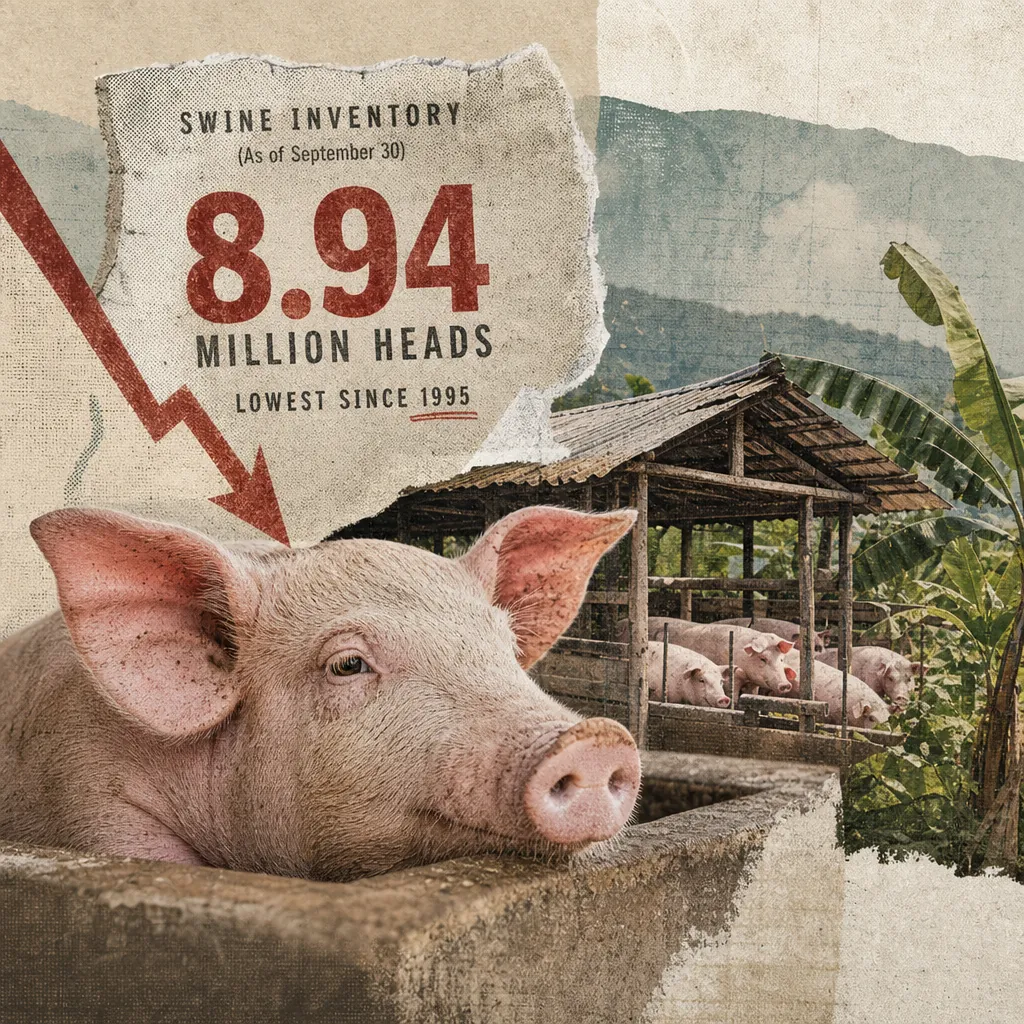
The Philippines counted 8.94 million pigs on its farms as of September 30, down 1.9 percent from 9.11 million a year earlier and the smallest national swine inventory recorded since 1995, according to Philippine Statistics Authority (PSA) data reported by the Inquirer's business desk51. The PSA is the government's official statistical agency, and its quarterly swine count is the reference figure the industry, lenders, and importers use to gauge supply. Smallhold farms — backyard raisers keeping a handful of animals — held 79.6 percent of the remaining herd, while commercial farms accounted for 19.2 percent and semicommercial operations 1.2 percent51. Calabarzon, the province cluster south of Manila made up of Cavite, Laguna, Batangas, Rizal and Quezon, held the largest regional population at 1.24 million heads, followed by Central Luzon at 1.06 million51.
The hog count was one of several agricultural and rural-economy items in the day's coverage. The National Irrigation Administration (NIA), the state agency that builds and operates irrigation systems, launched four solar-powered irrigation projects in Leyte and Samar on Saturday, November 21, covering a combined 54.99 hectares and serving 110 farmers, aimed at securing water supply against a possible El Niño4. El Niño is the periodic warming of the Pacific that typically brings drier conditions to the Philippines and stresses rain-fed farmland. In Caraga, the Regional Project Advisory Board approved an ₱87-million milkfish (bangus) consolidation, processing and marketing facility for a Dapa-based cooperative on Siargao Island7. In Cagayan Valley, a World Bank mission began assessing whether the region's vegetable program meets the conditions of the Philippine Sustainable Agriculture Transformation (PSAT) Program, backed by a $1-billion World Bank loan, and its companion Technical Assistance for Sustainable Agriculture Transformation (Tasat) Project, backed by a $24.5-million grant64.
Elsewhere the day's news ran across national politics, transport, banking, energy and foreign affairs. Malacañang, the presidential palace, answered Vice President Sara Duterte's claim that she no longer feels safe in the country by invoking the killings of the previous administration's drug war1, and a Manila congressman said he was surprised by her criticism of the national police52. The National Union of Peoples Lawyers (NUPL), a lawyers' group that represents political detainees and rights cases, disputed President Ferdinand Marcos Jr.'s statement that he was perplexed by protests against the US-led Pax Silica initiative83. The Philippine National Police (PNP) said it would deploy more than 6,000 personnel across Metro Manila and run free rides for commuters during a two-day transport strike by the group Manibela on November 23 and 249. Senator Joel Villanueva filed a resolution seeking a Senate inquiry into whether banks are protecting depositors from forged checks and unauthorized withdrawals8. Globe Telecom reported that theft of its network assets nearly doubled, with 2,616 pilferage incident tickets from January through October against 1,334 in the same period of 202559. And the COP31 climate summit in Antalya, Turkey ended without a final agreement76, even as Philippine officials pressed for climate finance at the talks1743.
Key themes
- The national pig herd is the smallest in three decades at 8.94 million heads. The September 30 count fell 1.9 percent from 9.11 million a year earlier, the lowest since 1995, with backyard raisers holding 79.6 percent of the animals51.
- Backyard raisers carry most of the remaining herd and most of the risk. Smallhold farms account for nearly four in five pigs, which means the sector's exposure to disease and price swings sits mostly with households that have the least capacity to absorb losses51.
- Senator Villanueva wants a Senate inquiry into bank safeguards against forged checks and unauthorized withdrawals. Senate Resolution No. 785 directs the Senate Committee on Banks to examine whether depositors who lose funds get timely and fair redress8.
- A two-day Manibela transport strike on November 23 and 24 drew a 6,000-person police deployment and free rides for commuters. The PNP said it would activate its "Libreng Sakay" program using police buses, trucks and vans at identified commuter areas9.
- The COP31 climate summit ended without a deal. Talks in Antalya ran two days past schedule and collapsed over fossil fuels, with the negotiations chair citing "unbridgeable red lines"76; the Philippines had used the summit to press for climate finance for developing nations1743.
- Globe Telecom's network theft incidents nearly doubled in ten months. Pilferage tickets reached 2,616 from January to October, up from 1,334 in the same period of 2025, with fiber cables, backup batteries and fuel among the stolen assets59.
- The Palace pushed back on the Vice President's security claims and on US trade expectations. Palace press officer Claire Castro said Filipinos were more afraid to go out under the previous administration1, and said Washington is an alternative supplier of food and energy, not the country's sole source14.
- Senators clashed over the 2027 budget's aid items and the risk of a reenacted budget. Senator Panfilo Lacson called ₱241 billion in fragmented aid and 3,950 multi-purpose buildings "papogi" spending3842, while Senate President Sherwin Gatchalian said reenacting the 2026 budget is not an option and that ratification should come before December 1765.
How the narratives stack
Dominant. The hog inventory figure led the business coverage in this set. It is a single statistic with a long tail: the lowest national pig count since 1995, a 1.9 percent year-on-year decline, and a herd that is overwhelmingly in the hands of smallholders51. The story carries consequence for food supply, farm incomes, and the price of pork, and it connects to a policy environment in which the Department of Agriculture has already used import restrictions to shield local raisers. Within the items gathered here, the agriculture and rural-economy cluster — the hog count, the solar irrigation launch, the Siargao processing plant, the World Bank review of the Cagayan Valley program — formed the largest single block of substantive business news514764.
Counter-narrative. The day's political coverage ran against the Palace's framing of the Vice President's security complaint. Castro's statement that "Mas takot ang mga Pilipino noon na lumabing dahil pag nakursunadahan, malamang ma-EJK ka" — Filipinos were more afraid to go out back then because if someone took a dislike to you, you could very well end up a victim — reframed the debate around extrajudicial killings under the previous administration1. Representative Joel Chua made a parallel argument, saying he was surprised by Duterte's criticism of the police given what he called her family's history of violence52. The counter-narrative here is that the Vice President's safety claim is being answered with the record of the drug war rather than with the specifics of her allegation.
Emerging. Two threads are forming rather than resolved. The first is depositor protection: Villanueva's resolution asserts that complaints about forged checks and repeated unauthorized withdrawals continue, but the resolution is a request for inquiry, not a finding8. The second is the cost of network theft for telecom subscribers. Globe's 96 percent increase in pilferage tickets is a company-reported operational figure, and the link between stolen cables and service interruptions is asserted by the company rather than independently measured59. Both threads will matter to consumers before they matter to policymakers.
Under-covered. The COP31 collapse received comparatively little attention in this set relative to its consequence for the Philippines, which is among the countries most exposed to climate-driven typhoons and drought and had sent its environment secretary to Antalya to argue for finance174376. The summit's failure to produce a final agreement affects the flow of adaptation funding that the Philippine government has been counting on. The World Bank's review of the Cagayan Valley vegetable program is similarly technical and lightly covered, though it determines whether a $1-billion loan program keeps disbursing64.
Platform insights
- X. Senator Panfilo Lacson used X to argue against the 2027 budget's aid allocations, calling the ₱241 billion in fragmented ayuda items "papogi" spending and citing a 29 percent drop in government construction in the January-to-September 2026 national accounts42. The post is a policy argument compressed into a thread, and it set the terms for the budget coverage that followed in the Manila Times and Journal Daily News3842.
- Facebook. The Manila City Disaster Risk Reduction and Management Department distributed drone video of the Sta. Mesa fire through its Facebook page, which is how the footage reached the Inquirer's report on the blaze that killed one man and left more than two families homeless48. Government agencies in the Philippines routinely use Facebook as their primary public-information channel, and this item shows the pattern: the official account supplies the visual record, and news outlets pick it up.
- YouTube and podcast platforms. The Manila Times published its November 23 headlines episode as a podcast, leading with Lacson's budget criticism and carrying a sponsor read for a home-improvement retailer38. The format puts a daily news summary into the same feed as entertainment content, which extends the reach of a Senate budget argument to listeners who would not open a broadsheet.
Key voices and communities
Hog raisers and their federations. Alfred Ng, vice chair of the National Federation of Hog Farmers, was quoted in the inventory report, and the federation speaks for commercial and semicommercial producers who have been squeezed by depressed farmgate prices, elevated production costs and competition from imported pork51. Their framing is that the contraction is structural, not seasonal, and that import policy is part of the cause.
The Senate economic bloc. Lacson and Gatchalian are arguing over the same budget from different angles: Lacson says the aid items are patronage spending that will not revive the economy42, while Gatchalian says a reenacted budget would be worse because the economy needs fresh spending and the government's problem is slow disbursement65. Both positions will shape what the 2027 budget looks like when it is ratified.
The Office of the Vice President and its critics. Vice President Sara Duterte's claim that she no longer feels safe, and her accusation that the PNP acts as an "enforcement arm" of politicians, drew responses from the Palace1 and from Representative Chua52. The exchange is being conducted through video statements and press briefings rather than in a single forum.
Transport groups and commuter advocates. Manibela's two-day strike put the PUV Modernization Program back in the news. The program, which requires jeepney operators to consolidate into cooperatives or corporations and replace older vehicles with newer ones, has been running for several years without full implementation. Bacolod Representative Alfredo Abelardo Benitez is pushing for a "status quo" in its local rollout, citing unresolved concerns over franchise consolidation and provisional authorities30.
Climate and environment officials. Environment Secretary Juan Miguel Cuna argued at COP31 that "after three decades of COP, catastrophic climate impacts escalate while the gap between promises and delivery remains dangerously wide"17. His department's position is that the Philippines needs adaptation finance now, and the summit's failure leaves that demand unanswered76.
Narrative streams
The pig herd shrinks to its lowest count since 1995
The PSA's September 30 count of 8.94 million heads is 1.9 percent below the 9.11 million recorded a year earlier and the lowest since 199551. The decline is not a one-quarter blip. The report attributes it to depressed farmgate prices, sustained elevated production costs and competition from imported pork51. Farmgate price is what a raiser receives at the farm before transport and retail markup; when it stays low while feed, fuel and veterinary costs stay high, smallholders cull breeding stock or exit, and the herd takes years to rebuild because a sow's offspring do not reach market weight quickly.
The structure of the herd matters as much as its size. Smallhold farms hold 79.6 percent of the animals, commercial farms 19.2 percent and semicommercial 1.2 percent51. That distribution means the national supply depends on hundreds of thousands of households making individual decisions about whether to keep breeding. Those households are the least able to borrow against future production or to absorb a disease outbreak. Calabarzon's 1.24 million heads and Central Luzon's 1.06 million make those two regions the country's pork basket, and a contraction there feeds directly into Metro Manila's wet markets51.
The read for the sector: raisers who remain will see tighter supply support prices eventually, but the recovery will be slow because rebuilding a breeding herd takes multiple production cycles, and importers will fill the gap in the meantime. For consumers, the near-term effect is that pork prices are unlikely to fall much even if feed costs ease, because the animals are not there. For lenders and cooperatives, the smallholder share is the addressable market — and the segment where a single disease event can wipe out a household's collateral.
A Senate inquiry asks whether banks protect depositors
Senator Joel Villanueva filed Senate Resolution No. 785 directing the Senate Committee on Banks to examine the implementation and adequacy of bank safeguards, the effectiveness of regulatory supervision, and the remedies available to depositors who lose money8. "Our banks hold the money of our countrymen, and our law is clear that financial institutions have the responsibility to safeguard it. We need to determine if this is being properly implemented for depositors," Villanueva said8. The resolution cites continuing reports and complaints involving forged checks, repeated unauthorized withdrawals and disputed transactions8.
A Senate resolution of this kind does not change the law by itself. It starts an inquiry in aid of legislation, which means the committee will call regulators and bank representatives, build a record, and decide whether to propose amendments to the charters and regulations that govern deposit accounts. The relevant regulators are the Bangko Sentral ng Pilipinas, the central bank, and the Philippine Deposit Insurance Corporation, which insures deposits up to a statutory ceiling. The inquiry's value to depositors is that it can force disclosure of how many complaints are filed, how many are resolved, and how long resolution takes — figures that are not routinely published.
The read for the sector: banks should expect questions about their fraud-detection timelines and their reimbursement policies for unauthorized transactions, and the answers will become part of the public record. For depositors, the practical question is whether the inquiry produces a faster, clearer process for recovering funds after a disputed withdrawal. For the banks, the risk is that a hearing establishes a benchmark for redress that individual institutions then have to meet.
A two-day transport strike tests the PUV modernization program
Manibela's strike on November 23 and 24 prompted the PNP to deploy more than 6,000 personnel across Metro Manila through the National Capital Region Police Office and to activate "Libreng Sakay" — free rides — using police buses, trucks and vans at identified commuter areas9. The police framing is that the deployment protects the right of transport workers to express their concerns while keeping commuters moving9.
The strike sits inside a longer dispute over the Public Utility Vehicle Modernization Program, which requires jeepney operators to consolidate into cooperatives or corporations and to replace older units with newer, lower-emission vehicles. The program has been running for several years without full implementation. In Bacolod, Representative Alfredo Abelardo Benitez is seeking a "status quo" and plans to coordinate with the Land Transportation Franchising and Regulatory Board (LTFRB), the agency that issues franchises and provisional authorities, over franchise consolidation and the processing of provisional authorities for jeepney operators30. "I will deal with the LTFRB because this modernization program will not be completed because of some problems," Benitez said30.
The read for the sector: operators who have not consolidated face a deadline structure that local officials are now openly questioning, which gives them room to negotiate but not certainty. Commuters bear the disruption during strikes, and the police free-ride program is a stopgap that does not address the underlying franchise question. For the LTFRB, the pressure is to publish a clear timetable for consolidation and provisional authorities so that operators can plan vehicle purchases.
COP31 ends without a deal as the Philippines presses for climate finance
The 31st Conference of the Parties to the United Nations Framework Convention on Climate Change, held in Antalya, Turkey from November 9 to 20, ended in failure on Sunday when a contentious deal collapsed over fossil fuels and the summit ran two days past schedule76. Negotiations chair Chris Bowen said he could not overcome "unbridgeable red lines," and UN Secretary-General Antonio Guterres said he shared "the very profound frustration of all those who expected governments to rise to the moment the climate crisis demands"76.
Environment Secretary Juan Miguel Cuna had used the summit to argue that "after three decades of COP, catastrophic climate impacts escalate while the gap between promises and delivery remains dangerously wide," and to call for urgent and adequate climate finance for developing nations17. A separate account of his remarks put the Philippine ask in the context of a $310-billion financing gap43. Climate finance is the money that wealthier countries and multilateral funds pledge to help developing countries adapt to climate impacts and cut emissions; for the Philippines, it funds flood control, drought-resistant seed varieties, and early-warning systems.
The read for the sector: Philippine agencies that had built adaptation plans around expected COP31 commitments now face a longer wait, and the failure shifts the burden onto bilateral deals and multilateral lenders. The World Bank's review of the Cagayan Valley program, with its $1-billion PSAT loan and $24.5-million Tasat grant tied to verified disbursement indicators, is an example of the alternative channel — funding that follows measured results rather than summit pledges64. For farmers and local governments, the practical consequence is that project timelines slip by at least a budget cycle.
Solar irrigation and a milkfish plant put money into rural production
The NIA's Region 8 office launched four solar-powered irrigation projects in Inopacan and San Miguel in Leyte and Jiabong in Samar on November 21, covering 54.99 hectares and benefiting 110 farmers, particularly those at the tail end of irrigation systems where water supply is often inadequate4. The projects are designed to provide a more reliable water supply amid possible El Niño impacts4. Solar-powered pumps matter in off-grid farmland because they do not depend on diesel deliveries or grid connections, and their operating cost after installation is close to zero.
In Caraga, the Regional Project Advisory Board approved an ₱87-million milkfish consolidation, processing and marketing facility to be run by the Consolacion Agri-Fishery Multi-Purpose Cooperative, a Dapa-based group known for producing bottled bangus7. The project falls under the Department of Agriculture's Investments in Rural Enterprises and Agricultural and Fishery Productivity (I-REAP) program, which funds value-added facilities owned and operated by farmer and fisherfolk groups7. Value-added processing — turning raw fish into bottled or smoked products — raises the price a cooperative can charge and keeps more of the margin in the community.
The read for the sector: the two projects are small in national terms, but they show where public agricultural money is going — toward water security and post-harvest processing rather than direct subsidies. For farmers at the tail end of irrigation canals, solar pumps change what they can plant in the dry season. For the Siargao cooperative, the plant converts a perishable catch into a product with a longer shelf life and a wider market.
The budget fight turns on aid items and construction spending
Senator Panfilo Lacson criticized at least ₱241 billion in fragmented aid programs and allocations for 3,950 multi-purpose buildings in the Senate version of the 2027 national budget, calling them "papogi" — grandstanding — spending that would do little to revive the economy3842. He noted the aid items had been reduced from ₱263 billion in the House version of the General Appropriations Bill42. In a post on X, he cited a 29 percent drop in government construction in the January-to-September 2026 national accounts, a 4.8 percent decline in agriculture, forestry and fishing, flat industry, and a 15.1 percent drop in public construction42.
Senate President Sherwin Gatchalian said reenacting the 2026 budget for 2027 is not an option. "It is not an option for us to re-enact the budget because our economy is bad. And we need a fresh and new budget to revitalize our economy," he said in a radio interview, adding that he expects ratification before December 1765. A reenacted budget means the previous year's spending levels carry over automatically, which freezes new programs and delays infrastructure starts.
The budget debate has a procurement angle. Public Works Secretary Giovanni Lopez vowed to tighten project screening after the Senate removed ₱97.5 billion worth of department proposals for failing technical and documentary requirements, and warned personnel against manufacturing or tampering with documents94. The required documents include an approved Program of Work, validated geo-tagged photographs, a Certificate of Implementability and a feasibility study with local government endorsement94.
The read for the sector: contractors should expect slower approvals and stricter documentation, and projects that were inserted without complete papers will not proceed. For local governments, the shift from multi-purpose buildings toward other spending changes what they can request. For the economy, the dispute is really about whether public spending can be accelerated — Gatchalian's concern — or whether more spending on small aid items simply fails to produce growth, which is Lacson's argument.
Globe reports a near-doubling of network theft
Globe Telecom recorded 2,616 pilferage-related incident tickets from January through October 2026, nearly double the 1,334 in the same period of 2025, a 96 percent increase59. Stolen assets include fiber optic cables, backup batteries, transmission equipment, fuel and electrical hardware, with 361 tickets in the Visayas alone59. "The increase in pilferage incidents is a serious concern, but the recent arrests and convictions show that coordinated action can produce results," said Froilan Castelo, Globe's general counsel59.
Fiber theft is not a victimless property crime. Cutting a cable to sell the copper or the cable itself takes a cell site or a neighborhood offline, and repairs take time and money that eventually show up in capital spending. The company's report is its own operational data, and the causal link between a specific theft and a specific outage is asserted rather than independently audited.
The read for the sector: telecom subscribers in affected areas should expect intermittent service, and the operators' remedy is more spending on security and hardened infrastructure. For local governments, the arrests and convictions Globe cites suggest that enforcement works when cases are pursued, which puts pressure on prosecutors to treat cable theft as a serious offense rather than a nuisance.
The Palace and the Vice President trade claims over safety and the police
Palace press officer Claire Castro said on Sunday that Filipinos had more reason to fear going out during the previous administration because of extrajudicial killings, responding to Vice President Sara Duterte's claim that she no longer feels safe1. "Mas takot ang mga Pilipino noon na lumabas dahil pag nakursunadahan, malamang ma-EJK ka," Castro said1. Extrajudicial killings are killings carried out by state or state-linked actors without legal process; the phrase refers to the thousands of deaths recorded during the 2016–2022 drug war.
Representative Joel Chua said he was surprised by Duterte's accusation that the PNP acts as an "enforcement arm" of politicians, saying her family has "a history of violence and a history of making threats"52. The PNP chief had earlier vowed impartiality after Duterte's criticism52. Separately, the Senate ethics committee, chaired by Senate President Vicente Sotto III, reiterated its request for Senator Ronald dela Rosa to answer a complaint filed by the anti-corruption group Wag Kang KuCorrupt over his prolonged absences1292.
The read for the sector: the exchange keeps the Vice President's security complaint in the news but on her opponents' terms, framed around the drug war record rather than the specifics of her allegation. For the PNP, the risk is that it becomes a political actor in the dispute regardless of its stated impartiality. For the public, the practical question — whether the country is safe and who is responsible for making it so — is being argued through competing historical claims rather than through current crime data.
The Philippines seeks US food and energy supply without exclusive dependence
Malacañang said the Philippines is looking to the United States as an alternative supplier of food and energy, not its sole source, after US President Donald Trump characterized the arrangement otherwise14. Palace press officer Claire Castro said Manila was exploring Washington as one of several potential sources to strengthen food and energy security as the country braces for a strong El Niño14. President Marcos put the logic in a Filipino-language report: "if you are standing on one foot, relying on just one, problems come easily. When you have many to rely on, even if one has a problem, you can still run to the others"58.
The read for the sector: importers and agricultural producers should read the statement as a signal that the government wants diversified supply contracts rather than a single-country dependence, which keeps the door open to other exporters. For consumers, the near-term question is whether imported food and fuel arrive in time and at what price during the El Niño period, not which country they come from.
The NUPL disputes the President's account of the Pax Silica protests
The National Union of Peoples Lawyers said President Marcos's statement that he was "perplexed" by protests against the US-led Pax Silica initiative is "difficult to take seriously," citing the Philippines–US Critical Minerals Memorandum of Understanding signed on February 4, 2026, and other government measures supporting the project83. Marcos had said there is "no deal yet" and that the project does not include plans to build data centers in the country83. Pax Silica is a US-led initiative that would involve critical-minerals supply chains and data infrastructure; the protests concern its environmental and sovereignty implications.
The read for the sector: the dispute is about whether the government has already committed to the project in practice while saying no formal deal exists. For communities near proposed sites, the practical question is whether consultation happens before agreements are signed. For investors, the uncertainty over the project's status is a reason to wait.
Conversation trajectory
Hog inventory and pork prices — next 4 to 6 weeks. The PSA's next quarterly swine report and the Department of Agriculture's monthly price monitoring will show whether the 8.94-million-head count is stabilizing or still falling. Watch the farmgate price series: if prices stay depressed while the herd shrinks, more smallholders will exit, and the recovery timeline extends into 2028. The Department of Agriculture's import policy is the swing factor — a renewed import ban would support local prices but raise consumer prices.
Senate bank inquiry — next 2 to 4 weeks. The Committee on Banks will need to schedule hearings on Resolution No. 785. Watch for the Bangko Sentral ng Pilipinas and the Philippine Deposit Insurance Corporation to be invited, and for the committee to request complaint and resolution statistics. If the inquiry produces a public count of unresolved unauthorized-withdrawal cases, that number will become the benchmark for the sector.
Transport strike and PUV modernization — November 23–24 and the following fortnight. The strike itself will be measured by commuter disruption and by whether the police free-ride program holds. After it ends, watch the LTFRB for any statement on consolidation deadlines and provisional authorities, and watch Bacolod for whether Benitez's request for a status quo produces a local suspension.
2027 budget — before December 17. Gatchalian has set ratification before December 17 as his target65. Watch the bicameral conference committee for whether the ₱241 billion in aid items survives, and watch the Department of Public Works for whether the ₱97.5 billion in removed proposals is restored. A failure to ratify would trigger a reenacted budget, which Gatchalian says would slow the economy further.
COP31 aftermath — next 4 to 8 weeks. With no final agreement, watch the Philippine delegation's statements on alternative financing channels and the World Bank's disbursement decisions under the PSAT program. The next signal is whether the Cagayan Valley mission's findings are published and whether the loan's disbursement-linked indicators are met.
Globe network theft — next quarter. Globe's next quarterly report will show whether the pilferage rate is still rising. Watch for arrests and convictions in the Visayas, where 361 tickets were recorded, and for any regulatory action from the National Telecommunications Commission on infrastructure protection.
Trigger events. The PSA's next swine inventory release; the first Senate banks committee hearing; the LTFRB's next statement on PUV consolidation; the budget ratification deadline of December 17; the World Bank's PSAT mission report; and Globe's fourth-quarter results.
Response guidance
Hog raisers and cooperatives: publish the cost structure, not just the head count. The 8.94-million figure will be read as a supply story, but the raisers' case is about margins. Provide feed cost, farmgate price and import volume data in the same release so that the contraction is understood as an economic outcome rather than a failure of husbandry.
Banks: prepare complaint and resolution data before the Senate asks. The inquiry will request figures on forged-check and unauthorized-withdrawal complaints, resolution times and reimbursement outcomes. Institutions that can produce clean numbers will shape the benchmark; those that cannot will be defined by the committee's estimate.
Transport operators: separate the strike from the modernization argument. The strike is about immediate costs and franchise rules; the modernization program is about vehicle replacement and consolidation. Communicating the two as one demand makes it easier for regulators to treat the strike as a disruption rather than a policy signal.
Climate communicators: explain what the COP31 failure means for a specific project. The summit's collapse is abstract until it is tied to a named adaptation project — a flood-control system, a seed program, an early-warning network — and to the financing channel that will now be used instead.
Telecom operators: report theft as a service issue. Subscribers experience cable theft as an outage. Publishing the number of sites affected and the average repair time turns an internal security metric into a public service story that local governments can act on.
Palace and Vice President's office: keep the safety dispute on current data. Both sides are arguing from historical records. Crime statistics for the current period, published by the PNP, would let the public judge the claim on present conditions rather than on competing accounts of the past.
Budget communicators: distinguish aid from investment in plain terms. The ₱241 billion figure will be read differently depending on whether it is described as cash assistance to households or as construction spending. State what the money buys and who receives it, and the argument about "papogi" spending becomes a question the public can evaluate.
See the full picture behind today's signals.
This report draws from Media Meter's MediaWatch, our real-time monitoring engine tracking 2,470+ Philippine sources across print, broadcast, digital, and social. Explore how the platform turns raw coverage into decision-grade intelligence, then see how it's configured for teams like yours — whether you're in PR agencies, corporate comms, government, or marketing.
Want more? Browse our Report Library for sector and crisis intelligence, or request a demo and we'll have your brand set up before the call.
Want this kind of intelligence on your brand?
This brief is built on the same MediaWatch methodology that runs continuously across every brand we monitor. See your competitive landscape, Impact Score, and narrative trajectory in a 30-minute demo.