Official Statistics Monitoring After the Measure Changes
The PSA now counts poverty in deprivations rather than pesos. What official statistics monitoring has to re-baseline before the next release day lands.

Official statistics monitoring has to be re-baselined when an official measure changes, and the instrument behind the Philippine Multidimensional Poverty Index changed in 2025. Keyword lists, sentiment dictionaries and report templates built on the income poverty line keep returning results while quietly under-counting coverage phrased in deprivations. For a Philippine government or public affairs office, the fix is a dated re-baseline against the measure a claim actually invokes.
On 22 October the Philippine Statistics Authority published two items. One was a number: the country's Class A coal, oil, natural gas and condensate reserves, valued at PhP 295.04 billion for 2025, up 3.2% on the PhP 285.80 billion recorded in 2024. The other was a forum on the instrument the Philippines now uses to measure poverty.
A communications office will treat the first as urgent and the second as a reading item. That is the wrong way round. Figures expire. Instruments do not, and when one of them changes, every keyword list, sentiment dictionary and report template calibrated to the old measure keeps running, keeps returning results, and keeps looking fine. That is the part of official statistics monitoring nobody puts in a workplan.
Two releases on one day, doing two different jobs
The energy figure behaved exactly as a figure release does. BusinessMirror carried the full valuation the next day with the breakdown intact, a 24-hour journey from primary source to public reference point. It also carried the kind of detail a release-day brief exists to catch: the headline put the rise at 3.25%, while the PSA release and the figures inside the story itself give 3.2%. Nobody is wrong, exactly. Somebody will still be asked which number the office stands behind.
The forum did a different job and travelled nowhere near as far. A sweep of Philippine outlets this cycle surfaced no comparable newsroom pickup of it, which is itself the argument for watching the primary source directly instead of waiting for coverage to interpret it. A figure release is a same-day monitoring and briefing task with a public deadline attached. An instrument release is maintenance on the official statistics monitoring setup itself, and it arrives with no deadline at all. Only one of those two reliably gets done.
The instrument changed in 2025, the number followed in August
The change is older than the forum. The PSA Board approved the national Multidimensional Poverty Index methodology in 2025 as Resolution No. 08, announced in a PSA press release reposted by OPHI on 30 May 2025, which makes the current results the first produced under the approved method. The 8 October forum, featuring OPHI director Sabina Alkire, co-developer of the Alkire-Foster method used to calculate the Philippine MPI, and opened by Undersecretary Claire Dennis S. Mapa, National Statistician and Civil Registrar General, came roughly six weeks after the first national figure was already public. The PSA's own account of the forum records an OPHI partnership running since 2017, Alkire citing policy applications in Colombia and Panama, and presentations on the methodology and on the measure's use in planning, policy and programming.
The figure itself landed on 27 August 2026. The Philippine Star reported that 12.8% of Filipinos and 12.4% of households were multidimensionally poor in 2024 on 2024 Community-Based Monitoring System data, with a national MPI value of 0.045 at individual level and 0.042 at household level, and a household counted as poor once its weighted deprivation score exceeds the 0.25 cutoff. Education was the most common deprivation, with housing and water and sanitation also significant. DEPDev Secretary Arsenio Balisacan put the reframe plainly in the same coverage: "poverty is not just about what people earn." Some reporting described the CBMS-based figures as preliminary, so read them as the current published result rather than a closed one.
Two numbers show how far the instrument moved. The 2018 national MPI was an explicitly initial methodology: as the Multidimensional Poverty Peer Network recorded at the time, 13 indicators across four dimensions, with a person counted poor on deprivation in at least one third of them, or at least 4 of the 13. OPHI's national MPI directory describes the current instrument at around 17 weighted indicators against a one-fourth cutoff, drawing on the 2024 CBMS. Thirteen indicators and a one-third threshold became roughly 17 and a one-fourth threshold. The indicator weights and the authoritative dimension structure sit in PSA technical material that is not citable here, so the count travels as OPHI's description, and no weight table belongs in anybody's report.
PhP 295.04 billion is now the figure every energy claim meets
Composition matters more than the total. Coal carried PhP 253.31 billion of the 2025 valuation, up 2.3% on 2024, while natural gas rose 38.5% to PhP 27.04 billion and oil rose by the same 38.5% to PhP 1.80 billion from a much smaller base of PhP 1.30 billion. Condensate went the other way, down 25.4% to PhP 12.89 billion. Resource rent across the four resources came to PhP 42.92 billion, which the PSA's energy accounts release puts at 0.15% of GDP, a useful reminder that a headline in the hundreds of billions can still round to nothing in the national accounts.
The physical accounts diverge from the peso ones, and that divergence is where the questions live. Natural gas reserves fell 15.9% to 195.00 billion standard cubic feet and extraction fell 9.6% to 63.56 billion scf, while the peso value of those same reserves rose 38.5%. Oil reserves rose 4.6% to 434.00 thousand barrels on upward reappraisals while extraction dropped 10.9%. Coal is the one resource up on both counts, reserves up 15.1% to 445.73 million metric tons on recorded discoveries and extraction up 22.8% to 21.68 million MT. A valuation built on net present value with a 10.0% social discount rate, the method the release names, can rise while less gas comes out of the ground. Value up, volume down, one release.
That pairing will get used. Coal is around 60% of the Philippine energy mix and roughly 95% of coal supply is imported, with 99% of those imports from Indonesia, on Department of Energy data reported by The Philippine Star in July, when Energy Secretary Sharon Garin said Jakarta's commitment "strengthens our efforts to keep our energy supply secure." A state of national energy emergency declared by executive order in March 2026 is the live policy frame around any 2026 reserve figure, described in a Philippine Star column that is commentary rather than an official text of the order. No October hearing or DOE statement citing the new reserve figures surfaced this cycle, so treat this as where the number will be met, not as a report that it already has been. For a public affairs team in a regulated sector, official statistics monitoring means the monitoring view holds reserve, extraction and import vocabulary together, not the peso headline alone.
Which measure does that programme claim actually invoke?
One release produced two headline numbers, and Philippine newsrooms split on which to lead with. The Star led on the 12.8% of persons. The Manila Times led on the household figure of 12.4% and on the argument that income growth alone will not lift Filipinos out of poverty, pointing at education, housing and water and sanitation. A template that captured one of those and not the other will misstate the office's own position at the exact moment somebody checks it. That Manila Times piece also paywalls after its opening paragraphs, so headline-and-lede capture keeps the number and loses the framing.
Then there is a third number in circulation. The global MPI, produced by OPHI with UNDP on a different instrument of 10 indicators across three equally weighted dimensions with a 33.33% cutoff and 2022 Demographic and Health Survey data, puts 3.9% of Filipinos as MPI poor with a value of 0.016 and intensity of 40.6%. Same country, same subject, 3.9% against 12.8%. The measure determines the number, which is why a claim about Philippine poverty is unreadable until you know which instrument produced it.
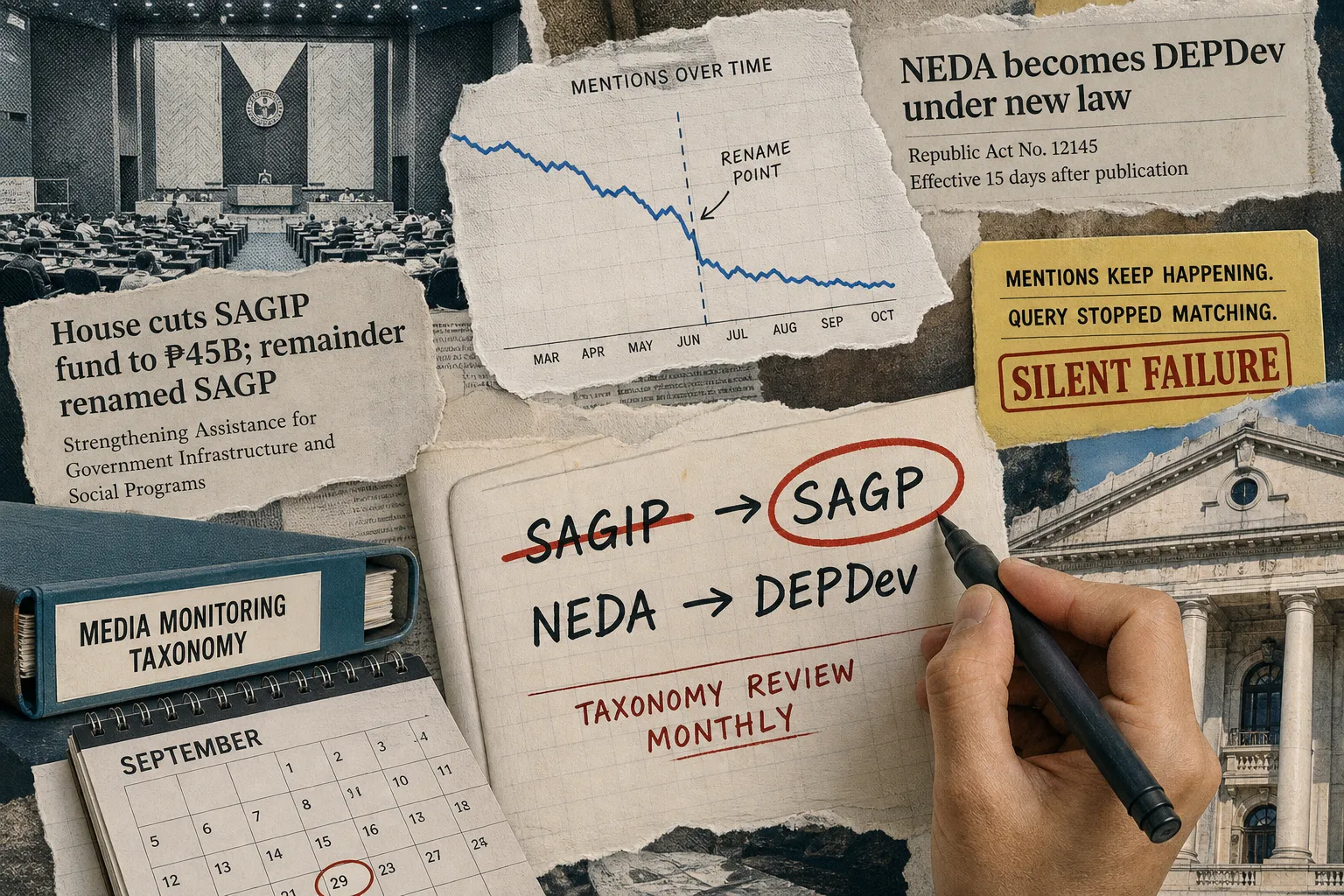
The vocabulary problem follows from there, and it is where official statistics monitoring fails quietly. A keyword set built on income-poverty language, poverty line, income threshold, subsistence, still returns results after the official measure becomes multidimensional. Nothing errors. Coverage phrased in deprivations, in the 0.25 cutoff, in regional and population-group cuts, simply goes uncounted, and the gap surfaces when somebody asks why the office's numbers and the coverage do not match. Think of it as the quieter cousin of taxonomy drift after a rename: the strings still work, and they describe a measure that no longer exists.
Two consequences land on reporting. Sentiment baselines drawn across the change are reading a shifted topic mix, and automated sentiment across English, Filipino and Taglish is directional rather than settled to begin with, so an unmarked instrument change compounds a reading that was already approximate. And because the MPI breaks down by indicator, region and population group, the exposure for an LGU or a regional office sits in cuts a national clipping sweep was never built to catch. No regional or vernacular pickup of those breakdowns was captured this cycle, which describes what the sweep found rather than proving the coverage is absent. Any series offered as board-ready measurement should carry the instrument change on its face.
Re-baseline official statistics monitoring before the next release day
Release dates are not a surprise, and that is the leverage official statistics monitoring has. Executive Order No. 352 adopted the system of designated statistics in 1996 and directed agencies to release data "in accordance with the designated time frame," with an annex fixing each activity's frequency and release schedule: the consumer price index monthly, five days after the reference month; the Family Income and Expenditure Survey every three years, 18 months after the reference year; income-based poverty incidence every three years, two years after the reference year. That order predates the PSA, which absorbed the NSO and NSCB under Republic Act 10625 in 2013, and the schedule has been revised since, so take it for the mechanism and the cadence; the lag times it lists are no longer current. The current calendar of releases is the artefact to subscribe to, and the PSA publishes it.
The practice is visible elsewhere in the statistical system. The Bangko Sentral ng Pilipinas advance release calendar dated 1 October 2026 names release dates from October 2026 through January 2027 with the periodicity of every item, from the peso-dollar rate at 9:30am daily and policy rates at 1:00pm to inflation and the month-ahead inflation forecast range, with the monetary policy stance six times a year. That is the BSP's calendar and not the PSA's, and it shows what diarised statistical exposure looks like when an institution commits to it in advance.
So what should a government or public affairs office actually do when the measure changes? Four artefacts, each one dated:
- A measure register. Which instrument a claim invokes, which version of it, which reference year, and which figure belongs to persons and which to households.
- An alias set per measure. Deprivation vocabulary held alongside income vocabulary, in English, Filipino and the regional registers the story travels in, so the new language is captured from the first release, not retrofitted after a mismatch.
- A re-baseline marker on every affected series at the point the instrument changed, so a shift in volume reads as instrumentation rather than as a change in public conversation.
- The official cuts mirrored in reporting. Indicator, region and population group, matching the breakdowns the measure now supports, which is also what makes a programme claim checkable against the statistic it cites.
For an office that has to buy this capability instead of building it, the clause worth writing into an official statistics monitoring terms of reference is maintenance: who re-baselines the taxonomy when an official measure changes, on what cadence, and with what record of the change. Accreditation and procurement readiness is the straightforward half of that question. The maintenance commitment is the half that decides whether next year's numbers still describe the thing being argued about.
Key takeaways
- Treat a figure release and an instrument release as two different jobs in official statistics monitoring. The first is a same-day briefing task; the second is scheduled maintenance that nothing will remind you to do.
- Keep persons and households separate in every template. One PSA release produced 12.8% and 12.4%, and Philippine newsrooms led with different ones.
- Record which instrument any poverty claim invokes. The national MPI reports 12.8% for 2024 while OPHI's global MPI reports 3.9% for the same country on a different measure.
- Hold deprivation vocabulary alongside income vocabulary in the keyword set, and mark the re-baseline point on every affected series so a volume shift is not misread as a quieter month.
- Mirror the official breakdowns. Indicator, region and population-group cuts are where a regional office's exposure sits, and a national sweep alone will not surface them.
- Diarise the statistical calendars. EO 352 fixed the principle that designated statistics land on a committed schedule, and the BSP's advance calendar shows the current practice.
About Media Meter
Media Meter gives Philippine government communicators monitoring that is maintained rather than merely installed: daily briefings, issue tracking and sentiment reading across national, provincial and vernacular media, with the taxonomies re-baselined as official measures change. See what that looks like for a public-sector office.