Earned Media Reach Is Shrinking: Reprice Each Placement
Philippine earned media reach is falling while coverage shifts into apps and feeds. Learn how PR agencies can state the reach basis behind every client number.

Earned media reach in the Philippines is shrinking on both sides of the equation. The audience behind each placement is smaller than any rate card implies, and more of the coverage that matters now reaches readers inside apps, platform feeds and membership tiers where open-web monitoring cannot see it, so the defensible move is to state the reach source, date and coverage footprint behind every number.
Ask ten Philippine agencies for the reach behind a placement and you get ten figures lifted off a rate card, a media kit or a vendor dashboard, each one treated as a fixed property of the outlet. It is the oldest input in your client report and the least interrogated.
Two things have moved underneath it. The audience Philippine outlets actually reach has contracted since 2020, and the coverage most likely to matter to a client is drifting into apps, feeds and paid tiers an open-web crawl cannot attribute to anyone. So a report can be wrong about the size of earned media reach and wrong about how much coverage it saw, from one dataset. What follows is the repricing: which basis you can cite here, and what travels with it.
Philippine news-site reach has fallen by nearly a third since 2020
Start with the multiplier, because it is the part everyone assumes is stable. Filipino use of news websites and apps has dropped hard: weekly use sat at 42% in 2026, down from 50% a year earlier and from 60% in 2020, as The Philippine Star reported from the Reuters Institute Digital News Report, with radio falling from 25% to 14% and television from 66% to 42%.
Those are survey-recall figures rather than audited audience. The study runs on 97,520 respondents across 48 markets, and its global overview records publishers' own sites and apps losing 12 percentage points of reach since 2021. BusinessMirror's reading of the PSA mass-media survey agrees, putting radio exposure at 52.9%, down from 75.2%, and television at 82.3%. Globally, the trade-press version is INMA's Greg Piechota, as reported by Digiday in October 2026: the typical publisher reaches a fifth fewer people a month than in 2019, across 3,018 news brands. INMA's own publication of that figure could not be retrieved, so carry it as a trade-press attribution with no stated method.
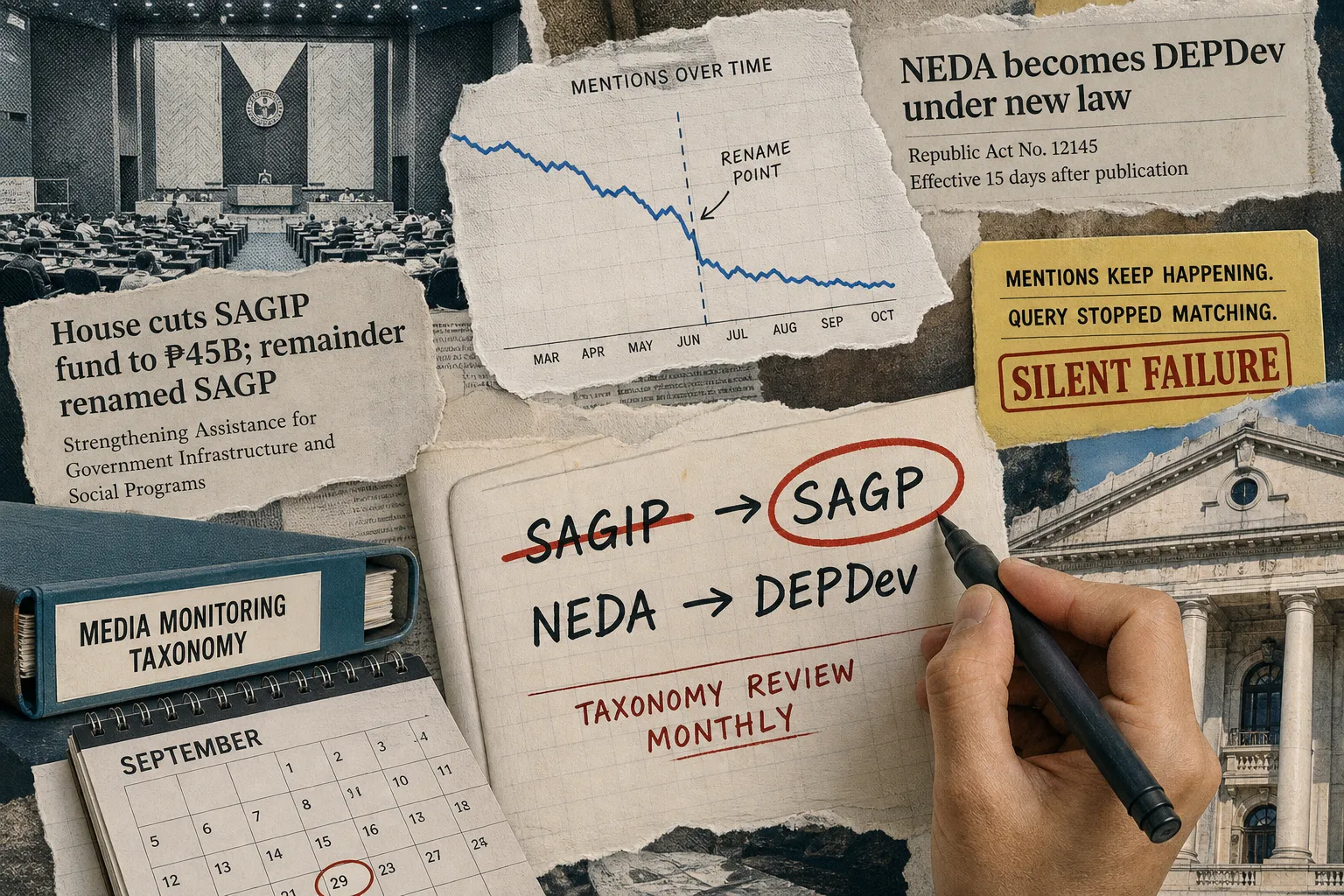
That BusinessMirror piece also gives print exposure as both down about 30% since 2019 and less than half its 2019 level, which cannot both hold. When the datasets you would cite contradict themselves, the basis has to be declared rather than assumed. Tracked volume can also fall for reasons nobody logged, which is how taxonomy drift quietly shrinks a number.
Rate-card audiences versus current earned media reach
So what can a Philippine agency legitimately cite? The most usable public basis is the 2026 brand table, and GMA News Online's report on the study carries it in full: GMA News Online at 49% weekly online reach, ABS-CBN News Online 43%, Inquirer online 29%, Rappler 24%, and DZMM Radyo Patrol 630 at 15% offline, below the 20% it held in 2020.
The caveat is printed in the source: "These figures are based on respondents' recall of the news sources they have used." Recall is a defensible basis as long as you name it, which is more than a flat impressions figure off a media kit gives a client to check. Treat a reach number the way a surveyor treats a benchmark: meaningless as an absolute, usable the moment you say which marker you measured from and when.
Radio is where the basis runs out. Kantar Media, an audience-measurement vendor, renewed the KBP radio currency across 26 key cities, up from 19 in the 2021 round in April 2023, and that release publishes no sample size or method. So a non-metro vernacular placement has no audited audience figure to multiply at all. Monitoring provincial and vernacular media tells you the placement happened; nothing here tells you how many people it reached. The alternative to disclosure is not a smaller number. It is an invented one.
When the best coverage moves inside an app
The second error sits in the denominator. Vox's first app reserves text stories for members at $5 a month while putting vertical video and podcasts in front of everyone, inverting the usual free-article funnel, and Comscore figures in the same report have its unique visitors down 36% year on year.
Reading the Philippine version as a paywall story will cost you. Hard walls are not the local obstacle, because few Filipinos pay for news at all: 13%, down two points. The Reuters Institute's Philippines profile records 53% reaching news through smart TVs and 36% taking news from creators whose channels are mainly about news. Local publishers have far less incentive than The Times of London to wall off text, so most Philippine coverage stays crawlable. The blind spot here is platform-shaped: the placement is visible, and the consumption happens inside a feed, a smart-TV app or a creator's channel no clip report can tie back to your client.
Where local walls exist they are shallow. The Manila Times sells premium digital access at P80 a month billed annually at P960, with basic-tier article access described as up to 30 days, so the restriction bites in the archive rather than on this week's clip. In the US, Pew Research Center found 74% of adults hitting paywalls at least sometimes, on 9,482 respondents surveyed in March 2025.
Nobody has measured what share of consequential coverage now sits behind paywalls, apps or membership walls, in any market, which is exactly why a report has to disclose the footprint it could see instead of implying completeness. Note the limit of the survey evidence too: it shows the subscription funnel thinning, not walls reducing external visibility. Your monitoring vendor's coverage claim deserves the same scrutiny, since Google's John Mueller told a site owner not to anchor on the Search Console links report at all, because it has always been a sample. Media Meter's footprint across more than 2,470 Philippine sources answers the visibility half of this and not the valuation half, and how monitoring changes as clippings become citations is a third question again.
Discrete editorial products: what The Times is actually testing
Repricing is already underway on the publisher side. The Times of London is preparing to test "macro payments", a term its subscriptions director Abs Ahmed says was coined in meetings with News Corp business units: selling one high-value package, such as the annual rich list or best-places guide, at the moment a reader wants it. Its hard paywall already holds roughly 680,000 digital subscribers, testing could begin within a couple of months starting in the UK, and it explicitly will not disaggregate ongoing coverage. Read it as a projection, because nothing has been tested and no outcome published.
Our own reading for Philippine publishers, and for brands that fund content, is that this is a sizing question before a production one: audiences that refuse a recurring subscription may still pay for a specific thing at the moment of want, which makes rankings, sector guides and election explainers worth costing out. We found no local publisher selling discrete editorial products in this sense, so treat that as reasoning rather than a Philippine example. The same logic lands on your own deliverable, because a bigger number with no basis is a commodity, and commodities get repriced by whoever quotes lowest.
State your reach basis before a client asks for it
The standards body has already done this work for you. AMEC's Barcelona Principles reached version 4.0 in June 2025, and Principle 5 is unambiguous: invalid measures such as advertising value equivalents should not be used, with the document naming Earned Media Value among the AVE aliases to avoid as variations of one flawed metric. AMEC's standing policy on AVEs goes further: where a client insists on one, members supply it only with a prominent disclaimer and at least two other valid metrics, and never in an awards entry.
On the reach input itself, the Barcelona Declaration's transparency principle asks for measurement that is transparent and replicable at every step, which in media measurement means specifying content sources, collection criteria and analysis methods. It also holds that multipliers meant to reflect the higher cost of earned media should not be applied unless proven in the specific case. So the disclosure line behind any earned media reach figure reads: outlet, reach figure, source, date, basis type, coverage footprint. Written out, "Inquirer online, 29% weekly reach, Reuters Institute Digital News Report 2026, survey recall, national online only." Put that in the report footer once and it stops being a quarterly negotiation.
Then choose between bases deliberately, because they measure different things. Survey recall, Kantar's 26-city radio panel, web-analytics visit estimates and platform-reported advertising reach are four incompatible instruments, and the labelling is where it goes wrong: MARKETECH APAC's reading of the Digital 2026 data puts Philippine internet users at 98 million on Kepios and GSMA Intelligence modelling, a modelled estimate rather than any of the four, while the platform-reported advertising-reach figures in that same report are the per-platform ones, Facebook at 95.8 million and TikTok at 64 million. Picking one of the four is the disclosure. Picking whichever is largest is what a client eventually discovers. At the next retainer review, reporting that carries the basis alongside the number covers the disclosure half, and a custom reach-basis read sizes what you can honestly claim.
Key takeaways
- Replace the rate-card audience figure with a cited one: outlet, reach percentage, source, date, basis type. The 2026 Digital News Report brand table is the most usable public Philippine basis, and it is survey recall.
- Say what you could not see. Name the footprint (sources, languages, platforms, archive depth) and state plainly that no market has measured the share of coverage sitting inside apps, feeds and membership tiers.
- Drop Earned Media Value, or carry it the way AMEC requires: a prominent disclaimer, at least two other valid metrics, and never in an awards entry.
- Price vernacular and provincial placements as unmeasured rather than estimated, because the national radio currency covers 26 cities and a non-metro station has no audited audience to multiply.
About Media Meter
Media Meter powers monitoring and measurement for Philippine agencies, white-labelled under your own brand, so your team spends its mornings on client work rather than on clippings. It is calibrated for the Philippine media landscape and built on AMEC-aligned methodology, and every reach figure it reports carries the basis and the footprint behind it.