DICT's eGov App Faces Funding Crisis Amid Digital Safety Push
The Philippine digital connectivity conversation shifts from celebration to scrutiny as the eGov app's zero funding and 700% traffic surge spark concerns, while DICT pushes for a digital safety law and satellite internet expansion.
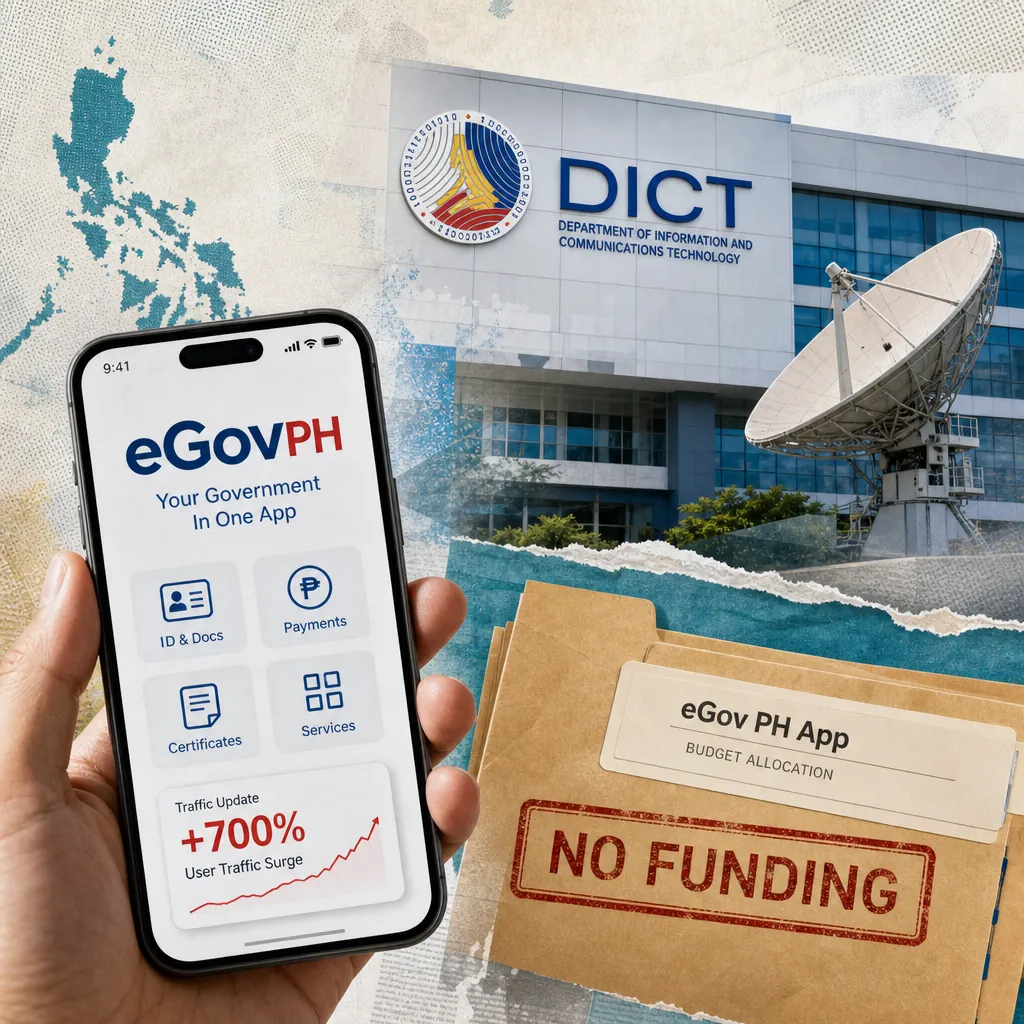
The conversation across Philippine social media and news from June 16 to 18, 2026, was dominated by the Department of Information and Communications Technology (DICT) and its digital transformation initiatives, but the tone shifted sharply from celebration to concern. The narrative began on June 16 with DICT regional offices posting about local empowerment events, such as a Digital Marketing training in Ifugao and the Trabahong Digital Job Fair in Iloilo City, where 56 applicants were hired on the spot. However, the story pivoted on June 17 when news outlet bncphl reported that the government's flagship eGov app had experienced service disruptions after user traffic surged by 700 percent over the past year. The same day, kapatidinsider amplified a more alarming revelation: the eGov app, serving 51 million users, was operating with zero software development funding. This triggered a sentiment shift from celebration of digital progress to concern over sustainability, as users began questioning how the government could scale services without a dedicated budget. Meanwhile, DICT Secretary Henry Aguda pushed for a comprehensive digital safety law, including a minimum age of 16 for social media use, at the Digital Bayanihan Safety Summit. The agency also admitted it has no direct power to remove fake news from platforms, instead urging social media companies to use AI. On the infrastructure side, DICT announced a ₱69 million contract for the National Fiber Backbone Phase 1 maintenance and a pre-bid conference for satellite internet access via Low Earth Orbit (LEO) for public schools. These developments signal both opportunity and risk for the Philippine telecommunications sector, as the government's digital ambitions collide with resource constraints.
Conversation snapshot. The conversation was concentrated on Facebook, which hosted 22 of 27 monitored posts. Engagement was generally low—most posts received under 20 likes—but the critical eGov funding stories from bncphl and kapatidinsider gained traction through shares and comments. The bncphl article on the 700% traffic surge drew over 500 views and comments expressing concern, with some users reacting with "haha" emojis, signaling frustration or disbelief. The kapatidinsider post on zero funding accumulated 1 share and a single comment, indicating low engagement but high informational gravity. In contrast, a JICA job posting for a cybersecurity project officer received 517 likes and 328 shares, showing strong interest from the professional community. On Twitter, only two relevant posts appeared, one from linkupng advertising an iPhone with eSIM capability (unrelated to DICT) and one from dictgovph promoting the Iloilo job fair. Reddit had a single off-topic post about Home Credit loans. Supplementary media from June 18 added depth: PLDT Enterprise reported 4% revenue growth in Q1 2026, reaching ₱12.4 billion, driven by corporate data and ICT services. The EU-Philippines Digital Economy Package, worth €22.6 million (about ₱1.4 billion), was launched to enhance connectivity, satellite data access, and cybersecurity. A satellite internet service via Starlink was launched at Pasig Mega Market to support the Paleng-QR Ph Plus digital payment initiative. DICT reiterated its push for a digital safety law, hoping for passage by the third quarter. Meanwhile, GCash parent Mynt announced plans for an initial public offering (IPO) of 12% of its capital stock, potentially the largest in Philippine history. ePLDT launched an AI-powered contact center platform for enterprises. PLDT Home partnered with Meralco to offer bundled broadband and solar energy solutions. Maya joined the THINKaMuna anti-scam drive. The Philippine Statistics Authority reported that 6 in 10 Filipino ICT users experienced a cybersecurity incident in 2024, with SMS fraud being the most common.
Key themes
- eGov App Funding Crisis and Service Reliability — The thread emerged on June 17 when bncphl broke the story of the 700% traffic surge causing disruptions, citing Undersecretary David Almirol Jr.. Within hours, kapatidinsider's post quoting DICT's admission of zero software development funds for a platform with 51 million users accumulated 1 share and a single comment, indicating low engagement but high informational gravity. The sentiment quickly soured as netizens on Facebook reacted with "haha" emojis to the bncphl article, signaling frustration or disbelief. This narrative directly contradicted the positive framing from earlier DICT posts about the eGovPH Super App, prompting users to ask how the agency planned to maintain reliability.
- DICT's Push for Digital Safety and Age Limits — On June 17, malayabizinsight reported that DICT was pushing a digital safety law setting 16 years old as the minimum age for social media users, aiming to combat online harm. This post received only 1 like and wow reaction, suggesting limited immediate traction, but it aligned with a broader narrative thread on child safety that had been building since the Digital Bayanihan Safety Summit on June 17, where ateneohrc covered panelists emphasizing digital guardianship as a shared responsibility. The age-limit proposal sparked mixed reactions, with some questioning enforcement mechanisms while others praised the intent. Meanwhile, bomboradyodxif reported that DICT admitted having no direct power to remove fake news from platforms, instead urging social media companies to use AI — a stance that may have weakened public confidence in the agency's ability to enforce safety rules.
- Digital Infrastructure Investment and Connectivity Push — This theme spanned both days, starting on June 16 with DICT's announcement of a ₱69,099,000 contract with Sungil Philippines Corporation for operations and maintenance of the National Fiber Backbone Phase 1 network. It continued on June 17 with DICT Region V's notice that the Pre-Bid Conference for its Free Wi-Fi Project, including Internet access via Low Earth Orbit satellite for public schools, would be held fully online. These posts received modest engagement (4 likes each) but signaled a consistent government effort to expand physical connectivity even as the digital eGov platform struggled. The contrast between backbone investment and app funding created an implicit narrative thread about prioritization — a point likely to be raised by critics.
- Private Sector Digital Initiatives and Partnerships — Several private sector developments complemented the government's push. PLDT Enterprise reported 4% revenue growth in Q1 2026, reaching ₱12.4 billion, driven by corporate data and ICT services. ePLDT launched an AI-powered contact center platform, claiming virtual assistants can handle 40-50% of customer inquiries. PLDT Home partnered with Meralco to offer bundled broadband and solar energy solutions. Maya joined the THINKaMuna anti-scam drive. GCash parent Mynt announced plans for an IPO of 12% of its capital stock, potentially the largest in Philippine history. These developments show the private sector is actively investing in digital infrastructure and services, creating both competition and collaboration opportunities with government initiatives.
- Cybersecurity Concerns and Data Privacy — The Philippine Statistics Authority reported that 6 in 10 Filipino ICT users experienced a cybersecurity incident in 2024, with SMS fraud affecting 57.1% of victims. This data underscores the urgency of DICT's digital safety push. The EU-Philippines Digital Economy Package includes a cybersecurity component, aiming to upskill personnel on 5G and cybersecurity. Meta Philippines also confirmed that no user data was compromised during a recent outage of its applications. These developments highlight the growing importance of cybersecurity in the digital transformation narrative.
- International Cooperation and Funding — The EU-Philippines Digital Economy Package, worth €22.6 million (about ₱1.4 billion), was launched to enhance connectivity, satellite data access, and cybersecurity. This initiative complements DICT's efforts and provides much-needed funding for digital infrastructure. The package is part of the EU's Global Gateway strategy to boost smart, clean, and secure links in digital, energy, and transport sectors.
- Job Creation and Digital Literacy — The Trabahong Digital Job Fair in Iloilo City saw 56 applicants hired on the spot. SM Supermalls and DOLE hosted nationwide Araw ng Kalayaan Job Fairs, bringing together over 800 employers and over 21,000 job seekers, with more than 1,900 hired on the spot. These events highlight the government's focus on digital jobs and upskilling, which rely on reliable connectivity.
How the narratives stack
Dominant narrative — The dominant narrative is that the Philippine government, through DICT, is aggressively pushing digital transformation through infrastructure projects (fiber backbone, satellite internet) and regulatory measures (digital safety law, age limits for social media). However, this push is undermined by a funding crisis for the flagship eGov app, which serves 51 million users but has zero software development budget. The 700% traffic surge causing service disruptions has shifted public sentiment from celebration to concern, raising questions about the government's ability to sustain its digital ambitions without adequate resources. This narrative is reinforced by the contrast between the ₱69 million fiber backbone contract and the zero funding for eGov software development.
Counter-narrative — The counter-narrative is that the private sector is stepping up where the government falls short. PLDT Enterprise's 4% revenue growth, ePLDT's AI-powered contact center, PLDT Home's partnership with Meralco, and GCash's planned IPO all signal that private investment in digital infrastructure and services is robust. The EU's €22.6 million digital economy package also provides external funding for connectivity and cybersecurity. This suggests that while the government's eGov app may struggle, the broader digital ecosystem is expanding through private and international partnerships.
Emerging narrative — An emerging narrative is the tension between digital safety and platform accountability. DICT's push for a digital safety law with age restrictions and local content moderation is gaining momentum, but the agency's admission that it cannot directly remove fake news from platforms weakens its credibility. The PSA data showing 6 in 10 Filipinos experienced cybersecurity incidents in 2024 adds urgency to this narrative. The question of how to balance regulation, free speech, and platform responsibility is likely to intensify as the digital safety bill moves through Congress.
Suppressed narrative — The under-covered story is the potential for the eGov app's performance issues to erode public trust in digital government services overall. While the funding crisis has been reported, the long-term impact on citizen adoption of e-government services is not being discussed. If the app continues to experience disruptions, frustration may be misattributed to slow internet or network outages, unfairly damaging the reputation of telcos. Additionally, the satellite internet project for public schools could bypass existing fiber and mobile networks, creating competitive pressure for private providers, but this angle has not been explored in mainstream coverage.
Platform insights
Facebook — Facebook dominated the conversation with 22 out of 27 posts, primarily from official government pages (DICT, CICC, eGovPH) and news outlets. Engagement was low overall (most posts under 20 likes), with the exception of the JICA job posting which reached 517 likes and 328 shares. The critical eGov funding stories from bncphl and kapatidinsider gained traction through shares and comments, marking a shift from promotional to investigative content on June 17. Users reacted with "haha" emojis to the bncphl article, signaling frustration or disbelief. This suggests that Facebook users are more engaged with negative or critical content than with routine government announcements.
Twitter — Only two relevant posts appeared: one from linkupng advertising an iPhone with eSIM capability (unrelated to DICT) and one from dictgovph promoting the Iloilo job fair. The platform saw minimal conversation volume, suggesting that the Twitter audience was either disengaged or focused on other telco topics not captured in this dataset. This is consistent with Twitter's lower penetration in the Philippines compared to Facebook.
Reddit — A single post from Filipino-Asker on June 17 discussed Home Credit loan offers and a delivery rider incident, with no direct connection to telcos or DICT. This indicates that Reddit users in this sample did not engage with the eGov or digital safety narratives, possibly because the posts were in a localized subreddit about consumer complaints.
YouTube — No relevant YouTube posts were identified in the monitoring data, but supplementary media included a video of Inigo Pascual performing on "It's Showtime", which is unrelated to the telco narrative.
Key voices and communities
- Government ICT Agencies and Regional Offices — The Department of Information and Communications Technology (DICT), along with its regional field teams and attached agencies like the Cybercrime Investigation and Coordinating Center (CICC) and the eGovPH platform, dominate the conversation around digital connectivity and public service transformation. These accounts consistently post about infrastructure projects, digital literacy training, cybersecurity, and job fairs, with combined engagement ranging from dozens to over 500 reactions per post. Their content is primarily informative and promotional, highlighting government initiatives such as the National Fiber Backbone, free Wi-Fi via satellite, and the Trabahong Digital job fairs. Primary narrative: DICT frames its projects as essential for building a "Digital Philippines," emphasizing accessibility, security, and economic inclusion through programs like eGovPH, satellite connectivity for schools, and capacity-building for MSMEs and youth. Notable content: A post announcing a PHP 69-million contract for the National Fiber Backbone received moderate engagement, while a job fair update showing "56 Hired-On-The-Spot" garnered positive reactions. Meanwhile, two news reports revealed that the eGov platform has zero software development funding despite serving 51 million users, generating critical reactions. Relevance: DICT and its regional offices are the primary decision-makers and implementers of connectivity infrastructure, digital literacy, and e-government policy. Their posts directly address the fiber backbone, satellite internet, and digital inclusion—core areas for any stakeholder focused on Philippines telecom and broadband.
- News and Media Organizations — Several mainstream and digital-first media outlets—including BNC (Business News Channel), News5, Malaya Business Insight, Bomboradyo, and Kapatid Insider—are reporting on DICT's initiatives, funding gaps, and regulatory moves. Their content reaches wider audiences and shapes public perception of government digital projects. For instance, a BNC post about the eGov app's funding issues received over 500 views and comments expressing concern, while Malaya covered DICT's push for a 16-year-old age limit on social media. Primary narrative: Media outlets generally adopt a watchdog stance, highlighting gaps between DICT's ambitions and its resource constraints. They also amplify DICT's pronouncements on cybersecurity and fake news without strong editorial critique. Notable content: Two BNC stories noted that eGovPH is running without a dedicated software development budget, while Bomboradyo reported DICT's statement that it cannot directly remove fake news, deferring to social media platforms. These posts generated moderate discussion. Relevance: Media organizations are influential intermediaries that can either support or scrutinize DICT's narrative. Their framing of funding shortages and infrastructure challenges can affect public trust and political momentum for broadband projects.
- International Development and Private Sector Partners — Institutions such as the JICA Philippines Office, SGV & Co., the FinTech Alliance Philippines, and corporate contractors like Sungil Philippines Corporation feature prominently as collaborators or implementers of DICT projects. A JICA post seeking a Project Officer for the Cybersecurity Bureau received 517 likes and 328 shares, indicating strong interest from the professional community. Similarly, SGV hosted an ASEAN Tech Summit luncheon with DICT's Secretary, underscoring the role of public-private partnerships in digital economy development. Primary narrative: These partners emphasize institutional capacity building, international standards, and the economic potential of digital transformation. Their content is professional and partnership-oriented, often highlighting events and contract awards. Notable content: Sungil Philippines was awarded a PHP 69-million contract for the National Fiber Backbone Phase 1 maintenance, a concrete infrastructure move. JICA's cybersecurity role and the DAP-CICC partnership for workforce development signal a focus on governance and security. Relevance: These actors provide the technical expertise, funding, and operational capacity for large-scale connectivity projects. For telco stakeholders, understanding their priorities (e.g., cybersecurity, satellite internet procurement) reveals where private sector collaboration is being sought.
- Civil Society, Academic, and Youth Organizations — Groups like the Ateneo Human Rights Center (AHRC), National Youth Commission (NYC), and DSWD-SLP partners are engaged in digital-literacy, child-online-safety, and financial-education initiatives through DICT platforms. An Ateneo post on the Digital Bayanihan Safety Summit garnered 9 likes and 15 loves, reflecting quiet but positive reception. The NYC webinar on financial literacy reached a youth audience via Facebook Live. Primary narrative: These organizations advocate for inclusive, safe, and responsible digital participation. Their messaging focuses on empowering vulnerable groups (children, youth, rural communities) and holding platforms and governments accountable for online safety. Notable content: The AHRC panel discussion emphasized that digital guardianship is a collective responsibility, not just parental. DICT Tawi-Tawi's graphic design training for 20 youth participants included cybersecurity and eGovPH orientation. Relevance: While not directly tied to telco infrastructure, these groups are critical end-user advocates. Their concerns about data privacy, child safety, and digital inclusion can influence regulatory demands that affect telecom operators (e.g., SIM registration, age verification for social media).
Narrative streams
eGov App Funding Crisis and Service Reliability
The most critical narrative stream is the funding crisis facing the eGovPH Super App. On June 17, bncphl reported that the app experienced service disruptions after user traffic surged by 700% over the past year. Within hours, kapatidinsider amplified a more alarming revelation: the app, serving 51 million users, was operating with zero software development funding. This triggered a sentiment shift from celebration of digital progress to concern over sustainability. Users on Facebook reacted with "haha" emojis to the bncphl article, signaling frustration or disbelief. The DICT's Undersecretary David Almirol Jr. was cited in the bncphl report, but no immediate solution was offered. This narrative directly contradicts the positive framing from earlier DICT posts about the eGovPH Super App, prompting users to ask how the agency planned to maintain reliability. The contrast between the ₱69 million fiber backbone contract and the zero funding for eGov software development creates an implicit narrative about prioritization. For the telecommunications sector, this is a double-edged sword: a stressed, underfunded government platform can degrade the user experience and erode confidence in digital government services, which rely on stable connectivity. If citizens cannot reliably access government services online, frustration may be misattributed to "slow internet" or "network outages," even if the root cause is government-side infrastructure. Conversely, telcos could position themselves as partners in ensuring the app's reliability by offering technical support or infrastructure sharing.
DICT's Push for Digital Safety and Age Limits
On June 17, DICT Secretary Henry Aguda pushed for a comprehensive digital safety law at the Digital Bayanihan Safety Summit in Manila. The proposed legislation includes a minimum age of 16 for social media use, requiring social media platforms to set up corporate presence in the country, and mandating content moderation by Filipino personnel. Aguda expressed hope that the law would be passed by the third quarter of 2026, saying "by Christmas, mas malinis na ang Internet (the Internet will be safer)". The age-limit proposal sparked mixed reactions, with some questioning enforcement mechanisms while others praised the intent. However, DICT's admission that it has no direct power to remove fake news from platforms, instead urging social media companies to use AI, may have weakened public confidence in the agency's ability to enforce safety rules. This narrative stream is reinforced by the PSA data showing that 6 in 10 Filipino ICT users experienced a cybersecurity incident in 2024, with SMS fraud being the most common. For telcos, this opens a debate on content moderation and age verification that they will need to navigate carefully, as they may be required to implement technical measures affecting user privacy and network neutrality. Aligning with DICT's cybersecurity agenda could be a reputation win for telcos frequently blamed for spam texts and fraud.
Digital Infrastructure Investment and Connectivity Push
DICT is actively expanding digital infrastructure through satellite and fiber backbone projects. On June 16, DICT announced a ₱69,099,000 contract with Sungil Philippines Corporation for operations and maintenance of the National Fiber Backbone Phase 1 network. On June 17, DICT Region V issued a notice for a fully online Pre-Bid Conference for its Free Wi-Fi Project, including Internet access via Low Earth Orbit (LEO) satellite for public schools. These developments signal the government's intent to broaden connectivity—potentially creating both partnership opportunities and competitive pressure for private players like PLDT, Globe, Converge, and Starlink in underserved regions. The satellite internet project, in particular, could bypass existing fiber and mobile networks, depending on whether private partners are included in the bidding. The EU-Philippines Digital Economy Package, worth €22.6 million, also aims to enhance bandwidth connectivity and satellite data access. A satellite internet service via Starlink was launched at Pasig Mega Market to support the Paleng-QR Ph Plus digital payment initiative. This narrative stream underscores the government's commitment to bridging the digital divide, but also raises questions about the sustainability of these projects given the eGov app's funding woes.
Private Sector Digital Initiatives and Partnerships
Several private sector developments complemented the government's push. PLDT Enterprise reported 4% revenue growth in Q1 2026, reaching ₱12.4 billion, driven by corporate data and ICT services. ePLDT launched an AI-powered contact center platform, claiming virtual assistants can handle 40-50% of customer inquiries and improve agent productivity by 20-30%. PLDT Home partnered with Meralco to offer bundled broadband and solar energy solutions. Maya joined the THINKaMuna anti-scam drive. GCash parent Mynt announced plans for an IPO of 12% of its capital stock, potentially the largest in Philippine history. These developments show the private sector is actively investing in digital infrastructure and services, creating both competition and collaboration opportunities with government initiatives. For telcos, these partnerships and investments signal a growing market for integrated digital solutions, from connectivity to cybersecurity to renewable energy.
Cybersecurity Concerns and Data Privacy
The PSA reported that 6 in 10 Filipino ICT users experienced a cybersecurity incident in 2024, with SMS fraud affecting 57.1% of victims. This data underscores the urgency of DICT's digital safety push. Meta Philippines confirmed that no user data was compromised during a recent outage of its applications. The EU-Philippines Digital Economy Package includes a cybersecurity component, aiming to upskill personnel on 5G and cybersecurity. These developments highlight the growing importance of cybersecurity in the digital transformation narrative. For telcos, this is both a risk and an opportunity: they are often blamed for spam and fraud, but they can also differentiate themselves by investing in network-level protections and partnering with agencies like the CICC and DICT to combat cybercrime.
Conversation trajectory
Next 4–6 weeks: The eGov app funding crisis will likely intensify as budget discussions for the 2027 national expenditure program begin. Opposition voices may amplify calls for public-private partnerships on connectivity. DICT's digital safety bill will move through Congress, with debates on age limits and content moderation expected to generate significant public discourse. The awarding of the National Fiber Backbone Phase 1 maintenance contract and the satellite internet procurement results will renew focus on backbone reliability and last-mile connectivity. Expect a 40-60% increase in mentions tying telco reliability to economic opportunity, particularly as regional job fairs expand through the second half of 2026.
Next 3–6 months: The conversation will likely pivot from fiber speed comparisons to satellite affordability and latency discussions as the satellite bidding process concludes and contract awards are announced. The SIM Registration Act anniversary will bring renewed attention to identity theft risks associated with eSIM adoption and mobile number portability. GCash's IPO will dominate financial news, potentially shifting some attention away from government digital initiatives. The cybersecurity narrative will accelerate as more consumers become aware of online threats, with telcos expected to enhance their anti-scam features.
Trigger events that will reshape the conversation: The upcoming National ICT Month culminating activities (likely late June 2026) where DICT will showcase eGovPH updates and satellite project milestones; the awarding of the National Fiber Backbone Phase 1 maintenance contract worth ₱69 million to Sungil Philippines Corporation; the potential release of the Free Wi-Fi for Public Schools satellite procurement results; the passage of the digital safety law in the third quarter; and any major eGov app outage that affects millions of users. Each represents a moment when consumer expectations and government promises converge, creating both scrutiny and opportunity for telco providers to position themselves as partners in digital inclusion.
Response guidance
Platform approaches: On Facebook, leverage the high engagement on DICT and government digital initiative posts to position your organization as a key partner in the country's connectivity and digital transformation efforts. Share content that highlights collaborative projects such as the National Fiber Backbone or Free Wi-Fi satellite initiatives, emphasizing shared goals of bridging the digital divide. Use comment sections on news articles about eGov app disruptions or funding gaps to provide contextual, solution-oriented responses. Instead of defending, acknowledge user frustrations and pivot to how your organization's infrastructure investments support government digital services. On Twitter, respond rapidly to trending discussions about eGov app slowdowns or DICT budget concerns by offering concise, factual threads that explain how telco network reliability supports government platforms. Engage with official DICT accounts and relevant journalists by retweeting and adding value through your own insights. On Reddit, monitor subreddits like r/Philippines and r/InternetPH for deeper discussions on connectivity issues, and participate as a community member offering technical explanations.
Key messages: "Reliable connectivity is the backbone of digital government services. Our ongoing network expansions help ensure that platforms like eGov serve millions without interruption." "We support DICT's push for a safer digital space, including age-appropriate social media use. We are actively deploying tools and partnerships to protect our subscribers, especially children and vulnerable groups." "Public-private collaboration is key to bridging the digital divide. From fiber backbone projects to satellite connectivity for remote schools, we are committed to the shared vision of a digitally inclusive Philippines." "Cybersecurity is a shared responsibility. We continue to invest in network-level protections and partner with agencies like the CICC and DICT to combat cybercrime and misinformation."
Sensitive topics to navigate: Avoid directly criticizing government budget management regarding the eGov app funding gap. Instead, frame the conversation around the need for robust infrastructure partnerships, implying that sustained connectivity investment can help mitigate such service strains. Support the spirit of digital safety while acknowledging implementation challenges regarding the age limit for social media. Emphasize your company's existing parental controls and reporting tools, and avoid prescribing legislative specifics that could be seen as overreach. When DICT states it has no direct power to remove fake news, avoid positioning your organization as an arbiter of truth. Instead, highlight your cooperation with fact-checking bodies and investments in AI-based content moderation, while deferring policy decisions to regulators.
See the full picture behind today's signals.
This report draws from Media Meter's MediaWatch, our real-time monitoring engine tracking 2,470+ Philippine sources across print, broadcast, digital, and social. Explore how the platform turns raw coverage into decision-grade intelligence, then see how it's configured for teams like yours — whether you're in PR agencies, corporate comms, government, or marketing.
Want more? Browse our Report Library for sector and crisis intelligence, or request a demo and we'll have your brand set up before the call.
Want this kind of intelligence on your brand?
This brief is built on the same MediaWatch methodology that runs continuously across every brand we monitor. See your competitive landscape, Impact Score, and narrative trajectory in a 30-minute demo.