Fuel Prices Climb Third Week as Diesel Nears P100
Diesel rises P8.82 per liter and gasoline P4.88 in a third straight weekly increase, with the Department of Energy saying pump prices will stay above pre-war levels through the end of 2026. Motorists queued in Iloilo and transport groups pressed for relief.
The Conversation
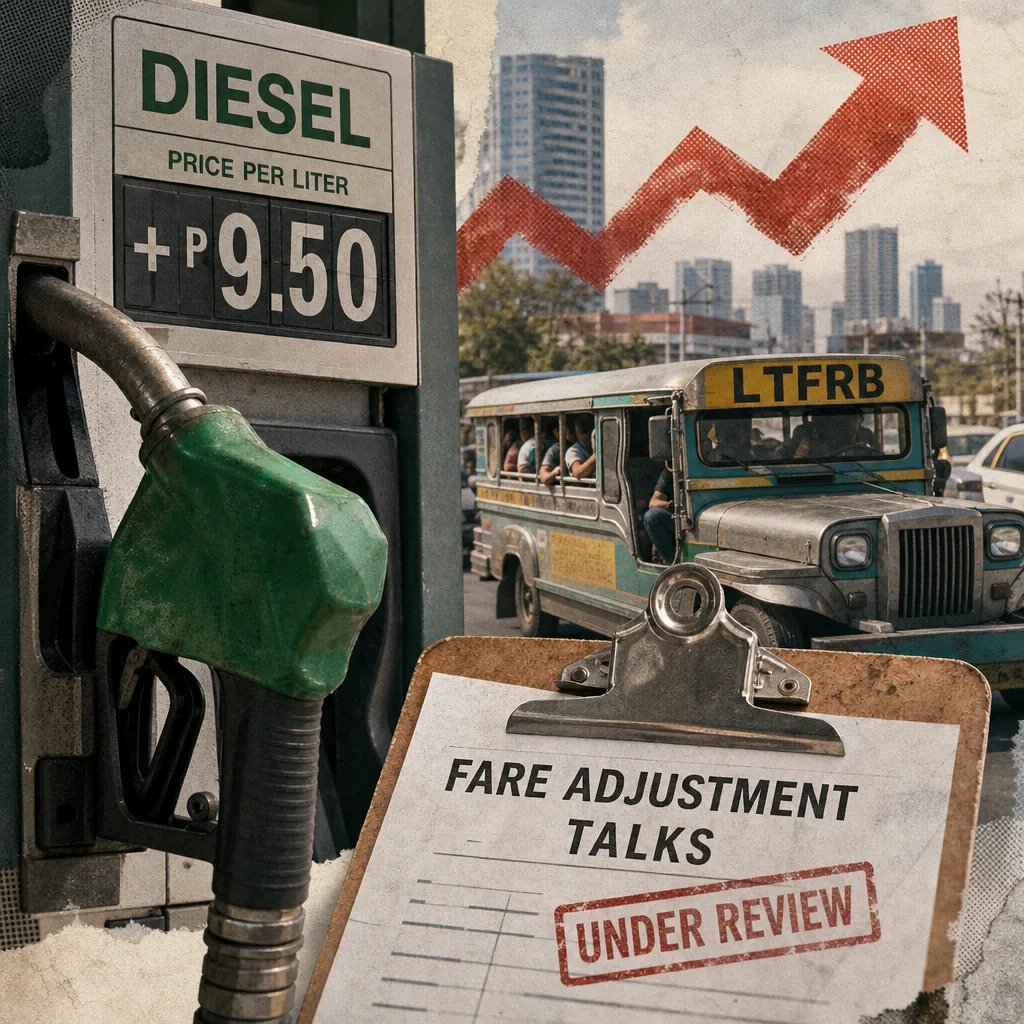
Diesel prices in Metro Manila moved to within a few pesos of P100 per liter on Tuesday, September 22, after oil companies implemented an P8.82-per-liter increase on diesel, P4.88 on gasoline and P6.47 on kerosene — the third consecutive week of major upward adjustments and the steepest single round since the current run began.4128 The Department of Energy (DOE), the government agency that monitors fuel supply and pricing, confirmed the figures and said the increases trace to elevated international crude prices and supply disruption linked to the war in the Middle East.3227
The story ran on two tracks. On the news side, the DOE's message dominated: Energy Secretary Sharon Garin told reporters at the Batasang Pambansa, the seat of the House of Representatives, that prices would not return to pre-war levels within the year. "With the currency exchange, with the situation in the Middle East, we expect that within the year, hindi pa siya bababa sa level na prewar," she said, mixing Filipino into the statement — in English, that oil prices will not ease back to their pre-war level.32 She added that the situation would likely stay elevated until Christmas unless the parties to the Middle East conflict reach a peaceful agreement.32 The DOE also said supply remains adequate, with the country holding roughly 50 to 54 days of oil inventory.27
On the ground, the response was immediate and physical. Motorists in Iloilo City lined up at gasoline stations on Monday evening, September 21, to fill their tanks before the new prices took effect at dawn.3 The scene — long queues, tanks topped off before a deadline — is the most visible consumer reaction in the coverage reviewed here, and it captures what the numbers mean for an ordinary household: a single week's adjustment adds hundreds of pesos to a full tank, and the increases have compounded since the start of September. Since September 1, diesel prices will have risen by P18.31 per liter, gasoline by P15.25 and kerosene by P16.67, according to the Iloilo report.3
The coverage in this set was carried almost entirely by online news outlets, from national business desks to regional radio and motoring sites, and the volume of items reflects how broadly the price move touched different audiences — commuters, drivers, farmers, fisherfolk and small retailers. The single most prominent item in the set by coverage value was a BusinessWorld report on the DOE's year-end outlook, which carried an estimated P548,803.84 in advertising-equivalent value — the estimated cost of buying the same space as paid advertising, not a measure of readership.32 A Philippine Star opinion column warning of a possible global supply shortage carried an estimated P711,822 in equivalent value.66 Those figures indicate the story drew heavy column inches across the business and opinion pages; they do not tell us how many people read the pieces.
Key themes
- Diesel rises P8.82 per liter, the third straight weekly increase. The adjustment took effect Tuesday, September 22, and pushed the cheapest Metro Manila diesel to an estimated P96.53 per liter, with more expensive stations above P110.41 Gasoline rose P4.88 and kerosene P6.47.28
- The DOE says prices will stay above pre-war levels through the end of 2026. Secretary Garin said the combination of a weak peso and the ongoing Middle East conflict would keep pump prices elevated at least until Christmas.32 The department does not expect increases as large as those seen in March 2026, when the US-Iran war began, but it also does not expect a return to pre-war costs.1
- Supply is adequate but the disruption is physical, not just financial. The DOE attributed the run-up to the shutdown of Saudi Arabia's East-West Pipeline, also called Petroline, after a drone attack. Oil Industry Management Bureau director Rino Abad said assessing and repairing the damage alone could take three to five weeks.28
- Motorists queued in Iloilo and other areas ahead of the deadline. Long lines formed at stations on Monday evening as drivers rushed to buy at the old prices.3 The behavior is a familiar pattern before large adjustments and signals how sensitive consumers have become to weekly price movements.
- Oil companies are staggering the increases. Shell Pilipinas implemented smaller per-liter adjustments than the headline figures — P7.80 on diesel, P4.80 on gasoline and P6.40 on kerosene — as a way to soften the impact.27 The DOE said it may appeal to petroleum companies to spread increases over multiple weeks.28
- The price pressure is regional, not just national. A Cebu City council resolution asked the Visayan Electric Company (VECO) to allow staggered payment of August and September electricity bills through December 2026 without penalties or disconnections, citing the sharp rise in power rates.59 The move shows local governments treating utility costs as a household emergency.
- Analysts warn of a deeper supply problem if the Strait of Hormuz stays constricted. A Philippine Star opinion column cited a JP Morgan report projecting that world oil inventories could hit their operational floor within the month, below which pipelines cannot maintain pressure and refineries could fail.66 That would turn a price problem into an engineering one.
- The government's response has focused on information and appeals rather than price controls. The DOE has emphasized supply adequacy and asked companies to stagger increases, while the Department of Justice separately called for a review of the Suggested Retail Price policy, warning that broad price controls restrict competition.22 The two positions — no controls on fuel, scrutiny of controls on retail goods — reflect the government's limited room to intervene in a globally priced commodity.
How the narratives stack
Dominant: The DOE's year-end outlook and the size of the weekly increase. Secretary Garin's statement that prices will not fall to pre-war levels within the year was the most widely carried line in the set, appearing in BusinessWorld, the Philippine Daily Inquirer, Head Topics and Bombo Radyo Cauayan.3213327 The BusinessWorld item alone carried an estimated P548,803.84 in advertising-equivalent value, and the Inquirer's report carried an estimated P712,908.321 The dominance here is a property of the items captured in this set, which skew toward national online news; it is not a claim about where all coverage sat.
Counter-narrative: The DOE's reassurance that supply is sufficient and that increases will not reach March-like spikes. Garin said the country has 50 to 54 days of oil inventory and that prices would not rise by around P20 per liter.271 This framing competes with the headline numbers: the same DOE that confirmed the P8.82 diesel increase also said the situation is manageable. The tension is real — the department is trying to prevent panic buying while acknowledging that costs are rising sharply.
Emerging: Local government and consumer responses. The Mandaue City Council resolution seeking staggered VECO payments is the clearest example in the set of a local body treating utility costs as a household emergency.59 The Iloilo queues are another.3 These responses are emerging because they are localized and reactive; they have not yet coalesced into a national consumer movement, but they indicate where pressure will build if prices stay high.
Under-covered: The physical supply risk. The Philippine Star opinion column warning that refineries could fail if the Strait of Hormuz remains constricted was the only item in the set to raise the possibility of a supply shortage rather than a price problem.66 It carried an estimated P711,822 in advertising-equivalent value, indicating it ran prominently, but the theme did not appear in the news reporting reviewed here. The under-coverage matters because a supply failure would be a different order of event from a price increase.
Platform insights
The monitoring writeup for this window did not include social platform data, so this section is limited to what the news coverage itself reveals about how the story moved.
- Online news: The story was carried by national business desks (BusinessWorld, Business Mirror, Philippine Star, Manila Bulletin), regional outlets (Panay News, Bombo Radyo Cauayan, SunStar Cebu via Philippine Star), and specialist sites (Zigwheels, Head Topics).3228273133 The breadth of outlets indicates the price move was treated as a national story with strong regional relevance.
- Radio: Bombo Radyo Cauayan's report in Filipino reached a provincial audience with the same core figures — P8.82 diesel, P4.88 gasoline, P6.47 kerosene — and Garin's assurance of 50 to 54 days of supply.27 Radio remains an important channel for reaching drivers and households outside Metro Manila.
- Opinion pages: The Philippine Star ran a column framing the price increases as a potential prelude to a global supply shortage, citing JP Morgan.66 Opinion coverage of this kind shapes elite and policy debate more than mass behavior, but it can influence how the story is framed in subsequent news cycles.
Key voices and communities
The Department of Energy. Secretary Sharon Garin and Oil Industry Management Bureau director Rino Abad are the primary official voices. Garin's framing — that prices are outside the country's control — sets the government's line.132 Abad's technical explanation of the pipeline damage gives the story its physical cause.28
Oil companies. Shell Pilipinas and Petron are named as staggering their increases, a decision that affects how quickly consumers feel the full adjustment.2733 Their pricing choices are watched as signals of how the industry expects the market to move.
Motorists and transport operators. The Iloilo queues are the most direct expression of consumer response in the set.3 Transport operators are particularly exposed because diesel is their primary input; the Land Transportation Franchising and Regulatory Board (LTFRB) was reported to have temporarily suspended something related to the increases, though the item does not specify what.31
Local government units. The Mandaue City Council's resolution on VECO payments shows local officials moving to cushion the impact on households.59 Cebu province also created a task force to monitor fish prices and supply, an unrelated but parallel response to cost-of-living pressure.64
Analysts and opinion writers. The Philippine Star column brought a global supply-risk frame into the Philippine debate, citing JP Morgan's inventory projections.66 This voice matters because it shifts the question from "how high will prices go" to "will there be enough oil at all."
Narrative streams
Diesel nears P100 per liter after P8.82 increase
The headline number is the increase itself: P8.82 per liter on diesel, P4.88 on gasoline and P6.47 on kerosene, effective Tuesday, September 22.2841 Based on prevailing National Capital Region retail prices the previous week, the adjustment could bring regular diesel to an estimated P96.53 to P110.82 per liter, meaning even the cheapest stations moved to within P3.50 of the P100 mark.41 Diesel Plus could climb to an estimated P100.72 to P121.22 per liter, putting the entire prevailing range above P100.41
The increase is the third straight week of major adjustments. Since the start of September, diesel will have risen by P18.31 per liter, gasoline by P15.25 and kerosene by P16.67.3 For a jeepney driver filling a 40-liter tank, the September increases alone add more than P700 to a single fill-up. For a household with a 50-liter car, the diesel increase adds roughly P900. These are the numbers that explain the Iloilo queues.3
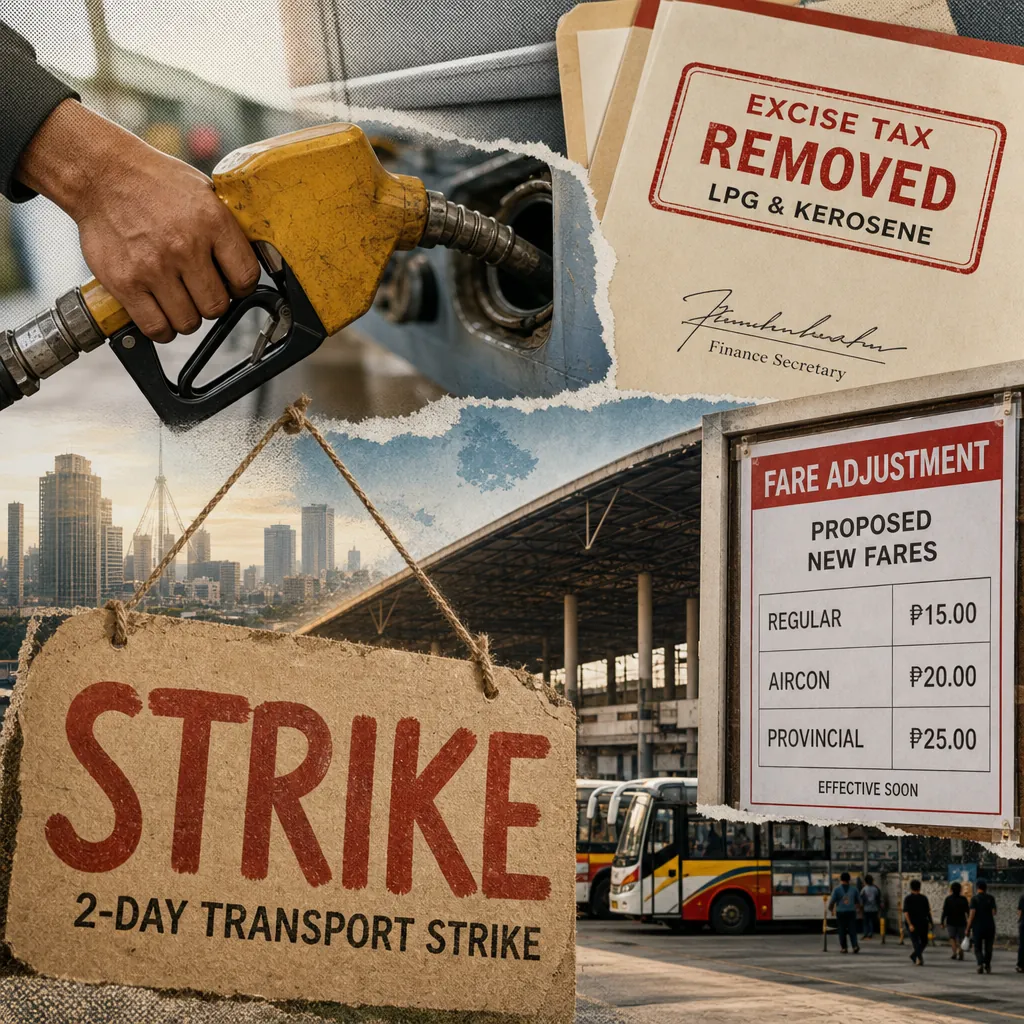
The read for the sector: transport operators and logistics companies face an immediate margin squeeze because fuel is a direct operating cost they cannot easily pass on. The LTFRB's reported suspension of something related to the increases — the item does not specify what — suggests regulators are looking for ways to cushion the blow, but fare adjustments typically lag price movements by weeks or months.31 Small retailers and market vendors who rely on delivery will see costs rise with each shipment.
DOE says prices will stay above pre-war levels through 2026
Secretary Garin's statement at the House briefing was the most consequential official line of the day: prices will not return to pre-war levels within the year, and the situation will likely stay elevated until Christmas unless the Middle East conflict reaches a peaceful agreement.32 She attributed the pressure to the combination of the war and a stronger dollar, which makes dollar-denominated oil more expensive in peso terms.32
The DOE's position is that the country cannot control global oil prices. "So its big compared to the recent weeks, but unfortunately its not within our control because even Saudi Arabia, all the other coun—" Garin said, the quote trailing off in the transcript.1 The department does not expect increases as large as those seen in March 2026, when the US-Iran war began, but it also does not expect relief.1
The read for the sector: businesses planning for the fourth quarter should assume fuel costs stay at or near current levels. That affects everything from delivery pricing to travel budgets to the cost of running generators during brownouts. The DOE's 50-to-54-day supply buffer is adequate for now, but it is a stock, not a flow; if the pipeline disruption persists beyond the three-to-five-week repair estimate, the buffer will shrink.2728
The physical cause: a drone attack on Saudi Arabia's East-West Pipeline
The price increases trace to a specific event: a drone attack that forced the shutdown of Saudi Arabia's East-West crude oil pipeline, also known as Petroline.28 The pipeline is a major artery for Saudi crude, and its closure restricts key delivery routes and drives up international market rates.28 DOE-OIMB director Rino Abad said assessing and repairing the damage alone could take three to five weeks.28
This is the detail that distinguishes the current run from ordinary price volatility. A pipeline outage is a physical constraint, not a financial one. The Philippine Star column took the logic further, citing a JP Morgan report projecting that world oil inventories could hit their operational floor within the month if the Strait of Hormuz remains constricted. Below that level, pipelines cannot maintain pressure and refineries could start failing.66 The column argued that even if Hormuz fully opens, refineries may need rehabilitation, and the disruption could last longer than the geopolitical event that caused it.66
The read for the sector: the risk profile has shifted from price to availability. If the column's scenario materializes, the relevant question for businesses is not how much fuel costs but whether it can be sourced at all. That would affect power generation, transport and manufacturing simultaneously. The DOE's supply assurances are based on current inventories; they do not address what happens if the disruption extends beyond the repair window.
Government response: appeals to stagger, no price controls
The government's tools are limited. The DOE said it may appeal to petroleum companies to stagger price increases over multiple weeks, and Shell Pilipinas and Petron have already done so, implementing smaller per-liter adjustments than the headline figures.282733 Shell's increases were P7.80 on diesel, P4.80 on gasoline and P6.40 on kerosene, each slightly below the DOE's announced figures.27
Separately, the Department of Justice's Office for Competition called for a review of the Suggested Retail Price policy, warning that the practice restricts competition and amounts to undue market interference. In a 23-page report, the office said price controls should be enforced only during emergencies rather than applied broadly across everyday consumer goods.22 The Department of Trade and Industry requires retailers to give 30 days' notice before raising prices and issues formal notices to businesses exceeding recommended levels.22
The read for the sector: the government is drawing a line between fuel, where it says it cannot intervene, and retail goods, where it is reconsidering how much it should. For fuel retailers and distributors, the practical effect is that they face public pressure to absorb or stagger increases without any formal mechanism to recover the difference. For consumer-goods retailers, the DOJ review could eventually loosen the informal price ceilings that currently constrain how quickly they pass on higher transport costs.
Households and local governments respond to the squeeze
The Mandaue City Council passed a resolution asking the Visayan Electric Company (VECO) to allow consumers to settle August and September bills through staggered payments extending to December 2026, without penalties or disconnections.59 Councilor Jennifer del Mar said the resolution responded to complaints from constituents who felt the increase in their bills.59 The resolution is a request, not a mandate; VECO has not yet responded in the coverage reviewed here.
The electricity issue is separate from fuel but part of the same cost-of-living pressure. Cebu province also created a task force to monitor fish prices and supply, adopting the Bantay Presyo Isda Program through Executive Order No. 50.64 The program will track prices at landing centers, fish ports, public markets and retail outlets, and monitor volumes in major trading centers.64
The read for the sector: local governments are becoming active participants in cost-of-living management, using resolutions, task forces and monitoring programs to pressure utilities and traders. For energy and utility companies, this means rate increases will increasingly be met with local political resistance, even when the increases reflect national or global market conditions. For retailers, it means more scrutiny of pricing at the local level.
Conversation trajectory
Over the next one to two weeks: The next weekly fuel price adjustment, typically announced Monday and effective Tuesday, will be the first test of whether the DOE's "no March-like spikes" forecast holds. If diesel rises again by a similar magnitude, the cumulative September increase will exceed P25 per liter, and pressure on transport fares and local government relief measures will intensify. Watch for LTFRB action on fare petitions and for more local resolutions like Mandaue's.3159
Over the next three to five weeks: The DOE's repair estimate for the Saudi East-West Pipeline sets a natural checkpoint.28 If the pipeline is restored within that window, international prices may stabilize and the weekly increases could moderate. If the repair takes longer, the supply buffer — currently 50 to 54 days — will begin to shrink, and the conversation will shift from price to availability.27
By the end of 2026: The DOE's forecast that prices stay above pre-war levels through the year gives a clear horizon for evaluating the department's credibility.32 If prices are still elevated in December, the government's messaging about supply adequacy will face harder questions. If a peace agreement in the Middle East materializes, the forecast could prove too pessimistic, but Garin explicitly conditioned relief on that outcome.32
Trigger events to watch: A formal LTFRB decision on transport fares; VECO's response to the Mandaue resolution; any announcement from the DOE on supply levels below 50 days; and the next JP Morgan or International Energy Agency inventory report, which would confirm or contradict the refinery-failure scenario.31592766
Response guidance
For energy companies: Communicate the composition of each price adjustment — how much reflects international crude, how much reflects the peso-dollar exchange rate, and how much reflects local costs. Consumers who understand the breakdown are less likely to attribute the increase to retailer margins. Where staggering is possible, explain the schedule clearly so customers know what to expect in the following weeks.2728
For transport and logistics operators: Prepare customers for fare or surcharge adjustments now, with reference to the cumulative September increases rather than a single week's figure. A P18.31-per-liter rise in diesel since September 1 is the number that justifies a fare change; a single P8.82 increase is easier to dismiss as temporary.3
For local government communicators: The Mandaue resolution and the Cebu fish-price task force show that constituents expect local officials to act on cost-of-living pressure even when the underlying cause is global.5964 Publish what the local government can and cannot control, and set up a channel for residents to report price anomalies. The Bantay Presyo Isda model — regular monitoring at landing sites and markets — is a template that can be adapted to other staples.
For consumer-goods retailers: The DOJ review of the Suggested Retail Price policy may eventually change how price increases are regulated, but until then the 30-day notice requirement and formal notices for exceeding recommended levels remain in force.22 Document cost increases from suppliers and transport providers so that any price adjustment can be explained with evidence.
For all communicators in the sector: Avoid predicting the duration of the price run. The DOE itself has given a year-end horizon and a repair estimate of three to five weeks; those are the only checkable timelines available.3228 Messages that promise relief by a specific date risk being contradicted by the next weekly adjustment.
See the full picture behind today's signals.
This report draws from Media Meter's MediaWatch, our real-time monitoring engine tracking 2,470+ Philippine sources across print, broadcast, digital, and social. Explore how the platform turns raw coverage into decision-grade intelligence, then see how it's configured for teams like yours — whether you're in PR agencies, corporate comms, government, or marketing.
Want more? Browse our Report Library for sector and crisis intelligence, or request a demo and we'll have your brand set up before the call.
Want this kind of intelligence on your brand?
This brief is built on the same MediaWatch methodology that runs continuously across every brand we monitor. See your competitive landscape, Impact Score, and narrative trajectory in a 30-minute demo.