Fuel Crisis Drives Excise Cut, Fare Hikes, Strikes
The Philippines' fuel crisis dominated the day as the Finance Secretary signed a resolution removing excise taxes on LPG and kerosene, bus operators cut trips and sought fare increases, and transport groups announced a two-day strike. The Department of Energy warned pump prices will stay elevated through Christmas.
The Conversation
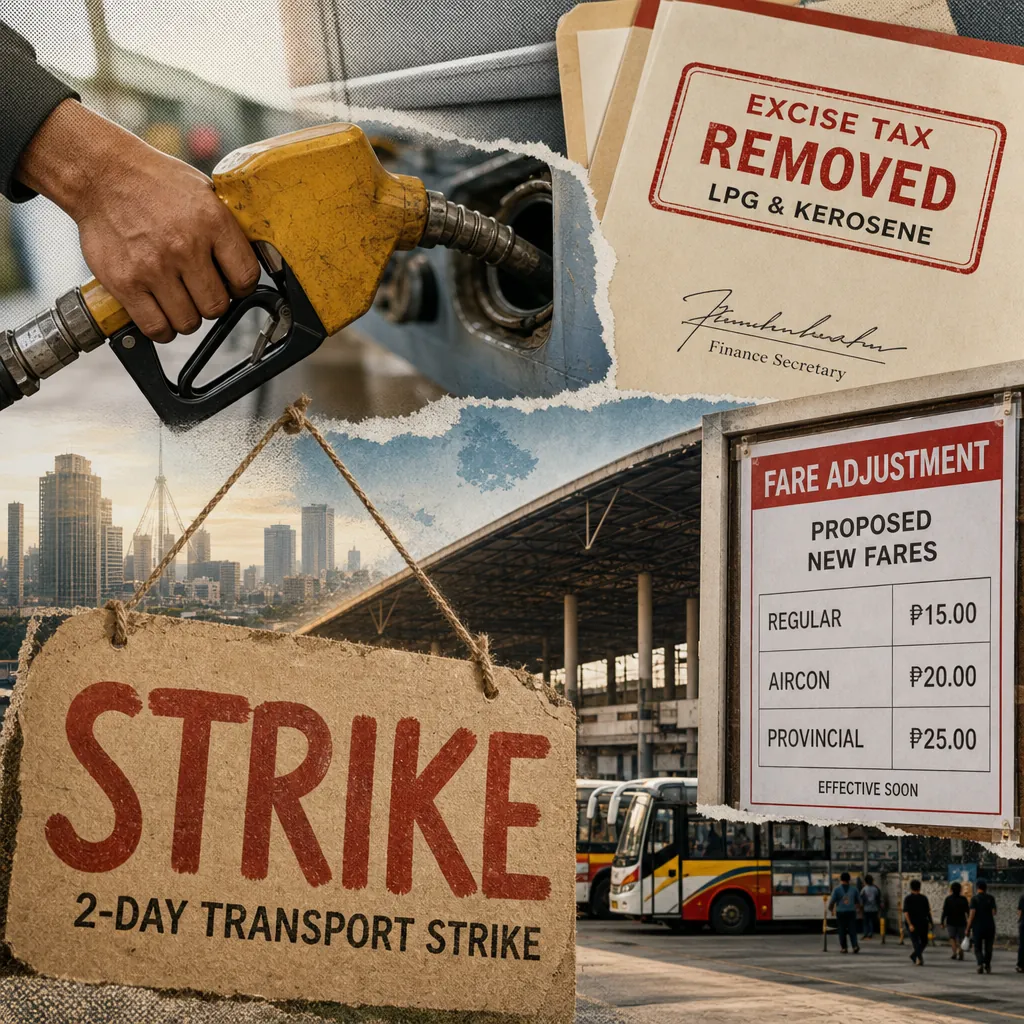
Finance Secretary Frederick Go signed a resolution removing the excise tax on liquefied petroleum gas (LPG) and kerosene during a Senate budget hearing on Tuesday, telling the panel he had put his signature to the measure roughly fifteen minutes earlier. "Kanina mga 15 minutes ago, pumirma ako dito, pinirmahan ko yung resolution to remove excise taxes on LPG and kerosene, which is very similar to what we did in the first round of the Middle East war," Go said, adding that he had long been aware oil was trading above $80 a barrel.1 The excise tax is a fixed levy the government collects on specific goods at the point of manufacture or import; removing it on LPG and kerosene lowers the base price consumers pay for cooking gas and the fuel used in many households and small businesses. The move came after Senator Christopher "Bong" Go urged the Department of Finance (DOF) to help ease fuel costs as tensions in the Middle East continue.1
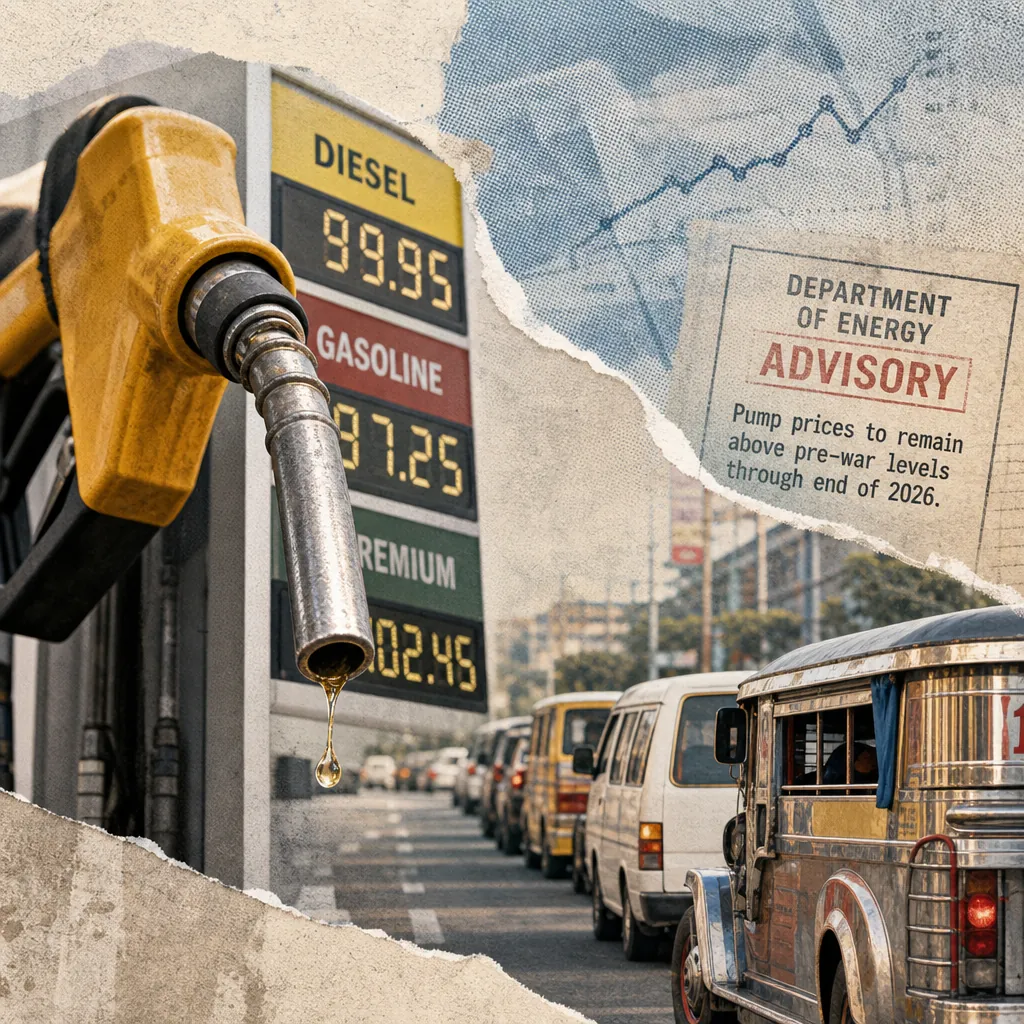
The excise cut landed the same day the Department of Energy (DOE) said pump prices are unlikely to return to pre-war levels within the year. Energy Secretary Sharon Garin said that with the peso weak against the dollar and fighting still ongoing in the Middle East, oil product prices could stay elevated until Christmas. "With the exchange rate and the situation in the Middle East, we expect that within the year, prices will not yet go down to pre-war levels. It will probably remain elevated until Christmas," Garin said.50 In a separate briefing, Garin noted that international crude had reached about $100 per barrel, driven by tensions around the Strait of Hormuz and attacks on Saudi oil infrastructure, and that price movements tracked developments in the conflict almost directly.63 The DOE's assessment was carried by Bombo Radyo Cauayan in Filipino, by Philstar in both its news and opinion sections, and by the Manila Times.9505563
The consumer consequences were already visible. Provincial bus operators have cut trips to avoid operating at a loss, with Alex Yague, a director of the Provincial Bus Operators Association of the Philippines (PBOAP), saying terminals are filling with parked buses that have no scheduled runs. "Lahat ng mga operator ngayon, nagbabawas na ng biyahe," Yague said in a GMA News "24 Oras" report. "Actually, makikita mo sa mga terminal nila, 'pag pumasok sa terminal ng bus, napakaraming bus na nakaparada doon na walang biyahe."23 The PBOAP is pressing the government to approve a fare increase, which it says is needed to keep services running; President Marcos Jr. had earlier suspended the hike, citing the burden on commuters.35 Transport group Pagkakaisa ng mga Samahan ng Tsuper at Operator Nationwide (PISTON) said it will hold a two-day transport strike on September 29 and 30, with president Mody Floranda estimating as many as 70,000 drivers and operators could join, alongside labor and urban poor groups and commuters. PISTON is demanding the removal of excise tax and value-added tax on petroleum products.58 The value-added tax is a consumption tax added at each stage of sale; PISTON argues that stripping both taxes from fuel would bring pump prices down.
Key themes
- Excise tax on LPG and kerosene removed by DOF resolution. Finance Secretary Frederick Go signed the measure during a Senate budget hearing, citing oil above $80 a barrel and Middle East tensions, and said it mirrors action taken during the first round of the Middle East war.1
- DOE says pump prices will stay elevated through Christmas. Energy Secretary Sharon Garin said pre-war price levels are unlikely to return within the year because of the weak peso and ongoing conflict, with international crude near $100 per barrel.5063
- Bus operators cut trips and seek a fare increase. PBOAP reported terminals filling with idle buses as operators avoid losses, and urged the government to approve a fare hike that President Marcos Jr. had suspended.2335
- PISTON announces a two-day transport strike for September 29–30. The group expects up to 70,000 drivers and operators to join and is demanding the removal of excise and value-added taxes on fuel.58
- The fuel crisis is spreading into food, festivals, and household budgets. Sinulog 2027 organizers in Cebu said inflation and fuel costs are complicating budget planning, and a Philstar opinion piece warned of a domino effect on fares, food, electricity, and nearly all goods.2455
- The government is also moving on agricultural smuggling and animal disease. The Bureau of Customs filed six criminal complaints against 14 individuals over misdeclared agricultural shipments, while Cebu tightened African Swine Fever containment and Ginatilan imposed livestock restrictions.575359
- Trade and investment news ran alongside the fuel story. The Philippines and the European Union reached a "substantial agreement" on a free trade deal targeted for signing in 2027, and the Philippines and Australia advanced a A$45-million grant to the project-selection stage.413
- A separate consumer-health tax proposal advanced. The Department of Health backed a Department of Finance plan to raise excise taxes on sweetened beverages, with rates possibly rising from P6 to P20 per liter and up to P40 per liter for high-fructose corn syrup products.56
How the narratives stack
Dominant: The fuel crisis and the government's response dominated the day's coverage across the items captured here. The excise removal, the DOE's Christmas warning, the bus trip cuts, and the PISTON strike announcement formed a single connected story about the cost of energy and who absorbs it. The excise resolution alone drew coverage from Inquirer Online, with an estimated advertising-equivalent value of ₱285,768 — the notional cost of buying the same space as paid advertising, not a measure of readership.1 The DOE's warning was carried by Philstar, Bombo Radyo Cauayan, and the Manila Times, and the bus operator story by GMA News Online and Head Topics.233550963 The breadth of coverage reflects how directly the story touches household budgets.
Counter-narrative: The government's excise cut is presented as relief, but the DOE's own forecast undercuts the idea that prices will fall meaningfully soon. Garin said prices will likely remain elevated until Christmas, and PISTON's strike demand for the removal of both excise and value-added taxes suggests the excise cut alone does not satisfy transport groups.5058 The counter-narrative is not that the excise cut is wrong but that it is partial: it addresses one tax on two products while the underlying drivers — the weak peso and Middle East conflict — remain outside the government's control.
Emerging: The spillover into non-energy sectors is becoming clearer. Sinulog 2027 organizers in Cebu said they are still determining the festival's budget amid inflation and higher fuel prices, with executive director Elmer "Jojo" Labella saying the foundation will meet every two weeks to deliberate on expenses. "It is actually an accepted fact that there is a crisis because of inflation. Fuel crisis, right? So, we're still getting a feel for it," Labella said.24 The sweetened beverage tax proposal is a separate emerging story about using excise taxes for public health, with the DOH supporting higher rates and the DOF estimating P25 billion to P34 billion in annual revenue for PhilHealth.56
Under-covered: The agricultural side of the cost-of-living story received less attention in the items captured here. The Bureau of Customs filed six criminal complaints against 14 individuals, including nine of its own personnel, over misdeclared white onions and carrots at the Port of Subic, and Cebu City culled 57 hogs in Barangay Toong after African Swine Fever was confirmed.5753 These stories matter because food prices are part of the same household budget squeeze as fuel, but they ran below the fuel coverage in this set.
Platform insights
Facebook: The fuel story generated the most visible engagement on Facebook through shares of news reports and opinion pieces. The Philstar opinion column "Oil price hike 'regalo hanggang Pasko?" framed the price increases as a holiday-season burden and asked whether the government has a clear plan, a framing that tends to travel well on the platform because it invites comment and sharing among commuters and household budget managers.55 The Bombo Radyo Cauayan report in Filipino also circulated among regional audiences, where fuel prices are felt most directly by jeepney and bus riders.9
X: The platform carried the political and policy reaction. Senator Christopher "Bong" Go's call for excise relief and Finance Secretary Frederick Go's announcement were the kind of short, quotable developments that spread quickly on X, where policy announcements are often relayed by journalists and advocacy accounts.1 PISTON's strike announcement also circulated on X among transport and labor accounts, with the September 29–30 dates and the 70,000-participant estimate serving as the key shareable details.58
Reddit: Discussion on Reddit focused on the practical math of the excise cut — how much a household actually saves on LPG and kerosene — and on skepticism about whether the savings would be passed through by retailers. The platform's communities tend to interrogate policy announcements with calculations and personal experience, and the fuel story fits that pattern: users compared the excise cut against the weekly price increases and questioned whether the DOE's Christmas forecast meant the relief would be temporary.50
YouTube: YouTube carried the broadcast segments, including the GMA News "24 Oras" report on bus operators cutting trips, which gave viewers the visual of parked buses in terminals.23 The platform's strength for this story is the on-the-ground footage that text reports cannot convey, and the bus terminal scenes were the most concrete illustration of the fuel crisis's effect on daily life.
Key voices and communities
Transport groups and operators: PBOAP and PISTON are the most directly affected industry voices. PBOAP's Alex Yague described the trip cuts in plain terms, and PISTON's Mody Floranda set the strike dates and the demand for excise and value-added tax removal.2358 These groups matter because they can disrupt commuting for hundreds of thousands of people, and their actions are the most immediate test of whether the government's excise cut is enough.
Government economic managers: Finance Secretary Frederick Go and Energy Secretary Sharon Garin are the two officials whose statements defined the day. Go's excise resolution is the government's main relief measure, and Garin's Christmas forecast is the government's own acknowledgment that relief will be limited.150 Their framing — that the government is acting but external factors constrain what it can do — is the official position that will be tested by the strike.
Senators and legislators: Senator Christopher "Bong" Go pushed for excise relief during the budget hearing, and the Senate finance subcommittee was the venue where the resolution was announced.1 The legislature's role matters because any broader tax changes, including the sweetened beverage tax proposal, require congressional action.56
Local government and festival organizers: Sinulog Foundation's Elmer "Jojo" Labella and Cebu Governor Pamela Baricuatro represent the local-level response, from festival budgeting to livestock restrictions and an overseas Filipino worker registry proposal.245962 These voices show how the fuel and inflation story reaches beyond Metro Manila into regional economies and cultural events.
Consumers and commuters: The Philstar opinion column and the Bombo Radyo report gave voice to the household perspective, framing the price increases as a holiday-season threat to family budgets.559 This group is the largest affected constituency and the one whose patience the strike will test.
Narrative streams
Excise removal on LPG and kerosene
Finance Secretary Frederick Go signed the resolution removing excise taxes on LPG and kerosene during the Senate finance subcommittee's budget hearing on Tuesday, saying the measure was similar to what the government did during the first round of the Middle East war.1 The timing was notable: Go announced the signing mid-hearing, after Senator Christopher "Bong" Go called for action to ease fuel costs. The excise tax is a per-unit levy built into the price of specific goods; removing it on LPG and kerosene reduces the cost of cooking gas and the fuel used by many households and small businesses. The resolution's coverage value in the items captured here was an estimated ₱285,768 in advertising-equivalent terms, reflecting the story's prominence in online news.1 For households that rely on LPG for cooking, the cut offers direct relief, but the DOE's forecast that prices will remain elevated until Christmas means the savings may be offset by continued increases in the base price.50 The read for the sector is that the excise cut is a targeted intervention that helps at the margin but does not change the underlying cost structure, and fuel retailers and distributors will face pressure to demonstrate that the savings reach consumers.
DOE warns of elevated prices through Christmas
Energy Secretary Sharon Garin said the government sees no indication that oil product prices will return to pre-war levels within the year, citing the weak peso and ongoing Middle East tensions. "With the exchange rate and the situation in the Middle East, we expect that within the year, prices will not yet go down to pre-war levels. It will probably remain elevated until Christmas," she said.50 In a separate briefing, Garin said international crude had reached about $100 per barrel, with price movements tracking developments in the conflict, including fighting around the Strait of Hormuz and attacks on Saudi oil infrastructure.63 The DOE's assessment was carried by Philstar, Bombo Radyo Cauayan, and the Manila Times, and the story's coverage value in this set was substantial, with the Philstar report alone carrying an estimated ₱171,157 in advertising-equivalent terms.50963 The read for the sector is that energy prices are now a structural constraint on household budgets and business costs for at least the rest of the year, and any planning that assumes a return to pre-war prices is unrealistic.
Bus operators cut trips and seek fare increase
Provincial bus operators have reduced the number of trips to avoid operating at a loss, with PBOAP director Alex Yague describing terminals filled with parked buses that have no scheduled runs.23 The operators are seeking a fare increase to sustain services, but President Marcos Jr. had suspended the hike, citing the burden on commuters.35 The standoff is a direct consequence of the fuel price increases: operators say the current fare structure does not cover the cost of fuel, and the government says commuters cannot absorb higher fares. The GMA News report carried the story on television and online, and Head Topics also covered it, with the GMA item carrying an estimated ₱422,436 in advertising-equivalent value in this set.2335 The read for the sector is that the bus industry is caught between fuel costs it cannot control and a fare ceiling it cannot raise, and the trip cuts are the visible result — fewer buses, longer waits, and reduced service for commuters who have no alternative.
PISTON announces two-day transport strike
PISTON will hold a two-day transport strike on September 29 and 30 to protest the continued increase in petroleum product prices, with president Mody Floranda estimating up to 70,000 drivers and operators could join, along with labor and urban poor groups and commuters.58 The group is demanding the removal of excise tax and value-added tax on petroleum products, arguing that both taxes inflate pump prices. The strike is the most disruptive action announced in the items captured here, and it follows weeks of successive price increases. The Philstar report on the strike carried an estimated ₱162,359 in advertising-equivalent value.58 The read for the sector is that the strike will test the government's ability to manage public frustration, and if it proceeds at the estimated scale, it will disrupt commuting for a large share of the workforce and increase pressure for broader tax relief.
Fuel costs reach festivals and local budgets
Sinulog Foundation Inc. (SFI) said it is still determining the cost of Sinulog 2027, which is a little over three months away, amid inflation and higher fuel prices. Executive Director Elmer "Jojo" Labella said the foundation's executive committee will meet every two weeks to deliberate on expenses covering activities, marketing, and operations. "There is no proposed budget yet. We're still working on it. We will be doing a lot of deliberations, especially on the budget that will be proposed for all aspects of expenses," Labella said. "It is actually an accepted fact that there is a crisis because of inflation. Fuel crisis, right? So, we're still getting a feel for it."24 The Manila Times report carried an estimated ₱412,432 in advertising-equivalent value.24 The read for the sector is that the fuel crisis is now affecting the planning and viability of major cultural events, and organizers of festivals and large gatherings will need to budget for higher transport, logistics, and materials costs.
Agricultural smuggling and animal disease enforcement
The Bureau of Customs filed six criminal complaints before the Department of Justice against 14 individuals, including nine of its own personnel, over the alleged misdeclaration of agricultural products at the Port of Subic. Customs Commissioner Ariel Nepomuceno personally led the filing, and the complaints cite violations of the Customs Modernization and Tariff Act (CMTA), a law that governs the importation, valuation, and classification of goods. The respondents include the owner and representatives of Berches Consumer Goods Trading and Customs officials responsible for examining and appraising the shipments, which involved misdeclared white onions and carrots.57 Separately, Cebu City culled 57 hogs in Barangay Toong after laboratory results confirmed African Swine Fever (ASF) infection, and the municipality of Ginatilan imposed livestock restrictions amid an ASF outbreak, following a provincial executive action by Cebu Governor Pamela Baricuatro that extended a ban on live hogs and pork products from affected areas for 45 days.5359 The read for the sector is that food supply enforcement is tightening on two fronts — smuggling and disease — and importers, brokers, and local livestock traders face higher compliance and enforcement risk.
Trade agreements advance on two fronts
The Philippines and the European Union reached a "substantial agreement" on a free trade agreement (FTA) targeted for signing in 2027, according to European Commission President Ursula von der Leyen, who said she spoke with President Ferdinand Marcos Jr. and agreed on the deal. The readout of the call said the two leaders "underlined the importance of working with likeminded partners across the world to ensure open, fair and predictable trade" amid geopolitical and geoeconomic challenges.41 A free trade agreement is a treaty that reduces tariffs and other barriers between signatories; an FTA with the EU would give Philippine exporters preferential access to one of the world's largest markets. Separately, the Philippines and Australia advanced a A$45-million grant to the project-selection stage, with priorities including renewable energy development, establishing a carbon market, developing the offshore wind industry, reducing red tape, and developing the digital economy. Australian Assistant Minister for Foreign Affairs and Trade Matt Thistlethwaite said the project is "very much about providing support for the Philippines government to deliver on their priorities."3 The BusinessWorld report on the EU FTA carried an estimated ₱673,796 in advertising-equivalent value, and the Inquirer report on the Australian grant carried an estimated ₱337,176.413 The read for the sector is that the Philippines is deepening trade and development ties with two major partners at a time of global trade tension, and exporters in renewable energy, digital services, and agriculture stand to gain from the agreements if they are finalized.
Conversation trajectory
September 29–30: PISTON transport strike. The strike is the most immediate trigger event. If it proceeds at the estimated scale of up to 70,000 drivers and operators, it will disrupt commuting and increase pressure on the government to expand tax relief beyond LPG and kerosene. Watch for the government's response in the days before the strike and whether the LTFRB issues a fare decision.5835
Next month: LTFRB recommendation on fare hike. The Land Transportation Franchising and Regulatory Board (LTFRB) is expected to make a recommendation on the bus fare increase next month, according to Head Topics. A favorable recommendation would ease pressure on operators; a rejection would likely lead to more trip cuts and possibly broader transport protests.35
Within the year: DOE price forecasts and weekly oil price adjustments. The DOE has said prices will remain elevated until Christmas, and the weekly price adjustments will continue to be the most visible signal of whether the situation is improving or worsening. Watch the exchange rate and Middle East developments, which Garin identified as the two main drivers.5063
2027: EU FTA signing and Australian grant project selection. The EU FTA is targeted for signing in 2027, and the Australian grant is in the scoping phase. Both are medium-term signals of the Philippines' trade and development direction, and progress or delays will indicate how the country is navigating global trade tensions.413
Ongoing: Sweetened beverage tax proposal. The DOH-backed proposal to raise excise taxes on sweetened beverages is at the legislative stage, with potential rates of P6 to P20 per liter and up to P40 per liter for high-fructose corn syrup products. The proposal could generate P25 billion to P34 billion annually for PhilHealth, but it faces industry opposition and requires congressional approval.56
Response guidance
For energy companies and fuel retailers: Prepare clear, plain-language explanations of how the excise removal on LPG and kerosene affects retail prices, and communicate the per-unit savings to customers. The DOE's forecast that prices will remain elevated until Christmas means consumers will be watching for any sign that the tax cut is being passed through, and retailers that fail to demonstrate the savings risk reputational damage.150
For transport operators and associations: Coordinate messaging around the fare increase request with concrete cost data — fuel costs per trip, operating margins, and the number of trips cut — to make the case to regulators and the public. The PBOAP's description of parked buses is a strong visual, and operators should be prepared to explain what the trip cuts mean for commuters in specific routes and regions.2335
For government communicators: Acknowledge the limits of the excise cut while explaining what it does achieve. The DOE's Christmas forecast is already public, so messaging that implies prices will fall soon will not be credible. Focus on the specific relief the excise cut provides and the timeline for any additional measures, including the LTFRB fare decision and any broader tax review.15035
For consumer and commuter groups: Document the practical effects of the fuel crisis — fare increases, trip cuts, and the cost of LPG and kerosene — with specific examples and figures. The Philstar opinion column's framing of the price increases as a holiday-season burden is likely to resonate, and groups that can put numbers to the household impact will have more influence in the debate.559
For agricultural importers and traders: Review compliance with the Customs Modernization and Tariff Act and ensure accurate declaration of goods, given the Bureau of Customs' filing of criminal complaints against importers, brokers, and its own personnel. The enforcement action signals that misdeclaration of agricultural products will be pursued criminally, and traders should also monitor ASF-related restrictions on livestock movement.575359
For festival and event organizers: Build fuel and inflation contingencies into budgets early, as the Sinulog Foundation is doing with biweekly deliberations. Events that depend on transport, logistics, and materials will face higher costs, and organizers should communicate any changes to schedules or budgets well in advance.24
See the full picture behind today's signals.
This report draws from Media Meter's MediaWatch, our real-time monitoring engine tracking 2,470+ Philippine sources across print, broadcast, digital, and social. Explore how the platform turns raw coverage into decision-grade intelligence, then see how it's configured for teams like yours — whether you're in PR agencies, corporate comms, government, or marketing.
Want more? Browse our Report Library for sector and crisis intelligence, or request a demo and we'll have your brand set up before the call.
Want this kind of intelligence on your brand?
This brief is built on the same MediaWatch methodology that runs continuously across every brand we monitor. See your competitive landscape, Impact Score, and narrative trajectory in a 30-minute demo.