NSCR Full Operations Slip to 2033 as Senate Flags Rail Delays
The Economy and Development Council moved the North-South Commuter Railway's full commercial operations from January 2032 to the third quarter of 2033, citing procurement problems, right-of-way disputes and tighter spending. Senators inspecting the Metro Manila Subway and the railway's Valenzuela station pressed for faster delivery, while Toyota Motor Philippines projected lower vehicle output for 2026.

The Conversation
The North-South Commuter Railway will not run end to end until the third quarter of 2033, nearly a year and a half later than the January 2032 target the government had been working to, after the Economy and Development Council approved a revised timetable at its 11th meeting on Wednesday, September 16, at Malacañang4554. Palace press officer Claire Castro told a briefing the following day that the change reflected "the need for fiscal prudence and careful management of public funds, challenges in the procurement process, and right-of-way issues"54. The railway, a 147-kilometer line that will link Clark International Airport in Pampanga to Calamba in Laguna, is designed to cut travel time between those two points from about four hours to two47.
The delay drew the widest coverage of any single development in the items reviewed here, appearing in at least four separate reports across Inquirer Online, Inquirer Plus and BusinessWorld Online, with the largest single item carrying an estimated ₱403,464 in advertising-equivalent value — the notional cost of buying the same space as paid advertising, not a count of readers454754. The same council meeting also approved changes to the operations and maintenance contract for the railway and to the Mactan-Cebu International Airport public-private partnership, revisions meant to attract more bidders23.
On the same day, Senate finance committee chair JV Ejercito inspected the railway's West Valenzuela Station and its Operations Control Center, the Metro Manila Subway depot and Quirino Station, and the Philippine Railway Institute, saying he was making sure funding was used properly so that "there will be no more delays"2. The two stories sit awkwardly together: a senator promising no further slippage, and a council formally approving one. Separately, Toyota Motor Philippines said its Santa Rosa assembly plant may build close to 60,000 vehicles in 2026, down from a record 63,803 in 2025, with production already 10 percent lower in the first eight months of the year at 38,221 units against 42,469 a year earlier475.
Key themes
- NSCR full operations move to the third quarter of 2033. The Economy and Development Council approved a revised schedule that pushes complete Clark-to-Calamba service back from January 2032, with partial operations from Valenzuela to Malolos now set for December 2027 and Malolos to Clark in the fourth quarter of 20284754.
- Procurement, right-of-way and budget discipline are the stated causes. The government cited difficulty attracting bidders, land acquisition problems and tighter spending rather than construction failure4554.
- A senator promises no further slippage on the same day the delay is confirmed. JV Ejercito inspected the railway and the Metro Manila Subway and said he was ensuring funds are used properly to avoid disruptions2.
- The railway's operations contract is being reworked to draw more bidders. The council approved changes to the terms of the ₱229.32-billion operations and maintenance contract, which had drawn interest from Japanese, French and local firms23.
- Toyota expects lower Philippine output in 2026. The automaker projects close to 60,000 units against 63,803 last year, blaming softer demand tied to higher oil prices from Middle East tensions45875.
- The Philippine Stock Exchange Index rebounded but stayed below 6,000. The benchmark rose 0.70 percent, or 41.70 points, to 5,958.64, recovering from a two-day slide but not reclaiming the level it lost earlier in the week313484.
- Ayala Land's Tarlac industrial park is nearly fully leased. Most lots at the 32-hectare Cresendo industrial park are taken, with the development expected to generate up to 2,000 jobs11.
- Filinvest Land is dissolving three subsidiaries. The property developer filed to shorten the corporate terms of two marketing support units and an unopened mall company, saying operations will not be disrupted107180.
How the narratives stack
Dominant. The railway delay is the day's clearest infrastructure story, and it is dominant within the items captured here rather than necessarily across all coverage: it appears in four separate reports, including the two longest treatments of the subject, and carries the highest single coverage value in the set at an estimated ₱403,464 in advertising-equivalent terms454754. The substance is a schedule change with a named cause and a named approver — the Economy and Development Council, the body chaired by President Ferdinand Marcos Jr. that coordinates the country's major development projects. Its decision converts a flagship promise into a longer timeline, and the government's own explanation ties the slippage to procurement and land acquisition rather than to construction itself.
Counter-narrative. Ejercito's inspection tour and his commitment to prevent further delays run against the council's decision, and the two were reported within hours of each other2. The senator's framing is about fund use and operational readiness; the council's is about fiscal prudence and bidding. Both can be true, but they point in different directions for anyone trying to judge whether 2033 will hold. The same council meeting that extended the timeline also approved revisions to the railway's operations and maintenance contract specifically to attract more bidders, which suggests the government sees the procurement problem as fixable rather than structural23.
Emerging. Two corporate signals point to where private capital is moving. Ayala Land says most lots at its 32-hectare industrial park inside the 290-hectare Cresendo estate in Tarlac City are already leased to manufacturing, logistics and distribution companies, with up to 2,000 jobs expected as tenants establish operations11. Filinvest Land, meanwhile, is dissolving three wholly owned subsidiaries — two marketing support companies and Filinvest Lifemalls Mimosa, which never began commercial operations — while keeping the Mimosa Lifestyle Mall project going through a different unit107180. One is expansion, the other is housekeeping, and both are routine corporate moves rather than signs of stress.
Under-covered. The clearest under-covered item in this set is the Development Bank of the Philippines' disclosure that ₱4.1 billion in loans to jeepney operators who shifted to electric units under the Public Transport Modernization Program are past due — 55 percent of the ₱7.5 billion the state-run bank issued for the program, affecting 2,753 of 3,249 financed units86. The Public Transport Modernization Program is the government's effort to replace aging jeepneys with newer, lower-emission vehicles, and the bank loans were the mechanism that let operators afford them. A default rate above half on a state-backed lending program is a direct measure of whether the shift is financially sustainable for the people who were asked to make it, and it received a single report in this set.
Platform insights
The monitoring writeup for this window did not include social platform data, so no engagement figures — likes, shares, views or comments — are available for the day's posts. What follows is drawn from the news items captured, not from social activity.
- Facebook. The only social platform activity visible in the captured items is a Facebook and TikTok post by a vendor known as Inday Panadera Gelyn, which described her experience of alleged inappropriate treatment at the Public Attorneys Office district office in Meycauayan, Bulacan, and prompted the agency to place its staff there under investigation44. The post is notable less for its volume than for its effect: a single citizen's account, published on two platforms, triggered a formal inquiry by a national agency within a day.
- X. No posts from X appear in the items reviewed.
- Reddit. No posts from Reddit appear in the items reviewed.
- YouTube. No posts from YouTube appear in the items reviewed.
Key voices and communities
National economic managers. The Economy and Development Council, chaired by President Marcos, is the body that approved the railway's revised timeline and the contract changes4554. Its decisions set the official schedule that contractors, commuters and lenders plan around, which is why a single meeting reshaped the day's infrastructure coverage.
The Senate finance committee. Ejercito's inspection tour and his public commitment to prevent delays put the legislature in the position of overseer2. Because the Senate approves the budgets these projects depend on, his framing — that funding must be used properly — carries weight beyond the site visit itself.
Toyota Motor Philippines. Senior vice-president Sherwin Chua-Lim's projection of lower 2026 output, tied to oil prices and softer demand, makes the country's largest automaker the clearest corporate voice on consumer strain in this set45875. The company also used the same briefing to press for a regulatory review of ride-hailing slot allocations that favor battery and plug-in hybrid vehicles over conventional ones58.
State lenders and transport cooperatives. The Development Bank of the Philippines' disclosure of ₱4.1 billion in past-due jeepney modernization loans puts the bank and the cooperatives that borrowed from it at the center of a question about who absorbs the cost of the transition86.
Local government units and regional economies. Iloilo province, the town of Mina and Passi City all reached the finals of the Philippine Chamber of Commerce and Industry's Most Business-Friendly Local Government Unit Awards, with Governor Arthur Defensor Jr. scheduled to present the provincial entry in Manila on September 231. The awards, run by the country's largest business membership organization, are a signal investors watch when comparing where to put money outside the capital.
Narrative streams
The railway's new timeline and what it costs commuters
The North-South Commuter Railway's full commercial operations from Clark to Calamba are now targeted for the third quarter of 2033, against a previous target of January 20324754. The revised schedule keeps partial service on a shorter horizon: Valenzuela to Malolos in December 2027, Malolos to Clark in the fourth quarter of 2028, and the Clark-Solis-Alabang to Calamba section in the fourth quarter of 203147. The railway is a flagship project of the administration's infrastructure program and is being built with Japanese financing; its 147-kilometer span is meant to connect the airport in Pampanga to Laguna and cut a four-hour trip to two47.
Castro's explanation named three causes: fiscal prudence and careful management of public funds, procurement challenges, and right-of-way issues54. Right-of-way is the legal process of acquiring the land a project needs, and it is a common source of delay for long linear infrastructure because it involves negotiating with thousands of property owners along a route. Procurement challenges, in this context, refer to the difficulty of attracting qualified bidders for the contract to operate and maintain the finished line. The council separately approved changes to the parameters and terms of that ₱229.32-billion operations and maintenance contract to draw more bidders, and the Department of Transportation had said in July it expected bids by end-September, with Japanese firms, French operators and local companies showing interest23.
For commuters between Central Luzon and Metro Manila, the practical effect is that the relief the railway promises — a two-hour trip where four hours is now normal — arrives later than advertised, and the interim burden falls on road transport that is already congested. For the contractors and operators bidding on the maintenance contract, the revised terms are the more immediate development, because they determine whether the project is attractive enough to draw the competition the government wants. For the government, the risk is credibility: each schedule change makes the next target harder to defend, which is why Ejercito's same-day pledge of "no more delays" matters as a political commitment even though it cannot bind the procurement process2.
The Senate's inspection and the pressure to deliver
Ejercito and Transportation Secretary Giovanni Lopez toured the railway's West Valenzuela Station and Operations Control Center, the Metro Manila Subway depot and Quirino Station, and the Philippine Railway Institute2. The Metro Manila Subway is the country's first underground rail line, and the inspection was part of a media tour of Japan-funded infrastructure projects2. Ejercito said he was making sure funding for these projects is used properly to ensure there are no disruptions that might hinder operations, and that the aim is to have both the railway and the subway operational as soon as possible2.
The subway's progress is also reshaping private development along its route. Market! Market! in Bonifacio Global City is set to host the Bonifacio Global City Station, reviving a mixed-use concept from Ayala Land's original 2000 master plan for the area, with the Bonifacio Global City development authority's transit-oriented plans repurposing part of the mall's Central Plaza for the station35. Transit-oriented development means concentrating homes, offices and shops around stations so that people can move without depending on cars, and it is the mechanism by which a rail line changes land values and daily routines well before the trains run. For the mall's owner, the station converts a retail property into an intermodal gateway linking BGC to gateways including the Ninoy Aquino International Airport35.
For the sector, the read is that the political pressure on rail delivery is now running on two tracks at once: the Senate is publicly auditing spending and timelines, while the economic managers are formally extending them. Contractors and operators should expect closer scrutiny of milestones and disbursements, and developers along the routes should expect station locations to keep driving commercial planning regardless of the schedule slips.
Toyota's output cut and the cost of fuel
Toyota Motor Philippines expects to build close to 60,000 vehicles in 2026, down from the record 63,803 it produced in 2025, with senior vice-president Sherwin Chua-Lim citing weak domestic demand and elevated fuel prices475. The decline is already visible in the data: production fell 10 percent in the first eight months of the year to 38,221 units from 42,469 in the same period last year475. The Vios accounted for 48 percent of that output at 18,321 units, the Tamaraw for 33 percent at 12,468 units, and the Innova for 19 percent at 7,432 units75. The company assembles those three models at its 82-hectare Toyota Special Economic Zone in Santa Rosa, Laguna75.
The stated cause is higher oil prices stemming from the Middle East conflict, which the company says has weighed on demand for gasoline-powered models75. That connects the Philippine assembly line to a conflict thousands of kilometers away: when fuel gets more expensive, buyers delay purchases of the vehicles that consume it, and the plant that builds them adjusts its schedule. Toyota also used the same briefing to urge a regulatory review of ride-hailing slot allocations that favor battery and plug-in hybrid electric vehicles over conventional internal-combustion models, arguing the rules disadvantage the vehicles it builds locally58.
For the sector, the read is that the domestic auto market's recovery now depends on fuel prices as much as on consumer confidence, and that the policy fight over which vehicle types get access to ride-hailing fleets will shape which models Philippine plants keep building. Suppliers to the Santa Rosa plant, and the workers whose shifts track its output, face a year of lower volume than 2025.
The peso cost of the jeepney modernization loans
The Development Bank of the Philippines reported that ₱4.1 billion in loans to jeepney operators who shifted to electric units under the Public Transport Modernization Program are past due, equal to 55 percent of the ₱7.5 billion the bank issued for the program86. The past-due loans affect 2,753 of the 3,249 units financed86. The modernization program is the government's effort to replace aging jeepneys with newer, lower-emission vehicles, and the bank loans were how operators were expected to pay for units that cost far more than the secondhand vehicles they replaced.
A default rate above half on a state-backed lending program is a direct measure of whether the economics work for the borrowers. Jeepney operators run on thin daily margins, and a loan sized for a new vehicle only services if ridership and fares hold up. When more than half the financed units fall behind, the question shifts from whether operators want to modernize to whether the fare structure and route economics let them. The Land Bank of the Philippines is the other state lender involved in the program86.
For the sector, the read is that the modernization program's financing model is under strain, and that the cost of resolving it — through restructuring, subsidy, or write-offs — will land on the state banks and, ultimately, on the public balance sheet. Transport cooperatives that took on the loans face the immediate pressure, and any change to how the debts are treated will set the terms for the next wave of operators deciding whether to convert.
Capital moves into Tarlac and out of Filinvest's support units
Ayala Land says most lots at its 32-hectare industrial park in Tarlac City are already leased to manufacturing, logistics and distribution companies, with the development expected to generate up to 2,000 jobs as more businesses establish operations11. The park forms part of the 290-hectare Cresendo estate, a mixed-use community combining industrial, commercial, institutional and residential components, designed for light-to-medium, non-polluting industries11. The estate is expected to accommodate about 54,000 residents11. Rica Balbido, senior project development head of Cresendo, said the estate is "set to grow with the community around it"11.
Filinvest Land, by contrast, is dissolving three wholly owned subsidiaries — Proleads Philippines, Realpros Philippines and Filinvest Lifemalls Mimosa — after filing applications with the Securities and Exchange Commission on September 16 to shorten their corporate terms107180. The first two provided marketing and administrative support for Filinvest's real estate projects, and their work may be taken over by other marketing units; the third never began commercial operations, and the Mimosa Lifestyle Mall project in Clark will continue through a different subsidiary1080. The company said the move will not have a material impact on operations71.
For the sector, the read is that industrial land in Central Luzon is filling up on the strength of manufacturing and logistics demand, while listed developers are pruning corporate structures that no longer earn their keep. The two moves point in the same direction: capital is being concentrated where it produces revenue, and idle or redundant entities are being wound down.
The market's partial recovery and the Fed's rate increase
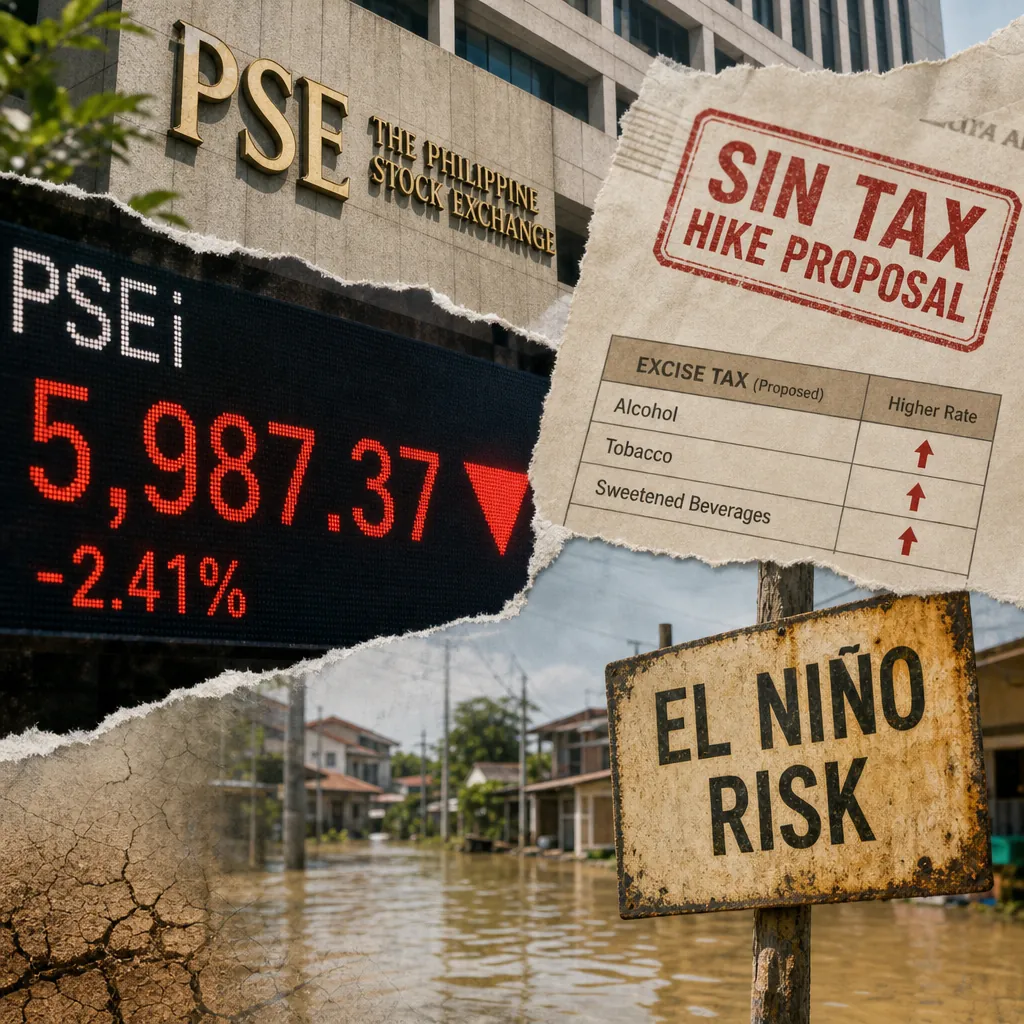
The Philippine Stock Exchange Index rose 0.70 percent, or 41.70 points, to close at 5,958.64 on Thursday, rebounding from two straight sessions of losses but failing to reclaim the 6,000 level313484. The index had fallen 1.51 percent in the previous session34. Holding firms led the advance, up 1.45 percent, powered by a 5.05-percent gain in Ayala Corp. to ₱508 and a 2.20-percent rise in SM Investments Corp. to ₱53534. SM Investments was the most actively traded stock, with 32.29 million shares changing hands for ₱16.84 billion, and total value turnover reached ₱25.50 billion34.
The rebound followed the US Federal Reserve's decision to raise interest rates by 25 basis points — its first increase in three years — which Michael Ricafort, chief economist at Rizal Commercial Banking Corp., said investors took positively as a sign the Fed is "serious about delivering on the price stability objective"63. A basis point is one-hundredth of a percentage point. Philstocks Financial research manager Japhet Tantiangco attributed the day's gain to investors picking up battered shares after the two-day decline, while Luis Limlingan of Regina Capital said sentiment remained measured amid market uncertainties and the Fed move31.
For the sector, the read is that Philippine equities are trading on external signals — US rate policy and oil prices — more than on domestic earnings, and that the 6,000 level has become a psychological marker that the market has not been able to hold. Investors with exposure to rate-sensitive sectors should expect the Fed's path, not local news, to set the tone in the near term.
Conversation trajectory
Watch the NSCR operations and maintenance bids through end-September. The Department of Transportation had said in July it expected bids for the ₱229.32-billion contract by end-September, and the council has now revised the terms to attract more competition23. If bids arrive on schedule, the procurement problem the government cited as a cause of the delay is at least partly resolved; if the deadline slips again, the 2033 target becomes harder to defend. Observation window: the next two to three weeks.
Watch the Senate budget hearings for the transport and agriculture agencies. Ejercito's inspection and Pangilinan's questioning of the National Irrigation Administration show the finance committee using the budget process to press agencies on delivery268. Expect further hearings to surface project-level detail on rail timelines and irrigation spending. Observation window: the remaining weeks of the 2027 budget deliberations.
Watch fuel prices and their pass-through to vehicle demand. Toyota's output projection rests on oil prices staying elevated because of Middle East tensions75. If Brent crude continues to ease — it had fallen to around the level cited in market reports — the demand picture for gasoline-powered vehicles could improve, and Toyota's 60,000-unit estimate could prove conservative. Observation window: the fourth quarter of 2026, as monthly production and sales data are released.
Watch how the state banks handle the past-due jeepney loans. The Development Bank of the Philippines has ₱4.1 billion in arrears on its modernization lending, and the Land Bank of the Philippines is also exposed86. Any announced restructuring, subsidy or write-off would set the template for the rest of the program. Observation window: the next quarter, as banks report and the transport department reviews the program.
Trigger events. The September 23 presentation of Iloilo's entry in the Philippine Chamber of Commerce and Industry's business-friendly awards will keep regional investment climate in the news1. The Fed's next rate-setting meeting will determine whether the second increase policymakers signaled materializes, which would feed directly into Philippine market sentiment2263. And the scheduled power interruption in Iloilo City on September 19, tied to the National Grid Corporation of the Philippines' substation upgrade, will test how well utilities communicate planned outages to households and businesses46.
Response guidance
On infrastructure timelines, lead with the schedule and the cause. When a project slips, the useful message names the new date, the reason and what is being done about it. The government's own framing — procurement, right-of-way, fiscal prudence — is specific enough to be checked against future milestones, and communicators should hold to that level of specificity rather than offering reassurance without dates4554.
On the jeepney modernization loans, address affordability directly. The ₱4.1 billion in past-due loans is a fact about borrowers' capacity, not their willingness86. Messages that treat the arrears as a discipline problem will not land with operators who cannot service loans sized for vehicles their routes do not support. Restructuring terms, if any, should be explained in plain language about what operators will pay and when.
On fuel-driven demand shifts, connect the global to the local. Toyota's output cut traces to oil prices set by a conflict abroad75. Communicators in manufacturing and retail should expect consumers to make the same connection and should be ready to explain how their own costs and prices respond to fuel, rather than treating it as background.
On market volatility, avoid predicting the index. The rebound to 5,958.64 left the market below 6,000, and analysts attributed the move to bargain hunting and external rate signals rather than to domestic fundamentals3163. Guidance that treats a single day's gain as a trend will read as noise; guidance that explains the Fed's role and the peso's exposure will hold up.
On regional investment stories, use the awards and the industrial parks as evidence. Iloilo's finals placement and Ayala Land's leased-out Tarlac park are concrete, checkable signals about where business activity is concentrating outside Metro Manila111. Communicators promoting regional locations should cite the specific mechanisms — awards criteria, lease commitments, job projections — rather than general claims about growth.
On citizen complaints that go public, respond within the day. The Public Attorneys Office opened an investigation into its Meycauayan staff after a single Facebook and TikTok post described alleged inappropriate treatment of a client44. The agency's response — acknowledging the concern, ordering an inquiry and issuing notices to explain — is the template: acknowledge, investigate, and give the people involved a chance to respond, without disputing the complainant's account in public before the facts are established.
See the full picture behind today's signals.
This report draws from Media Meter's MediaWatch, our real-time monitoring engine tracking 2,470+ Philippine sources across print, broadcast, digital, and social. Explore how the platform turns raw coverage into decision-grade intelligence, then see how it's configured for teams like yours — whether you're in PR agencies, corporate comms, government, or marketing.
Want more? Browse our Report Library for sector and crisis intelligence, or request a demo and we'll have your brand set up before the call.
Want this kind of intelligence on your brand?
This brief is built on the same MediaWatch methodology that runs continuously across every brand we monitor. See your competitive landscape, Impact Score, and narrative trajectory in a 30-minute demo.