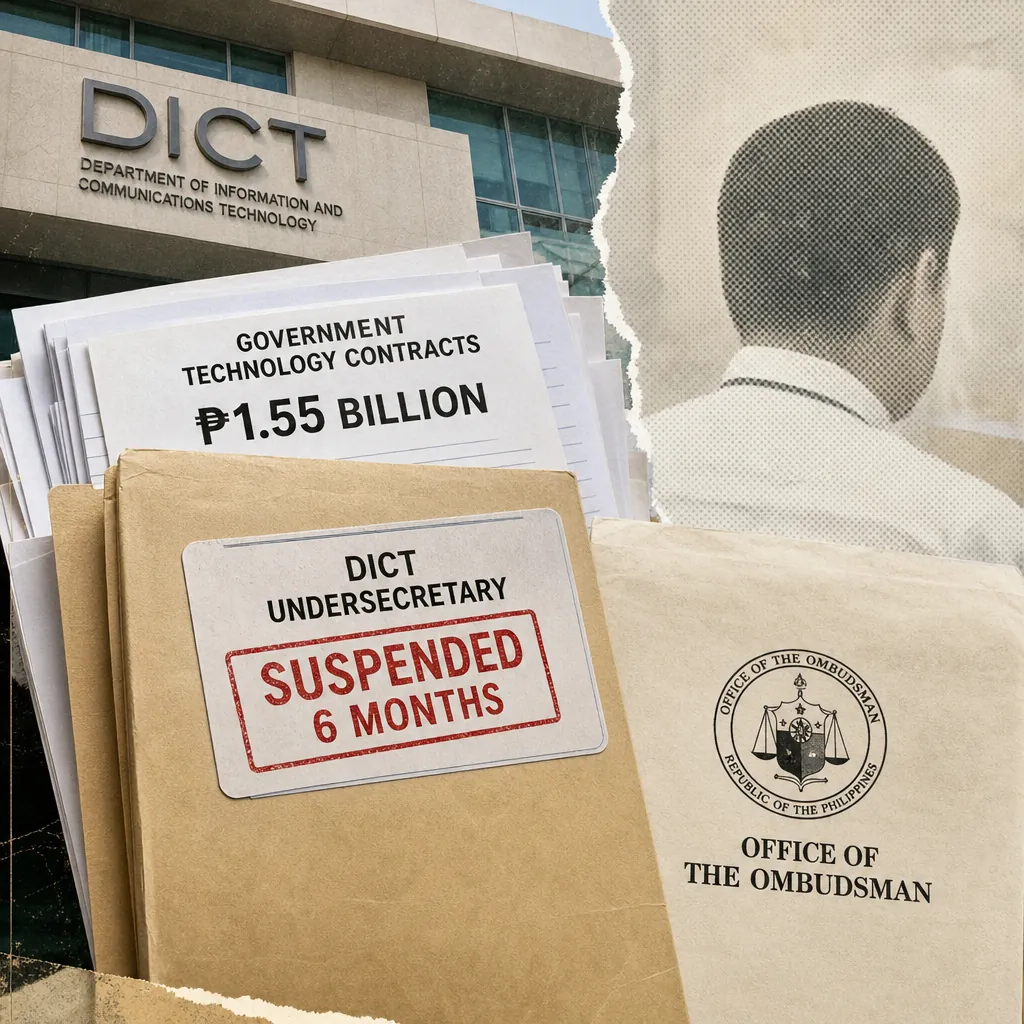
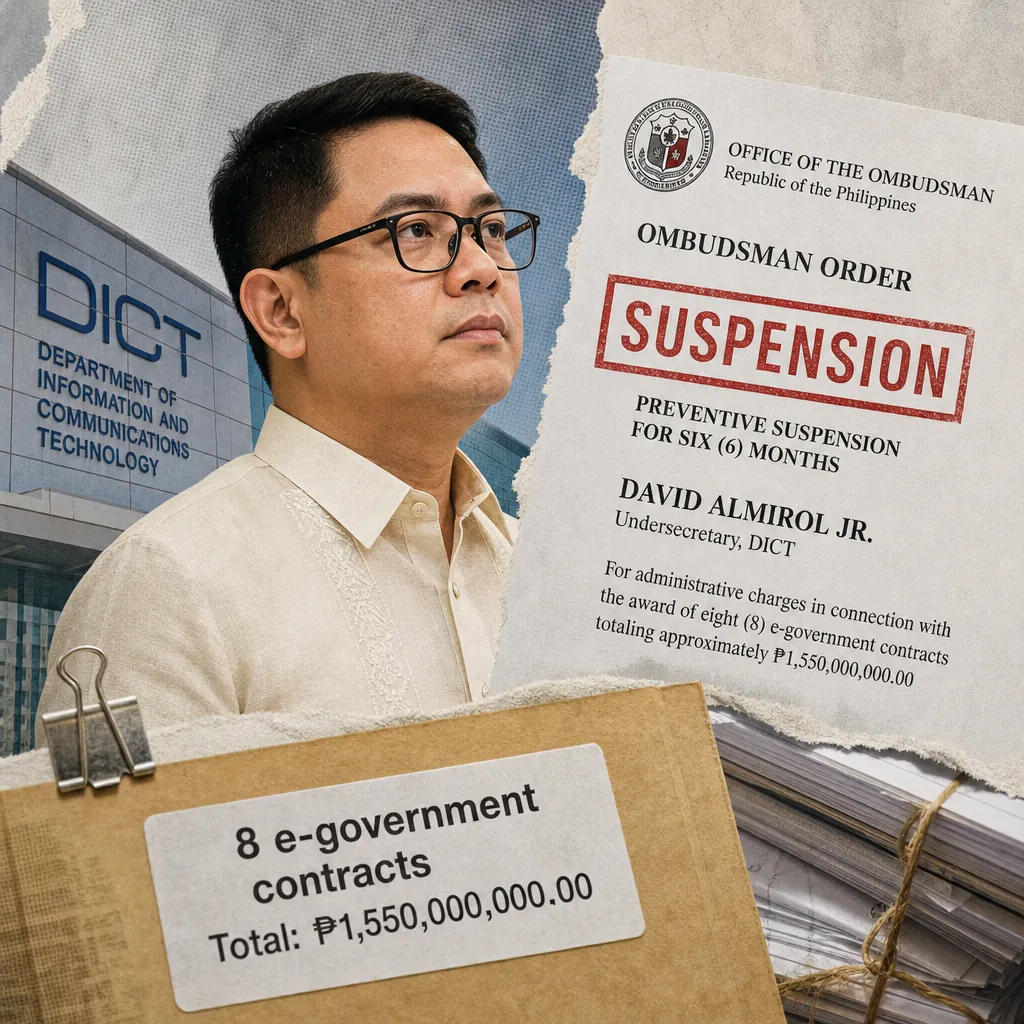
Ombudsman suspends DICT's Almirol over ₱1.55B contracts
The Office of the Ombudsman placed DICT Undersecretary David Almirol Jr. on a six-month preventive suspension without pay over alleged conflict of interest in ₱1.55 billion in e-government contracts, and Almirol denied wrongdoing the next day. The same week, the CICC opened a scam-verification website and the NTC tested mobile networks in Manila's University Belt.
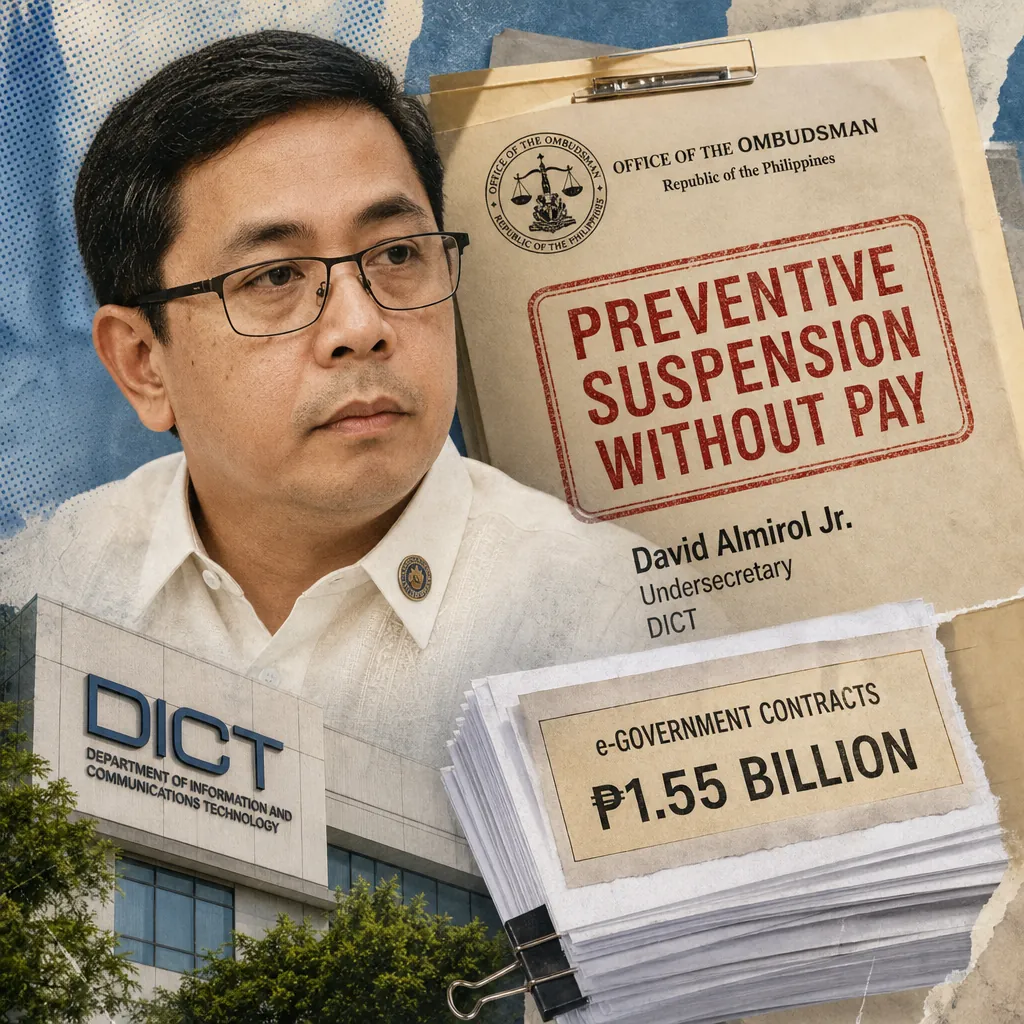
The Office of the Ombudsman ordered a six-month preventive suspension without pay for David Almirol Jr., the Department of Information and Communications Technology (DICT) undersecretary for e-government, on October 21, over alleged conflict of interest in about ₱1.55 billion in government contracts awarded to companies with financial ties to the technology firm he founded56. Almirol answered the next day with a statement posted to his Facebook page and an interview on DZRH's Dos Por Dos: "I firmly maintain that there was no conflict of interest," he said, and "No DICT contract was awarded to Multisys"3310.
The order drew coverage across national broadsheets, television and radio, and it was the item that travelled furthest of anything in the day's technology news. The Philippine Daily Inquirer, The Philippine Star, GMA Network, ABS-CBN, Rappler, the Manila Times and the Manila Bulletin all led on the suspension and its stated basis171819. Regional and free-to-air broadcasters — Bombo Radyo, NET25, PTV, DZMM Teleradyo, DZRH, RMN and Bilyonaryo News Channel — carried it in Filipino and in short bulletin form, most repeating the peso figure and the six-month, no-pay terms416. The Inquirer's follow-up on Almirol's defense ran under the headline "Almirol: eGov deals went to PLDT firms serving govt before me" and was syndicated on MSN, which put the story in front of an audience well beyond Philippine news sites826.
Public reaction on Facebook ran toward mockery rather than anger. One NET25 post drew 81 laughing reactions and 23 shares against two angry reactions; a separate NET25 post drew 114 likes and 60 comments136. The single most-commented post in the set came from a news page that summarized the Ombudsman's finding and asked why a case that began with a DICT internal audit in June 2025 produced an order only in October 2026, and who is running e-government in the meantime; it drew 58 comments5.
Elsewhere in the day's technology coverage, the Cybercrime Investigation and Coordinating Center (CICC) opened a free verification website called ScamSafe on October 22, letting Filipinos check suspicious links, phone numbers, email addresses and usernames before transacting online27. The National Telecommunications Commission (NTC) ran mobile network quality tests in Manila's University Belt, comparing DITO Telecommunity, Globe Telecom and Smart Communications against its service standards. The DICT's new secretary, Robert Joseph De Claro, signed a data-sharing agreement with the Social Security System (SSS) aimed at extending social protection to freelancers and digital professionals. And a DICT free Wi-Fi service was reported offline at several hospitals and government offices, with no public comment from the agency on when it would return1.
Key themes
- The Ombudsman suspended a DICT undersecretary for six months without pay over ₱1.55 billion in contracts. The order covers eight DICT contracts awarded between November 2023 and May 2025 to companies with financial links to Multisys Technologies Corporation, the firm Almirol founded in 2010 and led as president and chief executive until he joined government in August 202245.
- Almirol's defense rests on a September 2022 divestment and on PLDT being the actual contract holder. He says he sold his Multisys shares on September 1, 2022, inside the 60-day window after taking office, and that the contracts went to PLDT group companies that had served government before his tenure7815.
- The gap between the June 2025 internal audit and the October 2026 order drew the most comments. A news page's post asking why the decision took more than a year, and who is running e-government in the meantime, drew 58 comments, the highest count in the set5.
- Facebook reaction skewed to laughter rather than anger. Two NET25 posts carried 81 laughing reactions against two angry ones, and 114 likes with 60 comments respectively, a pattern of ridicule rather than outrage136.
- The CICC opened ScamSafe, a free tool for checking links, numbers, emails and usernames before transacting. The launch post on the agency's Facebook page drew one comment, one share and no reaction icons, a small response to a consumer-protection tool27.
- Phishing accounts for nearly 40 percent of reported banking fraud cases, with voice scams the largest single method. Bank of the Philippine Islands (BPI) fraud-risk head Jon Paz said at the bank's Cyber Awareness Month forum that social engineering remains the main route into victims' accounts, citing Bankers Association of the Philippines data showing voice phishing at more than 21 percent of reported incidents50.
- The NTC tested DITO, Globe and Smart in the University Belt against its quality-of-service standards. Commissioner Ella Blanca Lopez said the tests, run under stationary and moving conditions, will let the commission compare the three networks under identical conditions.
- The DICT signed a data-sharing deal with the SSS to extend social protection to freelancers and digital professionals. Secretary De Claro and SSS president Victor Alfonso Limlingan Jr. signed the memorandum of understanding and data-sharing agreement, which the agency framed around connecting online workers to social security coverage.
How the narratives stack
Dominant. The Almirol suspension is the day's dominant technology story by breadth of coverage and by public response. It ran in every major national outlet, in Filipino and English, on television, radio, YouTube and Facebook, and it produced the largest comment counts in the captured set171845. The dominance is real within the items reviewed here, and it is reinforced by the story's own facts: a named official, a peso figure in the billions, a regulator's order, and a direct denial the next day. The coverage value attached to individual items in this set is substantial — the Inquirer's follow-up alone carried an estimated ₱414,288 in advertising-equivalent value, the cost of buying the same space as paid advertising, and the Philippine Star's report carried an estimated ₱293,4083318. Those figures measure the cost of the coverage's space, not how many people read it.
Counter-narrative. Almirol's own account is the counter-narrative, and it is specific. He says he divested on September 1, 2022, within the 60-day deadline set for officials to give up business interests, and that delays in corporate filings at the Securities and Exchange Commission, which registers corporations, should not be read as the date of sale715. He says the contracts were competitively bid and went to PLDT, which he describes as the majority owner of Multisys, and that those PLDT companies were already serving government before he arrived810. He also suggested the complaint may be connected to his department's anti-corruption steps, including simplifying ICT projects and building in-house systems to reduce reliance on outside contractors10. A preventive suspension is not a finding of guilt, and the administrative cases remain pending5.
Emerging. Two threads sit below the suspension story. The first is consumer fraud prevention: the CICC's ScamSafe launch, its holiday-season scam warning, and BPI's disclosure that phishing accounts for nearly 40 percent of reported banking fraud cases together describe a government and banking sector converging on the same message — verify before you transact273050. The second is connectivity quality and access: the NTC's University Belt tests, the DICT–SSS agreement on freelancer coverage, and the reported outage of DICT free Wi-Fi at hospitals and government offices all concern whether the state's digital infrastructure and programs are delivering what they promise1.
Under-covered. The free Wi-Fi outage is the story that placed lowest. It was raised as an exclusive report on the current-affairs program #Agenda, and the report did not say how many sites lost the connection or when service would return, and the DICT has not publicly commented1. For a program meant to widen internet access, an outage at hospitals and government offices with no published restoration timetable is a delivery gap that received a fraction of the attention given to the suspension. The CICC's warning that NVE — a term the balita.com report did not define — is a "clear and present danger" to young people also drew no visible response from any group or official in the following days28.
Platform insights
- Facebook. Facebook carried both the news distribution and the public reaction. News pages posted the suspension in Filipino and English, and the reaction clustered on those posts: 81 laughing reactions and 23 shares on one NET25 item, 114 likes and 60 comments on another, and 58 comments on a post that questioned the timing of the Ombudsman's decision1365. The CICC's ScamSafe launch post, by contrast, drew one comment, one share and no reaction icons, showing how unevenly attention lands on agency announcements compared with controversy27.
- YouTube. Broadcasters used YouTube to carry full bulletins and interviews. DZRH's Dos Por Dos interview with Almirol is where his most detailed defense was aired, including his statement that PLDT now holds the majority ownership of Multisys10. PTV's interview with CICC Executive Director Aboy Paraiso on the Cybercrime Council's coordination efforts drew 89 views and no comments29. A Bilyonaryo News Channel report on alleged Chinese state-sponsored cyberattacks, citing Microsoft's Digital Defense Report, drew 9,304 views, 55 likes and 14 comments — the largest YouTube audience in the captured set31.
- X. The Inquirer's account posted the Almirol headline to X, which is where the story's framing reached journalists and policy watchers in headline form before the full articles circulated12.
Key voices and communities
National newsrooms. The Inquirer, Philippine Star, GMA, ABS-CBN, Rappler, Manila Times and Manila Bulletin set the terms of the suspension story for the widest audience, and their follow-ups are where Almirol's rebuttal reached the public171819. Their framing moved quickly from the order itself to the official's response, which is why the second-day story was the denial rather than the suspension.
Regional broadcasters. Bombo Radyo, NET25, PTV, DZMM Teleradyo, DZRH, RMN, SMNI and Bilyonaryo carried the story in Filipino to audiences outside Metro Manila, and RMN's Facebook report supplied the most detailed public breakdown of what the eight contracts covered: information technology consultancy, e-government application deployment, web-based messaging, cloud infrastructure, data center colocation and software subscriptions4.
Facebook commenters on news pages. This group drove the visible public response, and its tone was ridicule. The laughing-reaction counts on NET25 posts and the 58-comment thread questioning the year-long gap between audit and order show an audience focused less on the legal merits than on how long the process took and who is minding e-government now135.
The banking and cybercrime-prevention community. BPI's fraud-risk team and the CICC are pushing a shared consumer message this month. BPI's Jon Paz described scammers using voice phishing, email phishing and quishing, or QR code phishing, and the Bankers Association of the Philippines data he cited puts voice-based scams at more than 21 percent of reported incidents, malware and rogue applications at 7.5 percent, and SMS-based scams at 3 percent50. The CICC's ScamSafe tool is aimed at the same behavior — checking before you click or pay27.
Telecommunications and connectivity advocates. The NTC's testing program and the DICT's freelancer agreement bring the regulators and the carriers into the same frame. Converge ICT Solutions chief executive Dennis Anthony Uy, speaking at the 52nd Philippine Business Conference and Expo on October 14, argued that corruption and red tape are holding back the country's ability to attract investment and capitalize on artificial intelligence: "Corruption holds back our progress. Red tape chokes our small businesses"52.
Narrative streams
The Ombudsman's order covers eight contracts worth ₱1.55 billion awarded over 18 months
The case turns on a specific set of procurements. The Ombudsman's order covers at least eight DICT contracts worth about ₱1.55 billion, awarded between November 2023 and May 2025 to companies with financial links to Multisys Technologies Corporation45. The contract types span information technology consultancy, e-government application deployment, web-based messaging, cloud infrastructure, data center colocation and software subscriptions, including work on the eGovPH Super App, the government's consolidated mobile services platform4. The Ombudsman said it found sufficient grounds in administrative complaints of grave misconduct, conduct prejudicial to the best interest of the service, and violation of Republic Act No. 6713, the Code of Conduct and Ethical Standards for Public Officials and Employees, the law that sets the ethical rules for civil servants including the requirement to divest business interests within 60 days of taking office45. The Ombudsman also said Almirol remained a Multisys stockholder past that deadline and questioned the DICT's hiring of former Multisys employees5. Accounts differ slightly on the total: the Ombudsman figure cited in reporting is ₱1.55 billion, while some post language describes it as "mahigit ₱1.5 bilyon," or more than ₱1.5 billion164.
The case began with a DICT internal audit report in June 2025, which looked into the hiring of former Multisys staff and the awarding of contracts to companies connected to the firm45. For the companies that bid on and hold government ICT contracts, the practical effect is that procurement records from late 2023 through mid-2025 are now part of an active administrative case, and the agencies involved will be answering questions about how those awards were evaluated. For the DICT itself, the suspension removes the official in charge of e-government for six months while the cases proceed, and the department has not said publicly who takes over his functions5.
Almirol says he sold his Multisys stake in September 2022 and that PLDT holds the contracts
Almirol's defense is built on dates and on corporate ownership. He says he sold or divested his interest in Multisys on September 1, 2022, within the 60-day period required after he took office on August 4, 202215. He says delays in corporate filings with the Securities and Exchange Commission should not be read as the date of divestment, and that neither he nor his family holds any remaining stake7. On the contracts, he says they were competitively bid and went to PLDT, the listed telecommunications company he describes as now holding a majority stake in Multisys, rather than to Multisys itself810. In the DZRH interview he put it in Filipino: "PLDT na rin ang mayoryang nagmamay-ari sa Multisys," and "walang proyekto ng gobyerno ang iginawad sa Multisys sa panahon ng kanyang panunungkulan" — no government project was awarded to Multisys during his tenure10. He also said the e-government deals went to PLDT companies that were already serving government before his appointment8.
The Ombudsman's finding, as reported by other outlets, describes the recipients as companies with financial relationships to Multisys, which is a different characterization from Almirol's64. That difference is the heart of the dispute and will be tested in the administrative proceedings. For PLDT, being named as contract holder places the company inside a procurement controversy it did not initiate; the Ombudsman's order names Almirol, not PLDT, and a preventive suspension is not a finding of guilt5. For other technology vendors, the case signals that the ownership history of a bidder's affiliates will be examined closely in future DICT procurements.
The year-long gap between the internal audit and the Ombudsman's order drew the sharpest public questions
The timeline is the part of the story the public engaged with most. The DICT's internal audit was completed in June 2025; the Ombudsman's suspension order came in October 20265. A news page's Facebook post framed the gap directly: "That audit is more than a year old. Why did a decision only come in October 2026, and who is running eGov in the meantime?" It drew 58 comments, the largest comment count in the captured set5. The question about who is running e-government matters because the DICT's e-government function covers the eGovPH Super App and the digital services citizens use to transact with agencies4.
For the sector, the timing question is the one most likely to persist after the headlines move on. Administrative cases at the Ombudsman can take months or years, and a preventive suspension runs for six months unless lifted or extended. Agencies that depend on DICT e-government systems, and the vendors that maintain them, face a period in which the official who oversaw those systems is out of office and the case against him is unresolved. The public's reaction — ridicule rather than anger, and a focus on delay — suggests the reputational cost falls less on the alleged conflict itself than on the perception that the process moved slowly.
The CICC opened ScamSafe and warned of holiday scams while banks reported phishing at nearly 40 percent of fraud cases
The CICC launched ScamSafe on October 22, a free website where Filipinos can check suspicious links, phone numbers, email addresses and usernames before trusting or transacting with them27. The agency announced it on its Facebook page, and the post drew one comment, one share and no reaction icons27. The same day, the CICC warned the public against scammers during the holiday season in a YouTube bulletin that also carried items on driver drug testing and typhoon relief30. Two days earlier, CICC Executive Director Undersecretary Aboy Paraiso gave an interview about a Cybercrime Council meeting on strengthening and coordinating the government's response to what was described as a worsening cybercrime threat; the PTV interview drew 89 views and no comments29.
The banking sector's data explains why the CICC is pushing verification. BPI's Jon Paz, speaking at the bank's Cyber Awareness Month forum on Thursday, said phishing-related fraud accounts for nearly 40 percent of reported cases in the banking industry, and that voice phishing and other social engineering schemes remain major threats50. Bankers Association of the Philippines data he cited shows voice-based scams at more than 21 percent of reported incidents, malware and rogue applications at 7.5 percent, and SMS-based scams at 3 percent50. "So it's still social engineering as a whole. Scammers use different methods, including voice phishing, email phishing and quishing, or QR code phishing, to deceive victims and gain access to their money," Paz said50.
For banks and telecommunications companies, ScamSafe gives them a shared reference point for holiday-season fraud messaging: a government tool they can point customers toward when they warn about suspicious links and calls. Whether the CICC sustains this pace of announcements into November is unclear; no next date has been announced for the council's follow-up meeting29.
The NTC tested DITO, Globe and Smart in the University Belt against its service standards
The NTC conducted mobile network performance tests in Manila's University Belt on Thursday to assess the quality and reliability of mobile connectivity for students and other users. Commissioner Ella Blanca Lopez told reporters the tests aimed to determine whether mobile network operators are meeting the agency's quality-of-service standards, particularly in areas where students rely on mobile connectivity to access online learning resources, conduct research and attend virtual classes. The assessment covered DITO Telecommunity, Globe Telecom and Smart Communications, and the results will let the NTC compare each network's performance under similar testing conditions. Tests were run under stationary and moving conditions, at designated sites and along routes between testing locations.
Quality-of-service standards are the minimum performance levels the regulator sets for call reliability, data speed and coverage; operators that fall short can face sanctions or be required to improve their networks. For the carriers, published comparative results create a public scorecard in a dense student market where switching is easy. For students and universities in the University Belt, the tests put a number on connectivity problems that are usually described anecdotally. The NTC has not said when it will release the results.
The DICT and SSS agreed to share data to bring freelancers into social protection
DICT Secretary Robert Joseph De Claro and Social Security System president and chief executive Victor Alfonso Limlingan Jr. signed a memorandum of understanding and data-sharing agreement to connect more Filipino freelancers, virtual assistants and digital professionals with relevant opportunities, accessible social protection and sustainable livelihoods. The agreement was announced in a photograph caption in the Manila Standard's business pages, which carried an estimated ₱350,038 in advertising-equivalent value for the placement.
The SSS is the state-run social insurance program that provides sickness, maternity, retirement and other benefits to private-sector workers; freelancers and gig workers are harder to enroll because they have no single employer to remit contributions. A data-sharing arrangement between the DICT and the SSS is a step toward identifying and enrolling online workers who currently fall outside the system. For the fast-growing freelance and virtual-assistant workforce, the practical question is whether the agreement leads to actual enrollment and contribution collection, which the announcement did not detail.
DICT free Wi-Fi was reported offline at hospitals and government offices with no restoration timetable
The DICT's free public Wi-Fi service was reported offline in several hospitals and government offices as of October 22, raised as an exclusive report on the current-affairs program #Agenda1. The report did not say how many sites lost the free connection or when service would return, and the DICT has not publicly commented on the outage1. The free Wi-Fi program is one of the government's main vehicles for widening internet access in public spaces, and hospitals and government offices are among the sites where citizens rely on it most.
The same broadcast carried a separate DICT development: the agency's newly appointed chief formally took over its leadership, and President Ferdinand Marcos Jr. has sent the ad interim appointments of officials from the DICT, the Presidential Communications Office and the Department of Foreign Affairs to the Commission on Appointments, the body that confirms such appointments, for confirmation23. For the sector, the outage is a delivery question rather than a network failure: the service is a government program, and its reliability depends on funding, maintenance contracts and site management. The absence of a published list of affected sites or a restoration date leaves the agencies and hospitals that depend on the service without a clear answer for the people they serve.
Conversation trajectory
The Ombudsman case will produce a next procedural step within weeks. The suspension runs six months from October 21, and the administrative cases remain pending5. Watch for Almirol's motion for reconsideration or any appeal, and for the Ombudsman's response, over the next four to six weeks. A ruling that addresses the divestment date and the PLDT ownership question would settle the central factual dispute; a prolonged silence would keep the timing question — why the audit took more than a year to produce an order — alive in comment threads.
PLDT's exposure depends on whether any of the eight contracts run through its subsidiaries. Almirol's defense names PLDT as the contract holder, which means reporters working the Ombudsman case may ask PLDT and Smart for comment826. Watch for any statement from PLDT over the next two to three weeks, and for whether the company confirms or disputes its role in the specific contracts identified.
The CICC's ScamSafe launch will be tested by holiday-season fraud volume. The agency has flagged the holiday season as a period of heightened scam risk and has now given the public a verification tool3027. Watch for CICC usage figures or follow-up advisories in November and December, and for whether banks and telcos begin directing customers to the site in their own fraud warnings. A follow-up Cybercrime Council meeting has not been scheduled publicly29.
The NTC's University Belt results will set a public benchmark for the three carriers. The commission has not announced a release date for the test results. When they appear, they will allow direct comparison of DITO, Globe and Smart in one of the country's densest student markets, and they will give universities and local governments a reference point for connectivity complaints.
The DICT's leadership transition and the free Wi-Fi outage will converge on the Commission on Appointments. The confirmation process for the DICT chief and other officials is now with the Commission on Appointments3. Watch whether the confirmation hearings surface questions about the free Wi-Fi outage or the Almirol case, and whether the DICT publishes a list of affected Wi-Fi sites or a restoration timetable before then1.
Response guidance
Telecommunications carriers named in procurement cases. Prepare a factual statement on which contracts, if any, run through your company and its subsidiaries before reporters ask. Almirol's defense names PLDT as the contract holder in a live Ombudsman case, and the distinction between being named in an official's statement and being the subject of an order is one your spokespeople should be able to draw clearly85.
Banks and payment providers running holiday fraud campaigns. Map your existing fraud warnings against the four things ScamSafe checks — links, numbers, emails and usernames — and point customers to the tool where it fits your messaging27. BPI's disclosure that phishing accounts for nearly 40 percent of reported banking fraud cases, with voice phishing above 21 percent, gives you a current figure to cite when explaining why verification matters50.
Agencies and companies that depend on DICT e-government systems. Ask the DICT for a named officer handling e-government functions during the suspension, and for the status of any systems or procurements tied to the eight contracts under review45. Business continuity questions are better raised early than after a service interruption.
Consumer-facing technology and retail brands. The CICC's holiday scam warning and its NVE advisory set the frame for youth and consumer protection messaging in the coming weeks3028. Review campaign calendars for promotions that involve links, QR codes or account sign-ups, and make sure customer-service teams can answer questions about verification.
Schools, universities and local governments in dense urban areas. The NTC's University Belt tests will produce comparative network data for DITO, Globe and Smart. Prepare to use the results when raising connectivity issues with carriers, and document current service problems now so you have a baseline when the results are published.
Companies hiring freelancers and virtual assistants. The DICT–SSS data-sharing agreement is aimed at bringing online workers into social protection. If you engage freelancers, expect questions about SSS enrollment and contribution arrangements, and check whether your contracts and onboarding materials address them.
See the full picture behind today's signals.
This report draws from Media Meter's MediaWatch, our real-time monitoring engine tracking 2,470+ Philippine sources across print, broadcast, digital, and social. Explore how the platform turns raw coverage into decision-grade intelligence, then see how it's configured for teams like yours — whether you're in PR agencies, corporate comms, government, or marketing.
Want more? Browse our Report Library for sector and crisis intelligence, or request a demo and we'll have your brand set up before the call.
Want this kind of intelligence on your brand?
This brief is built on the same MediaWatch methodology that runs continuously across every brand we monitor. See your competitive landscape, Impact Score, and narrative trajectory in a 30-minute demo.