Pag-IBIG Plan Targets 80,000 Unsold Condos
The Department of Human Settlements and Urban Development will let developers sell existing condominium inventory priced at P3 million and below through Pag-IBIG Fund financing, as Metro Manila carries about 80,000 unsold units. AREIT shareholders separately approved a P17.3-billion infusion of Ayala Land malls and hotels.
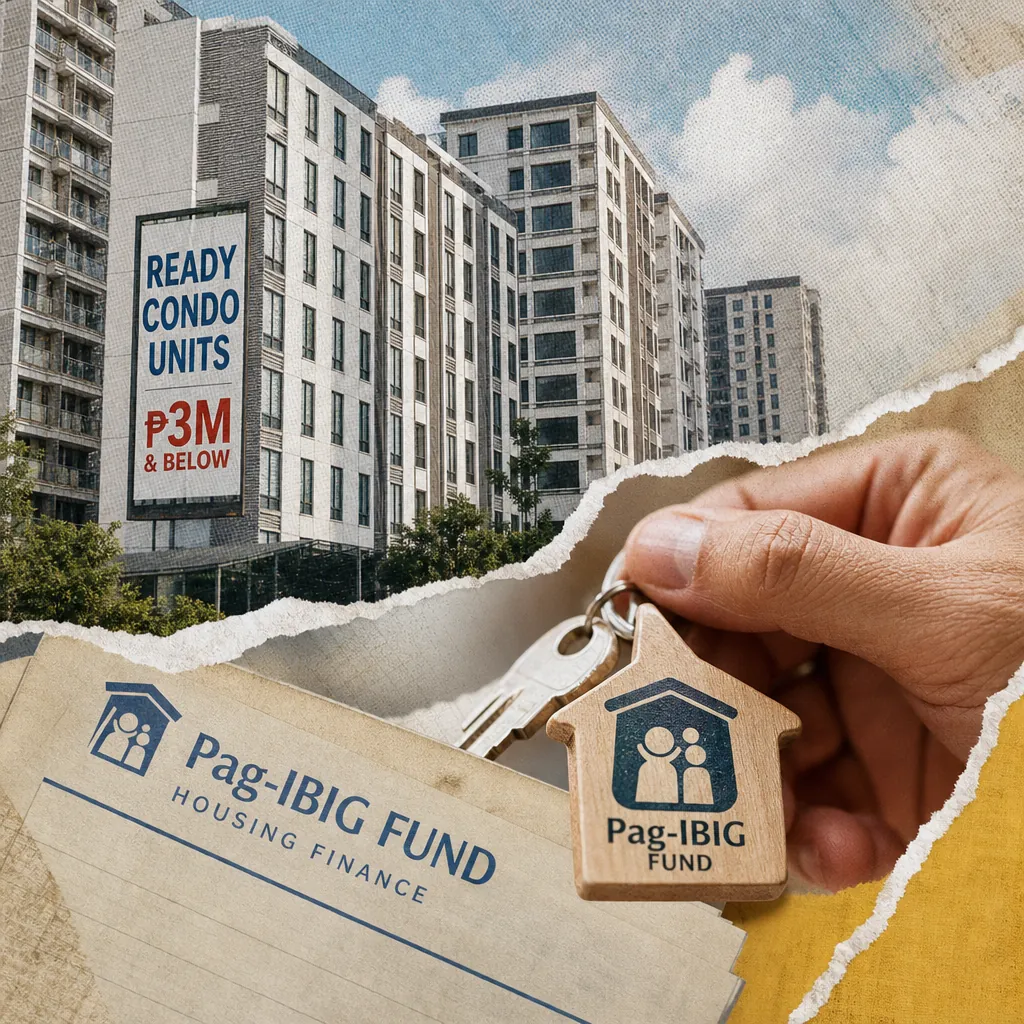
The Department of Human Settlements and Urban Development (DHSUD) said on Thursday it will open a new financing channel under the Expanded Pambansang Pabahay para sa Pilipino (4PH) program that lets private developers sell existing condominium units priced at P3 million and below through the Pag-IBIG Fund, the state-run home lending program funded by member contributions. The announcement, carried by BusinessMirror and BusinessWorld and echoed in Cebuano by state radio Radyo Pilipinas, is the government's most direct attempt yet to work down a Metro Manila condominium backlog that property consultancy Colliers Philippines puts at about 80,000 unsold units as of the second quarter, 32,600 of them already finished and ready for occupancy.76489
The same day, shareholders of AREIT, Inc., the real estate investment trust sponsored by Ayala Land, Inc., approved a P17.3-billion property-for-shares transaction that adds four malls and two hotels to its portfolio, lifting assets under management to P177 billion from P159 billion and pushing retail and hospitality to 41 percent of the trust's holdings, the highest share in its history.589 A Facebook post summarizing the deal drew 46 likes, 33 shares and 14 love reactions, the most engagement among the posts reviewed for this snapshot.6
On the consumer side, buyers used Reddit and Facebook to describe contract terms and turnover delays they say developers did not disclose, and property sellers warned that a proposed capital gains tax increase would raise the cost of transferring property. Those threads drew small audiences — the largest, a breakdown of who pays capital gains tax versus documentary stamp tax at closing, was shared 39 times — but they describe the same inventory problem from the buyer's end.91118
Key themes
- DHSUD opens Pag-IBIG financing to condos priced at P3 million and below. The new modality under the Expanded 4PH program is meant to let developers dispose of existing inventory while giving buyers access to lower-priced units in prime locations at Pag-IBIG's subsidized interest rates. DHSUD Secretary Jose Ramon P. Aliling said the program will also count toward developers' balanced housing compliance, the long-standing requirement that developers build a share of low-cost housing alongside market-rate projects.764
- Metro Manila's condominium backlog stands at about 80,000 unsold units. Colliers Philippines data cited by BusinessMirror shows 32,600 of those units are ready for occupancy. Only 1,200 units were launched in the second quarter, bringing first-half launches to 2,600, down 64 percent from a year earlier, while net take-up fell 60 percent quarter-on-quarter to 500 units, the lowest in five quarters.7
- AREIT shareholders approve a P17.3-billion infusion of Ayala Land malls and hotels. Ayala Land and its subsidiaries will subscribe to 462.48 million new AREIT shares at P37.48 each in exchange for Glorietta 4 and Ayala Malls Circuit in Makati, Ayala Malls Capitol Central in Bacolod, Ayala Malls Cloverleaf in Quezon City, New World Makati Hotel and Seda Vertis North. Offices will fall to 55 percent of the portfolio, retail will rise to 33 percent and hotels to 8 percent.589
- Filinvest Land joins Pag-IBIG's partner developer network. The partnership opens selected Filinvest residential projects to Pag-IBIG Housing Loan financing and gives qualified members preferential pricing, widening the pool of developers participating in the Expanded 4PH program.64
- Buyers report withheld loan documents and unannounced turnover delays. A first-time lot buyer on Reddit said a developer is holding back the documents needed to file a Pag-IBIG loan while pressing a Contract to Sell that would move the balance to an 18 percent in-house loan, with a reservation clause requiring signature within five days or forfeiture of the down payment. A separate post described equity paid for about three years on a Cebu unit whose turnover date had moved without notice.911
- Sellers and brokers warn that a proposed capital gains tax increase would raise transfer costs. Facebook posts described a proposed 6 percent to 10 percent hike as a direct hit to investors and entrepreneurs, and one real estate page explained that capital gains tax is typically paid by the seller while documentary stamp tax is paid by the buyer, computed on the highest of selling price, zonal value or market value.131718
- A Manila homeowner could not verify a July 2026 real property tax payment. The taxpayer said the payment did not appear in the statement of account and that city personnel told them there was no backup of data from April to August 16, 2026, leaving no way to confirm the transaction.10
- Robinsons Land signed a park development agreement with the Metropolitan Manila Development Authority. The company will build a Senior Citizens Park and Pet Park at Plaza Azul in Pandacan, Manila, providing park installations and pet amenities. President and CEO Mybelle V. Aragon-GoBio framed it as part of an inclusive-communities push.1
How the narratives stack
Dominant. The Pag-IBIG financing modality for sub-P3-million condominium inventory is the day's most consequential development for the sector, and it drew the broadest coverage in the items reviewed here — BusinessMirror, BusinessWorld, the Daily Tribune and a Cebuano-language post from state radio Radyo Pilipinas.764898 It is dominant within this captured set, and its substance supports that: it changes the terms on which developers can move unsold stock, and it was discussed at a Private Sector Advisory Council Infrastructure Sector Group-Real Estate meeting attended by President Ferdinand R. Marcos Jr. and representatives of Aboitiz Group, Ayala Land, Robinsons Land and SM Prime Holdings, according to DHSUD. The agency said top developers expressed willingness to cut selling prices to qualify.7
Counter-narrative. The buyer complaints on Reddit and Facebook run against the government's framing of the program as a straightforward win for homebuyers. The lot buyer's account — a developer withholding Pag-IBIG documents while steering the buyer into an 18 percent in-house loan, with a five-day signing deadline — describes a transaction where the state lending channel the program depends on was the thing being withheld.9 The Cebu buyer paid equity for roughly three years before learning, on a call about upcoming fees, that the turnover date had moved.11 These are individual accounts, not a documented pattern, and the material does not show whether the practices are widespread.
Emerging. The capital gains tax discussion is the earliest-stage story in the set. The posts reference a proposed 6 percent to 10 percent increase but the material does not identify the bill, its sponsor or its legislative status, so the proposal's actual likelihood is unknown.1317 What is observable is that seller- and broker-oriented pages are already organizing their audiences around it, and that one explainer on the capital gains tax versus documentary stamp tax split drew 39 shares, the most of any post in the tax cluster.18
Under-covered. The Manila real property tax records problem received a single Reddit post and no news coverage in this set. The taxpayer's July 2026 payment did not appear in the statement of account, and city personnel reportedly said there was no backup of data from April to August 16, 2026.10 If accurate, that is a records-keeping failure affecting an unknown number of Manila property owners, and it has drawn almost no attention.
Platform insights
- Facebook. The platform carried the widest range of activity, from corporate announcements to tax advocacy. The AREIT deal summary drew 46 likes, 33 shares and 14 love reactions, the highest engagement in the set, suggesting that readers respond to large, clearly quantified corporate transactions.6 The Robinsons Land park post drew 15 likes and 3 shares, a much smaller response for a community-relations item.4 The capital gains tax posts drew minimal engagement individually — one warning about "housing sector chaos" drew 2 likes, 1 share and 3 comments — but the tax explainer's 39 shares indicate that practical, how-it-works content travels further than alarm.1318 Radyo Pilipinas Cebu's post on the 4PH modality shows state media distributing policy news in regional languages.8
- Reddit. Activity was concentrated in investment and city-specific communities, and the tone was problem-solving rather than campaigning. The lot-buyer thread in r/phinvest drew 13 likes and 13 comments, a high comment-to-like ratio that indicates readers were asking follow-up questions and comparing experiences rather than simply reacting.9 The Manila property tax thread and the Cebu turnover thread each drew single-digit engagement, but they surfaced specific, checkable grievances — a missing payment record, a moved turnover date — that are the kind of detail that can escalate if others recognize the same experience.1011
- X. No posts from X appeared in the monitored set for this topic.
- YouTube. No posts from YouTube appeared in the monitored set for this topic.
Key voices and communities
Government housing agencies. DHSUD and the Pag-IBIG Fund are driving the day's main policy story, with Secretary Aliling as the named voice. Their framing is that the new modality is a "win-win" that clears developer inventory while giving buyers access to well-located units at low interest rates.764 This group matters because it controls the terms — the price ceiling, the interest rate, the guidelines still to be issued — that determine whether the program actually moves units.
Listed developers and their investor audiences. Ayala Land, through AREIT, and Filinvest Land generated the day's corporate news. AREIT President and CEO Alberto M. de Larrazabal said the infusions "strengthen AREITs scale and diversify our portfolio across offices, retail and hospitality, while introducing lease structures that allow us to participate more directly in the operating performance of these assets."5 The Facebook audience that engaged with the AREIT summary framed the deal as the trust becoming "a lot bigger and a lot less office-heavy."6
End-buyers on Reddit and Facebook. First-time buyers and existing unit owners are using forums to compare contract terms, loan documentation and turnover timelines. Their posts are the raw material for reputational risk on developer accounts, and they carry details — the five-day signing clause, the 18 percent in-house rate, the three-year equity payment — that are specific enough to be verified or disputed.911
Sellers, brokers and tax-focused pages. This group is organizing around the proposed capital gains tax increase, arguing it would raise the cost of selling property and slow transactions. Their content mixes advocacy with practical explainers on who pays which tax at closing.131718
Community and legal-advice pages. A DZRH Usapang Legal episode with Atty. Rhina Seco on the documents needed for "pasalo" transactions — the practice of a buyer assuming another buyer's remaining obligations on a property — shows that demand for guidance on distressed or informal transfers is strong enough to sustain regular programming.12
Narrative streams
Pag-IBIG financing opens to sub-P3-million condominium inventory
DHSUD's new modality under the Expanded 4PH program will let private developers sell existing condominium units priced at P3 million and below through Pag-IBIG Fund financing, with guidelines to be announced by the agency and the fund. Aliling said the measure will "enable private developers to sell more units, thus addressing inventory issues, while offering wider options for our homebuyers and access to best-located housing units at a lower price with low interest rates."7 The program will also count toward developers' balanced housing compliance, the requirement under Philippine law that developers provide a share of socialized or low-cost housing alongside market-rate projects.7
The scale of the problem the program is meant to address is documented in the same coverage. Colliers Philippines counted about 80,000 unsold Metro Manila condominium units as of the second quarter, including 32,600 ready for occupancy. Launches collapsed to 1,200 units in the quarter, and first-half launches of 2,600 were down 64 percent from a year earlier. Net take-up — the number of units actually sold after cancellations — fell 60 percent quarter-on-quarter to 500 units, the lowest in five quarters.7 The proposal was discussed at a Private Sector Advisory Council Infrastructure Sector Group-Real Estate meeting attended by President Marcos Jr. and representatives from Aboitiz Group, Ayala Land, Robinsons Land and SM Prime Holdings, and DHSUD said top developers expressed willingness to reduce selling prices to avail of the program.7
For developers holding finished but unsold units, the program offers a state-backed exit at a price ceiling that will require write-downs on some inventory but converts carrying costs into cash. For buyers, the practical effect depends on the guidelines: the P3-million ceiling limits the program to the lower end of the Metro Manila market, and the low interest rates come through Pag-IBIG, which means borrowers must qualify under the fund's membership and income rules. The material does not state what those qualification terms will be.
AREIT's P17.3-billion infusion shifts the trust toward malls and hotels
AREIT shareholders approved a property-for-shares transaction in which Ayala Land and its subsidiaries will subscribe to 462.48 million new AREIT common shares at P37.48 apiece in exchange for six commercial properties: Glorietta 4 and Ayala Malls Circuit in Makati, Ayala Malls Capitol Central in Bacolod, Ayala Malls Cloverleaf in Quezon City, New World Makati Hotel and Seda Vertis North. The transaction raises AREIT's assets under management to P177 billion from P159 billion and is subject to regulatory approval.589
The portfolio mix changes materially. After the swap, offices will account for 55 percent of assets under management, retail 33 percent, hotels 8 percent and land 4 percent, with retail and hospitality combined at 41 percent — the highest share in AREIT's history. The share price of P37.48 represents a premium to AREIT's 30-day volume-weighted average price as of the board's August 10 approval, meaning Ayala Land is paying above recent market levels for the shares it receives.5 AREIT posted P7.7 billion in revenue for the first half of 2026, up 30 percent from a year earlier.89 De Larrazabal said the infusions introduce lease structures that let the trust "participate more directly in the operating performance of these assets," a shift from fixed-rent arrangements toward leases tied to how the properties actually perform.5
For AREIT's investors, the deal reduces dependence on the office segment, which has faced weaker demand, and adds retail and hospitality assets whose income rises and falls with consumer spending and tourism. For the broader market, the transaction is a signal that Ayala Land sees more value in recycling mature commercial assets into its REIT than in holding them on its own balance sheet. The material does not state the expected yield on the infused assets or the timeline for regulatory approval.
Buyers describe withheld loan documents and turnover delays
A first-time lot buyer on Reddit's r/phinvest community wrote that after completing a six-month down payment, the developer withheld the documents needed to file a Pag-IBIG loan and pushed a Contract to Sell that would enroll the account in an 18 percent in-house loan. The reservation agreement, according to the post, gives five days to sign or the payment may be forfeited. The thread drew 13 likes and 13 comments.9 A separate post about a Lahug Prime Residence unit in Cebu said the buyer had paid equity for around three years and learned of a moved turnover date only upon following up about upcoming fees. The buyer's sibling wrote that the developer has no official Facebook page and responds slowly by email, and that a refund is being considered.11
These are individual accounts, and the material does not establish how common such practices are or whether the developers named in the posts dispute the claims. What they describe, however, is the buyer-side version of the same inventory problem the government is trying to solve: units that are sold on paper but not delivered on schedule, and contracts whose terms shift the cost of delay onto the buyer. The 18 percent in-house rate is roughly double what Pag-IBIG housing loans typically charge, so a buyer pushed from bank financing into in-house financing pays substantially more over the life of the loan.
For developers, these threads are a reputational exposure that compounds if the same complaints recur across buyers. For the government, they are a test of whether the new Pag-IBIG modality reaches buyers who are currently being steered away from the fund. The material does not show whether the developers in these posts are participants in the 4PH program.
Sellers and brokers organize against a proposed capital gains tax increase
Facebook posts from seller- and broker-oriented pages warned that a proposed 6 percent to 10 percent capital gains tax increase would hurt property sellers and the wider housing market. One post claimed the market faces "housing sector chaos if capital gains tax goes up," drawing 2 likes, 1 share and 3 comments.13 Another called the proposed hike "a direct hit to investors and entrepreneurs."17 A real estate page explained the split between capital gains tax, typically paid by the seller, and documentary stamp tax, usually paid by the buyer, both computed on the highest of selling price, zonal value or market value. That explainer drew 39 shares, the most substantive item in the tax cluster.18
Capital gains tax on real property in the Philippines is currently 6 percent of the gross selling price or fair market value, whichever is higher, and is generally shouldered by the seller. Documentary stamp tax is a separate levy on the transfer documents, typically paid by the buyer. A move to 10 percent would raise the cost of selling by roughly two-thirds on the seller's side, which sellers argue would either reduce their net proceeds or push asking prices up. The material does not identify the bill carrying the proposal, its author or its status in Congress, so the likelihood of enactment is unknown.
For developers, higher transfer taxes raise the effective cost of every unit sold and can slow the pace of resale, which matters when inventory is already moving slowly. For buyers, the incidence of the tax depends on how much of it sellers can pass through in the negotiated price. The observable pattern is that tax-focused pages are already mobilizing their audiences, and the practical explainer content is spreading further than the alarm.
Robinsons Land builds a park with the MMDA as community-relations placement
Robinsons Land Corp. signed a Memorandum of Agreement with the Metropolitan Manila Development Authority (MMDA), the government agency that coordinates traffic and development across the capital region, to develop a Senior Citizens Park and Pet Park at Plaza Azul in Pandacan, Manila. The company provided park installations and pet amenities. President and CEO Mybelle V. Aragon-GoBio said, "At Robinsons Land, we believe that thriving communities are built through inclusive spaces that bring people together."1
The story ran in at least three outlets — an Inquirer BrandRoom article, a separate business.inquirer.net item and insiderph.com — and a Facebook post about it drew 15 likes and 3 shares.1234 The Inquirer BrandRoom piece is labeled "ADVT." and carries the line "This article is brought to you by Robinsons Mall," meaning it ran as paid content rather than independent editorial coverage.1 That distinction matters for anyone assessing how much genuine news attention the announcement received: the placement was purchased, and the social response was modest.
For developers, community-space investments like this serve as goodwill assets that can be cited in local government negotiations and marketing. For the reading public, the practical value depends on whether the park is built and maintained as described. The material does not state a completion date or budget.
Filinvest joins the Pag-IBIG partner network
Filinvest Land Inc. joined Pag-IBIG Fund's network of partner developers under the Expanded 4PH program, opening selected Filinvest residential projects to Pag-IBIG Housing Loan financing and giving qualified members access to preferential pricing and other benefits. Aliling, who chairs the Pag-IBIG Fund Board of Trustees in his capacity as DHSUD Secretary, said the partnership builds on gains already achieved under the program.64
The addition of Filinvest follows the pattern set by the government's broader push to enlist private developers in the 4PH program. For buyers, each new partner developer widens the list of projects where Pag-IBIG financing can be used, which matters because the loan terms are typically more favorable than in-house financing. For Filinvest, participation opens its inventory to the fund's member base at a time when the market is slow. The material does not state which Filinvest projects are covered or what the preferential pricing amounts to.
Conversation trajectory
Guidelines for the new 4PH modality, expected within weeks. DHSUD and Pag-IBIG Fund said guidelines will be announced, and the details — the exact price ceiling, the interest rate, the eligibility rules for buyers and the compliance credit for developers — will determine whether the program moves inventory or stalls. Watch for the announcement and for which developers sign on first. The material does not give a date.7
AREIT's regulatory approval and first post-transaction earnings report, over the next one to two quarters. The transaction is subject to regulatory approval, and the next earnings disclosure will show how the new retail and hospitality assets perform under the direct and master lease structures de Larrazabal described. Watch whether the office segment's share of revenue falls as expected and whether the trust's distribution per share rises.589
Capital gains tax legislation, over the current congressional session. The posts reference a proposed 6 percent to 10 percent increase but the material does not identify the bill or its status. Watch for a filed measure, committee hearings or a revenue department position, which would move the discussion from advocacy to legislation.1317
Buyer complaint volume on Reddit and Facebook, over the next one to three months. Two detailed complaint threads is not a pattern. Watch whether similar accounts accumulate around the same developers or the same contract terms — particularly the withholding of Pag-IBIG documents and unannounced turnover moves — which would indicate a systemic issue rather than isolated cases.911
Manila real property tax records, over the next billing cycle. The taxpayer who could not verify a July 2026 payment said city personnel cited missing backup data from April to August 16, 2026. Watch whether other Manila property owners report the same problem, which would indicate a broader records failure rather than a single disputed transaction.10
Trigger events. The release of the 4PH modality guidelines, AREIT's regulatory approval and next quarterly disclosure, the filing or hearing of a capital gains tax bill, and the next Colliers or similar quarterly inventory report are the checkable points that will show whether the day's developments change the sector's direction.
Response guidance
Developers holding sub-P3-million inventory: prepare a position on the price ceiling before the guidelines land. The program requires selling at or below P3 million, and DHSUD said top developers have already expressed willingness to cut prices. Decide which projects can be offered at that level without impairing margins, and prepare internal talking points on why certain units qualify and others do not, so the first public statements are consistent.
Communications teams: treat buyer complaint threads as early-warning signals, not noise. The Reddit accounts describe specific, checkable practices — withheld loan documents, five-day signing clauses, moved turnover dates. Assign someone to monitor these communities and route credible complaints to the relevant business unit for verification before they accumulate. A single unanswered thread is an anecdote; a cluster is a story.
Sales and legal teams: review Contract to Sell and reservation agreement terms for clauses that shift delay costs to buyers. The five-day signing deadline and the 18 percent in-house loan rate described in the Reddit post are the kind of terms that generate complaints and, in volume, regulatory attention. Confirm that reservation agreements disclose the in-house rate clearly and that buyers are given a realistic window to secure bank financing.
Investor relations: be ready to explain the AREIT portfolio shift in plain terms. The transaction moves retail and hospitality to 41 percent of assets under management and introduces leases tied to operating performance. Prepare a short explanation of what that means for distribution stability and why the trust is reducing its relative exposure to offices.
Tax and government affairs teams: track the capital gains tax proposal and prepare a factual position. The posts reference a 6 percent to 10 percent increase but the material does not identify the bill. Once a measure is filed, prepare a plain-language explanation of how the tax is computed and who bears it, and avoid amplifying alarmist framing that the explainer content has already outperformed.
Developers with community-relations programs: distinguish paid placement from earned coverage in internal reporting. The Robinsons Land park announcement ran as labeled advertising in at least one outlet and drew modest social engagement. Report such placements as paid visibility, not as evidence of public interest, so that program decisions rest on accurate signals.
All sector communicators: use the Pag-IBIG program's mechanics as the frame for buyer-facing messages. The program's value to buyers depends on eligibility rules and interest rates that are not yet published. Until the guidelines are out, avoid promising specific savings and direct buyers to Pag-IBIG's official channels for qualification details.
See the full picture behind today's signals.
This report draws from Media Meter's MediaWatch, our real-time monitoring engine tracking 2,470+ Philippine sources across print, broadcast, digital, and social. Explore how the platform turns raw coverage into decision-grade intelligence, then see how it's configured for teams like yours — whether you're in PR agencies, corporate comms, government, or marketing.
Want more? Browse our Report Library for sector and crisis intelligence, or request a demo and we'll have your brand set up before the call.
Want this kind of intelligence on your brand?
This brief is built on the same MediaWatch methodology that runs continuously across every brand we monitor. See your competitive landscape, Impact Score, and narrative trajectory in a 30-minute demo.