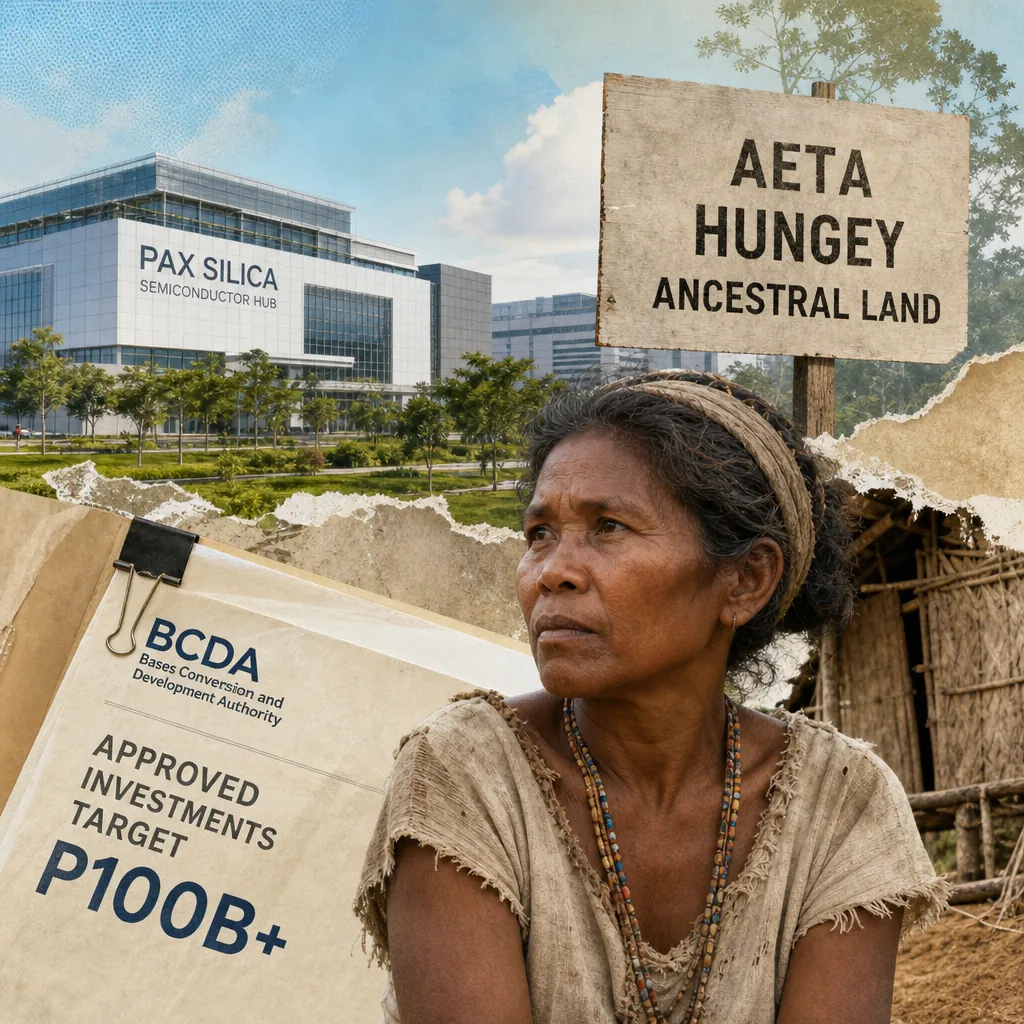
Pax Silica Draws Church, Celebrity Pushback
A Cagayan de Oro forum, a bishop's call for safeguards, and a comedian's viral post put the proposed New Clark City data-hub project under scrutiny, while fuel prices, flood-control protests, and housing policy dominated the day's other coverage.

The Conversation
A comedian's Facebook post about artificial intelligence became the loudest single item in a day of scattered but pointed scrutiny of Pax Silica, the proposed 1,620-hectare data-center and semiconductor hub planned for New Clark City in Tarlac. Singer-comedienne Kakai Bautista wrote on Sunday, September 20, that people who oppose the project keep posting AI-generated content anyway: "Kayo naman ayaw nyo ng PAX SILICA tapos panay naman ang Post nyo ng AI. Huy naman" 1768. The remark was picked up by two separate outlets the following day and drew a stream of agreeing and dissenting comments, with one netizen replying that critics "nanunuod pa ng mga AI movie" 68. It is a small, ironic observation rather than a policy argument, but it landed because it names a contradiction that the project's opponents have not had to answer: the same tools the hub would host are already embedded in everyday Philippine social media use.
The more substantive pushback came from the church and from civil society. On Tuesday, September 22, the Archdiocese of Cagayan de Oro's Commission on Social Apostolate and the Samdhana Institute convened a day-long multi-stakeholder dialogue at the San Agustin Metropolitan Cathedral, themed "Opportunities, Risks and Responsibilities for People, Planet and Peace," drawing members of the Interfaith Forum for Peace, Harmony and Solidarity 4. The same day, Bishop Gerry Alminaza of San Carlos, president of Caritas Philippines, told a press conference with Center for Energy, Ecology and Development executive director Gerry Arances that the government should hold off on irreversible commitments until water security, Indigenous land rights, ecological risks, and public accountability are addressed, and called for "genuine consultation and participation, especially with affected Aeta and local communities" 54. A Manila Times column by a self-described eight-decade observer framed the financing question bluntly: "The public builds, the private profits" 29.
Elsewhere, the day's news ran along more familiar tracks. Fuel prices rose again, with diesel up ₱8.82 per liter, kerosene ₱6.47, and gasoline ₱4.88 52, and the transport group PISTON announced a two-day nationwide strike for September 29 and 30, expecting as many as 70,000 drivers and operators to join 85. The Philippine Stock Exchange Index fell 0.50 percent, or 29.23 points, to 5,814.56, its second straight decline, as Fitch Solutions' BMI cut its 2026 Philippine growth forecast to 3.3 percent on infrastructure delays and weak household spending 3852. In Bulacan, residents of flood-prone Calumpit marched to demand transparency a year after anomalies were found in local flood-control projects 19, and the Government Service Insurance System (GSIS) opened nearly ₱8 billion in emergency loans to 317,721 members and pensioners in 16 areas hit by Typhoons Luis, Maymay, and Neneng and the enhanced southwest monsoon 1434.
Key themes
- A bishop asks the government to pause Pax Silica until water and land questions are answered. Bishop Gerry Alminaza of San Carlos, speaking for Caritas Philippines, called for full disclosure of the project's plans, agreements, and water and energy studies, an independent assessment of cumulative environmental and social impacts, and "a clear guarantee that no irreversible commitment will be made until land rights, water security, ecological risks, and public accountability are fully addressed" 54.
- A Cagayan de Oro forum put the project in front of affected communities. The Archdiocese of Cagayan de Oro and the Samdhana Institute gathered faith groups, local stakeholders, and civil society for a full-day dialogue on how Pax Silica affects livelihoods, the environment, technology, and regional peace-building 4.
- A comedian's post about AI use became the day's most-shared Pax Silica item. Kakai Bautista's September 20 Facebook post pointed out that people opposing the data hub keep posting AI-generated content, and the remark was republished by Bandera and Manila Bulletin the next day 1768.
- A Manila Times column asked who pays for the hub's infrastructure. The second installment of a series argued that the 1,620-hectare New Clark City site needs roads, power, water, wastewater treatment, skilled workers, and tax incentives, and that "someone will finance the infrastructure, surrender the taxes, and bear the environmental risks" while "someone else may collect the profits" 29.
- Fuel prices rose again and a two-day transport strike is set for September 29–30. Diesel climbed ₱8.82 per liter, kerosene ₱6.47, and gasoline ₱4.88 52; PISTON president Mody Floranda said the group expects up to 70,000 drivers and operators to join the strike, which will demand the removal of excise and value-added taxes on petroleum products 85.
- The finance department suspended excise taxes on LPG and kerosene, leaving gasoline and diesel untouched. Finance Secretary Frederick Go signed the resolution on Tuesday after Senator Bong Go renewed calls for relief amid high oil prices, reviving a break that had lapsed in July 32.
- The stock market fell for a second day as a research house cut its growth forecast. The PSEi shed 0.50 percent to 5,814.56, with net foreign selling of ₱1.01 billion, after Fitch Solutions' BMI lowered its 2026 Philippine growth estimate to 3.3 percent 3852.
- Flood-control transparency protests and emergency loans marked the storm season's aftermath. Calumpit residents marched a year after a ₱54-million flood-control project was flagged in anomalies 19, while GSIS opened nearly ₱8 billion in emergency loans to 317,721 members and pensioners in 16 typhoon-affected areas 1434.
How the narratives stack
Dominant. The Pax Silica story carried the day's most consequential news, and it did so across three distinct fronts: a bishop's formal call for safeguards 54, a multi-stakeholder forum in Cagayan de Oro 4, and a widely republished celebrity post that framed the debate in everyday terms 1768. The Manila Times column added a fourth, questioning the financing structure 29. Within the items captured here, this cluster drew the heaviest coverage of any single subject, with the Manila Times column alone carrying an estimated ₱842,856 in advertising-equivalent value — the notional cost of buying the same column space as paid advertising — and the Inquirer's report on the Cagayan de Oro forum carrying ₱335,664 429. The bishop's press conference, reported by LiCAS.news, carried ₱164,221 in equivalent value 54.
Counter-narrative. The strongest counter to the project's critics came not from a press release but from a comedian's observation that opposition to a data hub sits awkwardly alongside heavy daily use of AI tools 1768. It is not an argument about water rights or tax incentives, but it is the kind of point that travels further than a policy brief, and the comment threads it generated suggest it resonated with readers who see the debate as performative on both sides.
Emerging. The fuel-price story is building toward a concrete test. Diesel rose ₱8.82 per liter on Tuesday 52, the finance department suspended excise taxes on LPG and kerosene but pointedly declined to do the same for gasoline and diesel 32, and PISTON has called a two-day strike for September 29–30 85. The Land Transportation Franchising and Regulatory Board (LTFRB) has already secured an exemption from the Commission on Elections spending ban for its service contracting, Love Bus, free rides, fuel subsidy, and ₱12-per-liter fuel discount programs, as well as the public transport modernization program, ahead of the November 2 barangay and Sangguniang Kabataan elections 86. That exemption matters because it allows those programs to continue operating during the election period, when government spending on most other items is restricted.
Under-covered. Two stories with real consequences for ordinary Filipinos drew comparatively little attention in the items captured here. The first is the GSIS emergency loan program: nearly ₱8 billion for 317,721 members and pensioners in 16 areas affected by Typhoons Luis, Maymay, and Neneng and the enhanced southwest monsoon, with application deadlines running from September 20 to November 16 depending on the area 1434. The second is the Calumpit march, where 1,500 residents gathered at Gatbuca Bridge and the municipal hall before walking to Caniogan Linear Park to demand transparency a year after a ₱54-million flood-control project in their town was flagged in anomalies 19. Both are stories about people recovering from storms that have already happened, and both place low in the day's coverage relative to their scale.
Platform insights
- Facebook. The platform carried the day's most-engaged Pax Silica item: Kakai Bautista's September 20 post, which was screenshotted and republished by Bandera and Manila Bulletin 1768. The comment threads under those republished versions show the debate splitting into two camps — those who agree that opposing a data hub while using AI daily is inconsistent, and those who argue that individual AI use and a 1,620-hectare industrial project are different things entirely. Representative Duterte also used Facebook to respond to news anchor Korina Sanchez's criticism of Davao's pace of development, a separate exchange that ran in the Daily Tribune's front page 66.
- X. No posts from this platform appear in the items captured here, so no platform-specific engagement pattern can be described.
- Reddit. No posts from this platform appear in the items captured here.
- YouTube. No posts from this platform appear in the items captured here. The Senate of the Philippines' YouTube channel was the source of a screengrab used in Inquirer's report on Senator Alan Peter Cayetano's exchange with the Philippine Reclamation Authority, but that is a source image rather than a platform conversation 11.
Key voices and communities
The Catholic Church and faith-based groups. Bishop Gerry Alminaza of San Carlos, speaking as president of Caritas Philippines, gave the day's most detailed list of conditions for the project: full disclosure of plans and agreements, independent assessment of cumulative impacts, and consultation with affected Aeta and local communities 54. The Archdiocese of Cagayan de Oro's Commission on Social Apostolate co-convened the forum at San Agustin Metropolitan Cathedral, bringing the Interfaith Forum for Peace, Harmony and Solidarity into the conversation 4. This group matters because it can mobilize parish networks across regions that a government press release cannot reach.
Civil society and environmental advocates. The Samdhana Institute co-convened the Cagayan de Oro dialogue 4, and the Center for Energy, Ecology and Development's Gerry Arances appeared alongside Bishop Alminaza at the press conference 54. Alyansa Tigil Mina national coordinator Jaybee Garganera spoke at the forum on "Opportunities, Risks and Responsibilities for People, Planet and Peace" 4. These groups have long track records on mining and energy issues and are likely to keep pressing for the water and energy studies the bishop asked for.
Transport groups and commuters. PISTON president Mody Floranda announced the September 29–30 strike and said the group will not stop protesting until the government removes excise and value-added taxes on petroleum products 85. The group expects labor and urban poor organizations, as well as commuters, to join 85. This community matters because a two-day strike affects millions of daily commutes and puts direct pressure on the finance department's decision to leave gasoline and diesel taxes in place 32.
Celebrity and entertainment voices. Kakai Bautista's post is the clearest example of an entertainment figure shaping the Pax Silica conversation 1768. Her framing — that opposing a data hub while using AI daily is inconsistent — reached readers who may not follow policy debates, and the fact that two outlets republished it suggests editors judged it newsworthy on its own.
Business and finance commentators. The Manila Times column on who pays for Pax Silica's infrastructure 29 and the Business Mirror column on the weak peso's mixed effects on exporters, business process outsourcing firms, and inflation 63 represent the business-press strand of the conversation. The peso gained 6 centavos to ₱62.72 per US dollar on Tuesday, but the column noted that a weak currency raises import costs, especially for oil, and increases pressure to raise transport fares and wages 5263.
Narrative streams
Pax Silica faces calls for water, land, and accountability safeguards
Bishop Gerry Alminaza's press conference on September 22 was the day's most specific challenge to the project. Speaking as president of Caritas Philippines, the social action arm of the Catholic Bishops' Conference of the Philippines, he asked the government to hold off on irreversible commitments until four issues are resolved: water security, Indigenous land rights, ecological risks, and public accountability 54. He called for full disclosure of the project's plans, agreements, and water and energy studies, an independent assessment of cumulative environmental and social impacts, and "genuine consultation and participation, especially with affected Aeta and local communities" 54. The Aeta are Indigenous peoples with communities in the uplands of Central Luzon, including areas near the New Clark City site in Tarlac. The Bases Conversion and Development Authority (BCDA), the state agency that manages former military bases and is developing New Clark City, estimates the project's scale, according to the bishop's remarks 54.
The same day, the Archdiocese of Cagayan de Oro's Commission on Social Apostolate and the Samdhana Institute convened a full-day dialogue at the San Agustin Metropolitan Cathedral, themed "Opportunities, Risks and Responsibilities for People, Planet and Peace" 4. Discussions centered on how Pax Silica affects local communities, the environment, livelihoods, technology, and regional peace-building efforts 4. Jaybee Garganera, national coordinator of Alyansa Tigil Mina, spoke on the forum's theme 4. The event drew members of the Interfaith Forum for Peace, Harmony and Solidarity 4.
For the sector, the read is that the project's proponents now face a specific, named set of conditions rather than general opposition. Water studies, land-rights documentation, and an independent impact assessment are concrete deliverables that can be produced or withheld, and the church's network can keep the issue alive in parishes across Luzon and Mindanao. Companies and agencies involved in the project should expect questions about water sourcing and Aeta consultation to become standard in every public appearance.
A comedian's AI post reframes the Pax Silica debate
Kakai Bautista's September 20 Facebook post was short and pointed: "Kayo naman ayaw nyo ng PAX SILICA tapos panay naman ang Post nyo ng AI. Huy naman" 1768. She added that occasional AI use seems fine but daily use is another matter: "Ok naman siguro isa, pero araw araw? Huy" 17. She closed by telling her followers to decide whether they can practice what they preach 68.
The post was republished by Bandera on September 22 17 and by Manila Bulletin the same day 68. The Manila Bulletin report noted that the post drew varied reactions and comments from netizens, including one who wrote "True! Tapos nanunuod pa ng mga AI movie hahaha" and another who wrote "#NoToPaxSilica daw pero panay ang nood ng AI" 68. The Bandera report placed the post in the context of other celebrity commentary on the issue, including Romnick Sarmenta's position that Pax Silica does not help the Philippines 17.
For the sector, the read is that the AI-use contradiction is now part of the public conversation about the project, and it cuts against the credibility of blanket opposition. Project proponents have not had to make this argument themselves; a celebrity made it for them. Communicators on both sides should expect the "you use AI too" line to recur, and opponents should be ready to explain why individual use and a 1,620-hectare industrial hub are different in kind, not just in scale.
A columnist asks who pays for the hub's roads, power, and tax breaks
The Manila Times published the second installment of a series arguing that Pax Silica "arrives gift-wrapped in the language of the future: AI, semiconductors, critical minerals, high-quality jobs and $70 billion in investment" 29. The column noted that the 1,620-hectare New Clark City hub needs roads, electricity, water, wastewater treatment, skilled workers, and tax incentives, and asked: "Someone will finance the infrastructure, surrender the taxes, and bear the environmental risks. Someone else may collect the profits" 29. It added that "Philippine development often depends on pretending they are the same people" and that "history suggests otherwise" 29. The column carried an estimated ₱842,856 in advertising-equivalent value within the items captured here, the highest of any single Pax Silica item 29.
For the sector, the read is that the financing structure — who pays for infrastructure, who forgoes tax revenue, and who bears environmental risk — is now a named question in the business press, not just an activist talking point. Investors and government agencies promoting the project should expect to be asked for the cost-sharing details, and the answer will shape whether the project is seen as a public investment or a private subsidy.
Fuel prices rise again as a transport strike looms
Domestic fuel prices rose on Tuesday, with diesel up ₱8.82 per liter, kerosene up ₱6.47, and gasoline up ₱4.88 52. The same day, Finance Secretary Frederick Go signed a resolution suspending the excise tax on liquefied petroleum gas (LPG) and kerosene, reviving a relief that had lapsed in July 32. Go announced the signing at the Senate budget hearing for the Department of Finance, after Senator Bong Go renewed his call to suspend fuel excise taxes amid the Middle East conflict that has kept oil prices high 32. The finance chief said in Filipino that he had been following up on the matter for a long time and signed it as soon as it reached him 32. The resolution leaves excise taxes on gasoline and diesel untouched, and the Department of Finance said it is not inclined to suspend them 32.
PISTON president Mody Floranda said the group will hold a two-day transport strike on Tuesday, September 29, and Wednesday, September 30, expecting up to 70,000 drivers and operators to join 85. He said labor and urban poor groups, as well as commuters, are expected to join the protest, which aims to demand immediate government action against weekly oil price increases 85. Floranda said the group will not stop protesting until the government removes excise and value-added taxes on petroleum products 85.
The LTFRB has secured an exemption from the Commission on Elections spending ban for its service contracting, Love Bus, free rides, and fuel subsidy programs, as well as the ₱12-per-liter fuel discount for public utility vehicle drivers 86. Acting LTFRB Chairman Greg Pua Jr. said the exemption also covers the public transport modernization program, including three-month aid for the monthly amortization and operational expenses of PUV operators 86. The spending ban applies during the election period ahead of the November 2 barangay and Sangguniang Kabataan elections, and the exemption allows these programs to continue operating when most other government spending is restricted 86.
For the sector, the read is that the finance department has drawn a line at gasoline and diesel, and the transport strike is the first test of whether that line holds. If the strike proceeds and draws the expected numbers, pressure will build on the government to extend the excise suspension to the two fuels that affect the most drivers. Commuters should plan for disruption on September 29 and 30, and businesses that depend on road transport should factor in delays.
The peso's weakness cuts both ways for exporters and outsourcing firms
A Business Mirror column by Mark Villar described the weak peso as "a doubled-edged sword" 63. It noted that a weak currency encourages exporters to produce more because of higher potential earnings from a favorable exchange rate, and is a boon to business process outsourcing companies with overseas contracts denominated in foreign currencies 63. But it also translates into higher import costs, especially for oil, fuels inflation, and increases government pressure to raise transport fares and wages 63. The Philippine information technology-business process management industry is gaining short-term competitiveness from the peso's depreciation, but fears that rising inflation and blanket wage hikes could erode its long-term advantage 63. Proposed wage increases, while favorable or neutral to salaried employees, would create uncertainty and could affect investor projections and decisions 63. Renewed Middle East tensions drove the immediate drop in the peso's value, and Brent crude prices remain elevated 63.
The peso gained 6 centavos, or 0.10 percent, to ₱62.72 per US dollar on Tuesday 52. The PSEi fell 29.23 points, or 0.50 percent, to 5,814.56, with net value turnover at ₱5.52 billion and foreign investors posting ₱1.01 billion in net outflows 52. Services gained 0.86 percent, the only sector to advance, while holding firms fell 2.17 percent, mining and oil 1 percent, property 0.97 percent, financials 0.50 percent, and industrial 0.28 percent 52. Monde Nissin rose 1.48 percent to ₱6.16, while Ayala Corp. plunged 8.07 percent to ₱490 52. Fitch Solutions' BMI lowered its 2026 Philippine growth forecast to 3.3 percent, citing infrastructure delays and weaker household spending 52.
For the sector, the read is that exporters and outsourcing firms are the near-term beneficiaries of a weak peso, but the same weakness raises their input costs and the risk of wage adjustments that would erase the advantage. Companies with significant import exposure should model a peso that stays near ₱62–63 to the dollar, and those with large Philippine payrolls should watch the wage-hike proposals closely.
Flood-control transparency and storm recovery loans
Residents of Calumpit, Bulacan, marched over the weekend to demand full transparency as public works crews proceed with flood-control infrastructure tied to anomalies detected last year 19. Zul Kifli Magat, spokesperson of the movement Tindig Calumpitenyo, led a 1,500-strong rally on Sunday, September 20, marking the first anniversary since anomalies were found in many flood-control projects of the First District Engineering Office of the Department of Public Works and Highways 19. Among the flagged projects was a ₱54-million flood-control project in Calumpit 19. The protesters gathered at Gatbuca Bridge and the municipal hall before marching for more than an hour to Caniogan Linear Park 19. Magat said they are relying on a promise made by Public Works Secretary Vince Dizon 19.
The GSIS, the state pension fund for government employees, increased its emergency loan assistance to almost ₱8 billion, benefiting 317,721 active members and old-age and disability pensioners in 16 areas affected by widespread flooding and the impacts of Typhoons Luis, Maymay, and Neneng and the enhanced southwest monsoon 1434. The program covers qualified members and pensioners working or residing in affected areas in Luzon and Mindanao, with application deadlines ranging from September 20 to November 16, 2026, depending on the area 1434. Qualified members and pensioners in Hagonoy in Bulacan and Masinloc in Zambales could apply until September 20; those in Bulacan (except Calumpit and Hagonoy), Bataan, Zambales (except Olongapo City and Masinloc), and La Trinidad, Benguet until September 26; and those in Nasugbu in Batangas and Paluan in Occidental Mindoro until September 27 1434.
Separately, the Iloilo provincial government broke ground on a ₱40-million housing project to relocate 32 families repeatedly exposed to flooding near the Batiano River in Oton town 43. Of the project cost, ₱14 million came from the Department of Social Welfare and Development's KALAHI-CIDSS program, a community-driven development program that funds small infrastructure projects chosen by local residents 43. The beneficiaries include 15 families from Barangay Poblacion North, 10 from Barangay Tagbak Sur, and seven from Barangay San Antonio 43. Governor Arthur Defensor Jr. said the Purok Resilience Program is both a socialized housing initiative and a climate-change response 43.
For the sector, the read is that flood-control spending is now under sustained public scrutiny, and agencies that cannot show how projects are selected and audited will face protests like Calumpit's. The GSIS loan program and the Iloilo relocation show the recovery side of the same problem: money is moving, but the deadlines are staggered and the amounts are calibrated to specific areas, so affected residents need to check their local filing windows.
Housing policy moves on two fronts
President Ferdinand Marcos Jr. presided over a "special meeting" with the Private Sector Advisory Council (PSAC) Infrastructure Sector Group–Real Estate on Tuesday, September 22, to discuss challenges and opportunities in the real estate sector and push for ways to make housing more affordable 36. The Presidential Communications Office said in a statement that the meeting tackled steps to make housing more affordable, improve property valuation, and strengthen investment and growth in the sector 36. Palace Press Officer Claire Castro said earlier in the day that the agenda included the Balanced Housing Development Program 36. Only a few details from the meeting were released to the media 36.
Separately, Pag-IBIG Fund expanded its housing partnerships under the Expanded Pambansang Pabahay para sa Pilipino Program (4PH), with Filinvest Land Inc. joining its network of partner developers 15. The partnership opens select Filinvest residential projects to Pag-IBIG Housing Loan financing and allows qualified members to access preferential pricing and other benefits 15. Department of Human Settlements and Urban Development Secretary and Pag-IBIG Fund Board of Trustees Chairperson Jose Ramon P. Aliling said the partnership builds on gains already achieved under the Expanded 4PH Program as the government continues to work with the private sector to expand access to affordable housing 15. The 4PH program is the government's flagship housing initiative, which aims to build affordable homes for Filipino families through partnerships with private developers and government financing.
In Cebu, affluent buyers are driving strong demand for residential lots, pushing prices up 7 percent annually as buyers seek alternatives to condominiums and favor larger, more open properties, according to Colliers Philippines 76. Cebu had about 23,000 residential lots available as of the end of the first quarter of 2026, making it the second-largest lot-only market in the Visayas and Mindanao region after Negros Occidental, with an average take-up rate of 94 percent 76. Luxury projects priced at ₱10 million and above accounted for all lot-only launches in Cebu in 2025 and represented about a quarter of residential lots sold during the year 76.
For the sector, the read is that the government is pushing affordable housing through developer partnerships and financing programs while the private market in Cebu moves in the opposite direction, toward larger, more expensive lots. Developers that sign on to the 4PH program gain access to Pag-IBIG financing and preferential pricing for buyers, but they also take on the compliance and pricing requirements that come with government partnership. The Cebu data suggests that affluent buyers are not the target of the affordable-housing push, and that the two markets are diverging.
Conversation trajectory
The September 29–30 transport strike is the next concrete test of fuel-price policy. PISTON has announced the dates and expects up to 70,000 drivers and operators to join 85. The finance department has suspended excise taxes on LPG and kerosene but not on gasoline and diesel 32. Watch whether the strike proceeds at the announced scale and whether the government extends the suspension to the two fuels that affect the most drivers. Observation window: September 29–30, with a possible policy response in the first week of October.
Pax Silica's safeguards debate will continue through the church's network and the next round of project disclosures. Bishop Alminaza's call for full disclosure of plans, agreements, and water and energy studies gives project opponents a specific list of documents to demand 54. The Cagayan de Oro forum showed that the conversation is not confined to Metro Manila 4. Watch for whether the BCDA or the project's proponents release water and energy studies, and whether the Aeta consultation process produces a documented agreement. Observation window: the next four to six weeks, with the next scheduled forum or government briefing as the trigger.
The peso and oil prices will shape the next inflation reading and the wage-hike debate. The peso closed at ₱62.72 to the dollar on Tuesday 52, and diesel rose ₱8.82 per liter 52. The Business Mirror column noted that rising inflation and blanket wage hikes could erode the IT-BPM sector's long-term advantage 63. Watch the next inflation data release and any movement on wage-hike proposals in Congress. Observation window: the next monthly inflation report, typically released in the first week of the following month.
Flood-control transparency protests could spread to other towns with flagged projects. The Calumpit march drew 1,500 residents a year after anomalies were found in local flood-control projects 19. The GSIS emergency loan program covers 16 areas affected by recent typhoons 1434. Watch whether other towns with flagged projects organize similar marches, and whether the Department of Public Works and Highways releases the audit findings that protesters are demanding. Observation window: the next two to four weeks, with the anniversary of other flagged projects as potential triggers.
Housing policy details will emerge from the PSAC meeting and the 4PH partnership pipeline. The Palace released only a few details from the September 22 meeting 36, and Filinvest's entry into the Pag-IBIG partner network is the latest in a series of developer partnerships 15. Watch for the release of the Balanced Housing Development Program details and for additional developers joining the 4PH network. Observation window: the next four to six weeks, with the next Pag-IBIG or DHSUD announcement as the trigger.
Response guidance
For project proponents on Pax Silica: prepare water and land-rights documentation before the next public appearance. The bishop's call for full disclosure of water and energy studies and an independent impact assessment is specific and checkable 54. Proponents who can produce those documents will be in a stronger position than those who cannot. The Aeta consultation process should be documented, not just described.
For project opponents: address the AI-use contradiction directly. Kakai Bautista's post 1768 has given proponents a talking point that opponents have not answered. The strongest response is to distinguish between individual use of AI tools and a 1,620-hectare industrial hub with water, land, and tax implications, and to make that distinction in plain language rather than dismissing the criticism.
For transport groups and commuters: plan for September 29–30. PISTON expects up to 70,000 drivers and operators to join the strike 85. Commuters should check for alternative routes and adjusted work arrangements, and businesses that depend on road transport should build in delays. The LTFRB's exempted programs, including service contracting and the ₱12-per-liter fuel discount, will continue operating during the election period 86.
For fuel retailers and distributors: expect questions about the LPG and kerosene excise suspension. The finance department signed the resolution on Tuesday 32, and consumers will want to know how much they save per tank. Retailers should be ready to explain the pass-through in plain terms and to distinguish between the suspended LPG and kerosene taxes and the untouched gasoline and diesel taxes.
For developers and housing agencies: watch the PSAC follow-through and the 4PH pipeline. The Palace released few details from the September 22 meeting 36, and Filinvest's partnership with Pag-IBIG is the latest in a series 15. Developers considering 4PH participation should review the pricing and compliance requirements, and buyers should check whether specific projects are covered by Pag-IBIG financing before committing.
For government agencies handling storm recovery: publicize the GSIS loan deadlines by area. The application windows range from September 20 to November 16 depending on the area 1434, and affected residents in the 16 covered areas need to know their specific deadlines. Agencies should push this information through local government channels and barangay networks, not just national press releases.
For financial communicators: explain the peso's mixed effects in plain terms. The Business Mirror column's framing — that a weak peso helps exporters and outsourcing firms but raises import costs and inflation 63 — is a useful template. Communicators should avoid presenting the exchange rate as simply good or bad, and should state which sectors gain and which pay more.
See the full picture behind today's signals.
This report draws from Media Meter's MediaWatch, our real-time monitoring engine tracking 2,470+ Philippine sources across print, broadcast, digital, and social. Explore how the platform turns raw coverage into decision-grade intelligence, then see how it's configured for teams like yours — whether you're in PR agencies, corporate comms, government, or marketing.
Want more? Browse our Report Library for sector and crisis intelligence, or request a demo and we'll have your brand set up before the call.
Want this kind of intelligence on your brand?
This brief is built on the same MediaWatch methodology that runs continuously across every brand we monitor. See your competitive landscape, Impact Score, and narrative trajectory in a 30-minute demo.