PLDT Romblon outage sparks week-long subscriber frustration
A week-long PLDT internet outage in Odiongan, Romblon drew community frustration on Facebook, highlighting a communication vacuum around restoration timelines. Meanwhile, Globe's network spending and sustainability efforts, along with sports and entertainment news, shaped the day's telecom-adjacent conversation.
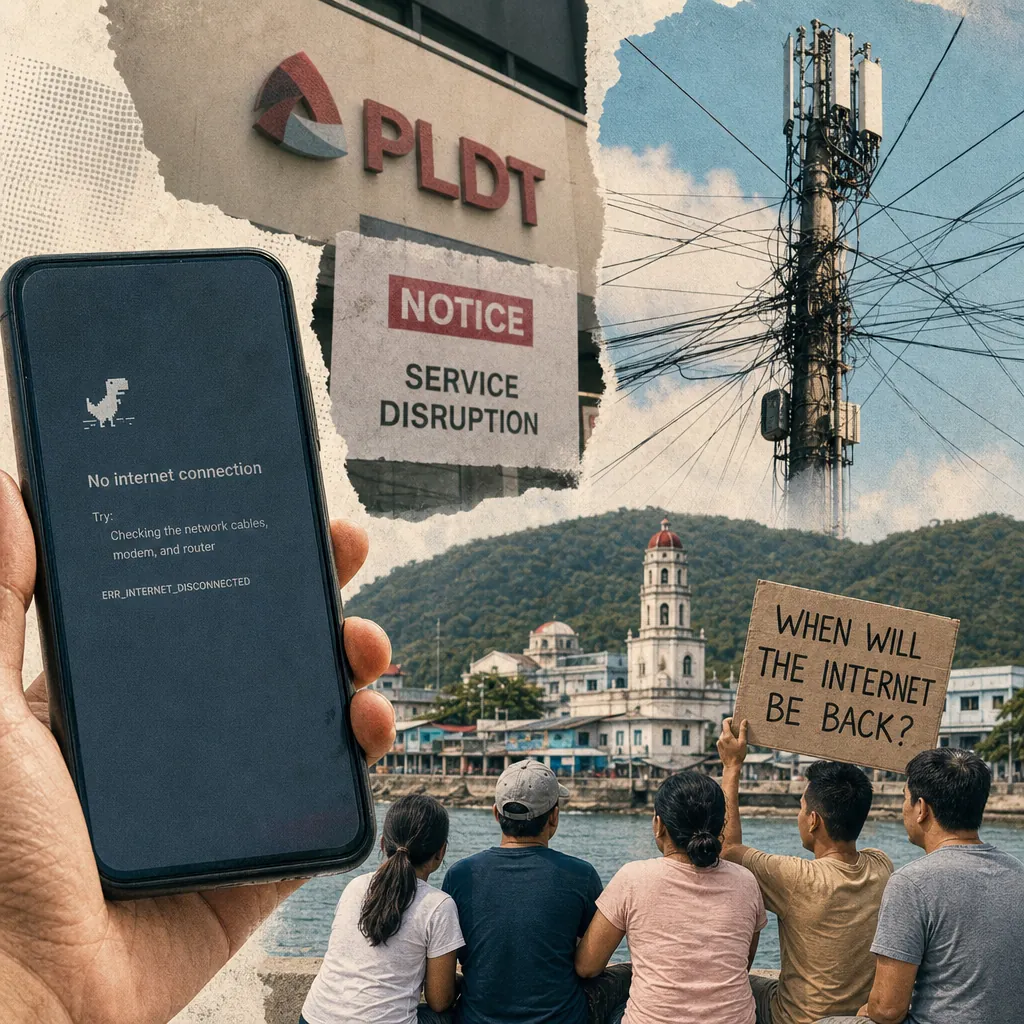
A week-long internet outage in the municipality of Odiongan, on the island province of Romblon, became the day's most consequential telecom story, not because of its size but because of what it revealed about how service failures turn into trust problems. A Facebook post by the community page Romblon News on Sunday, August 30, reported that PLDT subscribers had been without connectivity for nearly a week, citing a service interruption notice that dated the problem to August 22 but gave no cause and no restoration timeline.1 The post drew modest engagement—22 likes, 15 shares, and 29 comments—but the comment-to-like ratio was unusually high, and the reaction mix told a sharper story: 25 "haha" reactions, 7 "sad," and 1 "angry." That combination of mockery and genuine concern, in the absence of any visible PLDT response, turned an operational hiccup into a credibility issue.
The outage story competed for attention with a wave of unrelated national news that dominated Philippine social feeds through the morning: the Gilas Pilipinas basketball team's 68–56 victory over Iran, celebrated at the Mall of Asia Arena, and an NDRRMC report on 437 roads affected by monsoon rains and typhoons, including two destroyed bridges in Tarlac.4 These stories drew far larger engagement—a Gilas reel earned 195 likes, and a related Twitter thread drew 2,510 views—but they were not telecom stories.35 The PLDT outage was the only telecom-specific narrative in the captured data, and its low absolute numbers reflected a distracted field. Yet the people affected were not distracted: the comment thread showed active organizing and frustration, and the absence of any follow-up post meant the story remained unresolved by day's end.
The day's news-media coverage, captured across online outlets, was dominated by sports and business items. The most heavily covered story in the set was the retirement of June Mar Fajardo from the national basketball team, which drew coverage worth an estimated ₱456,654 in advertising-equivalent value across ABS-CBN News and Panay News.1216 The Premier Volleyball League Invitational Conference, which opens with PLDT defending its title, generated multiple articles.68111529 On the business side, Globe Telecom's capital expenditure and its stock performance drew several items, as did Ayala Land's sustainability ranking and a new master-planned city in Camarines Sur.172123243020 The captured set was heavily weighted toward online news, with a single blog item on a Yeng Constantino concert and no broadcast or print items, reflecting the monitoring scope rather than the full media landscape.22
Key themes
- PLDT's Odiongan outage entered its second week with no cause or restoration date given. A Facebook post by Romblon News reported that subscribers in Odiongan had been without internet since August 22, citing PLDT's "unexpected service interruption" notice, which offered no explanation and no timeline.1 The post drew 29 comments and a reaction mix of 25 "haha," 7 "sad," and 1 "angry," signaling a blend of mockery and genuine concern. The lack of any visible PLDT response in the captured data left the narrative unresolved.
- The comment-to-like ratio on the outage post signaled unusually high conversational intensity. With 29 comments against 22 likes, the thread showed affected subscribers actively discussing the outage, sharing information, and organizing complaints in localized spaces.1 This ratio, rather than raw volume, is the early-warning signal that a localized complaint could escalate into a broader #PLDTDown conversation.
- National sports and disaster stories crowded out telecom news on social media. The Gilas Pilipinas victory celebration drew 195 likes on a Facebook reel and 2,510 views on a related Twitter thread, while the NDRRMC road-damage report circulated across platforms.345 These stories captured far more engagement than the outage post, meaning the telecom narrative had to compete for attention in a distracted information environment.
- Globe Telecom's network spending and stock performance drew the heaviest business coverage. Globe reported spending ₱26.3 billion in capital expenditures in the first half of 2026, with 91% going to data and digital infrastructure, and its shares fell 6.8% week on week amid broader market weakness.212324 These items, worth an estimated ₱977,000 in combined advertising-equivalent value, positioned Globe as the most-covered telco in the captured set.
- The Premier Volleyball League Invitational Conference, featuring PLDT's title defense, dominated sports coverage. Multiple outlets previewed the tournament, which opens with PLDT facing Thailand's EST Cola, and highlighted Creamline's acquisition of Jaja Santiago-Minowa.68111529 The coverage drew an estimated ₱1.3 million in advertising-equivalent value, making it the most valuable sports story in the set.
- Ayala Land's sustainability recognition and a new provincial "global city" highlighted infrastructure and ESG narratives. Ayala Land ranked 369th in TIME's World's Most Sustainable Companies 2026, the only Philippine real estate developer on the list, and Camarines Sur launched CamSur Uptown, a 200-hectare master-planned city.2030 These stories, while not telecom-specific, reflect the broader infrastructure and sustainability context in which connectivity is discussed.
- Financial inclusion and digital access stories showed the sector's social impact. Over 500 students in Southern Leyte opened bank accounts in a Bangko Sentral ng Pilipinas-led activity, and free Wi-Fi went live at Bucari Pine Forest in Iloilo through the DICT's Free Wi-Fi for All program.1418 These items, though modest in coverage value, underscore the role of connectivity and digital services in everyday life.
- The captured article set was heavily weighted toward online news, with no print or broadcast items. All 25 supplementary articles came from online sources, including Inquirer, BusinessWorld, Philstar, and BusinessMirror, with a single blog item.22 This distribution reflects the monitoring configuration, not necessarily where coverage actually sat.
How the narratives stack
Dominant: The dominant narrative in the captured set is the PLDT Odiongan outage, judged by consequence and genuine audience response rather than by volume. The outage affected real subscribers for a week, and the communication vacuum around it—no cause, no timeline, no visible response—transformed a service failure into a trust issue. The Facebook post's comment-to-like ratio and the mix of mocking and sad reactions indicated that affected users were not merely inconvenienced but actively frustrated and organizing. This story carries disproportionate reputational risk for PLDT because it is specific, local, and unresolved.
Counter-narrative: The counter-narrative is the positive, celebratory coverage of sports and national pride, which dominated engagement on social media and drew the heaviest coverage value in the news set. The Gilas Pilipinas victory and the PVL Invitational previews showcased Filipino excellence and community cohesion, offering a stark contrast to the outage story. This counter-narrative is not in tension with the outage—it simply occupied the public's attention, temporarily burying the telecom complaint.
Emerging: An emerging narrative is the convergence of infrastructure damage from the monsoon and typhoon season with telecom service reliability. The NDRRMC report on 437 affected roads and two destroyed bridges in Tarlac provides a backdrop where connectivity disruptions will increasingly be framed within disaster-response narratives.4 As government agencies communicate about calamity impacts, telco service quality during emergencies becomes a natural extension of that conversation, creating openings for pointed questions about network resilience.
Under-covered: The under-covered story is the financial inclusion and digital access work by the Bangko Sentral ng Pilipinas and the Department of Information and Communications Technology. The opening of 528 bank accounts for students in Southern Leyte and the activation of free Wi-Fi at Bucari Pine Forest received only modest coverage, yet they represent the positive, tangible impact of digital infrastructure on everyday Filipinos.1418 These stories were not suppressed but simply placed low in the captured set, overshadowed by sports and business news.
Platform insights
- Facebook: Facebook served as the primary outbreak channel for the PLDT outage. The Romblon News post generated the highest engagement on any telecom-related item in the dataset, with 29 comments and a reaction mix that included 25 "haha" and 7 "sad."1 The platform's comment culture favored local problem-solving and complaint sharing, and the absence of any official PLDT response meant Facebook became the staging ground for user anger that could migrate to Twitter for escalation.
- Twitter: Twitter carried the NDRRMC disaster report and the Gilas Pilipinas celebration, with the latter drawing 2,510 views on a related thread.45 No direct PLDT outage post was captured on Twitter, suggesting either that complaints were still localizing on Facebook or that affected users had moved to direct messages with PLDT's customer service handles. Twitter's role as a sentiment amplifier for lighter content was evident in the sports coverage.
- Reddit: Reddit was entirely captured by political nostalgia—a throwback post about Vice President Leni Robredo's security detail drew 372 upvotes and only 2 comments.2 There was no telecom engagement on the platform on August 30, meaning the outage story had not yet penetrated Reddit's more analytical audience. If the outage continues into the workweek, Reddit threads questioning regulatory oversight and restoration processes are a likely next escalation point.
- YouTube: No YouTube content was captured in the dataset. The monitoring writeup noted that if video content documenting the outage surfaces, a community note or pinned comment with official updates would be an appropriate response, but no such content appeared in this window.
Key voices and communities
- Affected residential subscribers in provincial areas: Individual household subscribers in Odiongan, Romblon, who rely on PLDT for work, business, education, and daily communication.1 They are primarily on Facebook, where community complaint posts generate moderate engagement but high conversational intensity. Their influence is localized but significant, as they represent the real-world impact of service disruptions that can escalate into reputational risk.
- Sports enthusiasts and the PVL/Gilas fanbase: Filipino basketball and volleyball fans actively engaged with national team and league coverage. The Gilas victory celebration drew hundreds of reactions, and the PVL Invitational previews generated multiple articles.3568111529 This group's high emotional engagement with national pride content makes them a valuable audience for brand partnerships, though they are not directly connected to telecom operations.
- Political nostalgia and public service narrators: Users on Reddit sharing human-interest stories about public officials, exemplified by the Leni Robredo security detail throwback.2 This group's appetite for positive, humanized institutional narratives offers a template for telcos to highlight frontline staff during crisis response.
- Disaster impact information sharers: Individuals and outlets disseminating official NDRRMC updates on road and bridge damage from the monsoon and typhoon season.4 Their content is factual and serves as an early-warning signal for weather-related service interruptions, as infrastructure damage often precedes telco outage complaints.
- Business and financial media: Outlets like BusinessWorld, BusinessMirror, and Philstar covered Globe's capital expenditure and stock performance, Ayala Land's sustainability ranking, and other corporate news.1721232430 These voices shape the business narrative around telecom investment and network reliability.
Narrative streams
PLDT's Odiongan outage: a week without internet, and no end in sight
The central fact of the day's telecom conversation is that PLDT subscribers in Odiongan, Romblon, had been without internet for nearly a week as of August 30. A Facebook post by Romblon News reported the outage, citing a PLDT service interruption notice that dated the problem to August 22 but offered no cause and no restoration timeline.1 The post drew 22 likes, 15 shares, and 29 comments, with a reaction mix of 25 "haha," 7 "sad," and 1 "angry." The "haha" reactions are not mockery of the victims—they signal public fatigue with a brand that communicates vaguely. The "sad" reactions reflect genuine concern, and the single "angry" reaction hints at the frustration simmering beneath the surface.
The comment-to-like ratio of 1.3 comments per like is unusually high, indicating that affected subscribers were actively discussing the outage, sharing information, and organizing complaints in localized spaces. The 15 shares suggest the story was being circulated beyond the immediate affected area, potentially reaching other PLDT subscribers who might be bracing for similar issues.
The most damaging element is the communication vacuum. PLDT's notice acknowledged the problem on August 22, but the public post appeared on August 30—an eight-day gap with no interim update. That gap transformed the story from "we're fixing it" to "we don't know." The absence of any visible PLDT response in the captured data meant the brand did not counter the narrative's most damaging element: the lack of a restoration timeline.
For the sector, this case reinforces that service interruption communications are becoming a reputational battleground, even in small markets. Communications teams should treat any outage exceeding 48 hours as requiring proactive public updates with expected restoration windows, because the modern Philippine social media ecosystem punishes uncertainty. The Odiongan story, while small in volume, carries a structural risk: if it remains unresolved, it could become a template for similar stories in other provinces, and the narrative could escalate to national visibility within 24–48 hours.
Globe's network spending: data infrastructure at the core
Globe Telecom reported over the weekend that it channeled roughly 91% of its ₱26.3-billion first-half capital expenditure budget into data and digital infrastructure.2124 The ₱26.3 billion marked a 39% increase from the same period a year earlier and represented 31% of service revenues for the period. Despite the higher spend, Globe said it remains on track to keep full-year capital expenditures below $1 billion, part of what it described as a "disciplined capital allocation" strategy.
"Globe's continued investments in network infrastructure are about more than expanding capacity, they are about delivering a better everyday experience for our customers and ensuring that more Filipinos can benefit from reliable, high-quality connectivity," said Carl Cruz, Globe's president and CEO.21 The company said the heavy tilt toward data underpinned an accelerated 5G rollout.
The coverage of Globe's capex drew an estimated ₱515,000 in advertising-equivalent value across BusinessWorld and BusinessMirror, making it the most-covered telecom business story in the set.2124 This investment narrative stands in contrast to the PLDT outage, highlighting the different ways the two major telcos are positioning themselves: Globe emphasizing network expansion and reliability, PLDT facing a very public service failure.
For the sector, Globe's spending signals that data infrastructure is the competitive battleground. As 5G rollout accelerates, consumers will expect faster, more reliable connectivity, and any service failure—like the Odiongan outage—will be judged against these investment promises. The read for the sector is that network reliability is becoming a key differentiator, and communication around outages must match the scale of investment claims.
Globe shares decline amid broader market weakness
Globe Telecom's shares fell 6.8% week on week, closing at ₱1,630 per share on Friday, August 28, down from ₱1,748 a week earlier.1723 The decline was slightly smaller than the services sector's 6.9% drop but steeper than the 4.5% decline in the Philippine Stock Exchange index (PSEi). Year to date, Globe shares were up 2.9%, outperforming the PSEi's 1.6% decline but lagging the services sector's 31.6% gain.
The decline came despite renewed assurances over Mynt's planned initial public offering (IPO). Mynt, the operator of the GCash mobile wallet, is partly owned by Globe, and the IPO update gave the market some relief that the offering would push through despite a delay. "The update on the GCash IPO earlier this week gave the market some relief, an assurance that the offering will still push through despite getting delayed by a few days from the initial target," said Jasper Timoteo A. Ondap, an equity analyst at Regina Capital.23
Globe was the 15th most actively traded stock last week, with 240,000 shares worth ₱402 million changing hands from August 24 to 28.23 The coverage drew an estimated ₱844,000 in advertising-equivalent value across BusinessWorld and Head Topics.1723
For the sector, the stock decline reflects broader market weakness rather than company-specific problems, but it underscores how investor sentiment can be swayed by macroeconomic factors. The GCash IPO remains a key catalyst for Globe's valuation, and any further delays could weigh on the stock. The read for the sector is that telco valuations are increasingly tied to fintech and digital services, making the success of IPOs like Mynt critical for investor confidence.
The PVL Invitational: PLDT's title defense and the sports counter-narrative
The Premier Volleyball League Invitational Conference, which opens on Monday, August 31, at the Smart Araneta Coliseum, dominated sports coverage in the captured set. Defending champion PLDT begins its title-retention bid against Thailand's EST Cola at 1:30 p.m., followed by Creamline against Nxled, and Farm Fresh against Ho Chi Minh City.68111529
The tournament is a short but brutal sprint: six teams, six matches each, in just nine days. "This feels similar to the first PVL season when the games were back-to-back. The key thing now is how well we can truly recover from the first match, the second match, and all the subsequent games," said Creamline middle blocker Jaja Santiago-Minowa.8
The coverage drew an estimated ₱1.3 million in advertising-equivalent value across Inquirer, Tribune, Philstar, and Head Topics, making it the most valuable sports story in the set.68111529 The sports narrative provides a positive counterweight to the outage story, showcasing PLDT's brand in a celebratory context. However, the contrast is stark: the same company that owns the High Speed Hitters volleyball team is also the one failing to restore internet service in Romblon.
For the sector, the PVL coverage highlights the dual role of telcos as both service providers and sports sponsors. While sports sponsorships generate positive brand associations, they also create a vulnerability: when service failures occur, the contrast between the glamorous sports brand and the struggling service provider can amplify negative sentiment. The read for the sector is that sports marketing must be backed by reliable service, or the goodwill it generates can quickly evaporate.
Ayala Land's sustainability ranking and the infrastructure context
Ayala Land Inc. climbed 117 places to rank 369th globally in TIME's World's Most Sustainable Companies 2026, emerging as the only Philippine real estate developer on the list.30 The company also reported diverting 44% of waste from landfills in 2025, surpassing its 30% target, and targeting 40% diversion this year.13 Additionally, 98% of its gross leasable area was powered by renewable electricity or supported by renewable energy certificates as of end-2025.
The coverage drew an estimated ₱618,000 in advertising-equivalent value across Philstar and Head Topics.1330 While not a telecom story, Ayala Land's sustainability efforts are relevant because Globe Telecom is the only other Philippine company on the TIME list, and both companies are part of conglomerates with significant infrastructure interests.
In a separate development, Camarines Sur launched CamSur Uptown, a 200-hectare master-planned global city envisioned as a hub for business, technology, and governance outside the national capital.20 Governor Luis Raymund Villafuerte said the project "promises to be even better than the Bonifacio Global City" and will bring "digital education, modern or hi-tech jobs and now untrodden possibilities for high growth."20
For the sector, these infrastructure and sustainability stories provide context for the telecom conversation: as the country builds new cities and pursues sustainability goals, connectivity becomes a foundational requirement. The read for the sector is that telcos must align their network investments with these broader infrastructure ambitions, ensuring that new developments are connected and that network resilience is part of the sustainability agenda.
Financial inclusion and digital access: the quiet positive stories
Two modest but significant stories highlighted the social impact of digital infrastructure. Over 500 students at Southern Leyte State University opened transaction accounts in a financial inclusion activity led by the Bangko Sentral ng Pilipinas (BSP) and the Youth Financial Inclusion Ambassadors.14 The activity, held on August 20, was the second such event in the region, building on a similar onboarding in August 2025 when 551 accounts were opened.
Separately, free Wi-Fi went live at Bucari Pine Forest in Leon, Iloilo, through the Department of Information and Communications Technology's (DICT) Free Wi-Fi for All program.18 The program aims to provide free internet access in public spaces, particularly in rural areas.
These stories drew modest coverage value—an estimated ₱66,000 and ₱39,000 respectively—but they represent the positive, tangible impact of connectivity and digital services on everyday Filipinos.1418 They also underscore the importance of reliable internet for education, financial inclusion, and tourism, which makes the PLDT outage in Romblon all the more consequential.
For the sector, these stories highlight the social license that telcos operate under: connectivity is not just a commercial service but a public good. The read for the sector is that service failures in underserved areas carry outsized reputational risk because they directly undermine the promise of digital inclusion.
Conversation trajectory
- PLDT Odiongan outage resolution (1–2 weeks): The most immediate trigger is the restoration of service in Odiongan. If the outage remains unresolved within the coming days, expect additional complaint cycles and potential escalation to national visibility. The conversation pattern suggests the window for proactive communication closes within approximately one week—after that, the narrative becomes embedded in local community memory and generates recurring mentions during any future service issue.1
- Regional outage stories (2–3 weeks): The Odiongan story provides a template for how prolonged connectivity failures evolve from individual complaints into organized community pressure campaigns. Expect similar regional outage stories to surface across provincial community pages, particularly in areas with limited alternative connectivity options. These localized narratives carry disproportionate reputational risk because they amplify in civic and local government circles where service reliability is tied to economic activity claims.1
- Infrastructure and disaster convergence (7–14 days): The monsoon and typhoon damage report on 437 affected roads creates a backdrop where connectivity disruptions will increasingly be framed within broader disaster-response narratives.4 As government agencies communicate about calamity impacts, telco service quality during emergencies becomes a natural extension of that conversation. This convergence typically accelerates within 7–14 days following weather events as affected residents document their experiences.
- GCash IPO progress (next few weeks): The Mynt IPO remains a key catalyst for Globe's stock. Any further delays or positive updates will likely drive trading activity and media coverage. The IPO's success is tied to broader investor confidence in Philippine fintech and digital services.1723
- PVL Invitational and major sporting events (next 1–2 weeks): The PVL Invitational, running from August 31 to September 8, will generate predictable network stress tests and livestream quality complaints. Major events create opportunities for telcos to claim proactive capacity management narratives, but they also expose service weaknesses.68111529
Trigger events to watch:
- PLDT issues a public update on the Odiongan outage with a restoration timeline (positive trigger).
- A second post appears in the Odiongan thread saying "we are still working" without a timeline (negative trigger, likely to escalate).
- The NDRRMC releases new infrastructure damage assessments that implicate telco infrastructure (convergence trigger).
- The GCash IPO receives regulatory approval or faces further delays (market trigger).
- A major sporting event causes a visible network slowdown, generating speed test comparisons across providers (reliability trigger).
Response guidance
Outage communication: For any service interruption exceeding 48 hours, issue proactive public updates with expected restoration windows, even if the timeline is uncertain. The Odiongan case shows that vague notices without a cause or timeline fuel speculation and frustration. Acknowledge the specific start date, provide regular updates (at least twice daily), and avoid overpromising on deadlines. Respond to comments on public posts with empathetic, factual replies in Filipino to match the conversation's language.1
Localized response teams: Activate a dedicated customer service response team to monitor public posts about outages, particularly in provincial areas. Affected businesses and remote workers are likely amplifying complaints due to direct income impact; offering credits or priority restoration updates could convert negative sentiment into goodwill. The comment-to-like ratio on the Odiongan post is a leading indicator of escalation—flag any outage report with a high ratio as a "rising risk."1
Competitive positioning: The absence of competing brand mentions (Globe, DITO, Converge) in the outage conversation means PLDT owns this negative narrative entirely. Competitors could exploit the vacuum with positive counter-programming, but they should avoid directly referencing the outage to prevent appearing opportunistic. Instead, they can highlight their own network reliability and investment in data infrastructure, as Globe has done with its capex announcements.2124
Sports and entertainment adjacency: Major sporting events like the PVL Invitational offer opportunities for brand-positive messaging about network capacity and reliability. Position network reliability messaging around high-traffic occasions (concerts, sports finals, holiday surges) to claim proactive capacity management narratives. However, avoid injecting the brand into celebratory content during a crisis—the contrast between a glamorous sports brand and a struggling service provider can amplify negative sentiment.68111529
Human-interest storytelling: The positive engagement with the Leni Robredo security detail throwback on Reddit (372 upvotes) demonstrates the public's appetite for humanized institutional narratives.2 Telcos can adapt this template by highlighting customer service representatives, field technicians, or restoration crews during crisis response. These stories humanize the corporate response and generate positive sentiment, but they should be deployed within 48–72 hours of a service disruption to maximize impact.
Disaster and infrastructure framing: When responding to outage complaints during the monsoon and typhoon season, acknowledge the challenges of severe weather without using it as an excuse for extended downtime. Coordinate with relevant authorities to align restoration efforts with broader recovery operations. Monitor NDRRMC reports on road and bridge damage as an early-warning signal for service disruptions in affected areas.4
Financial inclusion and digital access: Highlight the positive social impact of connectivity, such as the BSP's financial inclusion activities and the DICT's Free Wi-Fi for All program.1418 These stories reinforce the message that reliable internet is a public good, which can help counterbalance negative service narratives.
See the full picture behind today's signals.
This report draws from Media Meter's MediaWatch, our real-time monitoring engine tracking 2,470+ Philippine sources across print, broadcast, digital, and social. Explore how the platform turns raw coverage into decision-grade intelligence, then see how it's configured for teams like yours — whether you're in PR agencies, corporate comms, government, or marketing.
Want more? Browse our Report Library for sector and crisis intelligence, or request a demo and we'll have your brand set up before the call.
Want this kind of intelligence on your brand?
This brief is built on the same MediaWatch methodology that runs continuously across every brand we monitor. See your competitive landscape, Impact Score, and narrative trajectory in a 30-minute demo.