Shopping Trends Filipino Consumers Can't Resist
The shopping trends Filipino consumers can't resist in 2026: budol culture, live selling, small carts, and AI-assisted buying.

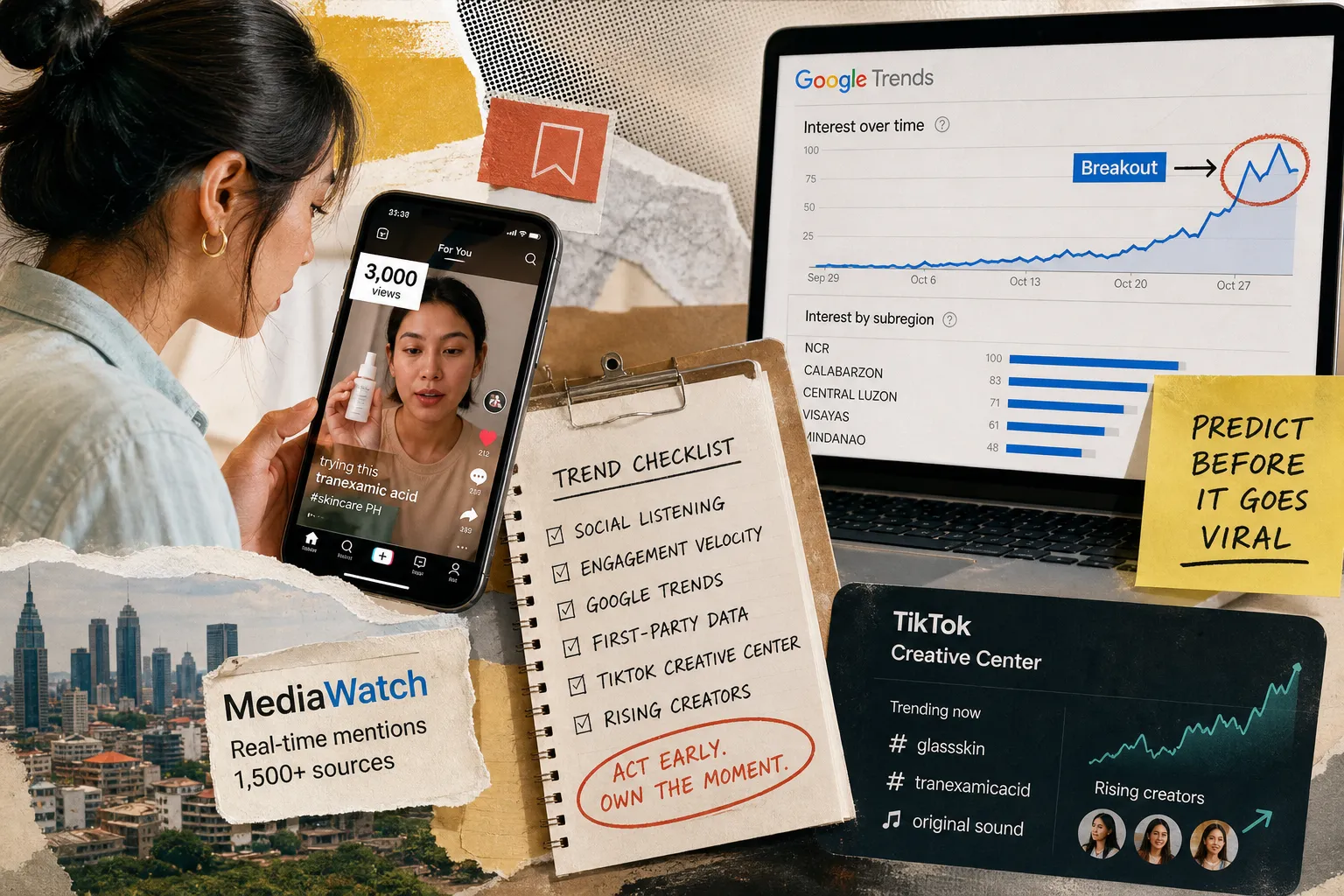
Some shopping trends you can see in a single scroll. Someone opens TikTok to kill ten minutes. Twelve videos later there's a serum in the cart, a confirmation email, and a rider on the way. Nobody searched for anything. Nobody compared prices.
The shopping trends behind that sequence are now the ordinary shape of Filipino online buying, and the numbers back them up. The Philippines now has 98 million internet users at 83.8% penetration, 56.4% of Filipinos buy something online every week, and 41.9% find new brands through social platforms. For marketers, the useful question is which of these behaviors is doing the selling.
The seven shopping trends covered in this article:
- Budol culture and the impulse buy with a name
- Discovery commerce replacing search commerce
- Live selling in Taglish, and why beauty moved with it
- Creators who became the brand
- The small-cart, high-frequency habit
- Paying the Filipino way
- Asking AI before adding to cart
1. Budol Culture and the Impulse Buy With a Name
"Budol" once meant a scam. Filipino internet culture repurposed it to describe a recommendation persuasive enough that you buy before you think, and the reframing changed the social cost: impulse spending became something to post about rather than hide. Commenters now tag friends to budol them. A study of 345 university students in Cebu City published in Philippine EJournals found a significant positive correlation between TikTok exposure and buying behavior (ρ = 0.480, p < .001), with user-generated content the strongest single driver (ρ = 0.517) and impulse buying close behind (ρ = 0.458), concentrated in fashion and personal care.
Creators own the budol format. Brands take part in it by invitation.
2. Discovery Commerce Replacing Search Commerce
Yves Gonzalez, head of public policy at TikTok Shop Philippines, told BusinessWorld that the buying process has shifted toward being discovery-centric rather than searching-centric. The GMV data agrees. Cube Asia's Tradewinds dataset puts combined Shopee, Lazada and TikTok Shop GMV at USD 22 billion in FY2025. Inside that total, TikTok Shop grew 53% to USD 6 billion and took 29% of combined platform GMV, up from 22% the previous year and 14% the year before that. It grew faster in FY2025 than in FY2024, and by Q4 it had overtaken Lazada as the second-largest platform by quarterly sales.
Lazada contracted 34% over the same period, so this is money moving between platforms rather than a market lifting all three. It is moving toward the one where nobody arrives with a shopping list.
3. Live Selling in Taglish, and Why Beauty Moved With It
Cube Asia describes live selling in the Philippines as the primary channel in several categories rather than a supporting tactic. Beauty shows why. Beauty and personal care is now TikTok Shop's largest category at 28% of GMV, the highest beauty share of any platform in the country, while beauty's share on Shopee has slid from 17% in FY2023 to 14% in FY2025. Categories that need demonstration follow the format that allows it.
Language carries much of the rest. Hosts sell in Taglish, answer comments by name, and repeat themselves for latecomers, because watching is what converts and nobody watches a script. At the 2026 TikTok Shop Creator Awards, Reinalie Morales (@rerefinds_ph) took the Live Record-Breaker award for consistently high-performing fashion livestreams built on accessible, trend-driven selling.
4. Creators Who Became the Brand
Filipino creators increasingly own the product instead of renting their audience to it. TikTok Shop Philippines brand ambassador Andrea Brillantes was named Gen Z CEO Celebrity of the Year at the 2026 Creator Awards for her beauty brand Lucky Beauty. Beauty creator Lierge Perey was recognized as New Star Creator of the Year after expanding from GRWM tutorials into her own SPOT Contact Lens line. We traced the same pattern across the wider sector in 5 Signs the Filipino Creator Economy Has Officially Gone Mainstream: the content channel becomes marketing infrastructure for a product business the creator owns outright.
Franco Aligaen, Marketing Lead of TikTok Shop Philippines, framed the shift as creator-led commerce evolving beyond content into sustained business-building. That leaves brands with awkward arithmetic: your creator partner may also be your competitor.
5. The Small-Cart, High-Frequency Habit
The average TikTok Shop basket is PHP 198, roughly a milk tea and a load, against PHP 316 on Shopee and PHP 416 on Lazada. On frequency, Filipino shoppers placed an average of 11 orders per person on Shopee across the year, among the highest rates in Southeast Asia. Economic pressure has reinforced the pattern rather than broken it. TikTok Shop told BusinessWorld that rising fuel costs are pushing consumers online to cut transport spending, with local sellers, roughly 90% of its merchant base, posting 200% sales growth in 2025.
The double-date sales concentrate all of it. Q4 alone accounts for nearly a third of annual combined platform GMV, though 3.3, 6.6, 9.9 and the mid-month events contribute year-round. Wishlist-hoarding between sale dates still counts, because that is where consideration forms.
6. Paying the Filipino Way
E-wallets have won online, but cash has not left. Worldpay's Global Payments Report 2026 found digital wallets, primarily GCash, at 41% of Philippine e-commerce transaction value in 2025, with InstaPay and QR Ph adding 13%. Cash on delivery still accounted for 23% of e-commerce value, concentrated among unbanked consumers. COD survives on trust rather than infrastructure, since it lets the buyer inspect the item first. Cube Asia notes it holds meaningful share outside Metro Manila, along with higher return and cancellation rates.
Buy-now-pay-later gets more attention than volume: around 5% of e-commerce transactions in 2026, projected to reach 6% by 2029, skewing toward millennials and Gen Z given low credit card penetration.
7. Asking AI Before Adding to Cart
Monthly ChatGPT use among Filipinos aged 16 and above sits at 42.4%, sixth highest globally and well above the 26.5% world average. Much of that use is commercial: comparing products, checking whether a viral claim holds up, asking what to buy. Discovery now runs through a feed and an assistant, and neither behaves like a page of search results.
Few Philippine brands are competing here yet. Whether an assistant recommends you depends on what credible third-party sources say about your brand rather than what your product page claims, and we break down the mechanics in Smart Content Optimization Techniques That Increase Reach.
What This Means for Brands and Marketers
These shopping trends overlap. Budol is what discovery commerce feels like from the inside. Live selling is why beauty changed platforms. The small basket is what happens when entertainment rather than intent starts the purchase.
Two shifts are worth watching into 2027. Regionalization: TikTok Shop's Unlad Lokal program with the DTI has reached 25,000 MSMEs, with 17,000 trained in 2025 across Metro Manila, Cebu and Naga, and expansion now aimed at Visayas and Mindanao. And formalization: the Internet Transactions Act (RA 11967) created the E-Commerce Bureau under the DTI, and selling through social media no longer exempts a business from DTI or SEC and BIR registration. Alongside it, BIR RR 16-2023 imposes a 1% withholding tax on one-half of platform remittances to online sellers, an effective 0.5%, once cumulative remittances pass ₱500,000 in a taxable year.
Cheap virality is getting more expensive to sustain. Holding position now depends on knowing which conversations move your category, and what those conversations actually reveal.
Shopping trends move quickly in this market, and the conversation moves first. Media Meter's MediaWatch tracks brand mentions, sentiment, and share of voice across Philippine media and social platforms, including the Taglish and vernacular conversation most tools misread. Contact us for inquiries or explore our sample media reports.