Competitive Advantages Hidden in Social Media Data
Unlock the competitive advantages hidden in social media data. 7 ways Philippine marketers turn public conversation into a faster edge.

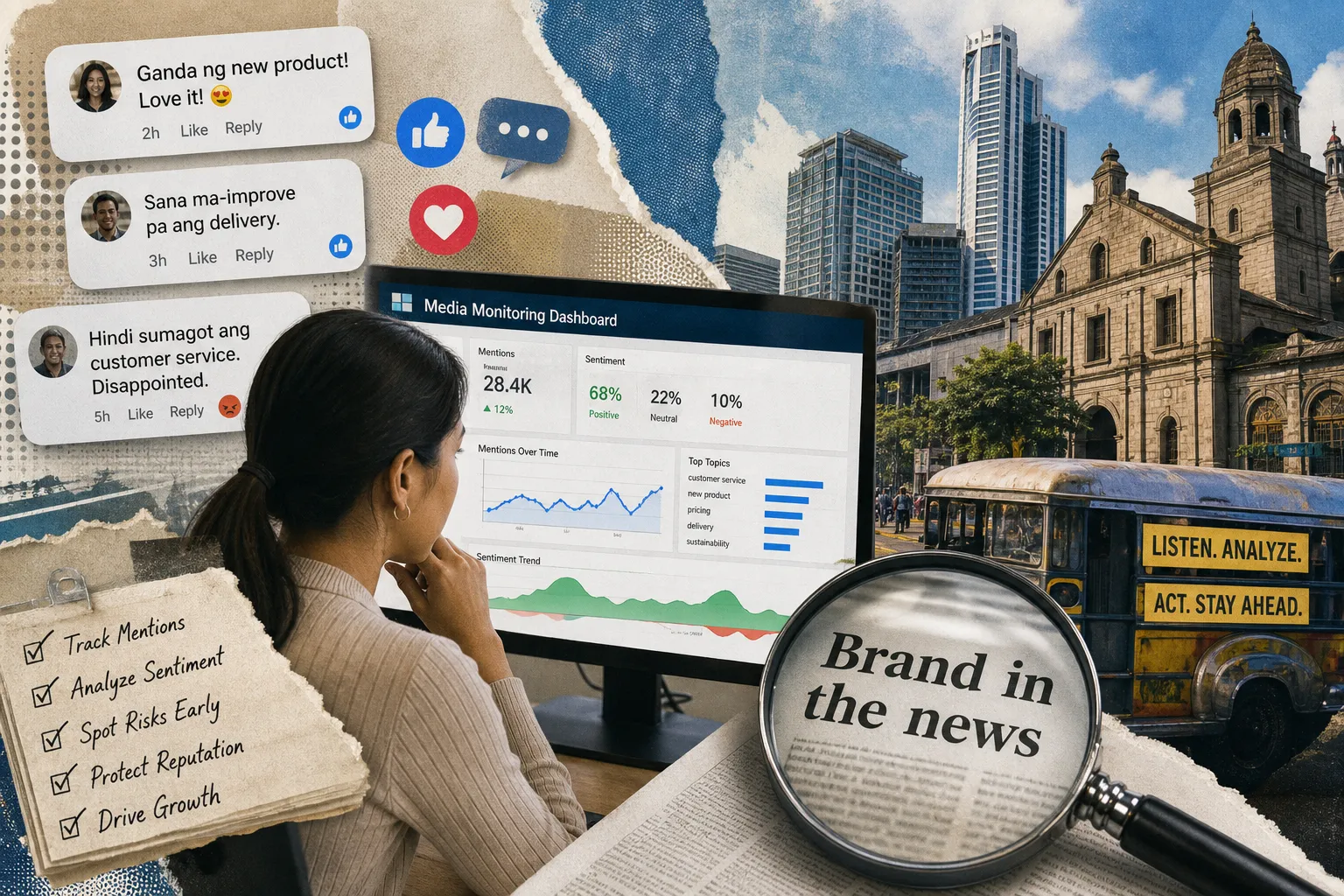
Every day, billions of people create social media data just by saying what they think about brands, products, and each other, in public, for free. In 2026, more than 5.41 billion people use social media worldwide, about 68.5% of the global population. In the Philippines alone, DataReportal counts 95.8 million social media identities, generating opinions, complaints, and purchase signals around the clock.
Most of that conversation never reaches a boardroom slide. It sits in comment sections, quote-posts, and TikTok duets, waiting for someone on your team to notice it before a competitor does.
That's the real value of social media data: not the follower count on your own dashboard, but the raw, unfiltered signal moving through everyone else's. Here's where the competitive edge is hiding, and how you can start pulling it out.
Social Media Data Advantages
- Early trend detection
- Competitor customer insight
- Faster product feedback
- Crisis prevention
- Partnership and whitespace discovery
- A durable, owned-adjacent data asset
- A report leadership doesn't have to double-check
What Counts as "Social Media Data," Exactly?
Before you go hunting for advantages, it helps to define the target. Social media data isn't just your own post analytics. It spans four broad categories: engagement and performance data (likes, shares, watch time, click-through), audience and demographic data (who's talking, where they are, what else they follow), conversation and sentiment data (mentions, reviews, comments, and the emotional tone behind them), and competitive data (a rival's posting cadence, share of voice, and audience reaction). The last three categories are where the hidden advantages live.
1. You Can Catch Trends 48 to 72 Hours Before They Go Mainstream
Social listening in 2026 has moved well past counting hashtags: AI-powered platforms now analyze hashtag velocity, micro-community activity, and early-adopter conversation to flag topics before they break into mainstream feeds, with some tools claiming to spot viral trends 48 to 72 hours before they peak. That head start matters even more in the Philippines, where Filipino users spend over 3.5 hours a day on social platforms and visit an average of eight different sites monthly, meaning the same trend can surface on TikTok well before it reaches Facebook feeds. Catching it on the platform where it's forming, through a real-time intelligence engine, is the difference between publishing at the peak and publishing after everyone else already has. The advantage isn't having more data than your rivals, it's noticing the same data one to three days sooner.
2. You See What Competitors' Customers Actually Think
Your competitor's internal reports are private, but their audience's reactions aren't: competitor benchmarking data, from posting cadence to comment sentiment, reveals gaps in the market and opportunities to differentiate your own brand that neither company would ever put in a press release. Say a rival telco launches a new data plan and the comments under their own announcement are lukewarm, that's not something they'll bring up on an earnings call, but it's sitting in plain view for any team watching. The stakes are especially high in the Philippines, where TikTok, Instagram, and YouTube collectively account for over 60% of product discovery, surpassing Google, so if you're only watching your own share of voice and not your competitor's, you're reading half the story on the exact channel where purchase decisions get made. Benchmark your competitor's comment section as closely as you benchmark their follower count, that's where the real signal is.
3. You Get Product Feedback Before It Reaches Your Support Queue
Customers describe what they love, what confuses them, and what they wish existed, constantly and unprompted, in public comments: social listening data functions as a goldmine for product feedback, with people suggesting features and flagging bugs long before those same complaints reach a formal support ticket. That same conversation works as an early-warning system too, since product feature feedback, pricing confusion, and service cues can predict churn risk or demand shifts well before they show up in a quarterly review. In the Philippines, this plays out live: TikTok Shop and Facebook live-selling comment sections function as real-time, unfiltered focus groups, where buyers question pricing, sizing, and delivery timelines in front of thousands of viewers at once, and a sentiment analysis layer turns that raw commentary into a pattern your product team can act on. The support queue tells you what already broke, social conversation tells you what's about to.
4. You Prevent Reputation Crises Instead of Cleaning Up After Them
Reputation risk moves fast: a crisis can spread across platforms within hours, not days, and 63% of a company's market value is tied to reputation. The damage can be immediate: a celebrity's offhand comment at a press conference once preceded a $4 billion drop in Coca-Cola's market value, yet only 31% of marketers believe they manage their brand's online reputation well, according to the same report. Picture a Philippine telco facing a data-privacy complaint that starts as a single comment thread: a team watching sentiment in real time catches the tone shift before it trends and gets ahead of it with a statement, while a team checking mentions once a day finds out from the news. This matters most with younger audiences, since 67% of Gen Z and 61% of millennials say social media is their preferred source for crisis-related news, ahead of traditional press, so Philippine brands are shifting from reactive damage control toward proactive sentiment monitoring paired with real-time alerts that flag a shift in tone before it becomes a headline. By the time a crisis is trending, you're already behind, the advantage is in the sentiment shift that happens before the trend.
5. You Spot Partnership and Whitespace Opportunities Competitors Miss
Social data doesn't just show you what's working for a competitor, it shows you where their audience is quietly checking out: community-based analysis can map a rival's audience into distinct segments and track engagement over time, and the communities where a competitor's engagement decays first are often the highest-value opportunity for your own brand to move in, provided you have the credibility and product to fill the gap. The same underlying data surfaces adjacent opportunities too, recurring conversation themes, unmet needs, and emerging categories that suggest where a partnership or co-branded product could land, and in the Philippines' fast-growing social commerce environment, where live selling, short-form video, and micro-seller "shoppertainment" are reshaping how products get discovered, spotting these openings early through competitive media intelligence can mean reaching an audience segment months before a larger competitor notices it's underserved. A competitor's weak spot isn't always a flaw in their product, sometimes it's an audience they've simply stopped listening to.
6. You Build an Owned Data Asset as Privacy Rules Tighten
Third-party tracking keeps getting harder to rely on: Google abandoned its plan to fully phase out third-party cookies in Chrome, shifting instead to a user-choice model, but the direction of travel for marketers hasn't changed, and the same report notes 87% of organizations are now leaning on first-party data, with 55.1% of marketers saying owned data is far more important now than it was two years ago. A retailer that used to lean on ad-platform targeting alone now has to rebuild that audience picture from what it owns, or can legally observe in public, and social media data occupies a useful middle ground in that shift: it isn't collected through cookies or cross-site tracking, it's drawn from what people choose to say publicly, which makes it a durable, compliant signal source even as third-party targeting keeps getting more restricted. For teams already investing in owned channels, a structured view of public conversation, through a platform built for consistent, ongoing monitoring, adds a layer of insight that doesn't erode as privacy regulations evolve. As tracking gets harder, listening gets more valuable, public conversation was never dependent on a cookie to begin with.
7. You Stop Reconciling Spreadsheets Before Every Report
The last hidden advantage isn't a data source, it's what happens when social data stops living in its own separate dashboard: integrating social intelligence with existing business intelligence and CRM systems closes the gap between social signal and everyday decision-making, instead of leaving it as a report that only your team ever opens. For whoever is building the monthly report, this is the difference between manually cross-referencing three exports before a meeting and pulling one number that's already been checked against sales and support data, since done well, social signals can feed pipeline forecasts, flag churn risk early, and shape product roadmaps automatically instead of staying siloed inside the social team's own dashboard. Philippine teams that connect their reporting and analytics to the rest of the business consistently spend less time formatting slides and more time acting on what the data shows. Data trapped in a social dashboard is a report you have to defend, data connected to the rest of your stack defends itself.
Ready to see these advantages in your own data? Media Meter helps you track sentiment and share of voice across social, broadcast, and print, so you catch the story wherever it starts. Request a demo to see it against your own brand and competitors.