ASEAN Trade Bloc Meets in Manila as Marcos Faces Protests
ASEAN economic ministers signed an investment protocol with Hong Kong and opened talks with Japan and South Korea on supply chains and energy security, while Manila braced for nationwide martial law anniversary protests and the Sara Duterte impeachment trial entered its eleventh week.
The Conversation
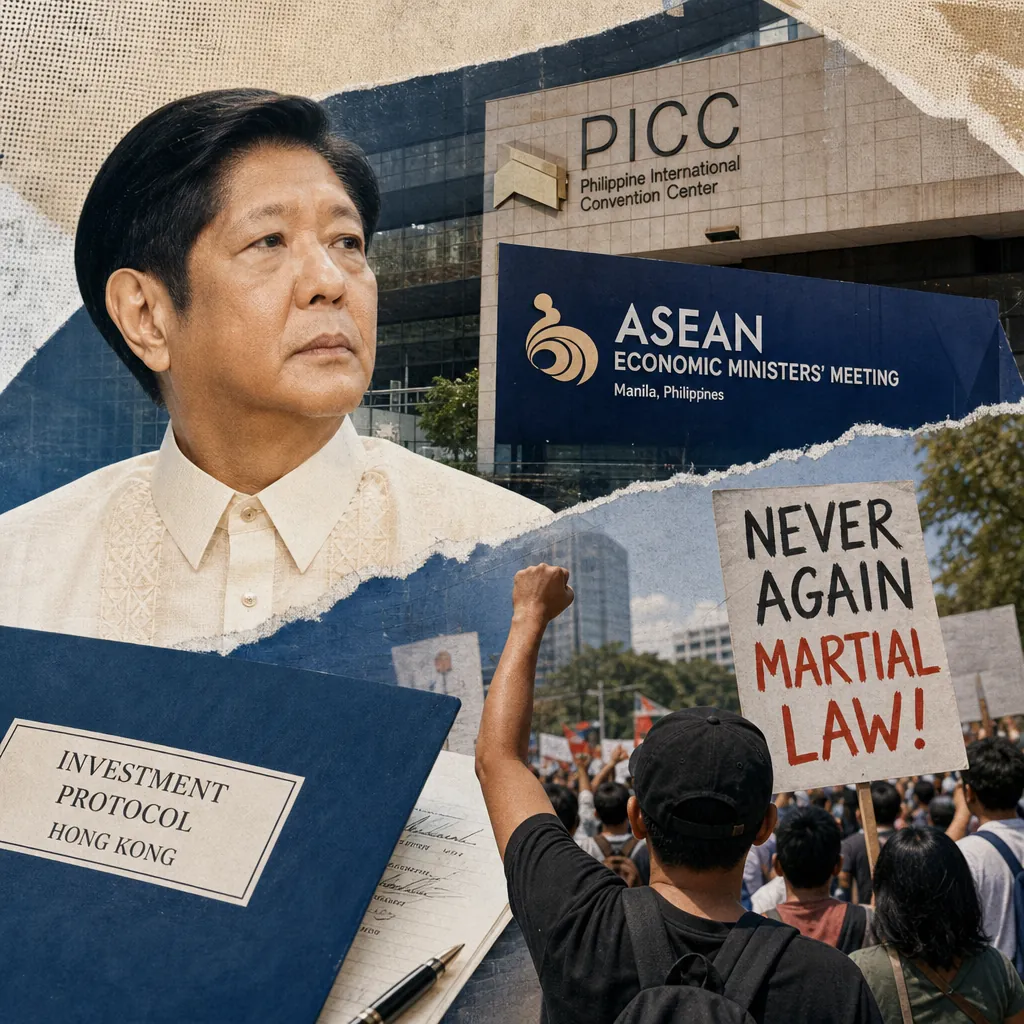
Trade ministers from the Association of Southeast Asian Nations (ASEAN) and Hong Kong signed a protocol amending their investment agreement at the Philippine International Convention Centre in Pasay City on Sunday, one of three separate ministerial consultations held the same day as the Philippines hosted the bloc's economic meetings.3 The same venue hosted the 32nd ASEAN Economic Ministers–Ministry of Economy, Trade and Industry Consultation with Japan, co-chaired by Trade Secretary Ma. Cristina Roque and Japan's Minister of Economy, Trade and Industry Akazawa Ryosei, and the 23rd ASEAN Economic Ministers–Republic of Korea Consultation, co-chaired by Roque and South Korean Minister for Trade Park Jung-sung.12 The three meetings produced a signed protocol, a joint statement, and a shared acknowledgment that geopolitical tensions and energy-market volatility are making the international trading environment harder to predict, particularly for micro, small and medium-sized enterprises.1
Domestically, the day's news was dominated by preparations for Monday's 54th anniversary of the 1971 declaration of martial law. The Philippine National Police (PNP) said it would deploy more than 17,000 personnel nationwide, including 8,553 from the National Capital Region Police Office, 465 from Regional Support Units, 1,000 from the Reactionary Standby Support Force, 1,000 each from the Cordillera and Ilocos regional offices, 2,000 each from Central Luzon and Calabarzon, and 1,000 from the Philippine Coast Guard.11 The National Capital Region Police Office later raised its own figure to 17,085 personnel, including crowd dispersal contingents.22 Malacañang announced a lockdown of the palace complex, closing the New Executive Building and suspending operations of the Presidential Action Center, the frontline office that handles citizen requests for guarantee letters and complaints against government agencies.5 Quezon City warned of slower traffic around the EDSA People Power Monument, and Manila Mayor Isko Moreno Domagoso suspended face-to-face classes.100
The impeachment trial of Vice President Sara Duterte entered its eleventh week with the Senate impeachment court hearing sharply divided testimony on the vote threshold required for conviction, while prosecutors continued building their case on alleged unexplained wealth.4 Three retired chief justices told the court the two-thirds threshold need not be fixed at 16 votes, arguing that senators legally or physically unable to participate should not be counted in the denominator; retired Associate Justice Adolfo Azcuna disagreed, saying "all means all" and that the full 24-member Senate should remain the basis.4 Prosecutors presented evidence from Duterte's own Statements of Assets, Liabilities and Net Worth (SALNs), the annual financial disclosures required of all Philippine public officials, including testimony that her declared net worth rose by ₱91.4 million, or 1,260.7 percent, from 2007 to 2025.4 The House prosecution has subpoenaed an official of the Securities and Exchange Commission (SEC), the agency that registers corporations and monitors their ownership; an assistant commissioner of the Civil Service Commission (CSC), which governs the civil service; and the chief of the Philippine Government Electronic Procurement System (PhilGEPS) division at the Department of Budget and Management, the government's central online portal for public bidding, to testify on Duterte's declared business interests and possible government contracts.57 Davao City Mayor Sebastian "Baste" Duterte was subpoenaed not as the vice president's brother but because of his official knowledge of transactions between the Davao City government and a company in which his sister had reportedly declared a financial interest, according to House trial spokesperson Zia Alonto Adiong.70 Oral arguments on the vote-threshold question are set for Wednesday, with House prosecutor Rep. Leila de Lima expected to represent the prosecution panel.79
Key themes
- ASEAN and Hong Kong signed an investment protocol to make cross-border investment rules more predictable. The First Protocol to Amend the ASEAN-Hong Kong, China Investment Agreement (AHKIA) was signed at the 10th ASEAN Economic Ministers–Hong Kong, China Consultation, co-chaired by Roque and Hong Kong Undersecretary for Commerce and Economic Development Bernard Chan. The meeting said the protocol would enhance the predictability and certainty of investment regimes for investors on both sides and urged parties to resolve outstanding issues under the AHKIA Work Programme.3
- ASEAN and Japan agreed to strengthen supply chain resilience and energy security. The 32nd consultation noted that rising geopolitical tensions, trade-related uncertainties and regional conflicts continue to undermine the stability and predictability of the international economic environment, creating challenges particularly for micro, small and medium-sized enterprises, and flagged increased volatility in global energy markets including risks to key energy supply routes in West Asia and straits used for international navigation.1
- ASEAN and South Korea called for closer, more practical economic partnership. The 23rd consultation discussed progress on the ASEAN-Korea Free Trade Area Upgrade negotiations, the regional and global economic situation, and ways to advance cooperation, with a joint statement issued afterward.2
- More than 17,000 police will be deployed nationwide for the martial law anniversary. The PNP deployment includes regional support units, a reactionary standby force, and Philippine Coast Guard personnel, with barricades and container vans set up at Ayala Bridge in Manila as early as Sunday evening.1122
- Malacañang will be locked down Monday, closing the New Executive Building and suspending the Presidential Action Center. The Presidential Communications Office cited "standard security protocols," and road and gate access to Malacañan Palace will be restricted.5
- The impeachment trial's vote-threshold dispute remains unresolved. Three retired chief justices argued the two-thirds requirement need not be fixed at 16 votes, while retired Associate Justice Adolfo Azcuna said the full 24-member Senate should remain the basis. Oral arguments are set for Wednesday.479
- Prosecutors presented SALN evidence showing Duterte's declared net worth rose by ₱91.4 million, or 1,260.7 percent, from 2007 to 2025. The SALN is the annual financial disclosure required of all Philippine public officials. The prosecution also began laying groundwork for comparisons with corporate, procurement and financial records.4
- The government and the Moro Islamic Liberation Front deployed peacekeepers to defuse clan-feud tensions in the Bangsamoro region. The Coordinating Committee on the Cessation of Hostilities, the Ad Hoc Joint Action Group, and Joint Peace and Security Teams coordinated with local governments and MILF commanders since Sept. 16 to prevent a long-standing "rido" over territorial control from escalating. The government Peace Implementing Panel said tensions have since eased.4751
How the narratives stack
Dominant: The ASEAN economic ministerial meetings in Pasay City produced the day's most consequential diplomatic output — a signed investment protocol with Hong Kong, a joint statement with South Korea, and a supply-chain and energy-security agreement with Japan.123 These are the kind of agreements that shape the rules under which Philippine and regional companies trade and invest for years. The meetings drew coverage from Bernama, the Malaysian national news agency, which carried all three stories through the Philippine News Agency.123 Within the items captured here, the ASEAN meetings and the martial law anniversary preparations together account for the bulk of the day's news volume, though the two stories occupy different registers — one diplomatic and forward-looking, the other domestic and security-focused.
Counter-narrative: The impeachment trial of Vice President Sara Duterte continued to generate the heaviest single-story coverage in the captured set, with the Inquirer's week-eleven recap alone carrying an estimated ₱584,388 in advertising-equivalent value — the notional cost of buying the same newspaper space as paid advertising.4 The Manila Times' podcast headline on the SEC, CSC and PhilGEPS witnesses carried ₱590,276 in equivalent value.57 These figures reflect the space the stories occupied in their outlets, not audience size. The trial's legal question — whether conviction requires 16 votes out of 24 senators or a shifting threshold based on active participation — has no precedent in Philippine impeachment history, and the Senate court's ruling will determine how difficult it is to convict any future impeachable official.479
Emerging: The government and MILF peace mechanisms moved to contain a localized clan conflict in the Special Geographic Area of the Bangsamoro Autonomous Region in Muslim Mindanao (BARMM), the autonomous region created by the 2019 Bangsamoro Organic Law to replace the Autonomous Region in Muslim Mindanao.4751 The Coordinating Committee on the Cessation of Hostilities and the Ad Hoc Joint Action Group — joint government-MILF bodies established under the 2014 Comprehensive Agreement on the Bangsamoro — intervened alongside Joint Peace and Security Teams to prevent the "rido," a family feud over territorial control, from spreading.47 Government Peace Implementing Panel Chair and Presidential Peace Adviser Secretary Mel Senen Sarmiento said the joint ceasefire mechanisms remain in place and tensions have eased.51 The story matters because BARMM held its first regular parliamentary elections only recently, and the region's stability depends on keeping local armed disputes from drawing in larger factions.
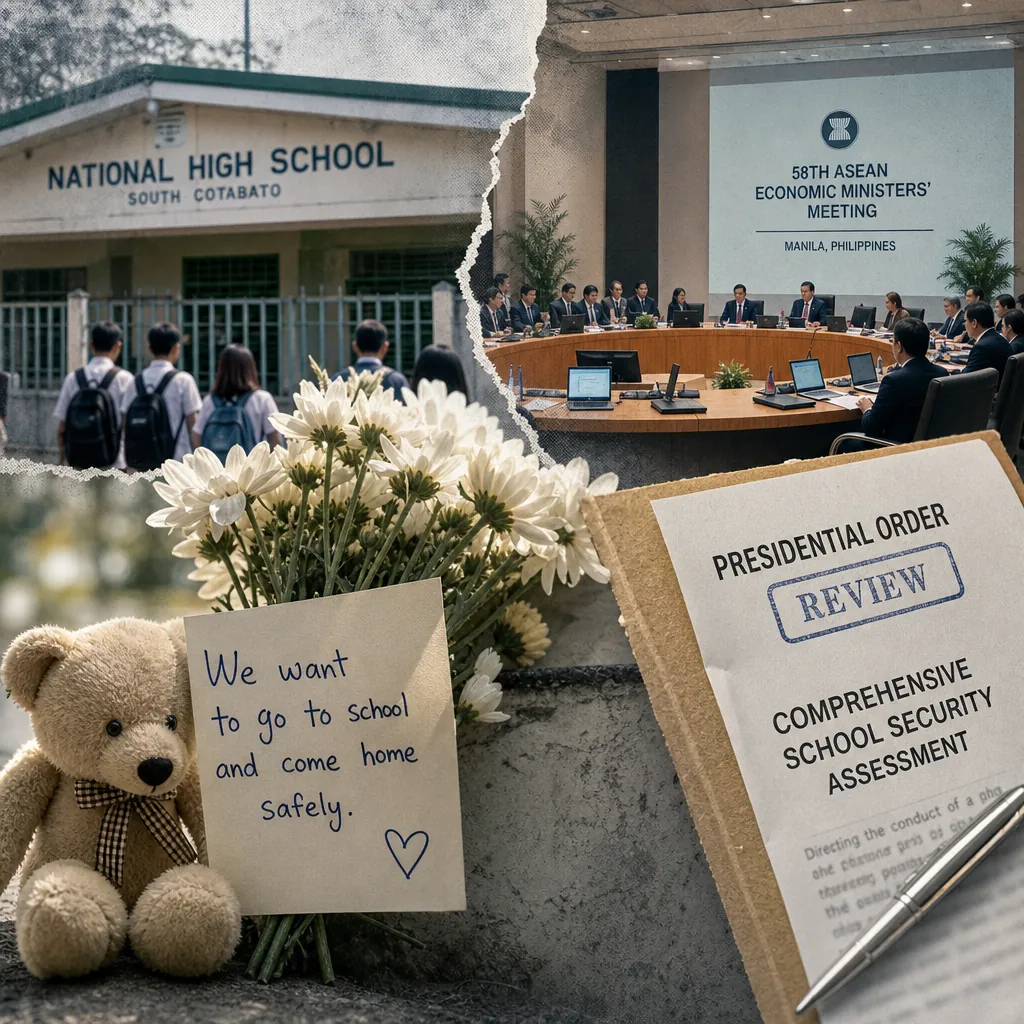
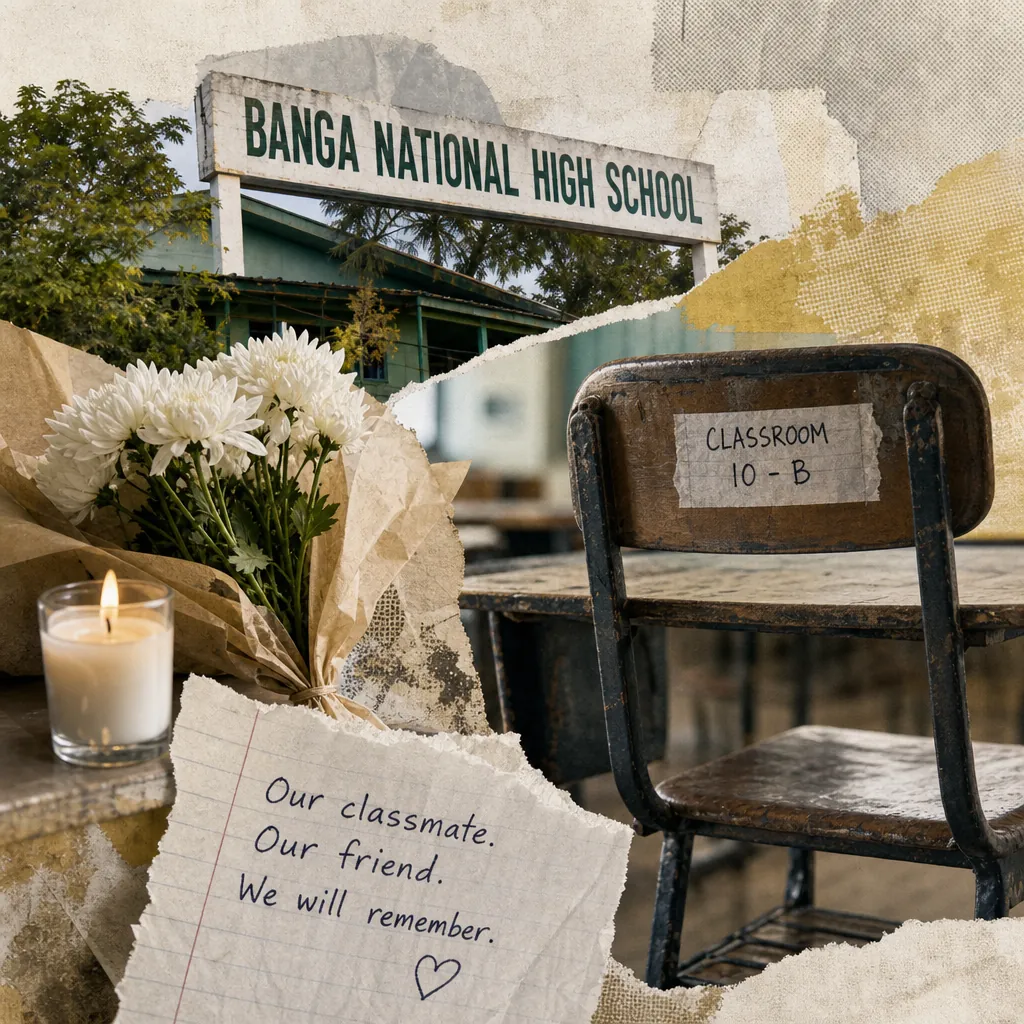
Under-covered: The Department of Education's response to school violence drew limited attention in the captured set despite the fatal shooting at Banga National High School in South Cotabato. DepEd outlined four steps on its official Facebook account: pushing a Joint School Safety Task Force with the Department of the Interior and Local Government and the PNP, conducting deeper security assessments, reviewing existing safety measures to identify gaps, and accelerating the hiring of School Counselor Associates.40 Three local government units in Sultan Kudarat suspended in-person classes for Monday after reported school threats.23 A 14-year-old student may be credited with saving at least 30 classmates by preventing the Grade 9 shooter from entering their classroom, according to Department of Social Welfare and Development Assistant Secretary Irene Dumlao; the student kicked the shooter and barricaded the door with a chair, and was injured when the suspect fired through the classroom window.68 The DSWD pledged financial assistance and psychosocial intervention for affected students.68
Platform insights
- Facebook: DepEd used its official Facebook page to announce its four-point school safety response, framing the measures as proactive rather than reactive: "Sa harap ng insidente ng karahasan sa mga paaralan, batid natin na kailangan ang mas maagap na aksyon—hindi lamang matapos ang insidente, kundi upang maiwasan ito."40 The post is notable for what it signals about institutional communication strategy — the department chose a social platform over a press conference to reach parents and teachers directly. Senator Bong Go also used Facebook to announce his opposition to the proposed passport fee increase from ₱950 to ₱1,500, citing the Middle East crisis, rising oil prices, and unemployment data from July 2026.95
- X (formerly Twitter): U.S. Attorney for the Southern District of Florida Jason Reding Quiñones used X to announce the extradition of 18 suspects in the 2021 assassination of Haitian President Jovenel Moïse, writing: "Today marks the next major phase in our pursuit of accountability for the assassination of President Jovenel Moïse. We will follow the evidence wherever it leads, to those who financed it, facilitated it, supported it or committed crimes to make it possible."39 The platform remains a primary channel for official legal and diplomatic announcements.
- YouTube and video platforms: A video of NLEX guard Enoch Valdez in a heated exchange with Changwon LG Sakers import Archie Goodwin, which appeared to originate from a South Korean television station, circulated online. The incident occurred during a tuneup game at Upper Deck Sports Center in Ortigas and nearly escalated before other players, including Carl Tamayo, intervened.6 The clip's spread illustrates how local sports incidents can travel through foreign broadcast footage before Philippine outlets pick them up.
- Instagram: Actress Kate Beckinsale's since-deleted Instagram posts — one with the word "bye" in white text on black, another reading "Congratulations. You won. I give up" over a rainbow photo — sparked concern among followers. Beckinsale has been open about grief following her mother's death in July 2025 and her stepfather's death in 2024.41 The episode shows how celebrity mental-health signals can generate widespread attention even when the posts are removed within hours.
Key voices and communities
Trade and economic diplomacy officials: Trade Secretary Ma. Cristina Roque co-chaired all three ASEAN consultations, positioning the Philippines as host and agenda-setter during its turn at the center of regional economic diplomacy.123 Japan's Minister of Economy, Trade and Industry Akazawa Ryosei and South Korea's Minister for Trade Park Jung-sung represented their governments, while Hong Kong Undersecretary for Commerce and Economic Development Bernard Chan signed the investment protocol.123 These officials shape the rules that determine how easily goods, services and investment move across the region.
Philippine law enforcement and security agencies: The PNP and NCRPO are the operational leads for Monday's deployments, with spokesperson P/Lt. Col. Hazel Asilo confirming the 17,085 figure.22 The Presidential Communications Office and the Presidential Action Center issued the lockdown advisories.5 Their framing — "standard security protocols" and "public safety" — emphasizes routine procedure over political context.
Impeachment prosecutors and defense: House prosecutor Rep. Leila de Lima will argue the prosecution's position on the vote threshold Wednesday, with Rep. Chel Diokno confirming her role in a DZBB radio interview.79 The defense has not yet presented its case on Article II. The retired chief justices who testified as amici curiae — legal experts invited by the court to advise on a legal question — split on the threshold interpretation, with Azcuna's "all means all" position representing the stricter reading.4
Peace process mechanisms in Mindanao: The government Peace Implementing Panel, the Coordinating Committee on the Cessation of Hostilities, the Ad Hoc Joint Action Group, and the Joint Peace and Security Teams are the institutional architecture that keeps the government-MILF ceasefire intact. Presidential Peace Adviser Secretary Mel Senen Sarmiento is the government's lead voice.4751 Their rapid intervention in the SGA-BARMM rido demonstrates that the mechanisms built after the 2014 peace agreement are operational, not just ceremonial.
Local government units and school communities: The Sultan Kudarat LGUs of Lebak and Isulan suspended classes as a precaution after reported threats.23 DepEd's central office and its regional counterparts are managing the national response to school violence, while the DSWD is handling psychosocial support.4068 These local actors are the first responders when national policy meets on-the-ground crisis.
Narrative streams
ASEAN signs investment protocol with Hong Kong and opens supply-chain talks with Japan and South Korea
The three ministerial consultations held Sunday at the Philippine International Convention Centre represent the Philippines' most visible diplomatic output of its ASEAN chairmanship year. The signed protocol amending the ASEAN-Hong Kong, China Investment Agreement is a technical document, but its purpose is straightforward: to make the rules governing cross-border investment more predictable so that companies in ASEAN and Hong Kong can put money into each other's markets with less legal uncertainty.3 The meeting urged parties to continue resolving outstanding issues under the AHKIA Work Programme, acknowledging that the agreement is not yet complete.3
The Japan consultation produced a shared acknowledgment that the international economic environment is becoming less stable. The meeting noted that rising geopolitical tensions, trade-related uncertainties and regional conflicts "continue to undermine the stability and predictability of the international economic environment, creating challenges for businesses, particularly micro, small and medium-sized enterprises."1 It also flagged increased volatility in global energy markets, including risks to key energy supply routes in West Asia and straits used for international navigation — a reference to the Strait of Hormuz and the Bab al-Mandab, both of which have seen disruptions linked to the Saudi-Houthi conflict.1 For Philippine businesses that import fuel and raw materials, these are not abstract concerns; they translate directly into shipping costs and input prices.
The South Korea consultation focused on the ASEAN-Korea Free Trade Area Upgrade negotiations, which aim to modernize an agreement that has been in force since 2010. The joint statement called for "closer and more practical" cooperation.2 The read for the sector: Philippine exporters and importers gain from any reduction in tariff and non-tariff barriers across these three partners — Japan, South Korea and Hong Kong are among the country's top trading partners — but the benefits depend on whether the upgraded agreements are actually implemented and whether Philippine firms can meet the rules of origin and standards they set. The meetings produced frameworks and statements; the commercial effect will show up in trade data over the next two to three years, not immediately.
Martial law anniversary draws 17,000 police and a Malacañang lockdown
Monday marks 54 years since President Ferdinand Marcos Sr. declared martial law in 1972, beginning a period of authoritarian rule that lasted until the 1986 People Power Revolution. The anniversary has become an annual focal point for protest, and this year it coincides with the anniversary of the Trillion Peso March, when various sectors staged mass protests over alleged corruption in government flood-control projects.11 The combination of the two anniversaries, plus the ongoing impeachment trial of Vice President Sara Duterte, has raised the expected scale of Monday's demonstrations.
The PNP's deployment of more than 17,000 personnel is one of the largest single-day domestic security mobilizations in recent memory. The breakdown — 8,553 in Metro Manila, 2,000 each from Central Luzon and Calabarzon, 1,000 each from the Cordillera and Ilocos regions, plus coast guard personnel — reflects an assessment that protests will occur in multiple cities, not just the capital.11 Barricades and container vans were already in place at Ayala Bridge by Sunday evening.22 The Malacañang lockdown closes the New Executive Building, which houses a number of palace offices, and suspends the Presidential Action Center, the office that processes citizen requests for guarantee letters and complaints against government agencies.5 The suspension of the action center means that for at least one day, the public's primary channel for seeking help from the Office of the President will be unavailable.
The read for the sector: government communicators and local government units face a day of heightened public attention and potential disruption. Quezon City has advised motorists to take alternative routes around the EDSA People Power Monument, and Manila has suspended face-to-face classes.100 The challenge for agencies is to keep essential services running while managing crowd control, and to communicate clearly about closures and alternative arrangements without appearing to restrict the right to assemble.
Impeachment trial enters week eleven with vote-threshold dispute and SALN evidence
The Senate impeachment court heard testimony from three retired chief justices on whether the two-thirds threshold for conviction — 16 votes out of 24 senators — should be computed on the full Senate or only on senators who are able to participate. The distinction matters because if the threshold is fixed at 16, the prosecution must convince at least 16 of the 24 senators; if the denominator shrinks to reflect only active participants, the number of votes needed could fall. Retired Associate Justice Adolfo Azcuna's position that "all means all" represents the stricter reading, while the three other retired chief justices argued for flexibility.4
Separately, prosecutors presented SALN evidence showing that Duterte's declared net worth rose by ₱91.4 million, or 1,260.7 percent, from 2007 to 2025.4 The SALN is the annual financial disclosure required of all Philippine public officials under the Code of Conduct and Ethical Standards for Public Officials and Employees; it lists assets, liabilities, and net worth, and is meant to allow the public to detect unexplained wealth. The prosecution also began laying groundwork for comparisons with corporate, procurement and financial records, and secured subpoenas for an SEC official, a CSC assistant commissioner, and the PhilGEPS division chief at the DBM.57 These witnesses are expected to testify on Duterte's declared business interests and possible government contracts.57
Davao City Mayor Sebastian Duterte was subpoenaed to testify, with House trial spokesperson Zia Alonto Adiong clarifying that the mayor is being called because of his official knowledge of transactions between the Davao City government and a company in which his sister had reportedly declared a financial interest, not because of his family relationship to the vice president.70 Oral arguments on the vote-threshold question are set for Wednesday, with Rep. Leila de Lima representing the prosecution.79
The read for the sector: the impeachment trial is the single most consequential political process in the country, and its outcome will determine not only the vice president's future but also the precedent for how future impeachments are conducted. The vote-threshold ruling, in particular, will shape the balance of power between the Senate and the House in any future impeachment proceeding. For government agencies, the subpoenas mean that SEC, CSC and DBM officials will be drawn into the trial as witnesses, with the attendant reputational and operational implications.
Government and MILF peace mechanisms contain a clan feud in the Bangsamoro region
The government and the Moro Islamic Liberation Front deployed joint peace mechanisms to defuse tensions in the Special Geographic Area of the Bangsamoro Autonomous Region in Muslim Mindanao, where some MILF commanders and their followers had been engaged in sporadic skirmishes over a long-standing "rido" — a family feud over territorial control.47 The Coordinating Committee on the Cessation of Hostilities and the Ad Hoc Joint Action Group, supported by Joint Peace and Security Teams, coordinated with local government units and concerned MILF commanders since Sept. 16 to prevent the conflict from escalating.51
The CCCH and AHJAG are joint government-MILF bodies established under the 2014 Comprehensive Agreement on the Bangsamoro, the peace deal that ended decades of armed conflict and led to the creation of BARMM. The JPSTs are the on-the-ground units that monitor ceasefires and separate combatants. Their intervention in the SGA-BARMM rido is a test of whether the peace architecture can handle localized disputes that are not part of the main government-MILF conflict but could destabilize the region if left unchecked.47
Government Peace Implementing Panel Chair and Presidential Peace Adviser Secretary Mel Senen Sarmiento said the joint ceasefire mechanisms remain in place and are assisting local authorities in de-escalating the rido, and assured the public that tensions have eased.51 The read for the sector: BARMM's stability depends on keeping local armed disputes from drawing in larger factions or undermining confidence in the peace process. The rapid deployment of peacekeepers shows the mechanisms are functioning, but the underlying land and clan disputes that fuel ridos remain unresolved and will require longer-term mediation.
School violence response and the Banga shooting
The fatal shooting at Banga National High School in South Cotabato prompted a national response from the Department of Education, which outlined four steps on its official Facebook account: pushing a Joint School Safety Task Force with the Department of the Interior and Local Government and the PNP, conducting deeper security assessments, reviewing existing safety measures to identify gaps, and accelerating the hiring of School Counselor Associates.40 DepEd framed the measures as proactive: "Sa harap ng insidente ng karahasan sa mga paaralan, batid natin na kailangan ang mas maagap na aksyon—hindi lamang matapos ang insidente, kundi upang maiwasan ito."40
Three local government units in Sultan Kudarat — Lebak, Isulan, and one other — suspended in-person classes for Monday after reported school threats.23 The suspensions were precautionary while authorities investigated. Additional security personnel were deployed to protect students and teachers.23 A 14-year-old student may be credited with saving at least 30 classmates by preventing the Grade 9 shooter from entering their classroom; according to DSWD Assistant Secretary Irene Dumlao, the student kicked the shooter and barricaded the door with a chair, and was injured when the suspect fired through the classroom window.68 The DSWD pledged financial assistance and psychosocial intervention for affected students.68
The read for the sector: school safety is now a national policy concern, not just a local law enforcement matter. The Joint School Safety Task Force brings DepEd, DILG and PNP into a formal coordination structure, which means schools will need to comply with security assessments and potentially adjust physical infrastructure. The hiring of School Counselor Associates addresses a long-standing gap in mental health support, but the pace of hiring will determine whether the response is substantive or symbolic.
Japan signals openness to funding the Mindanao Railway Project
Japanese Consul General in Davao Ono Hirotaka said Japan is open to studying possible funding support for the Mindanao Railway Project if formally requested by the Philippine government. "Of course, we will study if the Philippine government asks for assistance. We are ready to study," Ono said at the Japan-Philippines Friendship Kadayawan Matsuri Night on Friday evening at Dusit Thani Davao.97 He clarified that there are no known discussions at his level, noting that such negotiations are handled by the Japanese Embassy in Manila.97
The Mindanao Railway Project, one of the government's flagship infrastructure programs, remains without a confirmed funding source, with transport officials acknowledging that financing is still "up in the air."97 The project is envisioned to span key cities across Mindanao, starting with the Tagum-Davao-Digos segment, as part of a larger network aimed at improving connectivity in the southern island.84 The read for the sector: the railway's fate depends on whether the Philippine government formally requests Japanese assistance and whether Japan's own budget and diplomatic priorities allow for a major new commitment. For now, the project remains in planning, and the absence of confirmed funding means construction timelines cannot be set.
Philippine gambling revenue falls 20 percent as digital shift brings new risks
Philippine gross gambling revenue fell 20 percent in the second quarter to ₱88 billion, or about $1.4 billion, according to figures presented at the Inside Asian Gaming Academy Summit. The decline was attributed largely to weaker electronic gambling revenues, inflationary pressures, and geopolitical tensions.67 Despite the slowdown, speakers said the country retains several advantages, including an established gambling ecosystem, integrated resorts, a skilled workforce, a relatively young population, and a strategic location within Asia.67 Land-based casinos remain a major part of the market even as electronic and online gambling platforms continue to expand.67 Philippine Amusement and Gaming Corp. chairman Alejandro Tengco said advances in technology and digital connectivity have created new opportunities.67
The read for the sector: the 20 percent quarterly decline is a significant contraction for an industry that had been expanding rapidly. The shift toward electronic and online gambling brings new regulatory challenges, including consumer protection, money laundering risks, and the need for robust licensing and monitoring systems. The industry's long-term health depends on whether regulators can keep pace with technological change while maintaining public confidence.
AI growth raises copyright and jobs concerns in the ASEAN creative sector
Artificial intelligence and digital platforms are changing how creative works are produced, distributed, and monetized across Southeast Asia, while raising concerns over intellectual property rights, authenticity, and jobs, according to a study by the ASEAN Business Advisory Council.66 Global exports of creative services reached $1.7 trillion in 2024, more than double the $709 billion generated by creative goods exports.66 The technological shift has emerged as a key issue in the Philippines' creative economy agenda during its 2026 ASEAN chairship, as the regional bloc seeks to develop creative output into commercially viable intellectual property, exports, and investments.66
The read for the sector: creative workers and businesses in ASEAN face a dual challenge — adapting to AI tools that can generate content at scale while protecting their intellectual property and livelihoods. The ASEAN-BAC study signals that regional policymakers are aware of the tension, but concrete regulatory frameworks for AI and copyright in the creative sector are still being developed.
Conversation trajectory
ASEAN economic agreements implementation (next 6–12 months): The signed AHKIA protocol and the joint statements with Japan and South Korea will require ratification and implementation. Watch for announcements on when the protocol enters into force and whether the ASEAN-Korea FTA Upgrade negotiations conclude. The supply-chain and energy-security cooperation with Japan will likely produce working-group meetings and technical exchanges in the coming months.
Impeachment trial vote-threshold ruling (this week): Oral arguments are set for Wednesday, and the Senate court's ruling on the vote threshold will determine the trajectory of the trial. If the court adopts a flexible threshold, the prosecution's path to conviction becomes easier; if it fixes the threshold at 16, the prosecution must secure a larger absolute majority. Watch for the court's ruling and any subsequent motions from either side.
Martial law anniversary protests (Monday): The scale and tone of Monday's protests will indicate the current temperature of public sentiment toward the administration and the impeachment process. Watch for crowd estimates, any clashes with police, and whether the protests remain peaceful. The suspension of the Presidential Action Center and the Malacañang lockdown will be tested against the reality of the demonstrations.
School safety policy implementation (next 3–6 months): DepEd's four-point plan will move into implementation, with the Joint School Safety Task Force expected to conduct assessments and recommend changes. Watch for the pace of School Counselor Associate hiring and whether the task force produces concrete security standards for schools.
Mindanao Railway funding (next 6–12 months): Japan's openness to studying funding support is a signal, not a commitment. Watch for a formal request from the Philippine government and any subsequent feasibility or financing discussions. The project's status will also depend on the broader Philippine infrastructure budget and the government's fiscal position.
Trigger events: The Senate impeachment court's ruling on the vote threshold; the outcome of Monday's protests; any formal Philippine request for Japanese funding for the Mindanao Railway; the next quarterly gambling revenue data; and the implementation timeline for the AHKIA protocol.
Response guidance
For government communicators preparing for Monday's protests: Coordinate messaging across agencies to ensure consistent information about road closures, class suspensions, and service disruptions. The Presidential Action Center's suspension should be communicated with clear instructions on alternative channels for citizens seeking assistance. Avoid framing that could be read as restricting the right to assemble; emphasize public safety and the availability of alternative routes and services.
For trade and economic agencies: The ASEAN ministerial meetings produced agreements and statements that will require follow-through. Prepare plain-language explanations of what the AHKIA protocol and the Japan and South Korea agreements mean for Philippine businesses — particularly small and medium-sized enterprises that may not have the legal resources to navigate complex trade rules. Consider industry briefings to translate the agreements into actionable guidance.
For agencies involved in the impeachment trial: The SEC, CSC and DBM officials subpoenaed to testify should prepare for public scrutiny of their records and processes. Ensure that responses to subpoenas are timely and complete, and that agency communications about the trial are factual and limited to the agency's official role.
For DepEd and school safety stakeholders: The four-point plan should be accompanied by clear timelines and accountability measures. Parents and teachers need to know what specific changes to expect and when. The hiring of School Counselor Associates should be prioritized, as mental health support is a critical component of school safety that cannot be addressed through physical security alone.
For the gambling industry: The 20 percent quarterly revenue decline and the shift toward electronic and online platforms require a coordinated response from operators and regulators. Prioritize consumer protection and responsible gambling measures as the industry digitizes, and engage with regulators on clear licensing and monitoring frameworks.
For creative sector stakeholders: The ASEAN-BAC study on AI and copyright should prompt industry associations to develop position papers and propose regulatory frameworks. Creative workers and businesses should document their concerns and engage with policymakers during the Philippines' ASEAN chairship year, when the creative economy is on the regional agenda.
See the full picture behind today's signals.
This report draws from Media Meter's MediaWatch, our real-time monitoring engine tracking 2,470+ Philippine sources across print, broadcast, digital, and social. Explore how the platform turns raw coverage into decision-grade intelligence, then see how it's configured for teams like yours — whether you're in PR agencies, corporate comms, government, or marketing.
Want more? Browse our Report Library for sector and crisis intelligence, or request a demo and we'll have your brand set up before the call.
Want this kind of intelligence on your brand?
This brief is built on the same MediaWatch methodology that runs continuously across every brand we monitor. See your competitive landscape, Impact Score, and narrative trajectory in a 30-minute demo.