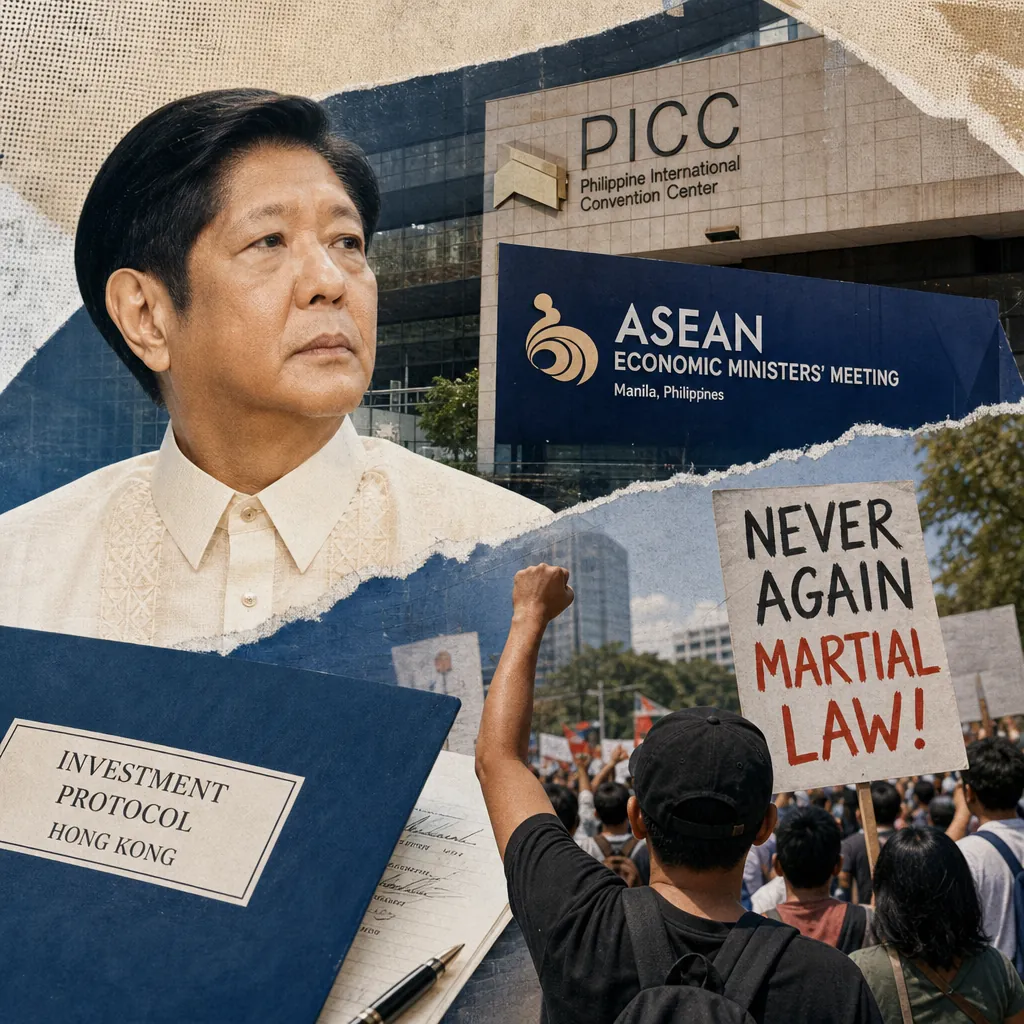
ASEAN Ministers Meet in Manila as School Shooting Dominates
Philippine trade officials chair the 58th ASEAN Economic Ministers Meeting in Pasay City, pushing MSME inclusion and higher-value investment, while a third deadly school shooting in South Cotabato draws national attention and a presidential order for a security review.
Trade ministers from across Southeast Asia gathered in Pasay City on Saturday for the 58th ASEAN Economic Ministers Meeting, where the Philippines, as this year's chair of the 10-member bloc, pressed for policies to lift small businesses into regional supply chains and to attract investment that produces better jobs rather than simply more capital. The meeting, held at the Philippine International Convention Center, was the day's most consequential economic story in the captured coverage, and it produced a clear set of Philippine priorities ahead of ASEAN's November leaders' summit.12
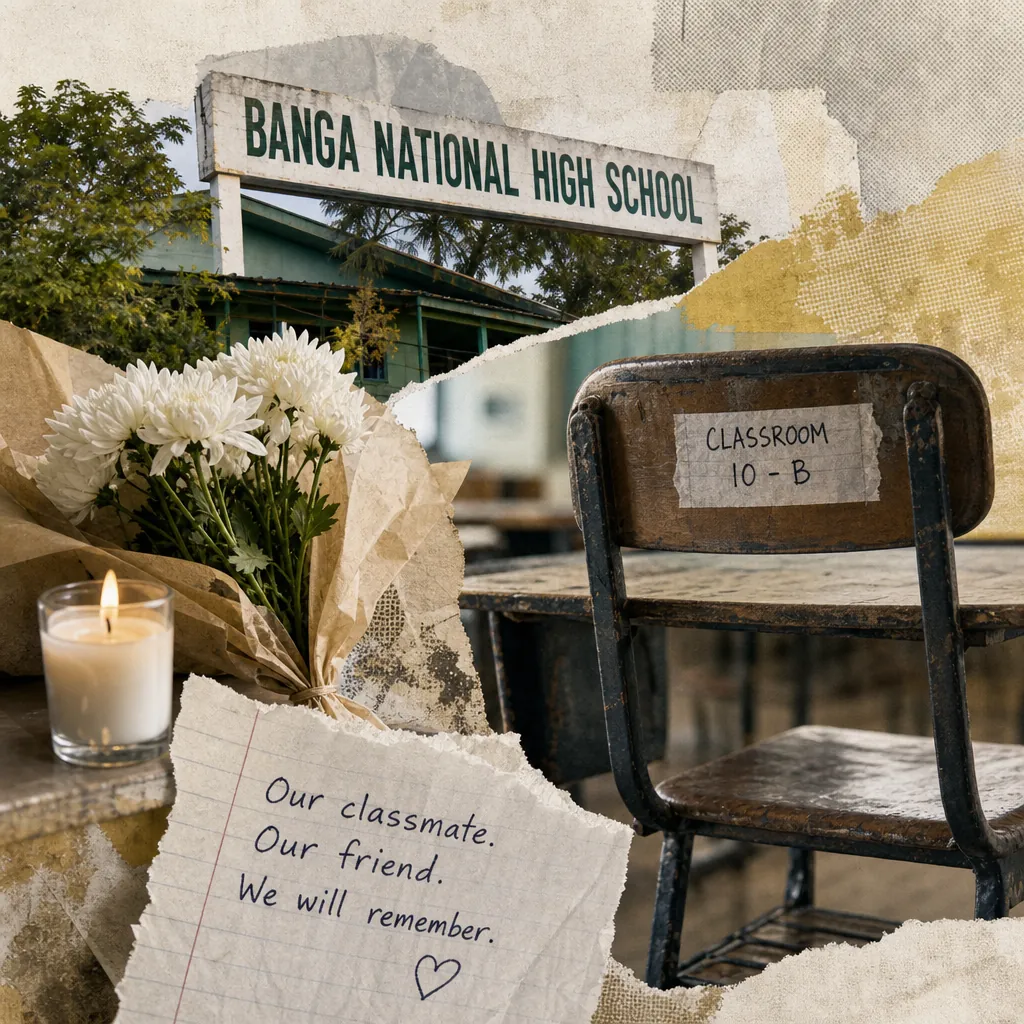
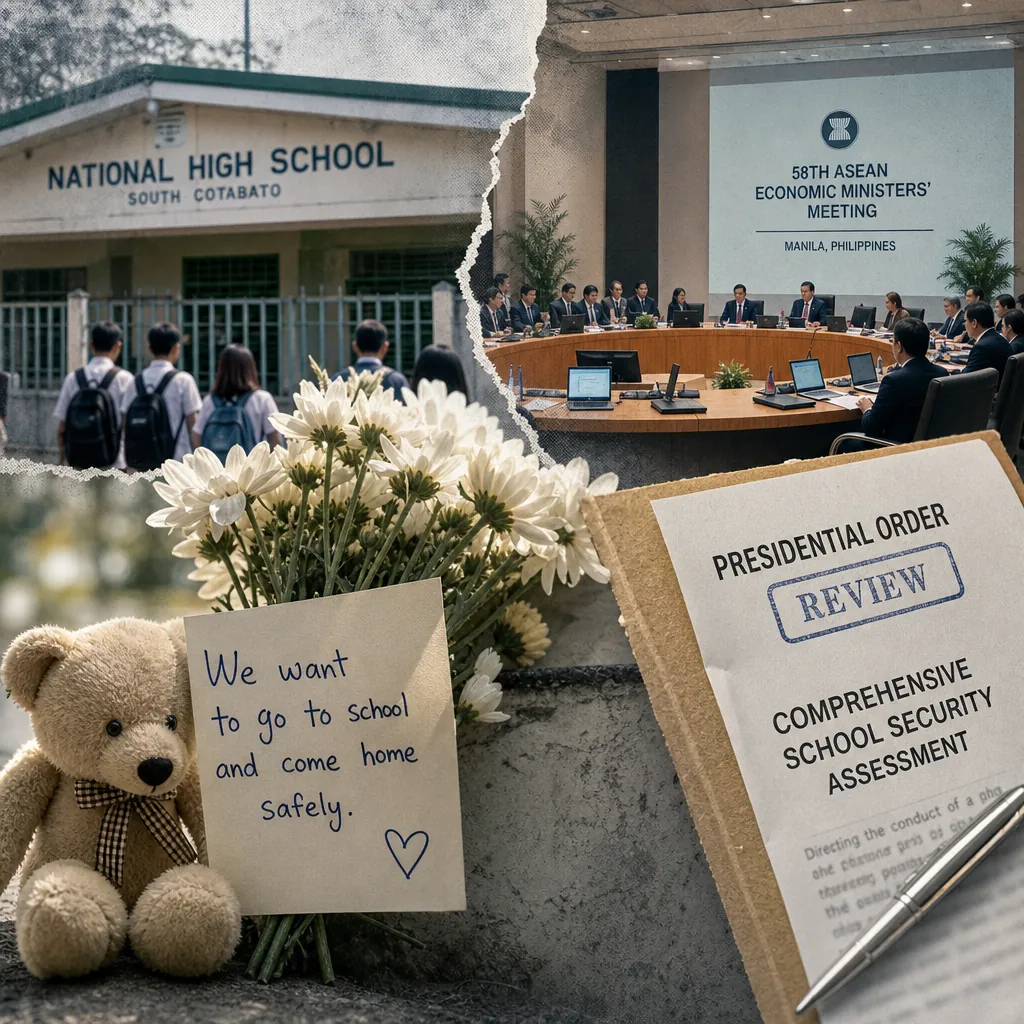
At the same time, the aftermath of a school shooting in South Cotabato — the third fatal campus attack in the country since June — drew the heaviest single-story coverage in the set, with President Ferdinand Marcos Jr. ordering an investigation and Education Secretary Sonny Angara proposing a joint security task force. The two stories ran on separate tracks: one about the region's economic architecture, the other about violence inside Philippine schools. Both were substantial, and neither displaced the other.
Key themes
- ASEAN ministers push MSME inclusion into regional value chains. Trade Undersecretary Ceferino Rodolfo said the bloc's inclusive-business agenda is meant to give micro, small and medium enterprises, farmers and community enterprises access to markets, financing and technology, framing it as a direct route to poverty reduction.1
- Investment policy shifts from volume to quality. After the 29th ASEAN Investment Area Council Meeting, Rodolfo said ministers want investment that generates innovation and quality jobs, not just larger capital inflows, and discussed priority sectors under a regional investment promotion plan.2
- A third deadly school shooting triggers a national security review. A 16-year-old student opened fire at Banga National High School in South Cotabato on Sept. 18, killing two classmates before turning the gun on himself; six others were wounded, and Marcos ordered a full investigation.24
- DepEd proposes a joint school safety task force. Education Secretary Sonny Angara wants the Department of Education, the Department of the Interior and Local Government and the Philippine National Police to conduct site-specific security audits across public schools nationwide.14
- Government weighs warrantless gun inspections. Interior Secretary Jonvic Remulla said the government is drafting a proposal asking the Supreme Court to allow police to inspect gun owners' storage without a warrant, after the Banga firearm was traced to the shooter's father, a legally armed DepEd employee.66
- A think tank links campus violence to counselor shortages. The Ibon Foundation argued the shootings reflect years of underinvestment in schools, including a shortage of guidance counselors, rather than isolated incidents.58
- The Philippines pushes ASEAN competitiveness ahead of the November summit. Trade Secretary Cristina Roque, who chaired the meetings, said governments build infrastructure and open doors but it is innovators and investors who turn opportunities into industries.12
- A separate inclusive-business forum is set for Sept. 22. The Philippines will host a high-level forum on the sidelines of the ministers' meeting at the Likhang Filipino Exhibition Hall in Pasay City, with MSME integration as the top agenda item.1
How the narratives stack
Dominant. The ASEAN Economic Ministers Meeting dominated the economic coverage in this set, with four separate items from the state-run Philippine News Agency carried by Malaysia's Bernama covering the ministers' meeting, the investment council meeting, the inclusive-business forum and the competitiveness push.1212 The school shooting story, meanwhile, generated the largest cluster of items in the captured set, spanning the Inquirer, Manila Times, Manila Bulletin and Daily Tribune, and included the President's directive, the education secretary's proposals, a UNICEF statement and a think-tank study.24114958 Within the items reviewed here, these two storylines accounted for the bulk of the day's substantive coverage.
Counter-narrative. The Ibon Foundation study offered a structural explanation for the school shootings that runs against the government's emphasis on security hardware and police powers. The study argued that the violence is a symptom of an education system that has prioritized mass production of labor for export over character development, leaving schools short of classrooms, resources and counselors.58 That framing competes directly with the Interior department's warrantless-inspection proposal, which treats the problem as one of gun access rather than institutional neglect.66
Emerging. Two threads appeared in the captured set without yet drawing heavy coverage. The first is the Bureau of Immigration's plan to equip all airport immigration officers with body-worn cameras by the end of October 2026, following an internal investigation into an attempted human-trafficking departure at Ninoy Aquino International Airport on Sept. 12.16 The second is the Department of Transportation's request for ₱5 billion in 2027 funding for its Service Contracting Program, which pays transport operators directly so that fuel-price increases are not passed on to commuters.39
Under-covered. Several items in the set addressed significant policy questions but appeared as single stories with no follow-up in the captured coverage. These include the right-of-way funding shortfall threatening the North-South Commuter Railway and Metro Manila Subway projects,64 the proposal to extend barangay and Sangguniang Kabataan terms to five years in exchange for an estimated ₱30 billion in election savings,51 and the pork industry's cost squeeze, where the Philippine Statistics Authority put farmgate liveweight at ₱172.44 a kilo in the second quarter against a production cost of around ₱180.96
Platform insights
The monitoring writeup for this window did not include social-media engagement data, so this section is limited to what the article set itself shows about how stories moved across platforms and outlets.
- State wire services. The Philippine News Agency's coverage of the ASEAN meetings was picked up and republished by Malaysia's Bernama, which carried four separate items on the ministers' meeting, the investment council, the inclusive-business forum and the competitiveness push.1212 This is the clearest example in the set of a single source's reporting traveling across national borders through wire distribution.
- Philippine news portals. The Inquirer, Manila Times, Manila Bulletin and Daily Tribune each carried multiple items on the school shooting and its aftermath, with the Inquirer running separate stories on the President's order, the education secretary's visit, the task force proposal, the class suspension in Norala and the UNICEF statement.2411148049
- International outlets. The Riyadh airport strikes and the Dutch far-right protest were covered by AFP, Reuters, the South China Morning Post, NBC News, Al Jazeera and The Straits Times, with the same basic facts — Houthi claims, flames near the airport, police clashes in The Hague — repeated across outlets.18226392
- Regional and specialist press. Vietnamese outlets Cafebiz and Cafef covered the iPhone 18 launch and Vietnam's FTSE Russell upgrade, while Norwegian outlets TV2, NRK, VG and Adressa covered the Trump press ban and the Middle East oil situation.530347470
Key voices and communities
Philippine trade officials. Trade Secretary Cristina Roque and Trade Undersecretary Ceferino Rodolfo were the most quoted figures in the economic coverage, setting out the Philippines' ASEAN chairmanship priorities: MSME inclusion, higher-quality investment and regional competitiveness.1212 Their framing matters because the Philippines holds the ASEAN chair this year, giving it agenda-setting power over what the bloc discusses ahead of the November summit.
Education and interior officials. Education Secretary Sonny Angara and Interior Secretary Jonvic Remulla drove the school-safety response, with Angara proposing a joint task force and Remulla floating warrantless gun inspections.1466 Their proposals set up a debate about whether the problem is gun access, school security or the broader condition of the education system.
The Ibon Foundation. The independent think tank's study provided the most critical framing of the school violence, arguing that the shootings are a consequence of decades of neglect in education funding rather than a sudden outbreak of violence.58 Its analysis gives critics of the government's security-first approach a structural argument to work from.
UNICEF Philippines. The UN children's agency expressed alarm at the shooting and urged the public and media to avoid sharing images or personal details of the victims, adding a child-protection dimension to the coverage.49
International wire services. AFP, Reuters and the Associated Press supplied most of the day's international coverage, from the Riyadh airport strikes to the Dutch protest to the Trump press ban, with their reports republished across multiple outlets in different languages.18224142
Narrative streams
ASEAN ministers meet in Manila with MSMEs and investment quality on the agenda
The 58th ASEAN Economic Ministers Meeting, chaired by Philippine Trade Secretary Cristina Roque, brought together economic ministers from the 10 ASEAN member states at the Philippine International Convention Center in Pasay City on Saturday. Roque, who led the discussions, said the meetings covered trade and investment, digital transformation, MSME development, innovation and sustainable growth, and that ministers would send clear recommendations to their leaders ahead of the November summit.12 The Association of Southeast Asian Nations, or ASEAN, is a 10-country bloc that includes the Philippines, Indonesia, Malaysia, Singapore, Thailand, Vietnam, Brunei, Cambodia, Laos and Myanmar; its economic ministers meet regularly to coordinate trade policy across a region of more than 600 million people.
On the investment side, Trade Undersecretary Ceferino Rodolfo said the 29th ASEAN Investment Area Council Meeting examined how the bloc could attract higher-quality investment rather than simply more of it. "The meeting highlighted the need to move beyond simply increasing investment volumes toward attracting investments that generate innovation, quality jobs, strengthen industrial capabilities and contribute to sustainable development," he said.2 The council also discussed priority sectors under the ASEAN Regional Investment Promotion Action Plan, a framework for coordinating how member states market themselves to foreign investors.
The MSME agenda is the Philippines' signature push as chair. Rodolfo said inclusive business models give micro, small and medium enterprises, farmers, micro-entrepreneurs and community enterprises access to markets, financing, technology and business opportunities, and that this "contributes directly to poverty reduction and more equitable growth."1 A separate high-level inclusive business forum is scheduled for Sept. 22 at the Likhang Filipino Exhibition Hall in Pasay City, on the sidelines of the ministers' meeting.1
For Philippine small businesses, the practical question is whether regional commitments translate into actual access to export markets, credit and technology. ASEAN's track record on this is mixed: the bloc has signed numerous agreements on MSME integration, but implementation at the national level has been uneven. The Philippines' chairmanship gives it a platform to push for concrete follow-through, but the November summit will be the test of whether the ministers' recommendations survive contact with leaders' priorities.
A third school shooting forces a national reckoning on campus safety
A 16-year-old student opened fire at Banga National High School in South Cotabato on Sept. 18, killing two classmates before shooting himself, according to the Manila Times, which corrected earlier reports that had put the death toll at six. Six others were wounded.24 The attack was the third deadly school shooting in the Philippines since June, following incidents in Tacloban and Zamboanga City.24
President Ferdinand Marcos Jr. ordered a full investigation and instructed the Department of Education, the Department of the Interior and Local Government and the Philippine National Police to submit a comprehensive assessment with concrete policy recommendations to prevent future campus violence.14 "I extend my condolences to the families who lost loved ones in the shooting at Banga National High School in South Cotabato," Marcos said in Filipino.24
Education Secretary Sonny Angara visited the school on Saturday, meeting with officials, parents, local leaders and police, inspecting the campus, attending security debriefings and visiting the wakes of the victims and the hospitalized.11 He proposed establishing a Joint School Safety Task Force with the DILG and the PNP to conduct site-specific security audits across public schools nationwide. "We cannot accept school shootings as a normal part of our children's lives. Our children have the right to study without fear," Angara said.14
Interior Secretary Jonvic Remulla said the government is drafting a proposal to ask the Supreme Court to allow police to conduct warrantless inspections of gun owners' storage. "We should have the power to inspect without a warrant all gun owners and how they handle their guns, how they store their guns," Remulla said.66 The firearm used in the Banga attack belonged to the shooter's father, a Department of Education employee, and was legally owned, according to authorities.66
UNICEF Philippines said it was "deeply saddened and alarmed" by the shooting and urged the public and media to refrain from sharing images or personal details of the affected children. "Children affected by serious violence need timely protection, psychosocial support, and help to return safely to school and community life," the agency said.49
The Ibon Foundation, an independent Philippine think tank, argued in a study that the shootings reflect a deeper problem: an education system that has suffered from years of neglect, with schools short of classrooms and basic resources, students in a deepening learning crisis, and teachers overworked and underpaid. The study also pointed to a shortage of guidance counselors.58 The foundation's framing challenges the government's emphasis on security measures, suggesting that the violence is a symptom of institutional underinvestment rather than a sudden breakdown in school safety.
In Norala, South Cotabato, Mayor Clemente Fedoc ordered the suspension of face-to-face classes on Monday, Sept. 21, to allow local and education officials to meet on strengthening school safety.80
For Philippine schools and the families they serve, the immediate question is whether the government's response will focus on security hardware — cameras, inspections, police presence — or on the broader conditions that the Ibon study identifies. The warrantless-inspection proposal, in particular, raises legal and civil-liberties questions that will likely slow its adoption. The task force proposal is more likely to move quickly, but its effectiveness will depend on whether site-specific audits lead to actual changes in how schools are secured.
The Philippines pushes ASEAN competitiveness as Vietnam draws investor attention
Trade Secretary Cristina Roque, chairing the 58th ASEAN Economic Ministers Meeting, said the bloc needs to raise its global competitiveness and bring "lasting prosperity" to its people. "Governments build infrastructure and policies and open doors, but it is our innovators, investors, and business leaders who transform opportunities into thriving world-class industries," she said.12
The competitiveness push comes as Vietnam, a fellow ASEAN member, has been upgraded by FTSE Russell from frontier to secondary emerging market status, a reclassification that is expected to draw billions of dollars in passive investment flows. At a conference marking Vietnam's inclusion in the FTSE Global Equity Index Series, Vanguard's Asia-Pacific head of global equity and investment management, Duncan Burns, said the firm expects to invest about $2.5 billion in Vietnam over the next year, higher than earlier analyst estimates of $1 billion to $2 billion.30 FTSE Russell is a global index provider whose classifications determine which markets large institutional investors can include in their portfolios; an upgrade from frontier to secondary emerging market status typically triggers automatic buying by index-tracking funds.
The contrast with the Philippines is uncomfortable. A Daily Tribune column noted that the Philippine Stock Exchange rose from 1,000 to about 9,000 points between 1987 and its 2018 peak — an 800-percent return over 30 years, or roughly 8 percent compounded annually, close to the S&P 500's 9-10 percent pace over the same period. But since then, the column argued, capital markets have slid into malaise, with the exception of real estate investment trusts issued during the early COVID-19 period.37
For Philippine businesses and investors, the ASEAN competitiveness agenda is about whether the region can present a unified front to global capital or whether individual member states will continue to compete against each other for the same investment. Vietnam's upgrade gives it a first-mover advantage in attracting index-driven flows. The Philippines' chairmanship year is an opportunity to push for regional standards that make the whole bloc more attractive, but the country's own capital-market reforms will determine whether it captures a share of that investment.
Government moves to tighten immigration oversight and transport subsidies
Bureau of Immigration Commissioner Joel Anthony Viado said the agency is fast-tracking the rollout of body-worn cameras with voice-recording capabilities for all immigration officers assigned to airports, with full deployment expected by the end of October 2026. "Body-worn cameras will reinforce accountability, transparency and monitoring, and serve as a deterrent against any personnel who might attempt to abuse their position," Viado said.16 The initiative follows an internal investigation into the attempted departure of a suspected human-trafficking victim at Ninoy Aquino International Airport Terminal 1 on Sept. 12, 2026.16 The Bureau of Immigration is the government agency responsible for border control and the enforcement of immigration laws; the case has raised questions about whether airport personnel were complicit in the attempted trafficking.
Separately, Transportation Secretary Giovanni Lopez told a Senate Finance Subcommittee hearing that the department is seeking ₱5 billion for its Service Contracting Program in 2027. The program pays participating transport operators and drivers directly, reducing the pressure to pass higher fuel costs on to passengers. "When we have service contracting, the government pays our transport groups, not the commuters," Lopez said. "We encourage drivers and operators to continue operating because the government will pay you, and we will not take it from our commuters."39 The Department of Transportation is the agency responsible for land, air and sea transport policy; the Service Contracting Program was first used during the COVID-19 pandemic to keep public utility vehicles running when passenger demand collapsed.
For commuters, the transport subsidy request is a signal that the government expects fuel prices to remain elevated. For immigration officers, the body-camera rollout is a direct response to a specific case that raised questions about internal accountability. Both measures are still in the proposal or early implementation stage, and their effectiveness will depend on funding and enforcement.
Infrastructure funding gaps and political disputes continue
The Daily Tribune reported that the North-South Commuter Railway and the Metro Manila Subway, two of President Marcos's flagship infrastructure projects, are again threatened with delays due to right-of-way funding shortfalls. In the 2024 national budget, the railway systems were moved from regular items in the National Expenditure Program to Unprogrammed Appropriations in the final General Appropriations Act, creating fiscal space for congressional insertions — often local pet projects like roads, flood control and multi-purpose buildings — which delayed the implementation of foreign-funded projects.64 Right-of-way acquisition is the process of buying or expropriating land needed for a project; when funding for it is uncertain, construction timelines slip.
In Bulacan, Public Works Secretary Vince Dizon met with Governor Daniel Fernando and local officials to discuss solutions to widespread flooding, where persistent flooding is reaching up to 5 feet in the hardest-hit towns. The meeting covered immediate, midterm and long-term aspects of the flood management plan.52
On the political side, Laguna First District Rep. Ann Matibag responded to Davao City Rep. Paolo Duterte's claims that he has videos showing anomalous projects in San Pedro, Laguna. Matibag said the National Bureau of Investigation's probe into flood control project anomalies in Davao City has nothing to do with Laguna, and that "one should not be used to obscure the other." She also acknowledged that her husband, Melvin Matibag, is the NBI director.43 The exchange is part of a broader congressional investigation into flood control projects that has become entangled with the impeachment trial of Vice President Sara Duterte.
For the infrastructure sector, the right-of-way funding issue is a recurring problem that affects the government's ability to deliver on its flagship projects. The flood control investigation, meanwhile, has become a political battleground that could affect how infrastructure contracts are awarded and overseen.
Conversation trajectory
ASEAN meetings and the November summit (observation window: through November 2026). The ministers' recommendations will be taken up by ASEAN leaders at their summit in November. Watch for whether the MSME inclusion agenda produces concrete commitments on financing and market access, or remains a statement of principles. The Sept. 22 inclusive-business forum in Pasay City will be the first test of whether the Philippines can translate its chairmanship into specific deliverables.112
School safety policy (observation window: 2-4 weeks). The DepEd-DILG-PNP assessment report ordered by President Marcos is expected in the coming weeks. Watch for whether it recommends security hardware, gun-control measures or broader education funding. The warrantless-inspection proposal will likely face legal challenges if it reaches the Supreme Court.1466
Immigration body cameras (observation window: through October 2026). The Bureau of Immigration has committed to equipping all airport officers by the end of October. Watch for whether the rollout meets that deadline and whether the NAIA trafficking investigation produces charges.16
Transport subsidy (observation window: 2027 budget deliberations). The Department of Transportation's ₱5 billion request will be debated in Congress as part of the 2027 budget. Watch for whether the program is funded at the requested level and whether fuel prices rise further.39
Vietnam's market upgrade (observation window: 3-6 months). Vanguard's expected $2.5 billion investment in Vietnam will flow in over the next year. Watch for whether other index providers follow FTSE Russell's lead and whether the Philippines takes steps to improve its own market accessibility.30
Trigger events. The ASEAN leaders' summit in November, the release of the DepEd-DILG-PNP school safety assessment, the Bureau of Immigration's October body-camera deadline, and the next FTSE Russell review of Philippine market status are the events most likely to move these stories forward.
Response guidance
For trade and investment communicators. The Philippines' ASEAN chairmanship is a platform to explain what MSME inclusion means in practice — access to financing, export markets and technology — rather than a slogan. Use the Sept. 22 forum to put specific numbers behind the agenda: how many MSMEs currently export, what share of bank lending goes to small businesses, and what the barriers are. Avoid framing the investment agenda as a competition with Vietnam; the more useful message is that regional integration raises all member states' attractiveness to global capital.
For education and public-safety communicators. The school shooting coverage is dominated by the immediate response — investigations, task forces, security proposals. The Ibon Foundation study offers a structural critique that will shape the debate if the government's response is seen as purely reactive. Communicators should be prepared to address questions about counselor shortages, classroom conditions and mental health support, not just gun access. The UNICEF statement's call to avoid sharing images of affected children is a useful guide for how to handle sensitive content.
For immigration and transport communicators. The body-camera rollout and the transport subsidy request are both responses to specific problems — a trafficking case and rising fuel prices. The body-camera program should be communicated as an accountability measure, not a surveillance one, and the transport subsidy as a way to keep fares stable, not as a permanent subsidy. Both will face scrutiny over cost and effectiveness.
For infrastructure communicators. The right-of-way funding shortfall is a technical issue with political consequences. Communicators should be prepared to explain why moving projects to Unprogrammed Appropriations creates delays, and what the government is doing to address it. The flood control investigation is a separate matter that should be addressed on its own facts, as Rep. Matibag argued.43
For all sectors. The day's coverage shows that stories with clear, specific consequences — a shooting, a trafficking case, a funding shortfall — travel further than general policy statements. Communicators should lead with the specific problem and the specific response, and avoid framing developments as part of a broader narrative that the audience cannot verify.
See the full picture behind today's signals.
This report draws from Media Meter's MediaWatch, our real-time monitoring engine tracking 2,470+ Philippine sources across print, broadcast, digital, and social. Explore how the platform turns raw coverage into decision-grade intelligence, then see how it's configured for teams like yours — whether you're in PR agencies, corporate comms, government, or marketing.
Want more? Browse our Report Library for sector and crisis intelligence, or request a demo and we'll have your brand set up before the call.
Want this kind of intelligence on your brand?
This brief is built on the same MediaWatch methodology that runs continuously across every brand we monitor. See your competitive landscape, Impact Score, and narrative trajectory in a 30-minute demo.