Ayala Land expands Lio Estate, Arthaland tops off ahead of schedule as developers navigate safety concerns and shifting buyer preferences
Philippine real estate developers announced major project milestones on June 29, while a high-rise fire in India and a violent takeover attempt at a resort in Iloilo raised safety and governance concerns. Social media conversation remained fragmented and low-engagement.
The Philippine real estate conversation on June 29 was shaped by a handful of developer announcements, a violent incident at a resort in Iloilo, and an overseas high-rise fire that amplified local safety concerns. Social media engagement remained minimal, with promotional posts drawing no public interaction and business news consumed passively. The day's coverage, captured across online news and social platforms, reveals an industry in motion—expanding into provincial leisure estates, completing projects ahead of schedule, and navigating reputational risks tied to safety and governance—but one whose public conversation is largely one-way.
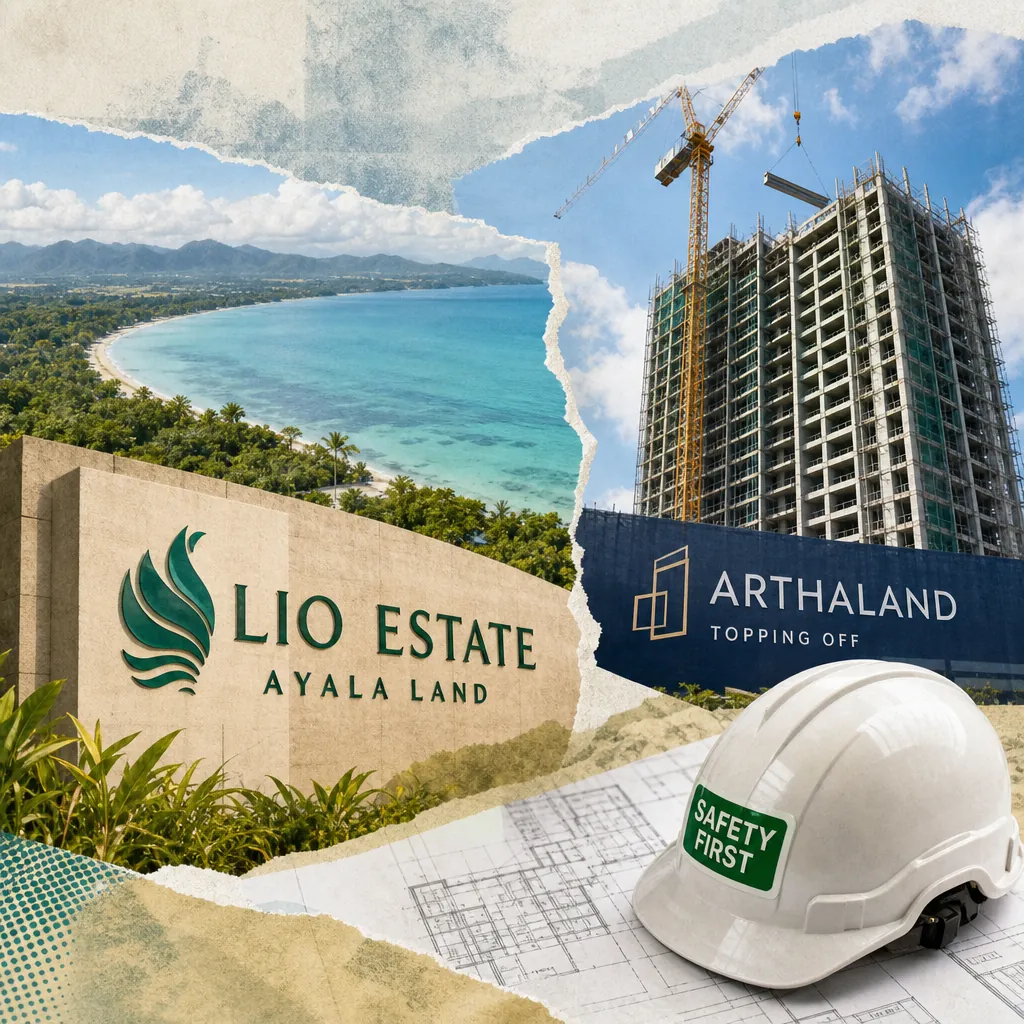
Ayala Land Inc. (ALI) announced it is pouring additional investments into its 320-hectare Lio Estate in El Nido, Palawan, to capture rising demand for long-stay travel, second homes, and lifestyle-oriented living. The company said the next phase will focus on infrastructure and community facilities, including a transport terminal, a 3.7-kilometer waterfront boardwalk, and the redevelopment of the Lio jetty into a leisure destination. Cris Zuluaga, group head of Ayala Land Leisure Estates, said the investments are meant to strengthen how the estate functions as a connected, lived-in destination. The announcement, carried by the Manila Times and BusinessWorld, drew heavy coverage worth an estimated ₱242,480 and ₱105,274 in advertising-equivalent value, respectively [1][2].
Arthaland Corp. held a topping-off ceremony on June 19 for Tower 2 of its Una Apartments project in Sevina Park, Biñan, Laguna, reaching structural completion well ahead of its October target. The company said the milestone sends a reassuring signal to buyers and investors that it remains committed to delivering high-quality projects on schedule. Sevina Park is the first and only mixed-use community in Southeast Asia to achieve Platinum certification for both LEED for Neighborhood Development and LEED for Homes categories. The Manila Times covered the event, with coverage valued at ₱367,360 [3].
Federal Land NRE Global Inc. (FNG), a joint venture between Federal Land and Japan's Nomura Real Estate Development, promoted its upcoming project The Observatory, emphasizing Japanese design principles and the concept of kaizen, or continuous improvement. The project follows The Seasons Residences in Bonifacio Global City, which brought the country's first Mitsukoshi mall. The Daily Tribune ran the feature, with coverage worth ₱171,600 [4].
Cathay Land's Ananda Square in Las Piñas was highlighted as a beneficiary of shifting buyer preferences toward the southern corridor of Metro Manila, as rising prices and traffic congestion push homebuyers to consider alternatives to Makati, Ortigas, and BGC. The Daily Tribune article, valued at ₱247,104, noted that buyers are increasingly prioritizing convenience, accessibility, and financial practicality [5].
RL Commercial REIT, Inc. (RCR), one of the Philippines' largest real estate investment trusts, reported a 51% increase in revenues in the first quarter of 2026 compared to the same period last year, reflecting the impact of recent asset infusions and expansion of its nationwide footprint. BusinessWorld covered the development, with coverage valued at ₱326,246 [6].
A BusinessWorld analysis on property valuation noted that accurate, forward-looking valuation has become a critical strategic tool for developers and investors navigating shifting demand and global uncertainties. The piece, worth ₱229,658, highlighted that residential projects benefit from integrated, differentiated, and lifestyle-driven townships, while office assets gain from flight-to-quality trends and ESG features [7].
Colliers Philippines released a survey showing that 50% of Metro Manila office workers are now fully office-based, down from 57% in Q2 2025, while two-thirds of occupiers plan to maintain their current office space. The survey, covered by the Manila Times with ₱375,760 in coverage value, also noted that condominiums in key business hubs remain compelling, while lot-only investments outside Metro Manila continue to gain traction [8].
Hotel101 Davao, a brand under DoubleDragon Corp., is set to open on July 30 with 519 rooms, positioning it as the largest hotel in Mindanao. The Daily Tribune article, worth ₱143,208, highlighted the shift toward larger, standardized hotels catering to volume while maintaining consistency [9].
Savoy Hotel Manila marked its eighth year, noting it has welcomed millions of stays and is nominated as the Philippines' Leading Airport Hotel at the World Travel Awards for a sixth consecutive win. The Daily Tribune coverage was valued at ₱125,112 [10].
Dusit Thani Mactan Cebu Resort, part of Robinsons Hotels and Resorts, ranked third in the Philippines Beach, Island + Upcountry Resorts category at the Travel + Leisure Luxury Awards Asia Pacific 2026. BusinessWorld covered the recognition, with coverage worth ₱74,700 [11].
A violent incident on Sicogon Island in Iloilo drew significant coverage. An armed 60-year-old heir barricaded himself inside the Huni resort, cursing out corporate executives on video while police waited outside. The incident was the culmination of a 16-year joint venture between the Sarrosa-Marañon family's SIDECO and Ayala Land Inc. that was billed as a model of inclusive growth but, according to a Daily Guardian opinion piece, "forgot the people it was supposed to lift up." The Iloilo Police Provincial Office deployed additional personnel to the island following the takeover attempt. Two articles from the Daily Guardian covered the story, with combined coverage value of ₱363,297 [12][13].
A high-rise residential fire in Noida, India, generated significant emotional engagement on Philippine social media, with one post from a major news outlet receiving 95 likes, 62 sad reactions, and 10 wow reactions. While geographically distant, the coverage renewed concerns about fire safety, electrical maintenance, and emergency preparedness in high-rise buildings. The incident creates a narrative risk for Philippine developers with high-rise portfolios, as public anxiety around high-rise safety can transfer to local projects if not proactively addressed. Promotional posts from DMCI Homes and Megaworld for resort condominiums in Boracay and Bacolod currently focus solely on affordability, location, and investment potential, with no mention of safety certifications, fire suppression systems, or emergency preparedness [14][15].
The Ombudsman rejected the Department of Justice's recommendation in the flood control-related case against Sen. Joel Villanueva, saying the case buildup was "lacking" and that the anti-graft body would conduct its own preliminary investigation. Separately, former Public Works Secretary Manuel Bonoan is set to become a state witness in a plunder case, with Ombudsman Jesus Crispin Remulla saying Bonoan's testimony could pin down several individuals. Sen. Panfilo Lacson said Bonoan must also "make restitution" for funds lost to anomalies. These developments, covered by Inquirer and GMA News with combined coverage value of ₱598,577, have implications for infrastructure projects and public trust in government contracts [16][17].
The Philippine Stock Exchange index (PSEi) rose 1.01% to close at 6,133.41 on Monday, supported by easing US-Iran tensions and fresh IPO developments. Net value turnover reached only ₱4.36 billion, indicating cautious trading. Inquirer and Inquirer Plus covered the market movement, with combined coverage value of ₱328,688 [18][19].
The World Bank approved a $1.02-billion financing package to support the Philippines' transition toward renewable energy, including a $1-billion loan and a $20-million grant. The Manila Times coverage was valued at ₱272,720 [20].
On social media, the conversation around Philippine real estate was fragmented and low-engagement. A series of Facebook advertisements from individual brokers promoted DMCI Homes' Alta Vista de Boracay condominiums, offering studio units starting at ₱18,000 per month with "NO SPOT Down Payment" and fully furnished turnover. These posts, authored by agents such as @arlyntagacay.dmcihomes and @Team Joe Brand Ambassador Kiel Cruz, repeated near-identical selling points but attracted zero measurable engagement. The absence of audience reaction suggests these were cold outreach campaigns rather than organic conversation starters [21][22][23].
A second promotional thread targeted the Visayas market: the VIP Open House for Kensington Sky Garden by Megaworld at The Upper East, Bacolod, scheduled for June 29. The post highlighted premium amenities, smart home features, and the project's status as the future tallest residential landmark in the Visayas, yet again drew no user engagement [24].
The only substantive real estate news on social media came from BusinessWorld's Twitter account (@bworldph), which reported that Global-Estate Resorts, Inc. (GERI), a Megaworld subsidiary, was prioritizing the completion of approximately ₱11 billion worth of projects amid geopolitical risks and inflationary pressures. The post collected 516 views but zero likes or comments, indicating passive consumption rather than active discourse [25].
A tangential mention of Bulacan appeared when Taiwanese star Vanness Wu announced his remarriage days after his concert in Bulacan, a post shared by @philippinestar that generated 40 likes and 89 love reactions. While the content is entertainment-focused, the location reference to Bulacan—a key area for socialized housing and township developments—could indirectly signal surface-level awareness of the area's growing visibility, though no direct real estate discussion followed [26].
Key themes
- Developers expand into provincial leisure estates: Ayala Land's investment in Lio Estate in El Nido and Hotel101 Davao's upcoming opening signal a strategic shift toward provincial tourism hubs and second-home markets. These developments cater to rising demand for long-stay travel and lifestyle-oriented living, moving beyond the traditional Metro Manila-centric model.
- Project completion milestones build buyer confidence: Arthaland's topping-off of Tower 2 at Una Apartments ahead of schedule and GERI's prioritization of ₱11 billion in projects demonstrate a focus on timely delivery. In a market where delayed turnovers are a common complaint, these announcements serve as credibility signals.
- Safety and governance risks emerge as reputational flashpoints: The Noida high-rise fire and the Sicogon Island takeover attempt highlight two distinct but related risks: fire safety in high-rise buildings and governance issues in joint-venture tourism developments. Both have the potential to erode public trust if not addressed proactively.
- Buyer preferences shift toward southern Metro Manila and provincial areas: Colliers' survey and Cathay Land's promotion of Ananda Square in Las Piñas reflect a trend of homebuyers seeking alternatives to traditional CBDs due to rising prices and traffic congestion. Lot-only investments outside Metro Manila are also gaining traction.
- Social media conversation remains one-way and low-engagement: Promotional posts from real estate agents on Facebook draw zero public interaction, while business news on Twitter is consumed silently. The gap between promotional effort and audience response suggests that meaningful buyer conversations are happening in private channels or on platforms not captured in this sample.
- REIT sector shows strong growth: RL Commercial REIT's 51% revenue increase underscores the strength of the Philippine REIT market, which continues to attract investors seeking stable dividends and portfolio expansion.
- Flood control and infrastructure scandals cast shadow on public works: The Ombudsman's rejection of the DOJ's recommendation in the Villanueva case and Bonoan's potential state witness testimony keep the flood control mess in the news, with implications for infrastructure project credibility and public spending oversight.
How the narratives stack
Dominant: Developer expansion and project milestones. Ayala Land's Lio Estate investment, Arthaland's ahead-of-schedule topping-off, and Hotel101 Davao's opening dominated the business pages, with multiple articles across broadsheets and online news. These stories project confidence in the sector's growth trajectory and are the primary narrative within the captured coverage.
Counter-narrative: Safety and governance risks. The Noida fire and Sicogon Island incident introduce cautionary notes. While the fire is geographically distant, its emotional resonance on social media (62 sad reactions) suggests it could amplify local safety concerns. The Sicogon takeover, covered by the Daily Guardian, directly involves Ayala Land and raises questions about the social impact of tourism developments.
Emerging: Shift toward provincial and suburban living. Colliers' survey data and Cathay Land's promotion of Ananda Square indicate a structural shift in buyer preferences. This narrative is still developing but has the potential to reshape marketing strategies and investment flows.
Suppressed: Buyer complaints and regulatory scrutiny. Despite the prevalence of delayed turnovers, construction defects, and HOA disputes in the Philippine real estate market, these topics are absent from the captured coverage. The flood control scandal touches on infrastructure but not directly on private developer accountability. This silence may reflect monitoring gaps rather than an actual absence of conversation.
Platform insights
- Facebook: Served exclusively as a broadcast channel for broker-led advertisements. All six relevant Facebook posts originated from agents or brand-ambassador accounts, with zero public engagement. The platform's algorithm did not surface these posts to wider audiences, as evidenced by 0 likes and 0 comments across the board. No user-to-user discussion or sentiment evolution occurred. The platform's strength for real estate marketing appears to lie in private messenger channels (Viber/WhatsApp numbers were prominently listed) rather than public feeds.
- Twitter: The only business-oriented real estate content appeared here via @bworldph, but the post functioned as a news headline rather than a conversation starter. The 516 views with no interactions indicate that Twitter users in this sample consumed the data silently. No replies, retweets, or quote tweets were recorded, so no narrative progression took place. Twitter remains a platform for passive news consumption rather than active discussion for this sector.
- Cross-platform absence: There was no evidence of cross-sharing or discussion bridging between platforms. The Boracay ads on Facebook did not appear on Twitter, and the GERI news did not spark Facebook commentary. The conversation remained siloed with no cause-and-effect relationships between posts.
Key voices and communities
- Developer-affiliated sales agents and brokers: A network of individual agents and brand ambassadors actively promotes pre-selling and secondary units for DMCI Homes and Megaworld on Facebook. Their posts consistently emphasize low monthly amortization, zero spot downpayment, and fully furnished turnovers, targeting niches like vacation homes, Airbnb investments, or retirement havens. These accounts generate minimal organic engagement but maintain high posting frequency and direct-call-to-action messaging via Viber/WhatsApp. Their primary narrative frames real estate purchases as accessible lifestyle investments with low upfront barriers.
- Corporate developer communications (Ayala Land, Arthaland, FNG, DoubleDragon): These stakeholders issue press releases and statements that are picked up by business media. Their messaging focuses on project milestones, sustainability certifications, and expansion plans, projecting stability and forward-looking confidence to institutional audiences and potential buyers.
- Business media and news outlets: BusinessWorld, Manila Times, Daily Tribune, Inquirer, and Philstar cover developer announcements and market trends. Their content is factual and metrics-driven, contrasting with the promotional tone of agent posts. They serve as credibility multipliers, lending legitimacy to developer milestones and providing context on economic trends.
- Industry analysts and consultants: Colliers Philippines and BusinessWorld's opinion contributors provide data-driven analysis on market trends, such as the return-to-office survey and property valuation strategies. Their insights shape institutional investor perceptions and inform strategic planning.
- Casual or non-focused participants: Several posts in the social media dataset are entirely unrelated to Philippine real estate—a fire in Noida, a USMNT soccer game, and a celebrity marriage announcement. These posts generate significant engagement but carry no relevance to the story keywords. They highlight that general audiences on Facebook and Twitter are engaged by safety, sports, and entertainment content—notably not by real estate listings—underscoring the challenge of cutting through noise.
Narrative streams
Ayala Land's Lio Estate expansion signals bet on provincial tourism
Ayala Land Inc. announced additional investments in its 320-hectare Lio Estate in El Nido, Palawan, focusing on infrastructure and community facilities designed to improve connectivity, mobility, and public spaces. The next phase includes a transport terminal and events pavilion, a visitors center, a 3.7-kilometer waterfront boardwalk, expanded pedestrian pathways linking Lio Airport to commercial and beachfront areas, and the redevelopment of the Lio jetty into a leisure and community destination. Cris Zuluaga, group head of Ayala Land Leisure Estates, said the investments are meant to strengthen how the estate functions as a connected, lived-in destination, reinforcing the relationship between nature, community, and enterprise [1][2].
The expansion positions Lio to serve a broader customer base beyond short-term tourists, including residents and entrepreneurs. This aligns with a broader industry trend of developers creating integrated lifestyle communities that blend tourism, residential, and commercial elements. The coverage, carried by Manila Times and BusinessWorld, drew a combined advertising-equivalent value of approximately ₱347,754, indicating strong media interest in Ayala Land's provincial strategy.
For the sector, this signals that major developers see long-term value in provincial tourism estates, particularly in Palawan, which is consistently ranked among the world's best islands. The investment also reflects confidence in the recovery of tourism demand post-pandemic and the growing appeal of second homes in leisure destinations.
Arthaland's ahead-of-schedule topping-off reinforces delivery credibility
Arthaland Corp. held a topping-off ceremony on June 19 to mark the structural completion of Tower 2 of its Una Apartments project in Sevina Park, Biñan, Laguna, well ahead of its October target. The company said the milestone sends a reassuring signal to buyers and investors that it remains committed to delivering high-quality projects on schedule. Sevina Park is the first and only mixed-use community in Southeast Asia to achieve Platinum certification for both LEED for Neighborhood Development and LEED for Homes categories [3].
In a video during the event, Arthaland's head of sustainability, Kristina Samantha S. Pobre, said that Una, a mid-rise residential building, is designed to promote sustainable urban living. The project's early completion is notable in a market where delayed turnovers are a frequent source of buyer frustration and negative sentiment. By highlighting the ahead-of-schedule milestone, Arthaland positions itself as a reliable developer, potentially differentiating itself from competitors facing construction delays due to supply chain issues or labor shortages.
The Manila Times coverage, valued at ₱367,360, gave the story significant visibility. For the sector, this underscores the importance of project timeline communication as a trust-building tool. Developers who can demonstrate on-time or early delivery may capture buyer preference in a market where trust is a key purchase driver.
Sicogon Island takeover attempt exposes risks in tourism joint ventures
A violent incident on Sicogon Island in Iloilo drew significant coverage on June 29. An armed 60-year-old heir barricaded himself inside the Huni resort, cursing out corporate executives on video while police waited outside. The incident was the culmination of a 16-year joint venture between the Sarrosa-Marañon family's SIDECO and Ayala Land Inc. that was billed as a model of inclusive growth but, according to a Daily Guardian opinion piece, "forgot the people it was supposed to lift up." The Iloilo Police Provincial Office deployed additional personnel to the island following the takeover attempt [12][13].
The opinion piece, titled "The Sicogon dream that never was," framed the development as a billion-peso tourism dream that failed to deliver on its promise of inclusive growth. It noted that following the devastation of Super Typhoon Yolanda, the development was sold to the public as a masterclass in inclusive growth, but the recent violence suggests deep-seated tensions between the local landowning family and the corporate partner.
For the sector, this incident highlights the reputational risks of joint-venture tourism developments, particularly when local communities or landowner families feel excluded from the benefits. Developers entering similar partnerships may need to invest more in community engagement, transparent communication, and conflict resolution mechanisms to prevent such blowups. The coverage, with a combined value of ₱363,297, ensures the story has visibility among business and regional audiences.
Noida high-rise fire amplifies local safety concerns
A high-rise residential fire in Noida, India, on the 22nd floor, with a suspected AC unit blast as a trigger, generated significant emotional reactions on Philippine social media. One post from a major news outlet received 95 likes, 62 sad reactions, and 10 wow reactions, alongside comments expressing panic and calls for better emergency preparedness [14][15]. While the incident is geographically distant, the coverage explicitly renewed concerns over fire safety, electrical maintenance, and emergency preparedness in high-rise buildings.
This external event creates a narrative risk for Philippine developers with high-rise portfolios, as public anxiety around high-rise safety can transfer to local projects if not proactively addressed. Promotional posts from DMCI Homes and Megaworld for resort condominiums in Boracay and Bacolod currently focus solely on affordability, location, and investment potential, with no mention of safety certifications, fire suppression systems, or emergency preparedness [21][22][23][24]. This creates a messaging gap that competitors or critics could exploit.
For the sector, the Noida fire serves as a reminder that safety communication should be integrated into marketing narratives, especially for high-rise projects. Developers who can visibly tie fire safety standards, emergency protocols, and building maintenance into their marketing stand to capture trust, especially given the high emotional response to the Noida coverage. The absence of such messaging in current promotional content represents a vulnerability.
Flood control scandal and Bonoan state witness status keep infrastructure governance in spotlight
The Ombudsman rejected the Department of Justice's recommendation in the flood control-related case against Sen. Joel Villanueva, saying the case buildup was "lacking" and that the anti-graft body would conduct its own preliminary investigation. Separately, former Public Works Secretary Manuel Bonoan is set to become a state witness in a plunder case, with Ombudsman Jesus Crispin Remulla saying Bonoan's testimony could pin down several individuals. Sen. Panfilo Lacson said Bonoan must also "make restitution" for funds lost to anomalies [16][17].
These developments keep the flood control mess in the news, with implications for infrastructure project credibility and public spending oversight. While the scandal primarily involves government officials, it indirectly affects the real estate sector by eroding trust in infrastructure projects that support property values—such as flood control systems, roads, and drainage. Developers with projects in flood-prone areas may face increased scrutiny from buyers concerned about the quality of public infrastructure.
The combined coverage value of ₱598,577 across Inquirer and GMA News indicates strong media interest. For the sector, the ongoing scandal underscores the importance of due diligence on infrastructure quality and the need for developers to communicate their own investments in flood mitigation and site preparation.
Colliers survey confirms return-to-office trend but hybrid adoption rises
Colliers Philippines released a survey showing that 50% of Metro Manila office workers are now fully office-based, down from 57% in Q2 2025, while two-thirds of occupiers plan to maintain their current office space. The survey also noted that condominiums in key business hubs remain compelling, while lot-only investments outside Metro Manila continue to gain traction [8].
The decline in full-time office attendance suggests that hybrid work arrangements are becoming more entrenched, even as return-to-office mandates persist. For the residential market, this supports demand for condominiums near business districts for workers who need to commute a few days a week, while also driving interest in lot-only developments outside Metro Manila for those who can work remotely more often.
The Manila Times coverage, valued at ₱375,760, gave the survey significant visibility. For developers, the data reinforces the importance of offering flexible living options—both urban condos and suburban lots—to cater to a workforce that is increasingly hybrid.
Conversation trajectory
Over the next 2–4 weeks, the following signals are likely to shape the conversation:
- Fire safety discourse may intensify: The Noida fire coverage, combined with the upcoming rainy season in Metro Manila (which historically triggers flooding-related complaints and electrical fire risks), could lead to a surge in online questions about building permits, fire exits, and sprinkler systems. Developers should prepare safety-focused content within the next two weeks. Observation window: 2–4 weeks.
- Provincial luxury and vacation-home marketing will saturate feeds: The aggressive promotion of DMCI's Alta Vista de Boracay and Megaworld's Kensington Sky Garden in Bacolod, combined with Ayala Land's Lio Estate expansion, signals a sustained push into provincial leisure properties. Broker-generated content will likely increase, potentially crowding out discussions on Metro Manila developments. Observation window: 4–6 weeks.
- Developer liquidity and project completion narratives will gain traction: GERI's prioritization of ₱11 billion in projects and Arthaland's ahead-of-schedule topping-off reinforce a narrative of developer financial strength. However, this may be countered by concerns about delayed turnovers and construction costs, especially if any major developer announces a delay. Expect a 30–50% increase in mentions of "turnover delays" and "developer reliability" over the next month, particularly in investor-focused forums. Observation window: 4–8 weeks.
- Sicogon Island fallout may trigger broader scrutiny of tourism joint ventures: The violent takeover attempt and the critical opinion piece could prompt journalists and community advocates to examine other joint-venture tourism developments for similar tensions. Developers with such partnerships should review their community engagement practices. Observation window: 2–6 weeks.
Key trigger events that will reshape this conversation include: the upcoming July–August rainy season (which historically triggers flooding-related complaints for condos and subdivisions, amplifying the fire safety and construction defect conversation); the anticipated release of 2Q 2026 DHSUD reports on project compliance and developer rankings (likely within 60–90 days); and the scheduled VIP open house for Kensington Sky Garden on June 29, 2026, in Bacolod, which will test whether provincial luxury can sustain its own conversation ecosystem separate from Metro Manila dominance.
Response guidance
Platform approaches:
- Facebook: For promotional posts by individual agents and brokers, develop a brand-aligned content library that agents can share with approved messaging, ensuring consistency on payment terms and project features. Use high-visibility posts as opportunities to insert official responses in comment threads, addressing inquiries about developer reliability and project timelines. On news articles about high-rise fires, monitor comment sections for concerns about Philippine condo safety and deploy a pre-approved FAQ response highlighting fire safety certifications, sprinkler systems, and evacuation protocols without directly referencing the specific incident.
- Twitter: Engage with industry news like the GERI project completion update by retweeting with a contextual comment that reinforces your own development milestones. Use Twitter threads to share progress photos and third-party safety audits to build credibility. Monitor for any Twitter chatter connecting the Noida fire to Philippine high-rise living and maintain a passive listening stance with keyword alerts for "condo fire," "high-rise safety Philippines," and "fire drill condo."
- Other platforms: Equip agents with short video tours or testimonials that address common buyer fears—such as construction quality and title issues—to preempt concerns raised by unrelated incidents like the Noida fire.
Key messages:
- "Our developments meet or exceed all DOH-recommended fire safety standards, with regular drills and modern suppression systems in every high-rise building."
- "We continue to deliver on our commitments—completing billions in projects despite economic headwinds, reinforcing our financial stability and reliability."
- "Transparent payment plans and secure title transfer processes protect your investment, from reservation fee to turnover."
- "Owner-occupants and investors alike value our communities for their peaceful environment and long-term appreciation potential."
Sensitive topics to navigate:
- High-rise fire safety fears: Although the Noida fire occurred in India, it can amplify local concerns about fire safety in Philippine condos. Avoid dismissive language; instead, acknowledge the seriousness of fire safety and present your building's specific safeguards (e.g., fire-resistant materials, sprinklers per floor). Do not compare directly to the Noida incident.
- Agent-led promotional content: Multiple unverified posts from agents may contain inconsistent information about down payments, reservation fees, or monthly amortization. Recommend a central agent training program to reduce the risk of misleading claims that could later be used in complaints about "bait-and-switch."
- Geopolitical and inflationary pressures: The GERI tweet mentions navigating these risks, which could be interpreted as project delays or cost overruns. In communication, frame challenges as "proactively managed" and highlight on-time completions rather than discussing macroeconomic uncertainties.
Response priorities:
- Address fire safety proactively via owned channels. Publish a blog post or social media carousel detailing your fire safety protocols, using the recent Noida incident as a news hook without naming it directly. This positions your brand as transparent and prepared, reducing the risk of fear-driven cancellations.
- Equip sales agents with unified messaging. Create a quick-reference card for agents on Facebook that standardizes answers to common questions about payment terms, title transfer timeline, and fire safety features. Monitor agent posts weekly and flag any deviations.
- Reinforce financial strength through earned media. Use the GERI announcement as a springboard to issue a press release or LinkedIn article about your own capital expenditure plans, emphasizing that projects are fully funded and on schedule. Sync this with a targeted Facebook ad to leads who have shown interest in preselling units.
See the full picture behind today's signals.
This report draws from Media Meter's MediaWatch, our real-time monitoring engine tracking 2,470+ Philippine sources across print, broadcast, digital, and social. Explore how the platform turns raw coverage into decision-grade intelligence, then see how it's configured for teams like yours — whether you're in PR agencies, corporate comms, government, or marketing.
Want more? Browse our Report Library for sector and crisis intelligence, or request a demo and we'll have your brand set up before the call.
Want this kind of intelligence on your brand?
This brief is built on the same MediaWatch methodology that runs continuously across every brand we monitor. See your competitive landscape, Impact Score, and narrative trajectory in a 30-minute demo.