Pax Silica, Pag-IBIG, and Flood Risk: Real Estate's Three Fronts
The Philippine real estate conversation on July 20-21, 2026, is shaped by three major forces: the government's push for affordable housing via Pag-IBIG, the controversial Pax Silica tech hub in New Clark City, and persistent flood risks from monsoon rains that threaten buyer confidence in Laguna developments.
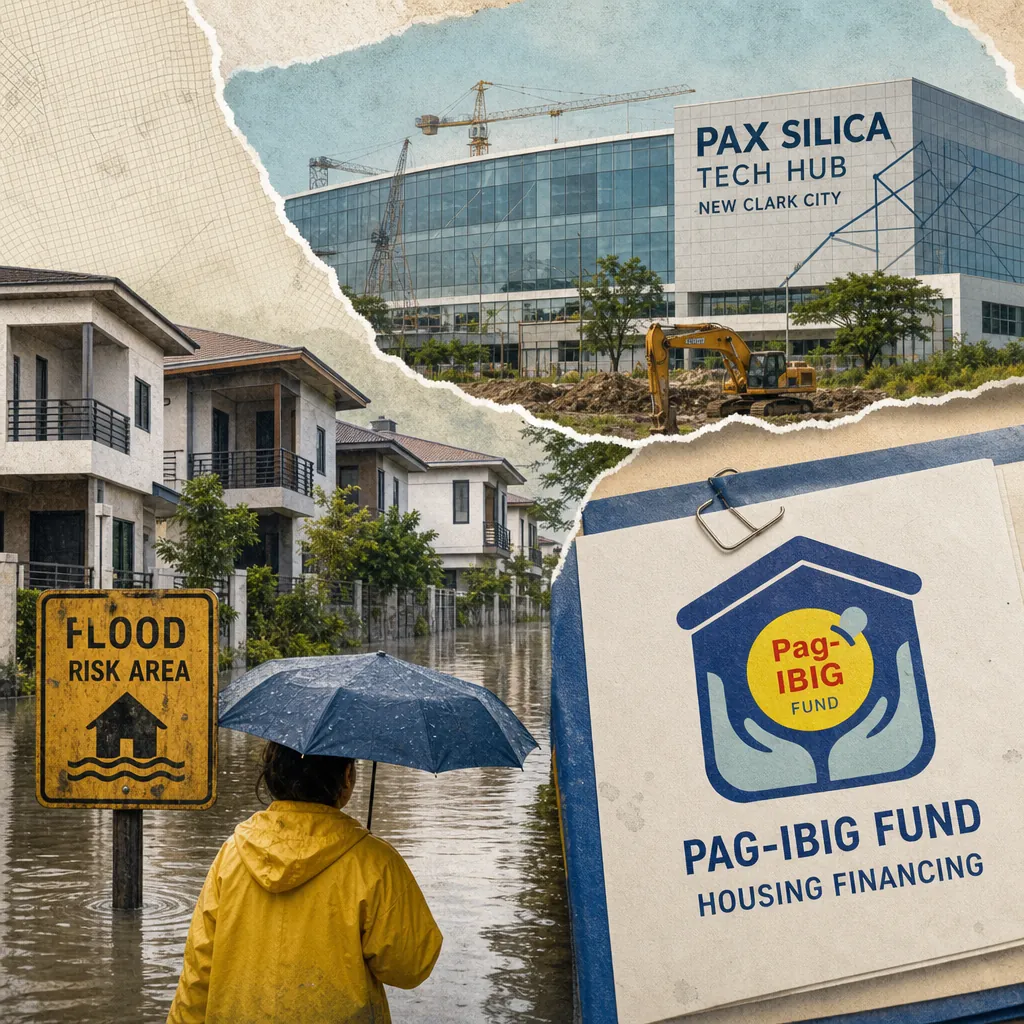
The Philippine real estate conversation on July 20-21, 2026, is not a single story but three simultaneous ones, each pulling the sector in a different direction. On one side, the government is leaning hard on developers to lower prices, backed by a 15% surge in Pag-IBIG home loan releases and a 118% jump in socialized housing financing. On another, the proposed Pax Silica technology hub in New Clark City is generating both excitement and resistance—indigenous groups protest land encroachment while the Palace promises environmental safeguards. And underneath it all, the monsoon season keeps flooding and landslide risks in the public eye, especially after a deadly landslide in Calamba, Laguna, that destroyed nine homes and left two children missing. These three narratives—affordability, development, and disaster—are running in parallel, and for anyone watching the sector, the question is which one will dominate the months ahead.
Key themes
- Pag-IBIG challenges developers to lower prices as loan releases hit record highs. The agency's deputy CEO publicly stated that affordable financing alone won't solve the housing problem if developers don't reduce selling prices. This message resonated strongly, with one Facebook post receiving over 50 positive reactions. Meanwhile, Pag-IBIG reported a 15% year-on-year increase in home loan releases to P69.19 billion in the first half of 2026, with socialized housing loans surging 118% to P6.7 billion, covering 6,601 units. The agency is positioning itself as a consumer champion, putting pressure on developers to respond.
- Pax Silica tech hub in New Clark City draws both government backing and indigenous opposition. The US-led initiative, anchored by Foxconn, aims to establish an AI and semiconductor manufacturing hub. Malacañang assured the public that environmental and legal safeguards will be followed, and that water supply is sufficient. However, indigenous groups and civil society organizations protested on July 14, warning of forced displacement and militarization of ancestral lands. The Palace's assurances generated significant media coverage, with multiple outlets reporting on the project's potential economic benefits and the government's commitment to compliance.
- Monsoon rains and a deadly landslide in Calamba heighten flood-risk awareness. A July 19 landslide in Barangay Mapagong, Calamba, destroyed nine homes and left two children missing. GMA News' Facebook post on the disaster received over 1,500 reactions and 585 comments, predominantly sad and care reactions. PAGASA continues to issue thunderstorm warnings for Cavite, Laguna, Batangas, Bulacan, and Metro Manila, areas where many pre-selling and ready-for-occupancy projects are concentrated. The Mines and Geosciences Bureau also released updated barangay-level hazard lists, amplifying official risk communication.
- Affordable housing promotions intensify in Pampanga, with Deca Homes leading the charge. Multiple Facebook and Reddit posts from agents promote Deca Homes Pampanga townhouses with reservation fees as low as P5,000, monthly amortizations starting at P9,000, and a reduced Pag-IBIG interest rate of 4.5%. One post even offers a fully finished townhouse for a P140,000 cash-out with no bank or Pag-IBIG approval required. While engagement on these posts is near zero, the sheer volume—over a dozen identical posts in two days—signals an aggressive push to clear inventory in Central Luzon.
- Developer expansion projects create a contrast narrative with affordability calls. Ayala Land and Eton Properties are advancing their 35-hectare Parklinks estate in Quezon City, with a 69,000-square-meter mall slated for 2027. Megaworld has started construction of the 313-room Paragua Sands Hotel within its 462-hectare Paragua Coastown in San Vicente, Palawan. These luxury-tourism projects may amplify perceptions of a disconnect between high-end supply and mass housing demand, especially as Pag-IBIG pushes for lower prices.
- Secondary market for "pasalo" transactions grows as buyer liquidity tightens. Multiple Reddit posts reveal a thriving informal transfer market for wedding venue bookings and rowhouse units under Pag-IBIG loans, with sellers offering discounts to recover sunk costs. One post sought to transfer a rowhouse unit in Pampanga with a P5,004 monthly amortization over 28 years, asking P300,000—the total spent to date. This trend signals growing financial distress among pre-selling buyers and could accelerate over the next quarter.
- First-time buyer confusion drives demand for practical Q&A on financing. Reddit posts reveal significant information gaps among prospective buyers—questions about Pag-IBIG loan application for VA/independent contractors, building requirements for construction loans, and differences between RFO and pre-selling. One user explicitly asked about using a P1–1.5M budget for a studio or 1BR unit via Pag-IBIG loan. This indicates rising organic demand for educational content, which will likely double in volume within the next two months.
How the narratives stack
Dominant: The Pag-IBIG affordability challenge is the most consequential narrative for the sector this day. The agency's direct public call for developers to lower prices, combined with record loan release data, creates a clear policy direction that developers, financiers, and regulators must address. The 118% surge in socialized housing loans provides concrete evidence of government action, while the 50+ positive reactions on Facebook indicate strong public support. This narrative has the potential to reshape pricing strategies and public perception of developer accountability.
Counter-narrative: The Pax Silica tech hub announcement offers a positive, forward-looking story that counters both the affordability pressure and the land rights protests. By emphasizing economic opportunity, job creation, and international investment, it provides a development-friendly frame that developers and government officials can use to offset reputational risk. However, the 6 angry reactions on the announcement post and the ongoing indigenous protests suggest this counter-narrative faces significant skepticism.
Emerging: The flood and landslide risk narrative is gaining traction as monsoon season intensifies. The Calamba landslide, which generated high-emotion engagement (over 2,600 sad reactions on one GMA post), is likely to refocus public attention on developer due diligence, building permits near waterways, and flood mitigation infrastructure. This could shift conversation from general property marketing to questions about safety and resilience, especially for developments in flood-prone areas like Laguna and Cavite.
Suppressed: The indigenous land rights protest in Capas, Tarlac, remains under-covered in mainstream media despite its strategic significance. While the protest directly challenges the Pax Silica project and the government's New Clark City model, engagement on the sole post documenting it is modest (5 likes, 2 shares). This story could escalate if picked up by national media or human rights organizations, potentially creating reputational risk for developers and government partners involved in the Clark corridor.
Platform insights
- Facebook: The platform is the primary battleground for the Pag-IBIG affordability narrative, with the agency's posts generating the highest engagement (50+ reactions). News outlets like GMA News and ABS-CBN also drive significant engagement on disaster coverage, with the Calamba landslide post receiving over 1,500 reactions and 585 comments. Real estate agents continue to flood the platform with property listings, but these posts consistently receive zero engagement, indicating a saturated, low-visibility marketing strategy.
- Reddit: The platform serves as a hub for practical, community-driven discussions about housing finance and market stress. Posts about "pasalo" transactions, Pag-IBIG loan processes, and build-vs-buy dilemmas receive modest but meaningful engagement (2-5 likes, 1-2 comments). The Deca Homes Pampanga rent-to-own post received 2 likes and 1 comment, the highest engagement for any affordable housing listing in the dataset. Reddit is where first-time buyers seek advice and share experiences, making it a valuable channel for educational content.
- YouTube: Property vloggers continue to produce long-form development update videos focused on Nuvali's transformation, with one channel's September 2025 update garnering 33,072 views and 239 likes. These videos frame Nuvali as "the next BGC of the South" and emphasize infrastructure catalysts like CALAX and new malls. The platform is underutilized for crisis communication or educational content, presenting an opportunity for developers and financiers to reach mobile-first audiences.
- Twitter: The platform is used for business-focused updates, such as Ayala Land's Parklinks Mall announcement and Megaworld's hotel construction. Engagement is lower than Facebook, but the platform serves as a forum for real-time news dissemination and stakeholder communication.
Key voices and communities
- Government Housing Agencies (Pag-IBIG Fund, DHSUD): These agencies are the most influential voices in the affordability narrative. Pag-IBIG's deputy CEO directly challenged developers to lower prices, and DHSUD Secretary Jose Ramon Aliling highlighted the 118% growth in socialized housing loans. Their messaging emphasizes the government's commitment to accessible housing and positions them as consumer champions.
- Property Developers (Ayala Land, Megaworld, Deca Homes): Developers are promoting expansion projects and affordable housing campaigns. Ayala Land and Megaworld focus on high-end developments like Parklinks Mall and Paragua Sands Hotel, while Deca Homes Pampanga runs an aggressive promotional campaign targeting first-time buyers. Their framing emphasizes growth, opportunity, and financing accessibility.
- Indigenous Communities and Civil Society (KATRIBU, Ayta groups): These groups are challenging the Pax Silica project and New Clark City expansion, warning of forced displacement and militarization of ancestral lands. Their key quote—"Hindi dapat gawing kampo militar o sentro ng negosyo ang lupang ninuno" (Ancestral lands should not be turned into military camps or business centers)—positions these developments as a betrayal of Indigenous rights.
- Real Estate Brokers and Listing Agents: This group dominates conversation volume across Facebook, Reddit, and YouTube, posting property listings and promotional content. Their messaging creates urgency with phrases like "the LAST affordable premium lot" and "MASSIVE PRICE DROP!" They shape buyer expectations about pricing, financing, and location desirability.
- Property Vloggers and Influencers: A small but highly engaged cluster of YouTube creators produces development update videos focused on Nuvali's transformation. Their content regularly achieves thousands of views and frames Nuvali as a world-class hub. They influence consumer perception of long-term value and are ideal partners for messaging around safe, flood-free developments.
Narrative streams
Pag-IBIG's affordability challenge: A turning point for developer pricing?
The most significant development in the real estate conversation this day is Pag-IBIG Fund's direct public challenge to major developers to lower home and condo prices. In a statement that generated over 50 positive reactions on Facebook, Pag-IBIG Deputy CEO Alex Aguilar said, "Affordable financing alone will not solve the country's housing problem if developers do not also reduce selling prices." This message was amplified through traditional media and social platforms, with multiple news outlets reporting on the agency's call.
The challenge is backed by strong performance data. Pag-IBIG reported a 15% year-on-year increase in home loan releases to P69.19 billion in the first half of 2026, covering 43,051 housing units. Socialized housing loans targeting minimum-wage and low-income members surged 118% to P6.7 billion, with the number of units financed jumping 132% to 6,601. Socialized housing now accounts for 15% of all units funded by the agency. DHSUD Secretary Jose Ramon Aliling said the gains demonstrate the reach of President Marcos Jr.'s flagship "Expanded 4PH" housing initiative, which aims to provide decent and affordable homes to Filipino families.
The narrative positions Pag-IBIG as a consumer champion and implicitly criticizes developers for not doing enough to make housing affordable. For developers, this creates a reputational risk: if they are seen as unresponsive to the government's call, they could face negative public sentiment. However, developers may push back by citing land costs, regulatory bottlenecks, and construction expenses as factors beyond their control. The next few weeks will be critical as developer rebuttals emerge and the conversation shifts from government pressure to industry response.
Pax Silica: Economic opportunity vs. land rights
The announcement that the Philippines and the United States aim to seal a deal for the Clark AI Hub by November 2026 has generated both excitement and opposition. The Pax Silica initiative, backed by Foxconn and the US government, aims to establish a technology hub in New Clark City focused on semiconductor and AI industries. Malacañang assured the public that the project will undergo legal, environmental, and regulatory safeguards, with Palace Press Officer Claire Castro stating, "Sinisigurado po ng Pangulo na lahat po ng gagawin ay naaayon sa batas at hindi po maaaring makasira ito ng ating environment o maka-displace man ng ating mga kababayan nang walang anumang kapalit" (The President ensures that everything will be done in accordance with the law and that it will not damage our environment or displace our countrymen without any compensation).
However, indigenous communities and civil society organizations are pushing back. On July 14, the Ayta community, backed by KATRIBU, protested the project, warning of forced displacement and militarization of ancestral lands. The protest coincided with President Marcos Jr.'s visit to the National Academy of Sports in New Clark City, directly linking the issue to state-backed township development. The key quote from KATRIBU—"Hindi dapat gawing kampo militar o sentro ng negosyo ang lupang ninuno"—positions these developments as a betrayal of Indigenous rights.
The engagement on the protest post is modest (5 likes, 2 shares), but the issue carries high symbolic weight. For developers with stakes in the Clark corridor, this represents a reputational risk that could attract negative media attention and trigger community relations challenges. The Palace's assurances of environmental and legal compliance are an attempt to mitigate this risk, but the angry reactions (6) on the AI hub announcement post suggest that skepticism remains.
Flood risk and the Calamba landslide: A threat to buyer confidence
The July 19 landslide in Barangay Mapagong, Calamba, Laguna, has injected a powerful counter-narrative into the otherwise optimistic real estate conversation. The disaster, which destroyed nine homes and left two children missing, generated massive public attention: GMA News' Facebook post received over 1,500 reactions and 585 comments, predominantly sad and care responses. TV Patrol Weekend's coverage on YouTube accrued over 263,000 views.
The landslide's location is significant: Barangay Mapagong is adjacent to the heavily marketed Nuvali estate, a master-planned community promoted as "the next BGC of the South." While the affected area is an informal settlement along a riverbank, the proximity risks guilt-by-association: potential buyers may conflate "Calamba" with "dangerous" unless the narrative is carefully managed. PAGASA continues to issue thunderstorm warnings for Cavite, Laguna, Batangas, Bulacan, and Metro Manila, areas where many pre-selling and ready-for-occupancy projects are concentrated. The Mines and Geosciences Bureau also released updated barangay-level landslide and flood hazard lists, amplifying official risk communication.
For developers, this disaster underscores the need for proactive safety messaging. The absence of any developer response to the disaster in the dataset is a notable gap—this silence could be interpreted as indifference. Property vloggers who promote Nuvali's flood-free claims and engineering standards could be leveraged to produce factual counter-narratives, but if they fail to address the disaster, their credibility could suffer.
Deca Homes Pampanga: Aggressive affordable housing push
A distinct thread in the conversation is the aggressive promotional campaign for Deca Homes Pampanga townhouses. Over a dozen near-identical Facebook and Reddit posts promote reservation fees as low as P5,000, monthly amortizations starting at P9,000, and a reduced Pag-IBIG interest rate of 4.5%. One post even offers a fully finished townhouse for a P140,000 cash-out with no bank or Pag-IBIG approval required, targeting cash-strapped buyers and OFWs.
The campaign's intensity—multiple agents posting identical copy across platforms—suggests a centralized marketing template aimed at clearing inventory in Central Luzon. While engagement on these posts is near zero, the sheer volume signals that developers are actively targeting price-sensitive buyers. The geographic concentration in Angeles City and Clark area aligns with the government's infrastructure-driven growth narrative, but the lack of buyer feedback makes it impossible to verify whether promises are being delivered on turnover schedules or title issues.
For banking clients like BPI, the prevalence of Pag-IBIG financing and the cash-out option indicates that bank mortgage penetration in socialized housing is low. For telecom clients like PLDT and Smart, the concentration of new housing inventory in Pampanga signals infrastructure demand that could inform fiber-to-the-home deployment planning.
Developer expansion projects: Luxury vs. socialized housing
While Pag-IBIG pushes for lower prices, major developers continue to advance high-end projects. Ayala Land and Eton Properties are developing the 35-hectare Parklinks estate in Quezon City, with a 69,000-square-meter mall slated for 2027. Megaworld has started construction of the 313-room Paragua Sands Hotel within its 462-hectare Paragua Coastown in San Vicente, Palawan. These projects generate positive coverage and reinforce narratives of economic growth and job creation.
However, the juxtaposition of luxury-tourism projects with the government's affordability calls creates a potential reputational risk. If media outlets highlight the tension between government affordability goals and developer high-end investments, major developers could face negative sentiment. The challenge for developers is to frame these projects as long-term investments that justify pricing while still serving middle-income buyers through socialized housing quotas or rent-to-own programs.
Conversation trajectory
Over the next 2-3 weeks, expect the Pag-IBIG affordability challenge to intensify as developer rebuttals emerge. Developers may question land costs and regulatory bottlenecks, shifting the conversation from pricing to structural barriers. The Pag-IBIG Service Caravan on July 22-23 in Lucena will provide a platform for direct public engagement on housing loan services, potentially amplifying the affordability narrative.
Within the next 4-6 weeks, the Calamba landslide will likely refocus public attention on flood and landslide risks in Laguna developments. Expect a shift from general property marketing to questions about developer due diligence, building permits near waterways, and flood mitigation infrastructure. The August 3 closure of multiple Nuvali lot bidding periods will produce a flurry of "sold" announcements and price comparison posts, potentially normalizing the concept of discounted premium lots.
Over the next 60-90 days, the October 2026 opening of new commercial destinations in Metro Santa Rosa will serve as a marketing inflection point, with developers and agents using "last chance" messaging to justify price increases. The November deadline for the Clark AI Hub deal will likely prompt a surge of promotional content from government and developer accounts emphasizing the project's economic benefits. However, the indigenous land rights protest could escalate if picked up by national media, creating a reputational risk for developers involved in the Clark corridor.
Key trigger events to watch: the Pag-IBIG Service Caravan on July 22-23; the August 3 Nuvali lot bidding deadlines; any formal statement from developer associations (CREBA, SHDA) in response to Pag-IBIG's challenge; and the potential escalation of the indigenous rights protest in Capas.
Response guidance
For communicators in the real estate sector, the immediate priority is to address the Pag-IBIG affordability challenge head-on. Issue a balanced statement within 48 hours that recognizes the housing gap and lists concrete steps developers are taking—socialized housing quotas, rent-to-own programs, partnerships with Pag-IBIG for direct takeout. Use the loan release growth data as a positive backdrop to demonstrate alignment with government goals.
Simultaneously, prepare crisis-communication templates for any client whose projects are near Calamba or other flood-prone zones. The emotional reaction to the landslide (nearly 2,700 sad reactions on one GMA post) signals extremely high public sensitivity—any developer statement perceived as tone-deaf could amplify reputational damage. Proactive safety messaging within 48 hours is critical: issue a statement emphasizing that masterplanned communities are built to strict engineering standards with drainage systems, flood controls, and setback regulations that informal settlements lack.
For banking and telecom clients, equip social media teams with FAQs linking Pag-IBIG loan requirements to property safety certifications, as affected buyers will start asking about financing post-disaster. Develop targeted financial literacy content addressing the build-vs-buy dilemma and Pag-IBIG loan processes, as Reddit conversations show high unmet demand for clear guidance.
Monitor the "pasalo" trend as a leading indicator of market stress. If this secondary market expands beyond 15-20% of total pre-selling transaction mentions, consider developing a targeted risk assessment brief for corporate affairs teams. The expansion announcements from Ayala Land and Megaworld provide a timely context for competitive intelligence reports—focus on how these projects position their brands amidst affordability pressures.
For the Pax Silica narrative, prepare separate talking points that acknowledge land rights concerns while highlighting job creation and infrastructure investment. Early engagement with indigenous communities—through community consultations, transparent land title verification, and clear communication of socialized housing provisions—could mitigate reputational fallout. Proactive messaging that distinguishes between lawful development and genuine ancestral domain protection will be critical to maintaining public trust in the New Clark City model.
See the full picture behind today's signals.
This report draws from Media Meter's MediaWatch, our real-time monitoring engine tracking 2,470+ Philippine sources across print, broadcast, digital, and social. Explore how the platform turns raw coverage into decision-grade intelligence, then see how it's configured for teams like yours — whether you're in PR agencies, corporate comms, government, or marketing.
Want more? Browse our Report Library for sector and crisis intelligence, or request a demo and we'll have your brand set up before the call.
Want this kind of intelligence on your brand?
This brief is built on the same MediaWatch methodology that runs continuously across every brand we monitor. See your competitive landscape, Impact Score, and narrative trajectory in a 30-minute demo.