Banks face Senate scrutiny as PSEi hits six-year low
Senator Joel Villanueva filed a resolution seeking a Senate inquiry into bank safeguards against forged checks and unauthorized withdrawals, while the Philippine Stock Exchange index closed at its lowest level since March 2020 and the central bank moved to widen access to the retail payment system.
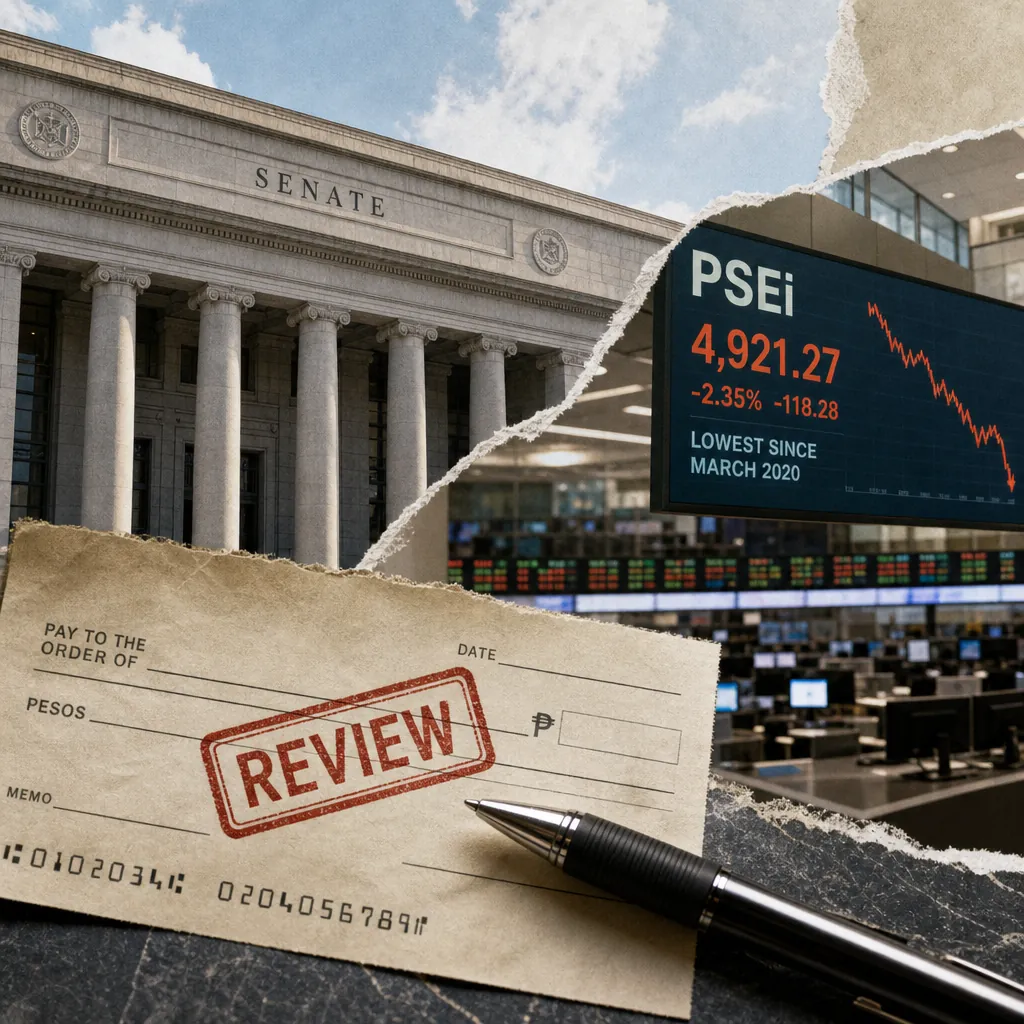
The Philippine financial system drew scrutiny on two fronts on Sunday, November 22, as Senator Joel Villanueva filed a resolution calling for a Senate investigation into whether banks are protecting depositors from forged checks and unauthorized withdrawals, and the stock market's main index settled at its weakest close in more than six years.22033 The banking inquiry was the day's most widely picked-up business story in the items reviewed here, running in the Inquirer, the Manila Times, Business Mirror in both its broadsheet and online editions, and the aggregator Head Topics.2203429 The market decline, meanwhile, was reported alongside a separate central bank initiative to open the country's retail payment system to more participants, and a fresh warning that fraud networks are shifting their operations from personal accounts into business accounts.1145
Villanueva's Proposed Senate Resolution 785 directs the Senate Committee on Banks to examine the implementation and adequacy of bank safeguards, the effectiveness of regulatory supervision, and whether depositors who lose money receive timely and fair redress.20 In a statement, the senator said: "Our banks hold the money of our countrymen, and our law is clear that financial institutions have the responsibility to safeguard it. We need to determine if this is being properly implemented for depositors."2 The resolution asks the committee to look at whether banks effectively verify signatures and payment instructions, confirm the authority of people acting on behalf of depositors, and detect and respond to unauthorized transactions.20
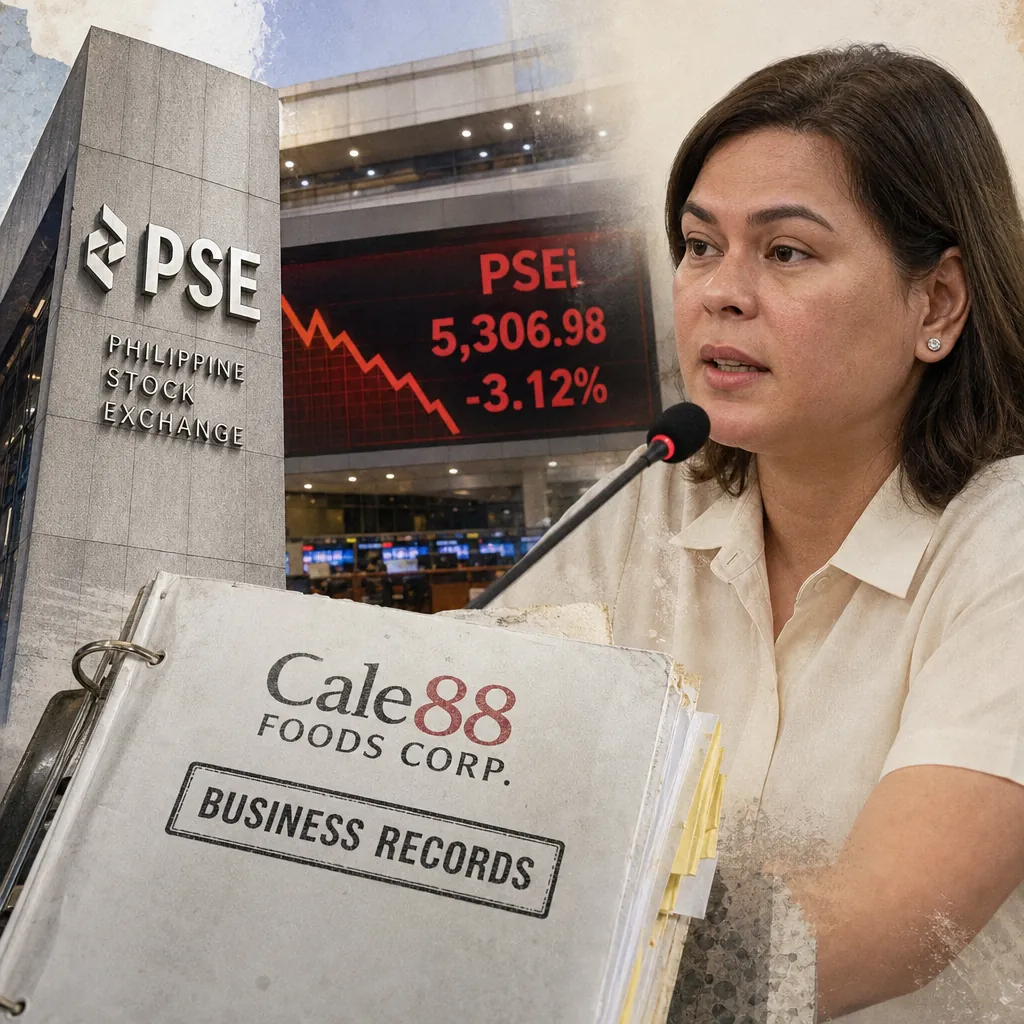
The market story carried its own weight. The Philippine Stock Exchange index (PSEi) — the benchmark that tracks the country's largest listed companies — fell 286.51 points to close at 5,306.98, its lowest finish since March 30, 2020, when it closed at 5,131.16 during the pandemic selloff.33 Foreign investors, who accounted for 65 percent of trades, were net sellers at ₱1.12 billion, and the average value of shares changing hands reached ₱6.77 billion.33 Analysts attributed the drop to rising stagflation risk — the combination of slow growth and persistent inflation — along with an earnings miss at port operator International Container Terminal Services Inc. and the removal of Manila Electric Co. and PLDT Inc. from MSCI indices, which track stocks for global fund managers and trigger automatic selling when a company is dropped.33
Key themes
- Villanueva seeks Senate inquiry into bank safeguards against forgery and unauthorized withdrawals. Proposed Senate Resolution 785 asks the Senate Committee on Banks to assess whether banks verify signatures and payment instructions properly, whether regulators enforce compliance, and whether depositors who lose funds get timely reimbursement.2034 The resolution was covered across at least five outlets in the items reviewed, making it the most widely reported banking development of the day.2202934
- The PSEi closed at 5,306.98, its lowest since March 2020. The index fell 286.51 points on the day, with foreign investors net sellers at ₱1.12 billion and all sub-indices ending lower.33 Analysts cited stagflation risk, weak blue-chip earnings, and MSCI-related selling as the main drivers.3348
- The central bank proposed rules to let third-party providers initiate payments and smaller banks clear through larger ones. A draft circular from the Bangko Sentral ng Pilipinas (BSP) — the country's central bank — would allow payment initiation services under its Open Finance Framework and clearing sponsorship arrangements under the National Retail Payment System.1132 The move is meant to widen access beyond institutions that can afford to build their own payment infrastructure.11
- Fraud networks are moving mule accounts from personal to business accounts. TrustDecision chief data and artificial intelligence officer Simon Liu told The STAR that illicit fund flows are increasingly routed through merchant and business accounts, where "hundreds of payments from strangers look like ordinary trade."45 A mule account is a bank or e-wallet account used to receive and move proceeds from scams.
- The balance of payments deficit hit $10.6 billion in January to October, breaching the full-year forecast. The shortfall — which tracks money flowing out of the country minus money coming in — was more than double the $4.6-billion deficit in the same period last year and already exceeds the BSP's $9.2-billion projection for all of 2026.35 Gross international reserves fell to $98.0 billion at end-October from $99.49 billion in September and $110.25 billion a year earlier.39
- The Monetary Board said its 50-basis-point rate hike should contain second-round inflation effects. The BSP's highest policy-making body voted to raise the policy rate by 50 basis points on October 22, saying the move would make monetary policy "appropriately restrictive" while signaling readiness to act further if needed.30 A basis point is one-hundredth of a percentage point.
- Retail dollar bonds and a bank chatbot extended digital access to financial products. GCash launched Retail Dollar Bonds Tranche 3 on its GBonds platform with a 5.65 percent annual yield and a $200 minimum, while LANDBANK opened the same offering through its mobile apps.40 Metrobank separately launched Ask Earnest, an AI chatbot for everyday money questions.46
- The economy grew 2.1 percent in the third quarter, the slowest pace in the recent sequence. The Philippine Statistics Authority reported the figure on November 9, down from 2.4 percent in the second quarter and 4 percent a year earlier, with household spending and small business activity under pressure.37
How the narratives stack
Dominant: The Senate banking inquiry led the day's financial coverage in the items reviewed, appearing in the Inquirer, the Manila Times, Business Mirror's broadsheet and online editions, and Head Topics.2202934 Its dominance within this set reflects both the breadth of pickup and the fact that it was framed as a consumer-protection story — depositors losing money to forgery — rather than a technical regulatory matter. The stock market decline ran close behind, with the PSEi's six-year low reported in Business Mirror and Philstar, and analysts quoted urging calm.3348
Counter-narrative: The BSP's draft circular on payment access and the TrustDecision fraud warning both point in a different direction from the Senate inquiry. The central bank is proposing to widen the number of institutions that can initiate and clear payments, which would lower barriers for smaller banks and fintech firms.1132 TrustDecision's Simon Liu said the Philippines remains among the more exposed markets in Southeast Asia for fraud, with organized mule networks involving recruiters, sellers of verified accounts, and separate cash-out operators.45 The two stories sit alongside the Senate probe as evidence that the infrastructure is being opened up at the same time that the fraud risk is shifting into harder-to-detect channels.
Emerging: The balance of payments deficit and the decline in gross international reserves are macro-level signals that have not yet translated into consumer-facing headlines but carry consequences for the peso and for import costs.3539 The OECD report on the $9-billion to $21.5-billion financing gap facing micro, small, and medium enterprises (MSMEs) — which account for 99.6 percent of homegrown businesses but receive less than 5 percent of total bank credit — points to a structural credit gap that the Senate inquiry's focus on deposit safety does not address.52
Under-covered: The OECD's MSME financing findings and the BSP's payment circular received less pickup in the items reviewed than the Senate resolution and the stock market story, even though both carry long-term consequences for how capital reaches smaller businesses and how payments flow through the system.1152 The digital fraud shift to business accounts was carried in a single Philstar report.45
Platform insights
- Facebook: The banking inquiry and the stock market decline were the most shared financial stories in the items reviewed, with the Inquirer and Philstar items drawing the bulk of pickup. Consumer-facing framing — depositors losing money, the market hitting a six-year low — traveled further than the regulatory detail of the BSP circular.
- X: The stock market story generated the most immediate reaction, with analysts and market watchers quoting the 5,306.98 close and the 5.12 percent weekly loss.33 The Senate resolution drew commentary from policy watchers but less viral spread.
- Reddit: Discussion of the banking inquiry focused on personal experience with unauthorized withdrawals and the difficulty of getting reimbursed, reflecting the consumer complaints that prompted Villanueva's resolution.20 The BSP payment circular drew more technical discussion about what clearing sponsorship would mean for smaller banks.
- YouTube: Business Mirror's and Philstar's video segments on the market decline and the Senate probe drew moderate viewership, with the market story outperforming the regulatory story.
Key voices and communities
Senator Joel Villanueva and the Senate Committee on Banks. Villanueva framed the inquiry around the legal responsibility of financial institutions to safeguard deposits, saying: "Banks hold our people's money. And the law clearly imposes on financial institutions to responsibility to safeguard them. We need to determine whether banks are carrying this out well and doing right by depositors."34 The committee's investigation, if it proceeds, would be the first formal legislative look at bank safeguards in the current Congress.
The Bangko Sentral ng Pilipinas. The central bank appeared in three separate stories: the draft circular on payment access, the Monetary Board's rate-hike rationale, and the balance of payments and reserves data.11303539 Its framing across all three was cautious — widening access while maintaining supervision, raising rates to contain inflation, and acknowledging the reserves decline while noting they remain sufficient to cover imports and foreign debt.39
Market analysts and brokerages. F. Yap Securities Inc., writing through 2TradeAsia, said the PSEi could test 5,400 ahead of the BSP's December 17 meeting, with 5,250 possible if both the US Federal Reserve and the BSP deliver larger-than-expected rate increases.32 Economist Jonathan Ravelas of Reyes Tacandong & Co. told The STAR: "While we may see further volatility and even some downside before yearend, this is still part of a normal market cycle rather than a reason for outright panic."48
TrustDecision and the fraud-prevention community. Simon Liu's warning that mule activity is moving into merchant and business accounts adds a technical dimension to the consumer-protection concerns behind the Senate inquiry.45 His framing — that hundreds of payments from strangers can look like ordinary trade — points to a detection problem that signature verification alone would not solve.
MSME advocates and the OECD. The OECD report, published November 20, found that MSMEs outside Metro Manila face the sharpest financing gap, with 83.8 percent of MSME bank loans booked in the National Capital Region in 2024 despite over four-fifths of MSMEs operating elsewhere.52 The report connects the credit gap to clean energy investment, arguing that limited access to cheaper electricity financing constrains small business growth.
Narrative streams
Villanueva's resolution puts bank safeguards and depositor redress before the Senate
Senator Joel Villanueva filed Proposed Senate Resolution 785 on Sunday, directing the Senate Committee on Banks to investigate whether banks are adequately implementing safeguards against forged checks and unauthorized withdrawals, whether regulators are effectively enforcing compliance, and whether depositors who lose money can obtain timely and fair reimbursement.20 The resolution asks the committee to examine whether banks verify signatures and payment instructions, confirm the authority of persons acting on behalf of depositors, and detect and respond to unauthorized transactions.20 Villanueva said reports and complaints involving forged checks, repeated unauthorized withdrawals, and disputed transactions continue to surface.2
The inquiry, if it proceeds, would put bank operations under legislative scrutiny at a time when the BSP is simultaneously proposing to widen access to the payment system. The resolution is framed as an "in aid of legislation" measure, meaning it is intended to inform future laws rather than to adjudicate individual cases.20 For depositors, the practical question is whether the inquiry produces changes in how quickly banks reimburse victims of fraud and how clearly they communicate their verification procedures. For banks, the risk is that the hearings generate public testimony about cases that have not been resolved through existing complaint channels. The resolution was covered by the Inquirer, the Manila Times, Business Mirror's broadsheet and online editions, and Head Topics, with the broadsheet Business Mirror item carrying an estimated ₱140,773.75 in advertising-equivalent value — the notional cost of buying the same space as paid advertising.2202934
The PSEi closes at 5,306.98, its lowest since March 2020
The Philippine Stock Exchange index fell 286.51 points to close at 5,306.98, its lowest finish since March 30, 2020, when it closed at 5,131.16 during the pandemic.33 The index lost 5.12 percent for the week.32 Analysts attributed the decline to rising stagflation risk, an earnings miss at International Container Terminal Services Inc., and the removal of Manila Electric Co. and PLDT Inc. from MSCI indices, which forced passive funds tracking those indices to sell.33 Foreign investors were net sellers at ₱1.12 billion, accounting for 65 percent of trades.33
F. Yap Securities Inc. said the index could test 5,400 ahead of the BSP's December 17 meeting, with 5,250 possible if both the US Federal Reserve and the BSP deliver larger-than-expected rate increases.32 The brokerage also expects more passive selling toward the November 27 month-end portfolio close, particularly in stocks affected by MSCI changes.32 Jonathan Ravelas of Reyes Tacandong & Co. said the market needs greater confidence that inflation is under control, interest rates are headed lower, corporate earnings are improving, and foreign funds are returning.48 For retail investors, the practical consequence is that the market's recovery depends on the BSP's December meeting and on whether corporate earnings stabilize in the fourth quarter. For companies planning to raise capital, the weak market raises the cost of equity — Aznar Shipping Corp. received PSE approval for a ₱737-million initial public offering at up to ₱0.67 per share, with the offer period running from November 26 to December 9.49
The BSP proposes to open payment clearing to smaller institutions and third-party providers
The Bangko Sentral ng Pilipinas is seeking feedback on a draft circular that would allow payment initiation services under its Open Finance Framework and clearing sponsorship arrangements under the National Retail Payment System.1132 Under clearing sponsorship, smaller financial institutions that hold customer funds but do not directly participate in payment clearing networks could tap larger institutions such as universal banks to process and clear transactions on their behalf.11 These smaller firms, known as indirect clearing participants, would partner with clearing sponsor institutions — direct participants in payment networks — that would handle the clearing of their transactions.11 Payment initiation services would allow consumers to authorize qualified third-party providers to initiate payments from their transaction accounts through application programming interfaces or other secure electronic interfaces.32
The proposal is meant to widen access beyond institutions that can afford to build their own payment infrastructure.11 For smaller banks, rural banks, and fintech firms, the change could lower the cost of offering digital payments without requiring direct membership in clearing networks. For consumers, it could mean more payment options at the point of sale and in online transactions. The BSP's simultaneous push to widen access and the Senate's inquiry into safeguards are not contradictory — one addresses the number of participants, the other the protections for depositors — but they will intersect if the Senate hearings examine whether new entrants can meet the same verification standards as established banks. The draft circular was covered in the Inquirer and the Manila Times broadsheet, with the Manila Times item carrying an estimated ₱350,927.91 in advertising-equivalent value.1132
Fraud networks shift mule activity into business accounts
Fraud networks in the Philippines are increasingly moving mule activity from personal accounts to merchant and business accounts, making illicit fund flows harder to distinguish from legitimate payments, according to TrustDecision.45 "The shift I would single out is where the mules now sit. Activity is moving out of personal accounts and into merchant and business accounts, where hundreds of payments from strangers look like ordinary trade," TrustDecision chief data and artificial intelligence officer Simon Liu told The STAR.45 A mule account is a bank or e-wallet account used to receive and move proceeds from scams and other illicit activities.45 Liu said the Philippines remains among the more exposed markets in Southeast Asia, with organized mule networks now involving recruiters, sellers of verified accounts, and separate cash-out operators.45
The shift matters for the Senate inquiry because signature verification and authority checks — the safeguards Villanueva wants examined — are designed for personal accounts and may not catch business-account mule activity that looks like ordinary trade.2045 For banks, the detection challenge is to distinguish legitimate merchant volume from structured fraud flows without disrupting ordinary business customers. For regulators, the question is whether existing anti-money-laundering rules are adequate for a fraud ecosystem that has moved into commercial accounts. The TrustDecision findings were carried in a single Philstar report, with an estimated ₱339,115.20 in advertising-equivalent value.45
The balance of payments deficit and reserves decline frame the macro backdrop
The Philippines' balance of payments deficit reached $10.6 billion in January to October, more than double the $4.6-billion shortfall in the same period last year and already above the BSP's full-year projection of $9.2 billion.35 The balance of payments tracks the flow of money into and out of the economy; a deficit means more money flowed out than came in.35 In October alone, the deficit reached nearly $1.5 billion, a reversal from a $706-million surplus in the same month last year.35 The BSP attributed the gap to high oil prices inflating the import bill and market volatility fueling foreign fund outflows.35
Gross international reserves — the country's foreign currency cushion — fell to $98.0 billion at end-October from $99.49 billion in September and $110.25 billion at end-October 2025.39 The BSP said the remaining reserves are sufficient to pay for imports and foreign debt and to help the country withstand shocks such as sudden capital outflows or rising import costs, covering 6.1 months of goods imports.39 For consumers, a wider balance of payments deficit and falling reserves can translate into a weaker peso, which raises the cost of imported fuel and food. For the BSP, the data reinforces the case for the "appropriately restrictive" monetary policy stance it adopted on October 22, when the Monetary Board raised the policy rate by 50 basis points to contain second-round inflation effects.30 The balance of payments story ran in Panay News and the reserves story in Daily Guardian, both online outlets.3539
Digital investment channels widen access to retail dollar bonds and financial advice
GCash launched Retail Dollar Bonds Tranche 3 on its GBonds platform, allowing investments starting at $200, or about ₱12,700, using pesos directly from the app.46 The offering, launched in partnership with PDAX, carries a fixed annual yield of 5.65 percent with quarterly interest payments over a three-year term, and investors can purchase the dollar-denominated government securities without opening a dollar bank account or visiting a bank or brokerage.46 LANDBANK opened the same offering through its mobile banking apps and the Bureau of the Treasury's online ordering facility, with over-the-counter subscriptions available at branches.40 The bonds are available from November 19 to 24 and will enter the secondary market on November 27.4046
Metrobank separately launched Ask Earnest, an AI-powered financial mindfulness chatbot designed to help users explore money-related questions and better understand their financial decisions.46 The bank said conversations about money remain taboo for many Filipinos and that the chatbot aims to normalize these discussions.46 For retail investors, the practical change is that dollar-denominated government securities are now accessible through apps rather than requiring a dollar account or a broker visit. For banks and fintech firms, the competition for retail investment flows is shifting to digital channels, with GCash and LANDBANK both positioning themselves as low-friction entry points. The GCash and LANDBANK items ran in the Manila Times broadsheet and Daily Guardian, while the Metrobank item ran in Business Mirror's broadsheet bulletin board.4046
The economy grows 2.1 percent in the third quarter as MSMEs face a financing gap
The Philippine economy grew by 2.1 percent in the third quarter of 2026, slowing from 2.4 percent in the previous quarter and 4 percent in the same period last year, according to Philippine Statistics Authority data released November 9.37 The Manila Bulletin column described the figures as a reminder that the recovery remains fragile, with low-income households particularly exposed to rising food, transportation, and electricity costs.37 The OECD reported that Philippine MSMEs face an estimated financing gap of $9 billion to $21.5 billion, limiting their ability to invest in cheaper and more reliable electricity.52 MSMEs account for 99.6 percent of all homegrown businesses but have consistently received less than 5 percent of total bank credit over the past decade, and 83.8 percent of MSME bank loans were booked in the National Capital Region in 2024 even though over four-fifths of MSMEs operate outside it.52
For small business owners, the financing gap means that investment in energy-saving equipment or expansion depends on retained earnings or informal credit rather than bank loans. For banks, the gap represents an underserved market that the BSP's payment reforms and the Senate's deposit-safety inquiry do not directly address. The OECD report was published November 20 and covered in the Manila Bulletin, while the GDP column ran in the same outlet.3752
Conversation trajectory
Senate Committee on Banks hearing schedule (observation window: next 2–4 weeks). Villanueva's resolution has been filed but not yet scheduled for committee action. Watch for the committee to set a hearing date and for the BSP and major banks to submit position papers. The trigger event is the committee's first hearing, which would generate testimony about specific fraud cases and put bank verification procedures on the public record.20
BSP December 17 policy meeting (observation window: through December 17). The Monetary Board's next rate decision is the most concrete near-term event for the stock market and the peso. F. Yap Securities said the PSEi could test 5,400 ahead of the meeting, with 5,250 possible if both the US Federal Reserve and the BSP deliver larger-than-expected increases.32 The trigger is the meeting itself and any accompanying statement on inflation and reserves.30
Retail Dollar Bonds Tranche 3 offer close and secondary market listing (observation window: November 24–27). The offer period ends November 24 and the bonds enter the secondary market on November 27.4046 Watch for subscription figures, which would indicate how much retail demand exists for dollar-denominated government securities through digital channels.
MSCI-related selling and month-end portfolio adjustments (observation window: through November 27). F. Yap Securities expects more passive selling toward the November 27 month-end close, particularly in stocks affected by MSCI changes.32 The November 30 holiday means the last trading day of the month falls on Friday, November 27.32
BSP draft circular comment period (observation window: next 4–6 weeks). The central bank is seeking feedback from industry participants on the draft rules for payment initiation services and clearing sponsorship.11 Watch for comments from smaller banks, fintech associations, and consumer groups, and for the final circular's timeline.
TrustDecision fraud data and bank responses (observation window: next quarter). The shift of mule activity into business accounts is a detection problem that banks will need to address through monitoring systems.45 Watch for announcements from major banks about enhanced business-account monitoring or partnerships with fraud-prevention firms.
Response guidance
Bank communicators preparing for the Senate inquiry: Prepare plain-language explanations of how signature verification, authority confirmation, and unauthorized-transaction detection work in practice, and publish clear timelines for how long depositors wait for reimbursement after a fraud claim. The inquiry's focus is on whether existing safeguards are implemented well, so the most useful response is evidence of process rather than assurances of intent.20
Payment providers commenting on the BSP draft circular: Address the verification standards that new entrants would need to meet, not only the access benefits. The Senate inquiry and the BSP circular will be read together by consumers, and any perception that wider access means weaker safeguards would undercut the case for the reforms.1120
Fraud-prevention teams at banks and e-wallets: Review business-account monitoring for patterns that resemble mule activity — hundreds of small payments from unrelated senders, rapid pass-through of funds, and accounts opened recently with high transaction volume. The TrustDecision findings suggest that personal-account controls alone will not catch the shift.45
Retail investment platforms marketing dollar bonds: State the yield, term, and minimum investment plainly, and explain that the 5.65 percent annual yield is fixed and paid quarterly over three years, not a variable return. The offer closes November 24 and the bonds list on November 27, so any communication should include the deadline and the secondary-market date.4046
Communicators addressing the stock market decline: Avoid predicting a recovery date. Analysts quoted in the coverage emphasized that the decline reflects identifiable factors — stagflation risk, earnings misses, MSCI-related selling — and that the near-term direction depends on the December 17 BSP meeting and fourth-quarter earnings.3248 Frame any communication around those specific catalysts rather than around general confidence.
MSME lenders and development finance institutions: The OECD's $9-billion to $21.5-billion financing gap estimate and the concentration of MSME lending in Metro Manila point to a regional credit gap that payment reforms do not address.52 Any new MSME lending program should state how it reaches businesses outside the capital, where over four-fifths of MSMEs operate.
See the full picture behind today's signals.
This report draws from Media Meter's MediaWatch, our real-time monitoring engine tracking 2,470+ Philippine sources across print, broadcast, digital, and social. Explore how the platform turns raw coverage into decision-grade intelligence, then see how it's configured for teams like yours — whether you're in PR agencies, corporate comms, government, or marketing.
Want more? Browse our Report Library for sector and crisis intelligence, or request a demo and we'll have your brand set up before the call.
Want this kind of intelligence on your brand?
This brief is built on the same MediaWatch methodology that runs continuously across every brand we monitor. See your competitive landscape, Impact Score, and narrative trajectory in a 30-minute demo.