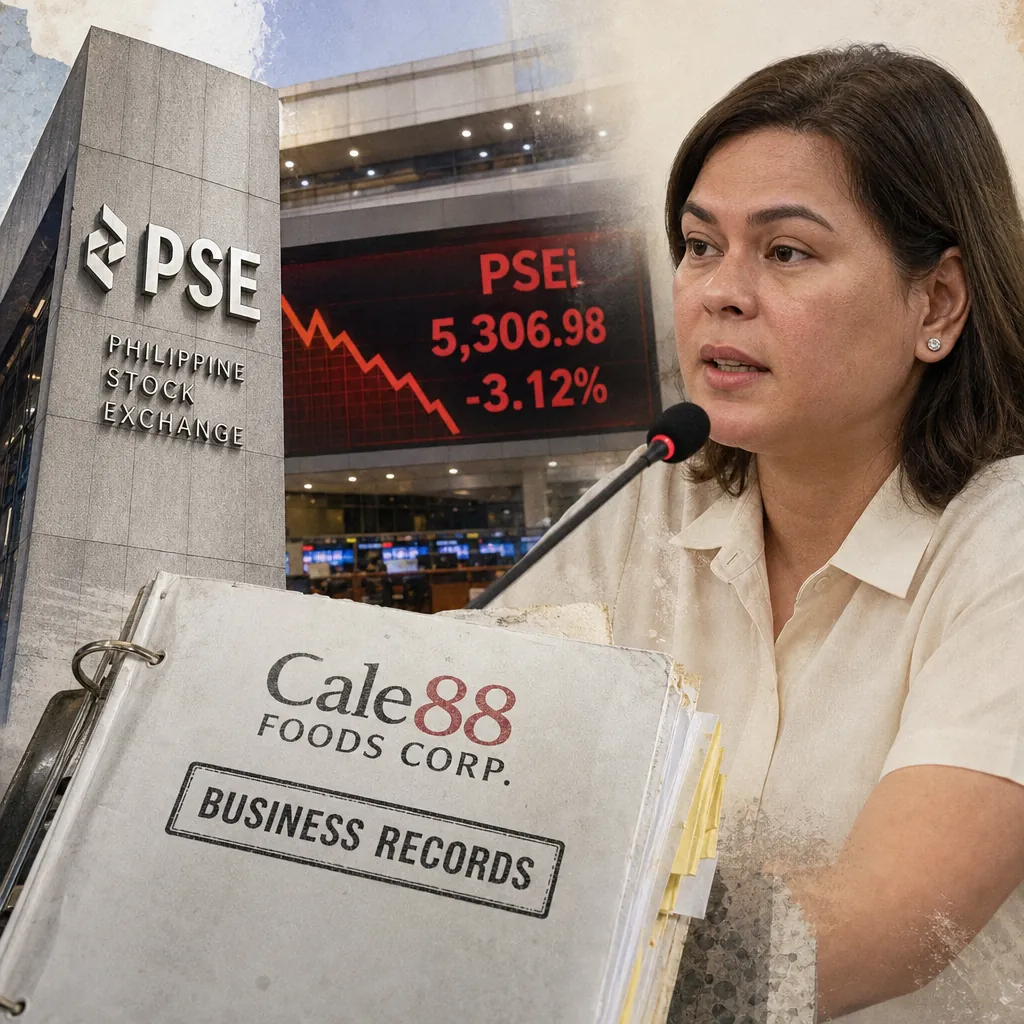
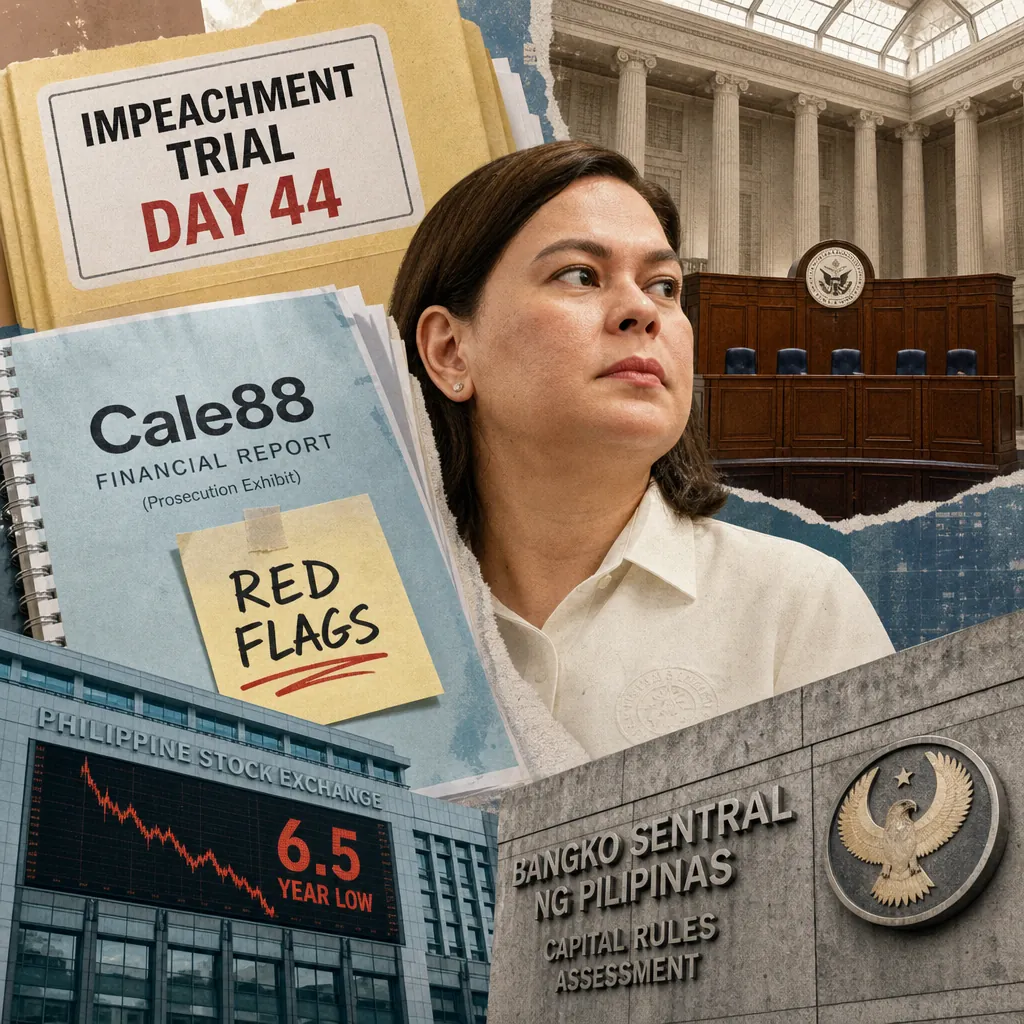
Duterte Trial Turns on P568-Million Cale88 Gap
House prosecutors say Cale88 Foods declared P208 million in sales against P776 million in bank inflows, putting tax-fraud questions at the center of Vice President Sara Duterte's impeachment trial. The same day, the Justice Department promoted a regional extradition treaty and the Senate leadership asked for a flexible trial timetable.
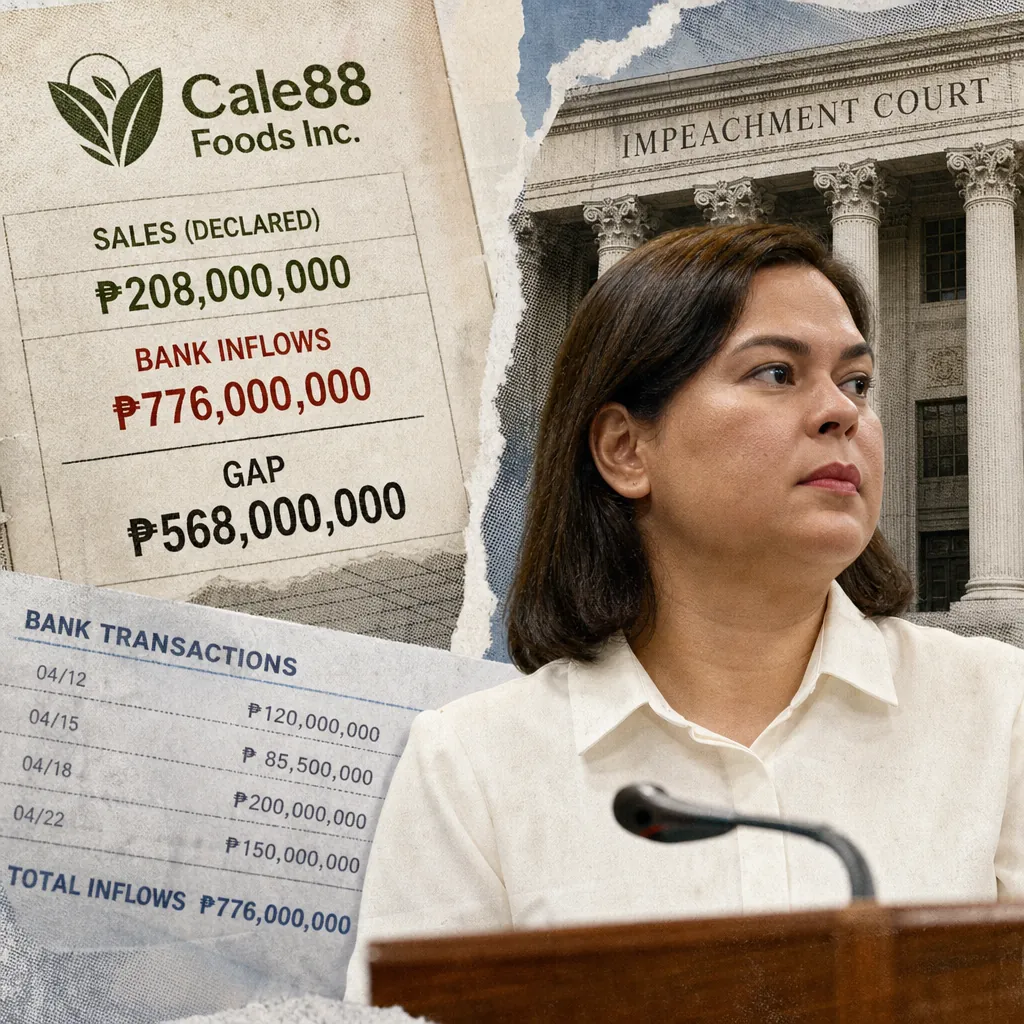
House prosecutors put a peso figure on the table on Saturday and asked Vice President Sara Duterte's defense to explain it: a gap of about P568 million between what Cale88 Foods Corp. told the tax authorities it sold and what the Anti-Money Laundering Council (AMLC) recorded flowing into its bank accounts. Cale88, a company linked to the Vice President's husband, Manases Carpio, reported roughly P208 million in sales, while the AMLC's financial records showed about P776 million in inward remittances, according to House prosecution spokesman and Lanao del Sur Rep. Zia Alonto Adiong, speaking at a news forum on Saturday20. The discrepancy, raised in the Senate sitting as an impeachment court, is the charge the prosecution has left standing after several others were dropped, and it drew the heaviest coverage in the items reviewed here — the Manila Times' report on the discrepancy carried an estimated P1.11 million in advertising-equivalent value, the cost of buying the same space as paid advertising, and its companion podcast episode on the day's headlines was valued at about P1.17 million520.
The trial's procedural fight ran alongside the substantive one. Senate President Sherwin Gatchalian said he personally hopes the trial finishes before Christmas, or at the very least before the New Year, but insisted the impeachment court keep its timetable flexible because witness testimony has repeatedly run longer than expected — a day's examination stretching to two or three3940. The House panel, meanwhile, called on the defense to respect the senator-judges after the Senate issued a show-cause order against defense lawyer Paolo Panelo over remarks suggesting some judges were biased; Adiong noted that the prosecution itself had faced criticism from the bench, including questions over forensic accountant Alexander Cabrera's report of an P817.87-million increase in the Vice President's wealth from 2022 to 202543. The Office of the Vice President also issued a statement denying any link between its "Pagbabago: A Million Trees" campaign and Cale88's compliance with a Board of Investments tree-planting requirement, after prosecution counsel Erwin Matib raised the connection during Friday's hearing38.
Two other stories shaped the day's political coverage. The Department of Justice (DOJ) said it will lean on the ASEAN Treaty on Extradition as its main instrument against fugitives who cross Southeast Asian borders, with Chief State Counsel Dennis Arvin Chan arguing that one binding regional framework replaces a patchwork of bilateral deals24. And a Manila Times column questioned the P22.895-billion budget allocated for the Philippines' 2026 ASEAN hosting, the largest of the country's five summit years, while noting that the figure is an allocation, not yet an audited spend6. A labor-group opinion piece tied the impeachment trial, the summit, and rising prices into a single question about whether those in power answer to the people paying the bill34.
Key themes
- Prosecutors put a P568-million gap at the center of the trial. Cale88 declared about P208 million in sales while AMLC records showed about P776 million in inward remittances, a difference House prosecutors say may amount to tax fraud and undeclared income20.
- The Tax Code's 30-percent threshold is the legal hinge. Adiong cited the National Internal Revenue Code provision that an underdeclaration of taxable sales or income exceeding 30 percent may be prima facie evidence of a false or fraudulent return — a standard the alleged gap far exceeds if the figures hold20.
- The Senate wants the trial finished by Christmas but will not fix a deadline. Gatchalian said he hopes for a pre-Christmas, or at least pre-New Year, conclusion while keeping the court's schedule flexible because testimony has run long3940.
- The defense is down to one charge and a thinner witness list. With several impeachment charges already dropped, a Philstar column argued the remaining undeclared-wealth case is giving the defense more trouble than the others, after a reported exodus of witnesses including bank officials and a constitutional law expert42.
- A show-cause order against a defense lawyer widened the procedural fight. The Senate ordered Atty. Paolo Panelo to explain remarks that some senator-judges were biased, and the House panel asked the defense camp to respect the court43.
- The OVP denied a link between its tree-planting campaign and Cale88. The Office of the Vice President said its "Pagbabago: A Million Trees" program had no association with Cale88's compliance with a Board of Investments requirement to plant trees38.
- The DOJ is promoting a regional extradition treaty as its main tool against fugitives. The ASEAN Treaty on Extradition, signed in Manila in November 2025, would give Philippine authorities one instrument across nine jurisdictions instead of separate bilateral arrangements24.
- The cost of hosting ASEAN drew scrutiny. A column put the 2026 summit budget at P22.895 billion across fiscal 2025 and 2026, the largest of the Philippines' five hosting years, while noting the amount is an allocation still awaiting audit6.
How the narratives stack
Dominant. The Cale88 discrepancy dominated the items reviewed here. The Manila Times ran it as both a news story and the lead of its daily headlines podcast, and the two items together carried more than P2.2 million in estimated advertising-equivalent value520. Philstar's column treated the same charge as the near-collapse of the defense case, and the OVP's tree-planting denial was a direct response to a line of questioning from the same trial3842. Within this captured set, the impeachment trial was the story every other political item orbited.
Counter-narrative. The defense's position, as reported, is that the Vice President's assets match her declarations, and its witnesses have been presented to make that case34. The OVP's categorical denial on the tree-planting program is part of the same effort to keep the trial's questions from spreading to the office's own programs38. The show-cause order against Panelo shows the defense also fighting on procedure, arguing that some judges have prejudged the case43.
Emerging. The DOJ's extradition push is a policy story with a longer fuse. The ASEAN Treaty on Extradition standardizes how member states surrender people wanted for prosecution or to serve sentences, and Chan's argument is that one instrument across nine jurisdictions narrows the world for fugitives24. It has no direct connection to the impeachment trial, but it sits in the same public conversation about accountability and cross-border enforcement, and it will matter when the first requests under the treaty are filed.
Under-covered. The cost of the ASEAN summit hosting received a single column in this set, despite the size of the figure: P22.895 billion allocated across fiscal 2025 and 2026, of which P5.4 billion fell in 2025 and P17.495 billion in 20266. The column is careful to say the allocation is not necessarily the amount spent and that liquidation still has to go to the Commission on Audit, the state's external auditor. The labor-group opinion piece also raised the summit, noting the four labor measures the Philippines brought to ASEAN leaders — labor market resilience, fair recruitment, safety in the informal sector, and labor inspection in the fishing industry — and support for regional guidelines for platform workers34. Both angles placed well below the trial in the items reviewed.
Key voices and communities
House prosecutors. Led in public by Adiong, the panel has built its remaining case on financial records from the AMLC and the Bureau of Internal Revenue, bank officials, a forensic accounting expert, and legal experts42. Its framing is arithmetic: declared sales against documented inflows, measured against the Tax Code's 30-percent threshold20. Adiong's call for respect toward the senator-judges positions the prosecution as the party defending the court's integrity43.
The Senate as impeachment court. Gatchalian's public comments set the court's tone: a personal hope for a pre-Christmas finish, paired with a refusal to bind the schedule3940. The show-cause order against Panelo shows the court policing its own members' conduct43. For senator-judges, the political cost of a rushed or a dragging trial is symmetrical, and Gatchalian's language reflects that.
The Office of the Vice President and defense team. The OVP's statement denying any link between its tree-planting campaign and Cale88 is its most direct public response in this set38. The defense's broader argument, that the Vice President's assets match her declarations, is being made through witnesses rather than press statements34. Philstar's column describes a defense left with witnesses who either suffer from selective amnesia or have dug the client deeper42.
The Department of Justice. Chan, the Chief State Counsel, is the public face of the extradition push, making the case in a Saturday radio interview that a single regional instrument is more useful than nine separate bilateral relationships2. The DOJ's framing ties the treaty to cross-border crimes including cyber fraud and human trafficking4.
Labor and civil-society commentators. Partido Manggagawa, a labor group, has argued since 2025 that impeaching the Vice President is the right course and that justice should not be strangled by technicalities, and it links the trial, the summit, and inflation as one question of accountability34. The Manila Times column on summit spending speaks from a fiscal-watchdog position, asking whether the outlay buys more than a good impression6.
Narrative streams
The P568-million gap and the Tax Code's 30-percent rule
The prosecution's remaining charge rests on a comparison of two sets of numbers. Cale88 Foods Corp. reported about P208 million in sales. The AMLC's financial records, presented in the trial, showed about P776 million in inward remittances. The difference is roughly P568 million20. Adiong anchored the legal significance in the National Internal Revenue Code, which provides that a substantial underdeclaration of taxable sales or income exceeding 30 percent may constitute prima facie evidence of a false or fraudulent return20. Prima facie means the evidence is enough on its face to establish the claim unless rebutted, so the provision shifts the burden of explanation onto the taxpayer once the threshold is crossed. The alleged gap is far above 30 percent of declared sales.
The read for the sector is that the trial's outcome now turns on accounting rather than constitutional argument. For the Vice President's office, the practical exposure is that a finding of fraudulent returns would not stay inside the impeachment court; it would invite a separate tax case and give the prosecution a narrative it can carry into the 2028 election cycle. For the Bureau of Internal Revenue and the AMLC, the case is a public test of whether their records can be stitched together into evidence that survives cross-examination by senator-judges. The defense's counter is that the Vice President's assets match her declarations, and its witnesses are being called to show that34. Philstar's column argues the defense has struggled to produce credible answers, describing a witness list thinned by departures and testimony that either forgets key facts or adds to the prosecution's case42. That is a columnist's characterization, not a court finding.
A trial timetable that the Senate will not fix
Gatchalian's comments set out the court's dilemma in plain terms. He hopes the trial ends before Christmas, and at the very least before the New Year, because finishing before the holiday is preferable3940. But he said the court cannot set a strict schedule because testimony has repeatedly run longer than expected, with witnesses expected to finish in a day taking two or three40. The Senate President's position matters because the impeachment court is the Senate itself, with all senators sitting as judges, and its rules and timetable are set by that body.
The read for the sector is that the trial's calendar is now a political variable. A finish before Christmas would clear the Senate's floor for the 2027 budget and other legislation and would remove the trial as a backdrop to the holiday period. A trial that runs into the New Year keeps the Vice President's case in the news through the filing of candidacies and the early campaign for the 2028 elections. For the defense, delay is not automatically an advantage: every additional week of testimony is another week of headlines built on the prosecution's financial evidence.
The procedural fight over the court's impartiality
The Senate issued a show-cause order against defense lawyer Paolo Panelo over statements suggesting some senator-judges were biased, and the House prosecution panel responded by calling on the defense camp to respect the court and its members43. Adiong noted that the prosecution had also been criticized from the bench, including questions about forensic accountant Alexander Cabrera's report of an P817.87-million increase in the Vice President's wealth between 2022 and 202543. A show-cause order requires the recipient to explain why they should not be disciplined; in this setting it is the court's way of protecting its authority without expelling anyone.
The read for the sector is that the defense's procedural strategy carries risk. Attacking the bench can rally supporters who already believe the trial is political, but it also gives the court a reason to police the defense's conduct and hands the prosecution a clean argument about respect for the process. For senator-judges, the exchange is a reminder that their individual conduct is now part of the record, and that any appearance of prejudgment will be used by one side or the other.
The OVP's tree-planting denial
The Office of the Vice President issued a statement denying any association between its "Pagbabago: A Million Trees" campaign and Cale88 Foods Corp.'s compliance with a Board of Investments tree-planting requirement38. The question came from prosecution counsel Erwin Matib, who asked defense witness Trade Undersecretary Ceferino Rodolfo whether the Vice President's program was connected to the BOI requirement for enterprises to plant trees38. The Board of Investments is the government's main investment-promotion agency, and its incentives can carry conditions, including environmental commitments, for registered enterprises.
The read for the sector is that the denial matters less for what it settles than for what it signals. The prosecution is testing whether the Vice President's public programs and her family's business interests intersect, and the OVP judged the question serious enough to answer in writing. For companies with BOI-registered incentives, the episode is a reminder that compliance conditions can become evidence in unrelated proceedings if a connection is alleged. For the OVP, the statement draws a line: the tree-planting campaign is a public program, and Cale88's compliance is a corporate obligation.
The DOJ's extradition treaty push
The Department of Justice is positioning the ASEAN Treaty on Extradition as its central tool against fugitives who seek refuge across Southeast Asia2. The treaty, signed in Manila in November 2025 after decades of regional negotiations, establishes a standardized, binding mechanism for member states to surrender individuals wanted for criminal prosecution or for the service of a sentence2. Chan's argument is that Philippine authorities can now invoke one instrument across nine jurisdictions instead of navigating nine separate legal systems, which he said effectively narrows the world for those evading justice24. The DOJ ties the treaty to cross-border crimes including cyber fraud and human trafficking4.
The read for the sector is that the treaty's value will be measured in requests, not signatures. Extradition is slow, evidence-heavy work, and a regional framework only helps if member states' courts apply it consistently. For Philippine law enforcement, the treaty gives prosecutors a single citation to use across the region; for defense counsel, it creates a new set of procedural objections. The first high-profile request filed under the treaty will show whether the framework shortens the process or simply adds a layer.
The cost of hosting ASEAN
A Manila Times column put the budget for the 48th ASEAN Summit in Cebu in May and the 49th ASEAN Summit and Related Summits in Manila on Nov. 15 to 17 at P22.895 billion, sourced from the national budget for fiscal 2025 and 2026 — P5.4 billion and P17.495 billion respectively6. The Philippines has hosted five times: 1987 under Corazon Aquino, 1999 under Joseph Estrada, 2007 under Gloria Macapagal Arroyo, 2017 under Rodrigo Duterte, and 2026 under Ferdinand Marcos Jr., whose hosting carried the largest allocation6. The column notes that the allocation is not necessarily the amount spent and that liquidation still has to be presented and audited by the Commission on Audit6.
The read for the sector is that the summit's fiscal story will outlast the event. The allocation is now a benchmark against which the eventual audit will be judged, and any gap between allocation and audited spend will be a story in itself. For the Department of Budget and Management and the Department of Foreign Affairs, which co-manage summit hosting, the column sets the terms of the public argument: whether the outlay bought diplomatic returns that justify the cost. The labor-group opinion piece adds a second lens, noting the four labor measures the Philippines brought to ASEAN leaders and its support for regional guidelines for platform workers34. That framing asks whether the summit's agenda delivered for workers, not just whether the hosting looked good.
Conversation trajectory
Watch the next hearing days for the defense's financial witnesses (observation window: the coming week). The prosecution's case rests on records; the defense's response rests on witnesses who can explain the gap between declared sales and bank inflows. If the defense cannot produce a document-based explanation, the 30-percent threshold argument will go unanswered in the record, and senator-judges will have to decide whether the prosecution met its burden. If it can, the trial's center of gravity shifts back to the legal definition of unexplained wealth.
Watch the Senate's calendar for a Christmas finish (observation window: through December). Gatchalian's stated hope is a pre-Christmas conclusion, with the New Year as the outer bound3940. A formal schedule announcement, or the absence of one, will signal whether the court believes the remaining witnesses can be heard in time. A trial that runs past the New Year keeps the case in the news through the holiday period and into the 2027 budget session.
Watch the show-cause proceeding against Panelo (observation window: the next session). The Senate's order requires an explanation, and the court's response — a reprimand, a fine, or nothing — will set the boundary for how far defense counsel can go in questioning the bench's impartiality43. A harsh sanction would harden the defense's supporters; a soft one would invite more of the same.
Watch for the first extradition request under the ASEAN treaty (observation window: the next quarter). The DOJ's public case for the treaty is that it replaces nine bilateral relationships with one instrument24. The first request will test whether member states' courts treat the treaty as binding and how quickly they act. A slow or contested first case would undercut the DOJ's framing; a smooth one would give it a template.
Watch the Commission on Audit's liquidation of summit expenses (observation window: the next audit cycle). The P22.895-billion allocation is the number in circulation; the audited spend is the number that will settle the argument6. Any material gap between the two will revive the column's question about whether the hosting was worth the cost.
Trigger events. A formal Senate schedule for the remaining trial days; a defense motion or witness that directly addresses the P568-million gap; a ruling on the Panelo show-cause order; the filing of the first extradition request under the ASEAN treaty; and the release of the Commission on Audit's findings on summit spending.
Response guidance
For the Vice President's office and defense team: answer the arithmetic directly. The prosecution's case is a comparison of two numbers, and the public explanation needs to be a comparison of the same two numbers — what the P776 million in inflows represents, why it differs from declared sales, and what documentation supports that account. Statements that the assets match the declarations do not address the gap between sales and bank inflows, and the gap is what the Tax Code provision targets2034.
For the Senate as impeachment court: publish the schedule logic, not just the hope. Gatchalian's preference for a pre-Christmas finish is clear, but the court has not said how many hearing days remain or what would have to happen for the trial to run into January3940. A short public statement of the remaining witness list and the estimated hearing days would let the public judge whether the timetable is realistic, and it would reduce the space for claims that the court is rushing or dragging.
For the House prosecution panel: keep the financial evidence in plain language. The 30-percent threshold is the strongest part of the case because it is simple, and the panel's public statements should keep returning to the two figures and the rule20. The temptation to widen the case to the tree-planting program and other side questions risks diluting the one charge that has survived38.
For the Department of Justice: explain what the treaty changes in practice. The public case for the ASEAN Treaty on Extradition is that it replaces nine bilateral arrangements with one instrument24. The next step is to describe, in plain terms, how a request moves from a Philippine prosecutor to a foreign court under the treaty, and how long that is expected to take compared with the old bilateral route.
For fiscal watchdogs and summit organizers: separate the allocation from the spend. The P22.895-billion figure is an allocation, and the Commission on Audit's liquidation will produce the number that matters6. Communications around the summit should be ready to explain the difference between the two, and to account for the labor measures and other agenda items the Philippines brought to the table34.
For all parties: treat the senator-judges' conduct as part of the record. The show-cause order against Panelo shows the court will act when its members are accused of bias43. Public statements from either camp that characterize individual judges' motives will draw a response from the court and will be used by the other side. The safer course is to argue the evidence and let the bench's questions speak for themselves.
See the full picture behind today's signals.
This report draws from Media Meter's MediaWatch, our real-time monitoring engine tracking 2,470+ Philippine sources across print, broadcast, digital, and social. Explore how the platform turns raw coverage into decision-grade intelligence, then see how it's configured for teams like yours — whether you're in PR agencies, corporate comms, government, or marketing.
Want more? Browse our Report Library for sector and crisis intelligence, or request a demo and we'll have your brand set up before the call.
Want this kind of intelligence on your brand?
This brief is built on the same MediaWatch methodology that runs continuously across every brand we monitor. See your competitive landscape, Impact Score, and narrative trajectory in a 30-minute demo.