GCash IPO and DICT network fuel Philippine digital shift
A daily snapshot of the Philippine telecom and digital connectivity conversation, covering consumer complaints, the GCash IPO announcement, and the DICT's Mindanao network launch.
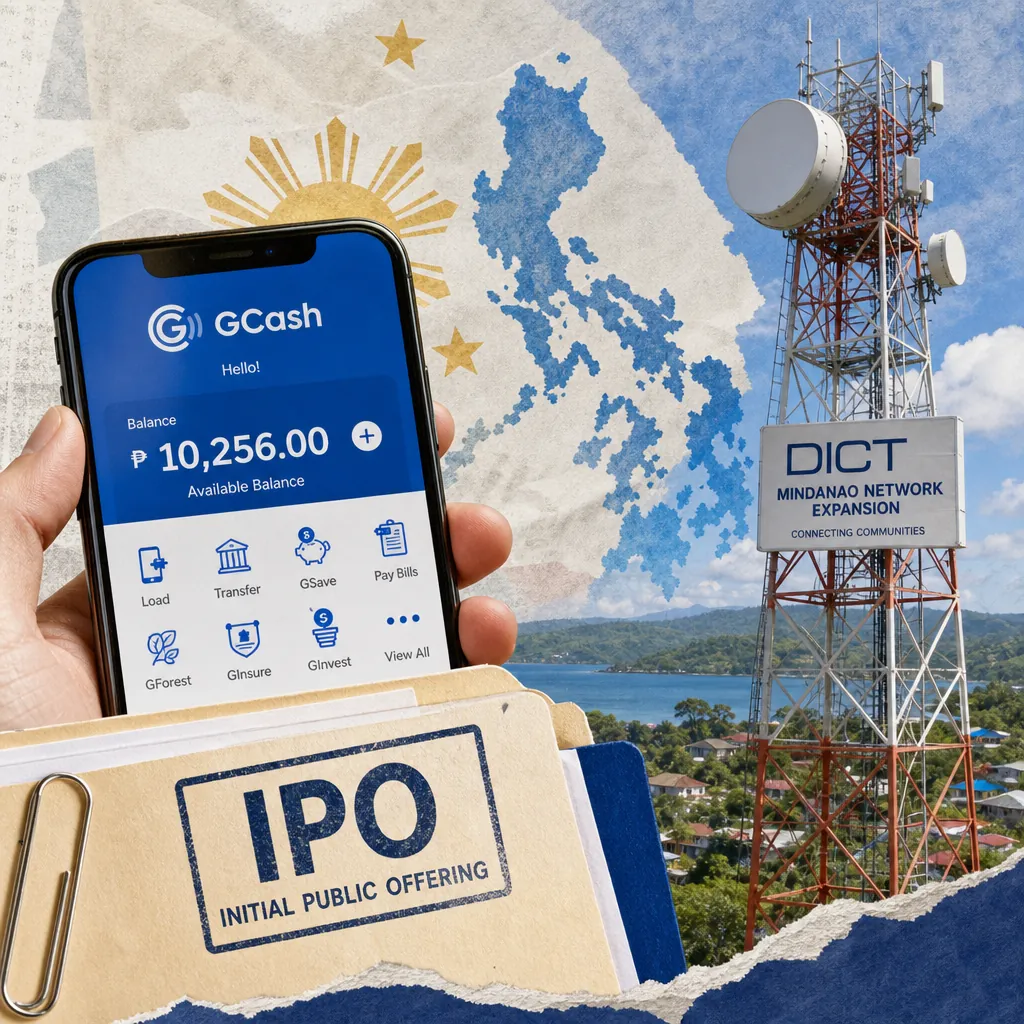
The conversation around Philippine telecommunications and digital connectivity on June 18–19, 2026, was split between two sharply contrasting narratives. On one side, consumer frustration with service quality continued to simmer on Reddit, with new posts detailing a DITO WoWFi Pro router being permanently deactivated after only 42 days for unspecified "fraud," a Globe At Home loss-of-signal (LOS) issue in Calamba, Laguna, and a puzzling speed gap between Smart mobile data hotspots and dedicated prepaid WiFi devices. On the other side, two major institutional announcements on Facebook and in the news shifted the conversation toward optimism: the Department of Information and Communications Technology (DICT) activated Phase 1 of the Mindanao Integrated Government Network, interconnecting roughly 500 government agencies across key Mindanao hubs, and Globe Telecom disclosed that its 34% stake in Mynt (the parent company of GCash) would be worth approximately 155 billion pesos at the fintech's upcoming initial public offering (IPO)—roughly two-thirds of Globe's entire market capitalization. A detailed investment analysis of the GCash IPO on Facebook drew 55 likes and 15 shares, making it the single most-engaged piece of content in the dataset. These two narratives—government infrastructure and telecom-financial synergy—provided a stark contrast to the user-generated crisis accounts that had defined the previous days, creating a bifurcated conversation landscape where consumer anger and institutional optimism coexisted without directly engaging each other.
Conversation snapshot. On June 18, three new Reddit posts added fresh angles to the telecom complaint narrative. A DITO WoWFi Pro user reported permanent deactivation for alleged fraud, receiving 4 comments. A Globe At Home subscriber in Calamba, Laguna, reported a loss-of-signal since Wednesday, with 1 like and no comments. A Smart prepaid WiFi user noted slower speeds compared to mobile data hotspot, also with 1 like. On June 19, the DICT's Facebook post on the Mindanao network activation received 17 likes and 9 positive reactions, while the Philippine News Agency's post on the same topic got 2 likes. The marvingermo investment analysis of the GCash IPO on Facebook garnered 55 likes, 19 loves, and 15 shares, with 2 comments. The Rappler analysis of the GCash IPO was published on June 19 but its engagement figures are not provided. The PLDT Enterprise growth story on bilyonaryoph received 10 likes and 3 shares.
Key themes
- DITO WoWFi Pro deactivation escalates trust crisis. A Reddit user reported that their DITO WoWFi Pro router was permanently deactivated after 42 days due to "fraud and violation of t&c" without specific details, moving the DITO narrative from speed complaints to accusations of arbitrary service termination.
- Geographic expansion of Globe service degradation. A Globe At Home subscriber in Calamba, Laguna, reported a loss-of-signal since Wednesday morning, with a technician citing an "area issue" and no clear fix timeline, adding to earlier outage reports in Davao and near DLSU.
- Smart prepaid WiFi performance gap emerges. A user discovered that mobile data hotspot from a phone gave fast speeds, while the dedicated Smart prepaid WiFi device delivered noticeably slower performance, raising questions about device throttling or plan limitations.
- DICT activates Mindanao Integrated Government Network Phase 1. The DICT officially launched Phase 1 of the Mindanao Integrated Government Network under the National Fiber Backbone project, interconnecting approximately 500 government agencies across Cagayan de Oro, Butuan, Davao City, Koronadal, and Pagadian, serving an estimated 5.3 million Filipinos.
- GCash IPO reframes Globe as fintech powerhouse. Globe Telecom disclosed that its 34% stake in Mynt (GCash's parent) would be worth approximately 155 billion pesos at the target $8 billion IPO valuation—roughly 66% of Globe's entire market capitalization. A financial analyst's post argued that "you are buying the largest fintech platform in the Philippines at a 34 percent discount — bundled inside a telecom company".
- PLDT Enterprise growth story gains traction. PLDT Inc.'s enterprise division reported first-quarter revenues of 12.4 billion pesos, up 4% year-on-year, driven by ICT services and network modernization. A business news post on Facebook received modest engagement.
- EU-Philippines digital package advances. The European Union-Philippines Digital Economy Package held its first Project Steering Committee Meeting, aiming to improve bandwidth connectivity, expand access to Copernicus satellite data, support 5G regulatory development, and strengthen cybersecurity capacity.
- Smart brings scam awareness to retailers. Smart Communications conducted a CX Caravan in Laguna and Cavite to educate load retailers about fraud and social engineering tactics, recognizing their frontline role in customer interactions.
How the narratives stack
Dominant narrative — Consumer frustration with telecom service quality persists. The dominant narrative across Reddit and Facebook comments is one of ongoing dissatisfaction with the reliability and transparency of major Philippine telecom providers. Posts about DITO's unexplained device deactivation, Globe's area-specific outages, and Smart's device performance inconsistencies paint a picture of an industry where marketing promises outpace actual service delivery. This narrative is driven by individual user experiences shared in real-time, with each new post adding a layer of distrust. The DITO WoWFi Pro deactivation is particularly damaging because it moves the conversation from speed complaints to accusations of unfair business practices, potentially scaring off new subscribers who rely on DITO as a cost-effective alternative.
Counter-narrative — Government and corporate initiatives signal progress. Two major announcements on June 19 provided a powerful counterweight to the consumer complaint narrative. The DICT's activation of the Mindanao Integrated Government Network directly addresses the "walang signal" frustrations that have dominated earlier conversations, framing connectivity as a public utility and a government priority. Simultaneously, the GCash IPO announcement reframes Globe Telecom not as a network with outages but as an undervalued fintech giant, with the financial analyst noting that Globe and Ayala shareholders have been "holding this asset at a discount for years." This counter-narrative is institutionally driven—coming from government agencies, business news outlets, and financial analysts—and while it generates lower engagement than consumer complaints, it reaches a different audience of policymakers, investors, and business leaders.
Emerging narrative — Telco valuations increasingly tied to fintech performance. The GCash IPO conversation introduces a new strategic dimension: telecom providers can now frame their value proposition as part of a broader digital ecosystem, attracting investors and partners interested in fintech rather than just connectivity. The marvingermo post explicitly ties Globe's financial health to its fintech holdings, suggesting that consumer frustration might be partly offset by institutional investor optimism. This narrative is still emerging but has the potential to reshape how Globe is perceived in both investor and consumer communications. The Rappler analysis further explores the market implications, noting that Mynt's IPO will consist of primary and secondary shares representing at least 12% of post-IPO capital stock, and that the stock split from P1 to P0.03 per share maximizes retail liquidity.
Suppressed narrative — The gap between enterprise growth and consumer experience. While PLDT Enterprise reports strong growth (12.4 billion pesos in Q1 2026, up 4% year-on-year) and PLDT Home partners with Meralco and MSpectrum for smart home solutions, the consumer-facing side of the business continues to attract negative reactions. PLDT's corporate news roundup post on Facebook received 8 angry reactions and 20 comments, indicating unresolved dissatisfaction among its subscriber base despite positive corporate messaging. This gap between enterprise success and consumer experience is under-covered in the conversation but represents a significant reputational risk: if consumers perceive that the company prioritizes enterprise clients over residential users, trust will erode further.
Platform insights
Reddit continued to serve as the primary channel for detailed, evolving telecom grievances. The three new posts on June 18 added fresh angles—fraud allegations, area-specific outages, and device performance gaps—each building on earlier threads from June 17. The DITO fraud post received 4 comments, indicating a small but engaged audience concerned about account security, while the Globe LOS and Smart posts had minimal engagement, likely because they were still fresh. Reddit's structure allows discrete issues to coexist without overwhelming earlier narratives, enabling a diversified complaint landscape within 24 hours. The platform remains the space where real-time, unfiltered user experiences are shared and can influence broader perception.
Facebook hosted a more diverse mix of content on June 19. The DICT and PNA posts represented government messaging, while marvingermo's investment analysis introduced a financial-optimism frame. The GCash IPO post was the single most-engaged piece of content in the dataset, with 55 likes, 19 loves, and 15 shares, suggesting that Facebook's audience includes a segment interested in investment and business news alongside consumer complaints. The PLDT Enterprise growth post on bilyonaryoph received 10 likes and 3 shares, indicating modest but targeted engagement from business audiences. Facebook's comment sections on corporate posts continue to attract negative reactions, as seen in the PLDT corporate news roundup post.
YouTube and Twitter saw no new relevant content in the provided data, leaving Reddit and Facebook as the primary platforms for telecom conversation. The lack of Twitter activity is notable given the platform's typical role in outage reporting (#GlobeDown, #PLDTDown), but the June 19 government announcement did not trigger visible Twitter debate in the provided data.
Key voices and communities
Government and regulatory bodies — The DICT, along with the Philippine News Agency (PNA), actively promotes digital transformation initiatives. The Mindanao Integrated Government Network activation was covered by both DICT's own Facebook page (17 likes, 9 positive reactions) and PNA (2 likes), signaling coordinated government communications. Their narrative frames connectivity as a public utility essential for financial inclusion and economic modernization, often citing presidential directives and inter-agency cooperation. The DICT also participated in Meta's Screen Smart digital literacy event, where Secretary Henry Aguda noted that nine out of ten Filipino youth spend time online.
Telecommunications service providers — Official corporate pages of PLDT, DITO, and Globe generate a mix of promotional, partnership, and customer-service content. The GCash IPO announcement reframes Globe as a dominant fintech platform owner, while PLDT Enterprise's growth story positions it as a leader in ICT services. DITO's WoWFi Pro deactivation incident, however, represents a severe trust risk that requires transparent communication. PLDT's partnership with Meralco and MSpectrum for smart home solutions signals a convergence of connectivity with energy and solar power.
Consumer and subscriber communities — Reddit users and Facebook commenters form the most vocal stakeholder group, sharing real-time service feedback, troubleshooting advice, and purchasing decisions. Their language mixes English and Taglish, often using phrases like "ang bagal ng net" and "GG internet." The new posts amplify concerns about unexplained account deactivation, prolonged outage communication gaps, and device-specific speed inconsistencies. This group drives organic word-of-mouth and can rapidly amplify positive or negative narratives.
Media and broadcast outlets — News organizations such as Rappler, Manila Bulletin, GMA News Online, and Context.ph provide official coverage of connectivity milestones and regulatory events. Rappler's analysis of the GCash IPO offers a detailed market perspective, while Context.ph covers both the Mindanao network activation and the PLDT Enterprise-Xeleqt partnership. These outlets serve as gatekeepers for broad public perception and can shape the "official" story of connectivity progress.
Enterprise and business sector — PLDT Enterprise's participation in cybersecurity forums and the Agribusiness Investment Forum targets senior decision-makers. The GCash IPO analysis by a financial commentator attracted significant engagement, indicating that the enterprise and investment crossover is gaining traction. This segment offers high-value, low-noise engagement for telecom providers seeking to upsell enterprise services.
Narrative streams
Consumer complaint stream: DITO WoWFi Pro deactivation
The DITO narrative, which began on June 17 with promotional hype and user reports of slow speeds, took a darker turn on June 18 when a Reddit user reported that their WoWFi Pro router was permanently deactivated after only 42 days due to unspecified "fraud and violation of t&c." Unlike earlier posts that focused on throttling and customer service, this new thread introduced fears of arbitrary terminations, with the user emphasizing the financial loss of an expensive device. The sentiment shifted from frustration to outright anger and distrust, as DITO failed to provide specific violation details. This post serves as a potential turning point, potentially escalating the DITO narrative from service quality issues to accusations of unfair business practices. For DITO, which positions itself as a challenger brand offering affordable alternatives, this incident undermines its core value proposition of trust and transparency.
Consumer complaint stream: Globe At Home LOS in Calamba
Building on previous days' Globe and PLDT outage reports in Davao and near DLSU, a Globe At Home subscriber in Calamba, Laguna, reported a loss-of-signal since Wednesday morning. The technician's explanation of an "area issue" and a lengthy fix timeframe reinforced the pattern that major providers were struggling with undisclosed network problems in specific regions. With only 1 like and no comments, this post did not generate widespread dialogue but contributed to the cumulative narrative that Globe's fiber service had multiple independent failures across Luzon within the same week. The lack of public communication from Globe's social media team leaves affected customers feeling abandoned.
Consumer complaint stream: Smart prepaid WiFi performance gap
A new theme emerged on June 18 when a user highlighted a puzzling discrepancy: their Smart mobile data hotspot on a laptop was fast, but the dedicated Smart prepaid WiFi device delivered slow speeds. This post introduced a device-specific concern that had not appeared in earlier discussions. It suggests that users are actively trying to find backup internet solutions for work but face inconsistent experiences across different Smart products. This thread could develop into a broader discussion about hardware throttling or plan limitations if additional users share similar observations.
Government infrastructure stream: Mindanao Integrated Government Network
The DICT officially activated Phase 1 of the Mindanao Integrated Government Network under the National Fiber Backbone project, interconnecting approximately 500 government agencies across Cagayan de Oro, Butuan, Davao City, Koronadal, and Pagadian. The project is projected to serve roughly 5.3 million Filipinos and aims to speed up access to education, employment, and public services, while enabling better coordination and real-time data sharing among national and local agencies. A key benefit is improved disaster preparedness and emergency response. This initiative directly targets the "walang signal" complaints that had been building, and while the low engagement indicates limited reach, it establishes a government-led performance benchmark against which user complaints can be measured. For stakeholders tracking public perception, this creates a new dynamic: users can now point to government initiatives as proof that better connectivity is possible, potentially increasing pressure on private telcos.
Financial narrative stream: GCash IPO
Globe Telecom disclosed that its board approved the proposed IPO and listing of Mynt Inc., the parent company of GCash. The offering will consist of both primary and secondary shares representing at least 12% of Mynt's total outstanding post-IPO capital stock, with a par value of P0.03 per share. Mynt executed an intensive stock split to maximize retail liquidity. Globe owns 34% of Mynt, valued at approximately 155 billion pesos at the target $8 billion IPO valuation—roughly 66% of Globe's entire market capitalization. Ayala Corporation holds 13% and confirmed it will not sell any shares. A financial analyst's post on Facebook argued that "you are buying the largest fintech platform in the Philippines at a 34 percent discount — bundled inside a telecom company," and noted that "Globe and Ayala shareholders have been holding this asset at a discount for years" that closes at IPO. This narrative reframes Globe not merely as a mobile network operator but as a bundled fintech powerhouse, and conversation around Globe's brand perception will increasingly be influenced by GCash's financial performance and user trust.
Enterprise growth stream: PLDT Enterprise and partnerships
PLDT Inc.'s enterprise business reported first-quarter revenues of 12.4 billion pesos, up 4% year-on-year, driven by sustained demand for ICT and digital infrastructure services alongside strong wireless performance. Corporate data and ICT reached 9.3 billion pesos, continuing to account for the majority of enterprise revenues. PLDT Enterprise also deepened its collaboration with Xeleqt Technology Innovations, Inc. to support the expansion of Xeleqt's Artificial Intelligence of Things (AI-IoT) ecosystem, focusing on providing scalable and reliable wireless connectivity to power intelligent, data-driven applications. Additionally, PLDT Home partnered with Meralco and MSpectrum to deliver integrated smart and solar-powered home solutions, signaling a convergence of connectivity with energy and renewable energy.
Digital literacy and safety stream: Meta's Screen Smart and Smart's CX Caravan
Meta launched its Screen Smart digital literacy initiative in the Philippines, with DICT Secretary Henry Aguda noting that nine out of ten Filipino youth spend time online and that 80% of digital platform traffic is still through Facebook or the Meta ecosystem. Meta also rolled out revamped Teen Accounts with built-in protections for users aged 13 to 17 on Instagram and Facebook. Separately, Smart Communications brought its SCAMpaign directly to load retailers in Laguna and Cavite through its CX Caravan, equipping them with practical knowledge to combat fraud and social engineering tactics. These initiatives highlight the growing focus on online safety and digital literacy as connectivity expands.
Conversation trajectory
Shift from pure speed promises toward reliability and consistency as primary differentiators. Users are increasingly vocal about intermittent connections and throttling, with multiple posts describing how advertised speeds are rarely sustained during actual use. The DITO WoWFi Pro deactivation incident and the Smart prepaid WiFi speed gap add new dimensions to this trend, moving beyond speed to include trust and device-specific performance. Over the next 1-2 months, expect more users to compare real-world performance against marketing claims and share device-specific experiences, making transparent speed guarantees, clear deactivation policies, and device-level performance standards critical for competitive positioning.
Government-led connectivity projects creating new expectations for free, reliable internet in public spaces. The DICT's satellite-powered free Wi-Fi at Pasig Mega Market and the Mindanao Integrated Government Network activation are generating positive sentiment and positioning connectivity as a public utility rather than a premium service. Expect similar announcements from other local government units within 3-6 months, which will pressure internet service providers to justify their pricing models against these free alternatives.
Growing frustration with major incumbent ISPs driving trial of newer entrants, but new entrants also face trust hurdles. Complaints about Globe fiber slowdowns in Davao and PLDT Wi-Fi outages in condo areas near DLSU are increasingly common, with affected users actively seeking alternatives like DITO WoWFi or GOMO powered modems. However, the DITO WoWFi Pro deactivation incident shows that even newer providers can erode trust through opaque enforcement of terms and conditions. This churn-intent segment will grow as more users share both migration success stories and cautionary tales, creating an opportunity for proactive retention campaigns that address specific pain points—including transparent dispute resolution processes.
Telco valuations increasingly tied to fintech performance, shifting consumer and investor attention beyond connectivity metrics. The GCash IPO creates a rare opportunity for Globe to reposition itself as a digital ecosystem leader rather than a legacy telco. Expect investor-focused and consumer-facing discourse to converge around the IPO timeline (likely late 2026 to early 2027), making this a high-stakes narrative moment for Globe's telecom credibility. The Rappler analysis notes that Mynt's IPO will be the largest in Philippine stock market history, and that the allocation of 12% of outstanding shares fits within adjusted public float rules.
Convergence of connectivity with energy and smart home ecosystems. The PLDT Home–Meralco–MSpectrum partnership for integrated smart and solar-powered homes signals a new narrative where internet is bundled with electricity and renewable energy solutions. As this partnership rolls out in the next 6-12 months, expect discourse around "smart home readiness" and "energy-efficient connectivity" to emerge as a distinct sub-conversation.
Key trigger events that will reshape this conversation include: the upcoming rollout of DITO's WoWFi Optima 500 Mbps plan (promo runs through November 2026), which will force competitors to respond with matching speed tiers or price cuts; the DICT's continued expansion of satellite-powered free Wi-Fi to additional public markets (likely within the next 3 months); the potential official removal of GOMO's 10 Mbps cap, which could set a new baseline for affordable unlimited plans; the activation of the Mindanao Integrated Government Network Phase 1, which will pressure private ISPs in those regions to match government-tier reliability; and Mynt's GCash IPO filing, which creates a public financial benchmark for Globe that will invite renewed scrutiny of its core telecom services.
Response guidance
Platform approaches. On Facebook, proactively address recurring service complaints by posting timely outage acknowledgments and estimated restoration times. A dedicated customer care response team should reply to comment threads with specific troubleshooting steps rather than generic apologies. Leverage positive partnership announcements (e.g., PLDT Home–Meralco solar integration) as shareable content that reinforces innovation and sustainability narratives. Incorporate the GCash IPO narrative to spotlight Globe Telecom's fintech leadership: posts can explain how telecom infrastructure underpins GCash's 94 million users and 323 billion pesos in outstanding loans, reinforcing the message that connectivity drives financial inclusion. On Reddit, engage indirectly by having a verified company account participate in discussion threads about intermittent connections or speed throttling. Avoid defensive language; instead, ask for specific location details via private message and offer personalized troubleshooting. Create a stickied "Tech Support Tuesday" thread on communities like r/InternetPH where users can report issues and receive curated responses. For posts reporting abrupt device deactivation (e.g., DITO WoWfi Pro flagged as fraud), respond by outlining the standard investigation process and offering a direct escalation channel without admitting fault prematurely. On Twitter, rapidly respond to service outage hashtags (e.g., #PLDTDown) with a standardized "We see you – here's our update" format that includes a link to a status page. Use media attachments showing network teams at work to humanize the response.
Key messages. "We invest continuously in network resilience and faster speeds – and we're transparent when things go wrong, so you always know what's happening." "Reliable connectivity is the backbone of digital inclusion – from cashless markets to remote learning, we're proud to partner with government and industry to make it happen." "Your experience matters to us. If you're facing slow speeds or intermittent service, we have dedicated teams ready to troubleshoot and resolve issues – just reach out." "Telecom infrastructure powers more than calls and data – it enables the largest fintech platform in the Philippines, GCash, which serves 94 million users and holds 323 billion pesos in loans. Our networks are the foundation of the digital economy." "When you buy a device or plan, you deserve consistent performance – whether it's mobile data or a prepaid WiFi device. We're constantly optimizing to close any gaps you may experience."
Sensitive topics to navigate. Outage transparency vs. brand image: Acknowledging widespread outages can temporarily worsen sentiment but builds long-term trust if paired with accurate restoration timelines. Avoid vague language like "working on it" without specifics. Speed guarantees and throttling: Promises like "up to 500 Mbps" or "unlimited data" create expectations that may clash with real-world throttling or congestion. Address this by explaining fair use policies clearly and offering upgrade paths for heavy users. Customer service escalation loops: Repeated reset router instructions frustrate users who feel their issues are unresolved. Acknowledge that basic steps have been tried and escalate to backend diagnostics without requiring another reset. Fraud accusations and device deactivation: Posts about devices being permanently deactivated for "fraud" without clear explanation can trigger distrust and public backlash. Provide affected customers with a concrete appeals process and clearer communication of what specific terms and conditions were violated, while protecting investigative integrity. Perceived over-focus on fintech: Discussions around GCash's IPO valuation may lead to questions about whether telco service quality is being deprioritized. Rebalance the narrative by emphasizing that fintech success relies on continuous network investment and that the two are complementary, not competing priorities.
See the full picture behind today's signals.
This report draws from Media Meter's MediaWatch, our real-time monitoring engine tracking 2,470+ Philippine sources across print, broadcast, digital, and social. Explore how the platform turns raw coverage into decision-grade intelligence, then see how it's configured for teams like yours — whether you're in PR agencies, corporate comms, government, or marketing.
Want more? Browse our Report Library for sector and crisis intelligence, or request a demo and we'll have your brand set up before the call.
Want this kind of intelligence on your brand?
This brief is built on the same MediaWatch methodology that runs continuously across every brand we monitor. See your competitive landscape, Impact Score, and narrative trajectory in a 30-minute demo.