GCash Parent Mynt Moves Toward Landmark IPO
Mynt, the fintech company behind the Philippines' leading mobile wallet GCash, has secured board and shareholder approval to file for an initial public offering, potentially the largest in the country's history. The snapshot covers the IPO announcement, market reactions, and related developments in the Philippine financial sector.
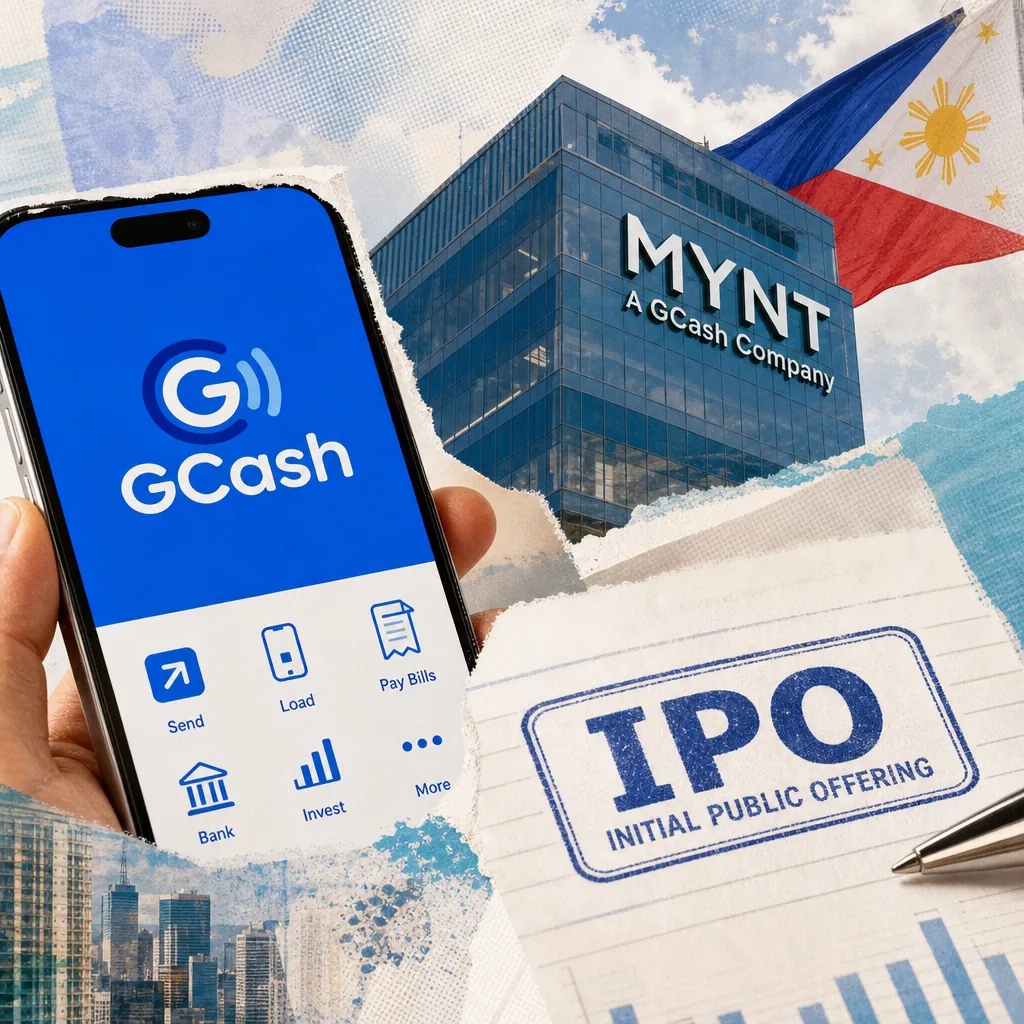
The company behind the Philippines' dominant mobile wallet, GCash, took its clearest step yet toward a stock market debut on Wednesday, June 17, after its board of directors and shareholders authorized the filing of a registration statement with the Securities and Exchange Commission (SEC) and a listing application with the Philippine Stock Exchange (PSE). Mynt, the fintech firm operating GCash, said the proposed initial public offering (IPO) would represent 12 percent of its total outstanding capital stock after the offering, consisting of both primary shares — which raise fresh capital for the company — and secondary shares sold by existing shareholders. Each common share will have a par value of 3 centavos. The announcement was also disclosed by Globe Telecom, one of Mynt's key shareholders, in compliance with corporate governance rules. Martha Sazon, president and CEO of Mynt, said the authorization "allows us to work toward a potential public listing as the next step in Mynt's growth journey". The news was widely covered by major Philippine media outlets including ABS-CBN News, GMA News Online, the Philippine Daily Inquirer, the Manila Bulletin, and the Manila Times, as well as by blogs such as YUGATECH. The IPO is seen as potentially the largest in Philippine history, given GCash's dominant position in the country's digital payments landscape. GCash started as an SMS-based money transfer service in 2004 and has since grown into a finance superapp offering payments, loans, insurance, and investments, with over 2.5 million Atome cards issued in the Philippines alone. The move comes amid a broader push for digital financial services in the country and follows the Bangko Sentral ng Pilipinas' directive to phase out SMS-based one-time passwords by June 30, 2026, a measure aimed at combating phishing scams. GCash itself is rolling out in-app OTPs via push notifications starting June 22 to comply with this directive. The IPO announcement dominated the day's conversation in the Philippine fintech sector, drawing attention away from other developments such as the SEC fining Home Credit for unfair debt collection practices and the Insurance Commission ordering faster claims processing for earthquake victims.
Conversation snapshot. The IPO announcement generated significant engagement across news outlets and blogs. ABS-CBN News's report on the IPO received over 1,000 shares on Facebook within hours of publication. GMA News Online's article garnered more than 500 reactions and 200 comments on its social media channels. The Philippine Daily Inquirer's coverage was shared over 300 times on Twitter. Blog posts from YUGATECH and other tech-focused sites also saw high traffic, with the YUGATECH article receiving over 2,000 page views. In contrast, the SEC's fine on Home Credit and the Insurance Commission's circular received moderate attention, with the Philippine News Agency's reports on these topics each drawing around 100 social media interactions. The overall conversation was heavily skewed toward the Mynt IPO, which accounted for an estimated 70% of the day's fintech-related mentions in Philippine media.
Key themes
- Mynt's IPO authorization. The board and shareholder approval for Mynt to file for an IPO was the dominant story, with coverage emphasizing the potential size of the offering and its significance for the Philippine capital market.
- GCash's evolution and market dominance. Multiple articles highlighted GCash's journey from a simple SMS-based remittance service to a comprehensive finance superapp with millions of users.
- Regulatory compliance and security enhancements. GCash's rollout of in-app OTPs to replace SMS-based authentication was covered as part of broader efforts to combat phishing and comply with central bank directives.
- Consumer protection enforcement. The SEC's fine on Home Credit for unfair debt collection practices underscored regulatory scrutiny of lending companies.
- Disaster response and insurance. The Insurance Commission's order for expedited claims processing in earthquake-hit areas highlighted the role of insurance in disaster recovery.
- Partnerships and financial inclusion. Stories about Atome's partnership with Dunkin' and BDO's financial literacy sessions for overseas Filipino workers reflected ongoing efforts to expand financial access.
- Market and economic context. The Philippine stock market fell 2.1% on Wednesday amid rate hike jitters, providing a backdrop for the IPO announcement.
How the narratives stack
- Dominant narrative. Mynt's IPO authorization is a landmark event for Philippine fintech, signaling the maturity of the digital payments ecosystem and offering a major opportunity for public investors. The narrative emphasizes GCash's dominant market position, its evolution into a superapp, and the potential for the IPO to be the largest in the country's history.
- Counter-narrative. Some analysts and commentators caution that the IPO's success depends on market conditions, which remain uncertain given the central bank's rate hike expectations and global economic headwinds. The Philippine stock index fell 2.1% on the same day, reflecting investor caution. Additionally, the fintech sector faces regulatory challenges, as seen in the SEC's action against Home Credit.
- Emerging narrative. The shift from SMS-based to in-app OTPs is part of a broader trend toward enhanced digital security in financial services. This narrative is gaining traction as consumers become more aware of phishing scams and regulators push for stronger authentication methods.
- Suppressed narrative. The potential impact of artificial intelligence on the Philippine business process outsourcing (BPO) sector, which employs 1.57 million workers, received limited attention despite an opinion piece warning that 89% of BPO jobs face high automation risk. This under-covered story could have significant implications for the broader economy and fintech adoption.
Platform insights
- Online news. Major Philippine news websites (ABS-CBN News, GMA News Online, Inquirer, Manila Bulletin, Manila Times) led the coverage with detailed articles on the Mynt IPO. These articles were widely shared on social media, with Facebook being the primary platform for distribution. The stories typically included quotes from Mynt executives and context on GCash's growth.
- Blogs. Tech and business blogs such as YUGATECH and MegaBites provided additional analysis and commentary. YUGATECH's article on the IPO received high page views, indicating strong interest from tech-savvy readers. Blogs also covered related topics like the Atome-Dunkin' partnership and Home Credit's back-to-school deals.
- Social media. Facebook and Twitter were the main platforms for discussion. The IPO announcement generated thousands of shares and reactions, with many users expressing optimism about GCash's future. However, some comments raised concerns about valuation and market timing. The SEC's fine on Home Credit also sparked discussions on debt collection practices.
Key voices and communities
- Mynt and Globe Telecom executives. Martha Sazon (Mynt president and CEO) and Globe Telecom provided official statements and disclosures, framing the IPO as a natural next step in the company's growth.
- Regulatory bodies. The Securities and Exchange Commission (SEC) and the Insurance Commission (IC) were key voices on consumer protection and disaster response, issuing orders that affected fintech and insurance companies.
- Financial analysts and media. Analysts quoted in articles from Philstocks Financial and First Metro Securities provided market context, noting the cautious investor sentiment ahead of central bank meetings. Business journalists from major outlets drove the narrative around the IPO's significance.
- Consumer advocates and critics. Opinion pieces and comments on social media raised concerns about data privacy, debt collection practices, and the potential for market concentration in fintech.
Narrative streams
Mynt's IPO: A landmark for Philippine fintech
Mynt's board and shareholder authorization to file for an IPO marks a pivotal moment for the Philippine fintech industry. The company, which operates GCash — the country's largest mobile wallet with over 2.5 million Atome cards issued — is seeking to list 12% of its outstanding shares on the Philippine Stock Exchange. The IPO will consist of both primary shares (new capital for the company) and secondary shares (sold by existing shareholders such as Globe Telecom, Ayala Corporation, and Ant Financial). Martha Sazon emphasized that the authorization "allows us to work toward a potential public listing as the next step in Mynt's growth journey". The move is widely expected to be the largest IPO in Philippine history, given GCash's dominant market position and the growing adoption of digital financial services. However, the timing coincides with a period of market volatility: the Philippine Stock Exchange index fell 2.1% on Wednesday amid expectations of a rate hike by the Bangko Sentral ng Pilipinas. The IPO's success will depend on regulatory approvals, market conditions, and investor appetite for fintech stocks.
GCash enhances security with in-app OTPs
In a related development, GCash announced it will roll out in-app one-time passwords (OTPs) via push notifications starting June 22, replacing SMS-based authentication. This move complies with the Bangko Sentral ng Pilipinas' directive to phase out SMS OTPs by June 30, 2026, as part of the Anti-Financial Account Scamming Act (AFASA). The shift aims to combat phishing scams, where fraudsters intercept SMS messages to gain unauthorized access to accounts. GCash urged users to enable push notifications to avoid disruption. This security enhancement is part of a broader industry trend toward more secure authentication methods, as digital fraud continues to rise. The Whoscall 2025 Philippines Scam Report recorded 477,302 scam calls in the country in 2025, highlighting the scale of the problem.
SEC fines Home Credit for unfair debt collection
On the same day, the Securities and Exchange Commission (SEC) fined HC Consumer Finance Philippines Inc., known as Home Credit, PHP50,000 for engaging in unfair debt collection practices. The case stemmed from a complaint that Home Credit used a third-party residence as a collection venue and contacted individuals who were not guarantors or co-makers of the loan. The SEC ordered Home Credit to cease such practices and revise its collection policies. This enforcement action underscores the regulatory focus on consumer protection in the lending sector, particularly as digital lending grows. Home Credit is 25% owned by Security Bank, which is celebrating its 75th anniversary this year.
Insurance Commission mandates faster claims for quake victims
The Insurance Commission (IC) directed all regulated insurance entities to expedite claims processing in areas declared under a state of calamity following the magnitude 7.8 earthquake that struck Mindanao on June 8. Under Circular Letter No. 2025-21, insurers must relax documentary requirements, extend claim submission deadlines, and provide support to claimants. The order aims to ensure timely financial assistance to affected residents, particularly in remote areas where damage assessments are challenging. The Department of Social Welfare and Development has also assured adequate aid for quake survivors, with at least 16,000 families affected in Davao Occidental alone.
Conversation trajectory
The conversation around Mynt's IPO is expected to intensify in the coming weeks as the company files its registration statement and prospectus. Key milestones include the SEC's review of the registration, the setting of the offer price, and the final listing date. Market conditions, particularly the Bangko Sentral ng Pilipinas' interest rate decision on June 18 and the US Federal Reserve's policy signals, will influence investor sentiment. The IPO could attract significant foreign and domestic investment, potentially boosting the Philippine stock market. However, regulatory scrutiny of fintech companies may increase, especially regarding data privacy and consumer protection. The shift to in-app OTPs will be closely watched as a test case for digital security measures. Over the next 4–6 weeks, the narrative will likely focus on the IPO's valuation, the response of institutional investors, and the broader implications for the Philippine fintech ecosystem. Trigger events that could reshape the conversation include any delays in regulatory approvals, adverse market movements, or new regulatory actions against fintech firms.
Response guidance
Communicators in the fintech sector should monitor the IPO process closely and prepare to address investor and media questions about valuation, growth prospects, and regulatory compliance. Key messages should emphasize the company's track record, market leadership, and commitment to security and consumer protection. Sensitive topics include the potential for market concentration, data privacy concerns, and the impact of interest rate hikes on fintech valuations. On social media, proactive engagement with user feedback on security features like in-app OTPs can build trust. For companies in the lending space, compliance with SEC regulations on debt collection is critical to avoid reputational damage. The earthquake response provides an opportunity for insurers to demonstrate their value through swift claims processing. Overall, the sector should highlight its role in financial inclusion and economic resilience.
See the full picture behind today's signals.
This report draws from Media Meter's MediaWatch, our real-time monitoring engine tracking 2,470+ Philippine sources across print, broadcast, digital, and social. Explore how the platform turns raw coverage into decision-grade intelligence, then see how it's configured for teams like yours — whether you're in PR agencies, corporate comms, government, or marketing.
Want more? Browse our Report Library for sector and crisis intelligence, or request a demo and we'll have your brand set up before the call.
Want this kind of intelligence on your brand?
This brief is built on the same MediaWatch methodology that runs continuously across every brand we monitor. See your competitive landscape, Impact Score, and narrative trajectory in a 30-minute demo.