Philippine Economy Faces Inflation, Growth Test
A snapshot of the day's conversation on the Philippine economy, covering inflation forecasts, Q2 GDP expectations, the impeachment trial's financial angle, and market reactions.
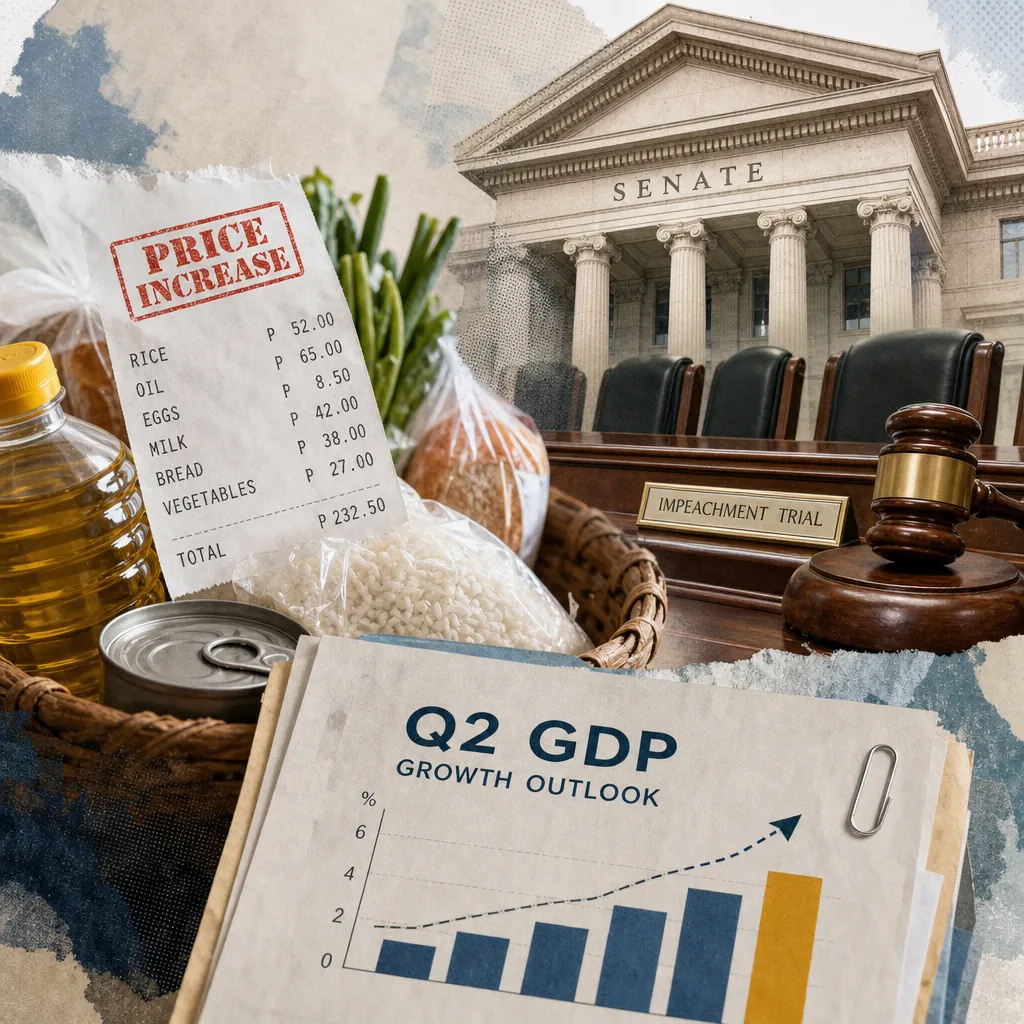
The day's economic conversation in the Philippines is dominated by a sense of cautious anticipation. With the release of July inflation data and second-quarter gross domestic product (GDP) figures scheduled for the coming week, analysts, investors, and the public are bracing for numbers that could shape the central bank's next moves and the country's economic trajectory. The prevailing mood is one of concern, as forecasts suggest inflation remains stubbornly above target and growth has slowed to levels not seen in nearly two decades, excluding the pandemic. This anxiety is compounded by geopolitical tensions in the Middle East, a weakening peso, and the ongoing fallout from a major government corruption scandal. Meanwhile, the impeachment trial of Vice President Sara Duterte continues to draw significant attention, with its focus shifting to the details of confidential fund disbursements, adding a layer of political uncertainty to the economic narrative. The day's coverage, drawn from a range of online news sources, reflects a nation grappling with immediate economic pressures and longer-term questions about governance and stability.
Key themes
- Inflation remains sticky, above target: Economists polled by major business outlets expect July inflation to have held steady at around 6.4 percent, marking the fifth consecutive month above the central bank's 2-4 percent target range. While lower food prices, particularly rice, provided some relief, higher fuel and electricity costs, along with a weak peso, kept price pressures elevated.
- Q2 GDP growth likely slowed sharply: Forecasts for second-quarter economic growth range from 1.8 percent to 2.8 percent, a significant slowdown from the 5.4 percent recorded a year earlier. Analysts attribute this to the inflationary impact of the Middle East conflict, stagnant public spending, and the lingering effects of a flood control project scandal that has dampened infrastructure investment.
- Impeachment trial shifts to financial forensics: The Senate impeachment trial of Vice President Sara Duterte is moving from tracing the withdrawal of P612.5 million in confidential funds to examining how the money was spent and who authorized the transactions. Testimony from bank managers and upcoming appearances by state auditors are central to this phase.
- Markets brace for data, weigh policy path: The stock market is expected to remain volatile as investors await the inflation and GDP data. Higher-than-expected inflation could strengthen the case for a central bank rate hike, while weaker growth could temper equity exposure. The peso's slide to record lows adds to the uncertainty.
- Corporate and regulatory developments offer counterpoints: Amid the macroeconomic gloom, several positive stories emerged, including a major mining investment by the Villar group, a potential resolution to the Lopez family feud, and new initiatives in financial inclusion and digital banking.
- E-governance and transparency pushed as remedies: In the wake of corruption scandals, the government is promoting digital platforms like the Sumbong sa Pangulo website and the DPWH Transparency Portal as tools to enhance accountability and restore public trust.
- Consumer financial vulnerability highlighted: A survey showing that a majority of Americans live paycheck to paycheck resonated in the Philippine context, where high inflation and debt levels are straining household budgets. Local banks are stepping up financial literacy efforts in response.
- Tourism and CSR provide soft news relief: The Philippine Travel Mart's theme of sustainable tourism and corporate social responsibility awards offered a more optimistic note, showcasing efforts to build a more inclusive and resilient economy.
How the narratives stack
Dominant: The dominant narrative is the impending release of key economic data—July inflation and Q2 GDP—and the widespread expectation that both will disappoint. This story dominates the business pages and online news, with multiple polls of economists converging on similar forecasts. The narrative is one of an economy struggling under the weight of global shocks, domestic policy missteps, and a loss of investor confidence. The coverage is extensive, with major outlets like BusinessWorld, the Inquirer, and the Manila Times all running similar stories, reflecting the high stakes of the upcoming data releases.
Counter-narrative: A counter-narrative, though less prominent, highlights resilience and opportunity. The BSP's Business Expectations Survey shows a sharp rebound in business sentiment in June, with firms turning neutral on current conditions and optimistic about the future. This suggests that while the economy is facing headwinds, there is underlying confidence in the medium-term outlook. Additionally, stories of corporate investment, such as the Kingking mining project and the potential Lopez deal, point to continued private-sector activity.
Emerging: An emerging narrative centers on the financial forensics of the impeachment trial. As the trial shifts from the sensational allegations of threats to the detailed examination of confidential fund disbursements, it is increasingly intersecting with economic governance issues. The public is being asked to focus on where the money went and who benefited, raising questions about accountability and the use of public funds. This narrative has the potential to shape public perception of the government's integrity and its ability to manage the economy.
Suppressed: A story that is receiving relatively little attention is the plight of ordinary consumers and workers. While inflation and debt are discussed in macroeconomic terms, the human impact—families struggling to make ends meet, workers facing stagnant wages, and the rise of predatory lending—is often relegated to the background. The PIDS report on food insecurity and malnutrition, and the survey on paycheck-to-paycheck living, touch on this, but the conversation tends to focus on aggregate numbers rather than lived experiences.
Platform insights
- Facebook: Facebook remains a primary platform for sharing news articles and public commentary. Posts from major news outlets like Inquirer, Manila Bulletin, and Philstar generate significant engagement, with users sharing their opinions on inflation, the impeachment trial, and government performance. The platform is also a space for viral content, such as the story about the Philippines' national debt reaching P19 trillion, which sparked discussions about fiscal responsibility and the burden on citizens.
- X (formerly Twitter): X is the go-to platform for real-time reactions to economic data releases and policy announcements. Economists, financial analysts, and journalists use X to share their forecasts and interpretations, often engaging in debates about the accuracy of predictions and the implications for monetary policy. The platform also amplifies political commentary, with hashtags related to the impeachment trial trending during key testimonies.
- YouTube: YouTube hosts longer-form content, including interviews with economists and analysts, as well as coverage of the impeachment trial proceedings. Channels like ANC and News5 provide live streams and analysis, attracting viewers who prefer in-depth discussion. The platform also features explainer videos on topics like inflation and GDP, helping to educate the public.
- Reddit: Reddit's Philippine subreddits (e.g., r/Philippines) offer a more informal and often critical space for discussion. Users share memes, personal anecdotes about rising prices, and skeptical takes on government announcements. The platform tends to amplify dissenting voices and can be a barometer of public sentiment, particularly among younger, more digitally savvy demographics.
Key voices and communities
- Economists and financial analysts: This group, including figures like Jonathan Ravelas, Miguel Chanco, and Emilio Neri, are the primary sources for inflation and GDP forecasts. Their analyses are widely quoted in the media and shape market expectations. They are seen as objective experts, though their divergent forecasts sometimes create confusion.
- Government officials and regulators: The Bangko Sentral ng Pilipinas (BSP) and the Philippine Statistics Authority (PSA) are the official sources of economic data. Their statements on policy and data releases are closely watched. The BSP's commitment to its inflation target and its regulatory actions, such as the crackdown on online lenders, are key talking points.
- Business and corporate leaders: Figures like Manny Villar and the Lopez family are in the spotlight due to major corporate developments. Their decisions are seen as indicators of business confidence and economic vitality. The business community also voices concerns about policy predictability and the investment climate.
- Political figures and legal experts: The impeachment trial has brought politicians like Robert Ace Barbers and Paolo Ortega, as well as legal experts like Domingo Cayosa, to the forefront. Their statements on the trial's financial aspects are closely followed, as they frame the narrative around accountability and governance.
- Consumer advocates and civil society: Groups representing consumers, workers, and indigenous communities are vocal about the impact of inflation and development projects. They push back against policies they see as harmful, such as the Pax Silica AI hub, and advocate for more inclusive economic policies.
Narrative streams
Inflation: Sticky and Stubborn
The inflation narrative is the most prominent economic story of the day. Multiple polls of economists, including those by BusinessWorld, the Inquirer, and the Manila Times, converge on a median forecast of around 6.4 percent for July, unchanged from June. This would mark the fifth consecutive month that inflation has breached the central bank's 2-4 percent target range. The forecasts range from 6.0 percent to 6.8 percent, reflecting uncertainty about the impact of various factors.
Analysts point to a mix of offsetting pressures. On the one hand, lower food prices, particularly rice and vegetables, have provided some relief. On the other hand, higher fuel and electricity costs, driven by the Middle East conflict and a weak peso, have kept inflation elevated. Jonathan Ravelas of Reyes Tacandong & Co. expects a slight acceleration to 6.8 percent, citing weather-related supply disruptions and the lingering effects of peso depreciation. In contrast, Pantheon Macroeconomics' Miguel Chanco predicts a slowdown to 6.0 percent, driven by cooling food prices.
The persistence of high inflation has significant implications. It erodes purchasing power, particularly for low-income households, and complicates the BSP's monetary policy. The central bank has been gradually raising interest rates to tame inflation, but the data will determine whether it needs to accelerate its pace. The BSP's own forecast for July is 5.6-6.6 percent, and the actual figure will be closely scrutinized.
GDP Growth: A Sharp Slowdown
The second-quarter GDP growth forecast is equally concerning. The median estimate from various polls is around 2.8 percent, down from 5.4 percent a year earlier and matching the first quarter's 2.8 percent. Some analysts, like BPI's Emilio Neri, project even lower growth of 1.9 percent, which would be the weakest since 2009, excluding the pandemic.
The slowdown is attributed to several factors. The inflationary impact of the Middle East conflict has weakened consumer spending, while public infrastructure spending has contracted sharply due to the fallout from the flood control project scandal. The government's anti-corruption crackdown has led to a slowdown in project implementation, as agencies become more cautious. Private investment has also softened, reflecting uncertainty about the economic outlook.
The GDP data, due on August 7, will be a key test of the economy's resilience. If growth comes in at the lower end of forecasts, it could raise concerns about the government's ability to meet its full-year target of 3.5-4.5 percent. It could also put pressure on the BSP to reconsider its monetary policy stance, as slower growth might warrant lower interest rates, but high inflation limits that option.
Impeachment Trial: The Money Trail
The impeachment trial of Vice President Sara Duterte has entered a new phase, focusing on the financial details of the P612.5 million in confidential funds. The prosecution has completed its presentation on the release and encashment of the funds, and now the trial is shifting to examine how the money was spent and who authorized the transactions.
Two former LandBank branch managers testified about the unusual and unprecedented encashment of treasury checks, describing the transactions as highly irregular. The prosecution is now calling Commission on Audit (COA) auditors to testify on the audit process and any anomalies found. The defense, meanwhile, is preparing to contest the use of the vice president's tax, bank, and Anti-Money Laundering Council (AMLC) records as evidence.
The trial's financial angle has captured public attention, as it raises questions about accountability and the use of public funds. House impeachment adviser Robert Ace Barbers emphasized that the public should focus on "where did the confidential funds go, and who benefited from it?" This narrative intersects with broader concerns about corruption and governance, which are already heightened by the flood control scandal.
Market Reactions: Cautious and Data-Driven
The stock market is bracing for a volatile week as investors await the inflation and GDP data. The Philippine Stock Exchange index (PSEi) fell for a second straight week, closing at 6,236.44, down 0.71 percent week-on-week. The decline was driven by rising oil prices and a record-low peso, which dampened investor sentiment.
Brokerages like F. Yap Securities and 2TradeAsia.com advise caution, suggesting that investors may trim exposure to policy-exposed sectors like energy utilities and shift to banks that benefit from higher interest rates. The market's direction will largely depend on the data releases. Higher-than-expected inflation could strengthen the case for a BSP rate hike, which might be negative for equities, while weaker GDP growth could also weigh on sentiment.
The peso's slide to record lows is another concern. A weaker peso makes imports more expensive, fueling inflation, and can deter foreign investment. The BSP's monetary policy will be crucial in stabilizing the currency, but the central bank faces a delicate balancing act between supporting growth and controlling inflation.
Corporate Developments: Bright Spots Amid Gloom
Despite the macroeconomic challenges, several corporate stories offered a more positive note. The Villar-led Kingking Mining Corp. announced plans to invest P307.8 billion in a copper-gold project in Davao de Oro, a significant boost to the mining sector. The project, which had been stalled for years due to regulatory hurdles, is now proceeding, leveraging the area's direct shipping access to Asian markets.
Another notable development is the potential resolution of the Lopez family feud. Reports of a strategic investor in talks to buy a controlling stake in Lopez Inc. sent shares of Lopez Holdings and ABS-CBN soaring. Investors are optimistic that a change in control could bring certainty and end the internal divisions that have plagued the conglomerate.
These stories highlight the resilience of the private sector and its willingness to invest despite the challenging environment. They also underscore the importance of policy predictability and a stable regulatory environment in attracting investment.
E-Governance and Transparency: A Response to Corruption
In the wake of the flood control scandal, the government is promoting digital platforms to enhance transparency and accountability. President Marcos highlighted the Sumbong sa Pangulo website, which allows citizens to report anomalous projects, and the DPWH Transparency Portal, which provides access to project documents and budgets. These initiatives are part of a broader push for e-governance, aimed at restoring public trust.
The narrative around e-governance is positive, framing digitalization as a tool to combat corruption and improve service delivery. However, critics argue that these platforms are only as effective as the government's willingness to act on the information they gather. The success of these initiatives will depend on their implementation and the political will to address the issues they uncover.
Consumer Financial Vulnerability
A survey by CNBC and SurveyMonkey found that 63% of Americans live paycheck to paycheck, with most having less than $500 left after paying bills. While this is a US-focused story, it resonates in the Philippines, where high inflation and debt levels are straining household budgets. The national debt has reached P19.065 trillion, translating to about P169,130 per Filipino, a figure that has sparked concern and debate.
In response, banks like Metrobank are stepping up financial literacy efforts, urging students to be mindful of their spending habits and the influence of social media. The bank's Moneygurado Campus Series aims to educate young Filipinos on money management and scam awareness. These initiatives are crucial in helping consumers navigate a challenging economic environment.
Conversation trajectory
- Immediate (next 1-2 weeks): The release of July inflation data on August 5 and Q2 GDP on August 7 will be the primary catalysts for market movement and policy discussions. If inflation comes in above 6.4%, the BSP may signal a more aggressive rate hike, which could further pressure the peso and equities. Conversely, a lower-than-expected inflation print could ease concerns and support a more dovish stance.
- Short-term (next 1-3 months): The BSP's monetary policy decisions will be closely watched. The central bank has been gradually raising rates, but the pace may accelerate if inflation remains sticky. The peso's trajectory will also be a key indicator, as a continued slide could force the BSP to intervene. The impeachment trial's progress could also affect political stability and investor confidence.
- Medium-term (next 6-12 months): The government's ability to implement its infrastructure program and manage the fallout from the flood control scandal will be critical. The push for e-governance and transparency could help restore trust, but tangible results are needed. The global economic environment, particularly the Middle East conflict and US monetary policy, will also influence the Philippines' economic outlook.
Trigger events to watch:
- July inflation data (Aug 5)
- Q2 GDP data (Aug 7)
- BSP policy meeting (likely in August)
- Impeachment trial developments, particularly testimony from COA auditors
- Peso exchange rate movements
- Any escalation in the Middle East conflict
Response guidance
For communicators in the financial and corporate sectors, the current environment demands a focus on transparency and clear communication. With inflation and growth concerns dominating the news, stakeholders will be looking for reassurance that businesses are managing risks effectively. Key messages should emphasize resilience, prudent financial management, and a commitment to long-term value creation.
- Acknowledge the challenges: Do not downplay the impact of inflation and slower growth. Acknowledge the difficulties faced by consumers and businesses, and outline concrete steps being taken to mitigate them.
- Highlight adaptability: Show how your organization is adapting to the changing economic conditions, whether through cost management, innovation, or new partnerships.
- Emphasize governance and accountability: In light of the corruption scandals, reinforce your commitment to ethical practices and transparency. This is particularly important for companies with government ties or those in regulated industries.
- Engage with data: Use the upcoming economic data releases as opportunities to provide context and analysis. Position your organization as a thought leader by offering insights into what the numbers mean for the sector.
- Be sensitive to consumer concerns: Avoid tone-deaf messaging that ignores the struggles of ordinary Filipinos. Focus on how your products or services can help consumers manage their finances or improve their lives.
- Monitor the impeachment trial: The trial's financial angle could have implications for public trust in institutions. Be prepared to respond to questions about governance and the use of public funds, even if your organization is not directly involved.
By adopting a proactive and transparent communication strategy, organizations can navigate the current uncertainty and build trust with their stakeholders.
See the full picture behind today's signals.
This report draws from Media Meter's MediaWatch, our real-time monitoring engine tracking 2,470+ Philippine sources across print, broadcast, digital, and social. Explore how the platform turns raw coverage into decision-grade intelligence, then see how it's configured for teams like yours — whether you're in PR agencies, corporate comms, government, or marketing.
Want more? Browse our Report Library for sector and crisis intelligence, or request a demo and we'll have your brand set up before the call.
Want this kind of intelligence on your brand?
This brief is built on the same MediaWatch methodology that runs continuously across every brand we monitor. See your competitive landscape, Impact Score, and narrative trajectory in a 30-minute demo.