Grab booking refusals, EV taxi prank, and LRT-1 delays: A day of regulatory friction in Philippine transport
A daily snapshot of the Philippine transport and mobility conversation on June 28, 2026, covering regulatory actions against Grab and an EV taxi driver, LRT-1 extension delays, new service contracting programs, and industry milestones.
The conversation on June 28, 2026, in the Philippine transport and mobility sector was dominated by regulatory friction and infrastructure delays, with a notable undercurrent of industry milestones and innovation. The Land Transportation Franchising and Regulatory Board (LTFRB) took center stage with two enforcement actions: issuing a show-cause order to ride-hailing app Grab over a vlogger's claim that drivers are allowed to decline bookings, and suspending an electric vehicle (EV) taxi driver for staging a prank robbery with vloggers. Meanwhile, a lawmaker revealed that the LRT-1 Cavite Extension Project may not be completed before President Marcos's term ends in 2028 due to unresolved right-of-way issues with the Villar Group. On a more positive note, the Department of Transportation (DOTr) and Cebu Province signed the country's first provincial government-led service contracting program for public transport, and Mitsubishi Motors Philippines celebrated its long history in the country. The day's coverage, drawn from a monitored sample of online news articles, also included a feature on battery swapping for electric motorcycles in Southeast Asia, a cycling industry bet on smart bikes, and a column on the impact of the US-Iran peace agreement on oil prices and xEV adoption.
Key themes
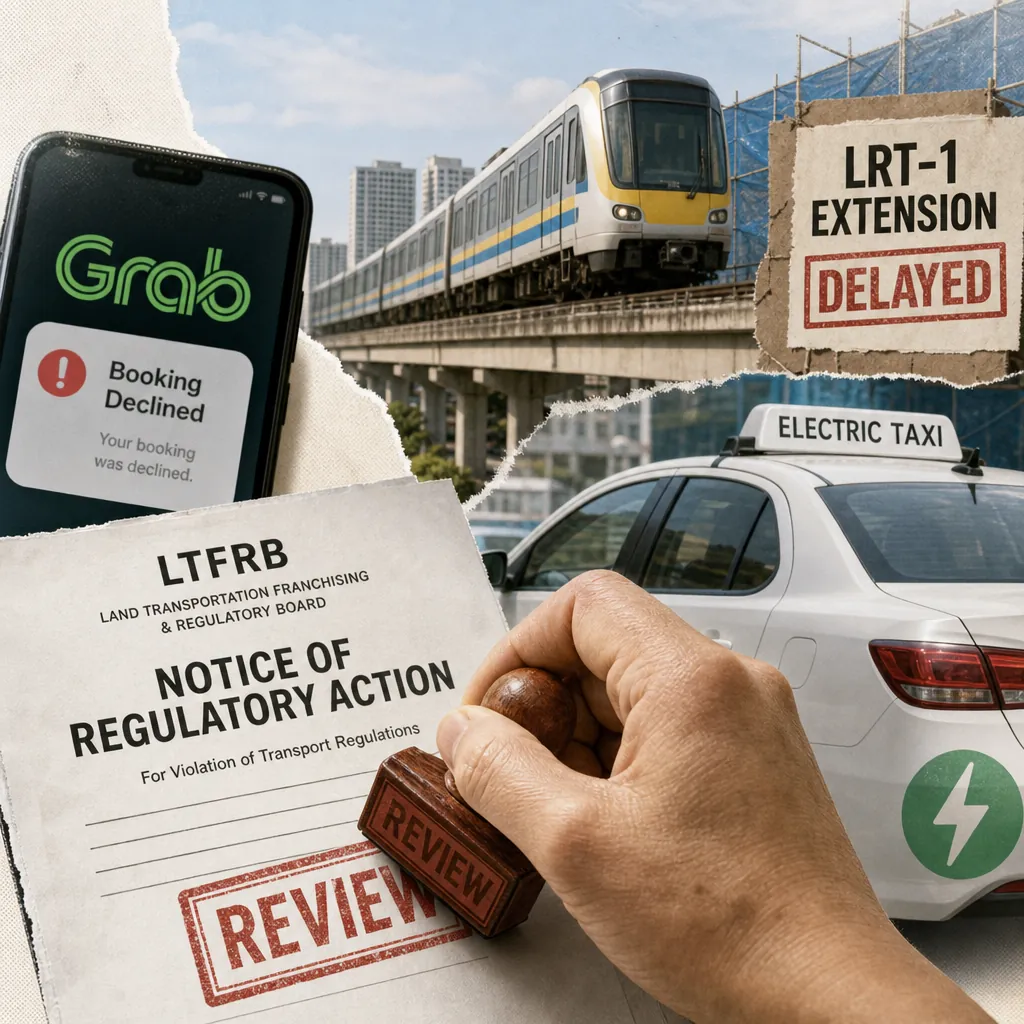
- LTFRB cracks down on Grab booking refusals: The LTFRB issued a show-cause order to Grab after a vlog surfaced in which a driver claimed the company allows partners to decline bookings. LTFRB Chairman Vigor Mendoza II called the claim false and a violation of regulations, stating that refusing to convey passengers is a breach of the conditions set in the provisional authority and certificate of public convenience. The board demanded Grab identify the vlogger and explain whether such a policy exists. [1]
- EV taxi driver suspended over prank robbery: The LTFRB suspended an electric vehicle taxi driver for 30 days pending investigation after a video showed him announcing a heist to his passenger, later revealed to be a prank involving two vloggers acting as robbers. Chairman Mendoza said the act caused fear among commuters and assured the public that disciplinary measures would be taken. The LTFRB also summoned Green and Smart Mobility Philippines Inc., the owner of the EV taxi. [2]
- LRT-1 Cavite Extension faces delays due to right-of-way issues: Las Piñas Rep. Mark Anthony Santos revealed that the multibillion-peso LRT-1 Cavite Extension Project may not be completed before President Marcos's term ends in June 2028 because the Right-of-Way Usage Agreement (Rowua) with the Villar Group remains unsigned. Despite the President's directive to the Department of Transportation (DOTr) to resolve bottlenecks, multiple technical meetings from September 2021 to June 2025 have failed to produce a signed agreement. [3]
- Cebu launches first provincial government-led service contracting program: The DOTr and Cebu Province signed a Memorandum of Agreement to launch the "Tabang Pangbyahe Program," the first provincial government-led service contracting program for public transportation in the Philippines. The DOTr provided P20 million in funding under the Net Service Contracting modality to provide financial assistance to public utility vehicle (PUV) operators and drivers. [4]
- Mitsubishi Motors Philippines celebrates six decades of operations: Mitsubishi Motors Philippines Corporation (MMPC) highlighted its 63-year presence in the country, emphasizing its contributions to local manufacturing, supplier and dealer networks, workforce development, and sustained investments. The company's manufacturing facility in Sta. Rosa continues to produce vehicles, supporting the Philippine automotive industry. [5]
- Battery swapping emerges as a solution for e-motorcycles in Southeast Asia: An article discussed how battery swapping could address the main barrier to electric motorcycle adoption in Southeast Asia: range anxiety and charging inconvenience. VinFast is promoting battery-swapping networks, already deployed in China, Taiwan, and France, as a way to make electric two-wheelers more practical for Filipino riders. [6]
- Cycling industry bets on smart bikes to revive sales: At the Eurobike trade fair in Frankfurt, manufacturers showcased AI-enabled bicycles with features such as automatic motor assistance adjustment based on terrain and rider movements. Avinox, a subsidiary of drone maker DJI, demonstrated a motor that uses sensors and AI to make riding easier and safer. The industry hopes smart bikes can reverse years of flagging sales. [7]
- US-Iran peace agreement impacts oil prices and xEV outlook: A column analyzed the effect of the US-Iran Memorandum of Understanding ending the war, which caused oil futures to drop 7% to 9%. The author discussed how lower oil prices could affect the adoption of xEVs (electric and hybrid vehicles) in the Philippines, noting that while cheaper fuel might slow the shift, long-term trends favor electrification. [8]
How the narratives stack
Dominant: Regulatory enforcement by the LTFRB dominated the day's coverage within the captured set. Two separate actions—against Grab for alleged booking refusals and against an EV taxi driver for a prank robbery—generated multiple articles across Philstar Online and other outlets. The LTFRB's swift response, including show-cause orders and suspensions, underscored the board's active role in policing transport network companies and drivers. The combined advertising-equivalent value (AVE) of these stories in the sample was approximately ₱237,652, reflecting significant editorial attention. [1][2]
Counter-narrative: While the LTFRB stories focused on enforcement, the launch of the Tabang Pangbyahe Program in Cebu offered a positive, collaborative approach to improving public transport. The program, the first provincial government-led service contracting initiative, aims to support PUV operators and drivers through financial assistance. This narrative contrasts with the punitive tone of the LTFRB actions, suggesting that both regulation and partnership are being pursued. [4]
Emerging: Battery swapping and smart bikes represent emerging trends in mobility innovation. Battery swapping for electric motorcycles, promoted by VinFast, could address a key adoption barrier in the Philippines. Similarly, AI-enabled bicycles showcased at Eurobike signal a shift toward smarter, more connected two-wheelers. These stories, while not yet dominant in local coverage, point to future developments in the sector. [6][7]
Suppressed: The LRT-1 Cavite Extension delays, despite being a major infrastructure project with significant public impact, received relatively limited coverage in the sample. Only one article from Business Mirror Online addressed the issue, with an AVE of ₱154,328. The story's implications for commuters and the government's infrastructure program deserve more attention, especially given the President's direct involvement. [3]
Platform insights
- Facebook: No specific Facebook posts were captured in the monitoring writeup, but the articles were shared across news organizations' Facebook pages. The LTFRB enforcement stories likely generated comments and shares from commuters and transport groups, though engagement data is not available.
- X (formerly Twitter): No specific X posts were captured, but the LTFRB's actions and the LRT-1 delay are topics that typically spark discussion among transport advocates, policymakers, and commuters. The LTFRB chairman's statements may have been quoted and debated.
- YouTube: The prank robbery video that led to the EV taxi driver's suspension was originally posted on YouTube by vloggers. The LTFRB's response was likely covered by news channels, but no specific YouTube engagement data is available.
- Online News: All captured articles were from online news sources, including Philstar Online, Business Mirror Online, Business World Online, Daily Tribune Online, Manila Times Online, and others. This reflects the monitoring setup's focus on online media, but also indicates that the day's transport stories were primarily covered by digital outlets rather than print or broadcast.
Key voices and communities
- LTFRB Chairman Vigor Mendoza II: The chairman was the most prominent voice, issuing show-cause orders and suspensions. His statements emphasized strict enforcement of regulations and passenger safety. He is a key authority figure shaping the regulatory narrative.
- Las Piñas Rep. Mark Anthony Santos: The lawmaker raised the LRT-1 extension delay issue, positioning himself as a critic of project bottlenecks. His revelation about the unsigned Rowua with the Villar Group highlights the political and business interests involved in infrastructure.
- Mitsubishi Motors Philippines Corporation (MMPC): The company's leadership, including managing director Pedro Simoes, highlighted the firm's long-term commitment to the Philippines. MMPC's narrative focuses on local manufacturing, job creation, and economic contribution.
- VinFast and industry innovators: VinFast's promotion of battery swapping and Avinox's AI-enabled bike motors represent voices from the innovation community. They advocate for technological solutions to adoption barriers.
- Transport groups and commuters: While not directly quoted in the captured articles, the LTFRB's actions directly affect transport network drivers and passengers. The prank robbery video and booking refusal claims likely mobilized commuter concerns about safety and service reliability.
Narrative streams
LTFRB vs. Grab: Booking refusal controversy
The LTFRB issued a show-cause order to Grab after a vlog surfaced in which a driver claimed the company allows partners to decline bookings. Chairman Vigor Mendoza II stated that the claim is false and violates regulations, as refusing to convey passengers breaches the conditions set in the provisional authority and certificate of public convenience. The LTFRB demanded Grab identify the vlogger and explain whether such a policy exists. This story, covered by Philstar Online with an AVE of ₱110,716, underscores the ongoing tension between ride-hailing platforms and regulators over driver behavior and passenger rights. The LTFRB's swift action signals a zero-tolerance approach to practices that could undermine the franchise system. [1]
EV taxi prank leads to suspension
In a separate incident, an EV taxi driver was suspended for 30 days after a video showed him announcing a heist to his passenger, later revealed to be a prank involving two vloggers. Chairman Mendoza imposed the suspension pending investigation, calling the act "not funny" and stating it caused fear among commuters. The LTFRB also summoned Green and Smart Mobility Philippines Inc., the owner of the EV taxi. The article, also from Philstar Online with an AVE of ₱126,936, highlights the regulatory challenges facing new mobility services like EV taxis, where driver conduct can attract intense scrutiny. The incident may prompt stricter oversight of EV taxi operations. [2]
LRT-1 Cavite Extension: Right-of-way impasse
Las Piñas Rep. Mark Anthony Santos revealed that the LRT-1 Cavite Extension Project may not be completed before President Marcos's term ends in June 2028 due to unresolved right-of-way issues. The Right-of-Way Usage Agreement (Rowua) with the Villar Group remains unsigned despite the President's directive to the DOTr to resolve bottlenecks. The LRTA disclosed that multiple technical meetings from September 2021 to June 2025 have failed to produce a signed agreement. The article, from Business Mirror Online with an AVE of ₱154,328, points to a significant infrastructure delay that could affect millions of commuters in Cavite and Metro Manila. The involvement of the Villar Group, a major business conglomerate, adds a layer of political and commercial complexity. [3]
Cebu's Tabang Pangbyahe Program: A new model for public transport support
The DOTr and Cebu Province signed a Memorandum of Agreement to launch the "Tabang Pangbyahe Program," the first provincial government-led service contracting program for public transportation in the Philippines. The DOTr provided P20 million in funding under the Net Service Contracting modality, which aims to provide financial assistance to PUV operators and drivers. The program was formalized at the Cebu South Bus Terminal. This initiative, covered by Philstar Online with an AVE of ₱365,294, represents a collaborative approach to improving public transport services and supporting drivers, contrasting with the regulatory crackdowns elsewhere. [4]
Mitsubishi Motors' six-decade legacy in the Philippines
Mitsubishi Motors Philippines Corporation (MMPC) highlighted its 63-year presence in the country, emphasizing its contributions to local manufacturing, supplier and dealer networks, workforce development, and sustained investments. The company's manufacturing facility in Sta. Rosa continues to produce vehicles, supporting the Philippine automotive industry. The article, from Manila Times Online with an AVE of ₱653,520, positions MMPC as a key contributor to economic progress and industrial capability. This narrative stream reinforces the importance of long-term automotive manufacturing in the Philippines. [5]
Battery swapping and smart bikes: Innovation in two-wheelers
Two articles focused on innovation in two-wheeled mobility. One discussed battery swapping for electric motorcycles in Southeast Asia, highlighting VinFast's belief that swapping networks can overcome range anxiety and charging inconvenience. The concept is already deployed in China, Taiwan, and France. The other article covered the Eurobike trade fair, where AI-enabled bicycles with features like automatic motor assistance adjustment were showcased. Avinox, a subsidiary of drone maker DJI, demonstrated a motor that uses sensors and AI to make riding easier and safer. These stories, from Amazing Manila Journal (AVE ₱263,004) and Manila Times Online (AVE ₱333,760), signal growing interest in tech-driven solutions for two-wheelers, a key mode of transport in the Philippines. [6][7]
US-Iran peace and its impact on oil and xEVs
A column in Business World Online (AVE ₱520,465) analyzed the effect of the US-Iran Memorandum of Understanding ending the war, which caused oil futures to drop 7% to 9%. The author discussed how lower oil prices could affect the adoption of xEVs (electric and hybrid vehicles) in the Philippines, noting that while cheaper fuel might slow the shift, long-term trends favor electrification. The column provides context for the energy and mobility transition, linking global geopolitics to local transport choices. [8]
Conversation trajectory
- Over the next 1–2 weeks: The LTFRB is likely to release the results of its investigation into Grab and the EV taxi driver. Grab may face fines or additional conditions on its franchise if found violating regulations. The EV taxi incident could lead to stricter rules for EV taxi operators, including mandatory driver training and monitoring.
- Over the next 1–3 months: The LRT-1 Cavite Extension delay may prompt further legislative inquiries or executive intervention. The DOTr and Villar Group may face pressure to finalize the Rowua. The Tabang Pangbyahe Program in Cebu will be monitored as a pilot for other provinces; its success could lead to similar programs nationwide.
- Over the next 6–12 months: Battery swapping infrastructure for electric motorcycles may see pilot deployments in the Philippines, especially if VinFast or other companies partner with local governments. Smart bike adoption remains niche but could grow if prices decrease and consumer awareness increases.
- Trigger events: A signed Rowua for LRT-1 Cavite Extension; a formal LTFRB ruling on Grab's booking policies; expansion of the Tabang Pangbyahe Program to other provinces; launch of a battery-swapping station in Metro Manila.
Response guidance
- For transport regulators: Maintain transparent and consistent enforcement to build public trust. Clearly communicate rules to operators and drivers to prevent misunderstandings. Consider issuing advisories on acceptable driver behavior, especially for new services like EV taxis.
- For ride-hailing and transport companies: Proactively review and communicate policies on booking acceptance to avoid regulatory clashes. Implement driver training programs focused on passenger rights and safety. Engage with regulators to clarify grey areas.
- For infrastructure developers and government agencies: Address right-of-way issues early in project planning to avoid delays. Publicly disclose progress and challenges to manage expectations. Consider alternative dispute resolution mechanisms for stalled negotiations.
- For innovators and investors: Battery swapping and smart bike technologies present opportunities in the Philippine market. Partner with local governments and transport cooperatives to pilot solutions. Highlight cost savings and environmental benefits to attract consumers.
- For communicators: Frame regulatory actions as consumer protection measures. Emphasize collaboration in programs like Tabang Pangbyahe. Avoid defensive messaging; instead, focus on commitment to safety and service improvement.
See the full picture behind today's signals.
This report draws from Media Meter's MediaWatch, our real-time monitoring engine tracking 2,470+ Philippine sources across print, broadcast, digital, and social. Explore how the platform turns raw coverage into decision-grade intelligence, then see how it's configured for teams like yours — whether you're in PR agencies, corporate comms, government, or marketing.
Want more? Browse our Report Library for sector and crisis intelligence, or request a demo and we'll have your brand set up before the call.
Want this kind of intelligence on your brand?
This brief is built on the same MediaWatch methodology that runs continuously across every brand we monitor. See your competitive landscape, Impact Score, and narrative trajectory in a 30-minute demo.