Megaworld scales back amid macro headwinds; DA destroys rotting onion shipment
Megaworld trims capex and residential launches due to high interest rates and inflation, while the Department of Agriculture orders destruction of P86.7 million in decayed Chinese onions. Other stories include Globe's new digital hub, HIV case rise, and ASF detection in Capiz.
Property giant Megaworld Corp. announced it is scaling back its capital spending and residential launch targets for 2026, citing a challenging macroeconomic environment marked by elevated material costs, sticky inflation, and high interest rates. The company now aims for P55 billion in capital expenditure and P50 billion in new residential launches, down from earlier plans of P65 billion and higher launch targets. Executive Director Kevin L. Tan said the strategy is "built to perform within" the current environment, not to wait for improvement. The move reflects broader caution in the Philippine property sector as developers navigate persistent cost pressures and subdued consumer demand.
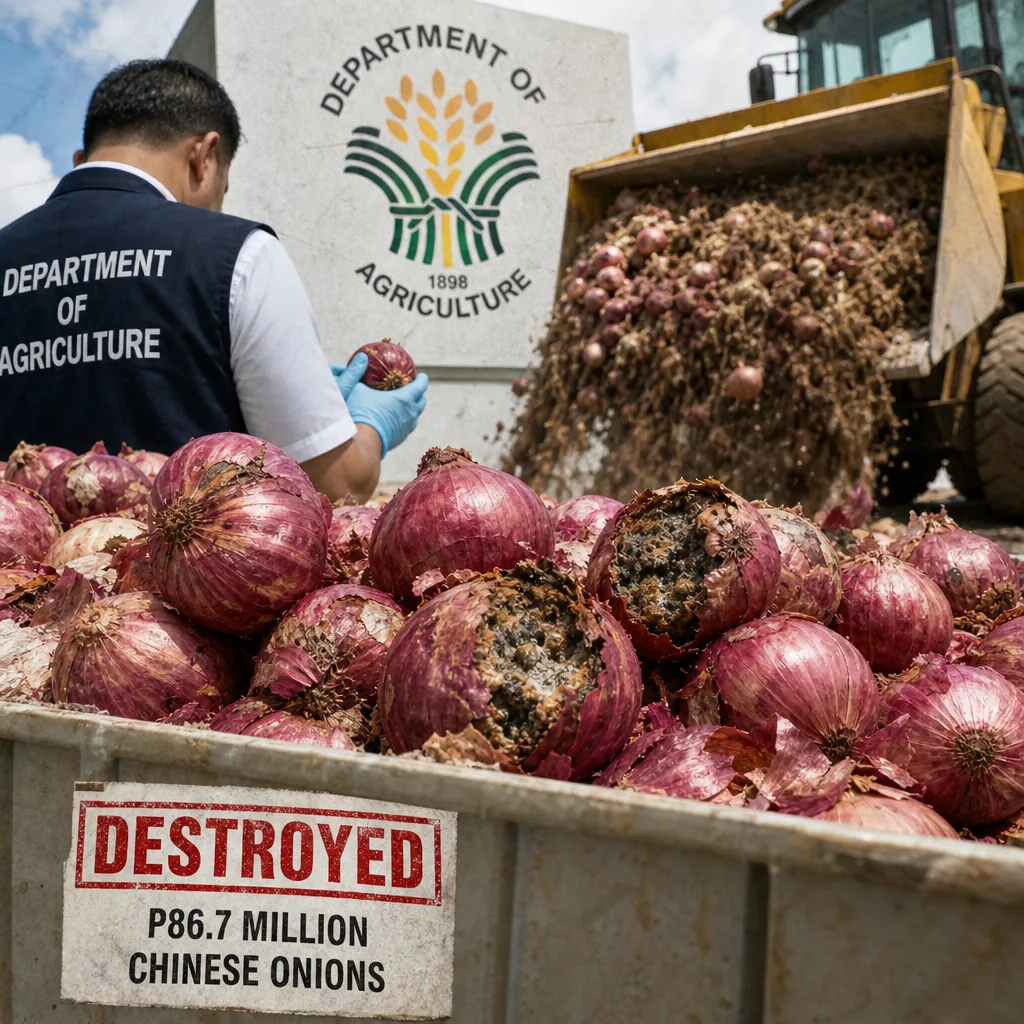
Meanwhile, the Department of Agriculture (DA) ordered the destruction of a shipment of Chinese red onions worth P86.7 million after laboratory tests found the imports in an advanced state of decay. The 26 shipping containers, abandoned at the Manila International Container Port between December 2025 and January 2026, contained about 650 metric tons of onions—roughly equivalent to a day's national consumption. Senator Francis Pangilinan has sought a probe into why the consignment was left unclaimed with unpaid duties and taxes estimated at P9.7 million. The incident raises questions about import monitoring and food safety protocols.
In other developments, Globe Telecom opened a new distribution and support hub in Angono, Rizal, as part of its push to expand internet access outside major urban centers. The facility will handle broadband applications, prepaid products, and customer support. The Philippines continues to face one of the fastest-growing HIV epidemics in Asia, with over 4,600 new cases reported in the first quarter of 2026, concentrated in Metro Manila, Calabarzon, Central Luzon, and Davao region. African Swine Fever (ASF) has been detected in three towns in Capiz province, prompting intensified biosecurity measures. The Department of Trade and Industry (DTI) called on Russia to regard ASEAN as a strategic partner, not just an export market, at the Russia-ASEAN Business Forum. Aboitiz Renewables launched a hog-raising initiative for indigenous communities in Benguet, providing piglets and feed to build sustainable livelihoods. SunAsia Energy and Vietnam's VineEnergo partnered to build three floating solar farms worth $416 million, with a combined capacity of 422 megawatts peak.
Conversation snapshot. The day's coverage was dominated by business and economic news, with Megaworld's recalibration and the onion destruction drawing significant attention. The Megaworld story appeared in both the Manila Bulletin and Philstar, while the onion destruction was covered by Philstar. The HIV epidemic story in the Manila Times and the ASF detection in Capiz also garnered readership. Engagement figures are not available from the provided media, but the breadth of coverage across multiple outlets indicates sustained interest in economic policy, food safety, and public health issues.
Key themes
- Economic caution in property sector — Megaworld's pullback reflects broader industry caution amid high interest rates and inflation, signaling that developers are prioritizing financial prudence over aggressive expansion.
- Food safety and import monitoring — The destruction of decayed Chinese onions highlights gaps in import inspection and raises concerns about food quality and waste.
- Public health challenges — The rapid rise in HIV cases and the resurgence of ASF in Capiz underscore ongoing public health threats that require sustained government and community response.
- Digital inclusion efforts — Globe's new hub in Angono represents continued investment in expanding internet access to underserved areas, supporting remote work and education.
- Renewable energy investments — The SunAsia-VineEnergo partnership for floating solar farms signals growing interest in large-scale renewable projects in the Philippines.
- ASEAN economic diplomacy — The DTI's call for Russia to view ASEAN as a strategic partner reflects efforts to diversify trade relationships beyond traditional markets.
- Community-based livelihood programs — Aboitiz Renewables' hog-raising initiative for indigenous communities exemplifies corporate social responsibility focused on sustainable income generation.
How the narratives stack
- Dominant narrative — The Philippine economy is facing headwinds from inflation and high interest rates, prompting businesses like Megaworld to adopt a more cautious stance. At the same time, government agencies are grappling with food safety and public health issues that affect consumer confidence.
- Counter-narrative — Despite macroeconomic challenges, companies continue to invest in digital infrastructure, renewable energy, and community development, suggesting that long-term growth prospects remain intact. Globe's hub expansion and the solar farm partnership are examples of forward-looking investments.
- Emerging narrative — Food import quality and monitoring are becoming a growing concern, as evidenced by the abandoned onion shipment. This could lead to stricter regulations and greater scrutiny of agricultural imports.
- Suppressed narrative — The HIV epidemic in the Philippines is escalating rapidly, yet it receives relatively less media attention compared to economic and political stories. The ASF outbreak in Capiz also risks being overshadowed by other news, despite its potential impact on the hog industry and food supply.
Platform insights
- Online news — The majority of stories were published by major Philippine news outlets including Philstar, Manila Bulletin, Manila Times, Business Mirror, and Daily Tribune. These platforms drive the mainstream conversation and set the agenda for public discourse.
- Social media — While not directly measured, stories about food safety and public health typically generate high engagement on social platforms like Facebook and Twitter, where users share concerns and call for government action. The Megaworld story may attract discussion among investors and business communities on LinkedIn.
Key voices and communities
- Business and economic analysts — Commentators and industry experts who analyze corporate strategies and macroeconomic trends. They frame Megaworld's move as a prudent response to challenging conditions.
- Consumer and food safety advocates — Groups and individuals concerned about food quality and import regulations. They amplify stories like the onion destruction to push for better monitoring.
- Public health officials and advocates — The Department of Health and HIV/AIDS advocacy groups are key voices in the HIV epidemic narrative, calling for increased testing and treatment access.
- Local government and agricultural stakeholders — Provincial veterinary offices and hog raisers are central to the ASF narrative, implementing biosecurity measures to contain the disease.
- Renewable energy proponents — Companies like SunAsia and VineEnergo, along with environmental groups, promote the benefits of floating solar technology for clean energy generation.
Narrative streams
Megaworld's recalibration
Megaworld Corp., one of the Philippines' largest township developers, announced it is reducing its 2026 capital expenditure budget to P55 billion and residential launch target to P50 billion, down from earlier plans of P65 billion and higher launches. Executive Director Kevin L. Tan stated the company is "not waiting for the environment to improve" but is building a strategy to perform within current conditions. The decision reflects the impact of elevated material costs, persistent inflation, and high interest rates on the property sector. Megaworld's move may signal a broader trend among developers to prioritize financial stability over rapid expansion, potentially slowing the pace of new housing supply in the market.
Destruction of decayed Chinese onions
The Department of Agriculture ordered the destruction of 26 shipping containers of Chinese red onions worth P86.7 million after they were found to be in an advanced state of decay. The shipment, abandoned at the Manila International Container Port between December 2025 and January 2026, contained about 650 metric tons of onions—roughly a day's national consumption. Senator Francis Pangilinan called for an investigation into why the consignment was left unclaimed with unpaid duties and taxes of P9.7 million. The incident raises questions about the effectiveness of import inspection procedures and the potential for food waste. It also highlights the need for stricter monitoring of agricultural imports to ensure quality and safety.
HIV epidemic in the Philippines
The Philippines continues to experience one of the fastest-growing HIV epidemics in Asia, with over 4,600 new cases reported in the first quarter of 2026. The highest concentrations are in Metro Manila, Calabarzon, Central Luzon, and the Davao region. Major urban centers like Manila, Quezon City, Cebu City, and Davao City remain critical areas for prevention, testing, and treatment efforts. The story, published in the Manila Times, emphasizes the need for increased awareness and testing, with the author sharing a personal commitment to regular HIV testing as part of leadership in health behavior.
African Swine Fever in Capiz
Swine blood samples from three towns in Capiz—Roxas City, Panitan, and Pontevedra—tested positive for African Swine Fever (ASF), according to the Capiz Provincial Veterinary Office. The disease remains endemic in Western Visayas, and recent weather fluctuations have accelerated its spread. Hog raisers are urged to enforce strict biosecurity measures, including limiting visitors, disinfecting equipment, and reporting unusual illnesses. The outbreak threatens the local hog industry and livelihoods of farmers.
Globe's digital hub in Angono
Globe Telecom opened an Onsite Distribution Operations (OSDO) hub in Barangay Mahabang Parang, Angono, Rizal, to provide closer access to broadband applications, prepaid products, and customer support for households, students, remote workers, and small businesses. The hub is part of Globe's nationwide push to make internet connectivity more accessible outside major urban centers. Company officials emphasized the importance of hyper-localized hubs in strengthening community connections.
Renewable energy partnerships
SunAsia Energy and Vietnam's VineEnergo signed a partnership to build three floating solar farms worth $416 million, with a combined capacity of 422 megawatts peak. One project is targeted for commercial operation in May 2027, with the other two online by 2028. All three have been awarded contracts under the Green Energy Auction – 4 (GEA-4). The partnership leverages SunAsia's track record with Macquarie's Green Investment Group, which is jointly developing a 1.3-gigawatt floating solar farm in Laguna Lake.
ASEAN economic diplomacy
Trade Undersecretary Allan Gepty called on Russia and the Eurasian Economic Union to regard ASEAN as a strategic partner, not just an export market, at the Russia-ASEAN Business Forum in Kazan. He highlighted ASEAN's young workforce and free trade agreements, including the Regional Comprehensive Economic Partnership (RCEP), as opportunities for cooperation in infrastructure, energy, manufacturing, technology transfer, logistics, and innovation. The Philippines also presented its priority economic deliverables under its 2026 ASEAN chairmanship.
Community livelihood program in Benguet
Aboitiz Renewables launched a hog-raising initiative for indigenous communities in Tuba, Benguet, benefiting members of the Ibaloi, Kankanaey, and Kalanguya tribes under the Tuba Ancestral Domain Indigenous Peoples Organization (TADIPO). The company provided 20 piglets and 1,000 kilograms of feeds to help families build sustainable income. The initiative supports food security and household needs while preserving cultural heritage.
Conversation trajectory
The conversation is likely to continue focusing on economic headwinds and corporate responses, with more developers potentially announcing similar recalibrations. The onion destruction story may lead to increased scrutiny of agricultural imports and calls for policy reforms. The HIV epidemic and ASF outbreaks will remain public health priorities, with government agencies expected to issue updates on containment efforts. Renewable energy investments and digital inclusion initiatives will likely maintain positive coverage as examples of private sector resilience. Over the next 4–6 weeks, key triggers include: the release of Q2 economic data, further interest rate decisions by the central bank, and updates on ASF containment in Capiz. A major trigger would be if other property firms follow Megaworld's lead, signaling a broader sector slowdown.
Response guidance
Communicators should monitor economic indicators and adjust messaging to reflect cautious optimism. For property sector stories, emphasize financial prudence and long-term value. For food safety issues, proactive transparency about inspection processes can build trust. Public health narratives require sensitive handling, focusing on prevention and support rather than stigma. Renewable energy and digital inclusion stories offer opportunities to highlight innovation and community impact. Avoid overpromising on timelines or downplaying risks. Engage with stakeholders on social media to address concerns and provide accurate information.
See the full picture behind today's signals.
This report draws from Media Meter's MediaWatch, our real-time monitoring engine tracking 2,470+ Philippine sources across print, broadcast, digital, and social. Explore how the platform turns raw coverage into decision-grade intelligence, then see how it's configured for teams like yours — whether you're in PR agencies, corporate comms, government, or marketing.
Want more? Browse our Report Library for sector and crisis intelligence, or request a demo and we'll have your brand set up before the call.
Want this kind of intelligence on your brand?
This brief is built on the same MediaWatch methodology that runs continuously across every brand we monitor. See your competitive landscape, Impact Score, and narrative trajectory in a 30-minute demo.