Inflation Forecast Sinks PSEi to 10-Month Low
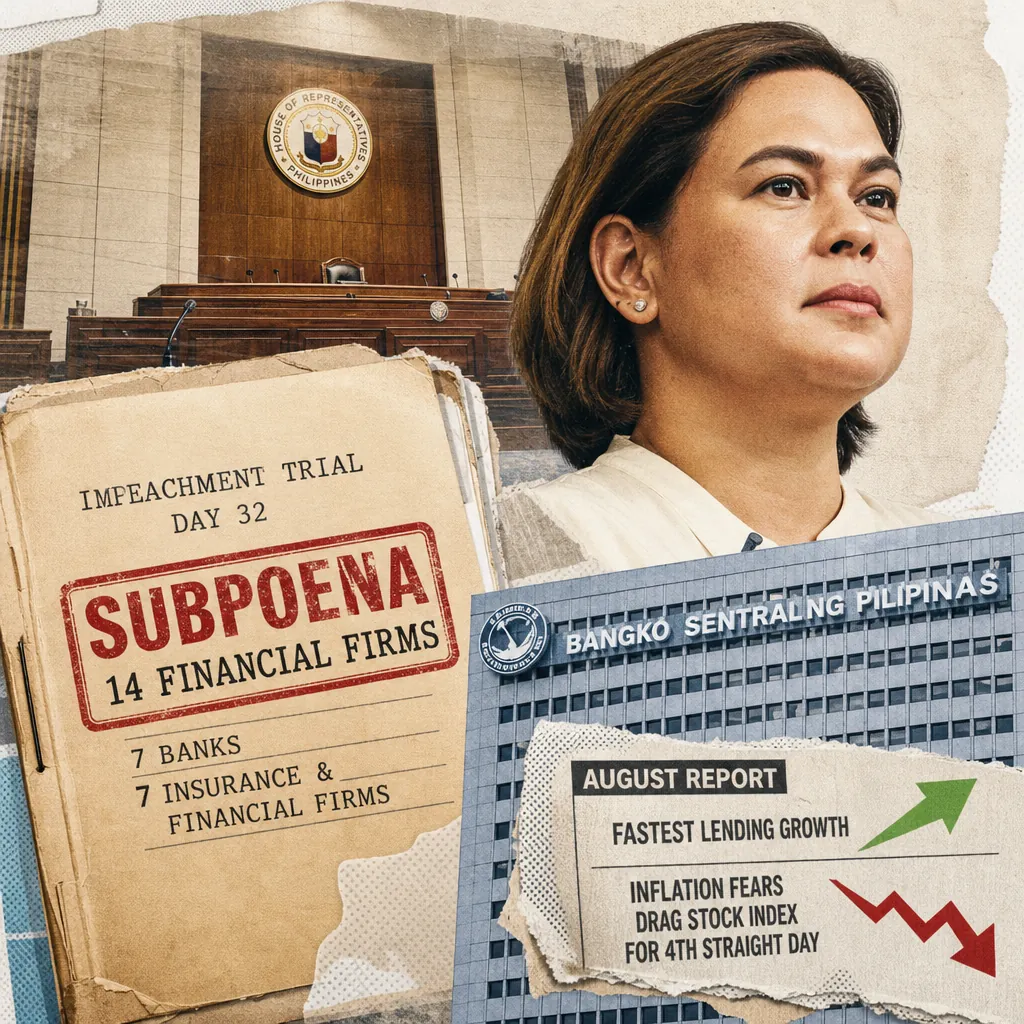
The Bangko Sentral ng Pilipinas projected September inflation at 6.4% to 7.4%, sending the Philippine Stock Exchange Index to its lowest close since November 2025 and the peso to 62.64 per dollar. Coverage also tracked a transport strike's end, a record P19.61-trillion national debt, and a pickup in initial public offerings.
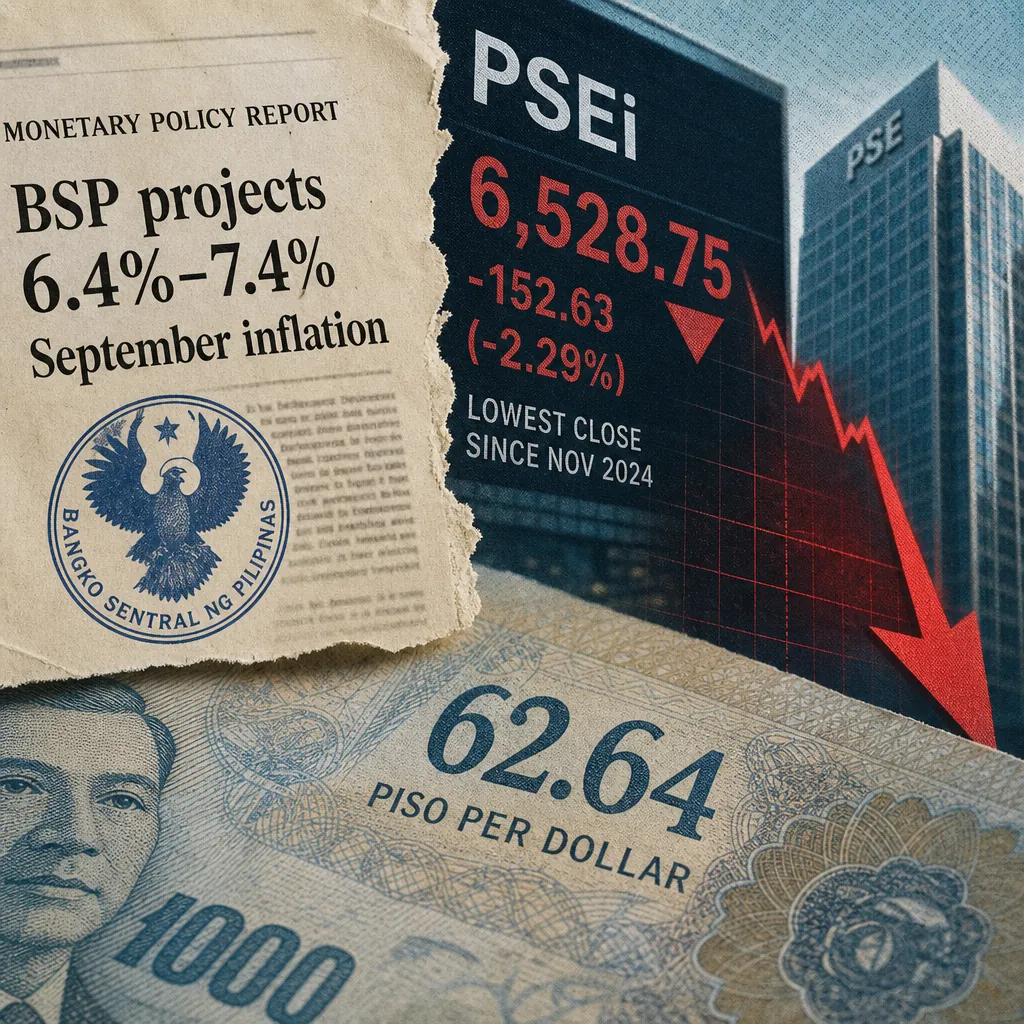
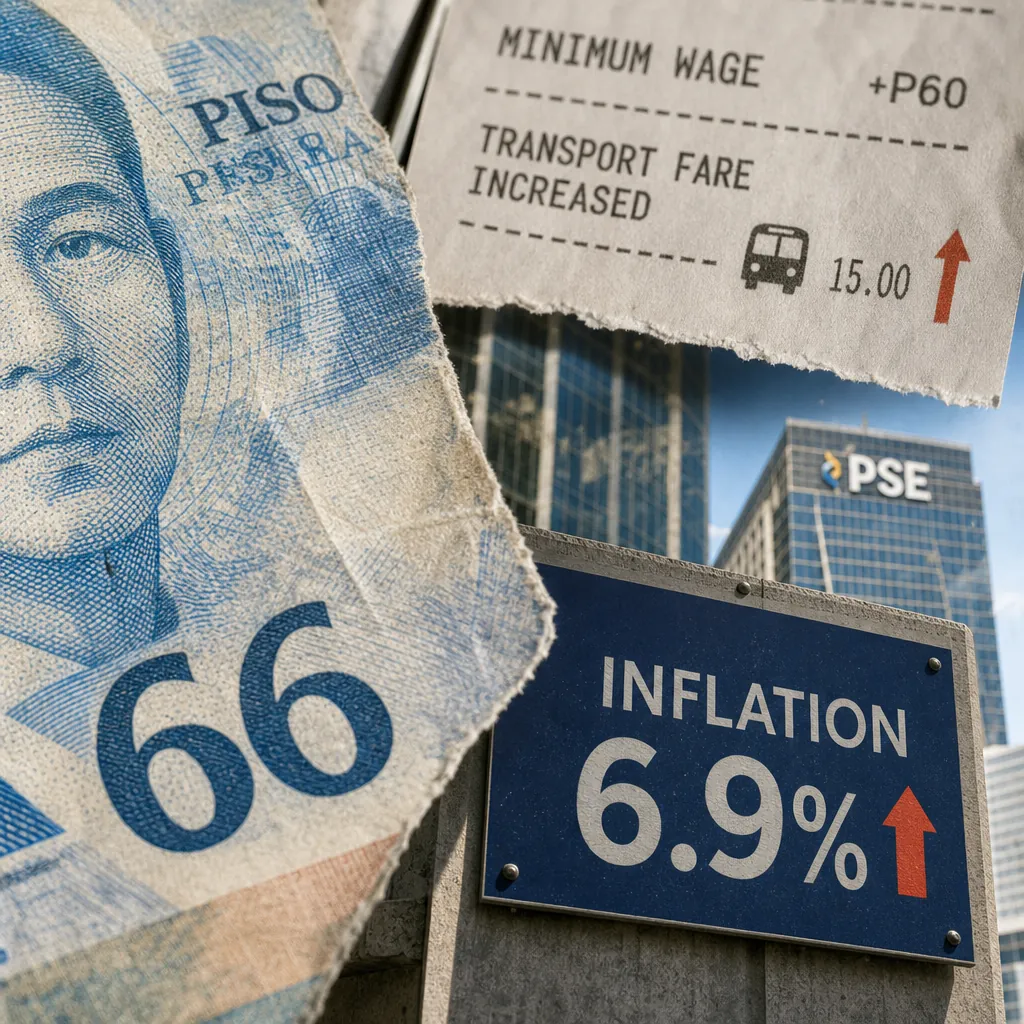
The Bangko Sentral ng Pilipinas (BSP), the country's central bank, said on Wednesday that inflation likely ran between 6.4 percent and 7.4 percent in September, measured as the year-on-year change in the prices of goods and services households commonly buy.51322 That range sits well above the BSP's 2-to-4 percent target band and, at the top end, would be the fastest pace since March 2023, when prices rose 7.6 percent.565 The forecast ended four straight months of easing price growth and landed on the same day the benchmark Philippine Stock Exchange Index (PSEi) fell 1.03 percent, or 58.92 points, to 5,679.48 — its lowest close since Nov. 14, 2025.1667 The peso weakened to 62.64 against the US dollar from 62.56 a day earlier.67
The BSP attributed the expected pickup to weather-related increases in the prices of vegetables, fish, rice and fruits, higher domestic petroleum prices, and the depreciation of the peso, partly offset by lower meat and electricity prices.52249 The Philippine Statistics Authority (PSA), the government's statistics agency, will release the official September figure on Oct. 6.522 The forecast drew coverage across at least a dozen outlets in the items reviewed here, from broadsheets to online business desks, and the story carried the largest combined advertising-equivalent value of any topic in the set — the estimated cost of buying the same column inches as paid advertising.51322384965
Away from the inflation story, the day's items also covered the end of a two-day transport strike, a record national debt tally, a pickup in stock-market listings, and a set of corporate and consumer finance developments. The items reviewed here are a monitored selection rather than a complete record of everything published, so the mix of topics and mediums reflects what the monitoring captured as much as what ran.
Key themes
- September inflation forecast at 6.4% to 7.4%, above target for a seventh month. The BSP's month-ahead projection would snap four months of easing and, at the upper end, mark the fastest pace in three-and-a-half years.52265 The official figure from the PSA is due Oct. 6.13
- The PSEi closed at 5,679.48, down 1.03% and its lowest since November 2025. The index fell for a third straight session as investors weighed the inflation outlook, rising US Treasury yields and a weaker peso.1667 The peso closed at 62.64 per dollar.67
- National government debt hit a record P19.61 trillion at end-August. That was up P217.62 billion, or 1.12 percent, from end-July and up 12.24 percent from a year earlier, driven by government securities issuance and foreign-exchange valuation adjustments.46
- Three companies are testing the initial public offering (IPO) market. Mynt Inc., VITRO Inc. and Aznar Shipping Corp. have filed for listings, with Mynt's offering potentially the largest in the exchange's history.2428
- A two-day transport strike ended with a vow to keep pushing for lower fuel prices. The Pinagkaisang Samahan ng mga Tsuper at Operator Nationwide (PISTON) ended its strike on Wednesday but called for repeal of the Oil Deregulation Law and a P10 increase in the minimum jeepney fare.1
- Banks' foreign-currency loans rose to $16.31 billion at end-June. The 5.6 percent quarter-on-quarter increase was driven mainly by export-oriented firms and other industries borrowing more.1457
- Government-backed microloans reached more than 650,000 borrowers. The Social Security System (SSS) and Government Service Insurance System (GSIS) disbursed over P31.7 billion through digital microloan programs in less than two years.66
- The Senate impeachment court shifted to a full-day schedule. The trial of Vice President Sara Duterte will run 10 a.m. to 5 p.m. Monday to Friday until Oct. 15, when it pauses for 2027 budget deliberations.4
How the narratives stack
Dominant: The BSP's September inflation forecast and its market fallout dominated the items reviewed here. The central bank's 6.4-to-7.4 percent projection was carried by the Manila Times, Inquirer, BusinessWorld, BusinessMirror, Malaya, Philstar, Manila Standard and Daily Guardian, among others.5132238496539 The PSEi's 1.03 percent drop to 5,679.48 and the peso's slide to 62.64 per dollar were reported as direct consequences.1667 The story's reach across outlets and its advertising-equivalent value — the estimated cost of buying the same space as paid advertising — were the largest of any topic in the set, though that reflects the items captured here rather than the whole day's coverage.
Counter-narrative: The IPO pipeline offered a contrasting signal. BusinessWorld and Head Topics reported that Mynt, VITRO and Aznar Shipping had filed for listings, with analysts calling the return of IPO activity constructive for market sentiment.2428 Globalinks Securities head of sales trading Toby Allan C. Arce said the return of IPO activity "brings new investment opportunities, improves market depth and can draw attention back to a market that has struggled with limited liquidity and relatively few new listings."24 This ran alongside, not against, the inflation story: the same market that fell to a 10-month low was also preparing to absorb new listings.
Emerging: Government-backed microloans and retail bond access pointed to a broadening of consumer finance. Philstar reported that more than 650,000 workers had tapped SSS and GSIS microloan programs, with over P31.7 billion disbursed.66 Separately, GCash made Retail Treasury Bond 32 (RTB 32) available through its GBonds feature, with a minimum investment of P5,000 and quarterly interest payments.61 Both developments suggest policymakers and platforms are pushing low-cost credit and savings products to households that traditional finance has served less well.
Under-covered: The transport strike's end received a single front-page mention in the items reviewed here, despite its direct link to fuel prices and inflation.1 PISTON's demands — repeal of the Oil Deregulation Law, removal of value-added and excise taxes on fuel, and a P10 fare increase — connect directly to the cost pressures the BSP cited, but the story placed lower in the captured set than the inflation forecast itself.
Platform insights
The monitoring writeup for this window did not include social-media engagement figures, so this section is limited to what the news items themselves show about how the story traveled.
- Online news desks: The inflation forecast was the most widely picked-up item, appearing across at least eight outlets in the set within hours of the BSP statement.5132238496539 The speed of pickup suggests the forecast was treated as a market-moving event rather than a routine data release.
- Broadsheet business pages: Manila Standard and BusinessWorld ran the inflation story on their front pages and business sections, alongside the PSEi decline and the peso's slide.6722 The pairing of the inflation forecast with the market reaction in the same editions indicates editors treated them as one story.
- Specialist and niche outlets: LionhearTV carried crypto and insurance stories, including the Philippine crypto community's response to tighter BSP rules on virtual asset service providers.3233 These items did not appear in the broader business coverage, suggesting they reached a different audience.
Key voices and communities
The Bangko Sentral ng Pilipinas. The central bank's month-ahead inflation forecast set the day's agenda. Its statement cited weather-related food price increases, higher fuel costs and peso weakness, and said it would remain "vigilant and guided by incoming data."49 The BSP's next policy move will be watched closely given inflation's seventh consecutive month above target.22
Market analysts and economists. Luis Limlingan of Regina Capital Development Corp. said the inflation warning "further weighed on investor confidence amid concerns over the potential implications for monetary policy and economic growth."67 Philstocks Financial Inc. cited negative cues from Wall Street and rising US Treasury yields.16 Ruben Carlo Asuncion, chief economist at Union Bank of the Philippines, estimated third-quarter growth at just 0.7 percent to 2 percent, citing weak investment and cautious consumer spending.55
The University of Asia and the Pacific (UA&P). In its report "The Market Call," UA&P said fourth-quarter growth could be slightly stronger than previous quarters on stable remittances, improving sentiment and holiday spending, but warned that faster inflation, minimum wage adjustments and an aggressive El Niño season could weigh on consumption.2327
Transport groups. PISTON national president Modesto "Ka Mody" Floranda called for the repeal of the Oil Deregulation Law and a P10 increase in the minimum jeepney fare, framing the strike around fuel prices and driver wages.1
Crypto traders and fintech advocates. Arlone Abello, CEO of Global Miranda Miner Group and founding chairman of the Innovative Movement of the Philippine Association of Crypto Traders, welcomed the BSP's proposed freeze on new payment system operator registrations and tighter controls on virtual asset service providers, while emphasizing that regulation does not make investing risk-free.32
Narrative streams
Inflation forecast ends four-month easing streak
The BSP's projection that September inflation settled between 6.4 percent and 7.4 percent marked a reversal from the 6.1 percent recorded in August and 1.7 percent a year earlier.22 At the upper end, it would be the fastest since March 2023's 7.6 percent; at the lower end, the fastest in four months, matching June.22 Either outcome keeps inflation above the BSP's 2-to-4 percent target for a seventh straight month.22 The central bank pointed to weather-related increases in vegetable, fish, rice and fruit prices, higher domestic petroleum prices and the peso's depreciation, partly offset by lower meat and electricity rates.549 The PSA will release the official September figure on Oct. 6.13 For households, the forecast means food and transport costs are likely to stay elevated through the rest of the year, squeezing budgets that were already stretched. For the BSP, it complicates the timing of any interest-rate cut, since easing too soon could add to price pressures. Analysts surveyed by Malaya put their own forecasts at 6.5 percent to 7 percent, with disagreement over whether the increase signals a sustained trend or a one-month weather-driven spike.49
PSEi falls to 10-month low as peso weakens
The PSEi lost 1.03 percent, or 58.92 points, to close at 5,679.48 on Wednesday, its worst finish since Nov. 14, 2025.67 The broader All Shares index fell 0.74 percent, or 23.75 points, to 3,179.08.67 The peso closed at 62.64 against the dollar from 62.56 on Tuesday.67 Limlingan said market sentiment remained cautious after the BSP's inflation warning, while Philstocks cited negative cues from Wall Street as US long-term Treasury yields continued to climb.1667 Department of Budget and Management Assistant Secretary Romeo Matthew Balanquit warned that a severe El Niño could slow public infrastructure spending early next year, adding to growth concerns.16 Most sectoral indices ended lower, led by services, which dropped 1.84 percent, followed by financials at 1.28 percent and mining and oil at 1.21 percent.67 For investors, the combination of above-target inflation, a weaker peso and rising US yields narrows the case for holding Philippine equities in the near term. For companies planning to raise capital, the market's weakness raises the stakes on pricing new offerings.
IPO pipeline tests investor appetite
Three companies — Mynt Inc., VITRO Inc. and Aznar Shipping Corp. — have filed for listings that could inject fresh capital into a market that has struggled with limited liquidity.2428 Mynt, the fintech firm behind the GCash mobile wallet, is expected to offer up to 1.61 billion primary shares and 6.42 billion secondary shares, with an overallotment option for an additional 1.2 billion.28 The PSE has said Mynt's offering could be the biggest in its history.24 Arce of Globalinks said a well-received listing could encourage more companies to tap the market, but warned that weak post-listing performance could reinforce investor caution.24 The timing is delicate: the offerings will test demand while the benchmark index sits at a 10-month low and inflation runs above target. For the exchange, a successful debut would deepen liquidity and draw attention back to a market that has seen relatively few new listings. For companies watching from the sidelines, the results will shape whether they follow.
National debt reaches record P19.61 trillion
National government outstanding debt climbed to a record P19.61 trillion as of end-August, up P217.62 billion, or 1.12 percent, from end-July and up 12.24 percent from P17.468 trillion a year earlier.46 The Bureau of the Treasury attributed the increase to the combined effects of financing activities and foreign-exchange valuation adjustments.46 Domestic debt accounted for 67.53 percent of the total at P13.24 trillion, while external obligations made up the remaining 32.47 percent.46 The month-on-month rise in domestic debt was driven by the Treasury's net issuance of government securities worth P127.85 billion, alongside a P2.52-billion increase from peso movements.46 For the government, the growing debt stock raises the cost of servicing obligations at a time when revenues are under pressure from slower growth. For taxpayers, it means a larger share of the budget goes to interest payments rather than public services. The debt figure also provides context for the Senate's deliberations on the 2027 national budget, which typically run from October to November.4
Transport strike ends with demands unmet
PISTON ended its two-day transport strike on Wednesday but vowed to continue pushing for lower fuel prices, higher jeepney fares and better wages and working conditions.1 The group called for the repeal of the Oil Deregulation Law, which removed government control over petroleum pricing, as well as the removal of value-added and excise taxes on fuel products, a P10 increase in the minimum fare for public utility jeepneys, and an end to continued fuel price increases.1 Members gathered at Welcome Rotunda, the boundary between Quezon City and Manila, and proceeded to the Mendiola Peace Arch in the afternoon, with strike centers in Baguio, Laguna, Albay, Cebu and Mandaue.1 The strike's demands connect directly to the cost pressures the BSP cited in its inflation forecast: higher domestic petroleum prices were one of the drivers of the expected September pickup.5 For drivers and operators, the end of the strike without concessions means the underlying cost squeeze remains. For commuters, the threat of future disruptions persists as long as fuel prices stay elevated.
Banks' foreign-currency loans rise on exporter demand
Outstanding foreign currency deposit unit (FCDU) loans — dollar-denominated borrowing extended by units of local banks and Philippine branches of foreign banks authorized to accept foreign currency deposits — stood at $16.306 billion at end-June, up 2.4 percent from $15.928 billion a year earlier and 5.6 percent from $15.439 billion at end-March.57 The BSP said the quarter-on-quarter increase was driven primarily by higher borrowing from export-oriented firms and other industries.57 Of the total, $11.653 billion, or 71.5 percent, went to Philippine-based borrowers, up from $10.117 billion a year earlier.57 The transport and logistics sector received the largest share among domestic borrowers at $3.07 billion, followed by exporters at $2.85 billion and power generation companies at $1.86 billion.14 Medium- to long-term loans with maturities of more than one year made up 73.3 percent of the total, down from 77.1 percent in the first quarter.14 For exporters, the rise in dollar borrowing reflects continued demand for trade financing even as the peso weakens, which raises the cost of repaying dollar-denominated debt in local currency. For banks, the growth in FCDU lending signals that corporate demand for foreign-currency credit remains steady despite market volatility.
Government microloans reach 650,000 borrowers
More than 650,000 Filipino workers have tapped government-backed microloan programs in less than two years, with the SSS and GSIS disbursing over P31.7 billion through digital lending platforms.66 Finance Secretary Frederick Go backed the initiatives as a way of meeting workers' immediate financing needs without adding unnecessarily to their debt burden.66 The figures highlight a persistent gap in the credit market: workers may need only a few thousand pesos to bridge a short-term cash crunch, but traditional lending can be poorly suited to such small and urgent borrowing.66 Separately, GCash made RTB 32 available through its GBonds feature, powered by the Philippine Digital Asset Exchange (PDAX) and PDAX Securities in partnership with the Bureau of the Treasury.61 The bond has a 2.5-year term, pays interest quarterly, and requires a minimum investment of P5,000, with an indicative annual coupon rate of 6.750 percent to 6.875 percent.61 For workers, these programs offer alternatives to informal lenders that can charge substantially higher rates. For the government, they represent a channel for financial inclusion at a time when inflation is eroding purchasing power.
Insurance and crypto sectors adjust to tighter conditions
EastWest Ageas Life Insurance Corp. expects minimal impact from tighter economic conditions due to the ongoing Middle East war, with financial strains concentrated mainly in lower-income segments.44 President and CEO Sjoerd Smeets said the company had seen "minor impacts, but not very significant" on renewal premiums, though he noted that segments with less spending power showed more strain.44 In the crypto sector, the Philippine trading community welcomed the BSP's proposed freeze on new payment system operator registrations and tighter controls on virtual asset service providers, with Abello of GMMG supporting stronger accountability and traceability while emphasizing that regulatory oversight does not mean risk-free investing.32 With users projected to reach nearly 12.8 million this year, the community warned that rules alone will not protect new market entrants unless the industry also improves market literacy.32 For insurers, the divergence between income segments means product design and collection strategies may need to adapt. For crypto platforms, tighter rules raise compliance costs but could improve the sector's credibility with mainstream investors.
Conversation trajectory
Watch the Oct. 6 inflation release. The PSA's official September figure will confirm or revise the BSP's 6.4-to-7.4 percent forecast. If inflation lands at the upper end, expect renewed pressure on the peso and further scrutiny of the BSP's rate stance. Observation window: one week.
Track the PSEi's next sessions. The index has fallen for three straight sessions to a 10-month low. Whether it stabilizes or continues to slide will depend on the inflation print and any signals from the BSP on monetary policy. Observation window: one to two weeks.
Monitor the IPO calendar. Mynt's offering, if it proceeds, will be the largest in PSE history and a test of investor appetite in a weak market. The pricing and subscription results will indicate whether other companies follow. Observation window: four to six weeks.
Watch for further transport actions. PISTON ended its strike without concessions and has vowed to continue its campaign. If fuel prices remain elevated, further disruptions are possible. Observation window: two to four weeks.
Track the Senate impeachment trial's budget pause. The trial runs full days until Oct. 15, when it suspends for 2027 budget deliberations. The resumption date and any procedural rulings will shape the timeline. Observation window: through mid-October.
Trigger events: the PSA inflation release on Oct. 6; the BSP's next policy meeting; the PSE's action on Mynt's listing application; any new fuel price adjustments; and the Senate's budget deliberations.
Response guidance
For financial institutions: Prepare customer communications that explain how above-target inflation affects loan rates, deposit returns and foreign-currency borrowing costs. Use plain language and avoid predicting the BSP's next move.
For retailers and consumer-facing businesses: Expect continued pressure on food and transport costs. If you are adjusting prices, communicate the reason clearly and early to avoid the appearance of opportunistic increases.
For employers: The combination of elevated inflation and soft labor market conditions means wage and benefits decisions will be closely watched. If you are holding wages flat, explain the constraints and any non-cash support available.
For transport operators: The strike's end does not resolve the underlying cost pressures. If fuel prices remain high, engage with driver groups early rather than waiting for another disruption.
For fintech and crypto platforms: The BSP's tighter rules on virtual asset service providers are coming. Use the lead time to strengthen compliance and customer education, and be clear with users that regulation reduces some risks but does not eliminate them.
For government communicators: The inflation forecast and the record debt figure will both draw scrutiny. Be prepared to explain what the numbers measure, what is driving them, and what is being done in response, without overpromising on timing.
For all sectors: Avoid treating the inflation forecast as a one-month event. The BSP has flagged weather, fuel and peso factors that are unlikely to reverse quickly. Plan for a period of elevated costs rather than a short spike.
See the full picture behind today's signals.
This report draws from Media Meter's MediaWatch, our real-time monitoring engine tracking 2,470+ Philippine sources across print, broadcast, digital, and social. Explore how the platform turns raw coverage into decision-grade intelligence, then see how it's configured for teams like yours — whether you're in PR agencies, corporate comms, government, or marketing.
Want more? Browse our Report Library for sector and crisis intelligence, or request a demo and we'll have your brand set up before the call.
Want this kind of intelligence on your brand?
This brief is built on the same MediaWatch methodology that runs continuously across every brand we monitor. See your competitive landscape, Impact Score, and narrative trajectory in a 30-minute demo.