PSEi slides below 6,100 as geopolitical jitters and economic uncertainty weigh on investor sentiment
The Philippine stock market fell sharply on June 30, with the PSEi dropping 1.57% to close at 6,037.17, as lingering geopolitical tensions and a weakening domestic outlook dampened investor confidence. Meanwhile, corporate news offered a mixed picture: Meralco and Megaworld reported strong earnings and lease renewals, while Manila Water assured uninterrupted supply despite El Niño. The day also saw significant political and social developments, including the Ombudsman's case against Romualdez and a large INC protest.
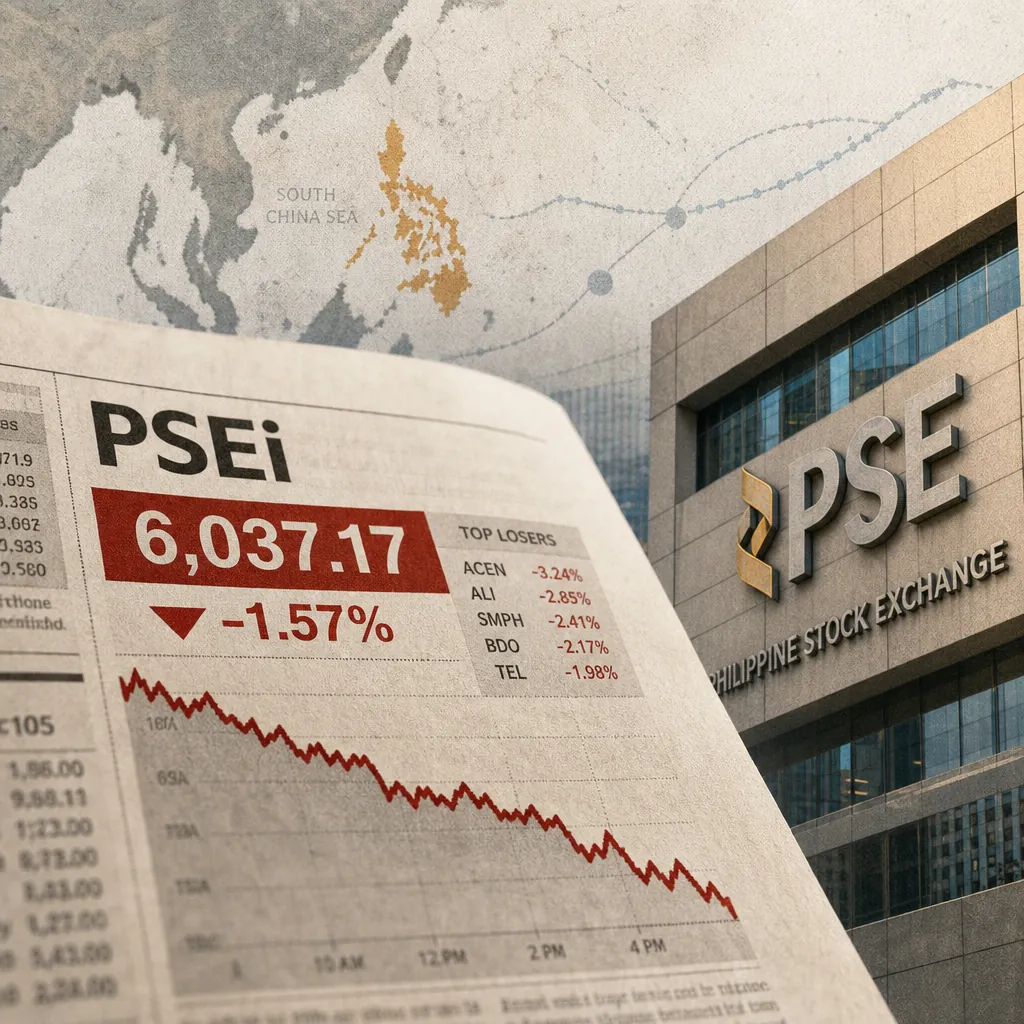
The Philippine Stock Exchange Index (PSEi) fell below the 6,100 level on Tuesday, closing at 6,037.17, down 1.57% or 96.24 points, as investors reacted to ongoing geopolitical tensions overseas and concerns about the domestic economic outlook [1]. Philstocks Financial Inc. noted that the market continued to grapple with external risks and the absence of fresh positive catalysts, leading to broad-based losses across sectors [1]. Luis Limlingan, head of sales at Regina Capital Development Corp., pointed to lingering geopolitical concerns as a key factor [1]. The decline came amid reports of rising Middle East tensions, including a warning from Iran about challenges to Hormuz routes that could spike oil prices [1].
Despite the market downturn, several major corporations reported positive developments. Manuel V. Pangilinan, chairman of Manila Electric Co. (Meralco), expressed optimism that the power giant would achieve a new record profit this year, driven by higher electricity sales, growth in its power generation business, and expansion of its retail electricity supply operations [2][3]. Meralco posted a 12% jump in consolidated core net income to P50.57 billion last year, and Pangilinan said full-year profits would likely exceed that [2]. However, he acknowledged that the Iran-US situation remains the "worst challenge," as it could lead to higher power rates due to fuel price surges [2].
Megaworld Corp. reported a 45.6% increase in office lease renewals in the first half of 2026, renewing about 122,000 square meters of office space, up from 83,353 square meters in the same period last year [4][5]. The renewals were spread across its township developments, with Eastwood City accounting for roughly 30% of the total [4]. The company attributed the strong performance to the resilience of its office portfolio and the appeal of its integrated township model [4].
In the water sector, Manila Water assured customers in its East Zone concession area of uninterrupted 24/7 service despite the effects of a strong El Niño and reduced water allocation from Angat Dam [6][7]. The National Water Resources Board (NWRB) lowered the allocation to 48 cubic meters per second (CMS) from the usual 52 CMS as the water level in Angat neared the critical 160-meter mark [6]. Manila Water said it has diversified its water sources through strategic infrastructure investments, reducing its dependence on Angat Dam [6].
On the political front, the Office of the Ombudsman said it was willing to hear former Public Works Secretary Manuel Bonoan's testimony to strengthen its case against former Speaker Martin Romualdez, who is embroiled in a flood control bribery scandal [8]. Assistant Ombudsman Mico Clavano said Bonoan was in a "unique position" to shed light on how the budget process was abused [8]. The Ombudsman is preparing a plunder case against Romualdez and former Senate President Francis Escudero [8].
In a separate development, at least 50,000 Iglesia Ni Cristo (INC) members gathered at the EDSA People Power Monument in Quezon City without a permit to protest the Ombudsman's filing of a plunder case against Senator Rodante Marcoleta [9]. The protest was notable for its sudden mobilization, catching authorities off guard [9]. INC spokesman Edwil Zabala delivered a statement implying that the administration's plans to use the Ombudsman against its critics would not succeed [9].
Other notable stories included the foiling of a potential school shooting in Cavite, where a Grade 10 student was taken into custody after school officials and police recovered an improvised firearm [10]. The incident followed a deadly school shooting in Tacloban City that killed three students and injured 20 others [10]. In Legazpi City, the local government donated 56 handheld metal detectors to public schools to strengthen security [11].
Key themes
- Market decline amid geopolitical and economic headwinds: The PSEi fell below 6,100, reflecting investor caution over overseas tensions and a weakening local economic outlook. The lack of fresh positive catalysts led to broad-based losses [1].
- Corporate resilience: Meralco and Megaworld post strong results: Despite market jitters, Meralco expects record profits this year, driven by higher electricity sales and growth in its power generation and retail supply businesses [2][3]. Megaworld reported a 45.6% surge in office lease renewals, signaling sustained demand for its township developments [4][5].
- Water security amid El Niño: Manila Water assured customers of uninterrupted supply despite reduced Angat Dam allocation, citing diversified water sources and infrastructure investments [6][7]. The assurance comes as the NWRB lowered allocation to 48 CMS due to critically low water levels [6].
- Political turmoil: Ombudsman case vs. Romualdez and INC protest: The Ombudsman signaled willingness to hear Bonoan's testimony to strengthen the plunder case against Romualdez [8]. Meanwhile, a massive INC protest against the Ombudsman's case against Senator Marcoleta highlighted growing political tensions [9].
- School safety concerns after Tacloban shooting: A foiled school shooting plot in Cavite and the donation of metal detectors in Legazpi City underscore heightened security measures following the Tacloban school shooting that killed three students [10][11].
- Property sector developments: Arthaland and DMCI launch projects: Arthaland Corp. launched Sondris, a luxury condominium in Makati in partnership with Mitsui Fudosan, betting on a recovery in the premium residential market [12]. DMCI Homes announced a long-term expansion of its Acacia Estates township, starting with the redevelopment of its Town Center [13].
- Healthcare expansion: Metro Pacific Health adds two hospitals: Metro Pacific Health completed its investment in First United 23, Inc., operator of two hospitals in Batangas, expanding its network to 31 hospitals and completing its presence in the Calabarzon region [14].
- Development finance: DBP's patient capital model: The Development Bank of the Philippines (DBP) highlighted its "development return on investment" (DROI) metric, arguing that a P1.26 billion capital injection could mobilize over P10 billion in private investments for sustainable infrastructure and climate resilience [15].
How the narratives stack
Dominant: The dominant narrative in the captured set is the market decline and its drivers—geopolitical tensions and economic uncertainty. The PSEi's fall below 6,100 was the most-covered financial story, with multiple outlets reporting on the drop and analysts citing external risks [1]. This narrative is reinforced by Meralco's cautious optimism, as Pangilinan acknowledged the Iran-US situation as the "worst challenge" [2].
Counter-narrative: A strong counter-narrative is corporate resilience and growth. Despite the market downturn, Meralco expects record profits, Megaworld reports surging lease renewals, and Manila Water assures service continuity [2][3][4][6]. These stories suggest that individual companies are weathering the storm through diversification and strategic investments, offering a more optimistic view of the economy.
Emerging: An emerging narrative is the intersection of politics and business. The Ombudsman's case against Romualdez and the INC protest signal potential political instability that could affect investor confidence [8][9]. The protest's scale and suddenness, along with the Ombudsman's aggressive stance, may create uncertainty around governance and rule of law.
Suppressed: A suppressed narrative within the captured set is the broader impact of climate change and extreme weather on business operations. While Manila Water's El Niño response is covered, the deeper implications for water security, agriculture, and energy costs are not extensively explored. The DBP's patient capital model touches on climate resilience, but it remains a niche story [15].
Platform insights
- Facebook: The INC protest generated significant engagement on Facebook, with posts from news pages and users sharing videos and photos of the large crowd at EDSA. The protest's sudden mobilization and the resulting traffic disruptions were widely discussed. The Tacloban school shooting and subsequent security measures also sparked emotional reactions and calls for stricter gun control.
- X (formerly Twitter): The PSEi decline and market analysis were trending topics among financial accounts and analysts. Tweets from Philstocks Financial and Regina Capital were shared, with users debating the impact of geopolitical risks. The Ombudsman's case against Romualdez also trended, with political commentators and netizens expressing divided opinions.
- YouTube: News channels uploaded videos of the INC protest and the Ombudsman's press briefing. The Tacloban school shooting continued to be a topic of discussion, with vloggers analyzing the juvenile justice system. Corporate announcements from Meralco and Megaworld received less video coverage.
- Reddit: The Philippine subreddit saw discussions on the PSEi drop, with users sharing investment strategies and concerns about the economy. The INC protest was debated in terms of its political implications, with some users criticizing the Ombudsman's actions. The school shooting plot in Cavite was also discussed, with calls for better school security.
Key voices and communities
- Financial analysts and brokers: Philstocks Financial Inc. and Regina Capital Development Corp. provided market commentary, attributing the PSEi decline to geopolitical and economic factors [1]. Their analysis shapes investor sentiment and is widely cited by media.
- Corporate leaders: Manuel V. Pangilinan (Meralco) and Roland J. Tiongson (Megaworld) offered optimistic outlooks for their companies, countering the broader market pessimism [2][4]. Their statements are closely watched by investors and business media.
- Government and regulatory bodies: The Office of the Ombudsman, through Assistant Ombudsman Mico Clavano, drove the political narrative with updates on the Romualdez case [8]. The NWRB's decision to reduce Angat Dam allocation also influenced the water security story [6].
- Civil society and religious groups: The Iglesia Ni Cristo (INC) emerged as a key voice through its large-scale protest, signaling political mobilization [9]. The group's spokesman, Edwil Zabala, delivered a pointed message against the administration.
- Education and local government officials: School officials and local governments in Cavite and Legazpi City were active in addressing school safety, with the Cavite police and Mayor Hisham Ismail taking preventive measures [10][11].
Narrative streams
Market jitters: PSEi falls below 6,100
The Philippine stock market experienced a sharp decline on June 30, with the PSEi dropping 1.57% to close at 6,037.17, slipping back below the 6,100 level [1]. Philstocks Financial Inc. attributed the drop to "geopolitical concerns offshore and weakening local economic outlook," noting that the lack of strong market drivers led investors to trim positions [1]. Luis Limlingan of Regina Capital Development Corp. added that lingering geopolitical tensions, particularly the Iran-US situation, weighed on sentiment [1]. The decline was broad-based, affecting all sectors. This story dominated the business pages, with coverage worth an estimated P212,176 in advertising-equivalent value [1]. The market's fall reflects a cautious investor mood amid global uncertainties, including the Iran-US conflict and its potential impact on oil prices and trade.
Corporate resilience: Meralco and Megaworld buck the trend
Despite the market downturn, two of the Philippines' largest companies reported positive developments. Meralco Chairman Manuel V. Pangilinan said the company expects full-year core net income to exceed last year's record P50.57 billion, driven by higher electricity sales, growth in its power generation business (including the P200-billion MTerra Solar Project), and expansion of its retail electricity supply operations [2][3]. Pangilinan acknowledged the Iran-US war as the "worst challenge," as it could lead to higher power rates, but remained optimistic [2]. The story drew coverage worth an estimated P143,420 from Inquirer Plus and P154,958 from BusinessWorld [2][3].
Megaworld Corp. reported a 45.6% increase in office lease renewals in the first half of 2026, renewing about 122,000 square meters of office space [4][5]. Eastwood City accounted for 30% of renewals, followed by Uptown Bonifacio, McKinley Hill, Iloilo Business Park, and Southwoods City [4]. Roland J. Tiongson, head of Megaworld Premier Offices, attributed the performance to the company's township model, which provides a "self-sustaining ecosystem" [5]. The story was covered by Inquirer Plus (P114,332) and BusinessWorld (P92,419) [4][5]. These reports suggest that while the broader market is under pressure, well-diversified companies with strong fundamentals continue to perform.
Water security: Manila Water assures supply amid El Niño
Manila Water assured its East Zone customers of uninterrupted 24/7 water service despite the effects of a strong El Niño and reduced allocation from Angat Dam [6][7]. The National Water Resources Board (NWRB) lowered the allocation to 48 cubic meters per second (CMS) from the usual 52 CMS as the water level in Angat neared the critical 160-meter mark [6]. Manila Water said it has diversified its water sources through strategic infrastructure investments, including the 80 MLD Calawis Water Treatment Plant, reducing its dependence on Angat Dam [6]. The company does not expect to impose rotational water interruptions or rationing [7]. The story was covered by Inquirer Online (P402,992) and Daily Tribune (P90,480) [6][7]. This assurance is critical for residents and businesses in the East Zone, as El Niño conditions persist.
Political storm: Ombudsman case vs. Romualdez and INC protest
The Office of the Ombudsman said it was willing to hear former Public Works Secretary Manuel Bonoan's testimony to strengthen its plunder case against former Speaker Martin Romualdez, who is embroiled in a flood control bribery scandal [8]. Assistant Ombudsman Mico Clavano said Bonoan was in a "unique position" to shed light on how the budget process was abused [8]. The Ombudsman is preparing a plunder case against Romualdez and former Senate President Francis Escudero [8]. The story, covered by Manila Times Online (P549,920), signals an escalation in the government's anti-corruption drive [8].
In a related development, at least 50,000 Iglesia Ni Cristo (INC) members gathered at the EDSA People Power Monument in Quezon City without a permit to protest the Ombudsman's filing of a plunder case against Senator Rodante Marcoleta [9]. The protest was notable for its sudden mobilization, catching authorities off guard [9]. INC spokesman Edwil Zabala delivered a statement implying that the administration's plans to use the Ombudsman against its critics would not succeed [9]. The story, covered by Manila Times Online (P812,560), highlights growing political tensions and the INC's willingness to flex its organizational muscle [9].
School safety: Foiled plot and security measures
A potential school shooting was foiled in General Mariano Alvarez, Cavite, when school officials and police recovered an improvised, unregistered firearm from a Grade 10 student [10]. The Cavite Police Provincial Office said the prompt response of school officials and police prevented a possible tragedy [10]. The incident followed a deadly school shooting at San Jose National High School in Tacloban City on June 22, which killed three students and injured 20 others [10]. In response, the Legazpi City government donated 56 handheld metal detectors to public schools to strengthen security [11]. Mayor Hisham Ismail said the devices would help ensure the safety of learners and personnel [11]. These stories, covered by Inquirer Online (P289,072 and P141,688), underscore the heightened concern over school violence and the need for preventive measures [10][11].
Property sector: New launches and expansions
Arthaland Corp. launched Sondris, a luxury condominium development in Makati in partnership with Mitsui Fudosan (Asia), betting on a recovery in the premium residential market [12]. The project features one- and two-bedroom units with Japanese-inspired space efficiency and design [12]. Pamela S. Go, Arthaland's marketing group head, said the goal is to deliver high-quality development that redefines premium living in a well-connected district [12]. The story was covered by BusinessWorld (P107,359) [12].
DMCI Homes announced a long-term expansion of its 130-hectare Acacia Estates township in Taguig City, starting with the redevelopment of its Town Center into a larger commercial hub with a supermarket, upgraded retail spaces, landscaped dining areas, a central plaza, and an activity park [13]. The project aims to improve convenience for residents and increase the township's attractiveness to future buyers and investors [13]. The story was covered by Daily Tribune (P120,432) [13].
Healthcare expansion: Metro Pacific Health adds two hospitals
Metro Pacific Health (MPH), the healthcare arm of Metro Pacific Investments Corp., completed its investment in First United 23, Inc., operator of two hospitals in Batangas: United Doctors of St. Camillus de Lellis Hospital and Medical Center (UDCMC) and United Doctors of St. Camillus de Lellis Mabini General Hospital (UDCMGH) [14]. This expands MPH's nationwide network to 31 hospitals and marks its first entry into Batangas, completing its presence in the Calabarzon region [14]. MPH President Augusto "Augie" Palisoc, Jr. expressed gratitude for the trust of hospital owners and doctors [14]. The story was covered by BusinessWorld (P127,858) [14].
Development finance: DBP's patient capital model
The Development Bank of the Philippines (DBP) highlighted its "development return on investment" (DROI) metric, arguing that a P1.26 billion capital injection could serve as "patient capital" to mobilize over P10 billion in private investments for sustainable infrastructure, climate resilience, and food security [15]. DBP President and CEO emphasized that the bank's success is measured not just by balance sheets but by long-term national impact [15]. The story, covered by Manila Bulletin Online (P741,704), presents an alternative approach to financing development projects [15].
Conversation trajectory
- Short-term (1-2 weeks): The PSEi is likely to remain volatile as geopolitical tensions, particularly the Iran-US situation, continue to evolve. Investors will watch for any escalation that could spike oil prices and affect corporate earnings. The Ombudsman's case against Romualdez may generate further political noise, potentially weighing on sentiment. However, positive corporate earnings reports from Meralco and Megaworld could provide some support.
- Medium-term (1-3 months): The impact of El Niño on water supply and agriculture will become clearer. Manila Water's assurance of uninterrupted service may be tested if Angat Dam levels continue to drop. The property sector's recovery, as signaled by Arthaland's launch and DMCI's expansion, will depend on interest rates and consumer confidence. The INC protest and Ombudsman's actions could lead to broader political realignments, affecting policy stability.
- Long-term (6-12 months): The DBP's patient capital model could gain traction if it successfully mobilizes private investments for infrastructure. The shift toward sustainability, as seen in Meralco's solar project and corporate ESG-linked executive pay, may accelerate. School safety concerns could lead to legislative changes, including amendments to the Juvenile Justice Welfare Act.
Trigger events to watch:
- Escalation of the Iran-US conflict and its impact on oil prices.
- Further reductions in Angat Dam allocation and potential water rationing.
- Developments in the Ombudsman's plunder case against Romualdez and Escudero.
- Additional school violence incidents or legislative action on juvenile justice.
- Interest rate decisions by the Bangko Sentral ng Pilipinas.
Response guidance
- For financial communicators: Emphasize corporate resilience and diversification strategies in messaging to counter market pessimism. Highlight long-term growth drivers such as renewable energy investments and office lease renewals. Acknowledge geopolitical risks but frame them as manageable through prudent management.
- For government and regulatory bodies: Communicate clearly about water management and El Niño preparedness to maintain public trust. Provide regular updates on Angat Dam levels and contingency plans. For the Ombudsman, ensure transparency in the Romualdez case to avoid perceptions of political motivation.
- For property developers: Leverage the positive news on lease renewals and new launches to reinforce confidence in the sector. Emphasize the value of integrated township developments and sustainable design. Address oversupply concerns by highlighting demand in specific segments.
- For education and local government: Proactive communication on school safety measures is critical. Share best practices from Legazpi City's metal detector program and Cavite's foiled plot to demonstrate responsiveness. Avoid panic but stress the importance of vigilance.
- Sensitive topics: Avoid politicizing the INC protest or the Ombudsman's case. Frame discussions around rule of law and due process. When covering school violence, be mindful of the trauma of victims and families, and avoid sensationalism.
See the full picture behind today's signals.
This report draws from Media Meter's MediaWatch, our real-time monitoring engine tracking 2,470+ Philippine sources across print, broadcast, digital, and social. Explore how the platform turns raw coverage into decision-grade intelligence, then see how it's configured for teams like yours — whether you're in PR agencies, corporate comms, government, or marketing.
Want more? Browse our Report Library for sector and crisis intelligence, or request a demo and we'll have your brand set up before the call.
Want this kind of intelligence on your brand?
This brief is built on the same MediaWatch methodology that runs continuously across every brand we monitor. See your competitive landscape, Impact Score, and narrative trajectory in a 30-minute demo.