SC ruling on BDO negligence draws 1,600 upvotes
The Supreme Court ruled that BDO Unibank cannot recover funds lost due to its own gross negligence, a decision that drew roughly 1,600 upvotes and over 200 comments on Reddit. The ruling has sparked broader conversations about bank accountability, consumer protection, and the legal standards for financial institutions in the Philippines.
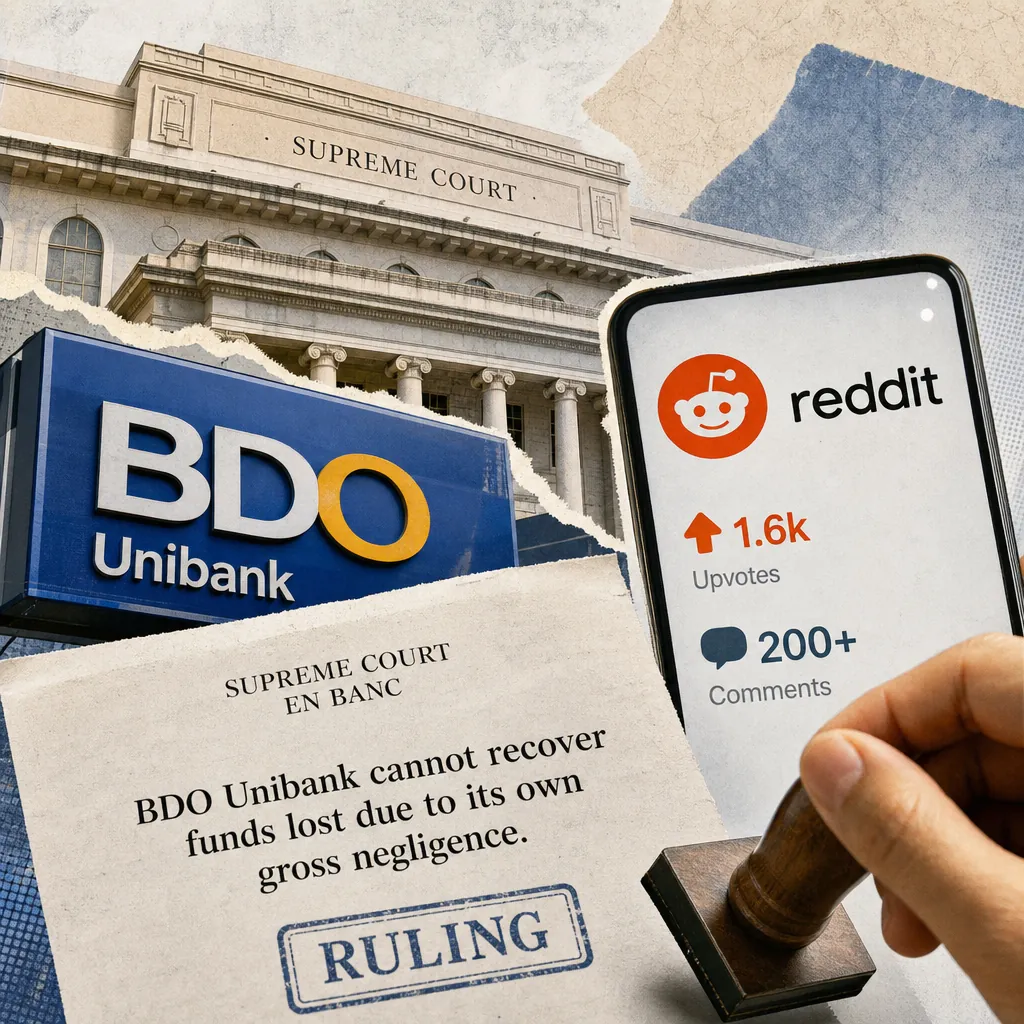
The Supreme Court's decision that BDO Unibank cannot demand the return of money it lost through its own gross negligence became the day's most resonant financial story, drawing roughly 1,600 upvotes and more than 200 comments across two near-identical Reddit posts on August 24. The posts, both headlined "Supreme Court: BDO / Banks can't demand money back if loss was caused by own negligence," appeared within moments of each other, with the first gaining 781 upvotes and 98 comments and the second surging to 808 upvotes and 103 comments. The near-simultaneous duplicate postings amplified the story's reach, as users encountered the ruling from multiple entry points and engaged rapidly.
The case at the center of the conversation involves Cristina Barcellano, a depositor who received ₱151,200 from a Land Bank check that BDO credited prematurely—after three banking days instead of the required seven. When BDO discovered the error, it filed an estafa complaint against Barcellano, a criminal charge for fraud or deceit. The Supreme Court's Third Division ruled that BDO's failure to follow its own procedures—misclassifying a regional check as local and releasing funds before clearing—constituted gross negligence, and that the bank could not invoke the legal doctrine of solutio indebiti, which allows recovery of payments made by mistake, because the loss stemmed from its own fault.
The Reddit discussion unfolded in three distinct phases. Initially, users focused on the specific facts of the case, framing the ruling as a vindication of ordinary depositors against institutional overreach. Commenters condemned BDO's "failure to observe basic safeguards meant to protect banks from invalid checks." The conversation then shifted to the legal doctrine of solutio indebiti and its limits when gross negligence is involved, with users dissecting the Court's emphasis on banking as "a business imbued with public interest" and the required "highest degree of diligence." Finally, the discussion expanded outward from BDO to systemic concerns across the entire banking sector, with users questioning whether other banks—including BPI, Metrobank, and even digital lenders like GCash and Maya—could face similar exposure if their procedures proved negligent.
The absence of counter-narratives or defensive posts from BDO supporters or banking industry voices was notable, allowing the pro-consumer framing to dominate without meaningful contestation. The high likes-to-dislikes ratio (808:0 on the second post) signaled near-unanimous approval of the ruling among the community.
Key themes
- Banks cannot recover funds lost through their own gross negligence: The Supreme Court ruled that BDO's premature crediting of a check and subsequent estafa complaint against a depositor constituted gross negligence, barring the bank from recovering the ₱151,200 under the doctrine of solutio indebiti.
- Consumer protection narratives carry substantial emotional weight: The ruling drew roughly 1,600 upvotes and over 200 comments on Reddit, signaling strong public resonance with the idea that depositors should not bear the financial consequences of bank errors.
- The ruling sets a new benchmark for bank conduct: Legal observers noted that the decision reinforces the high standard of diligence required of financial institutions, potentially affecting how similar disputes are handled across the sector.
- The conversation expanded from BDO to the broader banking and fintech landscape: Users questioned whether other banks and digital lenders like GCash and Maya could face similar exposure if their procedures proved negligent.
- The absence of counter-narratives allowed pro-consumer framing to dominate: No defensive posts from BDO supporters or banking industry voices appeared in the threads, allowing the ruling to be framed as a moral victory for customers.
- The ruling may encourage more customers to publicly share stories of bank errors: The legal precedent could embolden depositors to come forward with their own disputes, creating a wave of anecdotal evidence that may surface across platforms.
How the narratives stack
Dominant: The Supreme Court ruling against BDO dominated the day's conversation, both in the captured news media and on social platforms. The decision drew heavy coverage across Philippine business media, with multiple outlets reporting on the ruling's implications for bank accountability and consumer protection. The Reddit posts alone generated approximately 1,600 upvotes and over 200 comments, making it the most engaged financial story of the day. The ruling's dominance reflects its consequence for the banking sector: it establishes a legal precedent that could influence how depositors perceive similar situations across the industry.
Counter-narrative: Within the captured set, there was no significant counter-narrative defending BDO's actions or questioning the ruling. The absence of defensive posts from banking industry voices allowed the pro-consumer framing to dominate without meaningful contestation. This is notable because it suggests that public sentiment is strongly aligned with consumer protection, and any attempt to defend the bank's conduct would likely face swift backlash.
Emerging: The conversation is rapidly moving beyond the specific BDO incident toward broader commentary on banking diligence standards. Users are beginning to generalize the ruling's implications, questioning whether other banks—including BPI, Metrobank, and digital lenders like GCash and Maya—could face similar exposure if their procedures proved negligent. This expansion from "BDO failed" to "which bank is next" is the most strategically significant turn in the discussion, as it could reshape customer expectations and risk assessments across the industry.
Under-covered: While the BDO ruling dominated, several other significant financial stories received coverage in the captured set but drew less public attention. These include the BSP's new technical assistance program to help rural banks migrate to cloud-based core banking systems, the SEC's proposal to raise the minimum capital requirement for stockbrokers, and the life insurance industry's 17.91% increase in premium income for the first half of the year. These developments are consequential for the sector but did not generate the same level of public engagement as the BDO ruling.
Platform insights
- Reddit: Reddit served as the primary and only observed platform for the BDO ruling discussion, with both posts appearing there on August 24. The platform's upvote system enabled rapid visibility, with the second post's 808 upvotes and zero dislikes signaling near-unanimous approval of the ruling among the community. The comment threads functioned as a collective sense-making space, where users moved from initial emotional reactions to substantive legal analysis and finally to broader industry implications within a compressed timeframe.
Key voices and communities
- Retail Banking Consumers and Depositors: This group forms the largest and most active participant cluster, primarily surfacing on Reddit where the Supreme Court ruling is being shared and discussed heavily. Their influence stems from high engagement volume—each post variant attracted roughly 800 upvotes and nearly 100 comments—signaling strong resonance with individual account holders who feel vulnerable to bank errors. The sentiment skews sharply pro-consumer, with the discussion framing banks as powerful institutions that must be held to the highest diligence standards.
- Legal and Regulatory Observers: A secondary cluster of voices approaches the ruling from a doctrinal perspective, focusing on the legal precedents around solutio indebiti, gross negligence, and the standard of diligence required of banks under Philippine law. While smaller in volume, this group carries outsized influence because their interpretations shape how the ruling is understood by media, legal professionals, and compliance officers.
- Digital Media and News Amplifiers: This group includes news outlets and content aggregators that distribute the ruling across broader audiences, effectively setting the public agenda around bank accountability. Their role is aggregational rather than opinion-forming, yet their reach determines how widely the story penetrates mainstream consciousness.
- Financial Institution Communication Teams and PR Practitioners: Though not visibly active in the public thread, this stakeholder group is implicitly engaged—they are the intended consumers of media intelligence around this story. Their interest lies in assessing reputational fallout, anticipating client or regulator questions, and preparing guidance for internal stakeholders.
Narrative streams
Supreme Court rules BDO's gross negligence bars recovery of funds
The Supreme Court's Third Division ruled that BDO Unibank cannot demand the return of ₱151,200 from depositor Cristina Barcellano, who received the funds after the bank credited a Land Bank check prematurely—after three banking days instead of the required seven. The Court found that BDO's failure to follow its own procedures, including misclassifying a regional check as local, constituted gross negligence. As a result, the bank could not invoke the doctrine of solutio indebiti, which allows recovery of payments made by mistake, because the loss stemmed from its own fault.
The ruling drew immediate and overwhelming public endorsement on Reddit, with two near-identical posts about the decision appearing almost simultaneously on August 24. The first post gained 781 upvotes and 98 comments, while the second surged to 808 upvotes and 103 comments. The near-simultaneous duplicate postings created an immediate amplification effect, as users encountered the story from multiple entry points.
The Court's emphasis that "banking is a business imbued with public interest" and that banks must exercise the "highest degree of diligence" resonated strongly with commenters, who framed the ruling as a moral victory for customers who had been punished for bank errors. The decision also reinforces longstanding jurisprudence that mistakes arising from a bank's own gross negligence cannot be recovered under unjust enrichment principles.
Read for the sector: For Philippine banks, this ruling establishes a clear legal precedent: operational failures that harm customers acting in good faith will not be shielded by repayment doctrines. Banks must review their check-clearing procedures, fund availability policies, and dispute-handling practices to ensure they meet the "highest degree of diligence" standard. The reputational risk is significant—any institution perceived as blaming customers for internal errors will face swift and vociferous backlash.
The conversation expands from BDO to the broader banking and fintech landscape
As users digested the ruling's implications, the discussion evolved from "BDO failed" to "which bank is next." Commenters questioned whether other banks—including BPI, Metrobank, and even digital lenders like GCash and Maya—could face similar exposure if their procedures proved negligent. The conversation explored how the precedent might affect everything from check processing to unauthorized transaction disputes and even data breach liabilities.
This expansion is the most strategically significant turn in the discussion, as it demonstrates how a single legal ruling could reshape customer expectations and risk assessments across the industry. The conversation's progression from a specific case to systemic concerns occurred naturally, as users began generalizing the ruling's implications to other financial institutions.
For digital banks and fintech lenders, the ruling raises particular concerns about automated dispute-resolution processes. The "good faith customer" standard may be referenced in broader consumer protection discussions, meaning institutions like GCash and Maya should pay close attention to how their error-handling procedures might be scrutinized under the same standard.
Read for the sector: The ruling creates a comparative dynamic where customers may evaluate their own bank's conduct against the standard set by the Court. Financial institutions across the spectrum—from universal banks to digital lenders—must proactively communicate their adherence to procedural safeguards and customer good-faith protections. The precedent could encourage more customers to publicly share stories of disputed transactions, bank errors, or withheld funds, creating a wave of anecdotal evidence that may surface across platforms.
BSP moves to modernize rural banks with cloud-based core systems
While the BDO ruling dominated public conversation, the Bangko Sentral ng Pilipinas (BSP) issued technical assistance guidelines to help rural banks shift from legacy information technology systems to cloud-based core banking platforms. Under Memorandum M-2026-042, the central bank will provide support for the implementation and multiyear subscription of a software-as-a-service (SaaS) core banking system to eligible rural banks.
The assistance aims to improve rural banks' operational efficiency, resilience, business continuity, cybersecurity, and regulatory compliance while supporting their competitiveness amid the financial system's increasing digitalization. The technical assistance will cover a maximum six-month implementation period, followed by a fixed 36-month subscription period after the system goes live. Implementation support will include system configuration, data migration, system integration, testing, user training, cloud infrastructure, technical support, system updates, and maintenance.
This initiative forms part of the broader Rural Bank Strengthening Program (RBSP), which consists of Digitalization, Financial Advisory, and Capacity Building components meant to accelerate the digital transformation of rural banks and enhance their operations, capacity, and competitiveness.
Read for the sector: For rural banks, this program offers a pathway to modernize their operations without bearing the full cost of cloud migration. The BSP's support signals a regulatory push toward digitalization that could level the playing field between rural banks and their larger counterparts. Rural banks that participate will be better positioned to compete in an increasingly digital financial landscape, while those that delay may find themselves at a growing disadvantage.
SEC proposes raising stockbroker capital requirements and easing business permits
The Securities and Exchange Commission (SEC) is considering raising the ₱100-million minimum capital requirement for stockbrokers, a threshold that has stood since 2001. SEC Chairperson Francisco Ed. Lim told reporters on Monday that the review was prompted by previous incidents involving brokers with relatively small capital bases, while stressing that lower capitalization did not necessarily indicate misconduct.
The SEC is reviewing the requirement alongside a separate initiative by the Philippine Stock Exchange (PSE), which must seek SEC approval before implementing any rule changes. Lim said the two bodies were considering "more or less the same" changes.
Separately, the SEC proposed a "One Business Start Date" that would allow companies to begin commercial operations once they secure their SEC registration or other primary regulatory license, even while other government permits are still being processed. Lim said the proposal would address cases where a company has already been incorporated and secured its secondary license from the SEC but remains unable to start commercial operations because it is still completing requirements with other government agencies.
Read for the sector: For stockbrokers, a higher capital requirement would raise the barrier to entry, potentially consolidating the industry around larger, better-capitalized firms. For businesses generally, the "One Business Start Date" proposal would cut the time between company registration and the actual start of operations, reducing regulatory friction and supporting the SEC's stated priority of easing the ease of doing business.
Life insurance premiums jump 18% in first half
The Philippine life insurance industry recorded a 17.91% increase in premium income for the first half of the year, driven mainly by variable life products. The sector's combined premium income rose to ₱229.98 billion as of end-June, up from ₱195.05 billion a year earlier, the Insurance Commission (IC) said in a statement on Monday.
Benefit payments grew at a faster pace, climbing 19.57% to ₱69.21 billion from ₱57.88 billion a year earlier. Still, the industry posted higher profits during the period, with net income rising 3.42% to ₱21.42 billion from ₱20.72 billion last year. Total assets surpassed the ₱2 trillion threshold, rising 8.77%.
"These figures indicate the continued stability and resilience of the life insurance industry," the IC said. "Despite the financial challenges encountered earlier this year, the industry demonstrated its capacity to withstand financial shocks while continuing to meet its obligations to policyholders and beneficiaries."
Read for the sector: The strong premium growth signals sustained demand for life insurance products, particularly variable life policies that combine investment components with insurance coverage. The faster growth in benefit payments suggests the industry is meeting its obligations to policyholders, which supports consumer confidence. However, the modest 3.42% growth in net income indicates that rising benefit payouts are compressing margins, a trend insurers will need to manage through pricing and investment strategies.
Apple Pay's Philippine launch reshapes mobile payments landscape
Apple Pay launched in the Philippines on August 3 with four issuers: Chinabank, GoTyme Bank, Metrobank, and UnionBank. The launch has driven a "surge of enrollments" among both debit and credit cardholders at UnionBank, according to chief marketing and experience officer Albert Cuadrante, who expects the service to drive higher card usage and eventually contribute to revenues.
However, the country's two largest banks—BDO and BPI—are notably absent from the launch lineup. BDO is missing from both Apple Pay and Google Wallet, while BPI was not part of the August launch but is reported to be lined up for support by the fourth quarter. The absence of these major banks is the loudest gap in both wallets, and their clients have been asking when they will be able to add their cards.
Walmart's announcement that it will finally accept Apple Pay, Google Pay, and other tap-to-pay methods at its U.S. stores starting August 24 underscores the global shift toward mobile contactless payments. The share of U.S. consumers who made mobile payments at the register more than doubled between 2021 and 2025, and 70% of all mobile payments at the register were tap-to-pay.
Read for the sector: For Philippine banks, the Apple Pay launch represents both an opportunity and a competitive pressure. Banks that are live on the platform can capture early adopters and drive card usage, as UnionBank's enrollment surge demonstrates. Banks that are absent risk losing customers to competitors that offer the convenience of mobile wallet integration. The pressure to join the platform will intensify as consumer adoption grows, making it essential for BDO and BPI to secure their spots in the next wave of support.
GCash adds facial verification and loan scam insurance
Fuse Financing, the lending arm of GCash, has introduced facial verification for GLoan, using a Selfie Scan to help confirm that the legitimate account holder is applying for a loan. The update comes alongside other security measures, including GLoan Protect's new Loan Scam Insurance with coverage of up to ₱10,000 for select users. Eligible borrowers also continue to receive free health insurance with qualifying GLoan transactions.
The facial verification feature is designed to protect loan transactions during elevated-risk scenarios, adding a stronger layer of identity authentication to protect users against unauthorized loan applications and fraud.
Read for the sector: For digital lenders, the introduction of biometric verification and scam insurance reflects growing consumer concerns about fraud and unauthorized transactions. The BDO ruling's emphasis on customer good-faith protections may heighten scrutiny of how digital lenders handle disputed transactions. Institutions that proactively implement robust identity verification and consumer protection measures will be better positioned to maintain trust and avoid reputational damage.
Conversation trajectory
- Within 3–5 days: Expect the conversation to evolve from the specific BDO case to comparative discussions about other banks' check-processing and customer service procedures. The near-identical re-upload of the story within the same platform—with engagement jumping from roughly 780 to 800 upvotes and comments increasing from 98 to 103—indicates sustained interest rather than a one-day news cycle. This will directly affect reputational risk assessments for BPI and other universal banks.
- Within 1–2 weeks: The ruling is likely to encourage more customers to publicly share stories of disputed transactions, bank errors, or withheld funds, creating a wave of anecdotal evidence that may surface across platforms. Customer complaints involving bank negligence will now carry a legal reference point, making proactive resolution more important than defensive positioning.
- Within 7–14 days: Watch for whether policymakers reference this ruling during any upcoming financial consumer protection hearings or BSP briefings, as that would elevate the conversation from corporate reputational risk to regulatory narrative territory. The formal publication of the full Supreme Court ruling or an official summary from the SC Public Information Office will likely drive a second wave of coverage and deeper analysis.
- Trigger events: Any public statement from BDO or the Bankers Association of the Philippines addressing the ruling will significantly influence whether the narrative shifts toward institutional reform or defensiveness. The annual BSP financial stability report or any upcoming BSP circular on check clearing standards could also reframe the conversation toward regulatory implications.
Response guidance
- Legal and compliance review: Within 24 hours, convene the bank's legal team and compliance officers to analyze the Supreme Court's Third Division decision. Determine whether this ruling creates precedent that affects other pending cases or requires amendments to the Manual of Regulations for Banks (MORB) procedures regarding check clearing. This is a legal risk assessment first, communication second.
- Media Q&A and staff briefing: Within 48 hours, equip the communications department with a comprehensive Q&A document that addresses potential questions from journalists regarding the specific transaction mechanics (local vs. regional checks). Simultaneously, issue a memo to branch staff to ensure they are aware of the ruling and do not make casual or inaccurate comments to customers about the case, as this could be recorded and shared on social media.
- Proactive compliance-oriented press release: Within 72 hours, release a statement that does not fight the ruling but instead highlights the institution's existing investments in automation and enhanced check-processing verification. This demonstrates self-correction and de-emphasizes the human error aspect of the story.
- Reddit: prioritize monitoring and rapid flagging, not direct engagement: Direct participation from the bank's corporate account could easily be perceived as defensive or tone-deaf given the court's explicit finding of "gross negligence." The initial response should be to gather intelligence on the most prominent themes within the comment threads and provide a structured digest to the corporate communications team.
- Use "soft" thought leadership to counterbalance negative sentiment: Publish topical posts about consumer protection and financial literacy that do not reference the case directly but reinforce the sector's commitment to safety. This subtly shifts the discussion from negligence toward diligence without engaging in a public legal debate.
- Avoid direct confrontation with critics: The high likes-to-dislikes ratio (808:0) suggests a near-total consensus in favor of the ruling against the bank. Attempting to argue the legal merits publicly would be counterproductive. Treat this as a "no-debate zone" for the bank, while ensuring that any responses are limited to official statements that acknowledge the court's decision and express a commitment to enhanced standard operating procedures.
See the full picture behind today's signals.
This report draws from Media Meter's MediaWatch, our real-time monitoring engine tracking 2,470+ Philippine sources across print, broadcast, digital, and social. Explore how the platform turns raw coverage into decision-grade intelligence, then see how it's configured for teams like yours — whether you're in PR agencies, corporate comms, government, or marketing.
Want more? Browse our Report Library for sector and crisis intelligence, or request a demo and we'll have your brand set up before the call.
Want this kind of intelligence on your brand?
This brief is built on the same MediaWatch methodology that runs continuously across every brand we monitor. See your competitive landscape, Impact Score, and narrative trajectory in a 30-minute demo.