SC orders SM to honor raffle prize; consumer rights win
The Supreme Court ruled that SM Mall must deliver a Suzuki S-Presso raffle prize to a security guard's wife, affirming that declared winners hold binding rights. The ruling drew heavy social engagement, while a separate Reddit thread criticized Chowking's food quality.
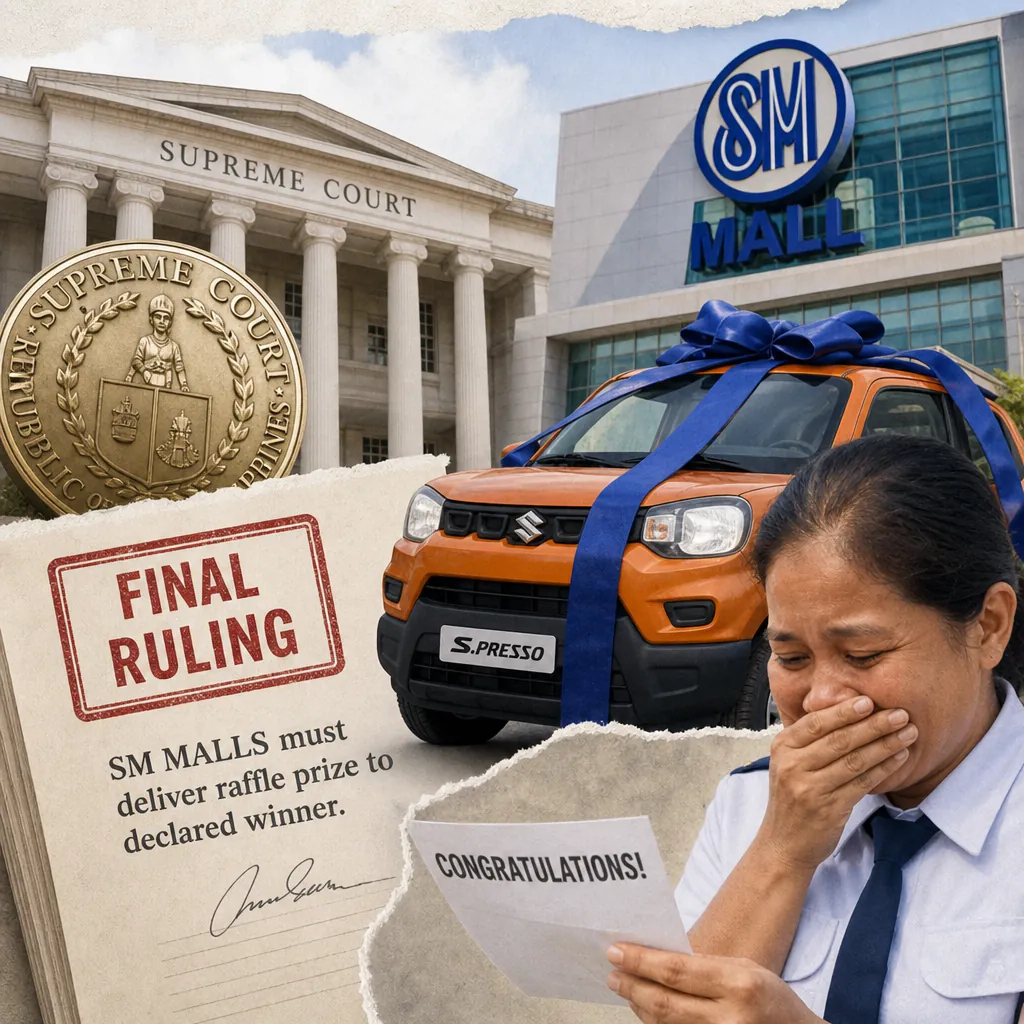
The Supreme Court's Third Division ordered SM Mall's Shopping Center Management Corporation (SCMC) to hand over a Suzuki S-Presso that a security guard's wife won in a 2019 raffle, a decision that drew more than 1,300 upvotes across two Reddit posts on August 23 and became the day's dominant consumer story. The ruling, penned by Associate Justice Samuel Gaerlan, affirmed that once a company declares a raffle winner, the prize becomes a binding obligation, and clarified that a security guard employed by a third-party agency is not an employee of the mall or its tenants. The case began when the Department of Trade and Industry (DTI) dismissed the wife's complaint, was reversed by the Court of Appeals, and finally settled by the Supreme Court, which cited Article 1370 of the Civil Code to establish that clear contract terms control. The two Reddit posts sharing the ruling drew 723 and 652 likes respectively, with combined comments exceeding 150, signaling strong public interest in consumer rights and corporate accountability. A separate, smaller thread on the same day criticized Chowking's food quality, with a user detailing a 10-minute wait for a chicken chop and describing the sauce as the breaking point, concluding with "Mag McDo na lang kung ganyan" (roughly, "Might as well go to McDonald's if that's the case"). That post drew 57 likes and 29 comments, a modest but genuine current of sentiment around quick-service restaurant (QSR) quality. The contrast between the two threads — one a legal victory with broad resonance, the other a product complaint with limited reach — illustrates how promotional and contractual issues can generate far more public engagement than routine quality rants. For businesses running raffles or loyalty promotions, the ruling serves as a clear warning: exclusionary clauses must be narrowly and precisely drafted, and any attempt to disqualify a declared winner based on ambiguous language will face intense public and legal scrutiny. The conversation also touched on the role of the DTI, the government agency that handles consumer complaints and regulates promotional mechanics, whose initial dismissal was overturned on purely legal grounds. The day's social media activity was concentrated on Reddit, where both the legal ruling and the food complaint were posted, with the legal narrative also shared via the Facebook page BatasPH, indicating cross-platform propagation. The Inquirer article covering the ruling was noted as removed, but the story was cited via the Filipino Times, showing that mainstream journalism fed the Reddit discussion and lent authority to the posts. For communicators in the consumer sector, the key takeaway is the need to audit promotional mechanics against the standards articulated in this ruling, and to prepare rapid-response protocols for service quality complaints that invite direct brand-to-brand comparisons. The ruling's emphasis on strict contract interpretation and the public's strong sympathy for the consumer over the corporation suggests that even legally defensible positions may carry disproportionate reputational costs. The day's conversation also included a range of other consumer-related news items, from GCash's four wins at the 2026 APAC Tambuli Awards for purpose-driven campaigns to the Bangko Sentral ng Pilipinas' (BSP) financial learning program in Nueva Ecija, and the Philippine Competition Commission's (PCC) market study of the concert ticketing industry. These stories, while not the focus of the social conversation, provide context for the broader consumer landscape in which the Supreme Court ruling and the Chowking complaint sit. The BSP's Economic and Financial Learning Program (EFLP), for instance, is a flagship initiative aimed at improving financial literacy among micro, small and medium enterprises (MSMEs), with the Nueva Ecija session drawing nearly 200 onsite participants and another 1,100 online. The PCC's market study of the ticketing sector, meanwhile, reflects growing scrutiny of dominant players in consumer markets, a theme that resonates with the Supreme Court's affirmation of consumer rights. Together, these developments paint a picture of a consumer environment where legal protections are being strengthened, financial education is being expanded, and market competition is being examined — all against a backdrop of everyday complaints about product quality and service. The Supreme Court ruling, however, stands out as the day's most consequential development, not only for the specific parties involved but for the precedent it sets for all promotional campaigns in the Philippines. The ruling's clarification that security guards are employees of their agencies, not the client entities they serve, has implications beyond raffles, touching on how companies classify outsourced labor and what obligations they owe to workers of third-party contractors. For the retail, banking, and telecommunications sectors, the ruling signals that promotional mechanics must be reviewed to ensure they do not contain overly broad exclusion clauses that could be challenged in court. The high engagement on the Reddit posts — with combined likes exceeding 1,300 — suggests that consumers are paying close attention to how companies treat winners and that any similar misstep could generate outsized negative sentiment. The Chowking complaint, while smaller in scale, highlights the persistent risk of "declining quality" narratives in the QSR space, which can be amplified if not addressed early. The user's direct comparison to McDonald's indicates that competitive positioning is a live factor in consumer complaints, and that a single negative experience can prompt brand-switching recommendations. For QSR clients, the recommendation is to have a customer service representative acknowledge the specific feedback without excusing the experience, and to offer a direct line for resolution, without engaging in brand-vs-brand comparisons. The lack of a visible corporate response to the Chowking thread could allow it to become a rallying point for other dissatisfied customers, so a quiet, non-public response is advised. For promotional campaign managers across all client sectors, the Supreme Court ruling conversation warrants immediate review of existing promo mechanics to identify any clauses that could be interpreted as overly broad or potentially disqualifying to ordinary consumers. The ruling establishes that ambiguity in promo mechanics will be resolved against the issuer, and that exclusionary language must be precise and defensible under civil code principles, not just administrative interpretations. This is directly relevant to any client running contests, loyalty draws, or limited-time offers, particularly those involving third-party contractors or service providers. The conversation trajectory suggests that quality complaints are shifting from anecdotal to comparative brand advocacy, with individual product grievances rapidly evolving into explicit brand-switching recommendations. Expect this comparative framing to intensify within the next 2-4 weeks as more consumers adopt the "switching" narrative, especially if similar complaints emerge across other brands. The promotional mechanics scrutiny is also expanding beyond legal circles into consumer rights discourse, with the Supreme Court ruling creating a precedent that consumers are beginning to reference when challenging denied prizes or disputed promotions. The high engagement levels suggest this legal interpretation will ripple into broader discussions about promotional fairness, potentially affecting how consumers perceive raffle-based marketing from FMCG and QSR brands. The concurrent reposting patterns indicate sustained interest in consumer protection rulings, with the identical content appearing across multiple posts with similar engagement metrics, suggesting the conversation will remain active for at least 1-2 more weeks. Key trigger events that will reshape this conversation include the upcoming release of Jollibee Foods Corporation's quarterly earnings report, which is likely to invite commentary linking financial performance to perceived quality investments, and the publication of the Supreme Court's full decision text or any related commentary from legal commentators, which could extend the raffle ruling discussion further. The possible circulation of similar consumer complaint posts across other QSR brands would transform this from a single-brand issue into a sector-wide quality debate. For the next 48-72 hours, the critical window is for monitoring competitor mention patterns emerging from quality complaints, and for preparing response protocols that acknowledge service gaps while highlighting quality improvement initiatives — but only if such initiatives are verifiable and recent. For the longer horizon, consider preparing a consumer rights explainer or FAQ addressing how promotional winners are determined and what protections exist under Philippine law, as this content could position clients as transparent and consumer-friendly if placed strategically within the next 1-2 weeks. The day's conversation, while dominated by the Supreme Court ruling, also included a range of other consumer-related news items that provide context for the broader landscape. GCash's four wins at the 2026 APAC Tambuli Awards for campaigns focused on civic accountability, public transit, financial access, and inclusion highlight how digital platforms are being used to address everyday challenges and expand access to services. The BSP's financial learning program in Nueva Ecija, part of its 2026 Economic and Financial Learning Program (EFLP), drew nearly 200 onsite participants and another 1,100 online for a two-day session aimed at helping MSMEs strengthen their financial management and business operations. The Philippine Competition Commission's (PCC) market study of the local concert ticketing industry, seeking input from Filipinos, reflects growing scrutiny of dominant players in consumer markets, a theme that resonates with the Supreme Court's affirmation of consumer rights. These stories, while not the focus of the social conversation, underscore the range of consumer issues being addressed by regulators, businesses, and advocacy groups. The Supreme Court ruling, however, stands out as the day's most consequential development, not only for the specific parties involved but for the precedent it sets for all promotional campaigns in the Philippines. The ruling's clarification that security guards are employees of their agencies, not the client entities they serve, has implications beyond raffles, touching on how companies classify outsourced labor and what obligations they owe to workers of third-party contractors. For the retail, banking, and telecommunications sectors, the ruling signals that promotional mechanics must be reviewed to ensure they do not contain overly broad exclusion clauses that could be challenged in court. The high engagement on the Reddit posts — with combined likes exceeding 1,300 — suggests that consumers are paying close attention to how companies treat winners and that any similar misstep could generate outsized negative sentiment. The Chowking complaint, while smaller in scale, highlights the persistent risk of "declining quality" narratives in the QSR space, which can be amplified if not addressed early. The user's direct comparison to McDonald's indicates that competitive positioning is a live factor in consumer complaints, and that a single negative experience can prompt brand-switching recommendations. For QSR clients, the recommendation is to have a customer service representative acknowledge the specific feedback without excusing the experience, and to offer a direct line for resolution, without engaging in brand-vs-brand comparisons. The lack of a visible corporate response to the Chowking thread could allow it to become a rallying point for other dissatisfied customers, so a quiet, non-public response is advised. For promotional campaign managers across all client sectors, the Supreme Court ruling conversation warrants immediate review of existing promo mechanics to identify any clauses that could be interpreted as overly broad or potentially disqualifying to ordinary consumers. The ruling establishes that ambiguity in promo mechanics will be resolved against the issuer, and that exclusionary language must be precise and defensible under civil code principles, not just administrative interpretations. This is directly relevant to any client running contests, loyalty draws, or limited-time offers, particularly those involving third-party contractors or service providers. The conversation trajectory suggests that quality complaints are shifting from anecdotal to comparative brand advocacy, with individual product grievances rapidly evolving into explicit brand-switching recommendations. Expect this comparative framing to intensify within the next 2-4 weeks as more consumers adopt the "switching" narrative, especially if similar complaints emerge across other brands. The promotional mechanics scrutiny is also expanding beyond legal circles into consumer rights discourse, with the Supreme Court ruling creating a precedent that consumers are beginning to reference when challenging denied prizes or disputed promotions. The high engagement levels suggest this legal interpretation will ripple into broader discussions about promotional fairness, potentially affecting how consumers perceive raffle-based marketing from FMCG and QSR brands. The concurrent reposting patterns indicate sustained interest in consumer protection rulings, with the identical content appearing across multiple posts with similar engagement metrics, suggesting the conversation will remain active for at least 1-2 more weeks. Key trigger events that will reshape this conversation include the upcoming release of Jollibee Foods Corporation's quarterly earnings report, which is likely to invite commentary linking financial performance to perceived quality investments, and the publication of the Supreme Court's full decision text or any related commentary from legal commentators, which could extend the raffle ruling discussion further. The possible circulation of similar consumer complaint posts across other QSR brands would transform this from a single-brand issue into a sector-wide quality debate. For the next 48-72 hours, the critical window is for monitoring competitor mention patterns emerging from quality complaints, and for preparing response protocols that acknowledge service gaps while highlighting quality improvement initiatives — but only if such initiatives are verifiable and recent. For the longer horizon, consider preparing a consumer rights explainer or FAQ addressing how promotional winners are determined and what protections exist under Philippine law, as this content could position clients as transparent and consumer-friendly if placed strategically within the next 1-2 weeks.
Key themes
- Supreme Court affirms raffle winner's binding right to prize — The Third Division ordered SM Mall's Shopping Center Management Corporation to deliver a Suzuki S-Presso to a security guard's wife, ruling that once a winner is declared, the prize becomes a binding obligation. The decision cited Article 1370 of the Civil Code, establishing that clear contract terms control, and drew over 1,300 combined upvotes across two Reddit posts.
- Security guards are employees of their agencies, not client entities — The Court clarified that a security guard employed by a third-party agency is not an employee of the mall or its tenants, rejecting SCMC's disqualification argument based on Promo Mechanics No. 22, which excluded employees of affiliates and service providers.
- DTI's initial dismissal overturned on legal grounds — The Department of Trade and Industry, the government agency that handles consumer complaints and regulates promotional mechanics, had dismissed the wife's complaint, but the Court of Appeals reversed this, and the Supreme Court affirmed the reversal, underscoring that administrative findings are subject to judicial review.
- Chowking quality complaint draws modest but genuine engagement — A Reddit user's critique of a 10-minute wait and subpar sauce quality at Chowking drew 57 likes and 29 comments, with the user recommending McDonald's as a superior alternative, highlighting competitive positioning as a live factor in consumer complaints.
- Promotional exclusion clauses face heightened scrutiny — The ruling signals that ambiguity in promo mechanics will be resolved against the issuer, and that exclusionary language must be precise and defensible, a precedent that applies to any business running raffles or loyalty promotions.
- Consumer rights stories drive higher engagement than product rants — The Supreme Court ruling posts drew significantly more engagement than the Chowking complaint, indicating that legal and contractual issues generate stronger public interest than routine quality complaints.
- Cross-platform propagation amplifies legal narratives — The ruling was shared via the Facebook page BatasPH and then migrated to Reddit, with mainstream journalism via the Filipino Times feeding the discussion, lending authority to the posts and contributing to their high engagement.
- Broader consumer landscape includes financial education and market scrutiny — The BSP's financial learning program in Nueva Ecija and the PCC's market study of the concert ticketing industry reflect ongoing efforts to strengthen consumer protections and expand financial access, providing context for the day's dominant legal narrative.
How the narratives stack
Dominant — The Supreme Court ruling on the SM Mall raffle prize was the day's most significant consumer story, drawing over 1,300 combined upvotes across two Reddit posts and generating extensive commentary on consumer rights and corporate accountability. The ruling's legal clarity and public sympathy for the consumer over the corporation made it the dominant narrative within the captured set, with the two posts sharing nearly identical content and attracting 723 and 652 likes respectively.
Counter-narrative — The Chowking quality complaint offered a contrasting consumer story, focusing on product quality and service failures rather than legal victories. While smaller in scale, with 57 likes and 29 comments, it highlighted the persistent risk of "declining quality" narratives in the QSR space and the potential for brand-switching recommendations, with the user explicitly suggesting McDonald's as a better alternative.
Emerging — The scrutiny of promotional exclusion clauses is emerging as a significant theme, with the Supreme Court ruling creating a precedent that consumers may reference when challenging denied prizes or disputed promotions. This could affect how consumers perceive raffle-based marketing from FMCG and QSR brands, and may prompt businesses to review their promo mechanics to avoid overly broad disqualification language.
Under-covered — The BSP's financial learning program in Nueva Ecija and the PCC's market study of the concert ticketing industry received news coverage but did not generate significant social conversation. These stories, while important for financial inclusion and market competition, placed low in the day's social media activity, which focused on the legal ruling and the food quality complaint.
Platform insights
- Reddit — All three social posts originated on Reddit, with the Supreme Court ruling posts drawing significantly higher engagement (723 and 652 likes) than the Chowking complaint (57 likes). The platform hosted both the emotional consumer rant and the clinical legal update, with the latter's duplication indicating strong sharing behavior among users who saw the ruling as broadly newsworthy. The legal narrative's lifecycle began on Facebook, where legal news pages typically break such decisions, and then migrated to Reddit for community commentary.
- Facebook — The Supreme Court ruling was also shared via the Facebook page BatasPH, indicating cross-platform propagation from Facebook to Reddit. No direct Facebook engagement metrics are available in the source data, but the reference suggests that legal news pages on Facebook played a role in breaking the decision and driving traffic to Reddit discussions.
- News Media — The Inquirer article covering the ruling was noted as removed, but the story was cited via the Filipino Times, showing that mainstream journalism fed the Reddit discussion. This external validation lent authority to the posts and likely contributed to their high engagement, as users shared news articles to support their commentary.
Key voices and communities
- Disgruntled Quick-Service Restaurant Patrons — Everyday consumers, primarily active on Reddit, expressing frustration over declining food quality at major Filipino QSR chains. These cost-sensitive diners frequently compare experiences across brands and use social platforms as a public complaint channel, making them an influential early-warning signal for reputational issues. Their posts typically generate moderate engagement, with one complaint thread on Chowking drawing approximately 57 upvotes and 29 comments.
- Legal and Consumer Rights Advocates — This community, active on Reddit and Facebook, amplifies legal rulings that impact consumer protection and corporate accountability, with a particular focus on promotional and raffle-related disputes. They demonstrate significant influence through high engagement metrics, with related posts drawing approximately 723 and 652 upvotes respectively, alongside dozens of comments. This group functions as a watchdog, interpreting judicial decisions for the public and framing them within broader consumer rights narratives.
- Institutional and Government Affairs Watchers — This smaller but highly targeted group monitors judicial and regulatory actions, specifically tracking how government bodies like the Supreme Court and DTI interact with commercial entities. Their influence is derived from the authority of the institutions they cite rather than high volume, with their posts shared primarily for civic awareness and legal education. They serve as intermediaries between legal rulings and public understanding, often syndicating content from legal information networks.
Narrative streams
Supreme Court orders SM Mall to honor raffle prize, affirming consumer rights
The Supreme Court's Third Division, in a decision penned by Associate Justice Samuel Gaerlan, ordered SM Mall's Shopping Center Management Corporation (SCMC) to deliver a Suzuki S-Presso to a security guard's wife who won the vehicle in a 2019 raffle. The ruling affirmed the Court of Appeals' decision, which had reversed the Department of Trade and Industry's (DTI) initial dismissal of the wife's complaint. The case centered on Promo Mechanics No. 22, which excluded employees of affiliates, service providers, and relatives up to the second degree from winning. SCMC had argued that the wife was disqualified because her husband, a security guard, was employed by a security agency contracted by BDO, a mall tenant. The Supreme Court rejected this argument, citing Article 1370 of the Civil Code to establish that clear contract terms control, and clarifying that security guards are employees of their agencies, not the client entity. The ruling drew over 1,300 combined upvotes across two Reddit posts, with 723 and 652 likes respectively, and combined comments exceeding 150. The high engagement reflects strong public interest in consumer rights and corporate accountability, with commenters interpreting the ruling as a victory for ordinary consumers over large corporations. The decision also has implications beyond raffles, touching on how companies classify outsourced labor and what obligations they owe to workers of third-party contractors. For businesses running promotional campaigns, the ruling establishes that ambiguity in promo mechanics will be resolved against the issuer, and that exclusionary language must be precise and defensible under civil code principles. The read for the sector is that companies must audit their promotional mechanics to ensure they do not contain overly broad disqualification clauses, and that any attempt to withhold a declared prize will face intense public and legal scrutiny.
Chowking quality complaint highlights QSR reputational risks
A Reddit user's critique of Chowking's food quality drew 57 likes and 29 comments on August 23, with the user detailing a 10-minute wait for a chicken chop with plain rice and describing the sauce as the breaking point. The post concluded with "Mag McDo na lang kung ganyan" (roughly, "Might as well go to McDonald's if that's the case"), directly recommending a competitor. The complaint evolved from a personal anecdote into a broader commentary on declining food quality within Philippine QSRs, with the comparative reference to McDonald's anchoring the sentiment around competitive alternatives rather than calling for boycotts or regulatory action. The thread remained isolated and did not generate secondary posts or follow-up discussions, indicating either limited resonance or absorption into larger conversations that day. For QSR clients, the post represents a reputational vulnerability around food quality consistency, and the lack of a visible corporate response could allow the thread to become a rallying point for other dissatisfied customers. The recommendation is to have a customer service representative acknowledge the specific feedback without excusing the experience, and to offer a direct line for resolution, without engaging in brand-vs-brand comparisons. The read for the sector is that quality perception battles are being fought in real-time on community platforms, and that a single negative experience can prompt brand-switching recommendations, making rapid-response protocols essential for managing reputational risk.
BSP expands financial education to MSMEs in Nueva Ecija
The Bangko Sentral ng Pilipinas (BSP), the Philippines' central bank, conducted the third leg of its 2026 Economic and Financial Learning Program (EFLP) in Cabanatuan City on 18 and 19 August 2026, drawing nearly 200 participants onsite and another 1,100 online. The two-day session, held under the theme "Planong Panalo Para sa Negosyo," focused on micro, small and medium enterprises (MSMEs) and covered recent economic developments, cash flow management, responsible borrowing, and the safe and secure use of digital financial services. Participants also learned strategies for building consumer trust and explored insurance solutions to protect their businesses. The EFLP is a flagship initiative aimed at making financial education more accessible, particularly to underserved sectors, and the Nueva Ecija session continued this effort. The program's focus on digital financial services aligns with the broader trend of financial inclusion in the Philippines, where mobile wallets and digital banking are expanding access to financial tools. For MSMEs, the program provides practical knowledge to strengthen financial management and business operations, which is crucial as the region moves toward an integrated digital economy. The read for the sector is that financial education is a key driver of MSME growth and resilience, and that programs like the EFLP play a vital role in equipping small businesses with the skills they need to navigate economic challenges and seize opportunities.
PCC launches market study of concert ticketing industry
The Philippine Competition Commission (PCC), the country's antitrust regulator, has launched a market study of the local concert ticketing industry and is seeking input from Filipinos. The study comes as Filipinos continue to flock to concerts by both local and international acts, with the ticketing sector growing alongside the country's fandom-crazy culture. The move follows a federal jury's finding in the United States in April that Live Nation and its subsidiary Ticketmaster were liable for monopolization, putting renewed attention on the influence that dominant players can wield over ticket prices and competition. The PCC's study aims to examine the structure of the Philippine ticketing market, including pricing practices, competition dynamics, and consumer welfare. For consumers, the study could lead to recommendations for regulatory reforms or enforcement actions if anticompetitive practices are found. For businesses in the ticketing sector, the study signals increased regulatory scrutiny and the need to ensure compliance with competition laws. The read for the sector is that the ticketing industry may face greater oversight, and that dominant players should review their practices to avoid potential antitrust challenges, while new entrants may find opportunities if the market is found to be concentrated.
GCash wins four APAC Tambuli Awards for purpose-driven campaigns
GCash, the Philippines' leading finance superapp and largest cashless ecosystem, won four 2026 APAC Tambuli Awards for campaigns focused on civic accountability, public transit, financial access, and inclusion. The winning campaigns include #MineAngBotoKo, Commute Fast Lane, Sachet Loans, and Wais Tindera, which address everyday challenges and expand access to services and opportunities across Filipino communities. The recognition highlights how GCash is using digital platforms not just for financial transactions but also to drive social impact. The awards underscore the growing importance of purpose-driven marketing in the financial services sector, where brands are increasingly expected to contribute to social good. For the sector, the wins demonstrate that campaigns with measurable social impact can earn recognition and build brand equity, and that financial inclusion is a compelling narrative for consumer engagement. The read for the sector is that purpose-driven campaigns are becoming a differentiator in the competitive fintech landscape, and that brands should consider how their marketing can address social challenges while driving business results.
Conversation trajectory
- Quality complaints shifting from anecdotal to comparative brand advocacy — The Chowking discussion reveals a trajectory where individual product grievances are rapidly evolving into explicit brand-switching recommendations, with one consumer directly suggesting McDonald's as the superior alternative after detailing a specific service failure. This pattern, where a single negative experience triggers competitor promotion, is significant for QSR clients because it indicates that quality perception battles are being fought in real-time on community platforms rather than through formal review channels. Expect this comparative framing to intensify within the next 2-4 weeks as more consumers adopt the "switching" narrative, especially if similar complaints emerge across other brands. Observation window: 2-4 weeks.
- Promotional mechanics scrutiny expanding beyond legal circles into consumer rights discourse — The Supreme Court ruling on the SM mall raffle case has generated substantial engagement across multiple community posts, with the conversation centering on the enforceability of declared winners and the interpretation of disqualification clauses. For brands running promotional campaigns, this ruling creates a precedent that consumers are beginning to reference when challenging denied prizes or disputed promotions. The high engagement levels suggest this legal interpretation will ripple into broader discussions about promotional fairness, potentially affecting how consumers perceive raffle-based marketing from FMCG and QSR brands. Observation window: 1-2 weeks.
- Concurrent reposting patterns indicating sustained interest in consumer protection rulings — The identical SC ruling content appearing across multiple posts with similar engagement metrics signals that this story has cross-community appeal and is being deliberately circulated for its consumer protection implications. This duplication pattern suggests the conversation will remain active for at least 1-2 more weeks, particularly as commentators connect the ruling to broader questions about how corporations treat consumers from lower-income backgrounds. Observation window: 1-2 weeks.
- Complaint velocity within quick-service dining creating reputational risk windows — The Chowking post demonstrates a notable engagement-to-content ratio where a relatively brief complaint generated nearly 30 comments, indicating that community members are actively validating and amplifying quality concerns rather than dismissing them. This amplification pattern typically accelerates when multiple similar complaints emerge within a short timeframe, so monitoring for subsequent Chowking or sister-brand quality posts over the next 7-10 days will be critical for early intervention opportunities. Observation window: 7-10 days.
Trigger events: The upcoming release of Jollibee Foods Corporation's quarterly earnings report, likely to invite commentary linking financial performance to perceived quality investments. The publication of the Supreme Court's full decision text or any related commentary from legal commentators, which could extend the raffle ruling discussion further. The possible circulation of similar consumer complaint posts across other QSR brands, which would transform this from a single-brand issue into a sector-wide quality debate.
Response guidance
Promotional mechanics audit — Review all active and planned promotional mechanics for retail, QSR, and beverage clients to ensure exclusion clauses are narrowly tailored and unambiguous, referencing the Supreme Court's expectation that contract terms control and that employee status is determined by actual employment arrangements, not assignment locations. This is particularly urgent given the legal clarity now established by the ruling.
Reputational risk advisory — Issue an advisory to client communications teams on the reputational risk of withholding prizes or benefits from consumers, as public reaction to the Supreme Court case shows strong support for the individual over the corporation, evidenced by the high engagement and positive sentiment toward the security guard's wife. Advise that even legally defensible positions may carry disproportionate reputational costs.
Competitive brand monitoring — Monitor comparative brand mentions in the context of service quality complaints, as the "switch to competitor" sentiment in the Chowking thread illustrates a direct conversion path for dissatisfied customers. For QSR clients, a rapid-response protocol for such mentions, including personalized outreach and corrective action, should be developed, as the current post has already generated visible discussion without any visible corporate response.
Reddit engagement strategy — Prioritize the Chowking quality complaint thread for monitoring and potential response. The post directly references a competitor and frames the issue around declining food quality, which is a reputational risk for the brand if it gains traction. Have a customer service representative acknowledge the specific feedback without excusing the experience, and offer a direct line for resolution, without engaging in brand-vs-brand comparisons.
Legal narrative monitoring — Do not engage directly on the Supreme Court raffle ruling threads, as they are about a legal decision involving a mall and a security agency, not a client's product or service. Monitoring is advised only to track sentiment around promotional mechanics, which could inform future client advisories on contest rules and consumer protection expectations.
Consumer rights content — Consider preparing a consumer rights explainer or FAQ addressing how promotional winners are determined and what protections exist under Philippine law. Given the sustained engagement on the raffle case across multiple posts, this content could position clients as transparent and consumer-friendly if placed strategically within the next 1-2 weeks, and timing this content release before any major promotional campaign launches would preemptively address the questions this ruling is generating.
See the full picture behind today's signals.
This report draws from Media Meter's MediaWatch, our real-time monitoring engine tracking 2,470+ Philippine sources across print, broadcast, digital, and social. Explore how the platform turns raw coverage into decision-grade intelligence, then see how it's configured for teams like yours — whether you're in PR agencies, corporate comms, government, or marketing.
Want more? Browse our Report Library for sector and crisis intelligence, or request a demo and we'll have your brand set up before the call.
Want this kind of intelligence on your brand?
This brief is built on the same MediaWatch methodology that runs continuously across every brand we monitor. See your competitive landscape, Impact Score, and narrative trajectory in a 30-minute demo.