Scam Hub Raids Free 53 as NBI Arrests Nine
The National Bureau of Investigation rescued 53 trafficking victims and arrested nine suspects in raids on two scam compounds in Zamboanga Sibugay, while transport, cybersecurity, and consumer stories filled the rest of the day's coverage.
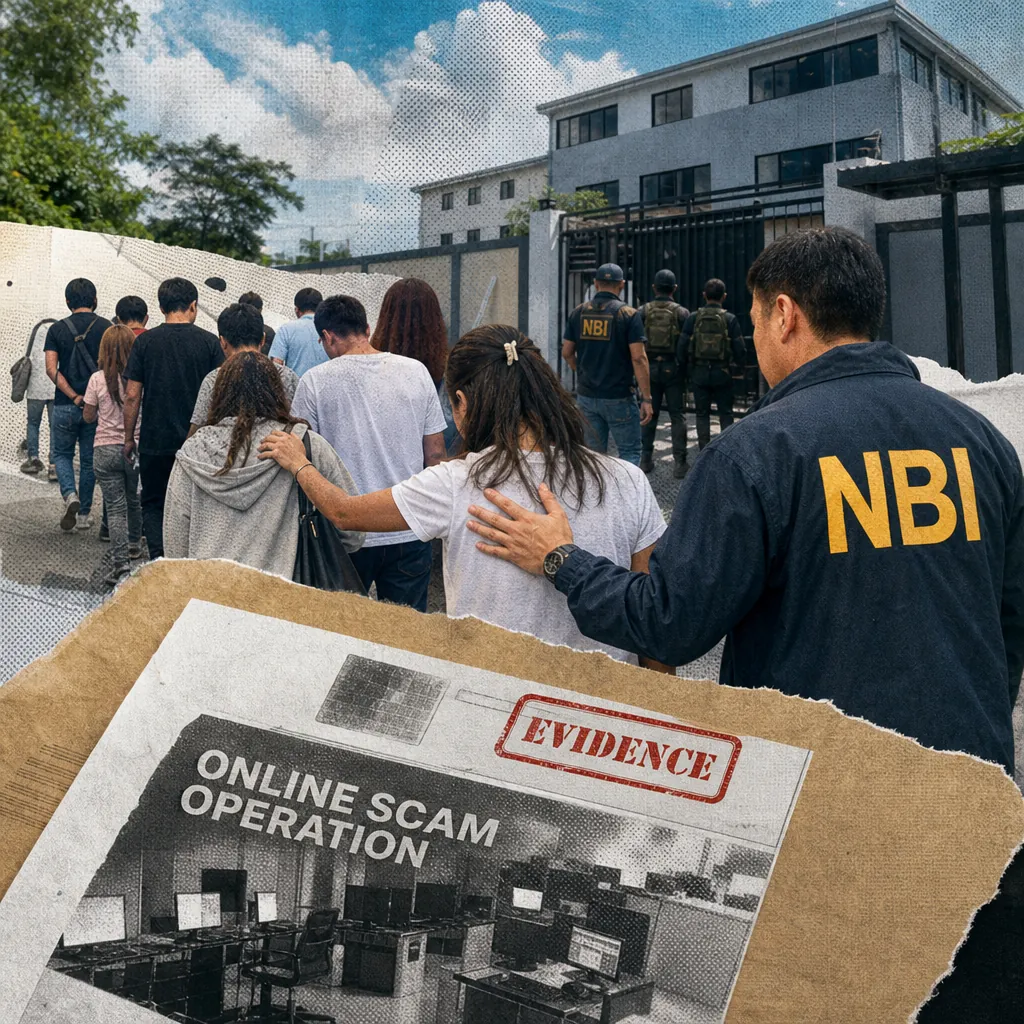
The National Bureau of Investigation (NBI), the country's primary investigative arm under the Department of Justice, rescued 53 trafficking victims and arrested nine suspects in raids on two alleged scam compounds in Zamboanga Sibugay, the agency reported on October 8.1 The operations, carried out in the towns of Alicia and Siay, targeted hubs specializing in love and investment scams that preyed on foreigners, according to the NBI.1 Six Chinese nationals identified as masterminds and a scam leader were arrested, along with three Filipino men who were found in possession of unlicensed firearms.1 Two other Chinese nationals identified as ring leaders remained at large.1
The Bureau of Immigration (BI), the government agency that regulates the entry and stay of foreign nationals, accounted for 255 foreigners at the two sites — 129 in Alicia and 126 in Siay — who are now undergoing vetting against immigration records.1 The NBI identified 52 foreign nationals and one Filipino woman as victims.1 The raids took place at Barangay Tandiong-Muslim in Alicia and the Casa de Coco Pension House in Barangay Kimos, Siay.1 The story ran as a page A-4 news item in the Manila Standard broadsheet, carrying an estimated advertising-equivalent value of ₱107,439.75 — the notional cost of buying the same column space as paid advertising, not a measure of readership.1
That rescue operation was the most consequential development in the day's captured coverage, but it was not the only story. The Department of Transportation (DOTr) launched a third route for its Love Bus service in Davao City, connecting Toril and Roxas Avenue, as part of an effort to extend public transportation outside Metro Manila. American Standard, the plumbing fixtures brand, launched a promotional campaign offering prizes to customers who spend at least ₱10,000 on its products between October 2026 and March 2027. A cybersecurity report from CrowdStrike described a China-based suspect who allegedly used artificial intelligence tools to hack South Korean financial institutions. Toyota Motor Philippines donated ₱3 million to the government's Tamaraw conservation program. And in Manila, police arrested three men posing as traffic and parking enforcement personnel.
Key themes
- NBI rescues 53 trafficking victims in Zamboanga Sibugay scam den raids. Two compounds in Alicia and Siay were raided, yielding nine arrests and the rescue of 52 foreign nationals and one Filipino woman, with two suspected ring leaders still at large.1
- Scam operations targeted foreigners through love and investment fraud. The NBI described the hubs as specializing in romance and investment scams aimed at overseas victims, a pattern that has drawn increasing enforcement attention across Southeast Asia.1
- DOTr expands Love Bus to a third Davao City route. The Toril–Roxas route spans 33.73 kilometers, is served by six buses making six daily trips each, and is expected to carry about 1,860 passengers per day.
- CrowdStrike links AI coding tools to South Korean bank hacks. A 26-year-old suspect in China's Guangdong province allegedly used a Chinese-developed AI agent called ARTEX and Anthropic's ClaudeCode in attacks on South Korean financial institutions from late September to early October.
- Toyota Philippines donates ₱3 million to Tamaraw conservation. The donation goes to the Department of Environment and Natural Resources' Tamaraw Conservation Program, which works to protect the critically endangered Bubalus mindorensis on Mindoro Island.
- American Standard launches a six-month purchase-with-purchase promotion. The Every Moment Matters campaign runs from October 2026 to March 2027, with every ₱10,000 in purchases earning an entry into a prize draw.
- Three men arrested for impersonating Manila traffic and parking personnel. The suspects allegedly demanded parking fees higher than the city's official rates near Rizal Memorial Stadium in Malate, Manila.
How the narratives stack
Dominant: The NBI raid on the Zamboanga Sibugay scam compounds is the day's dominant story in the captured set. It is the only item that combines a large-scale law enforcement action, a significant number of rescued victims, and an international dimension — the targeting of foreign nationals by what the NBI described as love and investment scam operations.1 The story's advertising-equivalent value of ₱107,439.75 places it in the middle of the day's coverage by that measure, but its news consequence — 53 people removed from trafficking situations, nine arrests, and two suspects still at large — is the most significant development reported.1 The Bureau of Immigration's involvement, accounting for 255 foreign nationals across the two sites, adds a layer of regulatory follow-through that most crime stories do not carry.1
Counter-narrative: The CrowdStrike report on AI-assisted cyberattacks against South Korean banks offers a different kind of security story — one that is not about physical raids but about the growing use of artificial intelligence tools by criminal actors. The report, published in BusinessWorld's World Business section with an estimated advertising-equivalent value of ₱319,327.80, describes a suspect who allegedly used a Chinese-developed AI agent called ARTEX and Anthropic's ClaudeCode to target financial institutions. This story does not directly involve the Philippines, but it sits in the same thematic space as the scam den raids: both concern cross-border criminal operations and the difficulty of defending against them. The CrowdStrike item drew the highest coverage value in the captured set, which reflects its placement in a broadsheet's international business pages rather than any measure of audience size.
Emerging: The DOTr's expansion of the Love Bus program to a third Davao City route is a smaller but concrete development in public transportation. The Toril–Roxas route, at 33.73 kilometers with six buses and an expected daily ridership of about 1,860 passengers, is part of a broader effort to extend services beyond Metro Manila. Transportation Secretary Giovanni Lopez framed the launch as a response to President Ferdinand Marcos Jr.'s directive to revive the Love Bus program and bring it to more cities. The story carried an estimated advertising-equivalent value of ₱297,974.16 in the Manila Standard. This is the kind of incremental infrastructure story that rarely dominates a news cycle but matters for residents in the areas it reaches.
Under-covered: Two stories in the captured set received less attention than their subject matter might warrant. Toyota Motor Philippines' ₱3 million donation to the Tamaraw Conservation Program, which supports the protection of the critically endangered Bubalus mindorensis on Mindoro Island, ran as a brief in the Manila Standard's business section with an estimated advertising-equivalent value of ₱167,478.30. And the arrest of three men for impersonating Manila Traffic and Parking Bureau personnel — accused of demanding parking fees higher than the city's official rates near Rizal Memorial Stadium — appeared only in the online outlet Saksi Ngayon, with an estimated advertising-equivalent value of ₱78,597.00. Neither story was actively suppressed; both simply placed low in the day's coverage. The impersonation case is a reminder that small-scale consumer fraud remains a persistent issue in urban areas, even as larger enforcement operations dominate headlines.
Platform insights
The monitoring writeup for this window did not include social media engagement data, so platform-level analysis is not available for this snapshot. The stories captured here ran in broadsheet newspapers and one online news outlet, and their distribution across those mediums reflects the composition of the monitored set rather than a complete picture of where the day's conversation occurred.
Key voices and communities
The NBI and the Bureau of Immigration are the primary institutional voices in the day's dominant story. The NBI led the raids and identified the suspects and victims; the BI accounted for the 255 foreign nationals found at the two sites and is now vetting them against immigration records.1 Their joint involvement signals that the case is being treated as both a criminal matter and an immigration enforcement issue.
The Department of Transportation, through Secretary Giovanni Lopez, is the key voice in the public transportation story. Lopez's statement that "President Marcos asked us to bring back the Love Bus and take it to more cities" frames the Davao route as part of a presidential directive rather than a standalone initiative.
CrowdStrike, the United States-based cybersecurity firm, is the primary source in the cyberattack story. Its report on the South Korean bank hacks provides technical details about the tools allegedly used — ARTEX and ClaudeCode — and identifies the suspect as a 26-year-old based in China's Guangdong province.
Toyota Motor Philippines and the Department of Environment and Natural Resources represent the corporate and government sides of the conservation story. Toyota's foundation donated ₱3 million to the Tamaraw Conservation Program, which operates on Mindoro Island.
Narrative streams
Scam den raids in Zamboanga Sibugay rescue 53 and net nine arrests
The NBI's operations in Alicia and Siay were the result of a composite team effort that targeted two alleged scam compounds operating in the towns.1 The raids took place at Barangay Tandiong-Muslim in Alicia and the Casa de Coco Pension House in Barangay Kimos, Siay.1 The NBI said the hubs specialized in love and investment scams preying on foreigners — a category of fraud that typically involves building romantic relationships or promising financial returns online to extract money from victims abroad.1
The arrests included six Chinese nationals described as masterminds and a scam leader, plus three Filipino men who were found with unlicensed firearms.1 Two other Chinese nationals identified as ring leaders remained at large.1 The Bureau of Immigration accounted for 255 foreign nationals at the two sites — 129 in Alicia and 126 in Siay — who are now undergoing vetting against immigration records.1 The NBI identified 52 foreign nationals and one Filipino woman as victims.1
The scale of the operation — 53 rescued victims, nine arrests, and 255 foreign nationals accounted for — places it among the larger anti-trafficking actions reported in the country in recent months. The presence of unlicensed firearms suggests the compounds were prepared to use force to maintain control, a detail that raises the stakes for the victims involved.1
For the sector, the case underscores that scam operations targeting foreigners remain active in the Philippines and that enforcement agencies are treating them as trafficking cases, not just fraud cases. The involvement of the Bureau of Immigration means the foreign nationals found at the sites will face individual assessment — some may be victims, others may be participants — and that process will determine what happens to them next.1 The two ring leaders still at large are a reminder that these operations often have leadership that extends beyond the physical compound.
CrowdStrike links AI tools to South Korean bank hacks
A report published by CrowdStrike on Wednesday described a campaign targeting South Korean financial institutions from late September to early October, allegedly carried out by a 26-year-old suspect based in China's Guangdong province. The suspect used a Chinese-developed artificial intelligence agent tool called ARTEX and Anthropic's ClaudeCode, according to the report. CrowdStrike said it uncovered personal details linked to the suspected attacker while analyzing AI coding-tool sessions and infrastructure associated with the campaign.
The case is likely to intensify concerns over the rise of AI agents and whether organizations are prepared to defend their systems against them. Australia said last month that an OpenAI autonomous agent breached a government health statistics portal in June, marking one of the first known instances of an AI agent hacking a government system.
The story ran in BusinessWorld's World Business section with an estimated advertising-equivalent value of ₱319,327.80 — the highest in the captured set — reflecting its placement in a broadsheet's international pages rather than any measure of audience size. For Philippine organizations, the report is a signal that AI-assisted attacks are moving from theoretical risk to documented incidents. Financial institutions, which hold sensitive customer data and process large volumes of transactions, are the most immediate targets, but the tools described are not specific to any one sector. The read for the sector is that security teams should be assessing whether their defenses account for AI agents that can automate reconnaissance and exploitation at a speed human attackers cannot match.
DOTr launches third Love Bus route in Davao City
The Department of Transportation launched the third Love Bus route in Davao City, connecting Toril and Roxas Avenue, as part of an effort to expand accessible public transportation outside Metro Manila. The route spans 33.73 kilometers and is served by six Love Bus units, each making six trips daily. It is expected to accommodate an estimated 1,860 passengers per day. Commuters can ride the Love Bus for free during the initial period, according to the report.
Transportation Secretary Giovanni Lopez said the new route forms part of the government's efforts to provide Dabawenyos with safe, reliable, and convenient public transportation. "President Marcos asked us to bring back the Love Bus and take it to more cities," Lopez said. "With the Toril–Roxas route, we are bringing the Love Bus closer to the communities."
The Love Bus program is a government bus service that was revived under the current administration and is being extended to cities outside the capital region. The Davao route is the third such launch, following earlier routes in other cities. The story carried an estimated advertising-equivalent value of ₱297,974.16 in the Manila Standard.
For residents along the Toril–Roxas corridor, the route adds a free transportation option that connects a residential area to a commercial district. The expected daily ridership of 1,860 passengers is modest relative to Metro Manila's bus volumes, but it represents a meaningful addition to Davao City's public transport network. The read for the sector is that the government is testing whether the Love Bus model can work outside the capital, and the ridership figures from this route will inform whether further expansions are justified.
Toyota donates ₱3 million to Tamaraw conservation
Toyota Motor Philippines Corp., through its social and humanitarian arm Toyota Motor Philippines Foundation, donated ₱3 million to the Department of Environment and Natural Resources' Tamaraw Conservation Program. The program supports the continued conservation and protection of the critically endangered Tamaraw (Bubalus mindorensis) on Mindoro Island.
The Tamaraw is a small buffalo species found only in the Philippines, and its population has been reduced to a few hundred individuals. The conservation program is the government's primary effort to prevent the species' extinction. The donation ran as a brief in the Manila Standard's business section with an estimated advertising-equivalent value of ₱167,478.30.
For the sector, the donation is a reminder that corporate social responsibility spending in the Philippines often flows to environmental causes with direct ties to national identity. The Tamaraw is a symbol of Philippine wildlife, and Toyota's contribution — while modest relative to the company's overall marketing budget — provides funding for a program that depends on a mix of government and private support. The read for the sector is that conservation funding remains reliant on corporate donors, and the visibility of such donations in business pages serves as both a public relations exercise and a genuine funding mechanism.
American Standard launches Every Moment Matters campaign
American Standard, the plumbing fixtures brand, launched the Every Moment Matters campaign, offering customers a chance to win prizes through purchases made between October 2026 and March 2027. Every ₱10,000 worth of American Standard products entitles customers to an entry in the prize draw. The campaign is built around three themes: Every Shower Matters, which highlights shower solutions like the EasySet Auto Temperature Mixer and Acacia Supasleek Shower Fittings; Every Detail Matters, which focuses on hygiene technologies in the E-lite shower toilet and Smart Washer M-bidet; and Every Space Matters, which showcases space-saving products like the Maxfit Collection, DuoStix Hand Shower, and DuoStix Hygiene Spray.
The campaign ran in BusinessWorld's bulletins section with an estimated advertising-equivalent value of ₱159,799.20. For the sector, the promotion is a standard example of a purchase-with-purchase campaign designed to drive sales during a six-month window. The prize structure — aspirational items like a Ford Terri — is intended to encourage larger basket sizes, since the ₱10,000 threshold is high enough to require multiple product purchases. The read for the sector is that home improvement brands are competing for consumer attention through experiential rewards rather than simple discounts, a strategy that can build brand loyalty but depends on sustained marketing spend.
Three arrested for impersonating Manila traffic and parking personnel
Three men were arrested for posing as personnel of the Manila Traffic and Parking Bureau (MTPB) and demanding parking fees higher than the rates set by the city government. The arrests took place in front of Rizal Memorial Stadium along Adriatico Street in Barangay 720, Zone 78, Malate, Manila. The suspects — Roel Grayda, 37; Emerson Adonis, 26; and Jervin Cordial, 23 — face charges of usurpation of authority or official functions under Article 177 of the Revised Penal Code.
According to a report by PMSG Oscar Vargas Jr., investigator of the Special Mayors Reaction Team (S.Ma.R.T), the arrests followed a complaint received through the Bilis Kilos Action Center-Citizens Complaint Hotline of the City Development Information Service. The complainants reported that the suspects identified themselves as MTPB personnel and demanded additional parking fees higher than those implemented by the local government unit. The story appeared in the online outlet Saksi Ngayon with an estimated advertising-equivalent value of ₱78,597.00.
For the sector, the case illustrates a persistent problem in urban areas: individuals impersonating government enforcement personnel to extract money from motorists. The MTPB is the city agency responsible for traffic management and parking enforcement in Manila, and its personnel are authorized to collect specific fees. When impostors demand higher amounts, they not only defraud motorists but also undermine public trust in the agency's legitimate operations. The read for the sector is that local governments need clear reporting channels — like the Bilis Kilos hotline used in this case — to catch impersonation quickly, and that public awareness of official fee schedules is a first line of defense.
Conversation trajectory
Over the next 1–2 weeks: The NBI is likely to release further details on the Zamboanga Sibugay case, including the status of the two ring leaders still at large and the outcome of the Bureau of Immigration's vetting of the 255 foreign nationals.1 Watch for whether the BI files charges against any of the foreign nationals or classifies them as victims eligible for repatriation. The case may also prompt statements from the Department of Justice or the Inter-Agency Council Against Trafficking, which coordinates the government's anti-trafficking efforts.
Over the next 2–4 weeks: The CrowdStrike report on AI-assisted attacks against South Korean banks may prompt responses from Philippine financial regulators, particularly the Bangko Sentral ng Pilipinas (the central bank) and the Securities and Exchange Commission, which oversee different parts of the financial sector. Watch for advisories or guidance on AI-related cybersecurity risks. The report's mention of Anthropic's ClaudeCode and the Chinese-developed ARTEX tool may also draw attention from the Department of Information and Communications Technology, which handles national cybersecurity policy.
Over the next 1–3 months: The Love Bus route in Davao City will begin generating ridership data, which the DOTr is likely to use to assess whether the model can be extended to other cities. Watch for announcements about additional routes or adjustments to the Toril–Roxas service based on actual passenger numbers. The free ride period may also be extended or ended, depending on the government's budget for the program.
Trigger events to watch: A court filing or preliminary investigation in the Zamboanga Sibugay case would signal that prosecutors are moving forward with charges against the nine arrested suspects.1 A statement from the Bangko Sentral ng Pilipinas or the Department of Information and Communications Technology on AI cybersecurity would indicate that the CrowdStrike report has prompted a policy response. An announcement from the DOTr on Love Bus expansion to a fourth city would show that the program is continuing to scale.
Response guidance
For financial institutions and cybersecurity teams: Review whether your defenses account for AI agents that can automate reconnaissance and exploitation. The CrowdStrike report describes tools that are publicly available or recently released, which means the barrier to entry for attackers is lower than it was a year ago. Prioritize monitoring for unusual coding-tool sessions and infrastructure patterns, and ensure that incident response plans include scenarios where the attacker is using AI to accelerate the attack cycle.
For local government units and traffic enforcement agencies: Publicize official fee schedules for parking and other services through multiple channels, including social media and physical signage at common parking areas. The Manila impersonation case shows that motorists can be defrauded when they do not know the correct rates. Ensure that complaint hotlines like the Bilis Kilos Action Center are staffed and responsive, and that reports of impersonation are acted on quickly.
For transportation agencies and local governments outside Metro Manila: The Love Bus expansion to Davao City provides a template for extending public transportation services to regional cities. Collect and publish ridership data from new routes to build the case for further investment. Communicate clearly with residents about route schedules, stops, and any fare changes after the initial free period.
For companies running consumer promotions: The American Standard campaign illustrates the use of aspirational prizes to drive purchase volume over a six-month window. Ensure that the mechanics of such promotions — spending thresholds, entry methods, prize fulfillment — are clearly disclosed to avoid consumer complaints. Consider whether the promotion's duration aligns with seasonal shopping patterns.
For conservation organizations and corporate donors: The Toyota donation to the Tamaraw Conservation Program highlights the role of private funding in protecting endangered species. Organizations seeking corporate support should be prepared to provide clear reporting on how funds are used and what conservation outcomes are achieved, as donors increasingly expect measurable results.
For anti-trafficking agencies and international partners: The Zamboanga Sibugay case involves foreign nationals as both victims and suspects, which means coordination with embassies and international organizations will be necessary.1 Ensure that victim identification processes are thorough and that those classified as victims receive appropriate support, including repatriation assistance if they wish to return home.
See the full picture behind today's signals.
This report draws from Media Meter's MediaWatch, our real-time monitoring engine tracking 2,470+ Philippine sources across print, broadcast, digital, and social. Explore how the platform turns raw coverage into decision-grade intelligence, then see how it's configured for teams like yours — whether you're in PR agencies, corporate comms, government, or marketing.
Want more? Browse our Report Library for sector and crisis intelligence, or request a demo and we'll have your brand set up before the call.
Want this kind of intelligence on your brand?
This brief is built on the same MediaWatch methodology that runs continuously across every brand we monitor. See your competitive landscape, Impact Score, and narrative trajectory in a 30-minute demo.