Fuel Prices Rise 15 Sen; LTFRB Opens TNVS Regularization
Malaysia's RON97 and unsubsidised RON95 climb 15 sen per litre for Oct 8-14 as Brent holds near US$100, while the Philippines' LTFRB opens a 30-day window to legalise 'tempo' ride-hailing units and drivers press for fare and commission transparency.
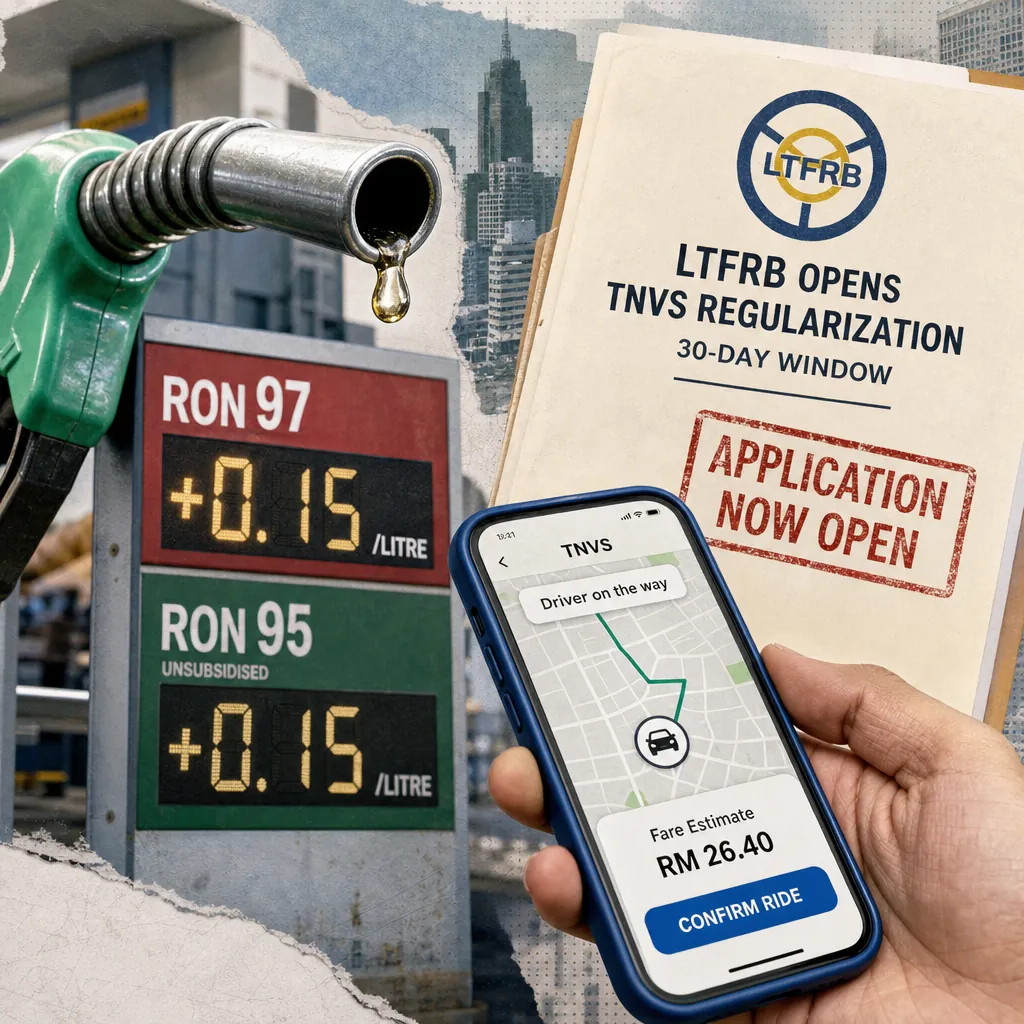
Malaysia's Ministry of Finance set the week's fuel prices on Wednesday, raising RON97 to RM5.15 per litre and unsubsidised RON95 to RM4.67, both up 15 sen, while unsubsidised diesel held at RM5.27 for the October 8 to 14 period 2. The ministry attributed the increase to pressure on refined petroleum product supply after China suspended most fuel exports for October, even as crude flows from West Asia recovered gradually; Brent crude hovered around US$100 per barrel through the Automatic Pricing Mechanism calculation period 2. The same day, the Land Transportation Franchising and Regulatory Board (LTFRB) began a 30-day program to regularise transport network vehicle service (TNVS) units in Metro Manila that transport network companies (TNCs) had onboarded before securing the required franchise authority, a practice the agency calls "tempo" 2635. Drivers used a Wednesday LTFRB hearing to dispute how a P15-per-kilometre pickup fare is being applied and to demand clearer accounting of commissions deducted from their earnings 2138.
The two stories are separate but connected by the same underlying pressure: the cost of moving people and goods. In Malaysia, the fuel adjustment is a direct pass-through of international refined-product prices to consumers at the pump. In the Philippines, the [ride-hailing dispute](https://media-meter.com/report-library/ltfrb-summons-19-ride-hailing-firms-over-unpaid-fare-hike "Ltfrb summons 19 ride hailing firms over unpaid fare hike") is about who absorbs cost inside the fare — the driver, who pays for fuel, time and vehicle wear before a trip begins, or the platform, which sets the commission. TNVS Community Philippines (TCP) chairman Walter Lugay Uy told the hearing that the prescribed pickup fare had not been carried out as intended: rather than computing the pickup component at P15 for every kilometre travelled to reach a passenger, the amount reflected for drivers was effectively fixed at P15 regardless of actual pickup distance 21. "If the rate is set at P15 per kilometre," Uy said, the computation should follow the distance 21.
Away from the fare tables, the day's transport and enforcement news ran through road safety and regulatory follow-through. The Land Transportation Office (LTO) summoned a motorcycle rider and suspended his licence for 90 days over a hit-and-run in Antipolo City involving the vehicle of television host Cianne Dominguez, with a show-cause order requiring the registered owner and rider to appear on 9 October 2336. In Surigao City, two 17-year-old boys died and a third teenager was injured when their motorcycle crashed into a parked fuel tanker before dawn 18. In Cainta, Rizal, an 18-year-old college student died after losing control of his motorcycle and hitting his head on the pavement 40. The Metropolitan Manila Development Authority (MMDA) said General Manager Nicholas Torre III extended his leave until 15 October, following a controversy over an MMDA-marked patrol vehicle 30. Manila, Muntinlupa, Quezon City and San Juan resumed the No Contact Apprehension Policy (NCAP) on 5 October, while Valenzuela and Parañaque deferred implementation 32.
Key themes
- Malaysia raises RON97 and unsubsidised RON95 by 15 sen per litre for Oct 8-14. RON97 moves to RM5.15 and unsubsidised RON95 to RM4.67, while unsubsidised diesel stays at RM5.27; the Finance Ministry cited China's suspension of most October fuel exports and Brent crude near US$100 per barrel 2.
- The LTFRB opens a 30-day window to legalise 'tempo' TNVS units in Metro Manila. Memorandum Circular No. 2026-111 covers units onboarded by TNCs before obtaining franchise authority, with applications processed online through the LTFRB portal 2635.
- Ride-hailing drivers dispute how the P15-per-kilometre pickup fare is applied. TCP's Walter Lugay Uy said drivers receive a flat P15 regardless of pickup distance, and asked the LTFRB for clearer commission and deduction accounting 2138.
- The LTO suspends a rider's licence for 90 days over an Antipolo hit-and-run. The show-cause order names reckless driving and failure to perform a driver's statutory duty after an accident, with the rider and vehicle owner due at the LTO on 9 October 2336.
- Three separate motorcycle crashes left three teenagers dead and one injured. Two 17-year-olds died in Surigao City after hitting a parked fuel tanker; an 18-year-old student died in Cainta, Rizal 1840.
- Four Metro Manila cities resumed camera-based traffic enforcement on 5 October. Manila, Muntinlupa, Quezon City and San Juan restarted NCAP; Valenzuela and Parañaque deferred, and the MMDA said local and MMDA cameras are sited separately to avoid double penalties 32.
- The MMDA general manager extended his leave to 15 October. Nicholas Torre III, a presidential appointee, filed a month-long leave after a controversy over an MMDA-marked patrol vehicle; the LTO sanctioned his driver, and the MMDA said it lacked disciplinary authority over the general manager 30.
- The DILG turned over 130 Unified 911 emergency response motorcycles to Calabarzon police stations. Interior Secretary Jonvic Remulla and PNP chief Gen. Jose Melencio Nartatez Jr. led the turnover in Calamba City, Laguna 34.
How the narratives stack
Dominant. The fuel price adjustment and the LTFRB's twin moves — the regularization window and the fare hearing — carried the day's transport news. The fuel story is a scheduled weekly announcement with immediate consumer effect: RON97 and unsubsidised RON95 both rose 15 sen per litre, and the ministry tied the increase to refined-product supply pressure after China's export suspension 2. The LTFRB story is regulatory and procedural but affects a large workforce: the 30-day regularization program under Memorandum Circular No. 2026-111 gives TNVS operators a defined window to obtain franchise authority, and the hearing surfaced a concrete dispute over the pickup fare computation 263521. Within the items captured here, these two threads account for the bulk of the transport coverage, though the monitoring set is a selection and not a full record of the day's output.
Counter-narrative. The road-safety stories cut against the regulatory framing. While agencies discussed fares and franchises, three separate crashes killed three teenagers and injured one, and the LTO moved against a rider in a hit-and-run involving a television host 18402336. These items frame the same road network as a site of immediate physical risk rather than a market to be priced and regularised. The NCAP editorial in Philstar's Pilipino Star Ngayon made the enforcement angle explicit: camera-based apprehension reduces direct enforcer-driver interaction and the opportunity for bribery or roadside negotiation, but the process after a citation must be clear and fair, and the online protest mechanism must be usable in practice, not just on paper 32.
Emerging. The regularization program is the newest element and its effects are not yet observable. The application period runs 30 calendar days from 8 October, and applications may be filed by individual TNVS operators or by accredited TNCs on behalf of eligible drivers 35. Whether the program brings a large share of tempo units into compliance, or whether operators and platforms treat it as a formality, will only be visible after the window closes. The fare and commission dispute is similarly unresolved: one TNC told the hearing it had implemented the LTFRB fare adjustment, including the P15-per-kilometre pickup fare, while TCP contested that claim 2138.
Under-covered. The DILG's turnover of 130 Unified 911 emergency response motorcycles to Calabarzon police stations drew a single item in the captured set, despite being a direct investment in response speed 34. The MMDA general manager's extended leave also placed low relative to the fare and fuel stories, even though it concerns the leadership of the agency that runs Metro Manila traffic enforcement and co-manages NCAP 30.
Platform insights
- Facebook. The fuel price announcement and the LTFRB regularization story are the kind of service news that spreads through shares and comments rather than original posts, with drivers and commuters likely to repost the price table and the application deadline. The captured set does not include engagement figures for these items, so the scale of response cannot be stated.
- X. The fare hearing and the LTO's 90-day licence suspension are the most quotable items — a specific peso figure and a specific penalty — and are the most likely to circulate as short posts with screenshots of the LTFRB memorandum and the show-cause order 2123.
- Reddit. Threads on Philippine commuting and ride-hailing typically focus on driver earnings and passenger wait times; the pickup-fare dispute gives that audience a concrete number to argue over, and the regularization deadline gives operators a practical question to ask 2638.
- YouTube. Local news channels and motoring vloggers are the likely carriers of explainer content on the fuel adjustment and the NCAP restart, since both require walking viewers through a table or a map of covered cities 232.
Key voices and communities
- TNVS Community Philippines (TCP). The driver group's chairman, Walter Lugay Uy, framed the fare issue as a computation problem rather than a rate problem, arguing that a flat P15 pickup component does not cover the fuel, time and vehicle use a driver spends before the trip starts 2138. TCP also asked the LTFRB for a clearer explanation of how TNCs calculate commissions and other deductions 38.
- The LTFRB. Acting chairman Greg Pua Jr. announced the 30-day application period and said applications would be processed online through the agency's digital platform or a designated portal 35. The board is the arbiter between drivers and platforms on fares and franchises.
- Transport network companies (TNCs). One TNC told the hearing it had complied with the fare adjustment, including the pickup fare, while a major industry player maintained it had already implemented the required pickup fare — a claim TCP disputed 21.
- The LTO. The agency's Intelligence and Investigation Division issued the show-cause order in the Antipolo case and suspended the rider's licence for 90 days, citing reckless driving and failure to perform a driver's statutory duty after an accident 2336.
- The DILG and PNP. Interior Secretary Jonvic Remulla and PNP chief Gen. Jose Melencio Nartatez Jr. led the turnover of 130 Unified 911 motorcycles in Calamba City, Laguna, positioning faster police response as the goal 34.
Narrative streams
Fuel prices rise 15 sen as refined-product supply tightens
The Ministry of Finance's weekly price announcement raised RON97 to RM5.15 per litre and unsubsidised RON95 to RM4.67, both up 15 sen, while unsubsidised diesel stayed at RM5.27 for October 8 to 14 2. The ministry said the increase was driven by pressure on refined petroleum product supply in the international market despite the gradual recovery of crude oil flows from West Asia, and that Brent crude continued to hover around US$100 per barrel throughout the Automatic Pricing Mechanism calculation period 2. The mechanism is the formula Malaysia uses to set retail fuel prices weekly based on international crude and product prices, so the announcement is a direct translation of global markets into the pump price. The ministry pointed to China's suspension of most fuel exports for October as the factor now concentrating price pressure on refined products rather than crude 2. For Malaysian motorists, the immediate effect is a 15-sen increase on the two grades that moved; for diesel users, the unchanged price offers no relief but no further increase this week. The read for the sector is that fuel retailers and transport operators should expect continued week-to-week volatility tied to refined-product supply, not crude alone, and that any operator with thin margins — hauliers, delivery fleets, bus and taxi operators — faces input costs that can move on a seven-day cycle.
LTFRB opens 30-day regularization for 'tempo' TNVS units
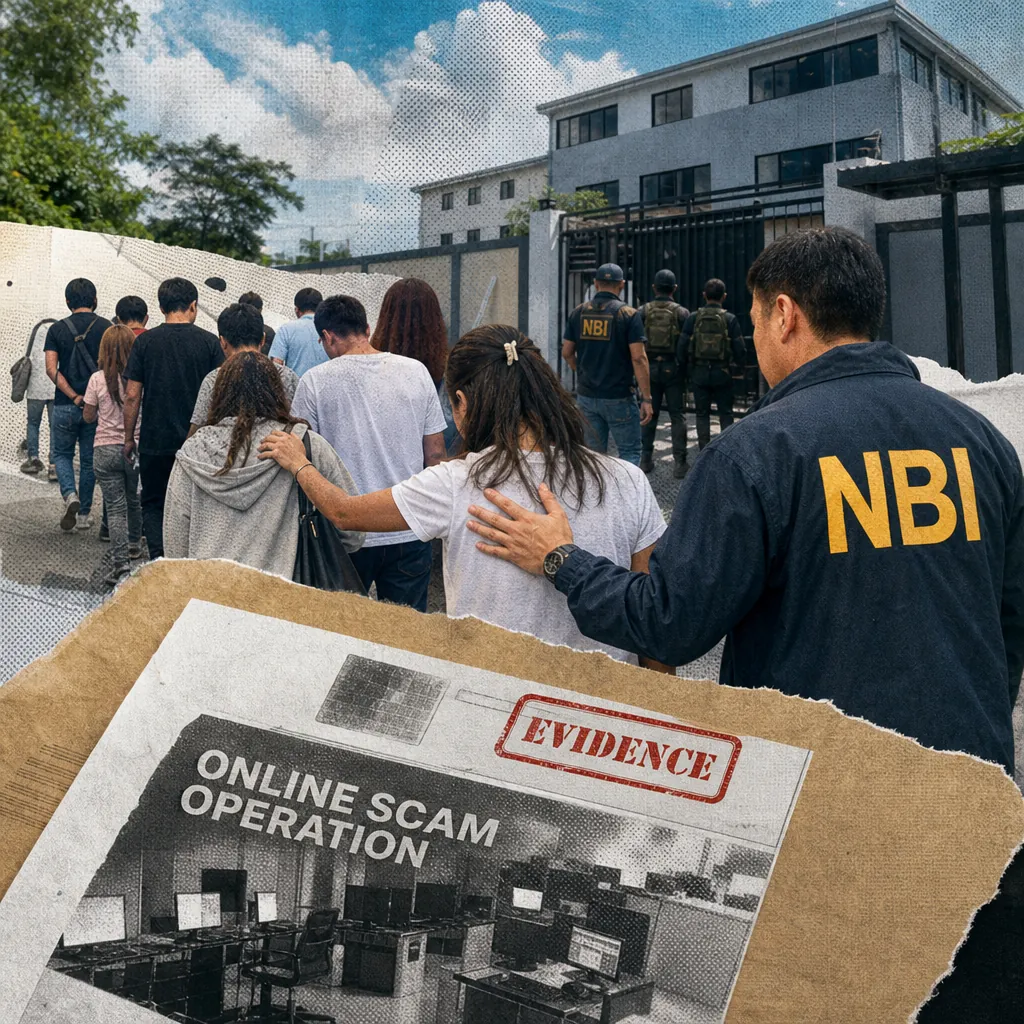
The LTFRB began on 8 October a 30-day program to regularise TNVS units in Metro Manila that TNCs had onboarded before the units obtained the required authority from the agency 2635. The practice, known as "tempo," violates LTFRB rules because it lets TNVS units offer transport services to commuters without a valid franchise 35. The program was issued under Memorandum Circular No. 2026-111, pursuant to a directive from Transportation Secretary Giovanni Lopez, and covers units operating under the Metro Manila Urban Transportation Integration Study Update and Capacity Enhancement Program that appear in the validated masterlist submitted by TNCs 26. Acting chairman Greg Pua Jr. said applications would be processed online through the official LTFRB digital platform or another designated portal, and may be filed by individual TNVS operators or by accredited TNCs through authorised representatives on behalf of eligible drivers 35. The read for the sector is that platforms and operators now have a fixed deadline to convert informal onboarding into legal franchises; those that miss it risk operating outside the rules, while those that comply gain a clearer legal footing and, potentially, access to the formal fare structure. The program also shifts work onto the LTFRB's digital processing capacity, which will be tested by the volume of applications in a 30-day window.
Drivers contest the pickup fare and commission deductions
At the LTFRB hearing on Wednesday, TCP chairman Walter Lugay Uy contested a TNC's assertion that it had implemented the prescribed P15-per-kilometre pickup fare 21. Uy said the amount reflected for drivers was effectively fixed at P15 regardless of the actual pickup distance, so a driver who travels far to reach a passenger is not compensated proportionally 21. He argued the pickup fare should be based on each kilometre travelled because the driver already incurs fuel, time and vehicle-use costs before the actual trip begins 38. TCP also asked the LTFRB for a clearer explanation of how TNCs calculate commissions and other deductions, so drivers can see what they actually take home 38. One TNC committed during the hearing to comply with the fare adjustment ordered by the LTFRB, while a major industry player maintained it had already implemented the required pickup fare 21. The read for the sector is that the fare formula's implementation, not just its headline rate, is now the point of contention; drivers are asking regulators to audit how platforms compute and display the pickup component and deductions, and platforms that cannot show a distance-based computation face continued disputes at future hearings.
LTO suspends rider's licence over Antipolo hit-and-run
The LTO summoned a motorcycle rider and suspended his licence for 90 days following a hit-and-run in Antipolo City involving the vehicle of television host Cianne Dominguez 2336. Dominguez, a host on the noontime program "It's Showtime," asked the agency to identify the motorist and initiate formal administrative proceedings 23. The LTO's Intelligence and Investigation Division issued a show-cause order directing both the registered motorcycle owner and the rider to appear at the agency's headquarters on 9 October 2026 to submit sworn affidavits and supporting documents 23. The order cites potential administrative charges for reckless driving and failure to perform a driver's statutory duty in the event of an accident, and notes the vehicle owner may also face liability for allowing an unauthorised individual to operate the vehicle 23. The read for the sector is that the case tests how quickly the LTO can act on a complaint when the complainant is a public figure; the 90-day suspension is a pre-hearing measure, and the 9 October appearance will determine whether administrative charges proceed. For vehicle owners, the case is a reminder that liability can extend to the registered owner when the driver is not authorised.
Three motorcycle crashes kill three teenagers in two days
Two 17-year-old boys died and a third teenager was injured early Wednesday when their motorcycle crashed into a parked fuel tanker on the national highway in Barangay Luna, Surigao City 18. Lt. Col. Mariano Lukban, chief of the Surigao Component City Police Station, said the accident happened past 4:40 a.m. in front of the Ford Surigao showroom, and that the victims were believed to be under the influence of alcohol 18. In a separate incident, an 18-year-old college student died after losing control of his motorcycle and hitting his head on the pavement in Cainta, Rizal, on Tuesday; CCTV footage showed him travelling along Ortigas Avenue Extension toward Pasig City before the crash 40. The read for the sector is that enforcement and infrastructure responses — NCAP cameras, licence suspensions, emergency response motorcycles — address violations and response times, but the crashes in this set point to risk factors that camera enforcement does not reach: alcohol, helmet use, and the vulnerability of young riders on national highways and urban arterials.
Metro Manila cities restart camera-based traffic enforcement
Manila, Muntinlupa, Quezon City and San Juan resumed the No Contact Apprehension Policy on Monday, 5 October, under which cameras capture traffic violations and notices and fines are sent to vehicle owners 32. Valenzuela and Parañaque deferred implementation 32. The policy is designed to reduce direct interaction between enforcers and drivers, which also reduces opportunities for bribery or roadside negotiation 32. The MMDA said there would be no double penalties because local government and MMDA cameras are sited separately, and that an online protest mechanism exists for drivers to contest citations 32. The editorial noted that these safeguards are good but must be easy to use in practice, not just written into guidelines 32. The read for the sector is that the policy's credibility depends on the back end: if drivers cannot easily contest a citation or if camera locations overlap in practice, the program will generate the same disputes it was meant to avoid. Fleet operators and delivery companies should expect citation notices to arrive by mail and should build a process for contesting them within the protest window.
MMDA general manager extends leave amid patrol vehicle controversy
MMDA General Manager Nicholas Torre III extended his leave until 15 October, according to Chairman Romando Artes Jr., after filing a month-long leave following a controversy involving an MMDA-marked patrol vehicle 30. Artes said Torre extended the leave for 15 days to attend his mother-in-law's funeral and would return to the office on 16 October 30. Torre had earlier floated the idea of early retirement 30. The LTO imposed sanctions against Torre's driver, while the MMDA said it did not impose a separate sanction against Torre because it lacked disciplinary authority over the general manager, who is a presidential appointee 30. The read for the sector is that the episode highlights a structural gap: the MMDA can sanction rank-and-file personnel but not its own general manager, so accountability for a presidential appointee rests outside the agency. For the agency's traffic enforcement programs, including NCAP coordination, the leadership question remains open until Torre returns or a replacement is named.
DILG turns over 130 emergency response motorcycles to Calabarzon
The Department of the Interior and Local Government (DILG) distributed 130 Unified 911 Emergency Response motorcycles to police stations across the Calabarzon region in a turnover ceremony at the Police Regional Office 4A command in Calamba City, Laguna 34. Interior Secretary Jonvic Remulla and PNP chief Gen. Jose Melencio Nartatez Jr. led the event, which was also attended by DILG 4A regional director Ariel Iglesia and Napolcom-Calabarzon officials 34. The stated purpose is faster police response 34. The read for the sector is that the motorcycles are a direct investment in response time for a region that includes the southern Metro Manila fringe and the Calabarzon industrial corridor; whether they shorten response times will depend on deployment and maintenance, which the announcement did not detail.
Conversation trajectory
Fuel prices (next 1-2 weeks). The next weekly price announcement, expected around 14-15 October, will show whether the 15-sen increase holds or reverses. The key variable is refined-product supply: if China's October export suspension continues through the month, pressure on refined products is likely to persist even if crude flows from West Asia keep recovering 2. Watch for any change in the diesel price, which held this week.
LTFRB regularization (next 30 days). The application window closes roughly 30 calendar days from 8 October. The observable signals will be the volume of applications filed and whether TNCs file on behalf of drivers or leave operators to file individually 35. If the volume is low, the program will not substantially reduce the number of tempo units; if it is high, the LTFRB's digital processing capacity will be the constraint.
Fare and commission dispute (next hearing). The LTFRB has not announced a resolution. The next scheduled hearing or any board order on the pickup fare computation and commission disclosure will be the trigger to watch; TCP's request for clearer deduction accounting is the specific ask on the table 38.
Antipolo hit-and-run (9 October). The rider and vehicle owner are due at the LTO Intelligence and Investigation Division on 9 October to submit sworn affidavits 23. Whether administrative charges are filed after that appearance will indicate how the agency handles complaints involving public figures.
NCAP (next few weeks). Valenzuela and Parañaque have deferred implementation; their decisions on whether to join Manila, Muntinlupa, Quezon City and San Juan will shape how uniform the policy is across Metro Manila 32. The usability of the online protest mechanism will be tested as the first citations are issued.
MMDA leadership (16 October). Torre is scheduled to return to the office on 16 October 30. Whether he returns, retires early, or is replaced will determine the agency's leadership through the rest of the year.
Response guidance
For fuel retailers and transport operators: prepare for week-to-week price movement tied to refined-product supply, not just crude. Communicate price changes to fleet customers with the specific grades and dates, and avoid framing any single week's adjustment as a trend.
For TNVS operators and drivers: treat the 30-day regularization window as a hard deadline. File through the LTFRB digital platform or a designated portal, and keep proof of filing. Operators filing individually should confirm whether their TNC will file on their behalf to avoid duplicate or missed applications 35.
For ride-hailing platforms: the fare dispute is now about computation transparency. Publish how the pickup component is calculated per kilometre and how commissions and deductions are applied, in language drivers can check against their own trip records. A platform that can show a distance-based computation has a stronger position at the next hearing than one that asserts compliance without detail 2138.
For road-safety communicators: the three fatal motorcycle crashes in this set point to alcohol, helmet use and young riders, which camera enforcement does not address. Coordinate with local police and schools on rider-safety messaging in Surigao, Cainta and comparable corridors, and avoid implying that NCAP alone will reduce fatalities 1840.
For fleet and delivery companies: build a process for handling NCAP citations, including a designated person to monitor mailed notices and file online protests within the window. Confirm camera coverage in the cities where your vehicles operate, and note that Valenzuela and Parañaque have deferred implementation 32.
For vehicle owners: the Antipolo case shows that liability can extend to the registered owner when the driver is not authorised. Keep records of who operates your vehicle and ensure authorised drivers are documented 23.
For local government units in Calabarzon: the 130 new Unified 911 motorcycles will only shorten response times if deployment and maintenance are planned. Publish which stations received units and how they will be used 34.
See the full picture behind today's signals.
This report draws from Media Meter's MediaWatch, our real-time monitoring engine tracking 2,470+ Philippine sources across print, broadcast, digital, and social. Explore how the platform turns raw coverage into decision-grade intelligence, then see how it's configured for teams like yours — whether you're in PR agencies, corporate comms, government, or marketing.
Want more? Browse our Report Library for sector and crisis intelligence, or request a demo and we'll have your brand set up before the call.
Want this kind of intelligence on your brand?
This brief is built on the same MediaWatch methodology that runs continuously across every brand we monitor. See your competitive landscape, Impact Score, and narrative trajectory in a 30-minute demo.