AI Visibility Reporting When the Number and Tool Disagree
AI visibility reporting broke twice in one week: the number and the instrument. What a Philippine comms team should ask before signing the next renewal.

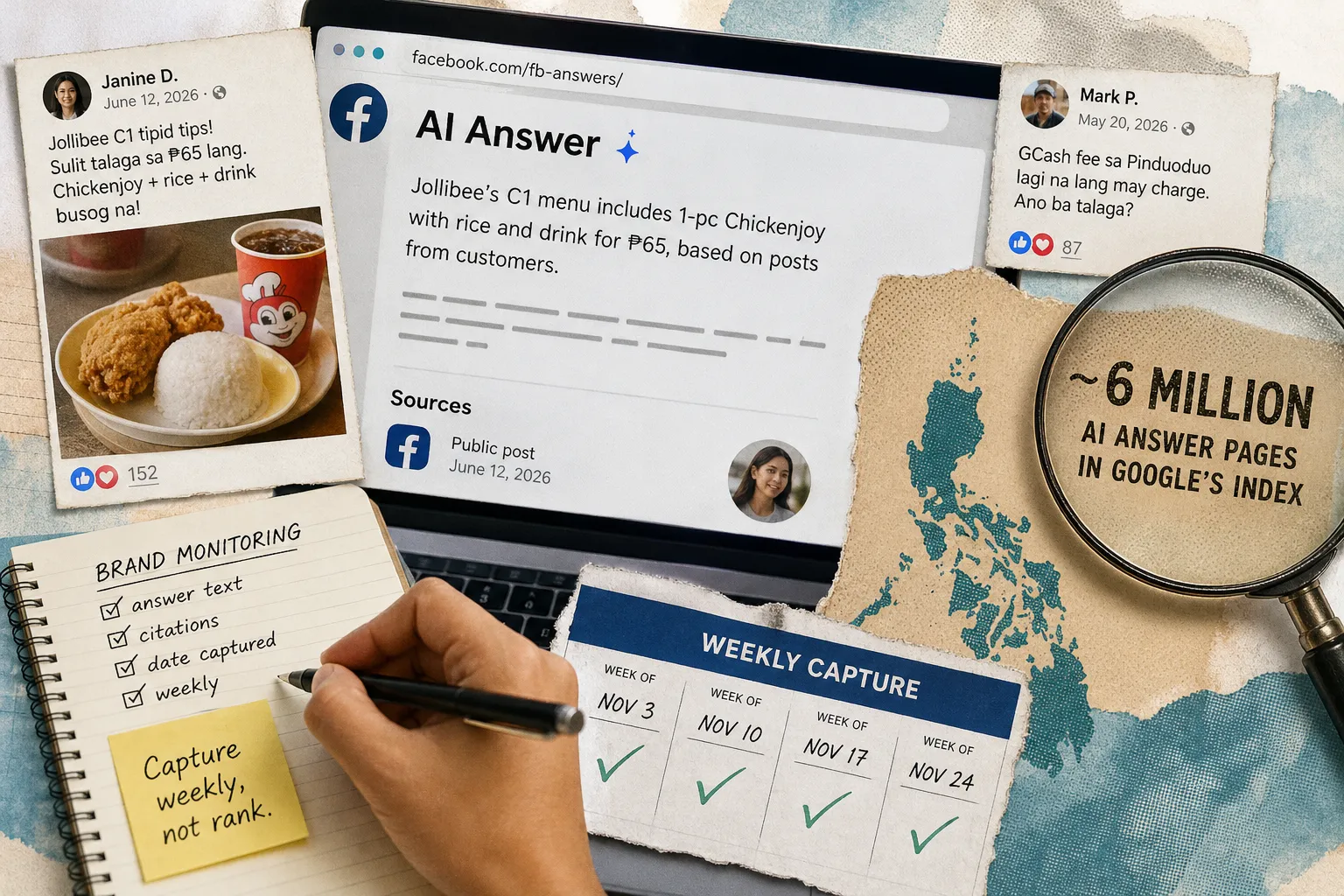
AI visibility reporting lost two foundations in the same week. The figures brands cite for AI exposure come from small vendor panels that disagree with one another, and Google Search Console began showing click spikes that practitioners traced to automated activity rather than readers. For a Philippine communications team, the defensible response is to name the unit in the contract and hold the measurement record outside the platform being measured.
Ask a Philippine comms team what it wants to know about AI search and the question arrives in one line: how visible are we? That line is the wrong question this quarter. In the first week of November, two of the things AI visibility reporting rests on went into dispute at once, and neither dispute is about optimisation. What the number counts is contested. So is whether the instrument producing it can be trusted.
Which makes the better question narrower. What does this count, who produced the count, and where is the record you hold yourself? Measurement that survives a CFO has to sit outside the platform it measures, and for this market the honest position is that the Philippine ratio is unmeasured rather than inferable from US, UK and Canadian panels.
Three Studies, Three Different Answers About the Same Traffic
The case against AI as a traffic channel is now three studies deep, and each came out of a different agency's client list. Marie Haynes put ChatGPT sessions at 0.62% of Google-organic-driven volume in her own sample. The SEO Works found organic delivering 39 times more traffic than AI assistants. Kevin Indig could not establish a reliable connection between AI visibility and subsequent branded search or direct traffic. The reframe in Search Engine Land's account of all three is the part to keep: the data challenges the promise that AI platforms become the next great traffic source, and it settles nothing about whether appearing on them carries brand value. Three agency client panels of unstated size and market, from three publishers that sell SEO services.
The Philippines has its own version of that contradiction, and it lands harder because both lines are local. Truelogic's 12-month study of 80 Philippine brands across seven sectors found mentions of those brands in Google AI Overviews rose more than 23-fold in 2025, while organic branded traffic across the same 80 websites fell between 3% and 8%, as adobo Magazine reported. The study did not establish cause and effect. The two lines simply moved in opposite directions. Truelogic sells the service it measured, and the sample is its own tracked set.
None of which makes Filipinos light users of assistants. Among surveyed Filipino internet users aged 16 and over, 42.4% said they had used ChatGPT in the previous month, sixth highest of any country, in Digital 2026 figures reported by GMA News. Read those as vendor research: self-reported answers from GWI's internet-user panel, published by Meltwater and We Are Social, one of them a direct Media Meter competitor. What nobody holds is the Philippine ratio. This market's flagship annual digital report shipped on 21 October with no comparable national figure for users of standalone generative-AI platforms, as The Manila Times reported, and its brand-discovery line is global: online adults were 74% more likely to say they used search engines than AI platforms when researching brands.
The instrument differs locally too. One tracking sample puts Gemini at 32.51% of Philippine chatbot traffic in October 2026, roughly double its usual US weighting, drawn from referred visits with no published method. A panel built on US prompts reads a different machine from the one your buyers use. And the Philippines is absent further up the stack: ChatGPT advertising reaches fewer than half of ad-eligible users even in its most established markets, on Similarweb and Graphite estimates reported by Digiday, and this market appears in none of the named ones.
No Published Definition Behind the AI Visibility Number
Nobody has agreed, and the consequence is already in print here. The same Truelogic release, reported by BusinessMirror, put "AI Visibility" across 40 of the firm's client projects up 750% between January and July 2025 against a 400% average for Philippine websites, with a leading Philippine bank at 38.1% "AI share of voice" and a major property developer at 53.38% across Google AI Overviews, ChatGPT and Perplexity, 3.8 times its closest competitor. Managing partner Bernard San Juan III is quoted throughout. The release publishes no definition of what either unit counts: no denominator, no prompt set, no engine weighting, no market. A comms director could be handed 53.38% this quarter with no way to ask what it is a percentage of.
The reason two tools can hand you different numbers for the same brand is structural. IAB's Measuring Visibility in the AI Era guidelines, released on 3 August 2026, record that more than 20 companies now sell AI visibility measurement tools, each using methodologies that can produce different answers for the same brand or publisher. Its useful move is a line through the middle of the category: measurement is either directional, explicitly not sufficient for budget allocation or executive strategy, or decision-grade, which first has to clear stated thresholds on query volume, sample size, prompt-type coverage, testing cadence, reproducibility and platform coverage. IAB is a marketing body rather than a PR one, and these are guidelines rather than an audited standard.
The communications side has gone further and named the risk by its old name. Julie Wilkinson's analysis for AMEC tells practitioners "do not create the next AVE" that you then spend the next decade trying to explain away, warning that citation numbers and "visibility percentages" are already being raised as the "silver bullet" and that "analyzing a small number of prompts and results does not show impact and can lead to dangerous bias." Advertising value equivalency is the measure AMEC and the Barcelona Principles already reject outright, so the comparison is a warning label from inside the category, issued in the same year Philippine business press began printing undefined percentages as board-readable numbers.
The Fidelity Gradient: Right Category, Wrong Customer
Appearing in an answer and being described correctly are two different outcomes, and the distance between them is measurable. A study of roughly 2,000 scored brand mentions across Google AI Overviews, Microsoft Copilot, Perplexity and ChatGPT, covering five dental practice-management brands on US and Canadian prompts, found accuracy degrading in a consistent order its authors call the fidelity gradient, set out in Search Engine Land. Think of the answer as a colleague briefing your prospect from memory: the industry comes out right, the customer roughly, the proof barely at all. Category accuracy was close to flawless, with errors in under 1% of full brand descriptions, while ideal customer, differentiation and proof fell away in that order.
The figure that should bother a comms director belongs to the best performer. Curve Dental appeared in 91% of the answers it belonged in, the strongest showing of any brand tracked, and only about one-third of those answers got ideal customer, differentiation and facts right together. In one Ontario example every engine recommended Curve Dental and none named Oryx, the only brand in the set with a dedicated Canadian version. Single vertical, and the author's firm sells AI visibility analysis, so hold the gradient as a pattern worth testing rather than a settled law. It is why how brands surface in AI answers is a monitoring question before it is an optimisation one.
A Philippine appearance study does now exist, which was not true a few months ago. Spiralytics generated 1,146 buyer questions (645 Philippine, 501 US), screened 255 as winnable, and scored 26 brands across three engines between June and August 2026, publishing the results that August: Philippine brands were mentioned on 83.2% of the 155 winnable Philippine questions, 82.5% once the publisher's own site is excluded, against 40% of the 100 US questions. Spiralytics sells answer-engine-optimisation services, the panel is its own set of 16 Philippine brands, and each question was run once, which the study concedes is a snapshot. It scores mention and reports no accuracy rate, so fidelity has no Philippine measurement behind it. What it records instead is three failure modes a Filipino brand will recognise: a similarly named foreign company answered in place of the local one, identity hedging, and a subsidiary answered as its parent.
When Search Console Disagrees With Its Own API
The second dispute is about the instrument, and it started on a Monday. From 2 November 2026, properties began reporting large click spikes with impressions flat, and on some profiles the anomaly surfaced in the Search Console API while the web interface showed nothing. Search Engine Roundtable's roundup corroborated it across practitioners: a minority of properties, no common vertical, several SEOs attributing the clicks to bots or rank trackers. The incidence rates traded in those threads are practitioner comments rather than measurements, and no Philippine property or practitioner has been publicly identified in the episode at all.
One programmatic scan found the shape of the Search Console click spike. Marie Haynes read her own properties against their 26 October to 1 November baseline and found it concentrated in positions 11 to 55, with impressions staying flat because the added volume is trivial against a large impression base and enormous against a small click base. One troubleshooting page went from zero or one click a day to 40, all from Canada, at roughly 80% click-through at average position 14.6. Most of her monitored properties showed nothing. Three anonymised sites, her own set, and she built the system that produced the finding and is launching it commercially.
The mechanism leg should change how you buy. Google has been serving deliberately falsified results pages to automated scrapers since mid-September, as Search Engine Land explains: rank-tracking firm Nozzle's analysis of 27.5 million results pages found roughly 8% poisoned, Ahrefs reported 5% to 20% of results sent to data providers affected, and the poisoning usually lasts a single request in about 80% of observed cases. Scrapers answered with consensus scraping, querying the same keyword until two result sets match, and that repeated volume is now appearing to inflate Search Console metrics. Both figure sources sell rank-tracking or SEO data. Many major tools also buy from the same three or four providers, so one contaminated pipeline reaches several dashboards that look independent. "We cross-checked two tools" is therefore not a control. It can be the same reading of the same water, which is the argument for keeping the measurement of record outside the measured platform.
Write the Unit Into the Contract Before the Renewal
The two disputes compound rather than cancel. The reference numbers in the first come from the very class of vendor-held reports the second shows cannot currently be certified, so a brand that settles the unit question still holds no trustworthy instrument. That makes the decision structural rather than technical: whether your measurement of record sits inside a vendor's free tool or in externally held monitoring you can audit.
Philippine vendors are already selling the capability without naming the unit. A Manila agency profiled under The Manila Times' newswire section is described as specialising in SEO, GEO and AEO with a growth programme covering digital visibility, lead generation and conversion optimisation, and the piece names no metric, no performance guarantee and no reporting unit. That is a promotional placement rather than newsroom reporting, so read it as the market's disclosure norm rather than a verdict on one agency. Prices exist, though. One Philippine agency publicly lists answer-engine-optimisation retainers from ₱53,000 a month for 10 core answer targets up to ₱132,000 for 25, with "AI visibility and featured snippet tracking" carried as a standard inclusion. That is an undated sales page and a list price, and no published figure exists for what Philippine brands actually pay.
So write three clauses before the next renewal. Name the unit, appearance or fidelity, with the definition spelled out in words rather than a product name. Name the panel and its market: how many prompts, how often they are rerun, which engines, and whether any prompt is Philippine. And require the vendor to state what it does when its upstream data provider is affected, plus who tells you and how fast. If sentiment sits in the same deliverable, keep automated sentiment across Filipino and Taglish registers labelled directional rather than settled, including on the readings that flatter you.
None of which is a Media Meter invention. AMEC's GEO Principles and practitioner's guide already set the baseline as repeatable prompts, documented methods, transparent assumptions and clear limitations, treat AI outputs as directional evidence rather than absolute truth, and caution against relying on any single score, platform or tool. Board director James Crawford frames the association's job as a responsibility to bring discipline to that conversation. They remain recommended principles rather than a certification or an audit standard, which is exactly why the buyer has to close the question in writing.
Two reminders before you sign. Rankings bought as an outcome do not reliably produce one: a four-store Connecticut grocery chain reached position one for "apples", above Wikipedia in some results, and its owner says the rankings generated no additional sales. And distrust internal metrics that reinforce themselves, which is why Google Trends works as a relative index and never a volume source, and why Google's attributed branded searches metric reads as a leading indicator only, being view-through, confined to signed-in users and mapped by a Google rep. The same test applies to AI visibility measurement sold into this market. A number you can brief on is not yet a number you can spend on. Teams that want the audit trail from launch build it as a custom report rather than a dashboard screenshot, which is also how in-house corporate communications teams keep a baseline when the tooling underneath changes.
Key takeaways
- Treat any AI visibility percentage without a published denominator, prompt set and market as directional evidence, and label it that way on the slide. The Philippine figures now in business press carry none of the three.
- A Philippine appearance study exists (Spiralytics, vendor-run, each prompt run once). No Philippine-sampled fidelity or referral measurement does, so the local AI-to-search ratio stays unmeasured rather than estimated.
- Appearance and accuracy are separate units. The best performer in the fidelity study appeared in 91% of relevant answers and still got customer, differentiation and facts right together only about a third of the time.
- Cross-checking two tools is not a control when many tools buy from the same handful of data providers. Keep the measurement of record outside the platform being measured.
- Put three things in the next contract: the unit, the panel and its market, and the vendor's duty to disclose upstream data contamination.
Frequently asked questions
What does AI visibility reporting actually count?
That depends on the vendor, and most do not say. IAB's August 2026 guidelines record more than 20 companies selling AI visibility measurement tools with methodologies that can return different answers for the same brand, so the unit has to be defined in the contract rather than inferred from a dashboard label.
Is there a Philippine study on AI visibility?
Yes, for appearance. Spiralytics scored 26 brands (16 of them Philippine) across ChatGPT, Gemini and Perplexity between June and August 2026, each prompt run once, and found Philippine brands mentioned on 83.2% of 155 winnable Philippine questions. It reports no accuracy rate, so it is not a fidelity measurement, and no Philippine-sampled referral study has been published.
Why did Google Search Console show a click spike in early November 2026?
Practitioners attributed the clicks to automated activity rather than readers, with the spike concentrated in positions 11 to 55 while impressions stayed flat. Google had not confirmed a cause during this cycle. The suspected mechanism is repeat "consensus" scraping, a workaround to Google deliberately feeding falsified results pages to scrapers since mid-September.
Can an AI visibility percentage go in a board pack?
Only with its method attached and its limits stated. AMEC's GEO Principles ask for repeatable prompts, documented methods, transparent assumptions and clear limitations, and caution against relying on any single score, platform or tool, while AMEC's own analysis warns that undefined visibility percentages risk becoming the next advertising value equivalency.
About Media Meter
Media Meter's Reports and Analytics turn raw coverage into board-ready measurement: share of voice, sentiment and Story Value scoring your CFO can interrogate without flinching, with the method stated on the page and calibrated for the Philippine media landscape rather than imported from a global panel.