Meta's Commercial Terms: Audit Your Pages by 20 November
Meta's commercial terms reach the websites linked to your business account. Run the exposure audit a Philippine organisation can finish before 20 November.

Meta's commercial terms grant the company the right to crawl the domains and pages "associated with your products or services", and Meta's own legal pages still print 20 November 2026 as the update date even after it paused the rollout on 28 October. No Philippine publisher, media body or industry association has responded publicly, so a local exposure audit is the only record a Philippine organisation will have.
The comfortable reading of late October is that Meta backed down. It announced a pause, promised publishers a consultation, and the deadline everybody had circled went soft. The accurate reading is narrower. Meta moved a date and left the clause standing. That clause hands the company a licence to crawl the websites sitting behind your Facebook and Instagram business presence, and as of 3 November 2026 Meta's commercial terms page still prints 20 November 2026 as the update's effective date.
For a Philippine head of corporate or public affairs, that gap is the exposure, and nobody local is closing it. No Philippine publisher, media body or association has said anything about them. So the work available before the date is an inventory of what you own, what sits on it, and how the issue is travelling here before someone asks you about it in a hearing or on air.
What Meta's scope language actually reaches
Start with Meta's own words, because the shorthand in circulation is not them. Senator Marsha Blackburn described the update as granting Meta "sweeping authority to scrape content from any website associated with Facebook and Instagram business accounts". Meta's text is narrower in wording and wider in effect. Under the heading "Licenses and rights you grant to Meta", Meta's preview of the updated Commercial Terms has the business grant Meta, or any entity acting on its behalf, the right "to use automated software (such as web scrapers, bots, robots, spiders, crawlers, and user agents)" and to create test credentials to "access, index, cache, analyze, collect, retrieve, or crawl" the "domains, web pages, or URLs" associated "with your products or services", pulling updates periodically, for advertising and business products and for platform integrity. Legal experts reading the same clause for Nieman Lab render it the same way.
That difference decides how you audit. "Associated with a business account" sounds like a list somebody filed. "Associated with your products or services" is a description, and descriptions expand. Your own product footprint sets the scope, so nobody at Meta publishes the list of your in-scope domains and you cannot request it. [PH] The same clause is served to Filipino readers in Tagalog on that page ("nauugnay sa iyong mga produkto o serbisyo"), so this is not a document that stops at the US border.
Scale is the easy half of the argument. Any Philippine organisation with a Facebook or Instagram presence sits inside that scope, and the platform's local footprint is close to total. Facebook's advertising reach in the Philippines ran to 95.8 million in late 2025, equal to 81.9% of the total population and 97.7% of internet users, with Instagram at 26.9 million, on the figures published in Digital 2026: The Philippines. Read that as vendor research, because it is: DataReportal is produced by Kepios with We Are Social and Meltwater, and Meltwater sells media monitoring in competition with Media Meter. Read it as advertising reach too, which the report itself cautions is not a count of active users and can exceed population benchmarks because of duplicate accounts.
The number you actually want is not published anywhere: how many Philippine organisations hold a Meta business account. No credible current figure could be confirmed, so the sizing stops at the audience and the rest of the point is reasoning. Anyone running a Facebook or Instagram page here is inside the scope of terms they did not negotiate, and what becomes of published material once AI systems absorb it is the question underneath how media monitoring changes in the AI era.
A delay is not a reversal: where Meta's commercial terms stand
The sequence on the record is short. The update was first set to take effect on 30 October 2026, Meta extended it to 20 November, and on 28 October the company paused the rollout pending consultation. Vice president of communications Andy Stone said Meta does "not plan to make policy changes without a full consultation with industry groups and leaders", that it expects "this consultation could extend beyond November 20, in which case we'd delay implementation of the updated terms", and that "until then our existing terms remain in place". Meta declined to say which groups and leaders it meant. Reuters carried the same statements and noted that EU and UK antitrust authorities have received complaints.
Three things survived the pause untouched. The word "train" came out of the terms while the permission stayed in. No published version offers an opt-out from the crawling publishers objected to. And no version contains language committing Meta to respect robots.txt, even though Meta's public explanation of the change leans on robots.txt as the control available to content owners.
The regulatory record and Meta's own legal pages now disagree about the date, and a careful reader should hold both. The UK Competition and Markets Authority opened a Competition Act 1998 investigation on 30 October into whether Meta is abusing a dominant position through its commercial terms for publishers and advertisers, covering the existing terms as well as the proposed revision. The CMA's record states that Meta moved implementation from 30 October to 20 November following engagement with the CMA and "has since put on hold" the 20 November revision. Meta's published pages read differently. The live Commercial Terms page, effective 6 March 2024, still carries the update notice for 20 November 2026, rendered in the edition served here as "Magkakabisa ang mga update na ito sa Nobyembre 20, 2026", verified on 3 November 2026. Nobody has withdrawn the update.
Regionally, the story arrived as an advertising-trade item. Campaign Asia's report that Meta delayed its website-crawling terms after publisher backlash is the only APAC trade pickup this cycle's search could find, noting that Meta removed the word "train" after publishers called the change a "shameless land grab", and that the delayed rollout "fails to settle concerns over AI scraping". Written for marketers, and never picked up by a Philippine title.
Philippine organisations hold almost none of the leverage producing concessions elsewhere
Every named party that has moved Meta so far sits outside the Philippines. California Democrat Adam Schiff wrote to Mark Zuckerberg urging the company not to implement on 20 November, calling the choice the terms force on publishers "a gross abuse of Meta's power as a powerful platform with critical access to consumers" and demanding "explicit guarantees that external technical boundaries like paywalls and robots.txt protocols will be fully respected", according to Nieman Lab's report on the letter. Tennessee Republican Marsha Blackburn, who chairs the Senate Judiciary Subcommittee on Privacy, Technology and the Law, had called for withdrawal days earlier, making the criticism bipartisan. The Norwegian Media Companies Association filed the first known lawsuit over the terms, and the same Nieman Lab report records a coalition of ten Norwegian media organisations asking the Oslo District Court to block them before they take effect. The European Publishers Council asked the European Commission on 21 October to block them under the Digital Markets Act, and the CMA names the News Media Association and the Movement for an Open Web as the stakeholders whose concerns prompted its investigation.
That list is an access map. Columbia Journalism Review's Tow Center makes the same argument with a dataset: its AI Deals and Disputes tracker records October alone producing $50m in OpenAI Foundation grants to 163 nonprofits including 29 journalism organisations, a USA Today Co. copyright suit against OpenAI seeking more than $250m, Canadian news organisations suing Anthropic, Google's licensing pilot passing 400 publications, and more than 40 journalistic organisations from the United States, Canada, Europe, Latin America and Asia joining the SPUR standards coalition. The Tow Center is explicit that every figure in the tracker is a floor rather than a ceiling, because disclosure is partial. Its conclusion is the line a Philippine reader should sit with: most publishers worldwide are party to no deal, no lawsuit and no grant, "yet they are affected by the design and data access decisions these companies make". Africa is the only continent with no publisher in either column, which the piece attributes to the absence of copyright frameworks strong enough to compel a negotiation.
[PH] The Philippine version of that asymmetry is already documented. When the government wanted Meta's attention this year, a delegation flew to Meta's Asia-Pacific headquarters in Singapore. The Philippine Star reported that NBI Director Melvin Matibag announced afterwards that Meta would open a Philippine office, with the delegation including ICT Secretary Henry Aguda, the CICC's Aboy Paraiso and representatives of Congress, DepEd, the National Telecommunications Commission and the National Privacy Commission. Matibag's line was "we have resolved that Meta should have an office here". The agenda was takedowns of harmful posts and data-sharing on violent extremism. Commercial terms were not on it, and since the NPC and the NTC were in that room on content questions, nobody should assume either body is currently tracking the terms.
The live Philippine proceeding aimed at Meta is a different instrument again. Philreca party-list Representative Presley De Jesus filed a resolution seeking a House probe into how Meta screens advertisers, removes scam content, handles complaints and cooperates with Philippine authorities, contemplating a "complete restriction on Meta's continued operation in the country" if its safety measures prove ineffective, GMA News reported. The DICT said in the same report that Meta "continues to fall short of its responsibility and commitment to youth safety". US senators objected to the terms and extracted a consultation. The Philippine instrument is a safety probe with a ban threat attached, and it touches the commercial terms nowhere, though for a regulated firm it is the concrete version of the hearing question, already sitting on the House calendar.
The local silence will not break on its own either. No Philippine publisher, media body or industry association has published a response to these terms, and the organisation most likely to have written one is gone: the Center for Media Freedom and Responsibility closed after 37 years on 30 September 2026, citing multiple factors affecting its funding environment. Waiting for an industry position here means waiting on an author who no longer exists. Your own record is the only record there will be.
Run the exposure audit while the clause is still unsettled
Let's take the audit in the order a hearing would. This is an evidence exercise rather than a legal opinion, and the aim is a dated account of what was true on your side before the terms land.
Scope inventory. List every domain, subdomain, campaign microsite and country page tied to your products and services, then map which Meta business accounts sit behind each one and who authorised the linkage. Most Philippine organisations have never run this, which is why the answer tends to surprise the people who carry the risk.
Content triage. Work through those properties for material you would never have volunteered: pre-announcement pages, pricing and tariff schedules, regulatory filings, community-consultation records, supplier documentation, staging URLs that nobody took down.
Technical state, with a timestamp. Record today what your robots.txt actually says and which sections sit behind a paywall or a login. Meta's explanation leans on robots.txt, Schiff asked for explicit guarantees on it, and the terms still say nothing about honouring it. A dated snapshot of your own configuration is cheap now and expensive to reconstruct later.
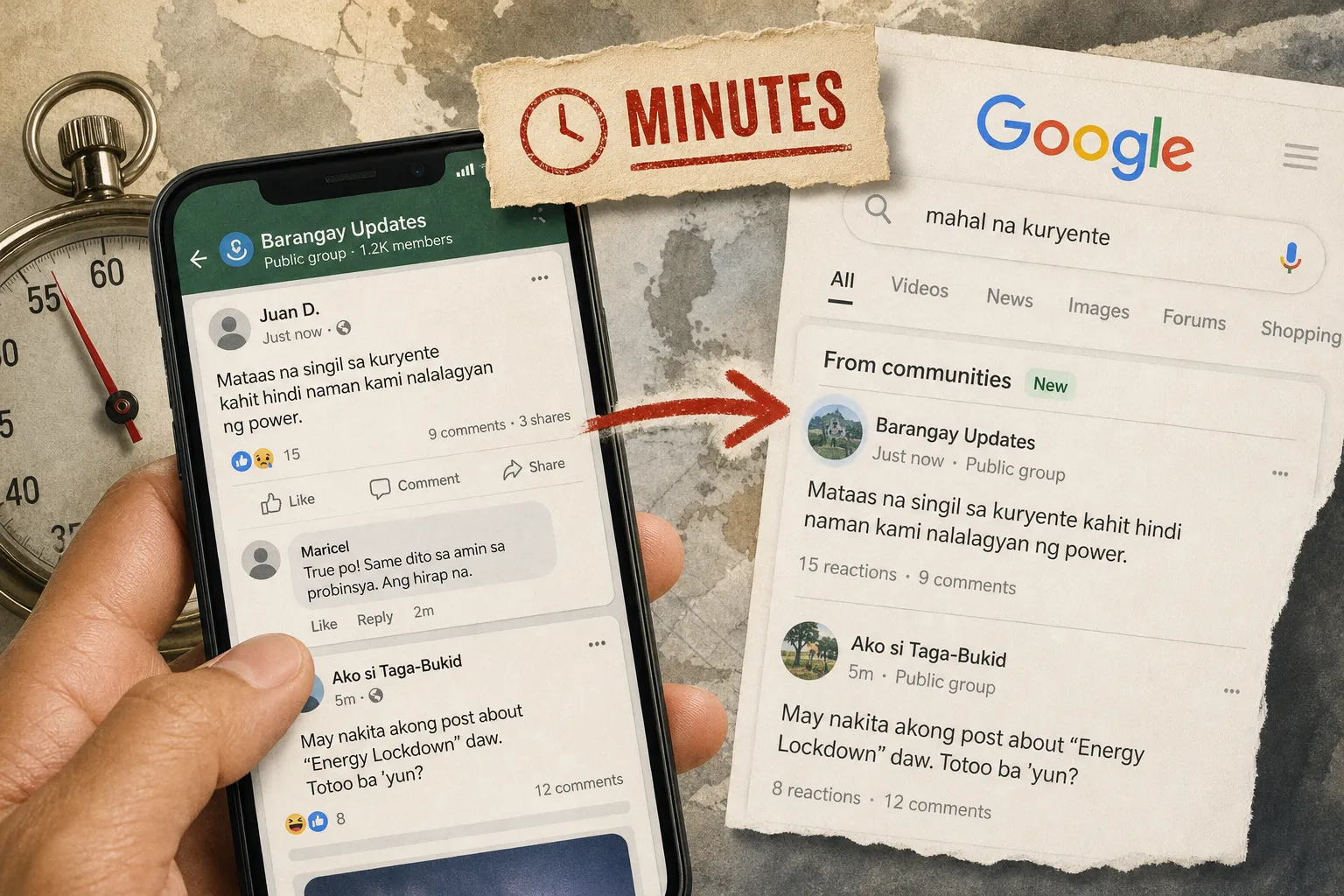
Conversation baseline. Establish how this issue reads in Philippine media and online conversation while it still reads as nothing at all. A baseline taken in a quiet week is what makes a later spike measurable, and here it has to run across Filipino, English and the vernaculars in between, which is the work real-time monitoring across Philippine sources exists to do. Treat volume and source as the firm part of that record and tone as the softer one, because automated sentiment across Filipino and Taglish registers is directional rather than settled, including when the reading flatters you.
Official government channels need one more step. Agencies and LGUs run Facebook as a primary public channel, and this cycle's search for a published national or local policy on platform terms for official pages returned nothing, so the question of who authorised which linkage is unanswered at the institutional level too. Public-sector teams will recognise the discipline from release-day work, where monitoring around official data releases separates briefing a story from chasing it, and the same habit now applies to the pages themselves for government and LGU communications teams.
Who answers when a legislator or a reporter asks first?
The question that arrives in a hearing or a radio interview will not be whether the clause is enforceable. It will be whether you knew your corporate site was in scope, and what you did about it. That reading is analysis rather than a sourced finding, but it follows from the record above: the probe is live, the clause is published, and the date is still on Meta's own legal page.
Waiting is a decision in its own right. The deadline is movable while the contested clause is standing, so holding off until the consultation concludes means accepting whatever that consultation produces, from a table nobody here was invited to. Meta does have a named Philippine country director, Jerry Bongco, who fronted the local launch of Business AI for Philippine businesses last year, so "who do we even ask" has a nominal answer. The decisions still sit with a regional desk in Singapore and a consultation whose participants Meta will not name.
Which leaves the part you control. Before the date, produce one dated exposure read: properties in scope, content at risk, technical state, conversation baseline, with the method and the as-of date on the front of it. That is the shape of a custom exposure read Media Meter builds for regulated clients, and if 20 November is the date your executives are asking about, start that conversation now.
Key takeaways
- The updated terms attach to the domains and pages "associated with your products or services", so your own product footprint defines the scope and nobody at Meta will hand you the list.
- The pause moved a date and left the clause standing. On 3 November 2026 Meta's live terms page still carried 20 November 2026 while the UK CMA's record described the revision as put on hold.
- Every party that has extracted movement sits outside the Philippines: two US senators, Norwegian publishers in court, the European Publishers Council, the CMA. No Philippine publisher, body or association has responded.
- Run four things before the date: a scope inventory, content triage, a timestamped record of robots.txt and paywall state, and a conversation baseline across Filipino, English and vernacular media.
- Write the method and the as-of date on whatever you produce. A dated record is what answers the hearing question months later.
About Media Meter
Media Meter is an AI-powered media intelligence company built for the Philippine market. Its Reports & Analytics turn coverage across print, broadcast, online and social into board-ready measurement, so the record you hand an executive before a hearing carries its own method and its own as-of date.