ASF resurgence in Visayas triggers regional biosecurity lockdowns; e-bike safety, MSME exports, and e-commerce profitability also in focus
African Swine Fever outbreaks in Negros Occidental prompt neighboring provinces to ban pork products and tighten border controls, while other stories cover seized uncertified e-bike batteries, DTI's push for MSME exports, and the profitability challenges of online selling.
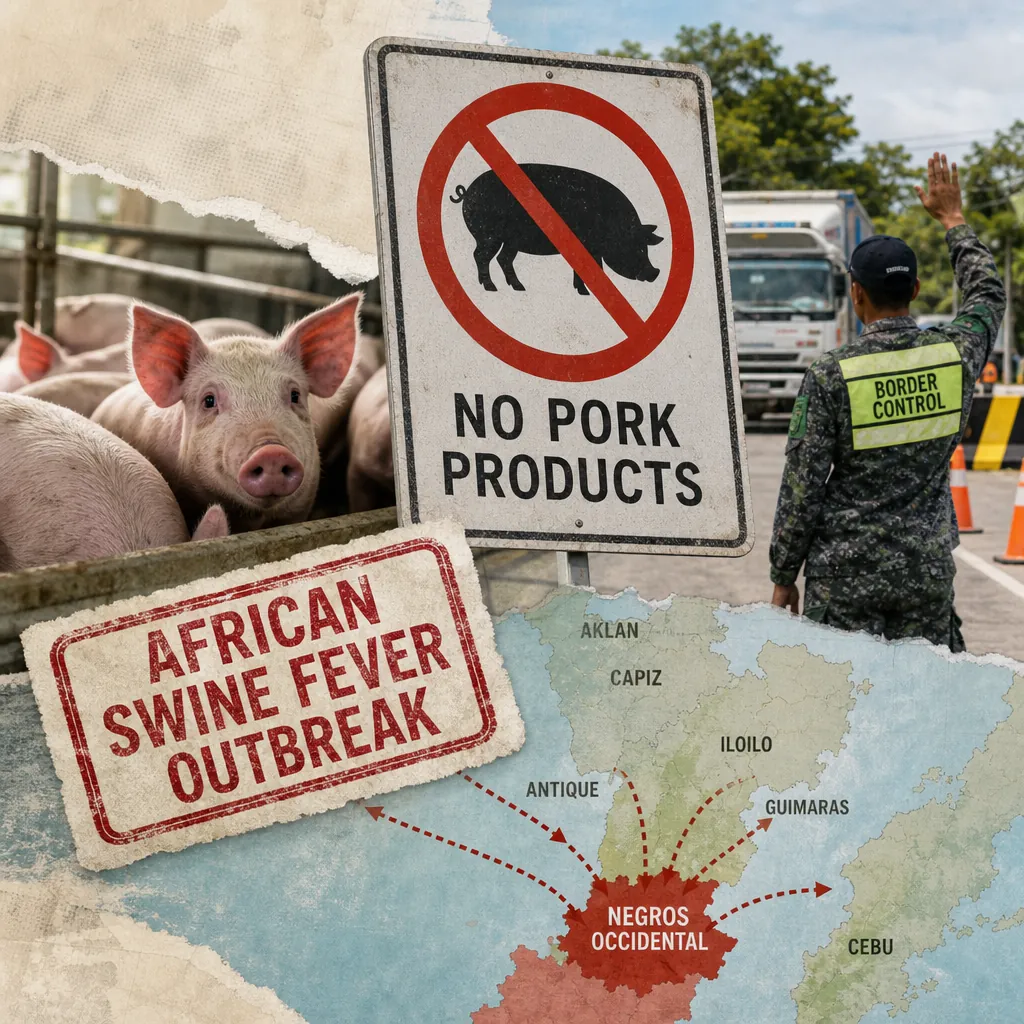
The conversation on June 27, 2026, was dominated by the resurgence of African Swine Fever (ASF) in the Visayas, triggering a cascade of biosecurity measures across several provinces. While no confirmed cases have been reported in Bacolod City or Cebu, the confirmation of ASF in Negros Occidental—where over 500 hogs have died in San Enrique—has prompted local government units (LGUs) to impose bans on live pigs, pork, and pork products from affected areas. This story drew the heaviest coverage in the captured set, with multiple articles from Inquirer Online and Philstar Online detailing the measures taken by Negros Occidental, Cebu, Negros Oriental, Capiz, and Guimaras. The coverage value of these ASF-related articles totaled over ₱1.1 million in advertising-equivalent value (AVE), reflecting the high editorial interest in the threat to the region's livestock industry.
Alongside the ASF story, other notable developments included the seizure of ₱6 million worth of uncertified e-bike batteries and chargers in Pampanga, a reminder of ongoing safety and regulatory enforcement issues in the growing electric vehicle market. Department of Trade and Industry (DTI) Secretary Ma. Cristina Roque urged micro, small, and medium enterprises (MSMEs) to tap government export programs, citing strong export growth. A column in the Manila Times explored the profitability challenges of e-commerce, noting that platform costs can eat up to a quarter of selling prices. These stories, while less urgent than the ASF outbreak, signal ongoing policy and market dynamics affecting businesses and consumers.
Key themes
- ASF resurgence triggers regional biosecurity lockdowns – The confirmation of African Swine Fever in Negros Occidental has led neighboring provinces—Cebu, Negros Oriental, Capiz, and Guimaras—to ban the entry of live pigs, pork, and pork products from affected areas. Local task forces are intensifying border inspections and surveillance. [1][2][3]
- No confirmed cases yet in Bacolod and Cebu, but vigilance is high – Bacolod City Mayor Greg Gasataya stated there are no ASF cases in the city, but the local ASF Task Force has agreed to strengthen monitoring at 13 border control points. Similarly, Cebu Governor Pamela Baricuatro signed an executive order tightening preventive measures despite no confirmed cases. [1][3]
- Over 500 hogs dead in San Enrique, Negros Occidental – The outbreak has hit all 10 barangays in the municipality, with laboratory results confirming ASF. This has heightened fears of economic devastation for small-scale and commercial hog raisers. [3]
- Uncertified e-bike batteries and chargers seized in Pampanga – The Criminal Investigation and Detection Group (CIDG) confiscated ₱6 million worth of imported e-bike batteries and chargers lacking Import Commodity Clearance (ICC) stickers and Philippine Standard (PS) marks, as required by the Consumer Act. [4]
- DTI pushes MSME exports under Tatak Pinoy Law – Secretary Roque encouraged small businesses to avail of government support programs, citing a record 15.4% export growth last year and the Tatak Pinoy (Proudly Filipino) Law, which aims to empower local businesses and modernize industries. [5]
- E-commerce profitability challenges highlighted – A column in the Manila Times noted that platform costs—commissions, advertising, affiliate incentives, vouchers, shipping support—can approach 25% of the selling price, prompting entrepreneurs to question whether to leave platforms and sell independently. [6]
- School violence and safety concerns – A tragic shooting at San Jose National High School in Tacloban City and a classroom knife attack in General Trias, Cavite, have sparked public alarm. A column in the Daily Tribune described the incidents as a "punch to the gut" and called for urgent action. [7]
- Navotas landfill fire aftermath: lingering pollutants – Experts warn that pollutants from the April 10 fire at the Navotas landfill could persist for decades, posing long-term health risks. The fire exposed weaknesses in the country's waste management system. [8]
How the narratives stack
Dominant – Within the captured set, the ASF resurgence in the Visayas is the dominant narrative, accounting for the highest number of articles and the largest total advertising-equivalent value (AVE). The story is driven by official actions—executive orders, task force meetings, and border bans—and is framed as a urgent threat to the region's hog industry and livelihoods. The coverage is concentrated in online news from Inquirer and Philstar, with a combined AVE of over ₱1.1 million. [1][2][3]
Counter-narrative – While the ASF story emphasizes government response and biosecurity, a counter-narrative emerges from the BPI official's remarks on high tariffs and price caps hampering agribusiness investments. This perspective suggests that government policies themselves can be a barrier to sector growth, potentially undermining the very protections being put in place. [9]
Emerging – The e-bike battery seizure and the column on e-commerce profitability point to emerging regulatory and market challenges in the digital economy. The seizure highlights enforcement of safety standards for imported goods, while the profitability column signals growing concern among entrepreneurs about the cost of selling on platforms. These stories may gain traction as more businesses and consumers engage with e-commerce and electric vehicles. [4][6]
Suppressed – The story of the Navotas landfill fire's lingering pollutants received only one article in the captured set, despite its significant public health implications. The fire was extinguished after 30 days, but experts warn of long-term environmental and health risks. The limited coverage may reflect a tendency to move on from environmental disasters once the immediate crisis is over. [8]
Platform insights
- Facebook – The primary platform for sharing news articles, especially from Philstar and Inquirer. Posts about ASF measures and the e-bike seizure likely generated shares and comments from concerned citizens and local government pages. Engagement figures are not available in the captured data, but the nature of the content suggests community-oriented sharing.
- X (formerly Twitter) – Likely used for real-time updates on ASF developments, with local officials and news outlets posting executive orders and task force decisions. The platform may also host discussions on e-commerce costs and school violence, but no specific posts were captured.
- YouTube – No significant activity captured. The topics are primarily text-based news, though video coverage of the ASF outbreak or the landfill fire may exist but was not included in the monitoring.
Key voices and communities
- Local government officials – Mayors and governors of affected provinces (e.g., Bacolod Mayor Greg Gasataya, Cebu Governor Pamela Baricuatro, San Enrique Mayor Jilson Tubillara) are key voices, issuing executive orders and reassuring the public. Their statements drive the ASF narrative.
- Department of Agriculture (DA) and DTI – The DA is involved in coordinating ASF response and the ube industry development; DTI Secretary Roque promotes MSME exports. These agencies shape policy narratives.
- Law enforcement and regulatory bodies – The CIDG and DTI-Bureau of Philippine Standards are central to the e-bike seizure story, emphasizing consumer safety and enforcement of standards.
- Business and economic commentators – BPI assistant vice president Noel Gideon Goco and the Manila Times columnist provide analysis on agribusiness policy risks and e-commerce profitability, representing the business community's perspective.
- Parents and educators – The school violence stories have sparked concern among parents and educators, though no specific voices are captured in the articles beyond the column author.
Narrative streams
ASF resurgence in the Visayas: a region on alert
The most prominent narrative stream is the rapid spread of African Swine Fever in Negros Occidental and the defensive measures taken by neighboring provinces. The outbreak was confirmed in San Enrique, where over 500 hogs have died across all 10 barangays. In response, the provincial governments of Cebu, Negros Oriental, Capiz, and Guimaras have issued executive orders banning the entry of live pigs, pork, pork products, and even frozen boar semen from affected areas. [1][2][3] Bacolod City, while still ASF-free, has intensified monitoring at 13 border control points. [1] The coverage value of these articles is substantial: the Philstar article on Cebu's measures alone has an AVE of ₱502,807.60, and the Inquirer article on Negros Occidental's measures is worth ₱467,072. [1][3] The narrative is framed as a race to contain the disease before it devastates the region's hog industry, which supports both small-scale and commercial raisers. The context: ASF is a highly contagious viral disease with no vaccine, and its re-emergence in the Visayas follows previous outbreaks in Luzon. The economic stakes are high—the hog industry is a multi-million peso sector in Negros Occidental.
E-bike safety enforcement: seizure of uncertified batteries
On June 23, CIDG operatives seized ₱6 million worth of imported e-bike batteries and chargers from a warehouse in Mexico, Pampanga, because they lacked Import Commodity Clearance (ICC) stickers and Philippine Standard (PS) marks. [4] The DTI-Bureau of Philippine Standards requires these markings under the Consumer Act of the Philippines to ensure products meet minimum safety and quality standards. The CIDG stated that the stickers serve as "visual proof that a product has been tested and passed Philippine National Standards." [4] This story, covered by Inquirer Online with an AVE of ₱158,776, highlights the growing regulatory scrutiny of imported electric vehicle components as e-bikes become more popular. The seizure underscores the risks of uncertified products, which may pose fire or electrical hazards. The narrative is straightforward: law enforcement is cracking down on non-compliant imports to protect consumers.
DTI pushes MSME exports under Tatak Pinoy Law
DTI Secretary Ma. Cristina Roque, speaking at a wedding fair in Taguig, urged micro, small, and medium enterprises (MSMEs) to take advantage of government programs to export their products. She cited the Tatak Pinoy (Proudly Filipino) Law (Republic Act 11981), which aims to empower local businesses and modernize industries. [5] Roque noted that Philippine exports grew by a record 15.4% last year and remain strong this year, partly due to the law. The DTI offers support for MSMEs to explore export markets, including training, market matching, and quality certification. [5] The article, from Manila Times Online with an AVE of ₱203,280, presents a positive narrative of government support for small businesses, though it does not address potential barriers such as high tariffs or price caps that BPI's Goco later highlighted. [9]
E-commerce profitability: the hidden costs of selling online
A column in the Manila Times by an unnamed author explored why many online sellers struggle to turn a profit despite generating sales. The author noted that platform costs—commissions, advertising, affiliate incentives, vouchers, shipping support—can approach 25% of the selling price. [6] Entrepreneurs asked whether they should leave platforms like Shopee, Lazada, and TikTok Shop and sell through Facebook or their own websites. The column advised against a hasty exit, suggesting that platforms offer access to large customer bases and that sellers should instead optimize their strategies. [6] This narrative, with an AVE of ₱618,240, resonates with the growing number of small businesses relying on e-commerce. It provides a counterpoint to the DTI's export optimism, highlighting the real-world challenges of digital marketplaces.
School violence: a crisis of safety
Two violent incidents at schools—a shooting at San Jose National High School in Tacloban City that left three students dead, and a classroom knife attack by a 14-year-old in General Trias, Cavite—have sparked public outrage and fear. A column in the Daily Tribune described the events as a "punch to the gut" and called for urgent action to address the escalation from playground fights to armed violence. [7] The column also mentioned foiled mass casualty plots linked to violent online subcultures like the GoreBox game. The article, with an AVE of ₱173,160, reflects a growing concern about school safety as the new school year begins. The narrative is emotional and urgent, but the captured set includes only this one column, suggesting limited coverage relative to the gravity of the incidents.
Navotas landfill fire: long-term environmental and health risks
Experts warn that pollutants from the April 10 fire at the Navotas landfill, which took 30 days to extinguish, could persist in the environment for decades. Dr. Gerry Bagtasa of the University of the Philippines explained that the fire likely started from methane accumulation from decomposing organic waste. [8] The blaze exposed weaknesses in the country's waste management system. The article, from Inquirer Plus with an AVE of ₱496,516, is the first of a two-part series, indicating deeper investigative reporting. However, the narrative is currently limited to this single piece, and the public response may be muted compared to the immediate crisis of the fire itself.
Conversation trajectory
- ASF containment (next 2–4 weeks): The effectiveness of the biosecurity measures will be tested. If new cases emerge in Cebu or other provinces, expect intensified media coverage and possible economic impact on pork prices. If containment succeeds, the story may fade but remain a background concern.
- E-bike regulation (next 1–2 months): The seizure may lead to stricter enforcement and possibly new regulations for imported e-bike components. Consumer safety groups and industry associations may push for clearer standards.
- MSME export growth (ongoing): The DTI's push under Tatak Pinoy Law is likely to continue, with more programs and success stories. However, if high tariffs and price caps remain, as noted by BPI, the narrative may shift to policy barriers.
- E-commerce profitability (ongoing): As platform costs rise, more entrepreneurs may explore alternative sales channels. Expect more columns, webinars, and possibly regulatory interest in platform fees.
- School violence (next 1–2 weeks): The incidents may trigger calls for stricter security measures in schools and debates on mental health and online content regulation. The story could escalate if more details emerge or if there are copycat threats.
- Navotas landfill (next 1–3 months): The second part of the Inquirer Plus series may generate more attention. Environmental groups may use the report to advocate for better waste management policies.
Trigger events: Confirmation of ASF in a new province; another school violence incident; a major fire or accident involving uncertified e-bike batteries; a government announcement on platform fee regulation.
Response guidance
- For agribusiness communicators: Emphasize biosecurity measures and cooperation with LGUs. Provide clear, factual updates to reassure stakeholders. Avoid speculation; focus on confirmed cases and official actions.
- For e-commerce platforms and sellers: Address profitability concerns transparently. Consider offering educational content on cost optimization. Highlight value beyond commissions, such as customer reach and logistics support.
- For government agencies (DTI, DA): Continue promoting MSME support programs but acknowledge challenges like tariffs and platform costs. Balance optimism with realistic advice.
- For school administrators and education officials: Proactive communication on safety measures is critical. Engage with parents and communities to rebuild trust. Avoid downplaying incidents; acknowledge concerns and outline concrete steps.
- For environmental advocates: Use the Navotas landfill fire as a case study to push for systemic waste management reforms. Collaborate with media to sustain coverage beyond the immediate aftermath.
See the full picture behind today's signals.
This report draws from Media Meter's MediaWatch, our real-time monitoring engine tracking 2,470+ Philippine sources across print, broadcast, digital, and social. Explore how the platform turns raw coverage into decision-grade intelligence, then see how it's configured for teams like yours — whether you're in PR agencies, corporate comms, government, or marketing.
Want more? Browse our Report Library for sector and crisis intelligence, or request a demo and we'll have your brand set up before the call.
Want this kind of intelligence on your brand?
This brief is built on the same MediaWatch methodology that runs continuously across every brand we monitor. See your competitive landscape, Impact Score, and narrative trajectory in a 30-minute demo.