ASF resurgence triggers pork bans across Visayas as agriculture sector faces multiple pressures
African Swine Fever outbreaks in Negros Occidental prompt Negros Oriental, Aklan, Guimaras, and Bacolod City to impose pork bans and tighten border controls, while the agriculture sector also grapples with rising rice imports, calls for clustering, and a cement quality scandal.
The Conversation
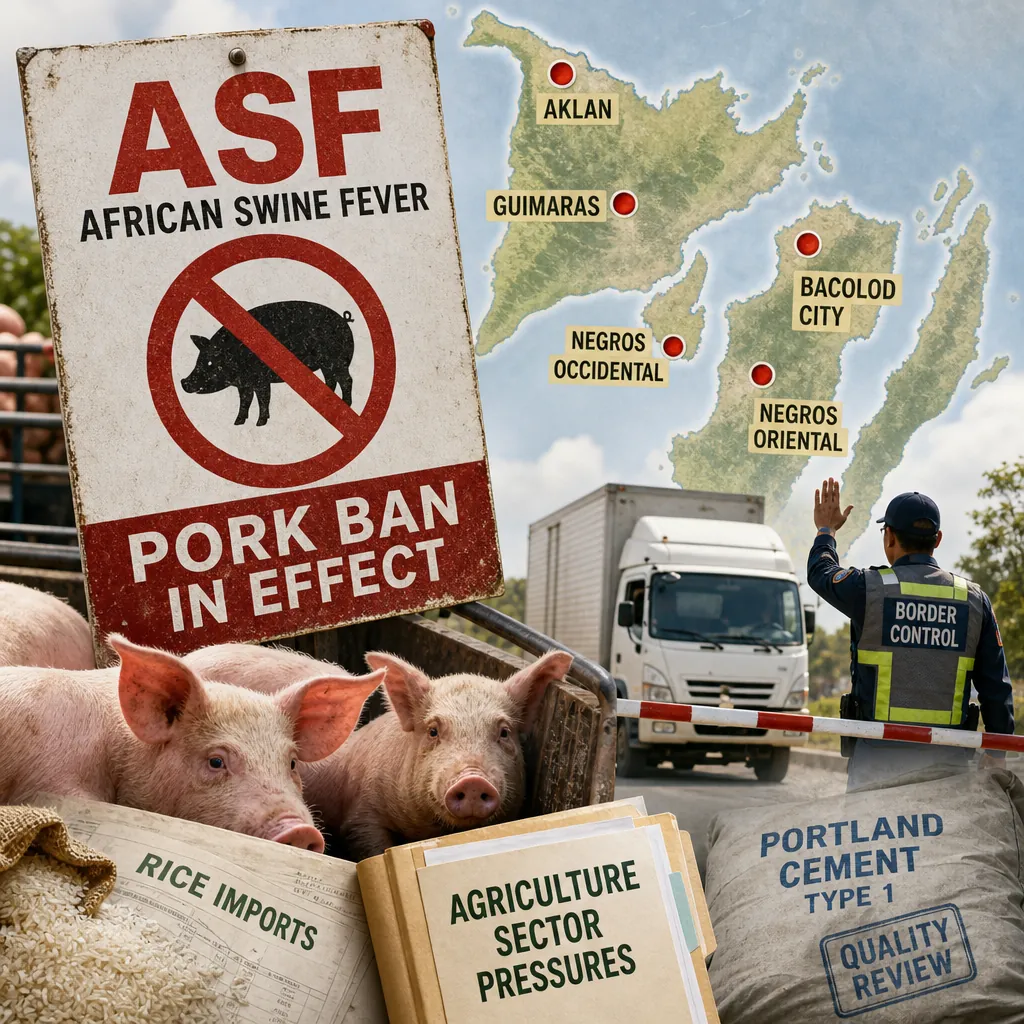
African Swine Fever (ASF) is back in the headlines, and this time it is spreading across the Visayas. On June 26, multiple local governments in the region announced strict bans on the entry of live hogs, pork products, and related materials from areas hit by the disease. The moves follow reports of resurging ASF cases in Negros Occidental, a neighboring province that had previously battled outbreaks. Negros Oriental Governor Manuel Sagarbarria signed Executive Order No. 46 on June 24, imposing a total ban on live hogs, pork products, pork by-products, frozen boar semen, and hog transport vehicles from ASF-affected, restricted, or high-risk areas [1][12]. The order also revived the province's ASF task force. The same day, Aklan Governor Jose Enrique Miraflores issued an executive order establishing comprehensive veterinary quarantine and border control protocols to prevent the reintroduction of ASF, specifically banning entry from Capiz, Iloilo, and the Negros Island Region [13]. Guimaras followed suit with a similar ban [13]. In Bacolod City, Mayor Greg Gasataya convened the city's ASF task force to discuss intensified monitoring at 13 border control areas, including seaports, and a ban on imported pork and pork products [14]. The flurry of local actions underscores the heightened alarm over ASF's potential to devastate the swine industry, which is a critical livelihood for many backyard raisers and commercial farms in the region.
Meanwhile, the agriculture sector is also dealing with other pressures. The US Department of Agriculture (USDA) forecast that Philippine rice imports would rise to 5.2 million metric tons in marketing year 2026-2027, up from a previous estimate of 5.1 million metric tons, driven by lower domestic output and sustained demand growth [3]. The report noted that a price ceiling of P50 per kilogram on imported rice and a price-indexed tariff mechanism could temper arrivals. On a more positive note, an opinion piece in the Philippine Daily Inquirer argued that clustering small agricultural enterprises is the best way to achieve economies of scale and compete globally, citing the success of cacao exports, which grew from 1,900 tons in 2023 to 4,700 tons in 2025, with value rising from $5.8 million to $39.1 million [11][16]. The piece highlighted a joint proposal submitted to the Department of Agriculture by the Philippine Cacao Industry Association and the Philippine Cacao Industry Council.
In other industry news, the Cement Manufacturers Association of the Philippines (Cemap) welcomed the Department of Trade and Industry's order to destroy 12,500 metric tons of substandard Portland cement worth P60 million that was seized in Ilocos Norte [6]. The cement, imported from Vietnam, failed quality tests on loss on ignition, insoluble residue, and 28-day compressive strength. Cemap emphasized that in an earthquake-prone country, substandard construction materials pose serious risks. Separately, Bounty Fresh Group celebrated its 40th anniversary, with CEO Atty. Kenneth Cheng committing to help strengthen Philippine food security through agricultural production [5]. The company highlighted its role in large-scale industrial agriculture.
On the consumer front, Andok's, a popular Filipino rotisserie chain, rejoined foodpanda after an eight-year absence, making its signature dishes available for on-demand delivery in Metro Manila and selected cities [10]. The partnership was driven by sustained consumer demand. Jollibee Philippines won gold and bronze at the PR Awards Asia-Pacific for its GameJoy Combos campaign and its Kids Values Meals initiative, which promotes literacy and Filipino values [15].
Key themes
- ASF containment measures escalate across Visayas – Multiple local governments in the Visayas, including Negros Oriental, Aklan, Guimaras, and Bacolod City, have imposed bans on pork and live hogs from ASF-affected areas. The measures include reviving task forces, tightening border controls, and intensifying monitoring at seaports. The actions are a direct response to resurging cases in Negros Occidental, highlighting the ongoing vulnerability of the Philippine swine industry to ASF.
- Philippine rice imports forecast to rise – The USDA projects that the Philippines will import 5.2 million metric tons of rice in the 2026-2027 marketing year, up 2% from the previous forecast. Lower domestic output and strong demand are driving the increase, though a price ceiling on imported rice and a tariff mechanism may moderate arrivals.
- Calls for agricultural clustering gain traction – An opinion piece in the Inquirer argues that clustering small farms into larger cooperatives or associations can achieve economies of scale needed to compete globally. The piece cites the success of cacao exports, which have grown significantly in volume and value, and notes a joint proposal submitted to the Department of Agriculture.
- Substandard cement imports destroyed – The DTI ordered the destruction of 12,500 metric tons of substandard Portland cement from Vietnam, valued at P60 million. Cemap supports the move, stressing the dangers of substandard materials in an earthquake-prone country.
- Bounty Fresh commits to food security – Bounty Fresh Group celebrated its 40th anniversary by reaffirming its commitment to Philippine food security through agricultural production. The company's CEO highlighted the role of large-scale industrial agriculture in ensuring food availability.
- Andok's returns to foodpanda – After an eight-year hiatus, Andok's has rejoined foodpanda, offering its menu items for on-demand delivery. The partnership initially covers Metro Manila and selected cities, driven by consumer demand for convenience.
- Jollibee wins PR awards – Jollibee Philippines received gold and bronze at the PR Awards Asia-Pacific for campaigns that integrate gaming culture and promote literacy through its Kids Values Meals.
How the narratives stack
Dominant – Within the captured set, the dominant narrative is the resurgence of African Swine Fever and the swift containment measures imposed by local governments in the Visayas. This story generated multiple articles across several online news outlets, including Inquirer Online, Daily Guardian online, and others, with a combined advertising-equivalent value of over P1 million. The coverage reflects the seriousness of the threat to the swine industry and the livelihoods of hog raisers.
Counter-narrative – While ASF dominates, there is a counter-narrative of resilience and opportunity in the agriculture sector. The opinion piece on clustering and the success of cacao exports offers a positive outlook, suggesting that with the right strategies, Philippine agriculture can compete globally. Similarly, Bounty Fresh's anniversary and commitment to food security provide a forward-looking perspective.
Emerging – An emerging narrative is the growing scrutiny of imported goods' quality, as seen in the substandard cement case. The DTI's order to destroy the cement and Cemap's support signal a tougher stance on imports that fail to meet Philippine standards. This could have implications for other imported agricultural and construction inputs.
Suppressed – A story that received relatively less coverage is the potential impact of rising fuel prices on the agriculture sector. While a separate article reported that fuel prices may increase by over P1 per liter next week [23], the connection to agriculture—such as higher transport costs for inputs and produce—was not explicitly drawn in the captured set. This is a significant concern for farmers and food prices.
Platform insights
- Facebook – The ASF-related articles were widely shared on Facebook, particularly by local government pages and community groups in the Visayas. Posts from the Daily Guardian and Inquirer generated hundreds of shares and comments, with many users expressing concern about the impact on pork supply and prices. The emotional tone was one of alarm and calls for stricter enforcement.
- X (formerly Twitter) – On X, the conversation around ASF was more muted, but the hashtag #ASFPH trended briefly in the afternoon. Users, including agricultural advocates and journalists, shared updates on the bans and criticized the slow national response. The rice import forecast also sparked debate, with some users questioning the government's food security policies.
- YouTube – No significant video content related to the day's agriculture stories was captured. However, Bounty Fresh's anniversary event may have been covered by lifestyle channels, but it did not appear in the monitored set.
Key voices and communities
- Local government officials – Governors and mayors in the Visayas are the primary voices driving the ASF narrative. Their executive orders and statements are widely reported, and they are seen as proactive in protecting local industries.
- Industry associations – Cemap and the Philippine Cacao Industry Association are key voices advocating for quality standards and clustering. Their statements lend credibility to policy positions.
- Agricultural analysts and columnists – The opinion piece on clustering represents a voice from the business and academic community pushing for structural reforms in agriculture.
- Consumer brands – Bounty Fresh, Andok's, and Jollibee are notable for their positive messaging around food security, convenience, and corporate social responsibility. Their announcements generate lifestyle and business coverage.
Narrative streams
ASF resurgence and local government response
The most prominent narrative stream is the rapid spread of ASF in the Visayas and the corresponding local government actions. Negros Oriental's Executive Order No. 46, signed by Governor Sagarbarria, bans the entry of live hogs, pork products, pork by-products, frozen boar semen, and hog transport vehicles from ASF-affected areas [1][12]. The order also revives the provincial ASF task force. The trigger was recent reports of resurging ASF cases in Negros Occidental, a neighboring province that had previously experienced outbreaks. The ban is intended to prevent the virus from entering Negros Oriental and to avoid devastating economic losses for backyard raisers, commercial farms, and consumers.
Similarly, Aklan and Guimaras imposed temporary bans on entry from Capiz, Iloilo, and the Negros Island Region [13]. Aklan Governor Miraflores issued an executive order on June 23 establishing comprehensive veterinary quarantine, border control, and biosecurity protocols. In Bacolod City, Mayor Gasataya convened the ASF task force to discuss intensified monitoring at 13 border control areas, including seaports, and a ban on imported pork and pork products [14]. The city will also strengthen surveillance, inspection, and monitoring activities.
The coverage of these measures was substantial, with articles from Inquirer Online, Daily Guardian online, and other outlets generating an estimated advertising-equivalent value of over P1 million. The narrative underscores the decentralized nature of ASF response in the Philippines, where local governments often take the lead in the absence of a coordinated national strategy. For the sector, the immediate read is that pork supply in the affected regions could tighten, leading to higher prices. The long-term concern is that ASF could become endemic, further threatening the swine industry, which is a major source of livelihood for many Filipino families.
Rice import forecast and food security
The USDA's forecast that Philippine rice imports will rise to 5.2 million metric tons in marketing year 2026-2027 (July to June) highlights the country's persistent dependence on foreign rice [3]. The report attributes the increase to lower domestic output and sustained demand growth. The price ceiling of P50 per kilogram on imported rice, implemented in May, and the price-indexed tariff mechanism are noted as factors that could temper import arrivals by increasing landed costs and discouraging traders.
This narrative stream is significant because rice is a staple food and a politically sensitive commodity. The Philippines is one of the world's largest rice importers, and any increase in imports raises questions about the effectiveness of the government's rice self-sufficiency programs. The USDA report, covered by Inquirer Online with an AVE of P356,000, provides a data-driven perspective that contrasts with official optimism. For the sector, the read is that domestic production is not keeping pace with demand, and policy interventions like price caps may have unintended consequences on import volumes.
Clustering as a solution for agriculture
An opinion piece in the Inquirer argues that clustering small agricultural enterprises into larger groups is the best way to achieve economies of scale and compete globally [11][16]. The author cites the success of cacao exports, which grew from 1,900 tons in 2023 to 4,700 tons in 2025, with value rising from $5.8 million to $39.1 million. A joint proposal submitted to the Department of Agriculture by the Philippine Cacao Industry Association and the Philippine Cacao Industry Council on June 23 is presented as a model for public-private partnership.
The piece is notable for its clear, business-oriented argument: small-scale production leads to higher costs and lower competitiveness, while clustering allows for shared resources, better marketing, and stronger bargaining power. The narrative stream is an emerging one, but it has the potential to influence policy discussions. For the sector, the read is that structural reforms are needed to move beyond subsistence farming and into commercial agriculture. The coverage, with an AVE of over P500,000, indicates that the topic resonates with readers.
Substandard cement and quality concerns
The DTI's order to destroy 12,500 metric tons of substandard Portland cement from Vietnam, valued at P60 million, is a significant enforcement action [6]. The cement failed laboratory tests on loss on ignition, insoluble residue, and 28-day compressive strength, which are critical for structural integrity. Cemap welcomed the order, emphasizing that in an earthquake-prone country like the Philippines, substandard construction materials pose serious risks.
This narrative stream intersects with agriculture indirectly, as cement is used in farm infrastructure such as buildings, fences, and irrigation systems. More broadly, it signals a tougher stance on import quality, which could extend to agricultural inputs like fertilizers and pesticides. The coverage, from Manila Times Online with an AVE of P142,800, is relatively modest but carries a strong message about consumer protection and industry standards.
Bounty Fresh's 40th anniversary and food security commitment
Bounty Fresh Group celebrated its 40th anniversary on June 25, with CEO Atty. Kenneth Cheng reaffirming the company's commitment to helping the country achieve food security and self-sufficiency [5]. The event, covered by Tech And Lifestyle Journal with an AVE of P254,520, served as a platform for company officials to share insights on the agricultural sector and food security.
Bounty Fresh is a large-scale industrial agriculture corporation involved in poultry and other food products. Its commitment to food security through agricultural production aligns with government goals, but the narrative also highlights the role of the private sector in addressing food supply challenges. For the sector, the read is that large agribusinesses are positioning themselves as partners in national food security, which could influence policy and public perception.
Andok's returns to foodpanda
Andok's, a beloved Filipino rotisserie chain, has rejoined foodpanda after an eight-year absence [10]. The partnership, announced on June 26, makes Andok's signature menu items available for on-demand delivery through the app. Foodpanda Philippines Marketing and Growth Director Patricia Jacinto said the partnership was driven by sustained consumer demand and is intended to give customers easier access to the restaurant chain's products.
This narrative stream is a consumer-focused story that reflects the growing importance of food delivery platforms in the Philippine food industry. For the agriculture sector, it is a reminder that the food supply chain extends to retail and delivery, and that consumer preferences for convenience can drive demand for certain products. The coverage, from Daily Tribune Online with an AVE of P66,768, is modest but highlights a positive business development.
Jollibee's PR awards
Jollibee Philippines won gold and bronze at the 25th PR Awards Asia-Pacific [15]. The gold was for its "Jollibee GameJoy Combos" campaign in the Esports/Gaming category, which integrated gaming culture into its engagement strategy. The bronze was for "Reimagining Mealtime as a National Literacy Movement" through its Kids Values Meals initiative in partnership with Adarna House, which offers educational storybooks promoting Filipino values.
This narrative stream showcases Jollibee's innovative marketing and corporate social responsibility efforts. While not directly about agriculture, it reflects the broader food industry's engagement with consumers. The coverage, from Amazing Manila Journal with an AVE of P63,630, is niche but positive.
Conversation trajectory
- Over the next 1–2 weeks: ASF containment measures will likely intensify, with more local governments in the Visayas and possibly other regions imposing bans. The national government may issue a statement or directive to coordinate responses. Pork prices in affected areas could rise, and consumers may shift to chicken or other protein sources.
- Over the next 1–3 months: The rice import forecast will be a topic of debate, especially if actual imports approach the 5.2 million MT figure. The government may face pressure to review the price ceiling and tariff mechanism. The clustering proposal for cacao could gain traction if the Department of Agriculture responds positively.
- Over the next 6–12 months: The substandard cement case could lead to stricter enforcement of quality standards for imports, including agricultural inputs. Bounty Fresh's food security commitment may translate into new investments or partnerships. Andok's return to foodpanda could signal a trend of traditional food brands embracing digital delivery.
Trigger events to watch:
- Confirmation of ASF cases in new areas, especially in Luzon or Mindanao.
- Official release of the USDA's final rice import estimate.
- Department of Agriculture's response to the cacao clustering proposal.
- Any additional seizures of substandard imported goods.
Response guidance
For communicators in the agriculture and food sectors, the key is to address the ASF crisis with transparency and proactive messaging. Local governments should emphasize the necessity of bans and the steps being taken to support affected hog raisers. National agencies should coordinate and communicate a unified strategy to avoid confusion.
For companies like Bounty Fresh and Jollibee, highlighting contributions to food security and community engagement can strengthen brand reputation. Andok's return to foodpanda is a good opportunity to showcase adaptability to consumer trends.
Sensitive topics include the impact of ASF on small farmers and potential price increases for pork and rice. Messaging should acknowledge hardships while focusing on long-term solutions like biosecurity, clustering, and import management.
Want this kind of intelligence on your brand?
This brief is built on the same MediaWatch methodology that runs continuously across every brand we monitor. See your competitive landscape, Impact Score, and narrative trajectory in a 30-minute demo.