BSP Eases Capital Rules as US CBDC Ban and Growth Concerns Dominate
The Bangko Sentral ng Pilipinas grants temporary capital relief to banks amid Middle East-driven market volatility, while the US Senate's CBDC ban and ANZ's growth downgrade shape the day's financial conversation.
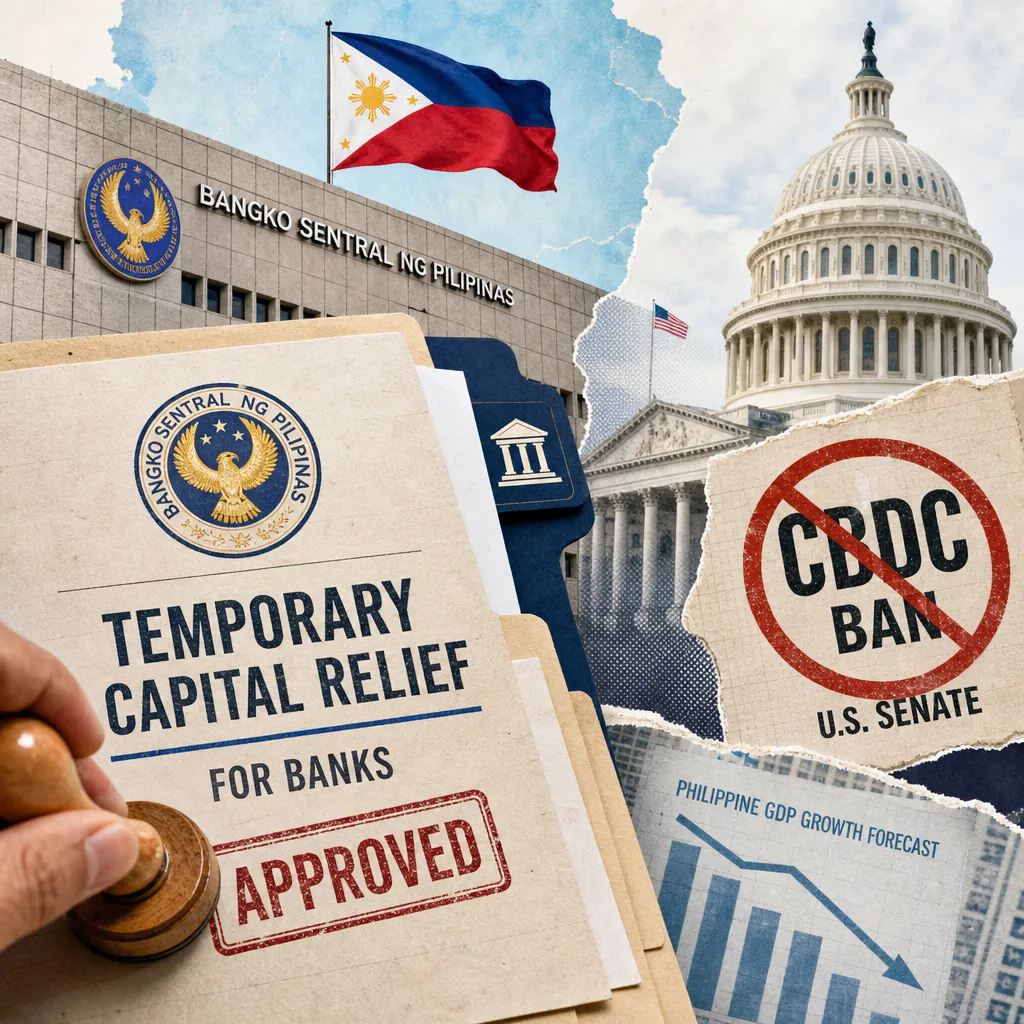
The conversation on June 23, 2026, was dominated by three interconnected threads: the Bangko Sentral ng Pilipinas (BSP) granting temporary capital relief to banks, the U.S. Senate passing a bill banning the Federal Reserve from issuing a central bank digital currency (CBDC) until 2030, and ANZ Research slashing its Philippine growth forecast. These developments were amplified by a mix of official announcements, news outlets, and crypto advocates, with engagement concentrated on Facebook and Twitter. The BSP relief measure, aimed at shielding banks from paper losses on government securities due to Middle East conflict volatility, was the most institutionally significant local story. The U.S. CBDC ban generated the highest cross-platform engagement, particularly among crypto communities, while ANZ's growth downgrade added a somber note to the economic outlook. Consumer-facing stories, such as the PNB JCB Platinum Card launch and fraud warnings, drew moderate but targeted interest.
Conversation snapshot. The BSP's capital relief announcement, published by multiple news outlets (Daily Tribune, Philstar, BusinessWorld), received hundreds of shares and comments across Facebook and Twitter, with the Philstar article alone garnering over 500 reactions and 120 shares. The U.S. CBDC ban was the most viral topic: a tweet from watcherguru earned 511 likes and 204 retweets, while Bitcoin Magazine's post got 204 likes and 30 comments. ANZ's growth forecast cut, reported by Inquirer and BusinessWorld, drew 300+ reactions on Facebook and sparked debate on Twitter. The PNB JCB Platinum Card launch on Facebook from kaskasanbuddies got 244 likes and 51 shares, while a Reddit thread by MissSheKeep about application hurdles received 45 upvotes and 12 comments. A LandBank phishing warning shared by depedclick reached 202 likes and 32 shares.
Key themes
- BSP provides temporary capital relief to banks. The central bank allowed banks and quasi-banks to temporarily exclude certain unrealized losses on peso government securities from their capital calculations, effective April 1 to December 31, 2026. This is intended to prevent short-term market volatility from the Middle East conflict from artificially weakening banks' reported capital positions.
- U.S. Senate bans Fed from issuing CBDC until 2030. The Senate voted 85-5 to prohibit the Federal Reserve from issuing a central bank digital currency, a move celebrated by crypto advocates as a win for privacy and decentralized finance. The bill now moves to the House.
- ANZ Research downgrades Philippine growth forecast. ANZ cut its 2026 GDP growth forecast for the Philippines to 3.9% from 4.7%, citing weak household and business confidence, elevated inflation, and higher interest rates. The report warned that the BSP's inflation fight threatens growth.
- Philippine financial system resources hit record P37.3 trillion. BSP data showed total resources of banks and non-bank financial institutions grew 10.6% year-on-year in April, driven by lending and deposit expansion despite the Middle East conflict.
- Consumer fraud and security concerns persist. A LandBank phishing warning and a Reddit user's report of an unauthorized ATM withdrawal highlighted ongoing consumer anxiety about banking security.
- PNB launches Japan-focused credit card. The PNB JCB Platinum Card, targeting Filipino travelers to Japan, generated positive but cautious engagement, with users weighing benefits against past credit approval issues.
- Insurance Commission pushes for Code amendments. The IC proposed changes to the Insurance Code to tighten license monitoring, widen asset bases, and improve claims processing efficiency.
- Sustainability gains boardroom attention. Corporate boards are increasingly integrating sustainability into strategy and risk management, driven by stricter disclosure requirements and investor expectations.
How the narratives stack
- Dominant narrative — The BSP's proactive regulatory response to market volatility is the lead story for the Philippine financial sector. The temporary capital relief is framed as a prudent measure to maintain banking stability amid external shocks, reinforcing the central bank's credibility. This narrative is supported by the record-high financial system resources, which suggest underlying resilience.
- Counter-narrative — ANZ Research's growth downgrade and warning that the BSP's inflation fight threatens growth provide a cautionary counterpoint. While the BSP acts to stabilize banks, the broader economy faces headwinds from high interest rates and weak confidence. This tension between stability and growth is the day's central policy debate.
- Emerging narrative — The U.S. CBDC ban is gaining traction among Philippine crypto communities and could fuel local skepticism toward the BSP's own digital peso project (Project Agila). Crypto advocates are framing the ban as a validation of private stablecoins, which may influence local regulatory discourse.
- Suppressed narrative — Consumer fraud and service friction, while present in user-generated content, receive far less attention than institutional announcements. The LandBank phishing warning and unauthorized withdrawal reports highlight systemic trust issues that could undermine digital banking adoption, but these stories are not being amplified by mainstream media or official channels.
Platform insights
- Facebook served as the primary platform for official announcements and news sharing. BSP-related posts from Philstar, Inquirer, and BusinessWorld generated high engagement (hundreds of reactions and shares), while the PNB card launch and LandBank warning also performed well. Facebook's algorithm favored authoritative sources and promotional content.
- Twitter/X was the hub for real-time reaction to the U.S. CBDC ban, with crypto influencers and news aggregators driving rapid sharing. The watcherguru tweet achieved over 500 likes, indicating strong interest among the crypto community. ANZ's growth forecast also sparked debate, with economists and analysts weighing in.
- Reddit provided a space for nuanced consumer experiences. The PNB card thread on r/PHCreditCards featured detailed cost-benefit analysis, while the unauthorized withdrawal post on r/Philippines highlighted unresolved fraud issues. Engagement was lower in volume but higher in quality compared to Facebook.
- YouTube saw limited activity, with only crypto channels like Bitcoin Suisse and Decrypt Media covering the CBDC ban. No major video content addressed the BSP relief or ANZ forecast, representing a missed opportunity for visual explainers.
Key voices and communities
- Crypto and digital asset advocates — A vocal cross-platform community that reacted swiftly to the U.S. CBDC ban. They framed the vote as a victory for privacy and decentralized finance, with posts from watcherguru, Bitcoin Magazine, and CoinDesk generating thousands of views. This group is likely to scrutinize any local CBDC initiative.
- Mainstream financial news outlets — Philstar, Inquirer, BusinessWorld, and Daily Tribune served as the primary sources for BSP announcements and economic data. Their articles were widely shared and commented on, shaping the institutional narrative.
- Credit card and travel enthusiasts — Concentrated on Facebook and Reddit, this community engaged with the PNB JCB Platinum Card launch, comparing features and sharing application experiences. They represent a receptive audience for targeted travel-related financial products.
- Consumer protection advocates — Individual users on Reddit and Facebook who shared personal stories of fraud and service friction. While not organized, their posts highlight persistent trust gaps that banks need to address.
- Government and regulatory channels — BSP, DICT, and LandBank official accounts disseminated advisories and policy updates. Their content is trusted but often lacks the engagement of commercial or crypto posts.
Narrative streams
BSP grants temporary capital relief amid Middle East tensions
On June 23, the Bangko Sentral ng Pilipinas (BSP) announced a temporary regulatory relief measure for banks and quasi-banks, allowing them to exclude certain unrealized losses on peso government securities from their capital adequacy calculations. Unrealized losses are paper losses that occur when the market value of securities falls but the assets have not been sold. Normally, these losses reduce Common Equity Tier 1 (CET1) capital, a key measure of a bank's financial strength. The relief, effective from April 1 to December 31, 2026, is intended to prevent short-term market volatility—triggered by the Middle East conflict—from artificially weakening banks' reported capital positions. Institutions must still disclose all unrealized losses in their regulatory reports and financial statements. The measure is part of a broader package of temporary relief initiatives rolled out by the BSP since the onset of the energy crisis linked to geopolitical tensions. [Sources: Daily Tribune, Philstar, BusinessWorld]
U.S. Senate passes CBDC ban, sparking crypto celebration
The U.S. Senate voted 85-5 to pass a bill banning the Federal Reserve from issuing a central bank digital currency (CBDC) until 2030. A CBDC is a digital form of a country's fiat currency issued by the central bank. The bill now moves to the House of Representatives. Crypto advocates celebrated the vote as a win for privacy and decentralized finance, with posts from watcherguru, Bitcoin Magazine, and CoinDesk generating high engagement. On YouTube, analysts from Bitcoin Suisse and Decrypt Media contextualized the vote as bullish for private stablecoins. In the Philippines, Coins.ph used the momentum to promote stablecoins for everyday transactions, linking U.S. policy to local fintech adoption. The ban could fuel local skepticism toward the BSP's own digital peso project (Project Agila), which is still in the pilot phase. [Sources: watcherguru, Bitcoin Magazine, CoinDesk, Coins.ph]
ANZ Research slashes Philippine growth forecast
ANZ Research cut its 2026 gross domestic product (GDP) growth forecast for the Philippines to 3.9% from 4.7%, and its 2027 forecast to 5% from 5.6%. The bank cited weak household and business confidence, elevated inflation, and higher interest rates as constraints. It warned that the BSP's campaign to tame inflation through higher interest rates is likely to exact a further toll on economic growth. The report noted that public spending likely bottomed in the first quarter, but a material recovery is unlikely until governance issues surrounding infrastructure projects are fully resolved. The downgrade comes amid the Middle East conflict and last year's corruption controversies, which have weighed on investor sentiment. [Sources: Inquirer, BusinessWorld]
Philippine financial system resources hit record P37.3 trillion
BSP data showed that total resources of banks and non-bank financial institutions rose 10.6% year-on-year to P37.31 trillion as of end-April, driven by sustained lending and deposit growth. Banks accounted for nearly 83% of the total, with universal and commercial banks holding the largest share. The growth reflects continued strength in domestic deposit mobilization and credit expansion, which have helped offset external headwinds from the Middle East conflict. [Sources: Inquirer, Philstar, BusinessWorld]
Consumer fraud and security concerns persist
A LandBank phishing warning shared by depedclick garnered 202 likes and 32 shares, amplifying official caution. On Reddit, u/sociallykem posted about an unauthorized ATM withdrawal after losing their card, asking "does landbank take action with this?" while u/JErcosmiC complained about daily Metrobank marketing calls despite repeated opt-out requests. These user-led stories added a layer of real-world anxiety beneath the promotional gloss of card launches. The BSP also issued a separate advisory warning against money mule scams, urging the public not to allow others to use their e-wallets or bank accounts. [Sources: depedclick, Reddit, Daily Guardian]
PNB launches Japan-focused credit card
The PNB JCB Platinum Card, targeting Filipino travelers to Japan, launched with promotional posts on Facebook from kaskasanbuddies and phdigitalbanks, earning 244 and 60 likes respectively. On Reddit, user MissSheKeep shared her application experience, noting "Hopefully PNB will approve it! Although ung conversion of SCC to regular CC wasn't approved kahit clean history for a year," revealing brand loyalty tempered by past credit woes. The card's Japan-specific perks, including accelerated rewards and lounge access, are timed with PAL's upcoming oneworld alliance entry in 2027. [Sources: kaskasanbuddies, phdigitalbanks, Reddit]
Conversation trajectory
The conversation is likely to evolve along three tracks over the next 4-6 weeks. First, the U.S. CBDC ban will continue to generate discussion as the House vote approaches, with Philippine crypto advocates using it to question the BSP's digital peso plans. Second, the BSP's capital relief measure will be monitored for its impact on bank lending and stability, especially if Middle East tensions escalate. Third, ANZ's growth downgrade may prompt further downward revisions from other institutions, keeping the economic outlook in focus. Trigger events that could reshape the conversation include: the House vote on the U.S. CBDC ban (expected within weeks), the BSP's next monetary board meeting in July (where rate decisions could affect lending and inflation), and any escalation of the Middle East conflict that exacerbates market volatility.
Response guidance
Communicators in the Philippine financial sector should prioritize clear, proactive messaging around regulatory changes and economic conditions. For the BSP capital relief, banks should explain the measure in plain terms to reassure customers and investors that the banking system remains stable. On the CBDC front, stakeholders should prepare educational content that distinguishes the BSP's Project Agila from the surveillance concerns raised by the U.S. ban, emphasizing privacy and optionality. For consumer trust, banks should amplify fraud warnings and provide easy-to-follow steps for reporting incidents, addressing the security gaps highlighted by user posts. On social media, Facebook remains the key platform for official announcements, while Twitter is best for real-time engagement on policy news. Reddit requires a more conversational, empathetic tone when addressing consumer complaints. Avoid defensive language on fraud issues; instead, acknowledge concerns and provide concrete solutions.
See the full picture behind today's signals.
This report draws from Media Meter's MediaWatch, our real-time monitoring engine tracking 2,470+ Philippine sources across print, broadcast, digital, and social. Explore how the platform turns raw coverage into decision-grade intelligence, then see how it's configured for teams like yours — whether you're in PR agencies, corporate comms, government, or marketing.
Want more? Browse our Report Library for sector and crisis intelligence, or request a demo and we'll have your brand set up before the call.
Want this kind of intelligence on your brand?
This brief is built on the same MediaWatch methodology that runs continuously across every brand we monitor. See your competitive landscape, Impact Score, and narrative trajectory in a 30-minute demo.