BSP Rate Hike and Loan Relief: Philippines Financial Policy in Focus
The Bangko Sentral ng Pilipinas raised its key rate to 4.75% and extended salary loan repayment to seven years, sparking debate on inflation, growth, and consumer debt. The stock market slipped, and economists are split on further tightening.
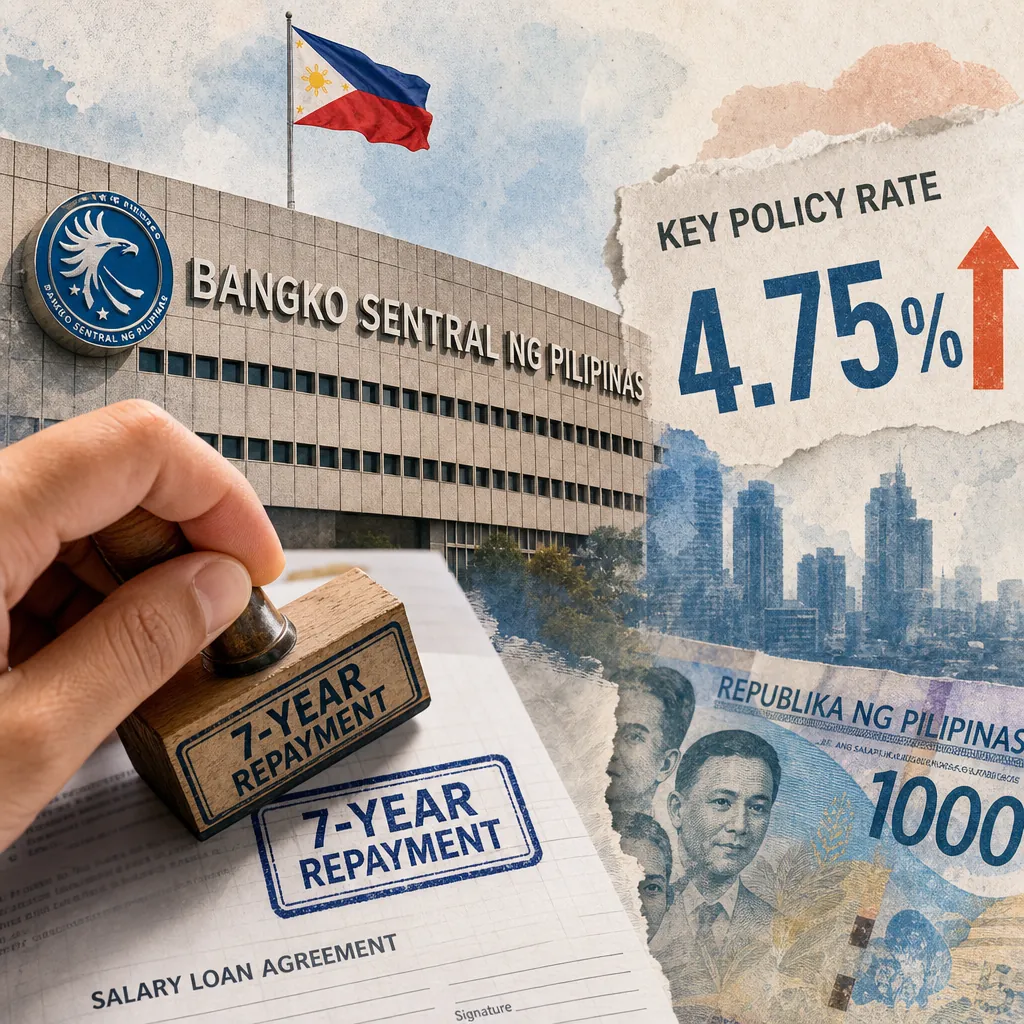
The Bangko Sentral ng Pilipinas (BSP) raised its benchmark interest rate by 25 basis points to 4.75 percent on June 18, its second increase this year, as it battles persistent inflation pressures stemming from the recent Gulf conflict. The move was widely covered in Philippine media on June 19, alongside a separate BSP decision to extend the maximum repayment period for salary-based general-purpose consumption loans to seven years, up from the previous standard of three years. The twin policy actions dominated financial news, with economists offering divergent views on whether further tightening lies ahead and the stock market slipping on rate hike fears.
Conversation snapshot. The BSP's rate hike and loan extension generated extensive coverage across major Philippine news outlets. The Manila Times, Inquirer, Philstar, Business Mirror, Daily Tribune, and Daily Guardian all published multiple articles on the decisions. The Inquirer's article "Bangko Sentral tightening cycle far from over" drew significant attention, as did Philstar's "More BSP rate hikes possible" and the Manila Times' "More measured tightening seen from Bangko Sentral." The stock market reaction was covered by Inquirer ("PSEi slips on rate hike fears"), Philstar ("Stocks end lower following BSP rate hike"), and Daily Tribune ("PSEi slips as BSP turns hawkish"). The loan extension was reported by Inquirer, Philstar, Business Mirror, and Manila Times. While specific engagement figures (likes, shares, comments) are not available from the provided media, the breadth of coverage indicates high interest among financial audiences.
Key themes
- BSP's cautious tightening bias. The central bank raised rates by 25 basis points, a move described by ING Bank economist Deepali Bhargava as "cautious" and pointing to a "steady tightening bias." HSBC's Aris Dacanay noted the modest hike signals a shift toward supporting economic growth, even as inflation forecasts were raised.
- Inflation concerns persist. The BSP raised its inflation forecasts for 2026 and 2027, projecting inflation to stay above its 2–4 percent target band. The Gulf conflict and oil price shocks remain key upside risks, even after the US-Iran peace deal.
- Growth vs. inflation trade-off. Economists highlighted the delicate balancing act the BSP faces. While higher rates curb inflation, they also weigh on economic growth, which has been "disappointingly slow" in recent quarters, according to BSP Governor Eli Remolona Jr.
- Salary loan repayment extended to seven years. Under Circular No. 1239, the BSP extended the maximum repayment period for salary-based general-purpose consumption loans (SBGPCLs) from three years to seven years, aiming to make payments more manageable while preventing excessive borrowing.
- Stock market reacts negatively. The Philippine Stock Exchange Index (PSEi) slipped 0.30 percent to 6,135.35 on June 19, as investors worried about further rate hikes and delays in US-Iran peace talks.
- Economists split on further hikes. HSBC, Capital Economics, and ING expect additional 25-bp hikes this year, while Pantheon Macroeconomics sees a possible pause if oil prices ease and growth weakens.
- Digital transaction fee rules set. The BSP also issued new pricing rules for electronic fund transfers (InstaPay and PESONet), requiring banks to justify fees based on actual costs, after lifting a five-year freeze on fee increases.
How the narratives stack
Dominant narrative. The BSP is carefully managing a tightrope between controlling inflation and supporting a sluggish economy. The 25-bp rate hike is seen as a measured step, but the central bank's raised inflation forecasts signal that the tightening cycle is not over. This narrative is reinforced by the stock market's decline and cautious commentary from economists.
Counter-narrative. Some analysts argue that the BSP's modest hike actually marks a pivot toward prioritizing growth over inflation. HSBC's Dacanay said the decision "marks a shift towards growth," noting that the BSP could have chosen a larger 50-bp increase but opted for a smaller move given weak economic data.
Emerging narrative. The extension of salary loan repayment terms to seven years is gaining attention as a consumer-friendly move that could ease debt burdens. However, it also raises questions about long-term borrowing risks and whether it might encourage over-indebtedness.
Suppressed narrative. The broader impact of the US-Iran peace deal on Philippine inflation and interest rates is under-discussed. While the deal eased oil price fears, the BSP remains cautious, and delays in peace talks in Switzerland added to market uncertainty. The potential for renewed geopolitical tensions is a risk that could reshape the rate outlook.
Platform insights
Online news portals. The bulk of coverage appeared on major Philippine news websites: Inquirer.net, Philstar.com, ManilaTimes.net, BusinessMirror.com.ph, DailyTribune.com.ph, and DailyGuardian.ph. These outlets provided detailed analysis, economist quotes, and market data. The articles were text-heavy with no visible multimedia elements, suggesting a traditional news consumption pattern.
Social media. While specific social media data is not provided, the articles were likely shared on platforms like Facebook and Twitter, where Philippine financial news often generates discussion among investors and economists. The lack of engagement figures suggests that the conversation was more informational than viral.
Print and broadcast. The stories originated from wire services and newspaper reports, indicating that the BSP decisions were covered in print editions and likely discussed on radio and TV news programs. The coordinated coverage across multiple outlets points to a coordinated news cycle driven by the central bank's announcements.
Key voices and communities
- Bangko Sentral ng Pilipinas (BSP). The central bank, led by Governor Eli Remolona Jr., is the primary source of policy decisions and inflation forecasts. Its statements and circulars drive the news cycle.
- Economists and analysts. HSBC's Aris Dacanay, ING's Deepali Bhargava, and Pantheon Macroeconomics provided expert commentary, shaping the narrative around the rate hike's implications. Their views were widely quoted across multiple outlets.
- Philippine stock market participants. Investors and brokers, including Philstocks Financial and Regina Capital, were cited for market reactions. Their comments on selective selling and FTSE rebalancing added color to the stock market decline.
- Business media. Journalists from the Manila Times, Inquirer, Philstar, Business Mirror, and Daily Tribune produced the bulk of coverage, framing the stories for a business audience.
- Borrowers and consumer groups. While not directly quoted, the loan extension story implicitly addresses teachers, employees, and other salary loan borrowers who stand to benefit from longer repayment terms.
Narrative streams
BSP rate hike to 4.75%
On June 18, the BSP's Monetary Board raised the target reverse repurchase rate by 25 basis points to 4.75 percent, the second increase this year. The decision was driven by persistent inflationary pressures from the Gulf conflict, which had pushed oil prices higher. The BSP also raised its inflation forecasts for 2026 and 2027, now expecting inflation to average above its 2–4 percent target band. The move was described as "cautious" by ING's Deepali Bhargava, who said it points to a "steady tightening bias" with future adjustments likely favoring smaller moves to limit market volatility. HSBC's Aris Dacanay noted that the modest hike indicates the BSP is now placing greater emphasis on supporting economic growth, which has been sluggish. The BSP's benchmark rate now stands at 4.75 percent, with the overnight deposit facility at 4.25 percent and the overnight lending facility at 5.25 percent.
Salary loan repayment extended to seven years
Under Circular No. 1239, signed by BSP Governor Eli Remolona Jr., the maximum repayment period for salary-based general-purpose consumption loans (SBGPCLs) was extended from three years to seven years. SBGPCLs are unsecured loans used for immediate to short-term needs such as education, healthcare, emergencies, travel, and household expenses, typically repaid through salary or pension deductions. The BSP said the longer period makes payments more manageable while the seven-year limit serves as a safeguard against excessive borrowing. Banks and other financial institutions must still determine the actual repayment period based on factors like employment records, repayment history, and disposable income. The BSP also prohibited loan renewals or extensions without a reassessment of the borrower's repayment capacity. The policy applies to all borrowers, including teachers and other employees.
Stock market declines on rate hike fears
The Philippine Stock Exchange Index (PSEi) slipped 18.31 points, or 0.30 percent, to close at 6,135.35 on June 19, extending its recent pullback. Investors turned cautious after the BSP raised its inflation forecasts, fueling concerns that interest rates may stay elevated for longer. Brokerage Philstocks Financial said sentiment was dampened by worries about further policy tightening. Adding to uncertainty were delays in peace talks between the US and Iran in Switzerland, which raised the risk of renewed geopolitical tensions. Selective selling was also seen after the FTSE Global Equity Index rebalancing. The broader All Shares index fell 0.37 percent to 3,380.77.
Economists divided on further tightening
HSBC, Capital Economics, and ING expect the BSP to deliver additional 25-bp rate hikes in the three remaining policy meetings this year, bringing the policy rate to 5.50 percent by end-2026. HSBC lowered its 2026 forecast from 6.00 percent to 5.50 percent, reflecting the more measured tightening cycle. In contrast, Pantheon Macroeconomics said the central bank may be inclined to pause if oil prices ease and growth weakens. The BSP is expected to start an easing cycle in the second half of 2027, bringing the policy rate down to 5.25 percent by year-end, according to HSBC.
Digital transaction fee rules set
Separately, the BSP issued new pricing rules for electronic fund transfers via InstaPay and PESONet, following the lifting of a five-year freeze on fee increases. Banks and other financial institutions are now required to adopt a "reasonable and fair market-based pricing mechanism" supported by an analysis of actual costs. The move aims to replace arbitrary fees with cost-justified competition, though it comes at a time when Philippine digital transaction fees are higher than in neighboring countries like Singapore, where PayNow allows free small transfers.
Conversation trajectory
The conversation around BSP policy is likely to intensify in the coming weeks as new inflation data and economic growth figures are released. The next policy meeting is scheduled for August 2026, and economists will be watching for signs of whether the BSP will hike again or pause. The US-Iran peace deal's durability and oil price movements will be key external factors. The loan extension story may fade from headlines but will be monitored by consumer groups and financial institutions implementing the new rules. The stock market's reaction to future rate decisions will remain a barometer of investor sentiment. Trigger events that could reshape the narrative include a sharp drop in oil prices, a significant slowdown in GDP growth, or a resurgence of geopolitical tensions in the Middle East.
Response guidance
Communicators in the financial sector should emphasize the BSP's commitment to price stability while acknowledging growth concerns. For rate hike coverage, focus on the "measured" and "cautious" nature of the tightening to avoid alarming consumers and investors. The loan extension story should be framed as a consumer protection measure that balances affordability with responsible lending. When discussing digital transaction fees, highlight the shift toward cost transparency and competition rather than the end of the fee freeze. Avoid speculating on the exact timing of future rate moves, and instead point to data-dependent decision-making. Sensitive topics include the impact of higher rates on borrowers and the potential for increased debt from longer loan terms.
See the full picture behind today's signals.
This report draws from Media Meter's MediaWatch, our real-time monitoring engine tracking 2,470+ Philippine sources across print, broadcast, digital, and social. Explore how the platform turns raw coverage into decision-grade intelligence, then see how it's configured for teams like yours — whether you're in PR agencies, corporate comms, government, or marketing.
Want more? Browse our Report Library for sector and crisis intelligence, or request a demo and we'll have your brand set up before the call.
Want this kind of intelligence on your brand?
This brief is built on the same MediaWatch methodology that runs continuously across every brand we monitor. See your competitive landscape, Impact Score, and narrative trajectory in a 30-minute demo.