Philippine digital finance: BSP rate hike, GCash IPO, and BPI outage reshape the landscape
A busy day in Philippine finance: the BSP raises rates to 4.75%, GCash parent Mynt moves toward a landmark IPO, and BPI's outage draws regulatory scrutiny, while new rules on digital payments and marketplaces signal a shifting landscape.
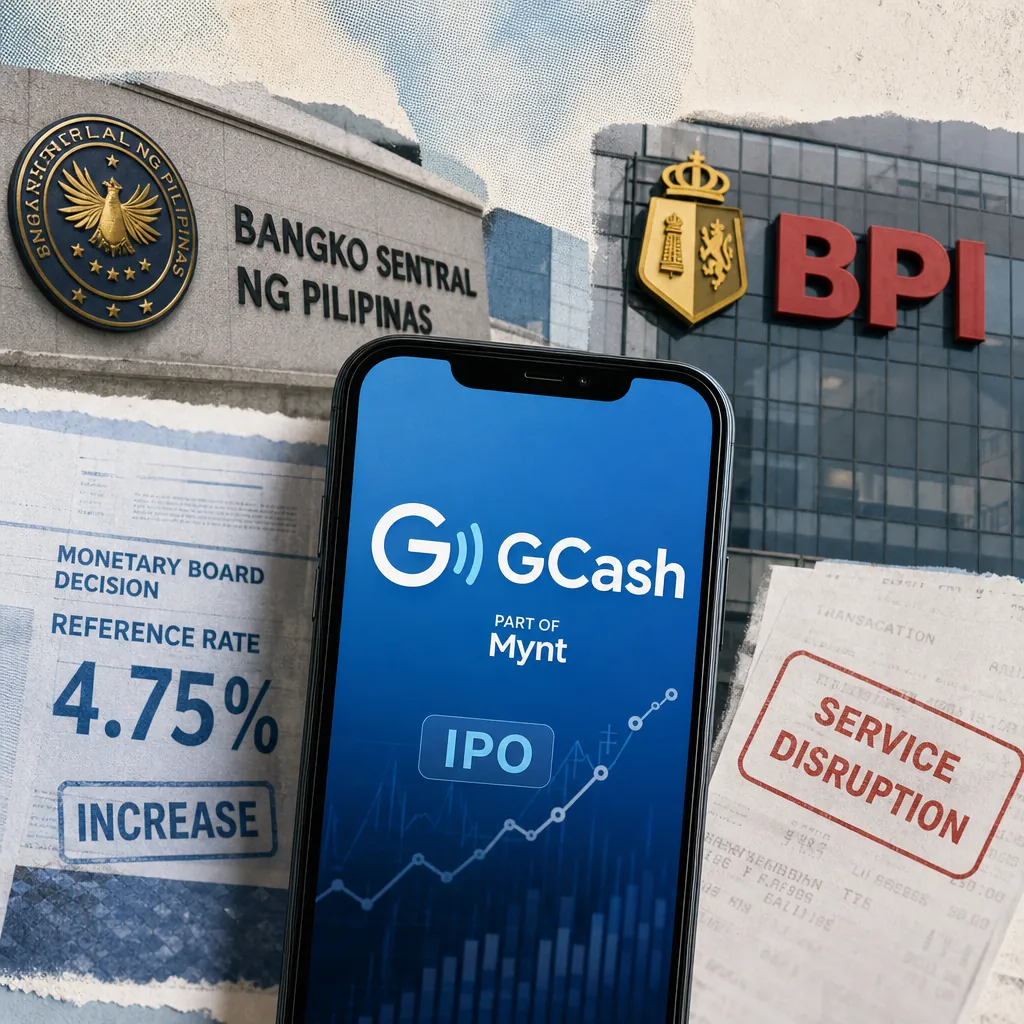
The conversation on June 18 and 19, 2026, was dominated by three major threads: the Bangko Sentral ng Pilipinas (BSP) raising its key interest rate to 4.75%, the formal approval for GCash parent Mynt to pursue what could be the largest initial public offering (IPO) in Philippine history, and the aftermath of a prolonged BPI system outage that had disrupted customers' digital banking access. These stories unfolded against a backdrop of new regulatory frameworks for digital payments and financial marketplaces, creating a complex picture of an industry navigating inflation, growth, and trust.
Conversation snapshot. The BSP rate hike generated the most institutional coverage, with multiple news outlets and analysts weighing in. A BusinessWorld report on the rate decision drew 4 likes and 1 share on Facebook, while a Manila Bulletin analysis of economists' split views received 2 likes. The GCash IPO story saw higher engagement: phltoday's Facebook post garnered 15 likes and 46 shares, and an anonymous user's post urging "Magimbak na ng Buying Power" collected 40 likes, 5 loves, and 10 comments. A Rappler analysis of the IPO's market implications was widely shared. The BPI outage continued to draw attention, with BusinessWorld's report on the BSP's investigation receiving 3 likes and 1 share. New product launches also performed well: BPI Wealth's peso-denominated global funds post on Facebook earned 93 likes and 21 loves, while Cebuana Lhuillier's HealthMax microinsurance promotion achieved 178 likes, 27 loves, and 14 comments. A Market Edge YouTube video on the IPO and rate hike accumulated 3,126 views and 32 likes.
Key themes
- BSP rate hike signals persistent inflation fight. The BSP raised its benchmark rate by 25 basis points to 4.75%, the second consecutive increase, citing elevated oil and fertilizer prices from the Middle East conflict and broadening second-round effects. The central bank also raised its inflation forecasts for 2026 and 2027 to 6.4% and 4.5%, respectively, both above the 2-4% target band. Economists were split: Barclays expected a prolonged pause, while Citi forecast two more hikes to 5.25% by October.
- GCash IPO moves forward amid market volatility. Mynt, the parent company of e-wallet GCash, secured board and shareholder approval to file for an IPO, with plans to offer at least 12% of outstanding shares. Reports valued the offering at around $1 billion, potentially making it the largest IPO in Philippine history. The news generated excitement among retail investors, but was tempered by the BSP rate hike and a 2.1% drop in the PSEi on June 17.
- BPI outage draws BSP scrutiny. The BSP confirmed it was investigating the multi-day BPI system outage that began June 14, which left customers unable to access mobile banking, online platforms, or use cards for e-commerce. The central bank said it would evaluate the incident under operational risk regulations and take supervisory actions if warranted. BPI attributed the disruption to network connectivity issues.
- New BSP rules reshape digital payments and marketplaces. The BSP lifted the moratorium on InstaPay and PESONet fee increases while introducing a new pricing framework that mandates zero fees for small merchant payments and clearer rules for person-to-person transfers. Separately, Circular No. 1237 allowed banks and electronic money issuers to operate digital financial marketplaces, enabling them to offer third-party products on their platforms, subject to capital and governance requirements.
- Accessible investment and insurance products gain traction. BPI Wealth launched peso-denominated share classes for two global equity funds, allowing Filipinos to invest internationally with as little as P1,000 and no need to buy dollars. Cebuana Lhuillier's HealthMax microinsurance, underwritten by PhilCare, generated strong engagement, highlighting demand for affordable health coverage among mass-market consumers.
- Cybersecurity and scam awareness remain urgent. A Manila Bulletin editorial noted that only 33.4% of Filipinos are aware of cybersecurity issues, while 62.5% of ICT users experienced at least one incident in 2024, with SMS fraud affecting 57.1% of victims. Maya partnered with THINKaMuna Pilipinas to strengthen scam defenses, and a Taskforce Firewall recap on SIM swap scams drew over 2,200 views.
- Macroeconomic crosscurrents: oil, inflation, and growth. The US-Iran peace deal led to expectations of lower oil prices, with the Department of Energy forecasting a sharp diesel rollback. However, the Philippines remains vulnerable to oil shocks, with over 90% of imports coming from the Middle East. The BSP's rate hike aims to anchor inflation expectations, but weak GDP data and geopolitical risks create a delicate balancing act.
How the narratives stack
Dominant narrative — The BSP's rate hike and the GCash IPO are the two most consequential stories, each signaling a major shift. The rate hike underscores the central bank's commitment to fighting inflation, even at the risk of slowing growth. The IPO represents the maturation of the fintech sector and a potential landmark for Philippine capital markets. Together, they frame a financial system under pressure from external shocks but also innovating and attracting investment.
Counter-narrative — The BPI outage and the SEC's fine on Home Credit for abusive collection practices inject caution into the fintech growth story. They highlight that digital finance's expansion brings operational and regulatory risks that can erode trust. The outage, in particular, shows how quickly a service failure can dominate conversation and trigger regulatory scrutiny, potentially slowing adoption among risk-averse consumers.
Emerging narrative — The BSP's new rules on digital payments and marketplaces point to a deliberate strategy to deepen financial inclusion while managing risks. The zero-fee mandate for small merchant payments and the framework for digital marketplaces could accelerate cash displacement and broaden access to financial products. This regulatory push, combined with product innovations like BPI Wealth's peso-denominated funds and RuralNet's microinsurance payouts, suggests a structural shift toward a more inclusive digital ecosystem.
Suppressed narrative — The impact of the US-Iran peace deal on Philippine inflation and growth is under-covered relative to its potential significance. While the Department of Energy expects fuel price rollbacks, the broader implications for BSP policy, corporate earnings, and consumer spending are not yet fully reflected in public conversation. The vulnerability of Philippine companies to oil shocks, as highlighted by Bloomberg Intelligence, deserves more attention.
Platform insights
Facebook remained the primary platform for both breaking news and promotional content. The GCash IPO post by phltoday achieved high share counts relative to likes, indicating users treated it as a "must-read" development. BPI Wealth's product launch and Cebuana Lhuillier's microinsurance post generated strong positive reactions, while the BSP rate hike and regulatory news saw lower engagement. The platform's algorithm appeared to favor visually-driven product posts over text-heavy policy pieces.
YouTube served as a venue for deeper analysis. Market Edge's segment on the GCash IPO and rate hike drew over 3,000 views, while smaller channels like DZRHTV's interview with an RCBC economist attracted only 23 views. This suggests that while YouTube can reach engaged audiences, it remains a niche channel for financial content compared to Facebook's broader reach.
News media pages from established outlets like BusinessWorld, Inquirer, and Manila Bulletin generated moderate likes but few comments, indicating passive consumption. Their credibility made them key sources for official statements and analysis, but they struggled to spark dialogue.
Key voices and communities
- Traditional news and business media — Outlets like BusinessWorld, Inquirer, Manila Bulletin, and Philstar drove the core conversation around the BSP rate hike, GCash IPO, and BPI outage. Their content framed these events as pivotal market developments, with moderate engagement but high authority.
- Financial analysts and economists — Experts from Barclays, Citi, and local institutions like Security Bank and RCBC provided the analytical framework for understanding the rate hike and its implications. Their insights were repackaged by media, amplifying their influence despite modest direct engagement.
- Retail investors and trading communities — Individual investors on Facebook expressed excitement about the GCash IPO, with posts urging "Magimbak na ng Buying Power" generating comments and emotional reactions. This group represents the potential retail subscription base for the IPO and is sensitive to macro headwinds.
- Affected digital banking customers — Users impacted by the BPI outage continued to express frustration, though the tone shifted from anger to resignation. Their conversations highlighted the deep reliance on digital banking and the reputational damage from service disruptions.
- Microinsurance and pawnshop providers — Cebuana Lhuillier's HealthMax promotion achieved the highest engagement of any post in the dataset, demonstrating strong resonance for simple, accessible insurance products among mass-market consumers. This community represents an underserved touchpoint for financial inclusion.
Narrative streams
BSP rate hike: inflation fight continues
The BSP's decision to raise the policy rate to 4.75% was widely expected but still generated significant commentary. Governor Eli Remolona cited "strong" inflationary pressures from elevated oil and fertilizer prices, as well as second-round effects. The central bank raised its inflation forecasts for 2026 and 2027, signaling readiness for further tightening. Economists were divided: Barclays interpreted the move as "restrained" and expected a prolonged pause, while Citi forecast two more hikes to 5.25% by October. The rate hike came amid a backdrop of weak GDP data and geopolitical uncertainty, creating a dilemma between controlling inflation and supporting growth. For consumers, higher rates mean increased borrowing costs for loans and credit cards, but also potentially higher returns on savings. The BSP's hawkish stance underscores the challenge of managing an economy heavily reliant on imported oil and vulnerable to global shocks.
GCash IPO: landmark listing on the horizon
Mynt's approval to pursue an IPO marks a milestone for Philippine fintech. The company, which operates the GCash e-wallet, plans to offer at least 12% of its outstanding shares, with reports valuing the deal at around $1 billion. The IPO would be the largest in Philippine history, surpassing previous records. The news generated excitement among retail investors, who see GCash as a household name and a symbol of the country's digital transformation. However, the IPO's timing coincides with market volatility driven by the BSP rate hike and geopolitical tensions. The PSEi dropped 2.1% on June 17 as investors braced for the rate decision, highlighting the macroeconomic headwinds. The IPO's success will depend on investor appetite for fintech stocks in a rising-rate environment, as well as the company's ability to demonstrate sustainable growth and profitability. The listing also raises questions about valuation, dilution for existing shareholders, and the impact on GCash's lending and investment products.
BPI outage: trust under scrutiny
The BPI outage, which began on June 14 and lasted several days, continued to reverberate. The BSP confirmed it was investigating the incident, stating it would evaluate the bank's compliance with operational risk regulations and take supervisory actions if warranted. BPI attributed the disruption to network connectivity issues and assured customers that branches and ATMs remained operational. The outage generated intense negative sentiment, with one post accumulating 104 angry reactions and 89 sad reactions. A follow-up post with a lighter tone suggested the immediate crisis had passed, but the underlying concern about digital banking reliability persisted. The incident underscores the critical importance of system resilience as digital banking becomes deeply embedded in daily life. For the industry, it serves as a cautionary tale: even a well-established bank can suffer reputational damage from a prolonged outage, and regulators are watching closely.
New BSP rules: reshaping digital payments and marketplaces
The BSP's lifting of the moratorium on InstaPay and PESONet fee increases, combined with a new pricing framework, represents a significant policy shift. The central bank mandated zero fees for small merchant payments and established clearer rules for person-to-person transfers, aiming to balance affordability with sustainable network economics. Separately, Circular No. 1237 allows banks and electronic money issuers to operate digital financial marketplaces, enabling them to offer third-party products on their platforms. This could transform banking apps into one-stop shops for financial services, from loans and insurance to investments. However, the rules impose capital and governance requirements, ensuring that risks are managed and consumer interests protected. These moves signal the BSP's commitment to deepening financial inclusion while maintaining stability. For consumers, the changes could mean lower transaction costs and greater access to a wider range of products.
Accessible investing and microinsurance: meeting unmet demand
BPI Wealth's launch of peso-denominated global funds and Cebuana Lhuillier's HealthMax microinsurance both generated strong engagement, highlighting a clear demand for products that lower barriers to entry. BPI's funds allow Filipinos to invest in global technology and equity markets with as little as P1,000, without needing to buy dollars. Cebuana Lhuillier's insurance, offered through its pawnshop network, provides affordable health coverage to mass-market consumers who may not have access to traditional insurance. These products address two key pain points: the high cost of accessing international markets and the lack of affordable health coverage. Their positive reception suggests that financial institutions can build trust and engagement by focusing on simplicity, accessibility, and tangible value.
Conversation trajectory
Next 1-2 weeks: The BSP rate hike will continue to dominate economic commentary, with analysts parsing the central bank's forward guidance and inflation data. Expect a wave of "what it means for your money" content, as consumers assess the impact on loans, savings, and investments. The GCash IPO narrative will shift from announcement hype to fundamental analysis, with valuation comparisons and discussions of the company's growth prospects. The BPI outage will likely fade from the headlines, but the BSP's investigation could resurface if regulatory actions are announced.
Next 3-4 weeks: The formal filing of Mynt's registration statement with the SEC will trigger detailed prospectus analysis and valuation debates. Retail investor sentiment will be tested by market volatility and the rate hike's impact on liquidity. The BSP's new digital payments rules will begin to take effect, with banks and payment providers announcing fee adjustments and marketplace offerings. Consumer response to these changes will be closely watched.
Next 2-3 months: The US-Iran peace deal's implementation will determine whether oil prices stabilize or spike again, directly affecting Philippine inflation and BSP policy. The GCash IPO could proceed, with its success or failure shaping the outlook for fintech listings in the region. The BSP's regulatory agenda, including potential further rate hikes and enforcement actions on lending practices, will continue to influence the conversation. The convergence of inclusion initiatives, product innovation, and regulatory reform suggests a structural shift toward a more digital and inclusive financial system, but trust and reliability remain critical.
Trigger events to watch: The BSP's next policy meeting (likely August); the formal filing of Mynt's IPO prospectus; any SEC enforcement actions against digital lenders; the full restoration of BPI services and the BSP's findings; and the trajectory of oil prices following the US-Iran deal.
Response guidance
For communicators in the Philippine financial sector, the key takeaway is that the conversation is increasingly fragmented across multiple narratives: inflation and rates, fintech growth, regulatory change, and consumer trust. To navigate this landscape:
- On Facebook, prioritize visual, value-driven content that addresses consumer pain points, such as low-minimum investment products or affordable insurance. Avoid generic institutional messaging, which underperforms. Use the platform to provide real-time updates during service disruptions and to amplify security awareness content.
- On YouTube, invest in explainer videos that demystify complex topics like rate hikes, IPO mechanics, and digital payment rules. Partner with credible analysts to produce content that positions your brand as a trusted source of information.
- Key messages should emphasize transparency, reliability, and inclusion. Acknowledge service issues promptly and outline concrete steps to prevent recurrence. Frame product innovations as solutions to real consumer needs, not just marketing pitches.
- Sensitive topics include bank outages, which require empathetic acknowledgment without overpromising; scam warnings, which should balance urgency with reassurance; and consumer credit, where transparency about terms is essential to avoid backlash.
- Opportunities lie in aligning with the BSP's inclusion agenda, co-creating content with retailers and microinsurance providers, and leveraging positive product launches to counterbalance negative narratives. The GCash IPO creates a window for educational content about investing, while the rate hike offers a chance to position savings and fixed-income products as hedges against volatility.
See the full picture behind today's signals.
This report draws from Media Meter's MediaWatch, our real-time monitoring engine tracking 2,470+ Philippine sources across print, broadcast, digital, and social. Explore how the platform turns raw coverage into decision-grade intelligence, then see how it's configured for teams like yours — whether you're in PR agencies, corporate comms, government, or marketing.
Want more? Browse our Report Library for sector and crisis intelligence, or request a demo and we'll have your brand set up before the call.
Want this kind of intelligence on your brand?
This brief is built on the same MediaWatch methodology that runs continuously across every brand we monitor. See your competitive landscape, Impact Score, and narrative trajectory in a 30-minute demo.