Calabarzon wage orders lift 1.76M pay floors
Wage boards in Calabarzon ordered daily increases of up to P45 for 1.56 million minimum wage earners and a P750 monthly raise for 201,000 domestic workers, while housing agencies advanced walk-to-work and mortgage-securitization programs.
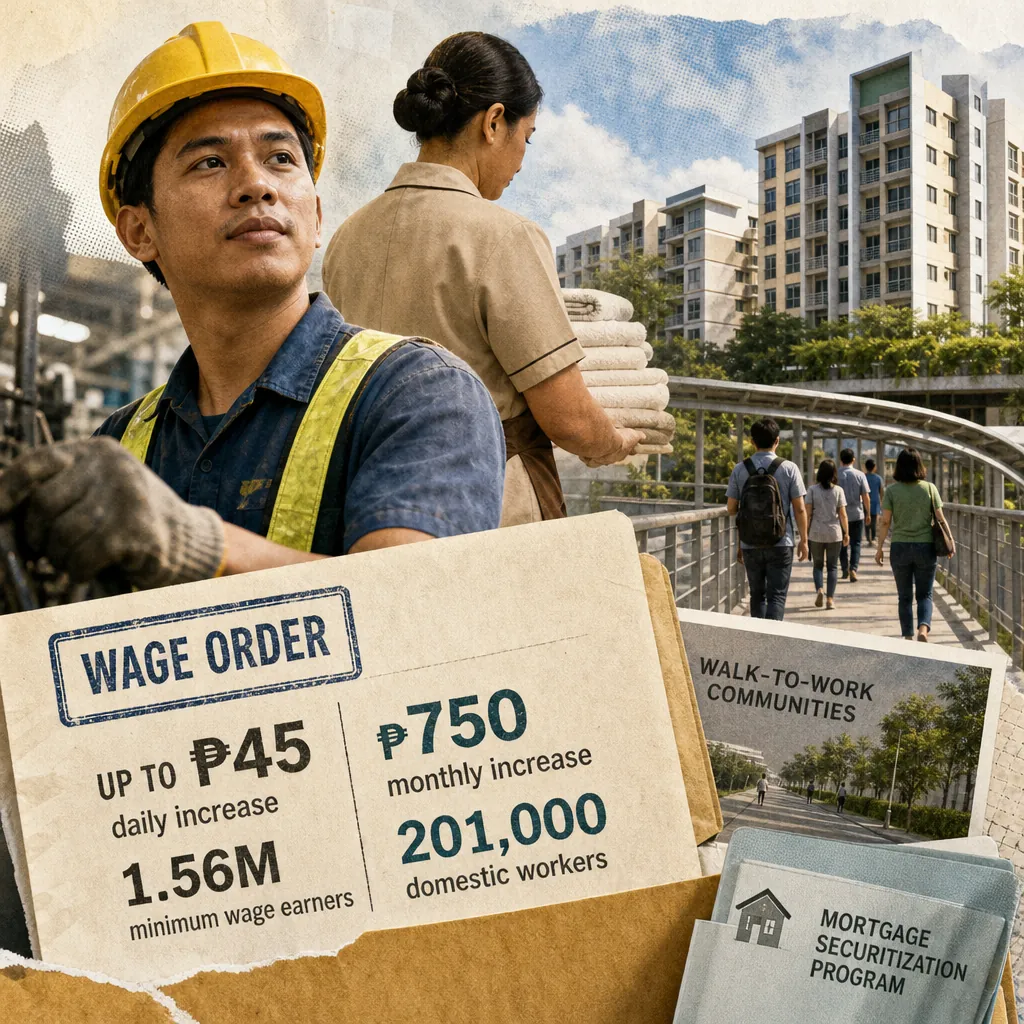
Two wage orders for Calabarzon landed on October 10, and together they reset the pay floor for roughly 1.76 million workers in the country's main industrial belt — a change that reaches directly into household budgets, rent capacity, and the affordability math behind every housing unit sold in the region.56
The Regional Tripartite Wages and Productivity Board IV-A, the regional body that sets minimum pay for Batangas, Cavite, Laguna, Quezon and Rizal, approved daily increases of P25 to P45 for more than 1.56 million minimum wage earners, and a separate order raised domestic workers' minimum monthly pay by P750, to P7,500, covering about 201,000 househelps, nannies, cooks, gardeners and laundry workers.56 Both take effect October 26. The Inquirer's two stories on the orders carried an estimated P213,948 and P226,044 in advertising-equivalent value respectively — the notional cost of buying the same space as paid advertising, not a count of readers.56
On the same day, the housing side of the beat produced a cluster of institutional stories: the Home Development Mutual Fund, better known as the Pag-IBIG Fund, signed an agreement with the Bases Conversion and Development Authority to build a walk-to-work township in New Clark City, Tarlac, under the government's Expanded 4PH housing program29; the National Home Mortgage Finance Corp. signed a P1.465-billion residential mortgage-backed securities issuance backed by 2,115 housing loans47; and a Manila Times feature urged condo buyers to spend time in the Mall of Asia Complex neighborhood before committing to a unit.1 A Facebook post about five Palawan siblings receiving a house and lot from Manny Villar and Vista Land drew seven likes and two love reactions, while a post promoting a diner at Avida Towers in Iloilo drew 56 shares and 11 comments.23
Key themes
- Calabarzon's daily minimum wage rises by P25 to P45 for 1.56 million workers. The increases vary by sector and by the income class of the city or municipality: non-agriculture workers in the Extended Metropolitan Area and component cities go from P600 to P645, while those in second- to fifth-class municipalities go from P525 to P550.5
- Domestic workers in the same region get a P750 monthly raise, to P7,500. The order covers live-in and live-out arrangements but excludes family drivers, service providers and workers hired occasionally or sporadically.6
- Pag-IBIG and BCDA will build a walk-to-work township in New Clark City. The memorandum of agreement, signed Thursday, advances the Expanded Pambansang Pabahay para sa Pilipino program and explores development on other government lands.29
- NHMFC issued P1.465 billion in mortgage-backed securities. The Bonds 8th issuance is backed by 2,115 long-term secured residential loans for low-cost and socialized housing, part of efforts to deepen the secondary mortgage market.47
- A developer feature pushed neighborhood testing over unit features. SMDC's October 10 piece on the Mall of Asia Complex told buyers to visit at different times and check routes, amenities and building rules before deciding.1
- Social posts tied developers to individual outcomes, not market trends. A Vista Land house-and-lot gift to a Palawan family and a diner at an Avida Towers project in Iloilo were isolated examples with no project, price or delivery details.23
- A Cebu resale listing showed the cost stack beyond the sticker price. A bare house-and-lot in Talisay was advertised at P1.3 million cash, with separate charges for document changes, move-in, utilities and construction permits.4
- Pasay's Bay Area is being marketed as an events destination. PNB Holdings promoted the PNB Financial Center's event spaces, with its Grand Atrium able to seat up to 1,500 guests.31
How the narratives stack
Dominant: The Calabarzon wage orders are the day's most consequential development for the housing sector, because they change what 1.76 million workers in the region can pay for rent and mortgages. The orders were the only items in the captured set that alter household income at scale, and they were covered by the Inquirer in two separate stories with a combined advertising-equivalent value of about P440,000.56 The wage board's decision is final and dated — effectivity October 26 — which gives the sector a fixed point to plan around.
Counter-narrative: The housing institutions' own announcements — the Pag-IBIG–BCDA township agreement and the NHMFC securitization — frame the same affordability problem from the supply and financing side. Pag-IBIG's partnership with BCDA aims to put homes within walking distance of jobs in New Clark City, addressing the transport cost that eats into a worker's take-home pay.29 NHMFC's P1.465-billion issuance, backed by 2,115 loans, is a mechanism to recycle capital so lenders can keep writing housing loans.47 Both are structural answers to a problem the wage orders address only at the margin.
Emerging: The SMDC feature and the social posts point to a buyer conversation shifting toward neighborhood quality and total cost of ownership. SMDC's advice to test a neighborhood at ordinary times and during events is a marketing frame, but it reflects a real buyer concern: what daily life costs beyond the unit.1 The Cebu listing's itemized extra charges — documents, move-in, utilities, permits — show the same concern from the resale side.4 The Avida Towers diner post, with 56 shares and 11 comments, shows commercial tenants at residential projects generating more social interaction than the housing posts themselves.3
Under-covered: The Vista Land post about the Palawan family is the clearest single development in the social writeup, but it carries no project name, price or delivery detail, and no outlet in the captured set followed it up.2 The PNB Financial Center events push and the Pasay Bay Area positioning also drew limited attention relative to their commercial significance.31
Platform insights
- Facebook: The platform carried the day's only measurable social engagement. A post about a diner at Avida Towers in Mandurriao, Iloilo City — describing food, art displays and free painting materials, with a P700 workshop — drew 56 shares and 11 comments, the highest interaction in the set.3 A post about five Palawan siblings receiving a house and lot from Vista Land drew seven likes and two love reactions, a small but positive response.2 A bare house-and-lot listing in Talisay, Cebu, at P1.3 million cash drew no likes, shares or comments, suggesting that listings without emotional or lifestyle framing generate little response in these groups.4
- X: No posts from this platform appeared in the monitoring writeup for the day.
- Reddit: No posts from this platform appeared in the monitoring writeup for the day.
- YouTube: No posts from this platform appeared in the monitoring writeup for the day.
Key voices and communities
Calabarzon wage boards and the Department of Labor and Employment: The Regional Tripartite Wages and Productivity Board IV-A is the body that sets minimum pay in the region, and its orders are the day's most concrete development. The board's decisions are binding on employers and take effect October 26.56
Pag-IBIG Fund and BCDA: The two agencies signed the walk-to-work township agreement, positioning themselves as the supply-side answer to housing affordability. Pag-IBIG is the government's mandatory savings and housing loan program for workers; BCDA manages former military bases and government land for development.29
NHMFC and the secondary mortgage market: NHMFC President Renato Tobias framed the P1.465-billion issuance as a step in strengthening the secondary mortgage market, which matters because it determines whether lenders have capital to keep issuing housing loans.47
Developers and their marketing arms: SMDC, Vista Land and Avida all appeared in the day's content, but through different channels — SMDC through a newspaper feature, Vista Land and Avida through Facebook posts. The contrast shows how developers use print for guidance and social for lifestyle and goodwill.123
Resale sellers and buyers in provincial markets: The Talisay listing, with its itemized extra charges, represents the informal resale market where buyers must budget beyond the advertised price.4
Narrative streams
Calabarzon wage orders reset the pay floor for 1.76 million workers
The Regional Tripartite Wages and Productivity Board IV-A approved daily increases of P25 to P45 for more than 1.56 million minimum wage earners, with the highest increase going to non-agriculture workers in the Extended Metropolitan Area and component cities, whose daily pay rises from P600 to P645.5 Agriculture workers in the same areas get P25, from P525 to P550. In first-class municipalities, non-agriculture workers get P40, except in Rosario, Cavite, where the increase is P45. In second- to fifth-class municipalities, non-agriculture workers get P25.5 A separate order raised domestic workers' minimum monthly pay by P750, from P6,750 to P7,500, covering about 201,000 workers in live-in and live-out arrangements.6
The read for the housing sector is that rent and mortgage capacity in Calabarzon rises for households at the bottom of the pay scale, but only by P25 to P45 a day — roughly P550 to P990 a month for a six-day work week. That is a meaningful addition to a household budget in a region where a socialized housing unit can cost under P1 million, but it does not change the fundamental affordability gap. Developers targeting Calabarzon's industrial workforce should expect buyers to factor the increase into down payment and amortization calculations, and lenders should expect slightly higher loan eligibility at the margin. The wage orders also set a precedent: the National Wages and Productivity Commission approved the adjustments after reviewing the region's socioeconomic conditions, and other regions may follow.6
Pag-IBIG and BCDA sign a walk-to-work township deal in New Clark City
The Home Development Mutual Fund, known as the Pag-IBIG Fund, signed a memorandum of agreement with the Bases Conversion and Development Authority on Thursday to pursue a walk-to-work township in New Clark City, Tarlac, and to explore development opportunities on other government lands.29 The partnership advances President Ferdinand Marcos Jr.'s Expanded Pambansang Pabahay para sa Pilipino program, known as Expanded 4PH, which aims to build housing units for low-income families. The agreement was signed by Pag-IBIG Fund CEO Marilene Acosta, BCDA President and CEO Joshua Bingcang, and other officials, with Department of Human Settlements and Urban Development Secretary Jose Ramon Aliling present as Pag-IBIG board chairman.29
The read for the sector is that the government is trying to solve two problems at once: the housing shortage and the cost of commuting. New Clark City is a planned development in Tarlac, north of Manila, designed to decongest the capital. Putting homes within walking distance of jobs there reduces transport costs for workers and makes the housing more affordable in practice, even if the unit price is unchanged. For developers, the signal is that government land near job centers will be opened for residential development, creating partnership opportunities. For buyers, the question is whether the township will have the schools, clinics and retail that make a neighborhood livable, not just the homes.29
NHMFC's P1.465-billion mortgage-backed securities issuance
The National Home Mortgage Finance Corp. signed its Bonds 8th Residential Mortgage-Backed Securities issuance, valued at approximately P1.465 billion, on September 30 at Raffles Hotel Makati.47 The issuance is backed by 2,115 long-term secured residential loans covering low-cost and socialized housing units. NHMFC President Renato Tobias said the offering marks another step in strengthening the secondary mortgage market's role in Philippine housing finance.47
Securitization is the process of bundling loans into securities that investors can buy. For housing, it matters because it lets lenders sell their loans and use the proceeds to issue new ones, rather than waiting years for borrowers to repay. The read for the sector is that NHMFC is trying to build a funding pipeline for low-cost housing, where commercial banks are often reluctant to lend because the margins are thin and the terms are long. If the secondary market deepens, developers of socialized housing gain a more reliable source of buyer financing, which supports demand. The risk is that securitization depends on borrowers continuing to pay, and any deterioration in loan performance would affect future issuances.47
SMDC tells buyers to test the neighborhood before the unit
SM Development Corporation, the residential property arm of SM Prime, published an October 10 feature in The Manila Times urging prospective condominium buyers to spend time in the Mall of Asia Complex in Pasay City before choosing a home.1 The feature highlighted nearby restaurants, shops, waterfront areas, event venues and Museo del Galeón, which opened in May 2026. It described housing options including homes and residential-office units in the complex, and suggested exploring the area at different times and checking travel routes, amenities and building rules before deciding.1
The read for the sector is that developers are competing on neighborhood experience as much as unit features. The advice to visit at an ordinary time and during a nearby event is practical, but it also serves a marketing purpose: it invites buyers to imagine their daily routine in the complex. For buyers, the feature is a reminder that the total cost of a home includes transport, food and leisure spending in the surrounding area, not just the monthly amortization. For developers, the message is that master-planned communities with retail, culture and waterfront access can command attention even in a market where affordability is the dominant concern.1
Social posts link developers to individual outcomes, with little detail
A Facebook post on October 10 said five siblings in Palawan received a house and lot from Manny Villar and Vista Land after losing their mother and never receiving a court award of two million pesos. The post drew seven likes and two love reactions.2 The same day, a post promoted Starboard Diner at Avida Towers in Mandurriao, Iloilo City, describing food, art displays and painting activities, with free painting materials and a P700 workshop. It received 56 shares and 11 comments.3 A separate listing advertised a bare house-and-lot unit in Preciousville Subdivision, Lagtang, Talisay, Cebu, for P1.3 million in cash, with additional charges for document changes, moving in, utilities and construction permissions. It received no likes, shares or comments.4
The read for the sector is that social media posts about housing generate engagement when they carry an emotional story or a lifestyle experience, and almost none when they are bare listings. The Vista Land post links a named developer to a personal housing outcome, but it gives no project, price or delivery details, so it cannot be read as evidence of a broader change in buyer demand or company performance.2 The Avida Towers diner post shows that commercial tenants at residential projects can generate more social interaction than the housing units themselves, which matters for developers trying to build community life around their projects.3 The Talisay listing's itemized extra charges — documents, move-in, utilities, permits — show the hidden costs that buyers in the resale market must budget for, and the absence of engagement suggests that listings without emotional or lifestyle framing are easily ignored.4
Pasay Bay Area markets itself as an events hub
PNB Holdings Corp. is promoting its event spaces at the PNB Financial Center as options for organizers seeking venues near major commercial and entertainment destinations in Pasay City.31 The district has become a hub where conventions, performances, tourism and retail converge, with landmarks such as the Bangko Sentral ng Pilipinas, the Cultural Center of the Philippines and the Coconut Palace alongside hotels, exhibition halls and shopping destinations. The PNB Financial Center, designed by National Artist for Architecture Gabriel Formoso, features a Brutalist style, and its largest venue, The Grand Atrium, can accommodate up to 1,500 guests.31
The read for the sector is that Pasay's Bay Area is positioning itself as a competitor to Makati and Bonifacio Global City for corporate events, which supports hotel occupancy, retail spending and property values in the surrounding area. For developers with projects in the Bay Area, the events business adds a demand driver beyond residential and office use. For event organizers, the pitch is proximity to entertainment and commercial destinations, which reduces transport time for attendees.31
Conversation trajectory
Wage order implementation (October 26): The Calabarzon wage orders take effect on October 26. Watch for employer compliance announcements, any petitions for exemption from distressed businesses, and whether other regional wage boards follow with their own adjustments. The Department of Labor and Employment typically issues guidance on implementation within two weeks of an order's publication.56
Pag-IBIG–BCDA township details (next 4–6 weeks): The memorandum of agreement sets the framework, but the specific location, unit count, price points and construction timeline for the New Clark City township have not been announced. Watch for a project launch or a joint briefing that provides these details, which will determine whether the walk-to-work concept is a pilot or a template for other government lands.29
NHMFC's next issuance (first half of 2027): The P1.465-billion Bonds 8th issuance is the latest in a series. Watch for NHMFC's announcement of the next issuance and any change in the loan performance of the underlying portfolio, which would affect investor appetite for future socialized housing securitization.47
Developer sales and price data (fourth quarter 2026): The wage orders and the housing programs will show up in buyer behavior only after they take effect. Watch for fourth-quarter sales reports from developers with Calabarzon exposure and for any change in the mix of socialized versus mid-market units sold, which would indicate whether the wage increase is expanding the buyer pool.56
Trigger events: The October 26 effectivity date for the wage orders; any announcement from Pag-IBIG or BCDA on the New Clark City township; NHMFC's next securitization; and the release of fourth-quarter housing sales data.
Response guidance
For developers with Calabarzon exposure: Recalculate affordability thresholds for buyers earning the new minimum wage. A P45 daily increase adds about P990 a month for a six-day work week, which may qualify some buyers for slightly larger loans. Update sales materials to reflect the new pay floors and consider payment terms that align with the October 26 effectivity date.5
For lenders and mortgage providers: Review loan eligibility criteria for minimum wage earners in Calabarzon. The wage orders change the income documentation that borrowers will present, and lenders should be ready to process applications that reflect the new rates. Coordinate with Pag-IBIG on any changes to its housing loan program parameters.56
For Pag-IBIG and government housing agencies: Communicate the walk-to-work township's benefits in terms of total household cost, not just unit price. Buyers need to understand how reduced transport spending affects their monthly budget. Provide clear timelines for the New Clark City project so buyers and developers can plan.29
For developers using social media: The day's engagement data shows that emotional stories and lifestyle experiences generate interaction, while bare listings do not. Invest in content that shows daily life in a community — food, art, activities — rather than unit specifications alone. The Avida Towers diner post's 56 shares and 11 comments show the potential of tenant-focused content.3
For event venue operators in Pasay: The PNB Financial Center's push for corporate events signals competition for the same organizers who book Makati and BGC venues. Differentiate on access, capacity and the Bay Area's entertainment cluster. The Grand Atrium's 1,500-guest capacity positions it for large conventions and receptions.31
For resale sellers and brokers: The Talisay listing's itemized extra charges — documents, move-in, utilities, permits — are a transparency practice that buyers need. Present the total cost of ownership upfront to build trust, even if it means the advertised price looks higher than competing listings.4
For communicators addressing housing affordability: Connect wage orders to housing demand in plain terms. The P25 to P45 daily increase is a small change in absolute terms, but for a household at the minimum wage, it is a measurable shift in what they can afford. Avoid framing the increase as a solution to the affordability gap; it is a marginal improvement that developers and lenders should factor into their planning.56
See the full picture behind today's signals.
This report draws from Media Meter's MediaWatch, our real-time monitoring engine tracking 2,470+ Philippine sources across print, broadcast, digital, and social. Explore how the platform turns raw coverage into decision-grade intelligence, then see how it's configured for teams like yours — whether you're in PR agencies, corporate comms, government, or marketing.
Want more? Browse our Report Library for sector and crisis intelligence, or request a demo and we'll have your brand set up before the call.
Want this kind of intelligence on your brand?
This brief is built on the same MediaWatch methodology that runs continuously across every brand we monitor. See your competitive landscape, Impact Score, and narrative trajectory in a 30-minute demo.