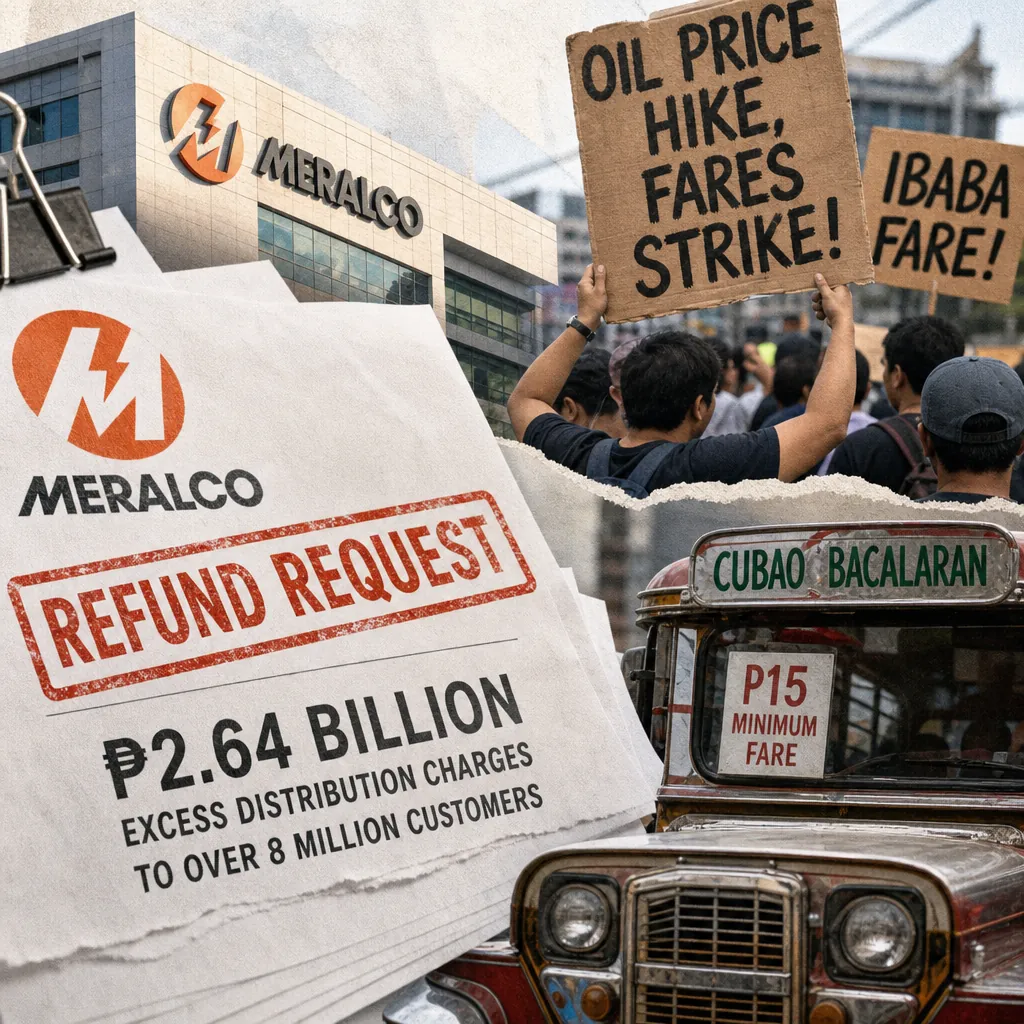
New Clark City Lands $1-B Taiwan Plant, P15-B Water Bid
A Taiwanese manufacturer signs for a $1-billion plant in New Clark City while the state developer opens the city's P14.8-billion water and wastewater project to rival bids. Transport groups in Iloilo plan a two-day strike over fuel prices as government aid reaches Western Visayas operators.
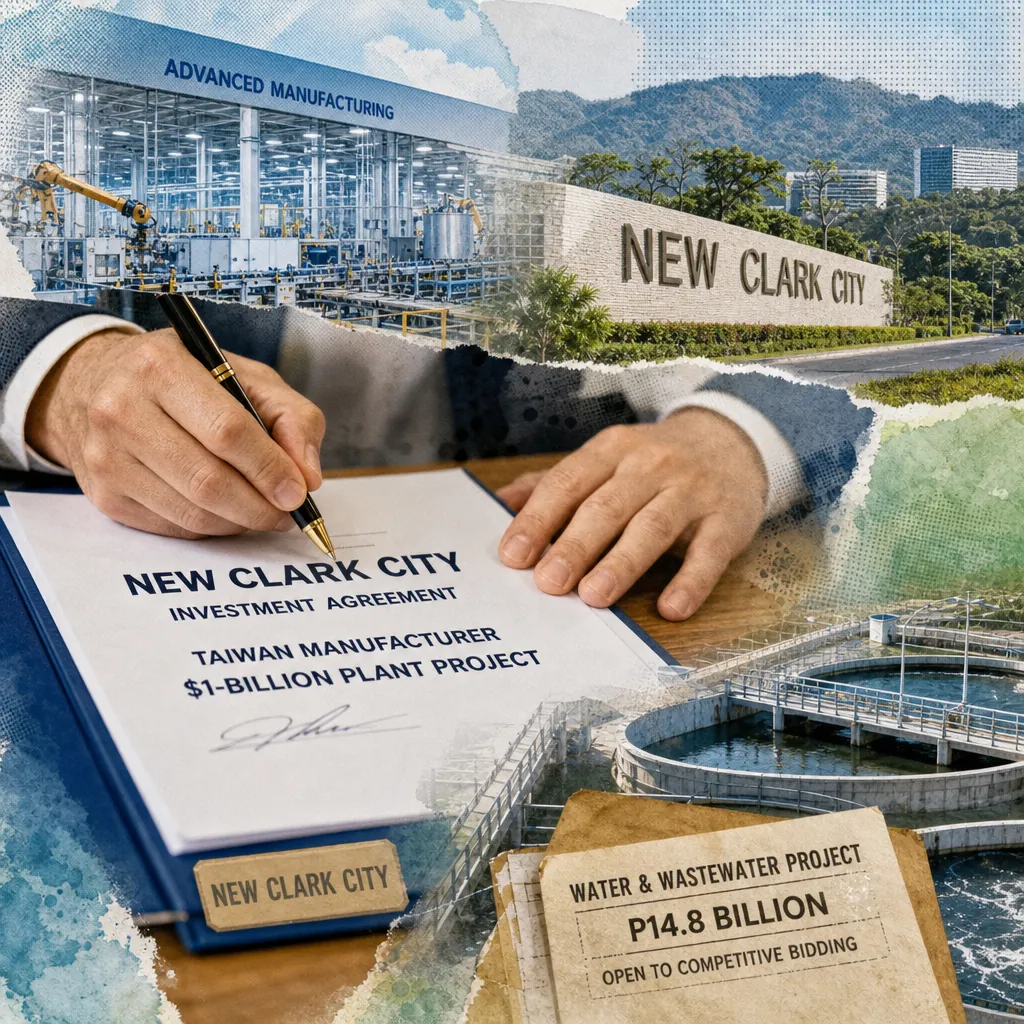
New Clark City, the industrial and administrative hub rising on the former United States military reservation in Tarlac, drew two commitments in the same news cycle: a Taiwanese manufacturer signed on for a roughly $1-billion plant, and the state agency developing the site opened its P14.8-billion water and wastewater project to competing bidders. The Bases Conversion and Development Authority (BCDA), the government corporation that converts former military bases into commercial and industrial estates, confirmed both. BCDA President and Chief Executive Officer Joshua Bingcang said the Taiwanese company had already signed an agreement and paid in advance to secure its site, and that it will initially occupy 30 hectares inside the Filinvest Innovation Park, with another 60 hectares reserved for expansion.14 The investor's identity is being withheld at the owner's request until it registers with the Philippine Economic Zone Authority (PEZA), the agency that grants tax and customs incentives to export-oriented locators.62 Bingcang said the project was among the first approved under the amended Investors Lease Act, which now allows foreign investors to lease land for longer terms.14
Separately, BCDA invited challengers to bid against the original proposal from Maynilad Water Services Inc. and Korea Water Resources Corp. (K-Water) for the New Clark City water supply and wastewater system, a project estimated at P14.8 billion.12 The two firms submitted an unsolicited proposal in January and received original proponent status on August 28; under Philippine public-private partnership rules, that status entitles them to match any better offer, a process known as a Swiss challenge.44 Interested parties must pre-qualify and pay a non-refundable P1-million fee, with comparative proposals due October 20 and the challenge running 90 days.67 The concession would run 25 years, subject to extension.44
Both stories ran across the business desks of the Philippine Daily Inquirer, the Manila Bulletin, and the BusinessMirror, and both concern the same patch of ground: a former air base being rebuilt as a technology and logistics hub. The water project matters because New Clark City has no utility-scale water and sewer system of its own; the manufacturing plant matters because it is the largest single private commitment announced for the site so far. Neither is finished. The Taiwanese investor has not been named, and the water deal has not been awarded.
Key themes
- A $1-billion Taiwanese plant anchors New Clark City's manufacturing push. The undisclosed company signed an agreement and paid in advance for 30 hectares in Filinvest Innovation Park, with an option on 60 more, according to BCDA.14 Bingcang said the facility would generate "billions of dollars" in exports once fully operational.62
- The P14.8-billion Clark water project enters a 90-day bidding contest. BCDA opened the Maynilad–K-Water proposal to comparative bids, with pre-qualification documents available from September 28 and proposals due October 20.1267 The original proponents retain the right to match any superior offer.
- Iloilo transport groups call a two-day strike over fuel prices. The No to Oil Price Hike Coalition will hold protests at Jaro Plaza on September 29 and 30, demanding lower fuel prices and higher wages, and criticizing the Oil Deregulation Law for reducing government control over pricing.28
- Government aid reaches Western Visayas jeepney and van operators. The Land Transportation Franchising and Regulatory Board (LTFRB) allocated about 1,500 slots for P20,000 monthly assistance per unit over three months, up to P60,000 each, to help modernized jeepney and UV Express operators cover loan amortization.23
- Foxconn scouts beyond New Clark City. Representatives of the Taiwanese contract manufacturer, identified by the government as a potential anchor tenant for the planned 1,619-hectare artificial intelligence hub, also visited the 600-hectare First Philippine Industrial Park in Batangas during a September 11 investor delegation.13
- A Cebu City councilor seeks to pause upland development. Councilor Alvin Arcilla proposed suspending new condominium and subdivision approvals in Talamban until water supply and traffic problems are addressed; the council referred the measure to committees instead of adopting it.65
- Mandaue expands its flood early-warning network. Two water-level stations and water post stations will be installed at Canduman Bridge and Butuanon Bridge II under a weather bureau program, with a third post at the 6.5 Relocation Site.66
- Housing developers adopt a seven-point policy roadmap. The Subdivision and Housing Developers Association (SHDA) closed its 34th National Developers Convention with resolutions aimed at accelerating housing delivery, after gathering more than 400 policymakers, regulators, and industry leaders.33
How the narratives stack
Dominant: The New Clark City investment and water-bidding stories dominated the business coverage in this set. The Taiwanese plant was reported by the Inquirer, the Manila Bulletin, and the BusinessMirror, and the water challenge by the Inquirer, the BusinessMirror, and the Manila Bulletin — six items across three outlets on two linked developments.142962124467 The Inquirer's report on the Taiwanese investment carried an estimated P303,156 in advertising-equivalent value, the notional cost of buying the same space as paid advertising, and the BusinessMirror's water story carried P344,088.1444 The concentration of coverage in business sections reflects both the size of the commitments and the fact that BCDA briefed reporters at a single event, the Foreign Correspondents Association of the Philippines forum in Taguig.29
Counter-narrative: The Iloilo transport strike and the LTFRB assistance program present the same fuel-price problem from opposite ends — protest and subsidy. The strike story, carried by the Iloilo-based Daily Guardian, frames rising pump prices as a failure of the Oil Deregulation Law, which removed the government's power to set fuel prices and left them to market forces.28 The assistance story, carried by Panay News, frames the same pressure as a problem the state is mitigating with cash.23 Neither outlet is a national business daily, and neither story appeared in the broadsheet business pages captured here, which suggests the coverage split along geographic lines as much as editorial ones.
Emerging: Two local governance stories point to the same constraint on growth. In Cebu City, a proposal to suspend new high-density residential approvals in Talamban until the Metropolitan Cebu Water District fixes supply and the Cebu Bus Rapid Transit eases traffic was referred to committee rather than passed.65 In Mandaue, the city is adding flood monitoring stations because existing ones do not cover all vulnerable areas.66 Both are responses to infrastructure lagging behind development, and both are early-stage: a referral is not a suspension, and a monitoring station is not a drainage system.
Under-covered: The SHDA's seven-point resolution roadmap, adopted at a convention that drew more than 400 stakeholders on September 16 and 17, received a single item in this set and no follow-up on whether the resolutions have been taken up by the agencies they target.33 The convention's timing — two weeks before the New Clark City announcements — makes it relevant context for the housing supply question, but the coverage here does not connect them.
Platform insights
- Facebook: The most-shared item in this set was not a news story but a sports announcement. The Golden State Warriors posted a tribute to Stephen Curry minutes after he signed a two-year, $116-million contract extension, and the post was quoted in the coverage itself: "If you ever get sad, just remember the earth is 4.54 billion years old and you somehow managed to exist at the same time as Stephen Curry."34 The post's reach is not measurable from the data here, but its inclusion in a Philippine community paper's sports coverage shows how a US team's own social account becomes a source for local outlets.
- X (formerly Twitter): The Drake Maye fumble clip circulated on X before it appeared in written coverage, with a slow-motion replay posted by a sports account and embedded in the Yahoo Sports article.8 The pattern — a single video clip driving a story that then gets written up — is the same one that carried the Curry news, though the Curry item originated on the team's own page rather than a fan account.
- Reddit: No Reddit activity appears in the material reviewed here. The absence is worth noting only because the topics that would normally generate it — the fuel strike, the Clark water bidding — are the kind that draw local subreddit discussion, and none was captured.
- YouTube: President Marcos's vlog carried the birthday greeting to his longtime photographer Wilfredo "Tata Willy" Avila, who turned 89.11 The vlog format is now a routine channel for presidential communications, and the Inquirer's story was built directly from the video rather than from a press release.
Key voices and communities
BCDA and its president, Joshua Bingcang. Bingcang is the single most quoted official in this set, appearing in the Taiwanese investment story, the water challenge story, and the Foxconn item.14294413 His framing is consistent: New Clark City needs anchor locators, and the agency is using the amended Investors Lease Act and the Swiss challenge process to get them. He told reporters the Taiwanese project is "the kind of project that we need to shore up our manufacturing industry."62
Transport operators and the No to Oil Price Hike Coalition. The coalition's statement says fuel prices have risen from around P55 per liter and that drivers' daily income has fallen to as little as P1,000.28 The group's demands go beyond pump prices to the Oil Deregulation Law itself, which it says gave oil companies greater influence over pricing. This is a constituency that measures policy in daily take-home pay, and its two-day strike is the most concrete expression of fuel-price pressure in the set.
The LTFRB and its regional offices. The board's Western Visayas office, led by Chief Transportation and Development Officer Joscet Abellar, is administering the P20,000-per-month assistance to about 1,500 operators.23 The program's design — three monthly payments, tied to valid franchise documents — makes it a debt-relief measure as much as a fuel subsidy, since the stated purpose is to prevent loan defaults on modernized units.
Local government councils in Cebu. The Cebu City Council's debate over the Talamban suspension and the Mandaue council's flood-monitoring expansion show local legislators responding to the same problem — development outrunning infrastructure — with different tools.6566 The Cebu City measure's referral to committee, rather than adoption, indicates the council is not yet convinced a blanket suspension is the right instrument.
Housing developers organized through SHDA. The association's convention resolutions represent the industry's own diagnosis of what slows housing delivery, and its membership of more than 400 stakeholders gives it a seat at the table with the regulators it is asking to act.33
Narrative streams
New Clark City's $1-billion anchor tenant
The Taiwanese company that signed for the Filinvest Innovation Park site has not been named, and that anonymity is itself part of the story. Bingcang said the identity would be disclosed once the firm registers with PEZA, the agency that administers incentives for export locators.62 The sequencing matters: the agreement and advance payment are done, but the incentive registration is not, which means the project's fiscal terms are still open. The company will start on 30 hectares and has reserved 60 more for expansion, a footprint that suggests a phased build rather than a single facility.14 Bingcang said the project was among the first approved under the amended Investors Lease Act, a law that lengthened the terms under which foreign investors can lease land in the Philippines — a change aimed squarely at manufacturers who need decades, not years, to recover capital costs.14
The read for the sector is that New Clark City has moved from marketing to contracting. For the industrial estate developers and construction firms that will build the plant, the commitment converts a pipeline story into a schedule. For PEZA, it creates a test of how quickly the incentive registration can be completed now that the commercial agreement is signed. And for the other foreign investors Bingcang says are circling — a South Korean company and a Singaporean investor among them — the Taiwanese firm's willingness to pay in advance sets a benchmark for how serious the site's prospects are.29
The P14.8-billion water challenge
The New Clark City water and wastewater project is the kind of infrastructure that rarely makes headlines but determines whether everything else works. Maynilad and K-Water submitted an unsolicited proposal on January 29 for a 25-year concession to build, operate, and maintain the system.44 Under the Swiss challenge framework, the government publishes the proposal, invites competitors to beat it, and gives the original proponent the right to match the best offer. BCDA's notice requires challengers to pre-qualify and pay a P1-million non-refundable fee, with proposals due October 20 and the challenge period running 90 days.67
The structure explains why the project is being bid this way. Unsolicited proposals let the government avoid the cost of designing a project from scratch, but they also risk locking in terms that were never tested against the market. The Swiss challenge is the test. For Maynilad and K-Water, the risk is that a challenger offers better terms and they must either match or walk away. For BCDA, the risk is that no credible challenger emerges, in which case the original proposal stands unchallenged and the agency has spent 90 days to confirm what it already had. The read for the sector is that water and wastewater concessions in new industrial cities are now competitive enough to attract multiple bidders, which was not true a decade ago when unsolicited proposals were routinely awarded without challenge.
Fuel prices, a strike, and a subsidy in Western Visayas
The No to Oil Price Hike Coalition's two-day strike at Jaro Plaza on September 29 and 30 is the sharpest expression of fuel-price frustration in this set. The coalition says prices have risen from around P55 per liter and that drivers' daily income has fallen to as little as P1,000.28 Its target is not just the pump price but the Oil Deregulation Law, which removed the government's authority to set fuel prices and left them to market forces — a policy choice made in the late 1990s that coalition members now say gave oil companies too much pricing power.28
The government's response, administered through the LTFRB, is a cash transfer rather than a price intervention. About 1,500 slots were allocated for Western Visayas, including Negros Occidental and Bacolod City, with qualified modernized jeepney and UV Express operators receiving P20,000 per unit per month for three months, up to P60,000 each.23 The stated purpose is to help cover amortization payments or operating expenses — in other words, to keep operators from defaulting on the loans they took out to buy modernized units under the government's public utility vehicle modernization program. That program required operators to replace older jeepneys with newer, compliant vehicles, often financed through bank loans. When fuel prices rise, the loan payments do not fall, and the assistance is designed to bridge that gap.
The read for the sector is that the modernization program's financing model is exposed to fuel-price shocks. Operators who borrowed to comply with the program now depend on government aid to service those loans when diesel and gasoline prices climb. For the banks that wrote the loans, the assistance reduces default risk in the short term but does not change the underlying economics. For the LTFRB, the program is a recurring obligation as long as global oil prices remain volatile, and the agency has not said whether the three-month window will be extended.
Foxconn's wider search and the Luzon Economic Corridor
Foxconn, the Taiwanese contract manufacturer best known for assembling Apple products, is looking at more than the planned artificial intelligence hub in New Clark City. Representatives joined a delegation of international investors that visited the 600-hectare First Philippine Industrial Park in Sto. Tomas, Batangas, on September 11, in a program organized by the US Trade and Development Agency and PEZA.13 The government has identified Foxconn as a potential anchor locator for the 1,619-hectare Pax Silica hub, but the Batangas visit shows the company is evaluating the broader Luzon Economic Corridor, the planned network of industrial and logistics zones stretching from Metro Manila through Central Luzon and southward.13
The read for the sector is that the competition for Foxconn's investment is now between sites within the Philippines, not between the Philippines and other countries. The First Philippine Industrial Park, developed by the Lopez group, already has infrastructure and tenants in place; New Clark City is still building its water system. For the industrial estate operators, the visit is a reminder that anchor tenants compare sites on readiness, not just incentives. For the government, it means the corridor concept has to deliver on connectivity between the zones if it is to convert interest into commitments.
Cebu's infrastructure lag and the pushback on upland development
Cebu City Councilor Alvin Arcilla's proposal to suspend new condominium and subdivision approvals in Talamban and other northern upland areas is a direct response to infrastructure that has not kept pace with construction. The resolution urges the City Planning and Development Office, the Business Permit and Licensing Office, and the Office of the Building Official to stop accepting new high-density residential applications until the Metropolitan Cebu Water District addresses supply problems and traffic decongestion measures such as the Cebu Bus Rapid Transit are in place.65 The council referred the measure to committees after a lengthy debate, with other councilors calling for clear standards and technical studies rather than an immediate freeze.65
In Mandaue, the response to a similar problem is technical rather than regulatory. The city is adding two water-level stations and water post stations at Canduman Bridge and Butuanon Bridge II, plus a third post at the 6.5 Relocation Site, under the Department of Science and Technology's weather bureau flood early-warning program.66 The stations measure rising water levels so that residents can be warned before flooding, which is a mitigation measure rather than a solution to the drainage problems that cause the flooding.
The read for the sector is that Cebu's upland developers face a growing risk that approvals will slow as water and traffic constraints bind. The council's referral, rather than adoption, means no freeze is in place yet, but the debate itself signals that the political tolerance for unconstrained high-density development in areas without adequate water supply is narrowing. For developers with projects in the pipeline, the practical effect is uncertainty about timelines. For the water district and the transport agencies, it is pressure to demonstrate progress before the next election cycle.
Housing developers' policy wish list
The Subdivision and Housing Developers Association's 34th National Developers Convention, held September 16 and 17 at Marquis Events Place in Bonifacio Global City, concluded with a seven-point resolution roadmap aimed at accelerating housing delivery.33 The convention drew more than 400 stakeholders, including national policymakers, regulators, financial institutions, and industry leaders, under the theme "Elevate: Sustaining Progress through Collaboration and Strategic Housing Innovations."33 The resolutions themselves are not detailed in the coverage captured here, but the format — an industry association presenting a consolidated policy wish list to the agencies that regulate it — is a standard pre-legislative maneuver.
The read for the sector is that housing developers are trying to shape the rules before the next round of policy changes rather than reacting to them afterward. The timing, two weeks before the New Clark City announcements, puts the housing supply question in the same frame as the industrial land question: both depend on infrastructure, financing, and regulatory predictability. For the agencies named in the resolutions, the convention output is a set of specific asks that can be tracked against actual policy movement.
Conversation trajectory
Over the next two weeks (through October 20): The Swiss challenge for the New Clark City water project enters its pre-qualification phase, with comparative proposals due October 20.67 Watch for whether any challenger pays the P1-million fee and pre-qualifies. A single credible challenger would validate the competitive process; none would leave Maynilad and K-Water's original terms effectively untested. The BCDA is scheduled to issue instructions to prospective challengers on September 28.67
September 29–30: The No to Oil Price Hike Coalition's strike at Jaro Plaza proceeds as planned.28 The observable signal is turnout and whether the protest spreads to other regions. A two-day local action is a contained event; a multi-region strike would indicate the fuel-price pressure is broader than Western Visayas. The LTFRB's assistance program, meanwhile, is in its first month of a three-month window, and the agency has not indicated whether it will extend.23
Within the next quarter: The Taiwanese manufacturer's PEZA registration will determine when its identity and incentive terms become public.62 The registration is the next formal step, and its completion — or delay — will indicate how quickly the project moves from agreement to construction. Bingcang has said the company intends to reserve another 60 hectares for expansion, which would be a second signal of confidence if exercised.14
Ongoing: The Cebu City Council's committee review of the Talamban suspension proposal will produce either a revised measure or a decision not to proceed.65 The council's debate indicated that the votes for a blanket freeze are not there yet, but the referral keeps the issue alive. In Mandaue, the flood monitoring stations are a procurement and installation process, not a policy question, and their completion is a matter of months rather than weeks.66
Trigger events to watch: A PEZA registration announcement for the Taiwanese investor; a challenger pre-qualifying for the Clark water project; an extension or expiration of the LTFRB assistance program; and any movement on the SHDA resolutions by the agencies they target.33
Response guidance
For infrastructure and industrial estate communicators: Lead with the contracting milestones, not the pipeline. The Taiwanese investment is newsworthy because an agreement was signed and an advance payment made, not because another company expressed interest. When communicating about New Clark City, distinguish between signed commitments and expressions of interest, because the coverage in this set did exactly that and readers noticed the difference.1429
For transport and logistics communicators: The fuel-price story is being told in two registers — protest and subsidy — and both are legitimate. Operators who receive LTFRB assistance should be prepared to explain what the money covers and what happens when the three months end.23 The coalition's criticism of the Oil Deregulation Law is a policy argument, not a personal grievance, and responding to it requires engaging with the law's design rather than dismissing the protest.28
For property developers in Cebu and other constrained markets: The Talamban proposal is a warning that water and traffic capacity are becoming approval criteria, not just operating costs.65 Developers with upland projects should be able to show how their water supply and traffic impact will be managed before the council asks. The Mandaue flood-monitoring expansion is a reminder that local governments are investing in measurement, which means claims about drainage and flood risk will increasingly be checkable.66
For housing industry associations: The SHDA's seven-point roadmap gives the sector a consolidated position, but the coverage here did not report what the seven points are.33 Publishing the resolutions in full and tracking agency responses would give the industry a way to measure progress and give journalists something to follow up on.
For all sectors in this set: The common thread is that infrastructure commitments are being made faster than the systems to support them are being built. The water project, the flood monitors, the upland development pause, and the transport subsidy are all responses to that gap. Communicators should expect questions about sequencing — what gets built first, and who pays for the delay — and should have answers that go beyond the announcement date.
See the full picture behind today's signals.
This report draws from Media Meter's MediaWatch, our real-time monitoring engine tracking 2,470+ Philippine sources across print, broadcast, digital, and social. Explore how the platform turns raw coverage into decision-grade intelligence, then see how it's configured for teams like yours — whether you're in PR agencies, corporate comms, government, or marketing.
Want more? Browse our Report Library for sector and crisis intelligence, or request a demo and we'll have your brand set up before the call.
Want this kind of intelligence on your brand?
This brief is built on the same MediaWatch methodology that runs continuously across every brand we monitor. See your competitive landscape, Impact Score, and narrative trajectory in a 30-minute demo.