COA: Yolanda housing in Pilar only 52% done
The Commission on Audit found a ₱191.27-million housing project for Typhoon Yolanda survivors in Pilar, Camotes Islands, was 52 percent complete at the end of 2025, more than three years past its deadline. The municipality says it has cut the target from 406 homes to 260 and expects to finish by May 2026.
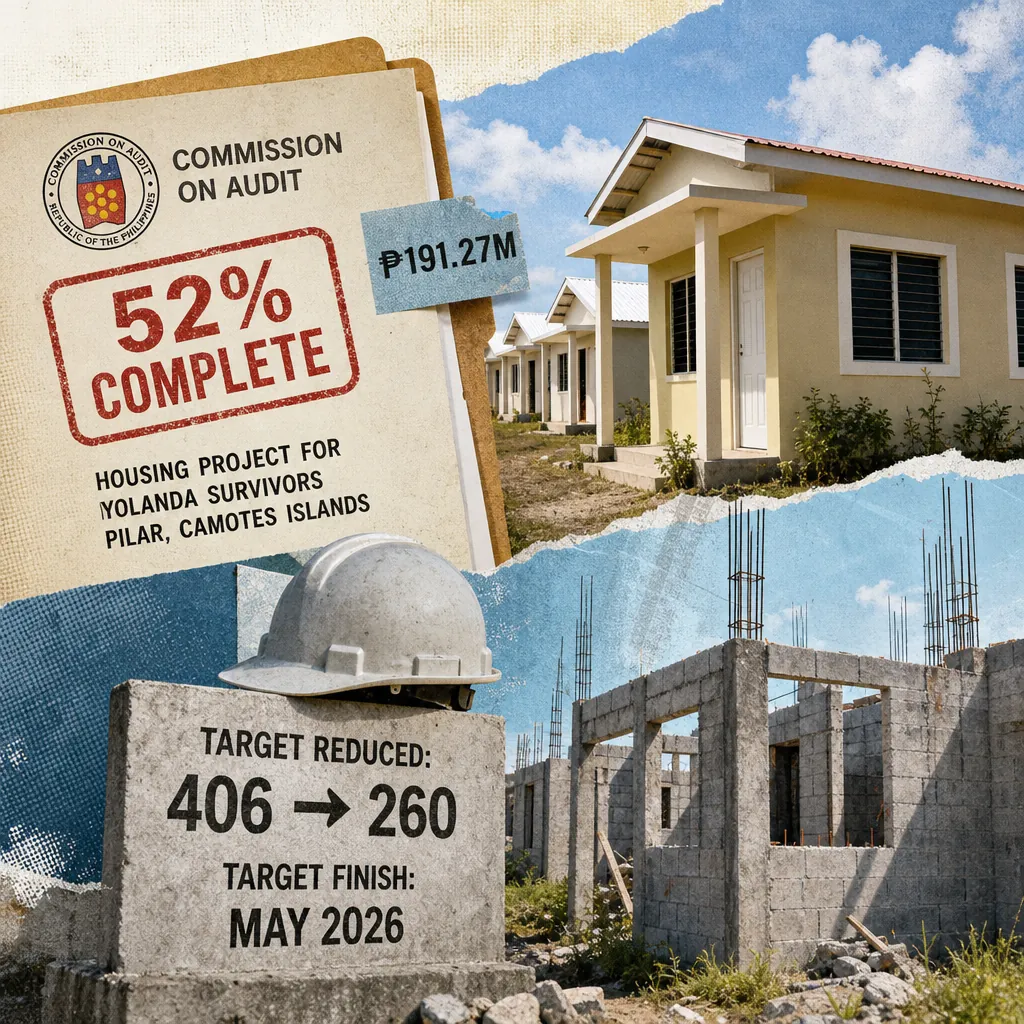
A ₱191.27-million housing project built for survivors of Typhoon Yolanda in Pilar, on the Camotes Islands in Cebu, stood 52 percent complete at the end of 2025 — more than three years after the July 31, 2022 deadline written into its contract. The Commission on Audit (COA), the government body that audits how public money is spent, blamed weak planning, engineering, supervision and monitoring for the gap, and repeated a finding it had already raised in its 2024 report after four recommendations went unimplemented.1
The audit details are specific. Pilar had paid contractor Jejors Construction Corp. ₱122.39 million by December 31, 2025, yet no progress billings were submitted in either 2024 or 2025 — meaning the paperwork that normally tracks work accomplished against money released had stopped. During a March 2, 2026 inspection, auditors found partially built homes whose doors and windows were already deteriorating. COA said the delay denied families safe, permanent housing and warned that stretching the work out further would raise its cost.1
The municipality's account differs in emphasis. Pilar told COA it expects to finish by May 23, 2026 under an approved contract extension, that 48 homes were handed over in March, and that the project had been reduced from 406 units to 260. COA's report does not say whether the contract amount changed along with the unit count. A municipal status report dated August 31 said another 48 homes were awaiting handover, held up because they had no electricity.1
That is the whole of the housing story in the items reviewed here, and it is worth being precise about what it does and does not establish. The 52 percent figure is a physical accomplishment rate at a point in time, not a spending rate. The ₱122.39 million is money already released to the contractor, not the value of work verified as done. Whether the May 23 deadline was met, and when the postponed handover will happen, is not settled by anything in the record.1
Key themes
- A ₱191.27-million project is 52 percent complete three years past deadline. COA measured physical accomplishment at end-2025 against a July 31, 2022 contractual completion date, a gap of more than three years.1
- ₱122.39 million was paid with no progress billings filed in 2024 or 2025. Payments to Jejors Construction Corp. continued to be recorded while the documentation that normally accompanies them stopped.1
- COA cited planning, engineering, supervision and monitoring failures. The audit office named four weak points rather than a single cause, and its four earlier recommendations had not been acted on by the time of the 2025 report.1
- The target was cut from 406 homes to 260. Pilar disclosed the reduction to auditors; the audit report does not say whether the contract amount was adjusted to match.1
- 48 homes were handed over in March; another 48 are waiting on electricity. The second batch was postponed because the units had no power connection.1
- A March 2, 2026 inspection found deteriorating doors and windows. Materials installed on unfinished units were already showing wear before the homes were occupied.1
- Pilar's completion target is May 23, 2026, under an approved extension. The municipality's own August 31 status report, which postdates that target, still described a pending handover.1
- Two developers are expected to join the Expanded Pambansang Pabahay para sa Pilipino program. The announcement carried no names and no commitments, and no later update on the Camotes project appears in the items reviewed.2
How the narratives stack
Dominant. The audit finding is the day's clearest housing story: a named project, a named contractor, a named funding agency, a hard completion percentage and a hard peso figure. COA's finding that ₱122.39 million had been paid while progress billings stopped in 2024 and 2025 is the kind of detail that turns a general complaint about slow construction into a specific accountability question. The story ran through SunStar Cebu and was picked up in a second item that paired it with the national housing program's expansion.12 Within the items reviewed here, this is the only housing story with audit-grade documentation behind it.
Counter-narrative. Pilar's response is not a denial but a reframing: the project is smaller than originally planned, an extension has been approved, homes are being turned over, and the finish line is May 23, 2026. The reduction from 406 to 260 units is the most consequential part of that reframing, because it changes what "complete" means. A project that finishes 260 homes has met its revised target and not its original one, and the audit report does not resolve whether the contract value moved with the unit count. The electricity problem on the second batch of 48 homes is a reminder that handover depends on utilities as much as on construction.1
Emerging. The Expanded Pambansang Pabahay para sa Pilipino program — the national government's flagship mass-housing effort — is expected to add two major developers this week, according to a post from the Tribune's account on X.2 The announcement gave no names and no commitments. Read alongside the Camotes finding, it points to a delivery model that increasingly leans on private developers to produce units, which makes contract enforcement and turnover discipline the things to watch. Public housing delivery depends on both developer participation and completed homes actually reaching the families meant to receive them.2
Under-covered. The electricity connection for the second batch of 48 homes is mentioned once, in a municipal status report, and nowhere else in the items reviewed. It is a small detail with a large consequence: a finished house without power is not a home a family can move into, and the cost and responsibility for energizing those units is not addressed in the audit finding.1
Platform insights
- X. The only social activity in the items reviewed is a post from the Tribune's account noting that two major developers are expected to join the Expanded Pambansang Pabahay para sa Pilipino program this week, alongside the Camotes project's May 23, 2026 completion target.2 The post carries the housing program's expansion and the audit finding in the same breath, which is how the two are likely to be read together: a national program scaling up while a local project it resembles struggles to finish.
- Facebook. No housing-specific Facebook activity appears in the items reviewed. The platform surfaces in the set only through political livestreams — Senate Minority Leader Alan Peter Cayetano's broadcast accusing Sen. Panfilo Lacson of threatening contractors with plunder charges over Taguig infrastructure projects, and Sen. Robin Padilla's clip answering questions about where he actually lives.1123 Neither touches housing delivery.
- Reddit and YouTube. Neither platform carried housing activity in the items reviewed.
The honest read of the platform picture is that this is a news-driven story, not a social one. The audit finding's reach comes from the reporting, not from a public response to it.
Key voices and communities
The Commission on Audit. COA is the constitutional body that examines whether government agencies spent public funds lawfully and effectively. Its role here is to document the gap between money released and work done, and to issue recommendations — four of which, it says, went unimplemented between the 2024 and 2025 reports. Its finding that no progress billings were filed in 2024 or 2025 is the strongest single fact in the story.1
The Municipality of Pilar. The local government is the project's implementing agency and the party COA directed to document contract extensions, follow suspension rules, intervene when work falls behind, and coordinate with the National Housing Authority (NHA) — the national agency that funds and builds public housing — to complete and hand over the homes. Pilar's disclosures to auditors, including the unit reduction and the March handover, are the counterweight to the audit finding.1
Jejors Construction Corp. The contractor holds the build contract and received ₱122.39 million by end-2025. The audit report does not assign blame to the contractor specifically, and the company is not quoted in the items reviewed.1
Typhoon Yolanda survivors in Pilar. The intended beneficiaries are the least quoted group in the story. COA's finding that the delay denied families safe, permanent housing is stated on their behalf, but no survivor voice appears in the items reviewed.1
The national housing program. The Expanded Pambansang Pabahay para sa Pilipino program, run through the Department of Human Settlements and Urban Development, is the government's mass-housing vehicle. The expected entry of two major developers is the program-side development in this set, and the department is the body to watch for the names and commitments.2
Narrative streams
A ₱191.27-million project, 52 percent built, three years late
The Camotes housing project was funded by the NHA and contracted to Jejors Construction Corp. with a completion date of July 31, 2022. At the end of 2025, COA measured it at 52 percent complete. The audit office attributed the shortfall to inadequate planning, engineering, supervision and monitoring — four separate functions, each of which would normally catch a slipping schedule before it became a three-year overrun. COA had flagged the project in its 2024 report and repeated the finding in 2025 after its four recommendations went unimplemented, which means the audit trail itself shows a year in which the identified problems were not fixed.1
The money side is where the finding sharpens. Pilar had paid the contractor ₱122.39 million by December 31, 2025. No progress billings were submitted in 2024 or 2025. Progress billings are the periodic statements a contractor submits to claim payment for work accomplished; their absence over two full years means the normal mechanism for matching payment to progress was not operating. COA also found, during a March 2, 2026 inspection, partially built homes with deteriorating doors and windows — installed materials aging in place before the units were finished.1
For the housing sector, the consequence is straightforward. Contractors and local governments delivering publicly funded housing face a documented case in which payment continued while the paperwork that justifies it stopped, and in which the audit office's own recommendations did not produce corrective action within a year. Any firm or agency in the same delivery chain should expect closer scrutiny of progress documentation, and any local government unit with a stalled project should expect COA to ask why the suspension and extension rules were not applied earlier.1
Pilar's revised target: 260 homes, not 406
Pilar told COA the project had been reduced from 406 units to 260, and that 48 homes were handed over in March. It expects to finish by May 23, 2026 under an approved extension. A status report dated August 31 said another 48 homes were awaiting handover, postponed because they lacked electricity. COA's report does not say whether the contract amount changed when the unit count fell by 146 homes.1
The unit reduction is the part of the story with the widest implications. A project can be reported as complete against a revised target while delivering 64 percent of the homes originally promised. Whether the ₱191.27-million contract value was adjusted proportionally is a question the audit report leaves open, and it is the question that determines whether the public got fewer homes for the same money or fewer homes for less money. The electricity gap on the second batch of 48 units adds a second dependency: handover requires a power connection, and nothing in the record says who is responsible for providing it or when.1
For local governments and housing agencies, the practical lesson is that target revisions need to be documented alongside contract amendments, and that turnover schedules should account for utility connections rather than treating them as an afterthought. For beneficiaries, the difference between a completed unit and a handed-over unit is the difference between a building and a home.1
The national program adds developers while a local project stalls
The Expanded Pambansang Pabahay para sa Pilipino program is expected to bring in two major developers this week, according to a post from the Tribune's account on X.2 The announcement named no companies and set out no commitments. The program is the national government's mass-housing push, and its reliance on private developers to produce units makes the terms of those partnerships — timelines, penalties, turnover obligations — the mechanism that determines whether units reach families.
Set beside the Camotes finding, the pairing is instructive rather than contradictory. A national program scaling up its developer roster and a local project three years past deadline are two ends of the same delivery system. The audit finding shows what happens when supervision and monitoring weaken on an individual project; the program expansion shows the government betting on more private capacity to avoid that outcome at scale. The department to watch is the Department of Human Settlements and Urban Development, which would announce the developers' names and commitments.2
For developers considering entry into public housing, the Camotes case is the cautionary precedent: payment schedules, progress documentation and turnover deadlines are the terms that get audited. For the program, the test is whether the new partnerships carry enforceable timelines that survive contact with the same planning and supervision problems COA identified in Pilar.12
Conversation trajectory
Whether the May 23, 2026 completion target was met — checkable now through the next COA report or a municipal status update. Pilar's own August 31 status report, which postdates the target, still described a pending handover of 48 units, so the target's status is unresolved in the record. Watch for a municipal announcement or the next audit cycle. Observation window: the next 4–8 weeks.1
Whether the contract amount was adjusted for the reduction from 406 to 260 homes — checkable through the contract documents and the next COA finding. COA's report does not address it. If the amount was not adjusted, the cost per delivered home rises; if it was, the public received fewer units for proportionally less money. Either answer is a concrete accountability fact. Observation window: the next audit report or a Pilar disclosure.1
Whether the second batch of 48 homes gets electricity and is handed over — checkable through the municipality and the local utility. The August 31 status report named the electricity gap as the reason for postponement. Watch for a handover announcement or a utility connection schedule. Observation window: the next 4–6 weeks.1
Which two developers join the Expanded Pambansang Pabahay para sa Pilipino program, and on what terms — checkable through the Department of Human Settlements and Urban Development. The announcement gave no names. The names and the commitments attached to them will indicate whether the program is adding capacity or adding announcements. Observation window: the coming week, per the announcement's own timing.2
Whether COA's four recommendations produce action this cycle — checkable through the next audit report. The recommendations were repeated after going unimplemented between the 2024 and 2025 reports. A third repetition would establish a pattern; implementation would break it. Observation window: the next COA reporting cycle.1
Trigger events. A municipal completion announcement, a COA follow-up finding, a Department of Human Settlements and Urban Development disclosure of developer names, or a handover notice for the electricity-delayed units would each move the story. Absent any of these, the next scheduled checkpoint is the audit cycle.12
Response guidance
For housing agencies and local government units with active projects: audit your own progress documentation before COA does. The Camotes finding turned on the absence of progress billings in 2024 and 2025, not on the construction delay alone. Any implementing agency should be able to produce, on request, the billing record that matches payments to verified accomplishment, and should be able to explain any gap between the two.1
For contractors on publicly funded housing: treat progress billings as a compliance obligation, not an administrative formality. Two years without filings is the fact that made this story an accountability case rather than a scheduling complaint. Contractors should also document material protection on unfinished units, since the March 2 inspection found deteriorating doors and windows on homes still under construction.1
For agencies revising project targets: document the change in the contract, not just in correspondence. The reduction from 406 to 260 homes is disclosed in Pilar's response to auditors but not resolved in the audit report as a contract matter. A revised unit count without a revised contract amount invites the question of what happened to the difference.1
For the national housing program: publish the terms attached to new developer partnerships. The expected entry of two major developers is an opportunity to set out timelines, penalties and turnover obligations in public. The Camotes case shows what the absence of enforceable milestones looks like three years on.12
For communicators addressing beneficiaries and affected communities: lead with the handover schedule and the electricity connection, not the completion percentage. A family waiting for a unit needs to know when it can move in and whether the lights will work. The 52 percent figure describes construction progress; the handover date and the power connection describe when the wait ends.1
For media covering the next phase: verify the current completed and handed-over unit count directly with Pilar and the NHA. The target changed and the planned handover was postponed, so the numbers in circulation may not match the current status. Ask specifically whether a revised contract amount exists, since the audit report did not clarify whether the reduction in homes changed the budget.1
See the full picture behind today's signals.
This report draws from Media Meter's MediaWatch, our real-time monitoring engine tracking 2,470+ Philippine sources across print, broadcast, digital, and social. Explore how the platform turns raw coverage into decision-grade intelligence, then see how it's configured for teams like yours — whether you're in PR agencies, corporate comms, government, or marketing.
Want more? Browse our Report Library for sector and crisis intelligence, or request a demo and we'll have your brand set up before the call.
Want this kind of intelligence on your brand?
This brief is built on the same MediaWatch methodology that runs continuously across every brand we monitor. See your competitive landscape, Impact Score, and narrative trajectory in a 30-minute demo.