Food-Price Anger Turns Partisan as Jollibee, Sprite Push Value
A celebrity's mockery of Vice President Sara Duterte's hunger and price claims drew nearly 400 Facebook comments, while Jollibee and Sprite ran value and flavor campaigns and a Sorsogon coconut trade fair prepared to open.
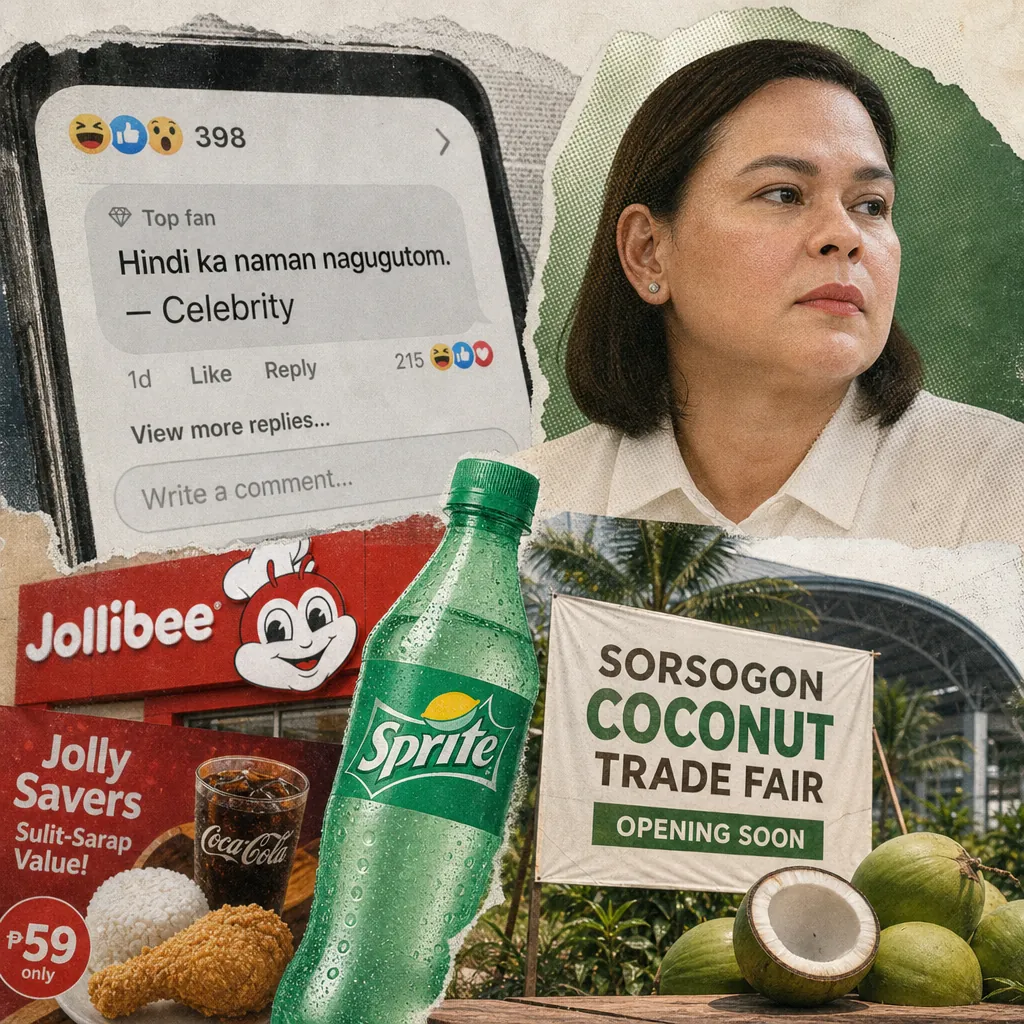
A single Facebook post mocking Vice President Sara Duterte's claims about hunger, flooding and high food prices drew 397 comments in its first day, more than the 309 likes and 15 shares it collected combined, and the reaction mix — 179 "haha" responses against 12 angry and 10 love — shows the audience treated the exchange as ridicule rather than outrage.1 The post, published on September 12, 2026, amplified actor Janus Del Prado's challenge to Duterte's credibility, framing it with the line "UTO-UTO NA LANG MANINIWALA KAY VP SARA?" and tying it to her September 11 call for President Ferdinand Marcos Jr. to resign over alleged abuse of power.1 The same text was reposted to Twitter the same day and drew 186 views with zero likes, quotes, shares or comments, a flat result that shows the framing did not travel across platforms.1
A second, unrelated item surfaced on Twitter the same day: the Land Transportation Office (LTO), the national agency that registers vehicles and enforces traffic rules, confirmed reports from Abante and Bilyonaryo about an alleged traffic citation involving Erick Arejola, team consultant of the Magnolia Hotshots, a Philippine Basketball Association franchise whose name is licensed from San Miguel Corporation's Magnolia food brand.2 That post drew 158 views with no measurable engagement.2
Against that political noise, the day's food and beverage news ran on a different track. Jollibee Philippines was named Brand of the Year Grand Prix winner at the Marketech Asia-Pacific NEXT Awards Philippines 2026, taking the highest overall points across marketing and innovation categories plus five Gold awards and three Silvers.56 Sprite launched a spicy-food collaboration with Your Local, a restaurant recognized in the 2026 MICHELIN Guide Bib Gourmand list, under its "Yan Ang Refreshing" campaign.8 The Department of Trade and Industry (DTI), the government agency that supports small businesses, confirmed that 30 micro, small and medium enterprises (MSMEs) from Sorsogon will sell coconut- and pili-based goods at the Kasanggayahan Sorsogon GoConut Trade Fair from September 17 to 20 at Shangri-La Plaza in Mandaluyong City.38 A blog post covered Korean beauty brands expanding into the Philippine market, a reminder that shelf competition in retail extends well beyond food.7
Key themes
- Food-price language is now a political weapon, not a consumer complaint. Vice President Duterte invoked "baha, gutom at mataas na presyo ng mga bilihin" — flooding, hunger and the high price of goods — as evidence of hardship, and the most-engaged response was a post mocking her credibility rather than debating actual price levels.1 The thread never moved into staples, price data or government response.
- The same message performed on Facebook and failed on Twitter. Identical text drew 397 comments on Facebook and zero comments, likes, quotes or shares on Twitter despite 186 views, showing the narrative depended on the comment-driven argument style native to Facebook.1
- The Facebook post stayed inside one audience cluster. Fifteen shares against 397 comments means the content generated argument rather than redistribution, which limits how far the sentiment traveled and means it is not a reading of broader public mood.1
- Jollibee collected the year's top marketing award. The country's largest fast-food chain won Brand of the Year Grand Prix at the NEXT Awards Philippines 2026, with Gold awards for its Joy Run app game, its Generation Joy Cycle 2 influencer campaign, its app customer-relationship-management program, its "Bida Best, Bida Pinoy" public relations campaign and its Museum of Pride event.56
- Sprite paired its flagship refreshment brand with spicy Filipino food. The "Yan Ang Refreshing" campaign with Chef Pat Go and the Bib Gourmand-recognized restaurant Your Local produced a menu including Spiced Salted Egg Hummus and Spicy Beef Lechon Toast.8
- Thirty Sorsogon MSMEs will sell coconut and pili products in Metro Manila. The DTI-organized Kasanggayahan Sorsogon GoConut Trade Fair runs September 17 to 20 at Shangri-La Plaza, covering virgin coconut oil, coco jam, vinegar, delicacies, pastries, preserves, plus abaca, apparel, baskets, home decor, coconut-shell crafts and sustainable charcoal.38
- A sports-franchise traffic case produced no consumer conversation. The LTO confirmation involving a Magnolia Hotshots consultant drew 158 views and no reactions, indicating that a brand-adjacent regulatory story only becomes a brand story when the brand itself is the subject of enforcement.2
- Korean beauty brands are expanding into Philippine retail. A blog report described Korean skincare and makeup labels finding a new home in the Philippine market, adding pressure on shelf space and consumer attention that food and beverage brands share in the same retail environment.7
How the narratives stack
Dominant. The most-engaged item in the captured set was the Facebook post challenging Vice President Duterte's credibility on hunger and high prices, with 397 comments, 309 likes and 179 "haha" reactions.1 Its dominance is a property of the items gathered here — three social posts in total — and the reaction profile matters more than the raw count: mockery outnumbered anger roughly fifteen to one, which means the audience was laughing at the claim rather than mobilizing against it.1 On the news side, the highest-value item in the captured set was a Manila Times report on President Marcos Jr. attending the 18th BRICS Summit in New Delhi as Association of Southeast Asian Nations (ASEAN) chairman and outreach representative, on his 69th birthday, with discussions covering global economic conditions, development, technology and climate change.37 BRICS is a grouping of major emerging economies originally comprising Brazil, Russia, India and China; the Philippines attends as a guest rather than a member. That item carried an estimated ₱920,360 in advertising-equivalent value — the notional cost of buying the same newspaper space as paid advertising, not a count of readers.37
Counter-narrative. Jollibee's Brand of the Year Grand Prix at the NEXT Awards Philippines 2026 ran against the day's price-anxiety framing by putting the country's largest fast-food chain in front of the industry as a marketing leader rather than a pricing target.56 The award recognized five Gold categories covering gamification, influencer marketing, marketing technology, public relations and event marketing, and three Silvers.56 Dorothy Ching, Jollibee Philippines vice president for marketing, said the award belonged to the whole team.56 The story is a trade-recognition item rather than a consumer story, and it drew modest coverage value within the captured set, but it is the clearest signal that brand-building investment in the sector is still being rewarded.
Emerging. Sprite's "Yan Ang Refreshing" campaign with Your Local and Chef Pat Go is the day's clearest example of a beverage brand buying into Filipino flavor culture rather than price positioning.8 The menu — Spiced Salted Egg Hummus with toasted sourdough, and Spicy Beef Lechon Toast — pairs a mass-market soft drink with a restaurant that holds a Bib Gourmand distinction, the MICHELIN Guide's recognition for good food at moderate prices.8 The campaign's logic is that an ice-cold Sprite balances spicy food, which lets the brand attach itself to a consumption occasion instead of a discount. The same logic appears in the DTI trade fair, where 30 Sorsogon MSMEs will bring coconut and pili products to an urban mall audience from September 17 to 20, giving provincial producers direct contact with Metro Manila shoppers, institutional buyers and distributors.38 Nine of the 30 enterprises were singled out in the announcement, and the product range spans food and non-food goods including abaca, apparel, baskets, home decor and coconut-shell crafts.38
Under-covered. The LTO confirmation involving the Magnolia Hotshots consultant is the story that placed lowest in the captured set: 158 views, no reactions, no comments.2 It is not suppressed — nothing indicates anyone worked to keep it down — it simply did not travel. Its relevance is structural rather than commercial: it shows how a well-known consumer brand name can become the headline hook for an enforcement story involving an individual, and how little attention such a story attracts until an agency confirmation converts a rumor into durable coverage.2 The Korean beauty expansion item sits in the same low-attention band, covered by a single blog post in this set, but it points at a competitive shift in Philippine retail that food and beverage brands share shelf space with.7
Platform insights
- Facebook. The only platform in the captured set where the political narrative actually circulated. The Del Prado post collected 397 comments against 309 likes and 15 shares, and the reaction mix — 179 "haha," 12 angry, 10 love — shows users argued in the thread rather than passing the content along.1 The comment-to-share ratio is the important detail: high argument, low redistribution, which keeps the sentiment inside one audience cluster.
- Twitter. Two posts, both flat. The reposted anti-Duterte text drew 186 views with zero likes, quotes, shares or comments, and the LTO-Magnolia item drew 158 views with no measurable engagement.12 Twitter functioned as a relay point where links landed and stopped, which means the platform's value in this window was as an early-detection surface for news items rather than as a place where narratives build.
- Reddit and YouTube. No meaningful activity from either platform appeared in the captured material for this window.
Key voices and communities
Political commentary and satire pages on Facebook. These accounts drove the highest engagement in the set, with a single post generating nearly 400 comments and a reaction profile dominated by laughter.1 Their influence comes from speed and framing rather than institutional authority, and their output is what turns a politician's statement into a contested public claim within a day.
Celebrity and entertainment-adjacent commentators. Actor Janus Del Prado's challenge to the Vice President's credibility gave the political argument a familiar face, which is what pulled the exchange out of policy debate and into personality-driven commentary.1 Celebrity participation is the mechanism by which political criticism reaches audiences that do not follow political pages directly.
Food price and economic hardship discussants. This group spans ordinary consumers, political operatives and media personalities, and it is diffuse by design.1 Its framing disputes whether hardship claims are genuine, but the underlying subject — elevated food prices — remains a persistent grievance that does not disappear when the political argument moves on.
Sports and celebrity news watchers on Twitter. A smaller group tracked the LTO confirmation involving the Magnolia Hotshots consultant, engaging with personalities connected to food-adjacent brands through franchise and endorsement relationships.2 The group's relevance is that it creates indirect reputational links between individual figures and the consumer brands they represent.
Trade and marketing industry audiences. The NEXT Awards Philippines 2026 recognition of Jollibee reached marketing and advertising professionals rather than consumers, and the award's five Gold categories show which disciplines the industry currently rewards: gamification, influencer marketing, marketing technology, public relations and event marketing.56
Narrative streams
Food-price grievance becomes a partisan attack line
The exchange began with Vice President Duterte's September 11 call for President Marcos Jr. to resign over alleged abuse of power, in which she cited flooding, hunger and high prices of goods as evidence of hardship.1 The following day, a Facebook post amplified actor Janus Del Prado's questioning of those claims, asking whether people would still be fooled into believing her, and the thread produced 397 comments against 309 likes and 15 shares.1 The reaction mix — 179 "haha," 12 angry, 10 love — is the substantive finding: audiences processed the exchange as political theater, and the thread never developed into discussion of actual price levels, staple goods or government response.1 The identical text was reposted to Twitter the same day and drew 186 views with no engagement at all, which shows the framing's mobilizing power was specific to Facebook's comment culture.1
For food and beverage brands, the consequence is that "presyo" — price — is now a partisan attack line before it is a commercial topic. Any brand that raises prices or advertises a value meal in the coming weeks enters a conversation where the emotional register has already been set by political ridicule, and where a claim of hardship without visible action behind it is the thing audiences punish. The practical implication is that value messaging should be concrete and product-specific rather than rhetorical, because the audience has demonstrated it will mock claims it reads as performative.
Jollibee takes the year's top marketing award
Jollibee Philippines won the Brand of the Year Grand Prix at the Marketech Asia-Pacific NEXT Awards Philippines 2026, earning the highest overall points across multiple marketing and innovation categories.56 The chain also took five Gold awards: Most Innovative Use of Gamification in a Campaign for the Jollibee Joy Run Jollibee App Game; Most Innovative Influencer Marketing Campaign for Generation Joy Cycle 2; Most Innovative Use of Marketing Tech in a Campaign for the Jollibee App Customer Relationship Management Campaign; Most Innovative Public Relations Campaign for Bida Best, Bida Pinoy; and Most Innovative Event Marketing Campaign for Jollibee's Museum of Pride. It added three Silver awards.56 Dorothy Ching, vice president for marketing at Jollibee Philippines, said accepting the Grand Prix on behalf of the team was an incredible honor and that the award belonged to the team.56
The read for the sector is that the largest domestic fast-food operator is being recognized for app-based engagement, influencer work and event marketing rather than for price promotion, which sets a template smaller chains and food manufacturers will follow. Brands with thinner marketing budgets face a widening gap: the disciplines being rewarded — gamification, marketing technology, influencer programs — require infrastructure that a single-store operator or a provincial food producer does not have. That gap is part of why the DTI's trade fair matters as a counterweight, giving small producers a physical route to urban buyers that does not depend on digital campaign spend.38
Sprite builds a spicy-food occasion around a mass-market drink
Sprite launched "Yan Ang Refreshing," a campaign built on the Filipino habit of adding chili to sawsawan and comfort food, in partnership with Your Local, a restaurant recognized in the 2026 MICHELIN Guide Bib Gourmand list, and Chef Pat Go.8 The menu includes Spiced Salted Egg Hummus served with toasted sourdough and Spicy Beef Lechon Toast, and the campaign's premise is that an ice-cold Sprite balances and elevates spicy food.8 The Bib Gourmand distinction is the MICHELIN Guide's mark for restaurants serving good food at moderate prices, which makes the partner a credible signal of everyday quality rather than luxury dining.8
The read for the sector is that a carbonated soft drink with mass distribution is buying cultural relevance through food pairing rather than through discounting, at a moment when price is politically charged. Beverage and snack brands that can attach themselves to a specific eating occasion — spicy food, merienda, late-night meals — get a positioning that does not require them to make a price claim at all. The risk is that pairing campaigns concentrate attention on urban, restaurant-going consumers while the price-sensitive majority shops in palengke and sari-sari channels, where the same brand is judged almost entirely on cost per bottle.
Sorsogon coconut producers get a Metro Manila storefront
Thirty MSMEs from Sorsogon will present locally crafted goods at the Kasanggayahan Sorsogon GoConut Trade Fair 2026 from September 17 to 20 at the Level 2 Grand Atrium of Shangri-La Plaza Mall in Mandaluyong City, organized by the DTI Sorsogon Provincial Office.38 Exhibitors will feature coconut- and pili-based products including virgin coconut oil, coco jam, vinegar, traditional delicacies, pastries and preserves, alongside non-food items such as abaca products, apparel and accessories, baskets, home decor, coconut-shell crafts, packaging materials and sustainable charcoal innovations.38 Nine of the 30 enterprises were highlighted in the announcement, and the fair is designed to give provincial entrepreneurs direct exposure to urban consumers, institutional buyers, distributors and new commercial partners.38
The read for the sector is that coconut and pili processors in Sorsogon are being routed around the distribution bottleneck that keeps provincial food products out of Metro Manila retail. A four-day mall activation does not build a supply chain, but it does put products in front of buyers who can place them in stores, and it gives the producers direct consumer feedback they cannot get through a wholesaler. For established food manufacturers, the medium-term effect is more competition in the coconut and preserved-fruit categories from producers with lower overhead and a regional story to sell.
A traffic citation puts a food brand's sports franchise in the news
The LTO confirmed reports from Abante and Bilyonaryo about an alleged traffic citation involving Erick Arejola, team consultant of the Magnolia Hotshots.2 The post drew 158 views with no reactions or comments.2 The Magnolia name is licensed to the basketball franchise from San Miguel Corporation's Magnolia food brand, which is why an enforcement story about an individual carries a consumer brand's name in its headline.2
The read for the sector is that conglomerate-linked sports franchises function as brand assets that can absorb attention from non-commercial incidents. The story is currently a niche thread with no measurable engagement, and the underlying matter concerns traffic enforcement and media confirmation rather than the product portfolio. What changes for brand managers is the monitoring requirement: an agency confirmation converts a media report into durable coverage, so the moment to prepare a holding line is before pickup escalates, not after.
Korean beauty labels expand into Philippine retail
A blog report described Korean skincare and makeup brands finding a new home in the Philippine market, framing the expansion around Korean beauty's emphasis on research and development, product efficacy and solutions for specific skin concerns.7 The report notes that Korean beauty grew from a phenomenon tied to Korean entertainment into a standalone global beauty movement, with Western market demand continuing to grow.7
The read for the sector is that shelf space and consumer attention in Philippine retail are being contested by an import category with strong cultural pull, and food and beverage brands share the same malls, the same e-commerce platforms and the same household budget. Personal care and beauty purchases compete directly with snack and beverage spending in the same discretionary envelope, particularly among younger urban consumers. The item is a single blog post in this set, so it is a directional signal about category competition rather than a measured shift.
Conversation trajectory
Political price framing will keep re-igniting through the fourth quarter (observation window: 4–8 weeks). The mechanism is the continuing exchange between the executive and legislative branches over food price policy, which periodically returns "presyo" to the same mocking register seen in the September 12 post.1 Each new round gives brands another window in which a price-related query can be answered inside a hostile frame. The checkable trigger is the next congressional hearing or executive statement on food prices, and the next official inflation report.
Holiday food spending will sharpen price and product scrutiny (observation window: through December). Noche buena and media noche shopping concentrates household attention on branded staples, and the captured material already shows price anxiety functioning as the connective tissue across food conversations.1 Expect value-meal, shrinkflation and budget-substitute discourse to intensify as households trade down. The trigger is the start of the holiday shopping period and the first major retailer promotions.
Agency confirmations will keep converting niche items into durable coverage (observation window: 72 hours per incident). The LTO confirmation pattern — a media report followed by official validation — is what turns a low-engagement item into a story with a paper trail.2 Any new regulatory or enforcement disclosure involving a conglomerate-linked entity should be treated as a potential escalation point. The trigger is the next agency statement naming a brand-linked individual or franchise.
Trade-fair and awards activity will continue to supply the sector's positive coverage (observation window: 2–4 weeks). The Sorsogon GoConut Trade Fair opens September 17 and runs to September 20, and award cycles like the NEXT Awards generate follow-on announcements from winners and shortlisted brands.3856 The trigger is the fair's opening day and any post-event sales or partnership figures the DTI releases.
Platform divergence will persist as a monitoring fact (observation window: ongoing). The same message produced 397 comments on Facebook and zero on Twitter in the same 24 hours, which means price-sentiment tracking has to be weighted toward comment-heavy platforms where argument drives the narrative.1 The trigger to watch is whether the anti-Duterte framing reappears on Facebook with a different emotional register — more anger, fewer laughs — which would indicate the ridicule phase is ending.
Response guidance
Separate political sentiment from brand sentiment in every report. Communications teams should receive price-related political commentary and brand-directed commentary as two distinct streams, because the September 12 post named no food or beverage product and generated no brand criticism.1 Treating political mockery as a brand threat would misdirect resources; treating it as irrelevant would miss the frame it sets.
Prepare value messaging that makes a concrete product claim. Brands should pre-approve language around specific price points, pack sizes and availability rather than general affordability statements, because the audience has demonstrated it mocks claims of hardship that are not backed by visible action.1 The Sprite campaign shows the alternative route: attach the brand to a consumption occasion and avoid the price argument entirely.8
Set a threshold alert for brand-linked individuals. Any personality connected to a brand through a franchise, endorsement or consultancy should trigger a prepared holding line when an agency confirms a report about them, following the LTO pattern.2 The recommended posture is no public comment unless the story escalates beyond enforcement reporting.
Use the trade-fair calendar for small-producer and regional stories. The Sorsogon GoConut Trade Fair gives food manufacturers and retailers a concrete, dated hook for coverage of provincial sourcing, coconut and pili ingredients, and MSME partnerships.38 Brands with regional supply chains can attach themselves to the same news cycle without making a price claim.
Track the awards cycle for competitive positioning. Jollibee's Grand Prix and five Gold awards identify which marketing disciplines the industry is rewarding — gamification, influencer work, marketing technology, public relations and events.56 Brands planning campaigns for the holiday period should weigh whether their plans include at least one of those disciplines, since award recognition feeds recruitment, partner confidence and trade press coverage.
Watch the beauty and personal-care category as a competing claim on household spending. Korean beauty brands expanding into Philippine retail compete for the same discretionary budget as snacks and beverages, particularly among younger urban consumers.7 Food and beverage marketers should factor that competition into occasion-based campaigns rather than assuming the category competes only with itself.
Keep political commentary out of brand channels. The Duterte-Marcos friction is polarized, and the captured material shows audiences reacting to it with ridicule rather than mobilization.1 Brand accounts should not engage the argument, contest the framing or amplify either side; the appropriate action is to observe, report internally, and respond only if a product or service is named directly.
See the full picture behind today's signals.
This report draws from Media Meter's MediaWatch, our real-time monitoring engine tracking 2,470+ Philippine sources across print, broadcast, digital, and social. Explore how the platform turns raw coverage into decision-grade intelligence, then see how it's configured for teams like yours — whether you're in PR agencies, corporate comms, government, or marketing.
Want more? Browse our Report Library for sector and crisis intelligence, or request a demo and we'll have your brand set up before the call.
Want this kind of intelligence on your brand?
This brief is built on the same MediaWatch methodology that runs continuously across every brand we monitor. See your competitive landscape, Impact Score, and narrative trajectory in a 30-minute demo.