El Niño Dry Spell Hits Negros as Cloud Seeding Begins
Cloud seeding sorties began over Negros and Panay as a "super, super El Niño" threatens sugar areas from October, while a transport strike over fuel prices and a water-safety scare in Melaka also drew attention.
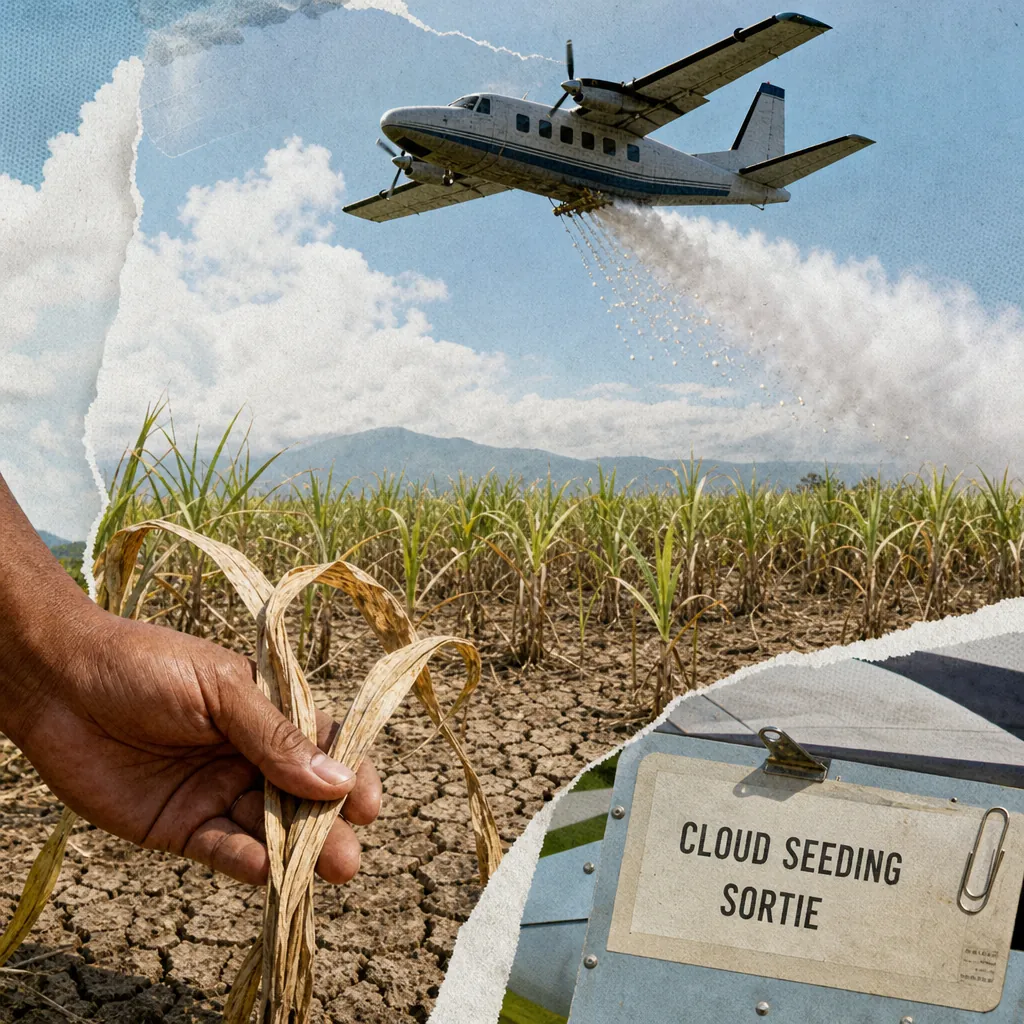
Cloud seeding aircraft have flown eight sorties over the Negros Island Region and Panay since operations began, an early response to dry conditions that sugar producers say are already cutting into the current crop and that a provincial governor warns will worsen from October.2 The intervention, confirmed Sunday by United Sugar Producers Federation (UNIFED) president Manuel Lamata, is the most concrete agricultural story in a day of coverage that otherwise ranged from a transport strike over fuel prices to a water-safety scare in Melaka and a government review of electric-vehicle incentives.2399
Lamata said four sorties were conducted in Panay and four in the Negros Island Region, and thanked the Department of Agriculture (DA) and the Sugar Regulatory Administration (SRA) for responding quickly to the industry's request for intervention.2 The DA is the national agency responsible for agricultural policy, research, and support programs, while the SRA is the government body that regulates and promotes the sugar industry, setting production and import policies and administering programs for sugar farmers. Negros Occidental Governor Eugenio Jose Lacson has said a "super, super El Niño" is expected to affect the province starting in October and possibly lasting until the first quarter of 2027.2 El Niño is a periodic warming of the central and eastern Pacific Ocean that shifts rainfall patterns worldwide; for the Philippines it typically means below-normal rainfall, dry spells, and in severe cases drought, which hits rain-fed crops and water-dependent industries hardest.
The cloud-seeding operation is the day's clearest signal of an agricultural sector bracing for a prolonged dry period. It is also the story with the most direct consequence for ordinary Filipinos: sugar is a staple input for food processors and a major export crop for Negros, and a sustained dry spell would affect farm incomes, mill output, and eventually retail prices for sugar-sweetened products. The eight sorties completed so far are a small fraction of what a months-long dry spell would require, and the outcome will depend on whether rain-bearing clouds form over the target areas at all — cloud seeding can only enhance precipitation from clouds that already exist, not create rain from clear skies.
A separate thread of the day's coverage concerned fuel prices and public transport. The Philippine National Police (PNP) said it was preparing for a transport strike on Monday, Sept. 14, organized by the transport group Manibela to protest continued increases in oil prices.3 Police units were placed on alert in areas where protesters were expected to gather, particularly at Philcoa in Quezon City, and PNP chief Gen. Jose Melencio Nartatez Jr. said the force respected the right to hold a strike while expecting the same respect for personnel tasked with ensuring public order and safety.3 The strike follows reports that local fuel prices could rise by up to P5 per liter starting Sept. 15, driven by the prolonged conflict between the United States and Iran.3 For commuters, the immediate effect is the possibility of stranded passengers and reduced transport routes on Monday; for the government, the strike is a test of how it manages public anger over fuel costs that feed into the price of nearly everything else.
In Melaka, Malaysia, the state government moved to reassure residents after suspected human remains were found in the Durian Tunggal Dam reserve, part of the catchment area that supplies the state's water.1 State Secretary Datuk Salhah Salleh said quality monitoring had detected no parameter breaches and that treated water remained safe, adding that water undergoes treatment before distribution and is tested against established standards.1 The state government said it would increase water quality monitoring and inspections in the affected area, including sampling and testing.1 The story matters beyond Melaka because it illustrates how quickly a single discovery in a catchment area can raise questions about the safety of a public utility's supply, and how governments typically respond with testing data and promises of tighter monitoring.
On the policy side, the Department of Trade and Industry (DTI) said it would have to weigh any extension of incentives for imported electric vehicles (EVs) against its parallel push to build a domestic EV manufacturing industry.99 Among the biggest incentives for imported EVs is the zero-tariff policy, which is set to run until 2028, and the Electric Vehicle Association of the Philippines has pushed for its extension until 2040 to sustain EV adoption amid elevated oil prices.99 Trade Undersecretary Ceferino Rodolfo said such a proposal would have to undergo careful review, with one key consideration being how an extension would jibe with the government's efforts to entice automakers to manufacture EVs locally.99 At the center of that manufacturing push is the P60-billion Electric Vehicle Incentive Strategy (Evis), the government's biggest automotive incentive program.99 The tension is straightforward: extending zero tariffs on imported EVs keeps prices low for buyers but makes it harder to justify local assembly, while withdrawing them protects domestic manufacturing ambitions but raises costs for consumers.
Key themes
- Cloud seeding begins in Negros and Panay as El Niño threat looms. Eight sorties have been completed — four in Panay and four in the Negros Island Region — to bring rain to areas affected by dry conditions, according to UNIFED president Manuel Lamata.2 A "super, super El Niño" is expected to affect Negros Occidental from October and possibly last until the first quarter of 2027, Governor Eugenio Jose Lacson has said.2
- Sugar producers secured a fast government response. Lamata thanked the Department of Agriculture and the Sugar Regulatory Administration for responding quickly to the industry's request for intervention, a sign that the sector's lobbying channels are working even as the dry spell worsens.2
- A transport strike over fuel prices is set for Monday. Manibela will hold a strike on Sept. 14 to protest continued oil price increases, and the PNP has placed units on alert in areas where protesters are expected, particularly at Philcoa in Quezon City.3 Fuel prices could rise by up to P5 per liter starting Sept. 15.3
- A water-safety scare in Melaka drew a government assurance. Suspected human remains were found in the Durian Tunggal Dam reserve, and the Melaka state government said quality monitoring had detected no parameter breaches and that treated water remained safe.1
- The DTI is weighing EV tariff incentives against local manufacturing goals. The zero-tariff policy for imported EVs runs until 2028, and the EV industry association wants it extended to 2040, but trade officials say any extension must be balanced against the P60-billion Electric Vehicle Incentive Strategy aimed at attracting local EV manufacturing.99
- A government service caravan in Cebu marked the President's birthday. The "Handog ng Pangulo, Serbisyong Sapat Para sa Lahat" caravan will bring national agencies and provincial offices to the Cebu Provincial Capitol on Monday to provide free assistance, health services, livelihood programs, and job opportunities.6
- A Laguna civil service review program faces allegations of mishandled financial assistance. Complainants alleged that participants were asked to sign documents indicating they would receive P15,500 each and were photographed holding the amount, but were allegedly given only P1,000 to take home.38
- A Baguio City ordinance proposes institutionalizing mobile government services. The proposed "Pasadang Pambarangay" would serve all 128 barangays of Baguio City through regular, continuous, and nonpartisan mobile government services, with dedicated annual funding to prevent interruptions caused by political transitions.38
How the narratives stack
Dominant: The cloud-seeding operation in Negros and Panay is the day's most consequential agricultural story, with eight sorties completed and a provincial governor warning of a "super, super El Niño" that could last into early 2027.2 The story dominated because it combines an immediate government action with a long-term threat to a major crop and the livelihoods that depend on it. The coverage in this set came through Inquirer Online, which carried the UNIFED president's confirmation and the governor's warning in a single report.2
Counter-narrative: The transport strike and the fuel price increase that triggered it represent a different kind of pressure on the same economy. Manibela's strike is a direct response to oil price increases of up to P5 per liter starting Sept. 15, and the PNP's preparations signal that the government expects disruption.3 This story is not about agriculture, but it shares a root cause with the El Niño coverage: both are about the cost of essential inputs — water and fuel — rising beyond what ordinary households and small businesses can easily absorb.
Emerging: The DTI's review of EV incentives is an early-stage policy debate that will shape the country's automotive sector for years.99 The zero-tariff policy for imported EVs runs until 2028, and the industry association wants it extended to 2040, but the government's P60-billion Electric Vehicle Incentive Strategy is designed to attract local manufacturing.99 The outcome will determine whether the Philippines becomes a market for imported EVs or a producer of them, and the decision has implications for jobs, investment, and the country's transition away from fossil fuels.
Under-covered: The Melaka water-safety scare received a single report in this set, despite the potential for public anxiety over water quality.1 The story is under-covered relative to its potential impact because it involves a utility that serves a large population and a discovery — suspected human remains in a catchment area — that could raise questions about contamination. The state government's assurance that no parameter breaches were detected is the key fact, but the story's low profile in this set means the public may not have the full picture of what was found or how the investigation is proceeding.1
Platform insights
Facebook: The day's most shareable content was the cloud-seeding story, which combines a visually compelling image — aircraft releasing particles into clouds — with a direct impact on farmers and food prices.2 Facebook is where agricultural communities and local news pages in Negros and Panay are most active, and the story's combination of government action and climate threat is well-suited to the platform's sharing behavior.
X: The transport strike story drove the most time-sensitive discussion on X, where commuters and transport groups use the platform to coordinate and share updates on routes and disruptions.3 The PNP's statement and the fuel price increase were the most quoted elements, and the platform's real-time nature makes it the primary channel for strike-related information.
Reddit: The DTI's EV incentive review generated discussion on Philippine subreddits, where users debated whether extending zero tariffs on imported EVs would help or hurt the country's manufacturing ambitions.99 The thread reflected a broader interest in electric vehicles among younger, urban users who are potential buyers and who follow policy debates that affect vehicle prices.
YouTube: The Melaka water-safety story and the Laguna civil service review allegations have the potential for video coverage, but in this set the most video-friendly content was the cloud-seeding operation, which lends itself to short documentary-style reports.1238
Key voices and communities
Sugar producers and agricultural cooperatives: UNIFED president Manuel Lamata is the most prominent voice in the day's agricultural coverage, confirming the cloud-seeding sorties and thanking the DA and SRA for their response.2 This community is directly affected by the dry spell and has the most at stake in the government's intervention.
Transport groups and commuters: Manibela is the organizing force behind the Sept. 14 strike, and its members are protesting fuel price increases that affect their daily earnings.3 Commuters are the secondary audience, as they bear the immediate cost of stranded routes and reduced transport availability.
Government agencies: The PNP, the DA, the SRA, and the DTI are the key institutional voices in the day's coverage, each responding to a different pressure — public order, agricultural support, and industrial policy.2399 Their statements set the terms of the public debate and provide the data that journalists and citizens use to assess the situation.
Local government units: The Melaka state government and the Baguio City government are examples of local authorities responding to specific concerns — water safety and mobile service delivery — with assurances and proposed ordinances.138 Their actions show how local governments manage public anxiety and deliver services in areas where national agencies may not have a direct presence.
Civil society and complainants: The Laguna civil service review allegations were raised by complainants who say they were asked to sign documents for P15,500 but received only P1,000.38 This community represents the accountability side of the day's coverage, holding government programs to their stated promises.
Narrative streams
Cloud seeding begins as Negros braces for a "super, super El Niño"
Eight cloud-seeding sorties have been completed over the Negros Island Region and Panay, with four in each area, according to UNIFED president Manuel Lamata.2 The operation is a direct response to dry conditions that are already being felt in parts of Negros Occidental, and it follows a request from sugar producers for government intervention.2 Lamata thanked the Department of Agriculture and the Sugar Regulatory Administration for responding quickly, a detail that matters because it shows the industry's concerns reached the agencies responsible for agricultural support and sugar regulation.2
The scale of the threat is significant. Governor Eugenio Jose Lacson has said a "super, super El Niño" is expected to affect Negros Occidental starting in October and possibly lasting until the first quarter of 2027.2 That timeline means the dry spell could span two planting seasons and affect not just the current crop but the next one as well. For sugar producers, the immediate concern is the current crop's yield; for the broader economy, the concern is the price of sugar and the stability of an industry that employs hundreds of thousands of workers in Negros and surrounding provinces.
Cloud seeding works by dispersing particles — typically silver iodide or salt — into clouds that already contain moisture, encouraging the formation of ice crystals or raindrops that then fall as precipitation. It cannot create rain from clear skies, and its effectiveness depends on the presence of suitable clouds and the right atmospheric conditions. The eight sorties completed so far are a start, but a months-long dry spell would require sustained operations, and the results will not be known until the rains either come or do not.
The read for the sector is that sugar producers and the government are in a race against the calendar. If the rains arrive in October as hoped, the cloud-seeding operation will have bought time; if they do not, the industry faces a prolonged dry period that could reduce output, raise prices, and strain the livelihoods of farm workers. The DA and SRA have shown they can respond quickly to a request for intervention, but the effectiveness of that response depends on factors — cloud formation, wind patterns, and the duration of the dry spell — that are beyond their control.2
Transport strike over fuel prices tests government's management of public anger
The Philippine National Police is preparing for a transport strike on Monday, Sept. 14, organized by the transport group Manibela to protest continued increases in oil prices.3 Police units have been placed on alert in areas where protesters are expected to gather, particularly at Philcoa in Quezon City, and PNP chief Gen. Jose Melencio Nartatez Jr. said the force respects the right to hold a strike while expecting the same respect for personnel tasked with ensuring public order and safety.3
The strike is a response to fuel price increases of up to P5 per liter starting Sept. 15, driven by the prolonged conflict between the United States and Iran.3 For transport operators, the increase is a direct hit to their margins: fuel is their largest operating cost, and a P5-per-liter increase can mean the difference between a profitable route and a losing one. For commuters, the strike means the possibility of stranded passengers and reduced transport availability on Monday, and the fuel price increase means higher fares or higher costs for those who drive.
The PNP's statement is notable for its tone. Nartatez said the force respects the right to hold a strike, a recognition of the constitutional right to peaceful assembly, while also signaling that police will be on the ground to maintain order.3 The balance the PNP is trying to strike — protecting the right to protest while preventing disruption — is a familiar challenge in the Philippines, where transport strikes are a recurring form of political expression.
The read for the sector is that transport groups and the government are on a collision course over fuel prices, and the strike is a test of how the government manages public anger over costs that affect nearly every household. If the strike proceeds peacefully and the government responds with measures to cushion the impact of fuel price increases, the tension may ease; if the strike leads to confrontations or if the government's response is seen as inadequate, the anger could escalate. The PNP's preparations suggest the government is taking the threat seriously, but the underlying issue — the cost of fuel — is not something the police can resolve.3
Melaka assures water safety after discovery in dam reserve
The Melaka state government has assured residents that the safety of raw water sources and treated supply remains a top priority after suspected human remains were found in the Durian Tunggal Dam reserve.1 State Secretary Datuk Salhah Salleh said that, based on quality monitoring so far, no parameter breaches have been detected and the treated water remains safe.1 She added that water undergoes treatment before distribution to consumers and that quality is monitored and tested in accordance with established standards.1
The discovery site is part of the catchment area and source for Melaka's water supply, which is why the state government moved quickly to reassure the public.1 Salhah said the state government, through relevant agencies, will increase water quality monitoring and inspections in the affected area, including sampling and testing.1 The statement is a standard response to a potential contamination scare: confirm that testing shows no problems, explain the treatment process, and promise tighter monitoring.
The story matters because water safety is a fundamental public health concern, and any discovery in a catchment area — especially one as sensitive as suspected human remains — raises questions that testing data alone may not fully answer. The state government's assurance is based on quality monitoring, but the public may want to know more about what was found, how it got there, and whether the investigation is ongoing. The increased monitoring and inspections are a reasonable precaution, but they also signal that the state government recognizes the potential for public anxiety.
The read for the sector is that water utilities and the governments that oversee them face a recurring challenge: maintaining public trust when something unusual is found in a catchment area. The Melaka state government's response — quick assurance, testing data, and a promise of tighter monitoring — is the standard playbook, and its effectiveness will depend on whether the public accepts the assurance or demands more information. For residents, the immediate concern is whether the water is safe to drink; for the utility, the concern is whether the discovery will lead to calls for a broader investigation or changes in how the catchment area is managed.1
DTI weighs EV tariff extension against local manufacturing push
The Department of Trade and Industry will have to carefully weigh any extension of incentives for imported electric vehicles against its parallel push to build a domestic EV manufacturing industry, according to trade officials.99 Among the biggest incentives for imported EVs is the zero-tariff policy, which is set to run until 2028, and the Electric Vehicle Association of the Philippines has pushed for its extension until 2040 to sustain the momentum in EV adoption amid elevated oil prices.99
Trade Undersecretary Ceferino Rodolfo said such a proposal would have to undergo careful review, with one key consideration being how an extension would jibe with the government's efforts to entice automakers to manufacture EVs locally.99 At the center of that manufacturing push is the P60-billion Electric Vehicle Incentive Strategy (Evis), the government's biggest automotive incentive program.99 The strategy is designed to attract investment in local EV assembly and component manufacturing, which would create jobs and reduce the country's reliance on imports.
The tension between the two goals is real. Extending the zero-tariff policy keeps imported EVs affordable, which helps adoption and reduces emissions from the transport sector, but it also makes it harder for local manufacturers to compete on price. Withdrawing the tariff exemption would protect domestic manufacturing ambitions but raise the cost of EVs for consumers, slowing adoption at a time when oil prices are high and the case for electric vehicles is strongest. The DTI's review will have to balance these competing priorities, and the outcome will shape the Philippine automotive market for years.
The read for the sector is that EV manufacturers, importers, and buyers are waiting on a decision that will determine whether the Philippines becomes a market for imported EVs or a producer of them. The zero-tariff policy's expiration in 2028 gives the government time to review the evidence, but the industry association's push for an extension to 2040 signals that the debate will be intense. For consumers, the decision affects the price of EVs; for workers, it affects the availability of manufacturing jobs; for the government, it affects the country's ability to meet its climate and industrial policy goals.99
Government service caravan and local governance initiatives
The "Handog ng Pangulo, Serbisyong Sapat Para sa Lahat" caravan will bring national government agencies and provincial offices to the Cebu Provincial Capitol on Monday to provide free assistance, health services, livelihood programs, and job opportunities.6 The activity is organized annually by the Office of the President as part of President Ferdinand Marcos Jr.'s birthday celebration, and the main program will include an interaction with Marcos through Zoom.6 Assistance desks will be provided by the Department of Justice, Department of Migrant Workers, Philippine Statistics Authority, PhilHealth, and the Technical Education and Skills Development Authority (Tesda).6
In Baguio City, the proposed "Pasadang Pambarangay" ordinance would serve all 128 barangays through regular, continuous, and nonpartisan mobile government services, according to Liga ng mga Barangay Baguio chapter president Rocky Aliping.38 The proposed ordinance seeks to institutionalize the program with dedicated annual funding, preventing interruptions caused by political transitions or changes in administration.38 The initiative is an example of local governments trying to make services more accessible to residents who may not be able to travel to central offices.
In Laguna, questions have been raised over the implementation of a free civil service examination review program following allegations involving the distribution of financial assistance to participants.38 Complainants alleged that participants were asked to sign documents indicating they would receive P15,500 each and were photographed holding the amount, but were allegedly given only P1,000 to take home.38 The allegations, if confirmed, would represent a serious breach of trust in a program designed to help participants prepare for civil service exams.
The read for the sector is that government service delivery is under scrutiny at both the national and local levels. The Cebu caravan and the Baguio ordinance are examples of governments trying to reach residents directly, while the Laguna allegations are a reminder that programs designed to help can be undermined by poor implementation or misconduct. For residents, the quality of service delivery affects their daily lives; for government agencies, the challenge is to maintain public trust while expanding access to services.638
Conversation trajectory
Over the next 1–2 weeks: The cloud-seeding operation in Negros and Panay will be closely watched, with the number of sorties and any rainfall recorded serving as early indicators of whether the intervention is working.2 The transport strike on Sept. 14 will be the immediate test of public order and government response, and the fuel price increase on Sept. 15 will determine whether the anger that triggered the strike persists or escalates.3 The Melaka water-safety investigation may produce more information about what was found in the dam reserve, and the state government's increased monitoring will generate testing data that either confirms or complicates its assurance.1
Over the next 1–3 months: The El Niño's expected arrival in October will be the key test for the agricultural sector, and the sugar industry's response — including any additional government support — will shape the outlook for the current crop and the next planting season.2 The DTI's review of EV incentives will continue, with the industry association's push for an extension to 2040 likely to generate more public debate as the 2028 expiration approaches.99 The Laguna civil service review allegations may lead to an investigation, and the outcome will affect how similar programs are administered in the future.38
Trigger events to watch: The first significant rainfall in Negros and Panay would be a positive signal for the cloud-seeding operation; a prolonged dry spell would confirm the worst-case scenario.2 A peaceful transport strike with no confrontations would ease tensions; any violence or prolonged disruption would raise the stakes.3 New testing data from Melaka would either reinforce or undermine the state government's assurance.1 A DTI decision on the EV tariff extension would resolve the uncertainty facing the industry.99 An investigation into the Laguna allegations would determine whether the complaints are substantiated.38
Response guidance
For agricultural communicators: Lead with the timeline and the numbers. The cloud-seeding operation has completed eight sorties, and the El Niño is expected to affect Negros Occidental from October until possibly the first quarter of 2027.2 Farmers and consumers need to know what the government is doing, how long it will take, and what the contingency plans are if the rains do not come. Avoid overpromising on cloud seeding's effectiveness; explain that it can only enhance existing clouds and that its success depends on weather conditions.
For transport and fuel price communicators: Acknowledge the pressure that fuel price increases place on transport operators and commuters, and provide clear information about the strike's impact on routes and schedules.3 The PNP's statement that it respects the right to strike is a useful model for balancing public order with the right to protest. If the government has measures to cushion the impact of fuel price increases, communicate them clearly and early.
For water utility communicators: The Melaka case shows the importance of rapid, transparent communication when something unusual is found in a catchment area.1 Provide testing data, explain the treatment process, and describe the additional monitoring being conducted. If there are unanswered questions about the discovery, acknowledge them and explain what is being done to find answers.
For trade and industry communicators: The EV incentive review is a complex policy debate with competing goals.99 Explain the trade-offs clearly: extending zero tariffs keeps EVs affordable but complicates local manufacturing ambitions, while withdrawing them protects domestic industry but raises costs for consumers. Provide data on EV adoption, manufacturing investment, and job creation to inform the debate.
For local government communicators: The Cebu caravan and the Baguio ordinance are examples of governments trying to reach residents directly.638 Communicate the services available, the locations, and the eligibility requirements. For programs that involve financial assistance, ensure that distribution is transparent and that participants receive what they are promised; the Laguna allegations show how quickly trust can be undermined.38
For all communicators: The day's coverage spans agriculture, transport, water safety, trade policy, and local governance, but the common thread is the pressure on essential costs — water, fuel, and food — and the government's response. Communicate what is being done, what the timeline is, and what the public can expect. Avoid speculation and provide verifiable data where possible.
See the full picture behind today's signals.
This report draws from Media Meter's MediaWatch, our real-time monitoring engine tracking 2,470+ Philippine sources across print, broadcast, digital, and social. Explore how the platform turns raw coverage into decision-grade intelligence, then see how it's configured for teams like yours — whether you're in PR agencies, corporate comms, government, or marketing.
Want more? Browse our Report Library for sector and crisis intelligence, or request a demo and we'll have your brand set up before the call.
Want this kind of intelligence on your brand?
This brief is built on the same MediaWatch methodology that runs continuously across every brand we monitor. See your competitive landscape, Impact Score, and narrative trajectory in a 30-minute demo.