Fuel contamination complaint, Iloilo pest losses top Oct 7 feed
A viral claim of water-contaminated RON95 petrol triggered inspections of six Perak stations, while Iloilo weighed a province-wide calamity declaration over P1.18 billion in crop losses from a sugarcane pest. Coconut, pork tariff, and halal supply-chain stories filled out the day's business coverage.
The Conversation
A viral social media post alleging that RON95 petrol had been contaminated with water — damaging consumers' vehicles — pushed Malaysia's domestic trade ministry into a coordinated inspection of six petrol stations across Perak on Tuesday, with enforcement officers dipping storage tanks by hand, cross-checking automatic tank gauge readings, and sending fuel samples to the Department of Chemistry for official analysis1. The Perak Domestic Trade and Cost of Living Ministry (KPDN) director, Datuk Kamalludin Ismail, said the checks covered areas around Ipoh, Taiping and Kuala Kangsar, and that the investigation was carried out "comprehensively" through manual dipping and record review1. The story is the clearest example in this window of a consumer complaint moving from a social post to state enforcement within days.
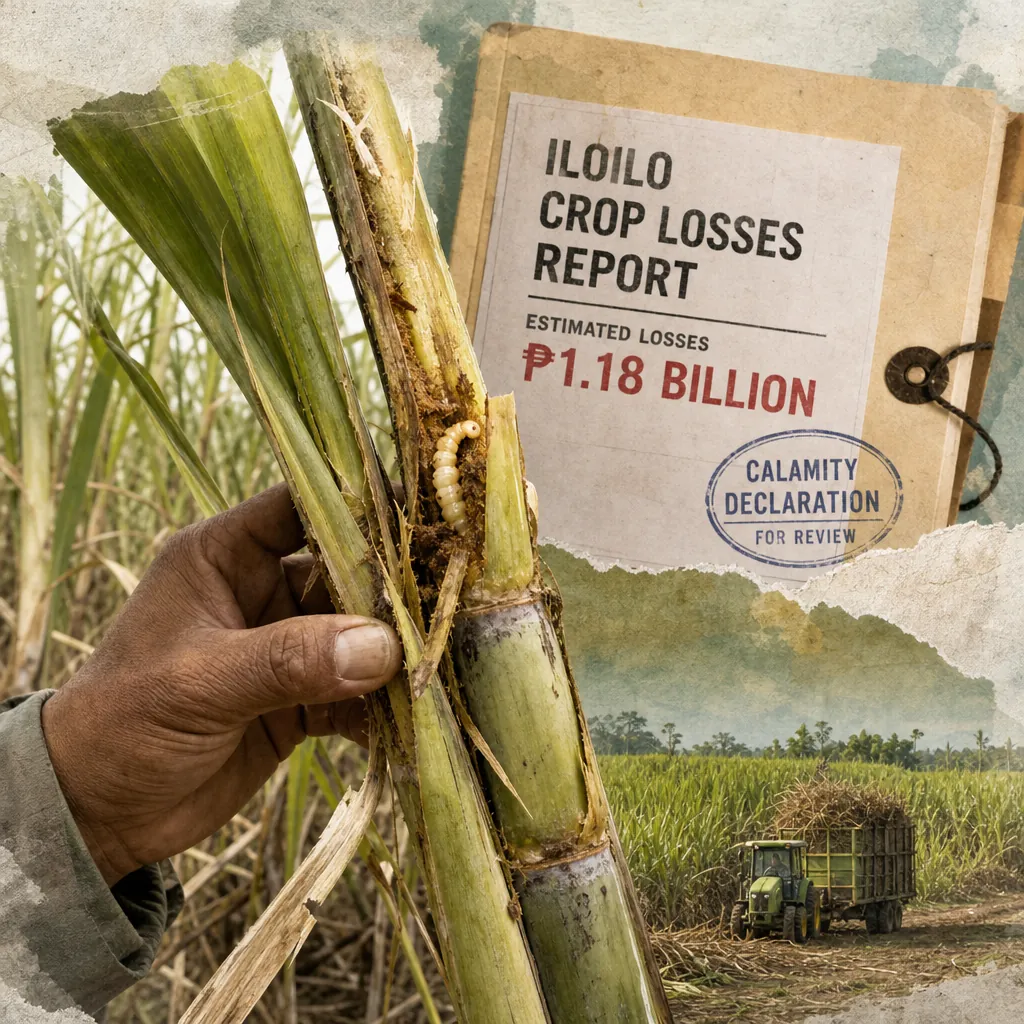
On the Philippine side, the day's most consequential agricultural story was the red-striped soft scale insect (RSSI) infestation in Iloilo, where the provincial government reported estimated production losses of P1,181,878,839 as of Oct. 5 — P122.5 million from totally damaged crops and P1.06 billion from partially damaged ones — across 10,342.72 hectares and 9,491 farmers in 27 of the province's 43 local government units17. Three municipalities have already declared states of calamity: Passi City on Aug. 25, San Enrique on Sept. 22, and Dueñas on Oct. 617. A separate report put the loss figure at P1.81 billion and said Governor Arthur Defensor Jr. is preparing a province-wide declaration32.
The rest of the captured coverage was a broad mix of trade, tariff, and market-access stories: the Philippines eyeing the United Arab Emirates for coconut exports3, pork producers pushing to reclassify frozen pork jowls5, a Southeast Asian Regional Center for Graduate Study and Research in Agriculture (Searca) policy brief urging Quezon's coconut industry to move beyond copra6, and the Department of Trade and Industry (DTI) mapping a halal calamansi supply chain in Oriental Mindoro12. A panel led by the Federation of Philippine Industries and Alyansa Agrikultura argued that political will alone could curb substandard products16. The window also carried a P2.19-billion block sale of Meralco shares13, a magnitude 5.2 earthquake off Davao Occidental14, and a warning from the Department of Energy that a "Super El Niño" could raise electricity prices and cause more brownouts42.
Key themes
- A viral fuel complaint became a six-station inspection in Perak. KPDN enforcement officers inspected stations around Ipoh, Taiping and Kuala Kangsar after a social post alleged RON95 was mixed with water and had damaged vehicles; samples went to the Department of Chemistry for analysis1.
- Iloilo's sugarcane pest losses reached P1.18 billion across 27 of 43 LGUs. The provincial government reported 10,342.72 hectares affected and 9,491 farmers hit, with three municipalities already under states of calamity17. A second report put the figure at P1.81 billion and said a province-wide declaration is being prepared32.
- The Philippines is courting the UAE for coconut exports. The Philippine Council for Agriculture and Fisheries convened government and private partners under Project Coco Bridge, aiming to move coconut products "from export potential to actual commercial and retail presence in the UAE," according to Agriculture Attaché Michael Sollera3.
- Pork producers want frozen jowls reclassified as swine meat. The Pork Producers Federation of the Philippines is pushing to remove the current 10-percent tariff treatment for standalone imported pork jowls and apply the 30-percent in-quota and 40-percent out-quota rates instead5.
- A Searca brief says Quezon's coconut industry must move past copra. The province accounted for about 10 percent of national coconut production in 2023 and had the largest coconut area, but many farming households remain dependent on low-value copra with limited processing6.
- DTI is mapping a halal calamansi supply chain in Oriental Mindoro. A focus group discussion on Oct. 6 in Victoria town brought together farmers, processors, retailers, agencies and the academe to identify bottlenecks and opportunities12.
- Industry leaders say political will, not new laws, can curb substandard products. A panel led by the Federation of Philippine Industries and Alyansa Agrikultura made the case at the Quezon City Journalists Forum on Oct. 6, with speakers from the University of the Philippines, FPI and the Philippine Iron and Steel Institute16.
- The energy regulator flagged higher power prices and more brownouts under a "Super El Niño." Energy Secretary Sharon Garin said the demand-supply relationship would weigh heavily on the market and that the DOE is coordinating with the Energy Regulatory Commission to prevent spot-market profiteering42.
How the narratives stack
Dominant. The Iloilo RSSI infestation is the heaviest agricultural story in this set by consequence: P1.18 billion in estimated production losses, 9,491 farmers affected, and a province-wide calamity declaration in preparation1732. The two reports differ on the loss figure — P1.18 billion as of Oct. 5 versus P1.81 billion — which likely reflects different cut-off dates or the inclusion of additional damage categories; the lower figure is the one tied to a specific reporting date. The story dominated because it combines a large, quantified loss with an active government response and a clear geographic footprint.
Counter-narrative. The coconut export push to the UAE and the Searca brief on Quezon both frame the coconut sector as an opportunity story rather than a distress story36. Project Coco Bridge is explicitly about moving products "from export potential to actual commercial and retail presence"3, while Searca's brief argues the constraint is low-value copra dependence, not lack of demand6. The two stories sit alongside each other: one is about opening a new market, the other about upgrading what is sold into existing ones.
Emerging. The halal calamansi supply-chain mapping in Oriental Mindoro12 and the DTI's One Town, One Product (OTOP) hub launch in Tigbauan, Iloilo33 are both early-stage interventions. Neither has produced a measurable outcome yet, but both signal a push to organize small producers around specific product categories — halal certification and local identity products respectively.
Under-covered. The pork jowl tariff reclassification push5 and the substandard-products panel16 both address trade and quality issues with direct price consequences for consumers, but neither drew the same volume of coverage as the pest infestation or the coconut export stories. The pork jowl story in particular has a clear consumer angle — a tariff change would affect the price of a common food item — but it ran as a single business item.
Platform insights
Facebook. The Perak fuel contamination story originated as a viral social media post before it became a government inspection1, which is the clearest example in this window of a platform post driving enforcement action. The mechanism is familiar: a consumer complaint with a visual or specific claim spreads quickly, and the agency responds to the public pressure rather than waiting for a formal complaint.
X. The platform's expansion of its "Gametime" sports hub beyond the National Football League to Major League Baseball1819 is a business-of-platforms story rather than a consumer conversation, but it matters for how sports content is organized and monetized. The move is aimed at wooing brands and advertisers looking to reach sports fans18.
Reddit and YouTube. Neither platform carried meaningful activity in this window's captured material. The absence is notable given the volume of consumer-facing stories — fuel contamination, food prices, power rates — that typically generate discussion on both platforms.
Key voices and communities
Perak fuel consumers and KPDN enforcement. The complainants who posted about water-contaminated RON95 and the ministry that responded are the two poles of the fuel story1. The consumers' claim is specific and testable — vehicle damage from contaminated fuel — and the ministry's response was procedural: manual dipping, gauge cross-checks, and chemistry lab analysis1.
Iloilo's provincial government and sugarcane farmers. Governor Arthur Defensor Jr. is the central official voice, saying the province has met the requirements for a calamity declaration and is preparing response protocols32. The farmers are the affected population: 9,491 of them across 27 LGUs17.
Philippine trade and agriculture agencies. The DTI appears in three separate stories — the halal calamansi mapping12, the OTOP hub launch33, and the substandard-products panel16 — making it the most active institutional voice in the captured set. The Philippine Council for Agriculture and Fisheries carries the coconut export push3.
Pork producers and coconut industry analysts. The Pork Producers Federation of the Philippines is the lead voice on the jowl tariff question5, while Searca researchers Anna Gale Vallez, Gerlie Tatlonghari and Kim Louisse Patagnan authored the Quezon coconut brief6.
Narrative streams
Fuel contamination complaint triggers six-station inspection in Perak
The sequence is straightforward: a social media post alleged that RON95 petrol sold at stations in Perak was contaminated with water and had damaged consumers' vehicles; KPDN enforcement officers then inspected six stations on Tuesday1. The inspection method matters for what the story can and cannot support. Officers used manual dipping with a dipstick to check storage tanks, cross-checked readings from the Automatic Tank Gauge system, and took RON95 samples from both storage tanks and pumps for submission to the Department of Chemistry Malaysia1. Until those lab results are released, the contamination claim is unverified — the inspection confirms that a complaint was made and acted upon, not that the fuel was contaminated.
For fuel retailers and consumers, the read is that a single viral post can trigger a multi-station enforcement operation within days, and that the operational response — tank dipping, gauge checks, lab sampling — is now the standard playbook. Retailers in affected areas should expect similar scrutiny if complaints recur, and consumers should treat the lab results, not the social post, as the evidentiary basis for any claim.
Iloilo weighs province-wide calamity as sugarcane pest losses mount
The red-striped soft scale insect is a sap-feeding pest that attacks sugarcane, and its spread in Iloilo has been rapid: 27 of 43 LGUs affected, 10,342.72 hectares infested, and 9,491 farmers hit as of Oct. 517. The loss estimate of P1,181,878,839 breaks down into P122.5 million from totally damaged crops and P1.06 billion from partially damaged ones17. Three municipalities — Passi City, San Enrique and Dueñas — have declared states of calamity, which is the legal step that unlocks access to provincial and national calamity funds17. Governor Defensor said the province has met the requirements for a province-wide declaration and is preparing response protocols, noting "since this is new, we have to make our own [protocols]"32.
The discrepancy between the P1.18-billion and P1.81-billion figures is worth flagging: the lower figure is tied to an Oct. 5 reporting date17, while the higher figure appears in a report on the province's calamity preparations32. The difference may reflect additional damage recorded after Oct. 5 or a broader definition of losses. For sugarcane farmers and the provincial government, the immediate read is that the response infrastructure — protocols, funding, and inter-agency coordination — is being built while the infestation is still spreading, which means the eventual loss figure will likely exceed both current estimates.
Coconut sector gets two contrasting signals: new market access and a call to move past copra
The Philippine Council for Agriculture and Fisheries said its National Sectoral Committee on Coconut recently convened government officials and private-sector partners to explore Middle East market opportunities through Project Coco Bridge3. Agriculture Attaché Michael Sollera framed the goal plainly: "Its goal is to move Philippine coconut products from export potential to actual commercial and retail presence in the UAE"3. The meeting also raised a proposal to use the Coconut Farmers and Industry Development Plan, an industry blueprint funded by the coco levy fund — a pool of money collected from coconut farmers decades ago and now being used to revitalize the industry3.
Separately, a Searca policy brief argued that revitalizing Quezon's coconut industry requires moving beyond low-value copra production toward higher-value processing, stronger farmer enterprises, and coordinated long-term investment6. Quezon accounted for about 10 percent of national coconut production in 2023 and had the largest coconut area nationwide, but many farming households remain dependent on copra with limited value addition6. The brief was authored by Anna Gale Vallez, Gerlie Tatlonghari and Kim Louisse Patagnan and is based on field scoping missions, baseline assessments, and rapid value chain analyses6.
The two stories point in the same direction from different angles: the export push is about finding buyers, while the Searca brief is about upgrading what is sold. For coconut farmers and processors, the read is that market access without product upgrading will not raise incomes much — the UAE opportunity is real, but it will reward higher-value products, not raw copra.
Pork producers push for tariff reclassification on frozen jowls
The Pork Producers Federation of the Philippines is asking the government to reclassify frozen pork jowls as swine meat rather than edible offal, which would move them from the current 10-percent tariff rate to the 30-percent in-quota and 40-percent out-quota rates applied to pork meat5. The group argues that the tariff gap disrupts the local industry and gives imported pork cuts an undue advantage, and it plans to create a distinct national tariff line for frozen pork jowls5. The core of the argument is that a jowl arriving as a standalone cut, without the pig's head, should not receive the tariff treatment designated for edible offal5.
For domestic pork producers, the read is that the current tariff structure makes imported jowls artificially cheap relative to local product, and a reclassification would raise the landed cost of that import. For consumers, the effect would depend on how much of the jowl supply is imported and how much of the cost increase is passed through — neither of which is established in the captured coverage. The story is a reminder that tariff lines are not technical trivia; they determine what food costs.
DTI maps halal calamansi supply chain and opens OTOP hub in Iloilo
The DTI's Supply Chain and Logistics Group, in partnership with the Philippine Association of Service Industries Inc., held a focus group discussion on the halal calamansi supply chain on Oct. 6 at the Provincial Agricultural Center in Victoria town, Oriental Mindoro12. The session brought together calamansi farmers, processors and retailers, along with national and local government agencies and the academe, to map the existing supply chain, identify bottlenecks, and find opportunities from production to market12. Halal certification matters here because it opens access to Muslim-majority markets both domestically and abroad; the DTI's framing is that Oriental Mindoro's calamansi industry needs to be "halal-ready" to compete12.
Separately, the DTI Iloilo office and the Tigbauan municipal government opened an OTOP Hub on Oct. 5 and signed a memorandum of agreement formalizing their collaboration33. The OTOP Philippines Program promotes products rooted in the culture, resources, skills and identity of local communities, and the hub provides a physical retail and support space for micro, small and medium enterprises33.
For small producers in both provinces, the read is that the DTI is organizing them around specific product categories — halal calamansi in Oriental Mindoro, local identity products in Tigbauan — rather than offering generic support. The halal mapping is the more consequential of the two because it addresses a certification barrier that can block market access entirely.
Industry panel says political will, not new laws, can curb substandard products
A panel led by the Federation of Philippine Industries and Alyansa Agrikultura argued on Oct. 6 at the Quezon City Journalists Forum that political will alone is enough to significantly reduce the proliferation of substandard products, even without new laws or additional budget16. The panel included Astro del Castillo from the University of the Philippines, Jesus Arranza from the FPI, and Joel Ronquillo from the Philippine Iron and Steel Institute16. Leaders from sectors including steel and angle bars, liquefied petroleum gas, and batteries shared their own problems and recommendations during the open forum16. The report notes that three initiatives recommended by the private sector had previously been approved by a government department16.
For manufacturers and consumers, the read is that the enforcement gap — not the legal gap — is the binding constraint on substandard products. If the panel is right, the fix is administrative: agencies using existing authority more aggressively. That is a testable claim, and the sectors represented — steel, LPG, batteries — are ones where substandard products carry safety risks, not just economic ones.
Energy regulator warns of higher power prices and more brownouts under Super El Niño
Energy Secretary Sharon Garin said on the sidelines of the ASEAN Ministers on Energy Meeting that the relationship between electricity demand and supply would have a large effect on the market, and that the Department of Energy is coordinating closely with the Energy Regulatory Commission to ensure no profiteering occurs in the spot market42. She also said the government is looking for ways to boost electricity supply and avoid shortages, and encouraged the public to conserve energy42. The warning comes as a "Super El Niño" — a climate pattern marked by unusually warm sea surface temperatures in the central Pacific — is forecast to begin this month and persist into the first half of 20273042.
For households and businesses, the read is that electricity bills are likely to rise and outages to become more frequent in the coming months, and that the government's main lever is monitoring the spot market rather than adding supply in the short term. The Baguio tourism story in the same window shows the flip side of the same climate pattern: the city expects a tourism boost as visitors flee the heat, while also marketing destinations "beyond Baguio" to ease pressure on traffic and water supply30.
Conversation trajectory
Fuel contamination lab results (next 1–2 weeks). The Department of Chemistry Malaysia analysis of the RON95 samples will determine whether the contamination claim is substantiated1. If the samples show water contamination, expect follow-up enforcement and possible consumer compensation claims; if they do not, the story shifts to the credibility of the original social post. Watch for KPDN's public statement on the results.
Iloilo province-wide calamity declaration (next 1–2 weeks). Governor Defensor said the response protocols could be completed within a week, after which the province will proceed with the declaration request and assess its capacity to respond32. The declaration would unlock additional funding and formalize the response. Watch for the final loss figure, which will likely exceed the P1.18-billion estimate as the infestation continues to spread17.
Coconut export and tariff decisions (next 1–3 months). Project Coco Bridge is at the convening stage3, and the pork jowl reclassification is a proposal5. Both require government action — a trade mission or market-access arrangement for the former, a tariff line change for the latter. Watch for DTI or Department of Agriculture announcements on either.
Super El Niño onset (October 2026 through first half of 2027). The climate pattern is forecast to begin this month30, and the DOE has already flagged higher power prices and more brownouts42. Watch for actual electricity rate adjustments and any supply-shortage advisories from the DOE or the Energy Regulatory Commission.
Trigger events to monitor. The release of the Perak fuel lab results, the Iloilo provincial board's calamity declaration vote, any DTI announcement on the halal calamansi supply chain or the pork jowl tariff line, and the first monthly inflation print covering the El Niño period.
Response guidance
Fuel retailers in affected areas: prepare for inspection and communicate proactively. The Perak case shows that a single viral complaint can trigger multi-station inspections within days1. Retailers should ensure tank-dipping records and automatic gauge readings are current and accessible, and should have a plain-language statement ready explaining what the inspection involves and when results will be available. Do not dismiss the complaint publicly before the lab results are out.
Agricultural cooperatives and local governments in Iloilo: coordinate on calamity protocols. The province is writing its RSSI response protocols from scratch because the pest is new32. Cooperatives and municipal agriculture offices should feed field data into the provincial assessment and prepare farmer lists for any assistance program. The three municipalities that have already declared states of calamity can serve as templates for the paperwork.
Coconut processors and exporters: position for higher-value products, not raw copra. The UAE market opening3 and the Searca brief6 both point to the same conclusion: buyers will reward processed, branded, or certified products. Processors should assess what certification or processing step would move their product into a higher tariff or retail category, and should engage with the Coconut Farmers and Industry Development Plan process if they have not already.
Pork importers and domestic producers: track the tariff line proposal. The reclassification push5 would raise the landed cost of imported jowls from 10 percent to 30 or 40 percent. Importers should model the cost impact and prepare for either outcome; domestic producers should be ready to document the competitive disadvantage they say the current rate creates.
Small producers in Oriental Mindoro and Iloilo: engage with DTI's category-specific programs. The halal calamansi mapping12 and the OTOP hub33 are both structured around specific product categories. Producers who participate in the supply-chain mapping or sign up for the OTOP hub will have earlier access to certification support and retail space than those who wait.
Energy consumers and businesses: plan for higher bills and possible outages. The DOE has flagged both42. Households should review consumption patterns ahead of the El Niño period, and businesses with backup power needs should verify generator readiness. The government's main intervention is spot-market monitoring, not supply addition, so price relief is unlikely in the near term.
Communicators across the agriculture and trade sectors: treat viral complaints as a trigger for proactive disclosure. The Perak fuel case1 and the Iloilo pest story17 both show that public pressure moves faster than formal reporting channels. Having a clear, factual statement ready — what is known, what is being checked, when results are expected — is more effective than waiting for the full picture before saying anything.
See the full picture behind today's signals.
This report draws from Media Meter's MediaWatch, our real-time monitoring engine tracking 2,470+ Philippine sources across print, broadcast, digital, and social. Explore how the platform turns raw coverage into decision-grade intelligence, then see how it's configured for teams like yours — whether you're in PR agencies, corporate comms, government, or marketing.
Want more? Browse our Report Library for sector and crisis intelligence, or request a demo and we'll have your brand set up before the call.
Want this kind of intelligence on your brand?
This brief is built on the same MediaWatch methodology that runs continuously across every brand we monitor. See your competitive landscape, Impact Score, and narrative trajectory in a 30-minute demo.