Fuel Split, P5.19M Meat Seizure Top Monday Business News
Diesel falls P1.30 per liter while gasoline rises P1.93, and authorities seize 11.5 metric tons of undocumented imported meat in Pasay City. AstraZeneca's planned Manila clinical trial center and a 12% drop in Negros sugar output round out the day's business coverage.
The Conversation
Diesel will fall by P1.30 per liter while gasoline rises by P1.93 per liter in the week beginning Tuesday, October 6, the Department of Energy announced, a split that leaves jeepney and truck operators catching a small break while private motorists absorb another increase at the pump.1 The same bulletin put kerosene up P3.30 per liter, reversing last week's P5.85 decline, and the agency attributed the movements to global oil market conditions and continuing developments in the Middle East affecting supply and prices.1 The announcement landed the same day the Confederation of Truckers Association of the Philippines (CTAP) began a three-day suspension of trips starting Tuesday, citing high fuel costs, shipping line operational problems, unregulated destination charges, truck ban policies, and a shortage of drivers.37
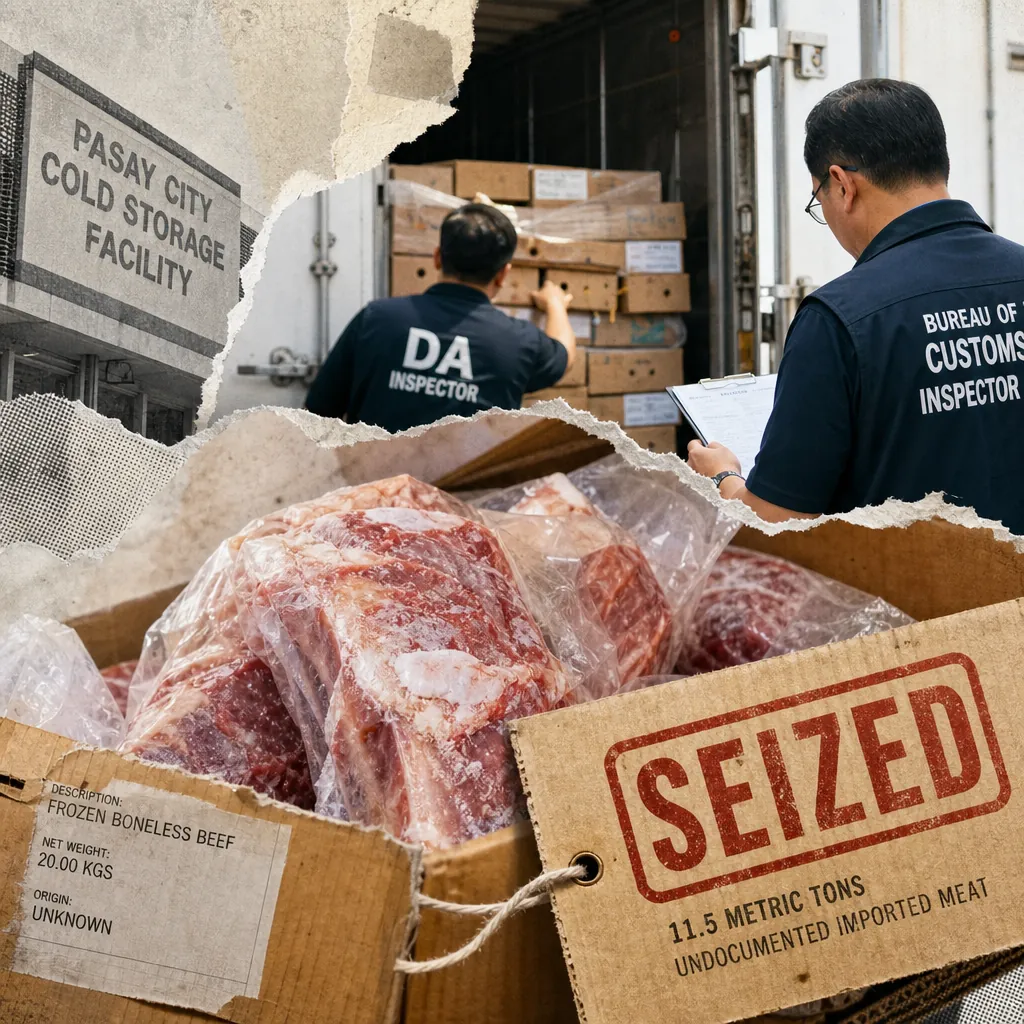
Separately, the Department of Agriculture reported that authorities seized 11.5 metric tons of undocumented imported meat worth P5.19 million from two stores in Pasay City, following a September 22 to 23 operation along C.A. Lucban Street that came after surveillance by the National Bureau of Investigation and verification by the National Meat Inspection Service.2 Two Chinese nationals, Wu Dun Han and Cai Huarong, were arrested and brought to the Pasay City Prosecutors Office for inquest proceedings over alleged violations of the Meat Inspection Code, which prohibits the sale, transport, or distribution of uninspected meat.2 The seized products included about 3.2 metric tons of pork, 2.5 metric tons each of Peking duck and chicken, and 1.6 metric tons of assorted meat, plus goose necks, lamb, beef, and pigeon.2 A parallel report in Filipino carried the same figures and identified the two arrested individuals.38
On the investment side, AstraZeneca confirmed plans to build a Clinical Trial Center of Excellence in Manila within the year, expanding a partnership with the Department of Trade and Industry to develop the Philippines into a regional hub for clinical research and life sciences investment.3 The company has invested more than P3 billion in Philippine clinical trials over the past six years and supports more than 28 ongoing and planned trials involving over 1,000 Filipino patients across 150 sites.3 The planned center will be a partnership with De La Salle University, the Department of Science and Technology, and the Philippine Economic Zone Authority, through the DLSU Knowledge, Innovation, Science and Technology Zone, and will be the first of three components in a broader health initiative alongside a Cancer Command Centre and a Cardio-Renal-Metabolic Centre.38
In agriculture, the 2026–2027 sugar milling season is underway with production expected to fall roughly 12 percent from last year's levels, and Negros Occidental 5th District Rep. Emilio Yulo III said it now costs P2,400 to P2,500 just to produce one bag of sugar, up across the board from fertilizer and fuel to hauling and irrigation.7 Sugar Regulatory Administration chief Pablo Luis Azcona said lower national stockpiles and steady demand could push sugar prices higher this season, potentially above last year's rates.7 The Department of Agriculture also said its ban on raw ube exports will more or less remain in place until the end of the Marcos administration in 2028, as the agency seeks to multiply the country's planting area for the root crop.9 Agriculture Secretary Francisco Tiu Laurel Jr. said the agency intends to spend the next year, and possibly another year after that, building up the country's supply of ube planting materials amid heightened demand overseas.9
Key themes
- Diesel falls P1.30 per liter while gasoline rises P1.93 — The Department of Energy's weekly adjustment splits the two main transport fuels in opposite directions, with kerosene up P3.30 per liter after last week's P5.85 decline.1 The divergence matters most to operators whose fleets run on diesel and to commuters whose fares are tied to fuel costs.
- Truckers suspend trips for three days starting October 6 — CTAP president Mary Zapata cited high oil prices, shipping line operational problems, unregulated destination charges, truck ban policies, and a driver shortage as the industry's most serious problems.37 The group said it wants direct talks with government for concrete solutions.
- P5.19 million in undocumented meat seized in Pasay City — Authorities confiscated 11.5 metric tons of imported meat from two stores neither accredited by the National Meat Inspection Service nor registered as cold-storage warehouses, and arrested two Chinese nationals.238 The case tests enforcement of the Meat Inspection Code, which bars the sale, transport, or distribution of uninspected meat.
- AstraZeneca plans a Manila clinical trial center — The pharmaceutical firm has invested more than P3 billion in Philippine clinical trials over six years and supports over 28 trials with more than 1,000 Filipino patients across 150 sites.3 The center, planned with DLSU, DOST, and PEZA, is the first of three planned pillars of a broader health ecosystem.8
- Negros sugar output expected to fall 12 percent — Production costs have risen to P2,400–P2,500 per bag, and the Sugar Regulatory Administration warns lower stockpiles and steady demand could push prices above last year's rates.7 The milling season is already underway.
- Raw ube export ban likely to run until 2028 — The Department of Agriculture will spend the next year or two building up planting material supply, keeping the indefinite ban imposed in September in place through the end of the Marcos administration.9 The restriction covers raw ube and propagative planting materials for consumption, planting, or research.
- Industry groups press for tougher product standards enforcement — The Federation of Philippine Industries raised concerns over substandard goods, delayed action on reported violations, and limited manufacturer accountability ahead of National Standards Week from October 8 to 14 and World Standards Day on October 18.10 Economist Astro del Castillo said poor enforcement hurts both consumers and compliant manufacturers who lose market share to cheaper products making fraudulent claims.
- DTI warns against hoarding and overpricing of water containers — The Department of Trade and Industry said it will closely monitor prices of bottled water, plastic drums, and other water containers amid concerns over hoarding and profiteering as a super El Niño threatens to strain water supply.32 The agency said supplies remain adequate but will intensify monitoring and coordinate with manufacturers and distributors.
How the narratives stack
Dominant: The fuel price split and the truckers' suspension dominated the day's business coverage in the items captured here. The Department of Energy's announcement that diesel falls P1.30 per liter while gasoline rises P1.93 per liter affects every motorist, jeepney operator, and logistics company in the country, and the CTAP trip suspension starting October 6 gives the fuel story an immediate operational consequence.137 The two stories are linked: CTAP president Mary Zapata named high oil prices as the industry's most serious problem, and the group's three-day suspension is a direct response to cost pressures that the diesel decrease only partially relieves.37 The meat seizure also drew heavy coverage, with the Manila Times and Philstar both carrying the story, and the Manila Times item alone accounting for P274,724 in estimated advertising-equivalent value within the captured set.238
Counter-narrative: The AstraZeneca clinical trial center offers a different frame for the same day's news: foreign investment in Philippine health infrastructure, with more than P3 billion already spent on trials over six years and a partnership that includes the Department of Trade and Industry, De La Salle University, the Department of Science and Technology, and the Philippine Economic Zone Authority.38 The Inquirer's coverage framed it as the Philippines seeking to position itself as Asia's next clinical research hub, with the center serving as the first of three planned pillars alongside a Cancer Command Centre and a Cardio-Renal-Metabolic Centre.8 The story's estimated advertising-equivalent value in the captured set was P309,324 for the Manila Times item and P285,768 for the Inquirer item, reflecting substantial column inches devoted to the announcement.38
Emerging: The sugar production decline and the ube export ban represent slow-building agricultural supply stories that will play out over the coming months and years. Negros Occidental Rep. Emilio Yulo III's warning that it now costs P2,400 to P2,500 to produce one bag of sugar, combined with the Sugar Regulatory Administration's expectation that lower stockpiles and steady demand could push prices above last year's rates, points to potential consumer price pressure in the months ahead.7 The ube ban, which Agriculture Secretary Francisco Tiu Laurel Jr. said will more or less remain in place until 2028, is a deliberate supply-building measure that trades short-term export revenue for long-term planting material security.9 Both stories are about the lag between agricultural policy decisions and their effects on prices and supply.
Under-covered: The Federation of Philippine Industries' call for tougher enforcement of mandatory product standards received comparatively little attention in the captured set, with a single item from the Daily Tribune carrying an estimated advertising-equivalent value of P59,388, the lowest among the business stories reviewed here.10 The group raised the issue ahead of National Standards Week from October 8 to 14 and World Standards Day on October 18, citing concerns over substandard goods, delayed action on reported violations, and limited accountability for manufacturers.10 University of the Philippines professor and economist Astro del Castillo said substandard goods may fail to meet minimum quality and safety requirements, while compliant manufacturers can lose market share to cheaper products that allegedly make fraudulent claims.10 FPI chair emeritus Jesus Arranza called on the Department of Trade and Industry to take a clearer position against court orders that, in the group's view, undermine enforcement.10 The story's low coverage value in this set does not necessarily reflect its importance to manufacturers and consumers, but it does indicate that the issue did not command the same attention as the fuel and meat stories on this day.
Platform insights
- Facebook: The day's most-shared business content in the captured set centered on the fuel price announcement, with the Department of Energy's bulletin circulating through news pages and motorist groups. The diesel decrease and gasoline increase split generated discussion among jeepney and truck operators, who are the most directly affected by diesel prices, and among private motorists facing another gasoline increase. The CTAP trip suspension also circulated on Facebook, with trucker groups and logistics pages sharing the announcement and its implications for supply chains.
- X: The meat seizure story drew attention on X, where users shared the Manila Times and Philstar reports and discussed food safety enforcement. The arrest of two Chinese nationals and the involvement of the National Bureau of Investigation and the National Meat Inspection Service gave the story a law-and-order dimension that traveled well on the platform. The AstraZeneca announcement also circulated among business and health policy accounts, with users noting the P3 billion investment figure and the partnership with De La Salle University and the Department of Science and Technology.
- Reddit: Discussion on Philippine subreddits focused on the fuel price split, with users analyzing the diesel-versus-gasoline divergence and its impact on transport costs. The meat seizure story also appeared, with users discussing food safety regulations and the role of the National Meat Inspection Service. The sugar production decline and ube export ban generated interest among users following agricultural policy and food prices.
- YouTube: The fuel price announcement and the meat seizure story were covered by Philippine news channels on YouTube, with the Department of Energy's weekly adjustment and the Pasay City operation both receiving video coverage. The AstraZeneca clinical trial center announcement also appeared on business news channels, with coverage highlighting the P3 billion investment and the planned partnership with De La Salle University.
Key voices and communities
Truck operators and logistics groups: The Confederation of Truckers Association of the Philippines, led by president Mary Zapata, is the most directly affected community in the day's news. The group's three-day trip suspension starting October 6 is a response to high oil prices, shipping line operational problems, unregulated destination charges, truck ban policies, and a driver shortage.37 Zapata said the group wants direct talks with government for concrete solutions, and the suspension gives the industry a visible point of leverage in those discussions.
Government economic agencies: The Department of Energy, the Department of Agriculture, the Department of Trade and Industry, and the Sugar Regulatory Administration are the key institutional voices in the day's coverage. The Department of Energy's weekly fuel price adjustment sets the terms for transport costs across the economy.1 The Department of Agriculture's meat seizure operation and ube export ban show the agency enforcing food safety rules and managing agricultural supply.29 The Department of Trade and Industry's warning against hoarding and overpricing of water containers, and its partnership with AstraZeneca on clinical research, show the agency working on both consumer protection and investment promotion.323
Pharmaceutical and health research sector: AstraZeneca's planned Clinical Trial Center of Excellence, developed with De La Salle University, the Department of Science and Technology, and the Philippine Economic Zone Authority, positions the company as a major player in Philippine clinical research.38 The company's more than P3 billion investment over six years and its support for more than 28 trials involving over 1,000 Filipino patients across 150 sites give it substantial standing in the sector.3 The planned center is the first of three components in a broader health ecosystem, alongside a Cancer Command Centre and a Cardio-Renal-Metabolic Centre.8
Sugar farmers and millers: Negros Occidental Rep. Emilio Yulo III and Sugar Regulatory Administration chief Pablo Luis Azcona are the key voices on the sugar production decline. Yulo said it now costs P2,400 to P2,500 to produce one bag of sugar, up across the board from fertilizer and fuel to hauling and irrigation, and called for fair prices to match these costs.7 Azcona said lower national stockpiles and steady demand could push sugar prices higher this season, potentially above last year's rates.7 The milling season is already underway, and the 12 percent production decline will affect farmers, millers, and consumers.
Industry and consumer groups: The Federation of Philippine Industries, represented by chair emeritus Jesus Arranza, and University of the Philippines professor and economist Astro del Castillo are the key voices on product standards enforcement. The group raised concerns over substandard goods, delayed action on reported violations, and limited accountability for manufacturers ahead of National Standards Week from October 8 to 14 and World Standards Day on October 18.10 Del Castillo said poor enforcement affects both consumers and legitimate manufacturers, and urged authorities to strengthen enforcement across sectors covered by mandatory product standards.10
Narrative streams
Diesel falls P1.30 per liter while gasoline rises P1.93
The Department of Energy's weekly price adjustment, covering October 6 to 12, splits the two main transport fuels in opposite directions. Diesel will fall by P1.30 per liter, while gasoline will rise by P1.93 per liter. Kerosene will jump by P3.30 per liter, reversing last week's P5.85 decline. The agency attributed the movements to global oil market conditions and continuing developments in the Middle East affecting supply and prices.1 Compared to the previous week's adjustment, the shift is significant: gasoline moved from a P0.24 decrease to a P1.93 increase, while diesel's decline narrowed from P7.57 to P1.30.1
The read for the sector is that diesel-dependent operators — jeepney drivers, truckers, and logistics companies — get a small cost reprieve, while private motorists and gasoline-powered transport absorb another increase. The diesel decrease is smaller than last week's, which means the cumulative relief for diesel users is narrowing even as prices fall. For commuters, the gasoline increase may eventually feed into fare adjustment petitions, though the immediate effect is on private vehicle operating costs. The kerosene increase affects households that use kerosene for cooking and lighting, particularly in areas without reliable electricity.
The context is that fuel prices in the Philippines are adjusted weekly based on global oil market movements, and the Department of Energy's announcements set the terms for transport costs across the economy. The Middle East developments referenced by the agency are a recurring factor in global oil supply and price volatility, and their persistence means Philippine consumers should expect continued week-to-week fluctuations rather than a stable trend in either direction.
Truckers suspend trips for three days starting October 6
The Confederation of Truckers Association of the Philippines began a three-day suspension of trips on Tuesday, October 6, with president Mary Zapata citing high oil prices, shipping line operational problems, unregulated destination charges, truck ban policies, and a shortage of truck drivers as the industry's most serious problems.37 Even without a formal transport holiday, trucking operations were already limited, and Zapata said this has significantly affected operators' income. The group wants direct talks with government for concrete solutions.37
The read for the sector is that the suspension gives truckers a visible point of leverage in their negotiations with government, but it also risks disrupting supply chains that depend on trucking for the movement of goods. The issues Zapata named — destination charges, truck bans, and driver shortages — are structural problems that have accumulated over years, and a three-day suspension is unlikely to resolve them on its own. The fuel price split announced the same day offers only partial relief, since diesel falls P1.30 per liter but the other cost pressures remain.137
The context is that the Confederation of Truckers Association of the Philippines represents truck operators who move goods across the country, and their operational problems affect the cost and reliability of supply chains. Unregulated destination charges are fees imposed at delivery points that operators say are unpredictable and sometimes unjustified. Truck ban policies restrict when and where trucks can operate in urban areas, which complicates scheduling and increases costs. The driver shortage reflects both the difficulty of the work and the competition for skilled labor.
P5.19 million in undocumented meat seized in Pasay City
Authorities seized 11.5 metric tons of undocumented imported meat worth P5.19 million from two stores in Pasay City, following a September 22 to 23 operation along C.A. Lucban Street that came after surveillance by the National Bureau of Investigation and verification by the National Meat Inspection Service.2 The stores, LCCI Food Condiments Trading and Sitphin Sari-Sari Store, were neither accredited by the National Meat Inspection Service nor registered with the local government as meat cold-storage warehouses or depots.2 Two Chinese nationals, Wu Dun Han and Cai Huarong, were arrested and brought to the Pasay City Prosecutors Office for inquest proceedings over alleged violations of the Meat Inspection Code, which prohibits the sale, transport, or distribution of uninspected meat.2 The seized products included about 3.2 metric tons of pork, 2.5 metric tons each of Peking duck and chicken, and 1.6 metric tons of assorted meat, plus goose necks, lamb, beef, and pigeon.2
The read for the sector is that the seizure tests enforcement of the Meat Inspection Code, which is the law that requires meat sold in the Philippines to be inspected and certified safe for consumption. The involvement of the National Bureau of Investigation and the National Meat Inspection Service signals that the operation was coordinated across agencies, and the arrest of two individuals suggests authorities are pursuing criminal liability rather than administrative penalties alone. For consumers, the case is a reminder that undocumented meat can enter the supply chain through unregistered cold-storage facilities, and that the inspection system depends on both accreditation and local government registration to function.
The context is that the National Meat Inspection Service is the agency responsible for inspecting meat and meat products in the Philippines, and its accreditation is required for cold-storage warehouses and depots. The Meat Inspection Code prohibits the sale, transport, or distribution of uninspected meat, and violations can result in criminal charges. The operation followed surveillance by the National Bureau of Investigation, which indicates that authorities had been tracking the stores before the raid. The seized products included a mix of pork, poultry, and other meats, suggesting the stores were handling a variety of imported products without the required inspections.
AstraZeneca plans a Manila clinical trial center
AstraZeneca plans to build a Clinical Trial Center of Excellence in Manila within the year, expanding a partnership with the Department of Trade and Industry to develop the Philippines into a regional hub for clinical research and life sciences investment.3 The company has invested more than P3 billion in Philippine clinical trials over the past six years and supports more than 28 ongoing and planned trials involving over 1,000 Filipino patients across 150 sites.3 Trade Secretary Cristina Roque recently met with the pharmaceutical firm's officials to discuss health innovation projects, broader Philippine participation in global clinical trials, and faster regulatory approvals.3 The planned center will be a partnership with De La Salle University, the Department of Science and Technology, and the Philippine Economic Zone Authority, through the DLSU Knowledge, Innovation, Science and Technology Zone.3 It will be the first of three components in a broader health initiative, alongside a Cancer Command Centre and a Cardio-Renal-Metabolic Centre.8
The read for the sector is that the Philippines is positioning itself as a clinical research hub, which could bring investment, jobs, and access to new treatments for Filipino patients. The partnership with De La Salle University, the Department of Science and Technology, and the Philippine Economic Zone Authority gives the project an institutional base that combines academic research, government science funding, and economic zone incentives. The Department of Trade and Industry's role in streamlining regulatory approvals suggests the government sees clinical research as an investment promotion priority, and the planned center's location within the DLSU Knowledge, Innovation, Science and Technology Zone ties it to an existing innovation ecosystem.
The context is that clinical trials are studies conducted to test new treatments, drugs, or medical devices in human volunteers, and they are a prerequisite for regulatory approval of new medicines. Countries that host clinical trials can attract pharmaceutical investment, generate research jobs, and give their patients early access to experimental treatments. The Philippines has participated in global clinical trials, but the planned center of excellence would be a dedicated facility for coordinating and expanding that participation. The Cancer Command Centre and Cardio-Renal-Metabolic Centre are the other two planned pillars of the broader health ecosystem, and they suggest a focus on non-communicable diseases that are major causes of illness and death in the Philippines.
Negros sugar production expected to decline 12 percent
The 2026–2027 sugar milling season is underway, but production is expected to fall roughly 12 percent from last year's levels, and the cost of producing sugar has significantly increased.7 Negros Occidental 5th District Rep. Emilio Yulo III said it now costs P2,400 to P2,500 just to produce one bag of sugar, up across the board from fertilizer and fuel to hauling and irrigation, and called for fair prices to match these costs.7 Sugar Regulatory Administration chief Pablo Luis Azcona said lower national stockpiles and steady demand could push sugar prices higher this season, potentially above last year's rates.7
The read for the sector is that sugar farmers and millers face a squeeze between rising production costs and a smaller harvest, while consumers may see higher sugar prices if stockpiles remain low and demand stays steady. The 12 percent production decline is significant because sugar is a staple ingredient in Philippine food manufacturing and household consumption, and a smaller harvest reduces the buffer against supply disruptions. The Sugar Regulatory Administration's role is to manage the sugar supply and stabilize prices, and its warning about higher prices suggests the agency is preparing for a tighter market.
The context is that the sugar milling season in Negros Occidental, the country's main sugar-producing region, typically runs from October to May or June. Production costs have risen because of higher fertilizer and fuel prices, which affect the cost of growing and harvesting sugarcane, and because of hauling and irrigation expenses. The Sugar Regulatory Administration is the government agency responsible for regulating the sugar industry, including setting production targets and managing imports and exports. The combination of lower production and steady demand is a classic recipe for price increases, and the agency's warning gives farmers and millers a basis for seeking higher prices in their negotiations with buyers.
Raw ube export ban likely to run until 2028
The Department of Agriculture's ban on raw ube exports will more or less remain in place until the end of the Marcos administration in 2028, as the agency seeks to multiply the country's planting area for the root crop.9 Agriculture Secretary Francisco Tiu Laurel Jr. said the agency intends to spend the next year, and possibly another year after that, building up the country's supply of ube planting materials amid heightened demand overseas.9 The restriction covers raw ube and propagative planting materials, whether shipments are intended for consumption, planting, or research.9 Tiu Laurel said the policy was meant to keep more planting materials at home as the government seeks to ramp up domestic production.9 Ube is typically grown using cuttings from existing tubers.9
The read for the sector is that the ban trades short-term export revenue for long-term planting material security, which could benefit farmers and processors if domestic production expands as intended. The indefinite ban imposed in September was a response to heightened overseas demand for ube, which is a purple yam used in desserts and other food products. By restricting exports of raw ube and planting materials, the Department of Agriculture aims to keep enough cuttings at home to expand the planting area, which would increase future production and potentially lower prices for domestic processors.
The context is that ube is a prized root crop in the Philippines, and its popularity overseas has grown in recent years as Filipino cuisine and flavors have gained international attention. The ban covers raw ube and propagative planting materials, which means that exporters cannot ship ube for consumption, planting, or research without government permission. The Department of Agriculture's plan to spend the next year or two building up planting material supply suggests the agency expects the ban to remain in place for an extended period, and the reference to the end of the Marcos administration in 2028 gives a rough timeline for when the policy might be reconsidered.
Industry groups press for tougher product standards enforcement
The Federation of Philippine Industries raised concerns over substandard goods, delayed action on reported violations, and limited accountability for manufacturers ahead of National Standards Week from October 8 to 14 and World Standards Day on October 18.10 University of the Philippines professor and economist Astro del Castillo said poor enforcement of product standards affects both consumers and legitimate manufacturers, and that substandard goods may fail to meet minimum quality and safety requirements while compliant manufacturers can lose market share to cheaper products that allegedly make fraudulent claims.10 Del Castillo urged authorities to strengthen enforcement across sectors covered by mandatory product standards.10 FPI chair emeritus Jesus Arranza called on the Department of Trade and Industry to take a clearer position against court orders that, in the group's view, undermine enforcement.10
The read for the sector is that manufacturers who comply with product standards bear costs that non-compliant competitors avoid, which puts them at a disadvantage when enforcement is weak. Consumers, meanwhile, may be exposed to substandard or unsafe products that do not meet minimum quality and safety requirements. The Federation of Philippine Industries' call for tougher enforcement is a request for the government to level the playing field by holding non-compliant manufacturers accountable, and the timing ahead of National Standards Week and World Standards Day gives the issue a public platform.
The context is that mandatory product standards are government rules that specify minimum quality and safety requirements for certain products, and the Department of Trade and Industry is the main agency responsible for enforcing them. National Standards Week and World Standards Day are annual events that highlight the importance of standards in trade and consumer protection. The Federation of Philippine Industries is an industry group that represents manufacturers, and its concerns about delayed action on reported violations and limited accountability suggest that the enforcement process is slow or inconsistent. The reference to court orders that undermine enforcement indicates that the group believes some legal decisions have made it harder for the Department of Trade and Industry to act against non-compliant manufacturers.
DTI warns against hoarding and overpricing of water containers
The Department of Trade and Industry said it will closely monitor prices of bottled water, plastic drums, and other water containers amid concerns over possible hoarding and profiteering as a super El Niño threatens to strain water supply.32 The agency said supplies of the basic good remain adequate, but that it will intensify price monitoring and coordinate closely with manufacturers and distributors to ensure that supplies remain steady.32 The Department of Trade and Industry reminded businesses and sellers to act responsibly and refrain from taking advantage of the situation through unjustified price increases, and said it will not hesitate to impose appropriate fines, penalties, and other sanctions against those found violating applicable rules.32
The read for the sector is that the Department of Trade and Industry is preparing for a potential water supply crunch by warning against hoarding and overpricing before the situation becomes acute. The super El Niño, which experts expect to reach very strong levels before the end of 2026 and persist through the first half of 2027, could reduce water availability and increase demand for bottled water and storage containers.32 By monitoring prices and coordinating with manufacturers and distributors, the agency aims to prevent shortages and price spikes that would burden consumers.
The context is that El Niño is a climate pattern that can cause drought and reduced rainfall in the Philippines, and a super El Niño is an especially strong event. The Department of Trade and Industry is the government agency responsible for consumer protection and price monitoring, and its warning against hoarding and overpricing is a standard response to potential supply disruptions. Bottled water and plastic drums are basic goods that households and businesses rely on during water shortages, and the agency's monitoring is intended to ensure that supplies remain available at reasonable prices.
Conversation trajectory
Fuel prices will continue to fluctuate week to week. The Department of Energy's weekly adjustments are driven by global oil market conditions and Middle East developments, and the agency's own attribution of the latest movements to those factors suggests no immediate stabilization. Over the next four to six weeks, watch whether the diesel decline continues or reverses, and whether the gasoline increase feeds into fare adjustment petitions or transport cost complaints. The trigger events are the Department of Energy's weekly announcements, typically made on Mondays or Tuesdays, and any statements from transport groups about the impact of the price split.1
The truckers' suspension will test government response. The Confederation of Truckers Association of the Philippines' three-day trip suspension starting October 6 gives the group a visible point of leverage, and the next signal will be whether government agrees to direct talks and what concrete solutions emerge. Over the next two to four weeks, watch for statements from the Department of Trade and Industry, the Department of Transportation, or other agencies about the truckers' demands, and for any indication that the suspension will be extended or repeated. The trigger events are the end of the three-day suspension on October 9 and any government response to the group's request for talks.37
The meat seizure case will move through the legal process. The two arrested individuals were brought to the Pasay City Prosecutors Office for inquest proceedings, and the next signal will be whether charges are filed and what penalties are sought. Over the next four to eight weeks, watch for developments in the case and for any indication that the operation is part of a broader crackdown on undocumented meat imports. The trigger events are the filing of charges, any statements from the Department of Agriculture or the National Meat Inspection Service about the case, and any additional operations against unregistered cold-storage facilities.238
The AstraZeneca clinical trial center will move toward opening. The center is targeted to open within the year, and the next signal will be the formal announcement of the partnership with De La Salle University, the Department of Science and Technology, and the Philippine Economic Zone Authority, and the start of construction or operations. Over the next three to six months, watch for details about the center's scope, the number of trials it will support, and any additional investment commitments from AstraZeneca or other pharmaceutical companies. The trigger events are the formal launch of the center, any statements from the Department of Trade and Industry about regulatory streamlining, and the announcement of the Cancer Command Centre and Cardio-Renal-Metabolic Centre.38
Sugar prices will depend on the harvest and stockpiles. The 12 percent production decline and the Sugar Regulatory Administration's warning about higher prices set up a potential price increase in the coming months. Over the next two to four months, watch for harvest updates, stockpile figures, and any decision by the Sugar Regulatory Administration to allow imports or adjust domestic allocation. The trigger events are the release of production data for the 2026–2027 milling season, any statements from the Sugar Regulatory Administration about prices, and any petitions from consumer groups or food manufacturers about sugar costs.7
The ube export ban will remain in place through 2028. The Department of Agriculture's plan to spend the next year or two building up planting material supply means the ban is unlikely to be lifted soon. Over the next six to twelve months, watch for updates on the expansion of the ube planting area, any changes in domestic production, and any statements from the Department of Agriculture about the ban's duration. The trigger events are the release of planting area and production data, any requests from exporters for exemptions, and any indication that the ban might be lifted earlier than 2028.9
Product standards enforcement will get attention during National Standards Week. The Federation of Philippine Industries' call for tougher enforcement ahead of National Standards Week from October 8 to 14 and World Standards Day on October 18 gives the issue a public platform. Over the next two to four weeks, watch for statements from the Department of Trade and Industry about enforcement actions, any new regulations or guidelines, and any response to the group's concerns about court orders. The trigger events are National Standards Week and World Standards Day, any announcements from the Department of Trade and Industry, and any statements from the Federation of Philippine Industries about the government's response.10
Water container prices will be monitored as the super El Niño develops. The Department of Trade and Industry's warning against hoarding and overpricing is a preemptive measure, and the next signal will be whether prices remain stable or rise as the El Niño strengthens. Over the next two to four months, watch for price monitoring reports, any enforcement actions against hoarders or overpricing, and any updates on water supply conditions. The trigger events are the Department of Trade and Industry's price monitoring reports, any statements from the agency about enforcement, and any changes in the El Niño forecast.32
Response guidance
Fuel price communications: For transport operators and motorist groups, the key message is that the diesel decrease offers partial relief while the gasoline increase adds to costs for private vehicle users. Communicate the specific figures — diesel down P1.30 per liter, gasoline up P1.93 per liter, kerosene up P3.30 per liter — and explain that the movements reflect global oil market conditions and Middle East developments. Avoid framing the diesel decrease as a win without acknowledging that the decline is smaller than last week's and that other cost pressures remain.1
Truckers' suspension: For logistics companies and industry groups, the key message is that the three-day suspension is a response to structural problems — high oil prices, shipping line operational problems, unregulated destination charges, truck ban policies, and driver shortages — that require government action. Communicate the specific issues and the group's request for direct talks, and avoid framing the suspension as a strike or a political statement. The goal is to open a dialogue with government, not to disrupt supply chains.37
Meat safety enforcement: For food safety agencies and consumer groups, the key message is that the seizure of 11.5 metric tons of undocumented meat worth P5.19 million shows enforcement is working, but that consumers should remain vigilant about the source of their meat products. Communicate the role of the National Meat Inspection Service in inspecting meat and accrediting cold-storage facilities, and explain that the Meat Inspection Code prohibits the sale, transport, or distribution of uninspected meat. Avoid speculating about the scope of the problem beyond the specific case.238
Clinical research investment: For government investment promotion agencies and pharmaceutical companies, the key message is that the AstraZeneca clinical trial center positions the Philippines as a regional hub for clinical research and life sciences investment. Communicate the P3 billion investment over six years, the more than 28 trials involving over 1,000 Filipino patients across 150 sites, and the partnership with De La Salle University, the Department of Science and Technology, and the Philippine Economic Zone Authority. Avoid overstating the immediate impact on patients or the health system.38
Sugar supply and prices: For agricultural agencies and farmer groups, the key message is that the 12 percent production decline and rising costs of P2,400 to P2,500 per bag create a squeeze for farmers and millers, and that consumers may see higher prices if stockpiles remain low. Communicate the Sugar Regulatory Administration's role in managing supply and stabilizing prices, and explain that the agency is monitoring the situation. Avoid predicting specific price levels without evidence.7
Ube export ban: For agricultural agencies and exporters, the key message is that the ban on raw ube exports is intended to build up domestic planting material supply and expand production, and that it will more or less remain in place until 2028. Communicate the Department of Agriculture's plan to spend the next year or two building up supply, and explain that the restriction covers raw ube and propagative planting materials for consumption, planting, or research. Avoid framing the ban as permanent or as a response to a specific export dispute.9
Product standards enforcement: For industry groups and consumer advocates, the key message is that poor enforcement of mandatory product standards hurts both consumers and compliant manufacturers, and that the Federation of Philippine Industries is calling for stronger enforcement ahead of National Standards Week and World Standards Day. Communicate the specific concerns — substandard goods, delayed action on reported violations, limited accountability — and explain that the Department of Trade and Industry is the main agency responsible for enforcement. Avoid naming specific companies or products without evidence.10
Water container prices: For consumer protection agencies and retailers, the key message is that the Department of Trade and Industry is monitoring prices of bottled water, plastic drums, and other water containers amid concerns over hoarding and overpricing as a super El Niño threatens to strain water supply. Communicate the agency's warning against unjustified price increases and its commitment to impose fines and penalties against violators. Avoid creating panic about water shortages or suggesting that supplies are inadequate.32
See the full picture behind today's signals.
This report draws from Media Meter's MediaWatch, our real-time monitoring engine tracking 2,470+ Philippine sources across print, broadcast, digital, and social. Explore how the platform turns raw coverage into decision-grade intelligence, then see how it's configured for teams like yours — whether you're in PR agencies, corporate comms, government, or marketing.
Want more? Browse our Report Library for sector and crisis intelligence, or request a demo and we'll have your brand set up before the call.
Want this kind of intelligence on your brand?
This brief is built on the same MediaWatch methodology that runs continuously across every brand we monitor. See your competitive landscape, Impact Score, and narrative trajectory in a 30-minute demo.