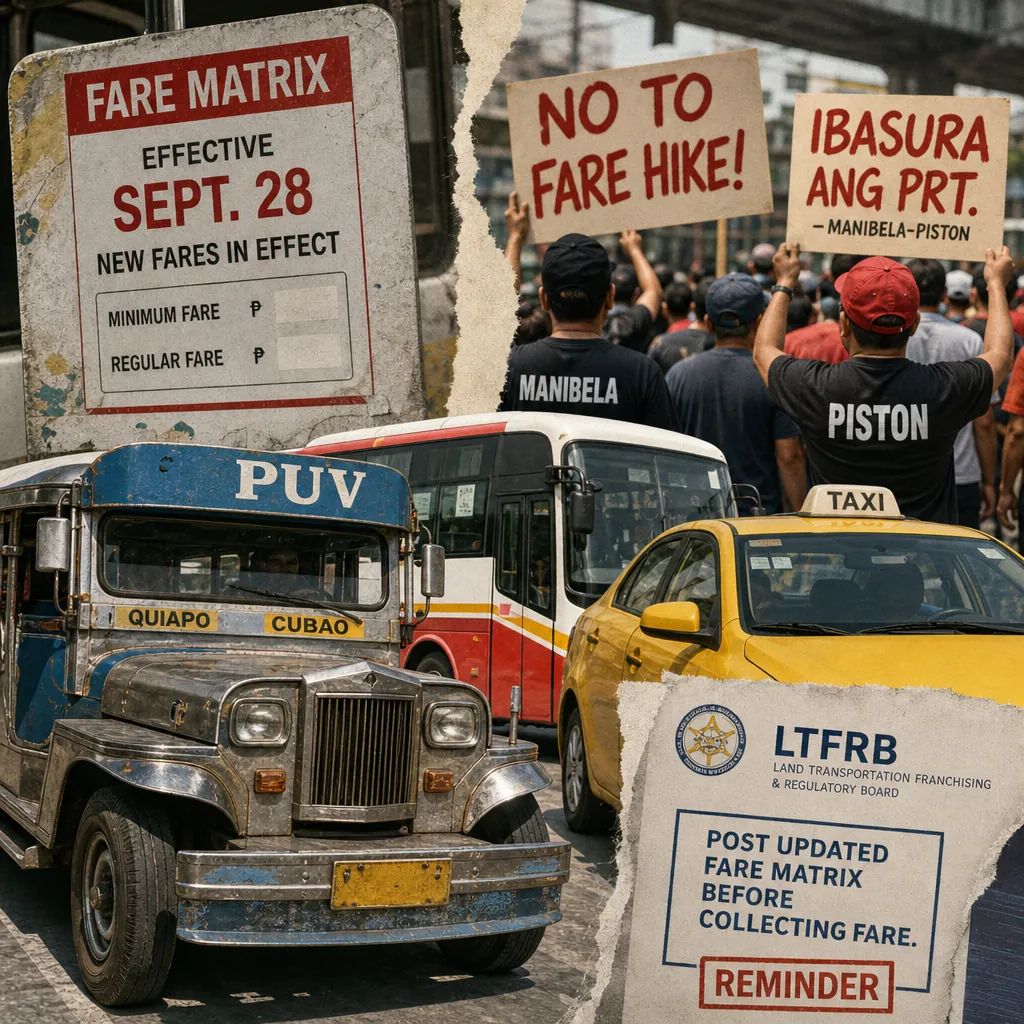
Fare hike, transport strike grip PH commuters
A nationwide jeepney and bus fare increase took effect Monday as transport groups began a three-day strike over fuel prices, while August vehicle sales fell 18.1 percent and electrified vehicle sales more than tripled.
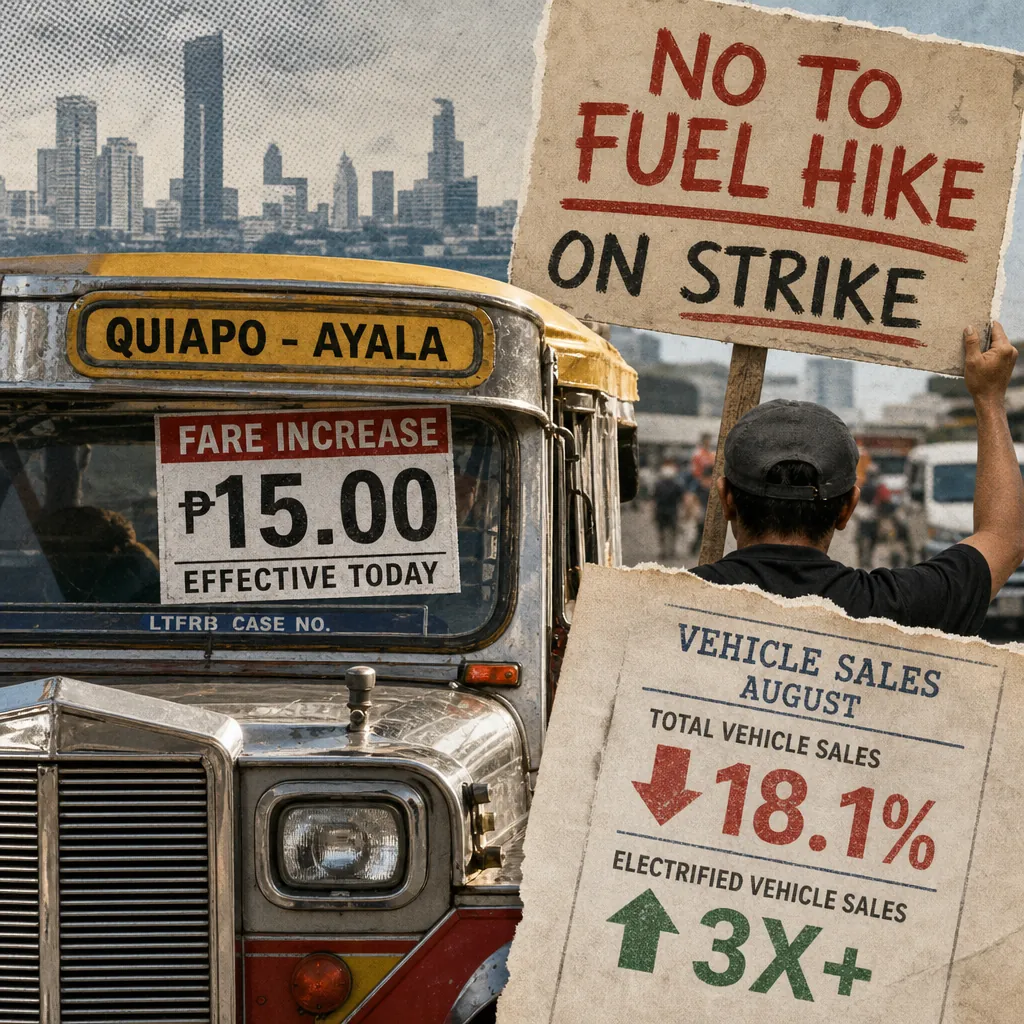
A jeepney ride in Metro Manila and most of the country cost one peso more on Monday, September 28, and by 6:21 a.m. that same morning drivers had already gathered at the Philcoa footbridge in Quezon City to say the increase was not enough. The Land Transportation Franchising and Regulatory Board (LTFRB), the agency that sets fares for public utility vehicles, approved the provisional increase covering jeepneys, buses, taxis and ride-hailing cars, and transport groups answered with a three-day strike that ran through September 30.6656 The same day, the Chamber of Automotive Manufacturers of the Philippines, Inc. (CAMPI) and the Truck Manufacturers Association, Inc. (TMA) reported that vehicle sales fell 18.1 percent in August from a year earlier, to 29,611 units, even as sales of electrified vehicles more than tripled.5964
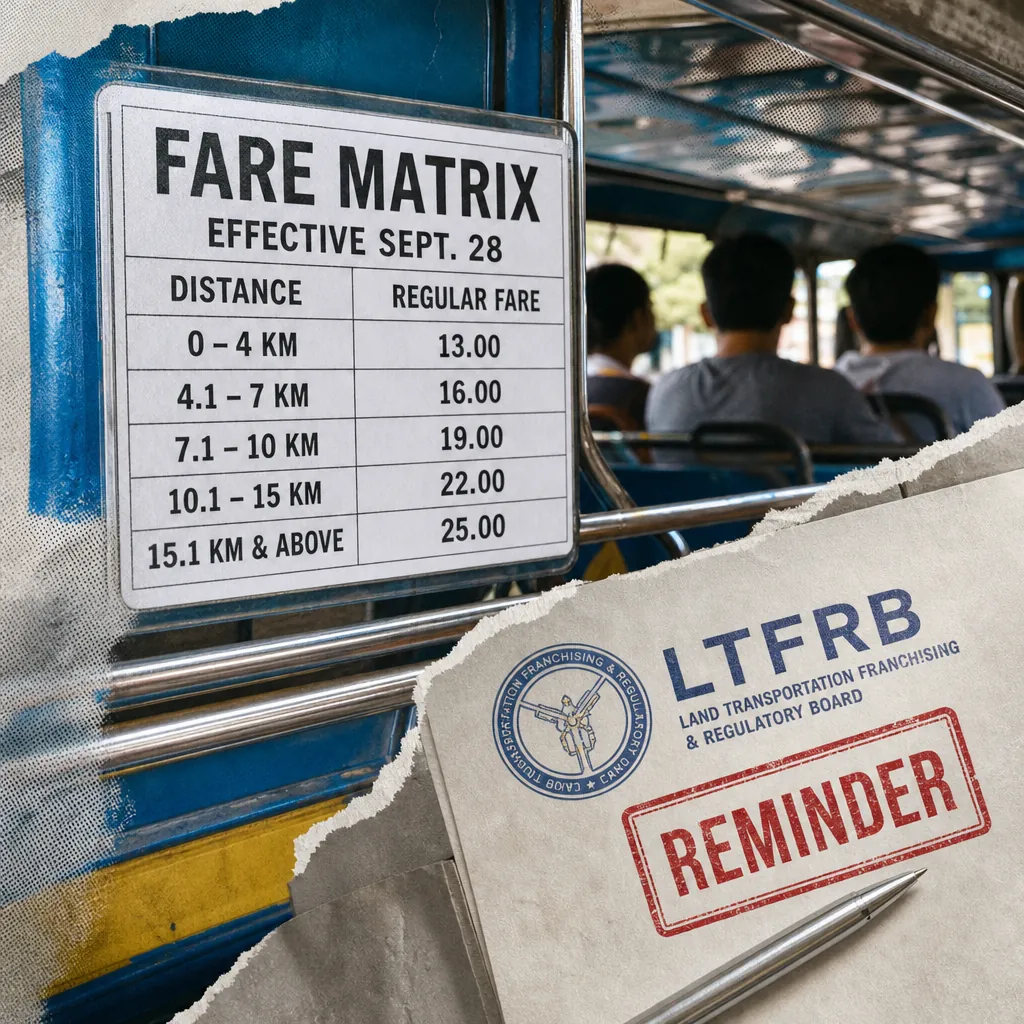
The fare increase and the strike dominated the day's coverage across the items reviewed here, and they are two halves of one story: the cost of fuel. For traditional jeepneys, the minimum fare for the first four kilometers rose to P14 from P13, with each succeeding kilometer at P2 instead of P1.80. For modern jeepneys — the newer, larger units bought under the government's Public Utility Vehicle Modernization Program, which requires operators to replace older jeepneys with vehicles meeting newer emission and safety standards — the minimum rose to P17 from P15, with succeeding kilometers at P2.40. Taxis saw their flag-down rate rise to P65 from P50.2122
Transport groups said the increase was too small and too late. Manibela chairman Mar Valbuena noted the petition behind it was filed in March, when pump prices were around P45 to P50 per liter, and said the group wants another P1. Piston national president Mody Floranda said pump prices have risen by around P50, leaving jeepney drivers short by at least P1,000 a day.76 The LTFRB said Manibela's separate petition for a P2 increase in the minimum fare remains under review.56
Key themes
- Fare increase takes effect nationwide, one peso for traditional jeepneys. The minimum fare for the first four kilometers rose to P14 from P13 for traditional jeepneys and to P17 from P15 for modern units, with taxi flag-down rates up to P65 from P50. The LTFRB fast-tracked a temporary fare guide so drivers could collect the higher fares without waiting for the official matrix.6622
- Transport groups call the increase insufficient and strike for three days. Manibela, Piston and allied groups staged a work stoppage from September 28 to 30, demanding lower pump prices, the suspension of the Oil Deregulation Law and the removal of excise taxes and value-added tax on petroleum products.3956
- August vehicle sales fall 18.1 percent on bad weather. CAMPI and TMA members sold 29,611 units in August, down from 36,174 a year earlier and 20.7 percent below July. Year-to-date sales of 271,336 units were 11.1 percent lower than the 305,381 sold in the first eight months of 2025.1959
- Electrified vehicle sales more than triple even as the overall market shrinks. Sales of xEVs — the industry's shorthand for battery electric, hybrid and plug-in hybrid vehicles — grew 214.9 percent to 7,069 units from 2,244 a year earlier, according to CAMPI and TMA.5964
- Mitsubishi plans to build hybrids in Laguna for export by 2030. Mitsubishi Motors Philippines Corp. is looking at 2030 to begin shipping locally assembled hybrid vehicles, under the government's Electric Vehicle Incentive Strategy, which gives incentives to manufacturers that produce or assemble electric and hybrid vehicles in the country.74
- Truck makers and body builders mount the first Philippine International Truck Show. The Truck Manufacturers Association and the Automotive Body Manufacturers Association of the Philippines will hold the inaugural show on October 22 to 24 at the SMX Convention Center Manila, bringing together manufacturers, body builders, fleet operators and logistics companies.1658
- Local truck assembly persists even as imports dominate. Isuzu Philippines, Mitsubishi and Hino continue assembling commercial vehicles in Laguna, and Centro Manufacturing marks 30 years of turning chassis into cargo vans, passenger vans and refrigerated trucks.13141518
- A driver's license fixing arrest in Aklan points to licensing fraud. An insurance agent was arrested in Kalibo after allegedly arranging a license transaction outside Land Transportation Office procedures for P12,000, in a case that began with a senior citizen's delayed license.17
How the narratives stack
Dominant. The fare increase and the transport strike carried the day across the items reviewed here. The increase took effect nationwide on September 28, and the strike began the same morning, with Manibela members confronting LTFRB personnel along Commonwealth Avenue at about 8:07 a.m. over allegations that enforcers were photographing participating jeepneys to issue fines. Manibela president Mar Valbuena told agency representatives, "I know you will again be ordered to take pictures of the poor drivers' vehicles, make things difficult for them, and fine them." LTFRB acting chairperson Greg Pua Jr. and Land Transportation Office chief Markus Lacanilao arrived at the protest site near the Philcoa footbridge, and Pua apologized for the misunderstanding.50 The Metropolitan Manila Development Authority said rallyists gathered at Commonwealth Philcoa as early as 6:21 a.m., and the Philippine National Police deployed personnel and vehicles to assist commuters and keep order, with chief Gen. Jose Melencio Nartatez Jr. ordering increased police presence at terminals and major roads.5641 The strike drew coverage from Manila Times, Philstar, Inquirer, Daily Tribune, Panay News, Sunstar and Daily Guardian, among others, and the fare increase itself was reported from Iloilo to Cebu to Bacolod.2122384566
Counter-narrative. The vehicle sales report told a different story about the same industry. CAMPI and TMA members sold 29,611 units in August, down 18.1 percent from 36,174 a year earlier, and the industry blamed heavy rain and flooding for disrupting dealership operations and consumer spending. CAMPI president Jose Maria Atienza said, "We're still optimistic that vehicle sales will bounce back over the next few months through year-end. The August dip appears to be a short-term disruption rather than a reversal of market momentum."59 Within that decline, electrified vehicle sales grew 214.9 percent to 7,069 units from 2,244, a figure that ran in Malaya Business Insight, Philstar and Head Topics.596472 The two stories are not in conflict so much as they measure different things: one counts what consumers paid for rides that day, the other counts what they bought in showrooms the month before.
Emerging. The commercial vehicle side of the industry is organizing itself around a dedicated event. The first Philippine International Truck Show, organized by the Truck Manufacturers Association and the Automotive Body Manufacturers Association of the Philippines, will run October 22 to 24 at the SMX Convention Center Manila under the theme "Driving Progress Together." It brings together truck manufacturers, distributors, body builders, fleet operators, logistics companies, transport groups and government agencies.1658 The show arrives as several manufacturers continue local assembly: Isuzu Philippines assembles trucks in Biñan, Laguna, and executive vice president Yasuhiko Oyama said local production gives the company "greater flexibility" to respond to changing market requirements; Mitsubishi produces the L300 alongside the Mirage G4 at its 23-hectare Sta. Rosa plant, which has an annual capacity of 50,000 vehicles and employs 1,310 workers; and Hino Motors Philippines combines chassis assembly and body manufacturing at its Canlubang, Calamba City facility.131518 Centro Manufacturing, which began in 1996 in Novaliches, Caloocan City, marks 30 years of building truck bodies, starting with a passenger van mounted on an Isuzu Fuego pickup chassis.14
Under-covered. Two stories with real consequences for drivers and commuters drew little attention in the items reviewed here. In Kalibo, Aklan, an insurance agent was arrested for allegedly acting as a fixer and arranging a driver's license transaction outside Land Transportation Office procedures. The case began when a senior citizen from Numancia complained that his license release was delayed; LTO Kalibo district chief Marlon Velez ordered the transaction checked through the Land Transportation Management System, and personnel found the license had supposedly been processed in another region, which the complainant said he had never visited. Police said he had paid P12,000 for the transaction.17 Separately, the Land Transportation Office's Region 6 office awarded driver's licenses and certificates of completion to 212 beneficiaries of its Scholarship and Livelihood Upscaling Program for the Transport Sector on September 24, a program that combines driver education, licensing and livelihood opportunities for people who could not afford training.42 Both stories touch the same licensing system the strike and fare debate depend on, and neither drew the volume of coverage the fare increase did.
Platform insights
- Facebook. The most-shared items in the set were practical and local: Malabon City's government prepared five vehicles for free rides for commuters who might be stranded during the three-day strike, positioning them at Malabon City Hall, Hulong Duhat, Concepcion, Acacia-Palengke, Panghulo-Tatawid, Catmon-Francis, Potrero-Del Monte and C-4 Road/Letre, with the city working alongside the Philippine National Police, Bureau of Fire Protection, MMDA and barangays.67 Cebu City's government, meanwhile, said it was investigating reports of employees engaging in non-work activities during office hours, including videos of personnel allegedly smoking inside a government-issued vehicle and others filming TikTok content during working hours; Mayor Nestor Archival's chief of staff and spokesperson Kenneth Siasar appealed to the uploader of the vehicle video to provide a plate number.68 Both items spread because they were concrete and visual.
- X. The strike generated the day's most confrontational exchange, when Manibela's Valbuena approached an LTFRB National Capital Region patrol vehicle along Commonwealth Avenue and accused enforcers of intimidation. The exchange, reported by Daily Tribune, was the kind of short, quotable confrontation that travels quickly on the platform.50
- Reddit. Discussion in the items reviewed here centered on the arithmetic of the fare increase: how much more a daily commute costs, and whether the P1 increase offsets fuel prices that transport groups say have risen by around P50. The Panay News report on household budgets gave that discussion its most concrete figure, quoting 52-year-old balut vendor Risa Jagonate of Barangay Ungka, Jaro district, whose daily transportation budget rose from P40 to P50.38
- YouTube. The most-watched video content in the set was the Manila Times' daily headlines podcast, which led with the impeachment trial testimony that 11 of 15 contracts awarded by the Davao City government to GenCorp Industries Inc. did not undergo public bidding.1 The episode carried an estimated advertising-equivalent value of P729,368, the highest of any single item in the set.
Key voices and communities
Transport groups and cooperatives. Manibela, Piston, the No to Oil Price Hike Coalition Panay, the Western Visayas Transport Cooperative, Knetco and Uundoc-Piston drove the day's agenda. Their framing is consistent: the fare increase is too small, fuel prices are too high, and the burden should not fall on drivers or commuters. In Bacolod, Bacod Manibela president Rudy Catedral said his group would not implement the increase at all, telling reporters, "The burden should not fall on families already struggling to make ends meet," and called off its own three-day work stoppage in favor of a solidarity gathering.45 In Panay, lead convenor Elmer Forro said the protest was expected to draw 400 to 500 participants.39
Commuters and household budget watchers. The most quoted voice in the set belonged not to an official but to a vendor. Risa Jagonate's P10 daily increase is small in absolute terms and large in proportion to her income, and Panay News used it to make the case that transport costs are eating into food and school spending.38 This is the community that the fare debate is ultimately about, and it is the one least represented in the policy discussion.
Government agencies. The LTFRB, the Land Transportation Office and the Department of Transportation were the day's official voices. Acting LTFRB chairman Greg Pua Jr. apologized for the confrontation at the protest site and directed regional offices to help operators obtain the temporary fare guide.5066 Acting Transportation Secretary Giovanni Lopez met Canadian Ambassador to the Philippines David Hartman on September 28 to discuss transport initiatives and major infrastructure projects, including railways, aviation, roads and maritime transportation.37
Automotive manufacturers and dealers. CAMPI, TMA, Mitsubishi Motors Philippines, Isuzu Philippines, Hino Motors Philippines and Centro Manufacturing framed the day's other story: an industry managing a weak sales month while investing in local assembly and electrification. CAMPI's Atienza called the August dip "a short-term disruption rather than a reversal of market momentum."59
Local government units. Malabon, Cebu City and Bacolod each responded to the strike in their own way, and their responses became part of the story: free rides, an internal investigation, and a refusal to implement the fare increase.676845
Narrative streams
Fare increase takes effect as transport groups strike for three days
The LTFRB's provisional fare increase took effect nationwide on Monday, September 28, raising the minimum fare for traditional jeepneys to P14 for the first four kilometers from P13, and for modern jeepneys to P17 from P15. Succeeding kilometers rose to P2 from P1.80 for traditional units and to P2.40 from P2.20 for modern ones. Taxis saw their flag-down rate rise to P65 from P50.2122 The increases were originally set for March but were suspended amid the conflict in the Middle East, which drove up global oil prices; Transportation Secretary Giovanni Lopez later approved the LTFRB's recommendation to lift the suspension, citing the continued rise in fuel prices and its impact on the transport sector.22
The strike began the same morning. Manibela, Piston and allied groups staged a work stoppage from September 28 to 30, demanding the suspension of the Oil Deregulation Law — the 1998 law that removed government control over petroleum prices and left them to market forces — along with the abolition of excise taxes and value-added tax on petroleum products and substantial wage increases for workers.3956 Manibela chairman Mar Valbuena said the protest aimed to press the government on concerns affecting drivers and the transport sector, and the group was joined by the Confederation of Truckers Association of the Philippines, transport network vehicle service drivers, motorcycle taxi riders and UV Express drivers.56
The confrontation at Commonwealth Avenue was the day's sharpest moment. Valbuena accused LTFRB enforcers of photographing participating jeepneys to issue fines, telling them, "Instead of helping us, you take a picture of the plate number to submit it and have us fined." Pua and Lacanilao arrived to defuse the situation, and Pua apologized for the misunderstanding.50 The PNP, meanwhile, deployed personnel and vehicles to assist commuters, with Nartatez ordering increased police presence at transport terminals, major roads and convergence points.41
In the Visayas, the response split. The Western Visayas Transport Cooperative in Iloilo City implemented the increase and posted the provisional fare matrix in its traditional and modernized units, while Bacod Manibela in Bacolod refused to implement it at all. Catedral said the group had called off its planned three-day work stoppage and instead held a solidarity gathering Monday morning before resuming regular operations.2145 In Panay, the No to Oil Price Hike Coalition Panay said it expected 400 to 500 participants across the island for the two-day "untat-biyahe" from 6 a.m. to 6 p.m. on September 29 and 30.39
For commuters, the increase landed on top of existing costs. Panay News reported that Jagonate's daily transportation budget rose from P40 to P50, an increase that does not yet include her child's transportation allowance as a student. "Para sa amon nga mga pigado, tama gid kamahal ka plete," she said — for people like us who are poor, the fare is really too expensive.38 The read for the sector is that the fare increase and the strike are the same dispute seen from two sides: operators and drivers say the increase does not cover fuel costs, while commuters say any increase at all comes out of food and school money. Until fuel prices fall or the fare formula changes, both groups will keep pressing in opposite directions, and the LTFRB's pending review of Manibela's P2 petition is the next decision point.56
August vehicle sales fall 18.1 percent as electrified vehicles more than triple
CAMPI and TMA reported that their members sold 29,611 units in August, down 18.1 percent from 36,174 units a year earlier and 20.7 percent below July's 37,319 units. Including estimates from brands outside the two associations, total industry sales reached 34,390 units, a 19.7 percent drop from July's 42,880, which CAMPI had described as the highest since the start of 2026. Year-to-date CAMPI-TMA sales totaled 271,336 units, 11.1 percent less than the 305,381 sold in the first eight months of 2025; the estimated industry-wide year-to-date figure was 300,550 units.192359
The industry blamed the weather. Heavy rainfall and flooding disrupted dealership operations and consumer activity, ending a short recovery in June and July. "While the market recovery seen in June and July was dampened by the adverse August weather conditions, Campi remains optimistic that demand will recover," the association said, with Atienza calling the dip "a short-term disruption rather than a reversal of market momentum."1959 The decline was driven primarily by an across-the-board slide in sales of internal combustion engine vehicles, which have struggled since the start of the Middle East conflict.23
Electrified vehicles ran the other way. Sales of xEVs grew 214.9 percent to 7,069 units from 2,244 a year earlier, according to CAMPI and TMA.59 The figure covers battery electric, hybrid and plug-in hybrid vehicles, and it is the clearest signal in the August data that buyer interest in electrified options is growing even as the overall market contracts. The read for the sector is that the August decline is a demand-timing problem, not a demand problem: the same buyers who stayed away from showrooms in the rain are still moving toward electrified models, and manufacturers that have not yet committed to a hybrid or electric lineup in the Philippines are losing ground to those that have.
Mitsubishi plans to build hybrids in Laguna for export by 2030
Mitsubishi Motors Philippines Corp. is looking at 2030 to begin exporting locally assembled hybrid vehicles, under the government's Electric Vehicle Incentive Strategy, which offers incentives to manufacturers that produce or assemble electric and hybrid vehicles in the country. The parent firm, Mitsubishi Motors Corp., has not set a group-wide timeline for when exports from the Philippines will start. MMPC chairman Noriaki Hirakata hinted that the model to be built in Laguna may be an SUV or crossover, without naming it.74
The plan sits alongside the company's existing local production. MMPC builds the Mirage G4 and the L300 at its Sta. Rosa, Laguna plant, which has an annual production capacity of 50,000 vehicles and employs 1,310 workers. Since the current-generation L300 was introduced in 2009, Mitsubishi says approximately 163,000 units have been sold in the Philippines through August 2026, a figure that reflects the model's continuing role for small businesses, fleet operators and enterprises that need a simple, adaptable commercial vehicle platform.15
The read for the sector is that the Philippines is being considered as a production base for hybrid vehicles, not just a market for imported ones. If the export plan proceeds, it would give the country a role in the regional hybrid supply chain and give local suppliers and workers a stake in a segment that is growing even as overall sales fall. The 2030 target is far enough out that policy changes — particularly the terms of the Electric Vehicle Incentive Strategy — could still alter the plan.74
Truck makers and body builders mount the first Philippine International Truck Show
The inaugural Philippine International Truck Show will run October 22 to 24 at Hall 1 of the SMX Convention Center Manila, organized by the Truck Manufacturers Association and the Automotive Body Manufacturers Association of the Philippines under the theme "Driving Progress Together." It brings together truck manufacturers, commercial vehicle distributors, body builders, fleet operators, logistics companies, transport groups, government agencies and suppliers.1658
The show reflects a part of the industry that rarely gets attention: the body builders who take chassis supplied by manufacturers such as Isuzu and Mitsubishi and turn them into cargo vans, passenger vans, refrigerated trucks, wing vans and rescue vehicles. Centro Manufacturing, which marks 30 years in 2026, began in 1996 in Novaliches, Caloocan City, producing utility vans and aluminum cargo vans; its first recorded product was a passenger van mounted on an Isuzu Fuego pickup chassis, and in 1999 it partnered with Isuzu Philippines to design and manufacture the Isuzu Passenger Van.14
Several manufacturers continue to assemble commercial vehicles locally. Isuzu Philippines assembles trucks at its Biñan, Laguna plant, one of the few remaining commercial vehicle manufacturers to maintain truck assembly in the country even as large-scale production in neighboring countries offers economies of scale Philippine factories cannot easily match. Executive vice president Yasuhiko Oyama said local assembly allows the company to respond more quickly to changing market requirements rather than relying entirely on imported finished vehicles.13 Hino Motors Philippines combines chassis assembly and body manufacturing at its Canlubang, Calamba City facility, allowing it to supply trucks configured for specific applications without relying entirely on outside body builders.18
The read for the sector is that the commercial vehicle industry is trying to build a shared platform for a segment that is fragmented across manufacturers, body builders and fleet operators. For logistics companies and transport cooperatives, the show is a chance to compare configurations and financing in one place; for manufacturers, it is a chance to argue that local assembly still matters as imports of fully built units become the default business model.1613
Driver's license fixing arrest and a licensing scholarship program
In Kalibo, Aklan, police arrested a female insurance agent for allegedly acting as a fixer and arranging a driver's license transaction outside Land Transportation Office procedures. The arrest followed an entrapment operation by the Kalibo Municipal Police Station with the LTO Kalibo District Office, and the case began when a senior citizen from Numancia complained to district chief Marlon Velez that his license release was delayed. Velez ordered the transaction checked through the Land Transportation Management System, and personnel found the license had supposedly been processed in another region — a finding that raised questions because the complainant said he had never traveled to another region to apply. Police said he had allegedly paid P12,000 for the transaction.17
On the other side of the same system, the LTO's Region 6 office awarded driver's licenses and certificates of completion to 212 beneficiaries of its Scholarship and Livelihood Upscaling Program for the Transport Sector on September 24. The program combines driver education, licensing and livelihood opportunities, and LTO-6 described it as a first-of-its-kind nationwide effort. Beneficiaries came from across Western Visayas, including remote communities whose participants had to overcome financial and geographical difficulties to complete training in Iloilo City.42
The read for the sector is that the licensing system is where the transport workforce is built, and it is being pulled in two directions at once: one program is trying to widen access to licenses for people who cannot afford training, while the arrest shows how easily the same system can be gamed for a fee. For transport operators, the practical consequence is that the supply of licensed drivers depends on both the integrity of the process and the affordability of training.
Conversation trajectory
Fare petition review, next 2 to 4 weeks. The LTFRB said Manibela's petition for a P2 increase in the minimum fare remains under review.56 Watch for a decision or a further hearing; a grant would raise fares again and likely trigger another round of operator and commuter reaction, while a denial would push transport groups toward more strikes.
Fuel price rollback, immediate. Oil companies rolled back pump prices across the board on Tuesday, with diesel — the fuel of traditional jeepneys — dropping by P7.57 per liter after three straight weeks of increases.4176 Watch whether the rollback holds through October; transport groups have said the fare increase is insufficient precisely because fuel prices rose, and a sustained rollback would weaken that argument.
Strike duration and spread, through September 30. Manibela's strike was scheduled for three days and Piston's for two, with the Panay coalition planning 6 a.m. to 6 p.m. stoppages on September 29 and 30.3941 Watch for whether the strikes extend beyond September 30, whether more cooperatives join, and whether the LTFRB and LTO maintain the conciliatory posture Pua and Lacanilao took at the protest site.50
September vehicle sales data, mid-October. CAMPI and TMA report monthly, and the August figures were released September 28.19 Watch the September number for whether the August decline was weather-driven, as the industry claims, or the start of a longer slide; the xEV segment's growth rate is the figure to track alongside it.
Philippine International Truck Show, October 22 to 24. The inaugural show at SMX Convention Center Manila will put manufacturers, body builders, fleet operators and government agencies in one venue.16 Watch for announcements on local assembly commitments, fleet financing and any government incentives for commercial vehicle modernization.
Mitsubishi hybrid export plan, through 2030. MMPC is targeting 2030 to begin exporting locally assembled hybrids under the Electric Vehicle Incentive Strategy.74 Watch for the company to name the model and for the government to clarify the incentive terms, since both determine whether the plan proceeds.
Response guidance
For transport operators and cooperatives: publish your fare matrix and your fuel-cost arithmetic in the same place. The LTFRB fast-tracked a temporary fare guide that operators can download and print, and drivers who hesitated to collect the higher fares because they lacked the matrix created confusion at the curb.66 Pair the matrix with a plain statement of what fuel costs have done to your daily operating budget, so the public sees the same numbers your members do.
For commuter-facing local governments: free rides and standby vehicles are the most visible response, and they travel well. Malabon's five-vehicle deployment and its coordination with the PNP, BFP, MMDA and barangays gave stranded commuters a concrete option.67 Announce routes and staging points early in the day, and keep the list current as the strike evolves.
For automotive manufacturers and dealers: the August sales decline and the xEV growth are the same story, and the second number is the one to lead with. Sales of electrified vehicles grew 214.9 percent to 7,069 units while the overall market fell 18.1 percent.59 Dealers with hybrid or electric inventory should say plainly what is available, what it costs to run, and what charging or service support comes with it; buyers are already moving in that direction.
For commercial vehicle manufacturers and body builders: the Philippine International Truck Show is the venue to make the case for local assembly in front of fleet operators and government agencies.16 Bring configuration and financing details, not just vehicle specifications; the buyers at this show are deciding how to move goods, not how a truck looks.
For the LTFRB and LTO: the confrontation at Commonwealth Avenue showed how quickly enforcement can become the story. Valbuena's accusation that enforcers were photographing jeepneys to issue fines turned a fare dispute into a confrontation, and Pua's apology defused it.50 Enforcement activity during a strike should be explained in advance, in plain terms, so drivers know what is being recorded and why.
For communicators across the sector: the most credible voice in the fare debate was not an official but a vendor counting her daily budget. Jagonate's P10 increase, and her statement that the fare is too expensive for people like her, carried more weight than any position paper.38 When the sector explains costs, it should use the same kind of concrete, personal arithmetic.
On sensitive topics: avoid framing the strike as a law-and-order problem. The PNP's role was to assist commuters and keep order, and the LTFRB's acting chairman apologized for the surveillance misunderstanding.4150 Treating drivers as adversaries will harden the dispute; treating the fare and fuel numbers as the subject will keep it negotiable.
On the licensing story: the Kalibo arrest and the LTO-6 scholarship program are two sides of the same system, and both are worth addressing together.1742 Communicators should be ready to explain how license transactions are verified and how training support reaches people who cannot afford it, because the public will ask both questions at once.
See the full picture behind today's signals.
This report draws from Media Meter's MediaWatch, our real-time monitoring engine tracking 2,470+ Philippine sources across print, broadcast, digital, and social. Explore how the platform turns raw coverage into decision-grade intelligence, then see how it's configured for teams like yours — whether you're in PR agencies, corporate comms, government, or marketing.
Want more? Browse our Report Library for sector and crisis intelligence, or request a demo and we'll have your brand set up before the call.
Want this kind of intelligence on your brand?
This brief is built on the same MediaWatch methodology that runs continuously across every brand we monitor. See your competitive landscape, Impact Score, and narrative trajectory in a 30-minute demo.