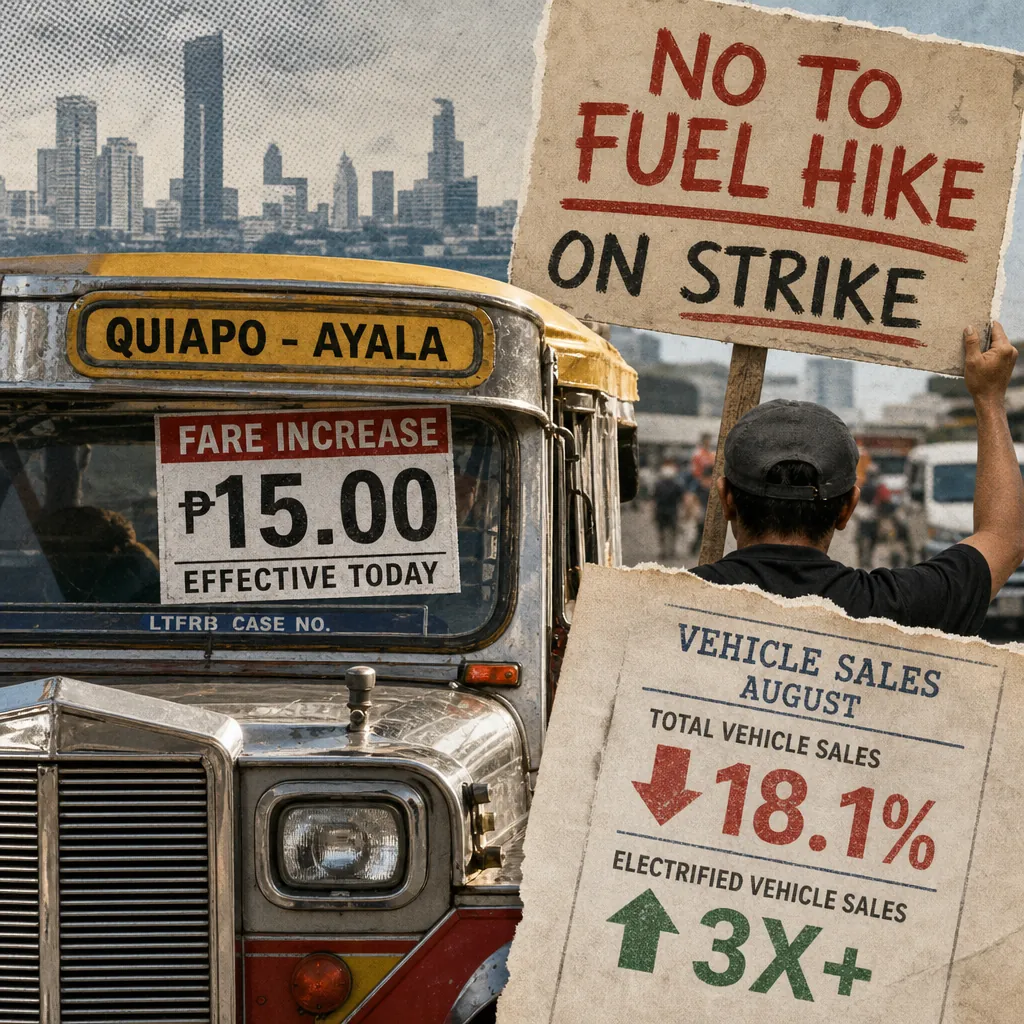
Fare Hikes, Fuel Costs Dominate Transport Coverage
Philippine transport coverage on September 30 centered on approved fare increases, a nationwide strike by the PISTON group, and the extension of two Cabinet officials' appointments. A separate thread of global AI regulation news also drew attention.
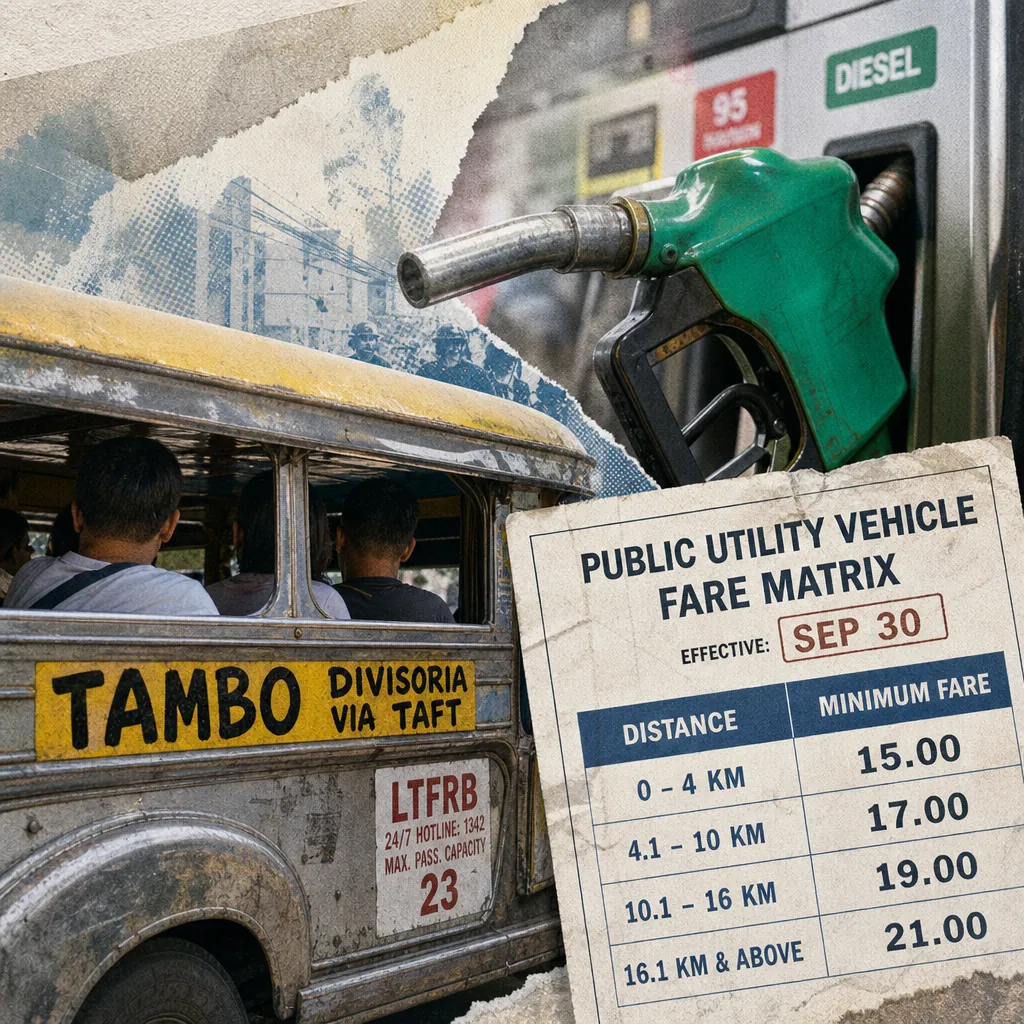
The Conversation
A 78-year-old jeepney driver suffered a heart attack while joining the first day of a nationwide transport strike in Caloocan City, an event that anchored much of the day's transport conversation. The driver, identified as Elmer Cordero, had spent five decades on the road and collapsed at the Monumento protest site on Tuesday, according to PISTON-NCR secretary Janette Gabatin, who said he had been complaining of chest tightness before losing consciousness.46 The strike, led by the Pinagkaisang Samahan ng mga Tsuper at Operators Nationwide (PISTON), a transport group representing jeepney drivers and operators, continued into its second day on Wednesday, with protesters gathering at Welcome Rotonda and marching to Mendiola to demand lower fuel prices and the removal of taxes on petroleum products.25 A separate group, Manibela, called off its planned protest after First Lady Liza Araneta-Marcos personally appealed to its chairman, Mar Valbuena, to refrain from another strike.8
The day's news coverage also carried a significant regulatory development: the Land Transportation Franchising and Regulatory Board (LTFRB), the agency that sets fares for public utility vehicles, approved fare increases that drew both praise and criticism. The United Transportation Coalition Philippines Inc. (UTCPI) lauded the Department of Transportation (DOTr) and the LTFRB for what it called "decisive action" that would protect drivers' livelihoods amid rising fuel costs.22 But the Philippine Councilors League (PCL) national president, Benjie Abalos, said local government units (LGUs) are best positioned to cushion the impact on commuters, noting that the national body can only offer guidance and that "the ultimate action rests on local governments."2 In Baguio City, Mayor Benjamin Magalong said the DOTr should pay attention to drivers' growing calls for a fare increase, adding that he has been in discussions with Transportation Secretary Giovanni Lopez.40
Beyond the fare issue, the day's transport and infrastructure coverage included the extension of the appointments of Public Works Secretary Vince Dizon and Transportation Acting Secretary Giovanni Lopez, confirmed by Executive Secretary Ralph Recto.1226 A consortium led by ComClark Network and Technology Corp. submitted a P33-billion unsolicited proposal to manage the country's air navigation services, which the Public-Private Partnership (PPP) Center endorsed to the Civil Aviation Authority of the Philippines (CAAP).3841 The North-South Commuter Railway (NSCR) Clark station was reported to be 73.29% complete, with partial operations targeted for December 2027.16 And a Business Mirror column warned that fuel costs driven by disruption in the Strait of Hormuz could shut down provincial bus routes if fares are not raised quickly.35
Key themes
- A 78-year-old driver's heart attack during a transport strike put a human face on the fare debate. Elmer Cordero, a five-decade jeepney driver, collapsed at the Monumento protest site on Tuesday and remained in critical condition, according to PISTON-NCR secretary Janette Gabatin.46 The incident drew attention to the physical and financial strain on aging drivers who continue working because they have no other income.
- PISTON continued its nationwide strike into a second day while Manibela called off its protest. PISTON protesters marched from Welcome Rotonda to Mendiola to demand lower fuel prices and the removal of petroleum taxes, with president Mody Floranda urging supporters to join.25 Manibela chairman Mar Valbuena called off his group's planned strike after a personal appeal from First Lady Liza Araneta-Marcos, who told him, "Wag ka na mag-strike" (Don't strike anymore).8
- The LTFRB-approved fare hike drew praise from one transport coalition and caution from local government leaders. The United Transportation Coalition Philippines Inc. said the fare adjustment would serve as a "vital lifeline" for drivers who have borne "severe financial strain" from rising petroleum prices and traffic congestion.22 Philippine Councilors League president Benjie Abalos said local governments, not the national body, must take the "ultimate action" to cushion the impact on commuters.2
- Baguio City's mayor added his voice to calls for a fare increase. Mayor Benjamin Magalong said the DOTr should address the concerns of public transport workers in the Summer Capital, noting that rising fuel costs are pressuring operators and drivers.40 He said the proposed adjustment would require approval from several agencies to ensure a comprehensive solution.
- President Marcos extended the appointments of two Cabinet officials pending confirmation. Executive Secretary Ralph Recto confirmed that the appointments of Public Works Secretary Vince Dizon and Transportation Acting Secretary Giovanni Lopez have been extended while awaiting submission to the Commission on Appointments (CA), the body that reviews and confirms presidential appointments.1226 The extension allows both officials to continue their duties; Dizon was appointed in September 2025 after his predecessor resigned amid investigations into flood control projects.23
- A P33-billion unsolicited proposal to manage air navigation services moved forward. ComClark Network and Technology Corp., JG Summit Infrastructure Holdings Corp., and Asia's Emerging Dragon Corp. submitted the proposal, which the PPP Center deemed complete and endorsed to the CAAP on Sept. 23.3841 The project covers air traffic management, communications, navigation and surveillance equipment, training, meteorological support, and search and rescue services.
- The NSCR Clark station reached 73.29% completion, with partial operations targeted for December 2027. DOTr Undersecretary for Railways Timothy John Batan expressed confidence that the first 28 kilometers and seven stations from Valenzuela to Malolos would begin partial operations by the end of 2027.16 The NSCR is a major railway project intended to connect Metro Manila with provinces to the north and south.
- A Business Mirror column warned that fuel costs from Strait of Hormuz disruption could shut down provincial bus routes. The column cited Victory Liner and bus operators' groups warning that without quick fare increases, provincial routes could be forced to close.35 It drew a parallel to Southwest Airlines' fuel hedging strategy in the 1990s and 2000s, noting that the airline bought insurance before the fire started while competitors went bankrupt.
How the narratives stack
Dominant: The fare hike and transport strike dominated the day's coverage across the items captured here. The LTFRB-approved fare increase, PISTON's second-day strike, the Manibela call-off, and the Baguio mayor's call for a fare increase all centered on the same underlying tension: the cost of fuel and its impact on drivers and commuters. The coverage spanned multiple outlets and mediums, from the Inquirer's report on the PCL chief's remarks2 to the Manila Times' report on the UTCPI's praise22 and the Philippine Star's report on the 78-year-old driver's heart attack.46 The Business Mirror column added a warning about provincial route closures.35 This story carried the most significant consequence for the sector because it directly affects the cost of daily commuting for millions of Filipinos and the livelihoods of thousands of drivers.
Counter-narrative: The extension of Dizon's and Lopez's appointments ran as a separate but related story, with Executive Secretary Recto confirming the move and explaining that the President will eventually submit the appointments to the Commission on Appointments.1226 This story is a counter-narrative in the sense that it focuses on the continuity of leadership at the DOTr and DPWH rather than the immediate fare dispute. It matters because the DOTr is the agency overseeing the fare hike and the NSCR project, and the extension ensures that Lopez remains in place to manage these issues. The coverage of this story was lighter than the fare hike coverage, with the Manila Times and Inquirer both carrying reports.122326
Emerging: The P33-billion air navigation proposal and the NSCR progress report represent emerging infrastructure stories that may gain more attention in the coming months. The ComClark consortium's proposal, endorsed by the PPP Center to the CAAP, would put a private consortium in charge of managing the country's air traffic services, a significant shift in how a core aviation function is delivered.3841 The NSCR Clark station's 73.29% completion and the December 2027 partial operations target give a concrete timeline for a project that has been discussed for years.16 These stories are emerging because they are still in early stages — the air navigation proposal has not been approved, and the NSCR is still under construction — but they have the potential to reshape transport infrastructure in the Philippines.
Under-covered: The human cost of the transport strike received less attention than the policy debate. The 78-year-old driver's heart attack was reported by the Philippine Star46 but did not dominate the day's coverage. Similarly, the Business Mirror column's warning about provincial route closures35 and the Philippine Star opinion piece describing the broader economic desperation of ordinary Filipinos49 were under-covered relative to the fare hike and strike stories. These pieces provide context about who is most affected by the fare and fuel debates — aging drivers, provincial operators, and low-income households — but they did not receive the same volume of coverage as the policy announcements.
Platform insights
Facebook: The day's transport stories were shared widely on Facebook, particularly the report on the 78-year-old driver's heart attack, which resonated with users who expressed sympathy for aging drivers still working because they have no other income. The Manibela call-off after the First Lady's appeal also generated discussion, with some users praising the direct conversation and others questioning whether the appeal addressed the underlying fuel cost issue. The Philippine Star's report on the driver's heart attack was shared by users who tagged fellow drivers and transport advocates.
X: The fare hike and strike dominated X conversations, with users debating whether the LTFRB-approved increase was sufficient for drivers and whether the government's response addressed the root cause of high fuel prices. The PISTON strike's second day and the Manibela call-off were both trending topics, with users sharing updates from the protest sites. The ComClark air navigation proposal also drew attention from users interested in infrastructure and aviation policy.
Reddit: Discussions on Reddit focused on the economics of the fare hike, with users analyzing whether the increase would actually help drivers or simply pass costs to commuters. Some users shared personal experiences of commuting costs and expressed frustration with the cycle of fare hikes and fuel price increases. The NSCR progress report generated interest from users who follow infrastructure projects, with some expressing skepticism about the December 2027 timeline.
YouTube: The day's transport coverage on YouTube included news clips of the PISTON protest and the Manibela call-off, as well as commentary from transport advocates and analysts. The 78-year-old driver's heart attack was covered in local news segments, with some channels interviewing fellow drivers about the challenges of the job. The ComClark air navigation proposal was discussed in business and infrastructure channels.
Key voices and communities
PISTON and Manibela: These two transport groups represent the interests of jeepney drivers and operators, and their actions — PISTON's strike and Manibela's call-off — shaped the day's conversation. PISTON president Mody Floranda framed the strike as part of a "much longer struggle," while Manibela chairman Mar Valbuena accepted the First Lady's appeal and expressed support for the administration.825 Their framing matters because they are the most visible representatives of drivers' economic concerns.
The United Transportation Coalition Philippines Inc. (UTCPI): This coalition praised the DOTr and LTFRB for approving fare adjustments, framing the decision as a "vital lifeline" for drivers who have faced years of financial strain.22 Their support provides a counterpoint to the strike groups and suggests that some transport stakeholders see the fare hike as a positive step.
Local government leaders: Philippine Councilors League president Benjie Abalos and Baguio Mayor Benjamin Magalong both weighed in on the fare issue, with Abalos emphasizing that local governments must take the "ultimate action" to help commuters and Magalong calling on the DOTr to address drivers' concerns.240 Their voices matter because they represent the local officials who will implement or respond to fare adjustments on the ground.
Business and infrastructure analysts: The Business Mirror column by John Mangun and the BusinessWorld report on the ComClark proposal brought a business and infrastructure perspective to the day's conversation.3538 Mangun's column warned about the potential closure of provincial bus routes, while the ComClark proposal highlighted the role of private consortiums in managing public infrastructure.
The Office of the President and the DOTr: Executive Secretary Ralph Recto's confirmation of the appointment extensions and the DOTr's reports on the NSCR and fare hike represent the government's official position.121626 Their statements provide the policy framework within which the day's debates took place.
Narrative streams
The fare hike and the strike: a dispute over who bears the cost of rising fuel
The LTFRB's approval of fare increases for public utility vehicles set off a day of competing reactions. The United Transportation Coalition Philippines Inc. praised the decision, saying it would protect drivers' livelihoods after years of financial strain caused by rising global petroleum prices and urban traffic congestion that increases fuel consumption and shrinks take-home pay.22 The coalition cited "several years of petitions, formal hearings and constructive stakeholder consultations" that culminated in the LTFRB's recommendation, which the DOTr approved.22 But the Philippine Councilors League's national president, Benjie Abalos, said local government units are best positioned to cushion the impact on commuters, noting that the national body can only offer guidance and that "the ultimate action rests on local governments."2 Abalos made the remarks at the PCL-Zamboanga del Norte Chapter Assembly in Cebu City on Tuesday.2
The strike by PISTON added a confrontational dimension. The group pushed through with the second day of its nationwide strike on Wednesday, with protesters gathering at Welcome Rotonda at 2 p.m. and marching to Mendiola at 3 p.m. to press for lower fuel prices and the removal of taxes on petroleum products.25 PISTON president Mody Floranda urged supporters to join the march, and the group declared the two-day strike a success while saying it was only part of a longer campaign. "Our fight does not end with our two-day strike. This is only part of a much longer struggle," the group's statement said.25 The strike's human cost was evident in the case of Elmer Cordero, the 78-year-old driver who suffered a heart attack at the Monumento protest site. PISTON-NCR secretary Janette Gabatin said Cordero had been complaining of chest tightness before collapsing, and that he had spent five decades as a driver. "Humuhugot siya sa pinaglalaban. Isa lang po ang sinasabi niya, kailangan manalo ang pinaglalaban na kita ng mga tsuper. Masama po ang loob niya kasi mababa po ang kita," Gabatin said, describing Cordero's commitment to the cause and his frustration over low earnings.46
Manibela's decision to call off its planned protest came after First Lady Liza Araneta-Marcos personally appealed to chairman Mar Valbuena at a government rice distribution program for transport workers at the Land Transportation Office Central Office in Quezon City on Tuesday. "Wag ka na mag-strike," Mrs. Marcos urged Valbuena, who responded, "Di na po, ma'am. I love you. Sama-sama po tayo, BBM!"8 Palace Press Officer Claire Castro said the First Lady's personal appeal helped ease tensions between the government and the transport group, noting the value of direct conversations.8 The exchange came a day after Manibela launched a planned three-day strike to protest high fuel prices and demand higher fares, as well as the suspension of the excise and value-added taxes on petroleum products.8
The read for the sector: The fare hike and the strike reflect a fundamental disagreement over who should bear the cost of rising fuel prices. Drivers and operators argue that fares must rise to keep pace with fuel costs, while commuters and local governments worry about the impact on household budgets. The LTFRB's approval of the fare increase is a partial response, but the strike groups' demands for tax suspensions on petroleum products remain unaddressed. For transport operators, the key question is whether the fare increase will be enough to offset fuel costs, and for commuters, whether local governments will step in with subsidies or other relief. The extension of Transportation Secretary Giovanni Lopez's appointment ensures continuity at the DOTr as it manages these tensions.1226
The ComClark air navigation proposal: a P33-billion bet on private management of air traffic services
A consortium led by ComClark Network and Technology Corp., in partnership with JG Summit Infrastructure Holdings Corp. and Asia's Emerging Dragon Corp., submitted a P33-billion unsolicited proposal to manage the country's air navigation services. The Public-Private Partnership (PPP) Center deemed the proposal complete and endorsed it to the Civil Aviation Authority of the Philippines (CAAP) on Sept. 23, according to the PPP Center's website.3841 The proposal covers the design, construction, financing, operation, and maintenance of air navigation services nationwide, including air traffic services, air navigation infrastructure, and the maintenance of air traffic services and communication, navigation, and surveillance equipment. Key service areas include air traffic management, aeronautical information, flight calibration, airfield lighting, civil aviation training, meteorological services support, and search and rescue.38
The proposal is significant because it would put a private consortium in charge of a core aviation function that is currently managed by the government through the CAAP. Air navigation services include the systems and personnel that guide aircraft safely through Philippine airspace, and any disruption or mismanagement could have serious safety implications. The PPP Center's endorsement to the CAAP is an early step in a process that will likely involve further review and approval. The consortium's partners bring different strengths: ComClark is led by Dennis Anthony H. Uy, a businessman with interests in technology and infrastructure; JG Summit is one of the Philippines' largest conglomerates; and Asia's Emerging Dragon Corp. is a holding company with investments in various sectors.3841
The read for the sector: If approved, the proposal would shift the management of air navigation services from the government to a private consortium, potentially bringing new investment and technology to a system that may be underfunded or outdated. For airlines and passengers, the key question is whether private management would improve efficiency and safety or introduce new risks. For the government, the proposal represents a significant PPP transaction that would need careful evaluation to ensure that the public interest is protected. The CAAP's review will be the next milestone to watch.3841
The NSCR Clark station: 73.29% complete and targeting December 2027
The North-South Commuter Railway (NSCR) Clark station in Pampanga is now 73.29% complete, according to the Department of Transportation. DOTr Undersecretary for Railways Timothy John Batan expressed confidence that the first partial operations of the NSCR extension project will begin by December 2027. "Currently, we are on track for our first partial operations by the end of 2027. That's the first 28 kilometers, seven stations, from Valenzuela to Malolos," Batan said.16 The DOTr and the Office of the Executive Secretary conducted a joint briefing and inspection of the Clark Station and key facilities of the NSCR Extension Project on Tuesday.16
The NSCR is a major railway project that aims to connect Metro Manila with provinces to the north and south, providing an alternative to road-based transport for commuters and reducing traffic congestion. The project has been discussed for years and has faced delays, but the 73.29% completion figure and the December 2027 target provide a concrete timeline. The first partial operations would cover the segment from Valenzuela to Malolos, which is part of the larger NSCR system. The project is funded by the Japanese government through the Japan International Cooperation Agency (JICA) and is being implemented by the DOTr.16
The read for the sector: The NSCR's progress is important for commuters who rely on public transport in Metro Manila and nearby provinces. If the December 2027 target is met, the railway could reduce travel times and provide a more reliable alternative to buses and jeepneys. For the DOTr, the project is a test of its ability to deliver major infrastructure on schedule. The 73.29% completion figure suggests that construction is well advanced, but the remaining work — including systems installation and testing — will determine whether the target is met.16
The appointment extensions: continuity at the DOTr and DPWH
President Ferdinand Marcos Jr. has extended the appointments of Public Works Secretary Vince Dizon and Transportation Acting Secretary Giovanni Lopez, Executive Secretary Ralph Recto confirmed on Wednesday. Recto said Marcos will submit the appointment papers of the two Cabinet officials to the Commission on Appointments (CA) for confirmation. "As secretary of finance, I went through the same process. Vince also went through it when he was secretary of the DOTr. We extended the appointments of Secretary Dizon and Secretary Lopez at the appropriate time," Recto said.1226 The extension allows Dizon and Lopez to continue performing their respective duties while awaiting the CA's review.23
Dizon was appointed secretary of the Department of Public Works and Highways in September 2025, replacing Manuel Bonoan, who resigned amid government investigations into alleged irregularities in flood control projects.2326 Lopez assumed the role of acting DOTr secretary following Dizon's transfer to the DPWH.23 The extension comes after Sen. Imee Marcos scrutinized Dizon's position at the DPWH, flagging that his acting capacity at the agency had exceeded the one-year limit.12 The Commission on Appointments is a constitutional body that reviews and confirms presidential appointments to Cabinet and other key positions; without confirmation, an appointee can only serve in an acting capacity for a limited period.12
The read for the sector: The extension ensures continuity at two key agencies — the DOTr, which is managing the fare hike, the NSCR project, and the air navigation proposal, and the DPWH, which oversees infrastructure projects. For transport stakeholders, Lopez's continuation at the DOTr means that the policies and projects he has been pursuing will continue without interruption. For the government, the extension avoids a leadership vacuum while the CA process plays out. The CA's confirmation hearings will be the next step, and any delays could affect the agencies' ability to plan and implement long-term projects.122326
The Strait of Hormuz warning: fuel costs and the risk to provincial bus routes
A Business Mirror column by John Mangun warned that fuel costs driven by disruption in the Strait of Hormuz could shut down provincial bus routes if fare rates are not increased quickly. The column cited Victory Liner and bus operators' groups warning that provincial routes could be forced to close.35 The Strait of Hormuz is a narrow waterway between the Persian Gulf and the Gulf of Oman through which a significant portion of the world's oil supply passes; any disruption there can raise global oil prices, which in turn affects fuel costs in the Philippines.35
The column drew a parallel to Southwest Airlines' fuel hedging strategy, noting that the airline began hedging its fuel costs in 1998 when oil traded near US$11 a barrel, locking in protection against rising prices. When crude surged past US$140 a barrel in 2008, Southwest was still paying roughly US$51, while competitors that were unhedged or under-hedged filed for bankruptcy protection or sought government help. "Southwest bought insurance before the fire started," Mangun wrote.35 The column's implication is that Philippine bus operators, unlike Southwest, have not hedged against fuel price increases and are therefore more vulnerable to disruptions like the Strait of Hormuz closure.
The read for the sector: The warning about provincial route closures is a reminder that the fare debate is not just about urban commuters but also about the viability of provincial transport services. If bus operators cannot cover their fuel costs, they may be forced to cut routes, leaving passengers in rural areas without reliable transport. For the government, the challenge is to balance the need to keep fares affordable for commuters with the need to keep operators solvent. The Business Mirror column suggests that without quick action on fares, the consequences could be severe for provincial routes.35
Conversation trajectory
Over the next 1–2 weeks: The LTFRB's fare hike will be implemented, and commuters will begin to feel the impact on their daily budgets. Watch for reactions from local government units, which the Philippine Councilors League says are best positioned to cushion the impact.2 Some LGUs may announce subsidies or other relief measures, while others may not. The PISTON strike may continue or escalate, with the group saying it will organize more strikes in the coming weeks.25 The Manibela group's decision to call off its protest suggests that direct engagement with the government can ease tensions, but the underlying demands for fuel tax suspensions remain unaddressed.8
Over the next 4–6 weeks: The Commission on Appointments will likely begin its review of Dizon's and Lopez's appointments. The CA's confirmation hearings will be a key milestone for the DOTr and DPWH, and any delays could affect the agencies' ability to plan and implement long-term projects.1226 The ComClark consortium's air navigation proposal will be reviewed by the CAAP, and the next step will be a decision on whether to proceed with a full evaluation or a competitive bidding process.3841 The NSCR project will continue construction, with the December 2027 target for partial operations serving as a benchmark for progress.16
Over the next 3–6 months: The Strait of Hormuz situation will be a key variable for fuel prices. If the disruption continues or escalates, fuel costs could rise further, putting more pressure on transport operators and potentially leading to more strikes or route closures.35 The government may consider measures such as fuel subsidies or tax suspensions to ease the burden, but these would have fiscal implications. The NSCR project's progress will be closely watched, and any delays could affect the December 2027 target.16
Trigger events: The next LTFRB fare adjustment announcement, the Commission on Appointments' confirmation hearings for Dizon and Lopez, the CAAP's decision on the ComClark proposal, and any escalation in the Strait of Hormuz situation are the key events to watch. The PISTON group's next strike announcement and any response from the government will also be important signals.81216253538
Response guidance
For transport operators and drivers' groups: Communicate the specific impact of fuel costs on your operations, using concrete figures where possible. The UTCPI's statement cited "severe financial strain" and "urban traffic gridlock that increases fuel consumption and shrinks drivers' take-home pay" — this kind of specific framing helps the public understand why fare increases are necessary.22 Avoid framing the issue as a confrontation with commuters; instead, emphasize the shared interest in a sustainable transport system.
For local government units: Prepare to communicate what relief measures, if any, you can offer to commuters affected by the fare hike. The Philippine Councilors League's statement that "the ultimate action rests on local governments" puts the onus on LGUs to respond.2 Consider whether subsidies, discounted fares for students and seniors, or other measures are feasible within your budget, and communicate your plans clearly.
For the DOTr and LTFRB: Provide clear, timely information about the fare adjustment and its rationale. The UTCPI praised the agencies for "decisive action," but the PISTON strike shows that not all stakeholders are satisfied.2225 Explain how the fare increase was calculated, what it means for drivers' incomes, and what other measures the government is considering to address fuel costs.
For the Office of the President and the DOTr: The extension of Dizon's and Lopez's appointments should be communicated as a measure to ensure continuity, not as a sign of instability.1226 Emphasize the ongoing projects and policies that the extension will allow to proceed, such as the NSCR and the air navigation proposal.1638
For all stakeholders: The human cost of the transport debate should not be overlooked. The 78-year-old driver's heart attack and the Business Mirror column's warning about provincial route closures are reminders that the fare and fuel debates have real consequences for real people.3546 Communicators should acknowledge these human dimensions and avoid reducing the debate to abstract policy arguments.
For communicators covering the air navigation proposal: Explain what air navigation services are and why they matter for aviation safety. The ComClark proposal would put a private consortium in charge of a core aviation function, and the public should understand the implications.3841 Avoid technical jargon and focus on what the change would mean for airlines, passengers, and the government.
For communicators covering the NSCR: Provide regular updates on the project's progress and explain what the December 2027 target means for commuters.16 The 73.29% completion figure is a useful benchmark, but the public also needs to understand what work remains and what could cause delays.
For communicators covering fuel costs: Explain the connection between global oil prices and local transport costs. The Strait of Hormuz disruption is a global event with local consequences, and the public should understand how it affects their daily commute.35 Avoid alarmism, but be clear about the risks if fuel costs continue to rise.
See the full picture behind today's signals.
This report draws from Media Meter's MediaWatch, our real-time monitoring engine tracking 2,470+ Philippine sources across print, broadcast, digital, and social. Explore how the platform turns raw coverage into decision-grade intelligence, then see how it's configured for teams like yours — whether you're in PR agencies, corporate comms, government, or marketing.
Want more? Browse our Report Library for sector and crisis intelligence, or request a demo and we'll have your brand set up before the call.
Want this kind of intelligence on your brand?
This brief is built on the same MediaWatch methodology that runs continuously across every brand we monitor. See your competitive landscape, Impact Score, and narrative trajectory in a 30-minute demo.