LTFRB Fines Move It P555.7M for Excess Riders
The Land Transportation Franchising and Regulatory Board ordered ride-hailing firm Move It to pay P555.7 million for keeping 55,575 motorcycle riders beyond its authorized cap, as transport regulators also summoned Libreng Sakay jeepney operators in Cebu and flagged driver fitness and road-safety failures.
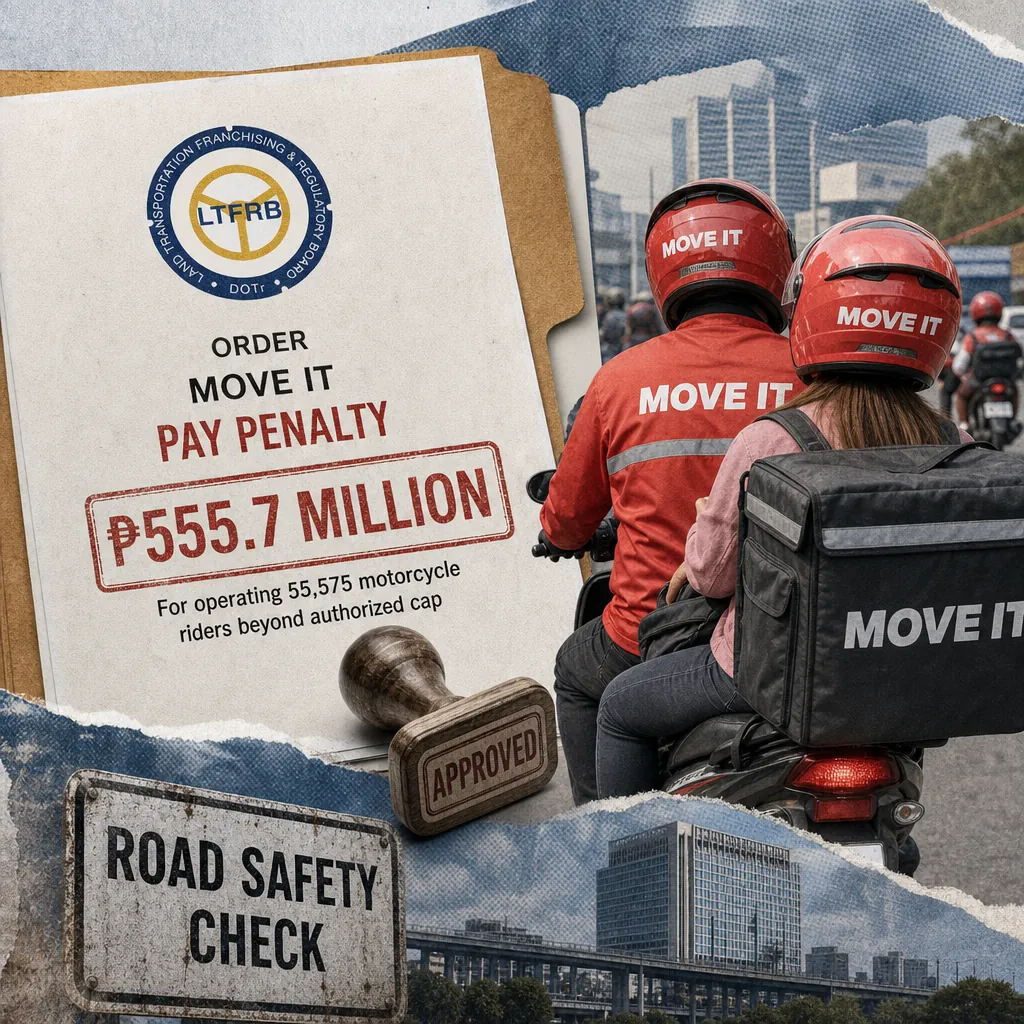
The Land Transportation Franchising and Regulatory Board (LTFRB) has ordered ride-hailing company Move It PH to pay a P555.7-million fine for carrying far more motorcycle-taxi riders than the government allowed, according to a document obtained by The Philippine STAR68. The board found Move It administratively liable for breaching the rider allocation set under the Motorcycle Taxi Pilot Program, the government's trial framework for legalizing and regulating motorcycle-for-hire services. As of May, Move It had 73,321 active riders across Metro Manila, Cebu and Cagayan de Oro, against an authorized allocation of 17,746 — an excess of 55,575 rider-partners68. The LTFRB imposed a P10,000 administrative fine for each excess rider, producing the P555.7-million total, and warned that failure to pay could lead to suspension of Move It's authority to participate in the program and revocation of its accreditation68.
The fine landed on the same day the Department of Transportation (DOTr) said it had issued show cause orders to two public utility jeepney operators in Cebu City whose modern jeepneys allegedly refused to pick up passengers under the government's Libreng Sakay free-ride program during peak hours24. The orders, dated Oct. 31, were issued by the LTFRB's Central Visayas office against JP and Sons Transport Group Inc. and Aleja Fua Rent a Car Corp. after a public complaint and a viral video published by The Freeman showed commuters waiting at a designated stop on the 01K route in Mabolo while the jeepneys passed them by62. Transportation Secretary Vince Dizon directed the investigation62.
Both stories sit inside a broader run of transport-regulation news: the DOTr's traffic advisory for the movement of a subway tunnel-boring machine through the Ortigas-Shaw corridor from Nov. 4 to 71; a P1-million advisory package for restructuring the LRT-1 concession43; the Land Transportation Office's (LTO) show cause order against a driver who hit a pedestrian in Angeles City, Pampanga15; and the LTO regional office in Western Visayas pressing driver fitness as a road-safety issue after a fatal holiday-period crash34. The day's coverage also carried a BusinessMirror editorial defending Dizon's terminal inspections47, a Daily Tribune column alleging a Plimsoll-mark scam in ship safety46, and a Philippine STAR opinion piece tracing how fuel prices have climbed through the year66.
Key themes
- Move It's P555.7-million fine sets a per-rider penalty standard. The LTFRB calculated the fine at P10,000 for each of 55,575 rider-partners above the 17,746 cap, a formula that turns the authorized allocation into a hard ceiling with a price attached68.
- Libreng Sakay compliance is now being enforced through show cause orders. Two Cebu operators must explain why their franchises should not be sanctioned after a viral video showed their jeepneys bypassing waiting commuters on the 01K route6224.
- The DOTr is using terminal inspections to force service standards. Dizon's unannounced visits to Sampaloc and Edsa Malibay terminals produced LTFRB summonses against operators over filthy, waterless restrooms and cramped waiting areas47.
- Road safety enforcement is widening beyond sobriety checks. The LTO's Western Visayas office is telling motorists that fatigue and illness impair driving as much as alcohol, after an Oct. 31 motorcycle crash in Iloilo involving an allegedly drunk rider34.
- The Metro Manila Subway's construction logistics are spilling onto city streets. Moving a tunnel-boring machine from a Pasig stockyard to the Shaw Boulevard Station will affect traffic in the Ortigas-Shaw area from Nov. 4 to 71.
- LRT-1's concession is being renegotiated with P1 million in advisory support. The Public-Private Partnership (PPP) Center approved transaction advisory services for the DOTr's review of the LRT-1 Extension operations and maintenance contract with Light Rail Manila Corp.43.
- Fuel prices continue to squeeze jeepney and tricycle operators. A Philippine STAR column reports gasoline up by a net P68 a liter and diesel by P65 since January, with diesel breaching P130 a liter in March when the Strait of Hormuz closed66.
- Ship-safety certification faces a credibility question. A Daily Tribune column alleges that an agency under the DOTr has been complicit in adjusting Plimsoll marks — the load lines painted on hulls to show safe loading depth — after the MV Virgen de Peñafrancia II tilted 10 meters from Real Port in Quezon46.
How the narratives stack
Dominant. The Move It fine is the day's heaviest transport story by consequence and by the breadth of its pickup in the captured set. It is the first time in this window that the LTFRB has attached a peso figure of this size to a rider-allocation breach, and the P10,000-per-rider formula gives the regulator a repeatable enforcement tool68. The story ran in a national broadsheet's online edition and was framed around a document obtained by the paper, which means the board's finding is on the record even though Move It's response is not yet part of the coverage. The fine's size — P555.7 million against a company operating in three metropolitan areas — makes it the reference point for how the Motorcycle Taxi Pilot Program will be policed going forward.
Counter-narrative. The Libreng Sakay show cause orders tell a different story about the same regulator: instead of penalizing a company for having too many riders, the LTFRB is going after operators for carrying too few passengers6224. The Cebu case is built on a viral video and a public complaint, and the orders were issued within days of the video's circulation. The counter-narrative matters because it shows the LTFRB applying pressure at both ends of the compliance spectrum — against over-supply in ride-hailing and against under-service in subsidized public transport.
Emerging. Driver fitness and vehicle safety are being framed as systemic risks rather than individual failures. The LTO-6 reminder in Iloilo followed an Oct. 31 collision involving an allegedly intoxicated motorcycle rider34, and the Daily Tribune's Plimsoll-mark column raises the question of whether ship safety certificates are being issued on accurate load lines46. Neither story has produced a formal finding yet, but both point to inspection and certification processes as the next front for transport regulators.
Under-covered. The LRT-1 concession restructuring received a single item in the captured set despite its long-term financial stakes43. The PPP Center's P1-million advisory package will fund a review of proposed amendments to the LRT-1 Extension operations and maintenance agreement, including negotiations with Light Rail Manila Corp., the private operator. The story placed low in the day's transport coverage, but the contract's terms will shape fares and service on the capital's busiest rail line for years.
Platform insights
- Facebook. The DOTr used its Facebook page to announce the Ortigas-Shaw traffic advisory for the tunnel-boring machine movement1 and to publicize the Libreng Sakay show cause orders24. Both posts are official-channel communications rather than organic conversation, which means the department is using the platform as a direct-to-commuter notice board. The Libreng Sakay post carried the enforcement message to the same commuters who had complained about being bypassed.
- X. The day's transport conversation on X is not directly captured in the items reviewed, but the Move It fine and the Libreng Sakay video are the kind of stories that circulate there through screenshots of official documents and clips of the incident. The Philippine STAR's report on the LTFRB document68 and The Freeman's viral video62 are the likely source material for that circulation.
- Reddit. No transport-specific Reddit activity appears in the captured set. The broader pattern in Philippine transport discussions on Reddit tends toward commuter complaints and policy debates, but the items here do not include a Reddit thread to cite.
- YouTube. No YouTube item appears in the captured set for this window. The viral video at the center of the Libreng Sakay story was published by The Freeman and circulated through Facebook and news sites62.
Key voices and communities
The LTFRB and DOTr leadership. Chairman Greg Pua signed the Move It fine68, and Secretary Vince Dizon directed both the Libreng Sakay investigation62 and the terminal inspections that produced the BusinessMirror editorial47. Their framing is enforcement-first: the board and the department are presenting themselves as willing to penalize both over-supply and under-service.
Ride-hailing riders and operators. The 55,575 rider-partners counted above Move It's cap are the people most directly affected by the fine68. If the penalty leads to suspensions or accreditation changes, those riders face lost income, and the pilot program's rider cap becomes a live constraint on how many people can legally work in the sector.
Cebu commuters and local media. The Freeman's viral video turned a routine complaint about jeepneys passing waiting passengers into a regulatory case62. The commuters on the 01K route in Mabolo are the constituency behind the show cause orders, and their experience is the evidence the LTFRB is acting on.
Road-safety advocates within the LTO. The LTO-6 office in Iloilo is pushing a message that sobriety is not the only measure of fitness to drive34. Regional director Atty. Gaudioso P. Geduspan II is the named voice, and his office's framing extends the road-safety agenda to fatigue, illness and physical condition.
The BusinessMirror editorial board. The paper's editorial defended Dizon's terminal inspections as a service-standard intervention rather than an outrage cycle, arguing that the LTFRB summonses are the consequential part of the episode47. That framing gives the department cover for continuing inspections.
Narrative streams
Move It's rider cap breach draws a P555.7-million penalty
The LTFRB's finding against Move It PH is the largest single administrative penalty in the captured set. The board counted 73,321 active riders as of May against an authorized allocation of 17,746, a gap of 55,57568. At P10,000 per excess rider, the fine reaches P555.7 million. The Motorcycle Taxi Pilot Program is the government's framework for allowing motorcycle-for-hire services to operate legally while regulators study their safety and fare impact; the rider allocation is the mechanism that limits how many rider-partners each operator may deploy. Move It's breach is not a paperwork error — it is a fourfold overshoot of the cap across three metropolitan areas.
The read for the sector is that the rider allocation is now a hard constraint with a per-unit price. Operators that onboard beyond their allocation face a fine calculated rider by rider, and the threat of suspension or accreditation revocation gives the penalty teeth68. For the 55,575 rider-partners counted above the cap, the immediate risk is that their platforms could be forced to reduce active riders if Move It cannot pay or negotiate the fine. For competitors, the case sets a benchmark: the LTFRB has shown it will count riders and bill for the difference.
The story's context is the long-running tension between ride-hailing demand and the government's effort to keep motorcycle-taxi supply within studied limits. The pilot program exists because motorcycle taxis operate in a safety-sensitive space — two-wheeled vehicles carrying passengers through dense traffic — and regulators have argued that uncontrolled growth makes safety and fare monitoring harder. Move It's fine is the first time in this window that the tension has produced a peso figure of this scale.
Cebu's Libreng Sakay operators face show cause orders over skipped passengers
The Libreng Sakay program subsidizes free rides on designated public utility vehicle routes, and operators who participate receive government support in exchange for carrying passengers under the program's terms. In Cebu City, two operators on the 01K route — JP and Sons Transport Group Inc. and Aleja Fua Rent a Car Corp. — were ordered to explain why they should not be sanctioned after their modern jeepneys allegedly refused to pick up passengers waiting at a designated stop in Mabolo during rush hour62. The LTFRB-7 issued the orders dated Oct. 31, acting on a public complaint and a viral video published by The Freeman62. The DOTr's social media post said the orders were issued on Dizon's directive24.
The read for the sector is that subsidized service comes with enforceable obligations. Operators who accept Libreng Sakay support are now on notice that skipping passengers can trigger a franchise review, and the show cause order is the regulator's tool for putting that obligation on the record. For commuters, the case is a test of whether the free-ride program actually delivers rides at peak hours, when the subsidy matters most. For other operators, the precedent is that a viral video and a public complaint are enough to start a formal proceeding.
The context is the government's broader effort to modernize public transport while keeping fares affordable. Libreng Sakay is one of the programs meant to cushion the cost of commuting, and its credibility depends on vehicles actually stopping for passengers. The Cebu case is the clearest example in this window of the program's enforcement gap being tested in public.
Terminal inspections turn into franchise proceedings
Dizon's first day back at the DOTr included unannounced inspections of bus terminals in Sampaloc and along Edsa Malibay, where he found cramped waiting areas, no electric fans, and restrooms so filthy and waterless that the conditions drew national television coverage47. The BusinessMirror editorial argues that the shouting and swearing were the delivery mechanism, and the consequential act was ordering the LTFRB to summon operators and make them explain why their Certificates of Public Convenience should not be suspended, cancelled or revoked47. A Certificate of Public Convenience is the franchise that allows a transport operator to run a route; losing it ends the business.
The read for the sector is that terminal conditions are now part of franchise compliance. Operators who treat restrooms and waiting areas as afterthoughts face proceedings that go to the heart of their authority to operate. For travelers, the inspections put a national spotlight on the first and last thing they see of a city or province. For the DOTr, the episode is a test of whether public outrage can be converted into durable service standards rather than a one-day news cycle.
The editorial's argument is that a bus terminal is a gateway — for foreigners, often the first and last thing they see of the Philippines — and that the volume of Dizon's delivery should not obscure the regulatory action behind it47. That framing gives the department a rationale for continuing inspections beyond the initial round.
Driver fitness and vehicle certification emerge as safety fronts
The LTO's Western Visayas office is telling motorists that being sober is not enough to guarantee safe driving. Regional director Atty. Gaudioso P. Geduspan II urged drivers to assess their physical condition before taking the wheel, warning that fatigue, illness and poor physical condition can compromise judgment and reaction time34. The reminder followed an Oct. 31 collision in Iloilo involving a motorcycle rider who allegedly drove under the influence of alcohol and collided with a multipurpose vehicle34. The LTO-6 message is part of a broader road-safety advocacy that extended through the All Saints Day and All Souls Day enforcement period.
The read for the sector is that road-safety enforcement is widening from sobriety checks to fitness assessments. For drivers, the message is that a clean breath test does not settle whether they are fit to drive. For regulators, the challenge is translating the advice into inspection practice — there is no roadside test for fatigue the way there is for alcohol. The Iloilo crash gives the campaign a concrete case, and the LTO-6 office is using it to argue that fitness is a preventable risk factor.
A separate safety question sits in the Daily Tribune's Plimsoll-mark column. The column alleges that an agency under the DOTr has long been complicit in adjusting Plimsoll marks — the load lines painted on a ship's hull to show how deep it can be safely loaded — and asks why the MV Virgen de Peñafrancia II was sailing with a permit at all before it tilted 10 meters from Real Port in Quezon last Friday46. All 58 passengers and crew were rescued, and Dizon suspended the ship's Passenger Ship Safety Certificate46. Early findings pointed to a snapped mooring line amid strong current, though investigators conceded this was not conclusive46. The column's allegation is not a formal finding, but it raises the question of whether certification is based on accurate load lines.
The Metro Manila Subway's construction logistics reach the street
The DOTr announced on Facebook on Monday, Nov. 2, that vehicular traffic in the Shaw-Ortigas area would be affected from Wednesday, Nov. 4, to Saturday, Nov. 7, by the transport of a tunnel-boring machine from the CP104 Stockyard on Julia Vargas Avenue in Pasig City to the Shaw Boulevard Station in Mandaluyong City1. The machine will be used to construct the tunnels connecting the Shaw Boulevard and Ortigas Avenue Stations1. Under Contract Package 104, the Shaw Boulevard Station segment is being implemented with a contract cost of P18 billion1. The DOTr advised motorists to take alternate routes and apologized for the inconvenience1.
The read for the sector is that the subway's construction phase is now producing visible disruptions in the capital's busiest commercial corridor. For commuters and motorists, the four-day window is a reminder that the project's benefits arrive years before its costs are fully felt. For the DOTr, the advisory is a test of how well it can manage construction logistics in a corridor already carrying heavy traffic. The project's schedule has been described by President Marcos as ahead of schedule, which makes the boring-machine movement a sign of progress as well as a source of congestion.
LRT-1's concession restructuring gets P1 million in advisory support
The PPP Center's Project Development and Monitoring Facility Committee approved the DOTr's request for transaction advisory services during a meeting on Oct. 2343. The funding will support a comprehensive review of proposed amendments to the LRT-1 Extension operations and maintenance concession agreement, including negotiations with Light Rail Manila Corp.43. The PPP Center said the engagement aims to ensure the revised contract is financially sustainable, legally sound, and consistent with applicable laws and government policies43. The advisory services will help the DOTr and the Light Rail Transit Authority evaluate the amendments43.
The read for the sector is that the terms of the LRT-1 concession are being reopened at a moment when the railway's financial sustainability is under scrutiny. For commuters, the contract's terms shape fares and service levels on the line. For the private operator, the review is a negotiation over the balance of risk and return in the extension. The P1-million advisory package is small relative to the contract's value, but it signals that the government intends to rework the agreement rather than leave it as signed.
Fuel prices keep squeezing jeepney and tricycle operators
A Philippine STAR column reports that gasoline has risen by a net P68 a liter and diesel by P65 since January, with diesel climbing past P130 a liter and gasoline past P110 in March when the Iran war closed the Strait of Hormuz66. The President declared a national energy emergency, and jeepney drivers have gone on strike at least four times66. Government responded with a fuel discount for jeepneys and a tax cut on liquefied petroleum gas (LPG) and kerosene66. The column follows a rider who fills his tank every Tuesday, the day new pump prices take effect, and calculates that a three-peso-per-liter increase costs him 30 pesos before his first passenger66.
The read for the sector is that fuel costs are now a structural pressure on public transport operators, and the government's relief measures are partial. For jeepney and tricycle drivers, the weekly price adjustment is a recurring hit to take-home income. For commuters, the pressure feeds into fare debates and service reliability. The column's framing — that a war in the Middle East ends up in a lunchbox in Caloocan — connects the global oil market to the daily economics of Philippine public transport66.
Conversation trajectory
Move It's response and payment window (next 2–4 weeks). The LTFRB's order gives Move It a defined obligation, and the company's next move — payment, appeal or negotiation — will determine whether the case becomes a template or a prolonged dispute. Watch for a statement from Move It and for any LTFRB announcement on suspension or revocation if the fine goes unpaid68.
Libreng Sakay hearings in Cebu (next 2–4 weeks). The show cause orders require the two operators to explain why they should not be sanctioned62. The hearings will show whether the LTFRB treats the viral video as sufficient evidence or whether it needs additional testimony from commuters. A decision against the operators would set a precedent for subsidy compliance nationwide.
LTO action on the Pampanga incident (Nov. 6). The LTO has ordered the registered owner and designated driver of the vehicle involved in the Angeles City incident to appear before its Intelligence and Investigation Division on Nov. 615. The hearing will produce the first official account of what happened and whether license suspensions follow.
Subway boring-machine movement (Nov. 4–7). The DOTr's traffic advisory covers a four-day window in the Ortigas-Shaw corridor1. Traffic conditions during that period will test the department's route management and give commuters a concrete measure of construction disruption.
Fuel price adjustments (weekly, every Tuesday). The weekly pump-price cycle is the most reliable forward signal in the set. Each Tuesday adjustment will show whether the year's increases are moderating or continuing, and jeepney groups have already shown they will strike when the burden becomes too heavy66.
LRT-1 concession negotiations (next 1–3 months). The PPP Center's advisory package funds a review of proposed amendments, and negotiations with Light Rail Manila Corp. will follow43. The terms that emerge will shape fares and service on the line, and any change to the concession will require regulatory approvals that generate public documents.
Response guidance
Ride-hailing operators: audit rider counts against allocations now. The Move It case shows the LTFRB will count active riders and bill for the difference at P10,000 per excess rider68. Operators should reconcile their rider-partner lists with their authorized allocations before the next enforcement cycle and prepare a compliance plan for any gap.
Public transport operators in subsidized programs: document service at peak hours. The Cebu show cause orders were triggered by a viral video of jeepneys bypassing waiting passengers62. Operators participating in Libreng Sakay should keep dispatch and trip records that show vehicles stopped at designated stops during rush hour, and should respond to complaints through official channels before they become videos.
Terminal operators: treat restrooms and waiting areas as franchise compliance items. The BusinessMirror editorial makes the case that the LTFRB summonses, not the shouting, are the consequential part of Dizon's inspections47. Terminal managers should schedule cleaning, water and ventilation checks against the standards inspectors are likely to apply, and keep records of corrective actions.
Road-safety communicators: broaden the fitness message beyond alcohol. The LTO-6 campaign is telling drivers that fatigue and illness impair driving34. Communicators should pair sobriety messaging with practical advice on rest breaks and self-assessment, and should avoid framing fitness as a matter of willpower.
Shipping and port stakeholders: prepare for questions on load-line certification. The Daily Tribune column's allegation about Plimsoll marks46 is not a formal finding, but it puts certification under scrutiny. Operators and agencies should be ready to explain how load lines are set and inspected, and should avoid public comment that dismisses the allegation without addressing the certification process.
Fuel-dependent transport groups: coordinate relief requests around the weekly price cycle. The Philippine STAR column documents a year of steep increases and four jeepney strikes66. Groups seeking relief should time their requests to the weekly pump-price adjustments and present cost data per liter and per trip, which gives the government a concrete basis for extending discounts or tax relief.
Rail and PPP watchers: track the LRT-1 amendment documents. The PPP Center's advisory package will produce a review of proposed amendments to the LRT-1 Extension concession43. Stakeholders should watch for the publication of the revised terms and for any changes to fare-setting or service-level obligations.
See the full picture behind today's signals.
This report draws from Media Meter's MediaWatch, our real-time monitoring engine tracking 2,470+ Philippine sources across print, broadcast, digital, and social. Explore how the platform turns raw coverage into decision-grade intelligence, then see how it's configured for teams like yours — whether you're in PR agencies, corporate comms, government, or marketing.
Want more? Browse our Report Library for sector and crisis intelligence, or request a demo and we'll have your brand set up before the call.
Want this kind of intelligence on your brand?
This brief is built on the same MediaWatch methodology that runs continuously across every brand we monitor. See your competitive landscape, Impact Score, and narrative trajectory in a 30-minute demo.