Undas 2026: 1M Port Passengers, Light Expressway Traffic
The Philippine Ports Authority counted 1,026,049 passengers at ports from October 27 to November 1 as Filipinos travelled for All Saints' Day, while NLEX and SLEX reported light traffic and the government kept emergency services on alert. A jeepney crash in Camarines Sur killed two and injured 42.
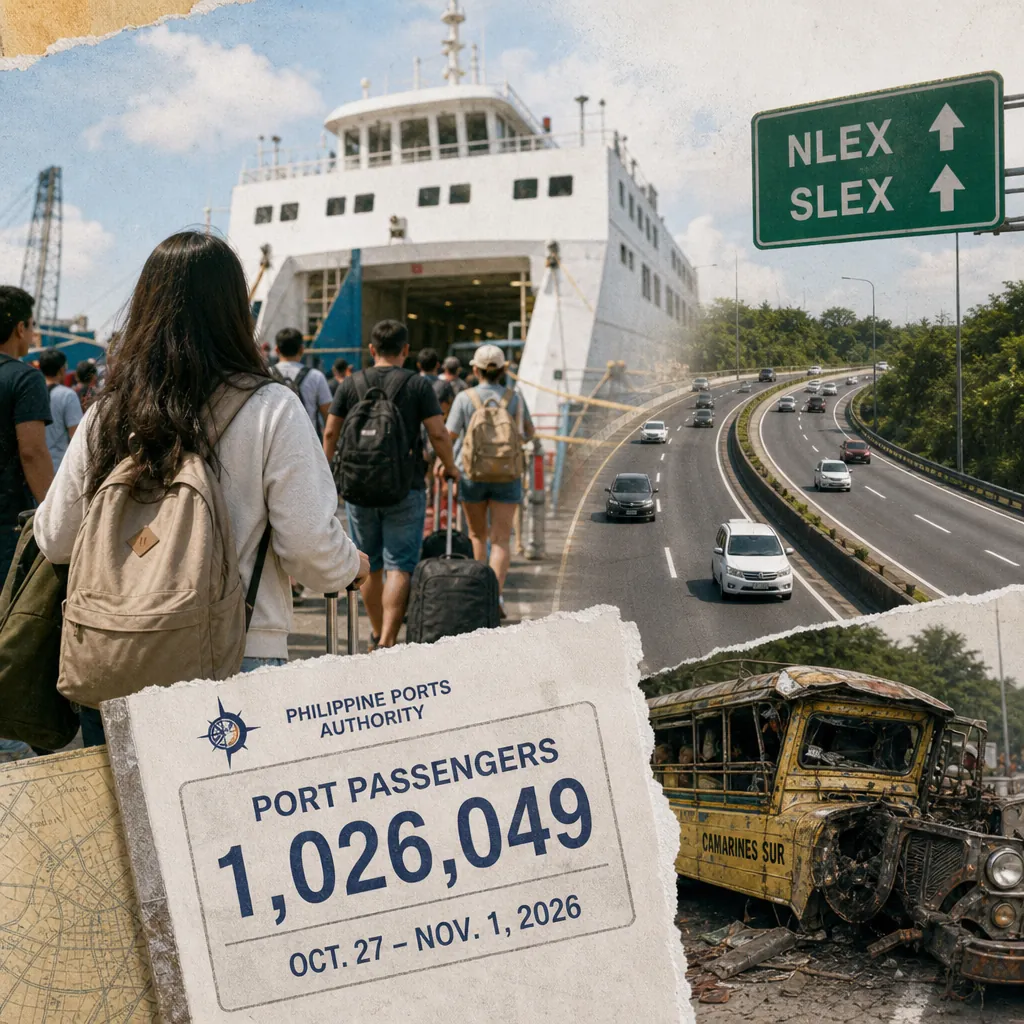
The busiest travel weekend of the Philippine calendar produced a split picture on Sunday, November 1. The Philippine Ports Authority (PPA), the state agency that runs the country's seaports, counted 1,026,049 passengers passing through ports nationwide between October 27 and November 1, the six-day window around All Saints' Day, the Catholic feast on November 1 when Filipino families visit the graves of relatives28. On the same day, the two expressways that carry most road traffic in and out of Metro Manila reported light conditions through the evening, and the Department of Public Works and Highways (DPWH) said its roadside assistance hotlines would stay open around the clock beyond the holiday232.
The port figure is the largest single number in the day's transport coverage. The PPA logged 36,753 passengers as of 8 a.m. on Sunday alone, and the heaviest days came earlier: 245,718 travellers on Saturday, October 31, and 222,874 on Friday, October 3028. The agency expects 1,934,604 passengers across the whole October 27 to November 5 period, up from its forecast of 1,905,063 for the same stretch last year28. Its five busiest ports for the season are Iloilo River Wharf, Babak Port in Davao del Norte, Batangas Port, Jordan Port, and one more the report lists among the top five28.
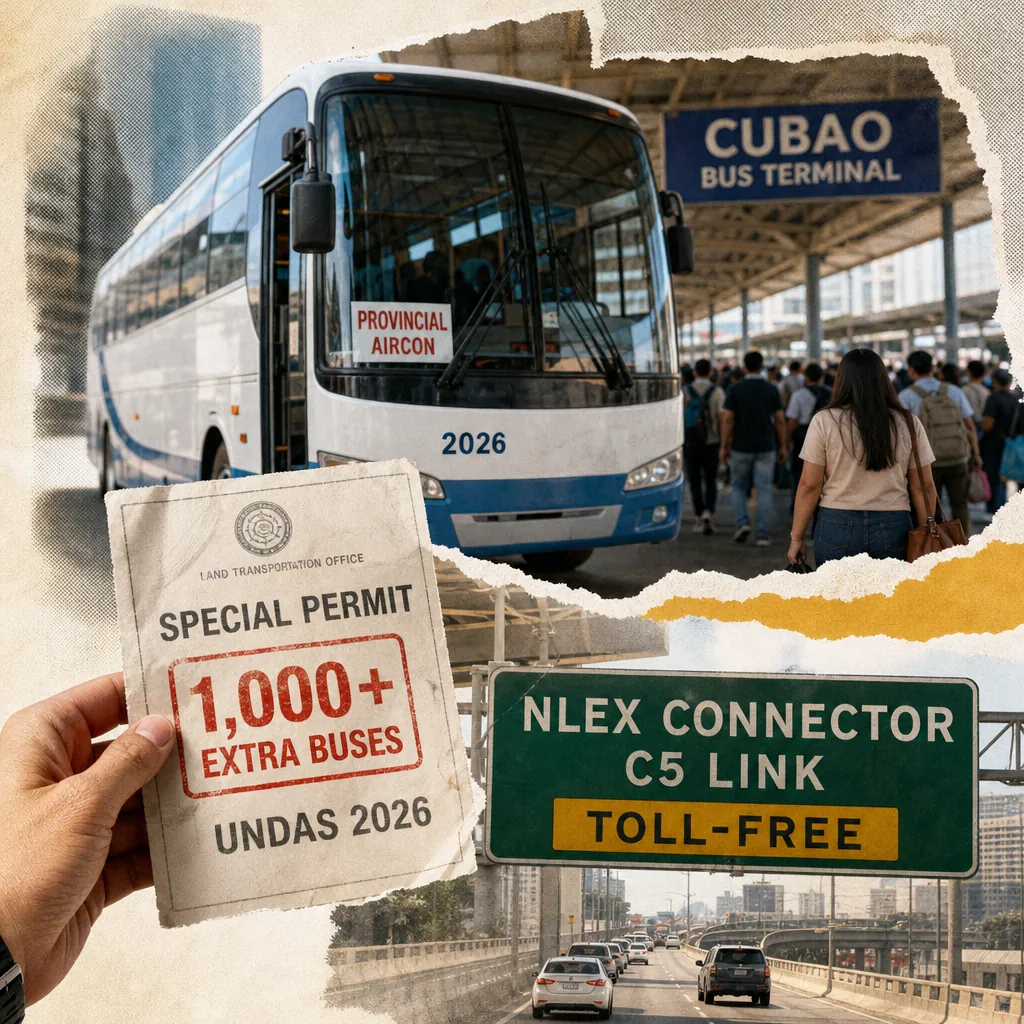
Road traffic told a different story. As of 8 p.m. on Sunday, the North Luzon Expressway (NLEX) reported light conditions at the Balintawak, Mindanao and Bocaue toll plazas and at the San Simon and San Fernando interchanges in both directions, and the NLEX Corporation said the same held across the NLEX-SCTEX-NLEX Connector network2. The South Luzon Expressway (SLEX) reported smooth flow from Magallanes in Makati to Alabang as of 10 p.m., including toll plazas and on and off ramps211. The light traffic is consistent with the holiday pattern in which many families travel in the days before November 1 and return afterward, which is why the Department of Transportation (DOTr) added trains for the Monday return34.
Not every item in the day's transport coverage was routine. A passenger jeepney travelling from Naga City to Siruma in Camarines Sur blew a tyre and overturned on Pasusuhan Bridge in Barangay Binalay, Tinambac, at about 2:20 p.m. on Saturday, killing two people and injuring 42, among them children aged four and ten40. The vehicle, plate number EVN-844, was carrying 43 passengers plus its driver, more than a jeepney is built to hold40. The crash is the day's clearest evidence of the risk that comes with the holiday's heavy travel volumes, and it sits alongside the security and traffic deployments that agencies had announced for the same period.
Key themes
- Ports handled 1,026,049 passengers in six days. The PPA's count from October 27 to November 1 already exceeds one million, with the season total projected at 1,934,604 by November 5, slightly above last year's forecast of 1,905,06328.
- Expressway traffic stayed light through Sunday evening. NLEX and SLEX both reported smooth flow at toll plazas and interchanges as of 8 p.m. and 10 p.m. respectively, with the NLEX Corporation confirming the same across the NLEX-SCTEX-NLEX Connector211.
- The DPWH made its holiday hotline permanent. Public Works Secretary Giovanni Lopez said the 24/7 motorist assistance line, part of the annual Lakbay-Alalay program, will now run beyond All Saints' Day and connect callers directly to regional and district engineering offices32.
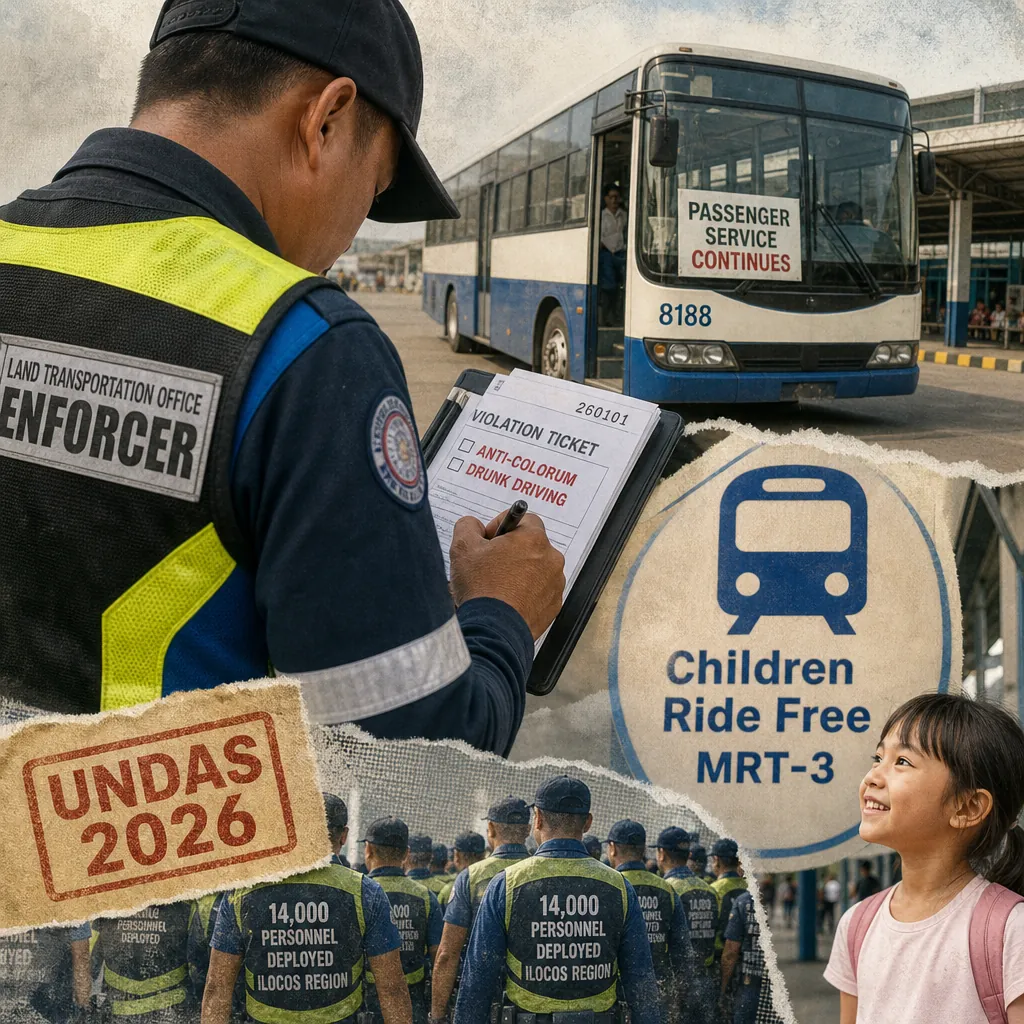
- The DOTr added MRT-3 trains for the Monday return. Nineteen trains will run at peak hours on November 2, against the regular holiday deployment of 14 off-peak and 16 at peak, to absorb passengers coming back to Metro Manila34.
- A jeepney crash in Camarines Sur killed two and injured 42. The overloaded vehicle blew a tyre on Pasusuhan Bridge in Tinambac on Saturday afternoon, and the injured included two children40.
- The police stayed on full alert with 166,365 personnel deployed. The Philippine National Police (PNP) said the force and its partner agencies would remain at full alert on the second day of Undas, with officers posted at cemeteries, churches, terminals and checkpoints42.
- Air travel costs rose before the holiday. A Philippine Star column noted that fuel surcharges set by the Civil Aeronautics Board have reached Level 19, allowing airlines to add up to ₱1,834 on domestic and ₱15,397 on international fares, after jet fuel prices passed $200 a barrel following the US-Iran war in February37.
- Rail and road projects advanced on the policy side. The government approved $1 million in advisory support to restructure the LRT-1 concession and opened the search for a ₱313-million independent consultant to monitor the North-South Commuter Railway3839.
How the narratives stack
Dominant. The holiday travel story dominates the items captured here, and it does so on volume of official numbers rather than on any single dramatic event. The PPA's million-passenger count, the expressway updates, the MRT-3 deployment and the DPWH hotline all describe the same system under its heaviest annual load, and each agency issued its own accounting of how it coped2823432. The dominance is a property of this set of items: the monitoring behind it drew heavily on government advisories and transport reporting, which is why the official figures appear so often.
Counter-narrative. The jeepney crash in Tinambac cuts against the orderly picture the agency advisories paint. Two dead and 42 injured on an overloaded vehicle is the kind of event the holiday travel system is meant to prevent, and it happened on a provincial highway far from the expressways and ports that produced the day's headline numbers40. The crash drew coverage in the Philippine Star's Filipino-language section, and it is the item in this set that most directly concerns ordinary passengers rather than agencies.
Emerging. Two rail financing decisions point to a longer story about who pays for and oversees Metro Manila's rail expansion. The Public-Private Partnership (PPP) Center approved $1 million from its Project Development and Monitoring Facility to hire transaction advisers for restructuring the LRT-1 extension's operations and maintenance contract3841. Separately, the DOTr began looking for an independent consultant, budgeted at about ₱313 million for its first three years, to check whether the private operator of the North-South Commuter Railway complies with its concession agreement39. Both are procedural steps, but they set the terms under which private operators will run two of the country's largest rail lines.
Under-covered. The cost side of holiday travel received little attention in this set relative to the volume of traffic. The Philippine Star column on fuel surcharges is the only item that examines what the trip actually cost passengers, noting that surcharges at Level 19 can raise fares by up to 25 percent and that jet fuel passed $200 a barrel after the US-Iran war in February37. The peso's weakness against the dollar and rising inflation are named in the same column as pressures on travel budgets, but no other item in the set takes up the question.
Platform insights
- Facebook. The day's transport material circulated mainly through official and news pages rather than through user posts. The NLEX Corporation's traffic updates and the PPA's passenger counts were published as advisories, and the ABS-CBN News item on a family's reported haunting in an old Metro Manila house shows the other kind of transport-adjacent content that spreads on the platform: a viral social post picked up by a television program22. Engagement figures for these items are not reported in the material reviewed.
- X. No posts from X appear in the material reviewed for this snapshot, so the platform's role in the day's transport conversation cannot be described from the evidence available.
- Reddit. No Reddit threads appear in the material reviewed, and no discussion of the holiday travel numbers or the Camarines Sur crash is captured from that platform.
- YouTube. No YouTube content appears in the material reviewed. The video elements in the set, such as the ABS-CBN segment on the reported haunting, are described as television productions rather than as platform-native uploads22.
Key voices and communities
Government transport and public works agencies. The PPA, DPWH, DOTr and PNP set the terms of the day's coverage, each issuing its own count or advisory. The PPA's passenger tally and forecast, the DPWH's hotline announcement and the DOTr's train deployment are the primary sources for most of the numbers in circulation28323442. Their framing is managerial: the system is coping, here is the evidence, here is what travellers should expect.
Expressway operators. The NLEX Corporation and SLEX published their own traffic bulletins, which news outlets reproduced almost verbatim. Their interest is in showing that the roads are moving and that toll plazas are not backing up, and the bulletins are structured as checkpoint-by-checkpoint status reports211.
Provincial newsrooms and Filipino-language desks. The Philippine Star's Pilipino Star Ngayon section carried the Tinambac crash and the police advisories in Filipino, reaching readers outside the English-language business and national news audience40424344. This is where the day's most consequential human story appeared.
Business and policy analysts. The Philippine Star column on Undas travel costs and the Manila Bulletin's reports on the LRT-1 and NSCR financing decisions address readers who follow budgets and contracts rather than traffic conditions373839. Their framing treats holiday travel as an economic story about fuel, fares and foreign exchange.
Police and local traffic authorities. The PNP's full-alert announcement and the Iloilo City Traffic and Transportation Management Office's decision to allow police U-turns at a pedestrian lane during emergencies show local agencies adjusting rules to the holiday's demands4226. The Iloilo decision followed a complaint about a police vehicle using the crossing, and the office's head, retired Police Colonel Uldarico Garbanzos, framed the exemption as strictly for emergency responses26.
Narrative streams
Ports pass one million passengers as the Undas exodus peaks
The PPA's count of 1,026,049 passengers from October 27 to November 1 is the clearest measure of how many Filipinos moved through the country's seaports for All Saints' Day28. The daily breakdown shows the pattern: 245,718 on Saturday and 222,874 on Friday, with only 36,753 recorded by 8 a.m. on Sunday as the outbound rush gave way to the holiday itself28. The agency's full-season forecast of 1,934,604 passengers through November 5 is slightly higher than last year's 1,905,063, which suggests demand grew modestly rather than sharply28.
The top ports named by the PPA, Iloilo River Wharf, Babak in Davao del Norte, Batangas, and Jordan, are the gateways to the Visayas and Mindanao routes that carry the largest share of sea travellers during the holiday28. For the shipping lines and port operators that serve these routes, the six-day window is the year's busiest, and the PPA's daily updates function as a public accounting of whether terminals are keeping up. The read for the sector is that sea travel remains the main way millions of Filipinos get home for Undas, and the capacity of a handful of provincial ports determines whether that trip is orderly or not.
Expressways report light traffic while the return wave builds
The NLEX and SLEX bulletins describe a road network that was largely empty on the holiday itself. NLEX listed light conditions at every checkpoint from Balintawak to San Fernando in both directions as of 8 p.m., and the NLEX Corporation extended that to the whole NLEX-SCTEX-NLEX Connector system2. SLEX reported smooth flow from Magallanes to Alabang as of 10 p.m., including toll plazas and ramps211.
The light conditions are the calm before the return. The DOTr's decision to run 19 MRT-3 trains at peak hours on Monday, November 2, against the regular holiday deployment of 14 off-peak and 16 at peak, is a direct response to the expected surge of passengers coming back to Metro Manila34. The first revenue trains leave North Avenue at 4:30 a.m. and Taft Avenue at 5:05 a.m.34. For commuters, the extra trains are the difference between a manageable Monday and a crowded one, and for the DOTr they are a test of whether holiday scheduling can be adjusted quickly enough to match demand.
A jeepney overturns in Camarines Sur, killing two and injuring 42
The crash on Pasusuhan Bridge in Tinambac is the day's most serious transport incident. The jeepney, travelling from Naga City to Siruma, blew a tyre and overturned at about 2:20 p.m. on Saturday40. It was carrying 43 passengers plus its driver, well beyond the vehicle's designed capacity, and the dead were a fisherman known as "Carl" from Barangay Vito and Vanessa, 27, from Poblacion, both in Siruma40. The injured included a four-year-old and a ten-year-old, most of them residents of Siruma, and the driver, Ben, 32, of Calabanga40.
The Police Regional Office 5 reported the details, and the story ran in the Philippine Star's Filipino-language section40. Overloading is a persistent feature of provincial jeepney travel, and the holiday period puts more passengers on routes that already run close to capacity. For local government units and the Land Transportation Office, the crash is a reminder that road safety enforcement on provincial highways matters most when demand is highest. For passengers, it is a warning that the cheapest and most common form of holiday transport carries risks that the expressway and port advisories do not capture.
The DPWH turns its holiday hotline into a year-round service
The DPWH's announcement that its 24/7 motorist assistance hotline will continue beyond All Saints' Day is a small institutional change with practical consequences32. Public Works Secretary Giovanni Lopez said the line, part of the annual Lakbay-Alalay program, connects motorists directly with regional and district engineering offices, and that President Ferdinand Marcos Jr. ordered the hotlines activated so travellers can reach the department during road-related emergencies32. Lakbay-Alalay is the agency's yearly motorist assistance initiative, which deploys personnel and equipment to help drivers whose vehicles break down or who face other roadside problems32.
Making the hotline permanent means the DPWH is committing staff to answer calls outside the holiday windows when the service was traditionally offered. For motorists, the change shortens the path from a roadside problem to a government response, since the call goes to the engineering office responsible for that stretch of road rather than to a central switchboard. For the department, it creates a standing obligation to respond, which will be judged by how quickly those offices pick up.
Rail concession restructuring moves forward on two fronts
The PPP Center's approval of $1 million in advisory support for the LRT-1 extension's operations and maintenance contract is the first of two rail financing decisions in the set3841. The money comes from the Project Development and Monitoring Facility, a revolving fund the PPP Center administers to pay for the technical, financial and legal studies that government agencies need before they can restructure or tender a public-private partnership3841. The fund's committee, chaired by the Department of Economy, Planning and Development (DEPDev) and composed of the Department of Finance and other agencies, approved the DOTr's request at a special meeting on October 2341.
The second decision is the DOTr's search for an independent consultant to monitor the North-South Commuter Railway, a rail line being built to link Clark in Pampanga to Calamba in Laguna through Metro Manila39. The consultant will check whether the private operator complies with its concession agreement across the pre-operation, partial operation, full operation and handback phases, and the first three years of the job are budgeted at $4.91 million, or about ₱313 million, half from the PPP Center's facility and half from the railway's operator39. For the riding public, both decisions affect who runs the trains and under what terms; for the private operators, they set the oversight they will face once the lines open.
Holiday security and traffic rules adjust to local pressure
The PNP said it would stay on full alert on the second day of Undas, with 166,365 personnel from the police, other government agencies and volunteer force multipliers deployed as of 6 a.m. on November 142. Officers were posted at cemeteries, churches, major roads, transport terminals, tourist destinations and checkpoints42. In Iloilo City, the Traffic and Transportation Management Office approved a narrow exception allowing police vehicles responding to emergencies to make U-turns through the pedestrian lane in front of the city police office, after a police vehicle was spotted using the crossing26. The office's head, retired Police Colonel Uldarico Garbanzos, said the exemption applies strictly to emergency responses and that the city is considering moving the road marking altogether26.
The PNP's Highway Patrol Group also warned officers against using impounded vehicles for personal purposes, following a Senate committee hearing on the practice, and inspected the impound lot at Laperal Compound in Laguna on October 3043. Under PNP Memorandum No. 2025-049, officers who use impounded cars or remove their parts face administrative and criminal cases43. For the police, the holiday is a test of public trust as much as of crowd control, and the two stories show the force managing both the volume of travellers and the conduct of its own personnel.
Air fares rise as fuel surcharges reach their highest level
The Philippine Star column on Undas travel is the only item in the set that examines what the holiday cost travellers37. It notes that the Civil Aeronautics Board, the agency that regulates air fares, has repeatedly raised fuel surcharges, reaching Level 19, which allows airlines to add up to ₱1,834 on domestic fares and up to ₱15,397 on international ones, raising travel costs by as much as 25 percent37. The trigger was jet fuel prices passing $200 a barrel after the US-Iran war in February37. The column also points to the peso's deterioration against the dollar and rising inflation as pressures on travel budgets, and notes that travel disruptions in Middle East airports have dampened demand for Europe while Southeast Asian and US routes have been unaffected37.
For airlines, the surcharge mechanism passes fuel costs to passengers without a formal fare increase, which protects the headline fare but raises the final price. For travellers, the effect is that the same trip costs more than it did a year ago, and the holiday period is when that difference is most visible. The column's framing suggests the travel industry's recovery depends on fuel prices and the exchange rate as much as on demand.
Road safety and enforcement stories run alongside the holiday advisories
Two police stories in the set concern road safety and crime rather than holiday logistics. A Korean tourist, 46, was robbed on Macapagal Boulevard in Parañaque City on Saturday night by three men posing as motorcycle riders for a ride-hailing company; one suspect, 30, was arrested after a patrolling officer heard a gunshot at about 9:15 p.m., and two accomplices escaped44. The Southern Police District director, Police Brigadier General Rodel Pastor, reported the arrest44. The case matters for ride-hailing companies and their passengers because the suspects used the uniform of a ride-hailing firm as cover, which puts pressure on platforms to verify rider identities.
The PNP-HPG's warning on impounded vehicles, meanwhile, follows a Senate hearing on officers using confiscated cars instead of returning them to their owners43. Both stories sit outside the holiday travel numbers but belong to the same period, when police are deployed in large numbers and public attention to their conduct is high. For the sector, the lesson is that the holiday's security operation is judged on incidents as much as on deployments.
Conversation trajectory
November 2, the return wave. The DOTr's 19-train deployment on MRT-3 and the PPA's expectation of continued passenger traffic through November 5 give a checkable window for whether the return trip runs smoothly3428. Watch the PPA's daily updates for whether the season total approaches its 1,934,604 forecast, and watch MRT-3 loadings on Monday morning for whether the extra trains absorb the demand.
The next two weeks, LRT-1 and NSCR procurement. The PPP Center's $1 million approval and the DOTr's search for an NSCR consultant both move into procurement, with expressions of interest and adviser selection to follow3839. The terms of reference for the NSCR consultant will show how strictly the government intends to police the operator's compliance, and the LRT-1 restructuring will show whether the concession terms change in ways that affect fares or service.
Through November, fuel surcharge decisions. The Civil Aeronautics Board reviews fuel surcharges periodically, and with jet fuel above $200 a barrel and the peso weak, another increase is possible37. Watch the board's next adjustment for whether Level 19 holds or rises, and watch airline load factors for whether higher fares are suppressing holiday-season demand.
Ongoing, the Camarines Sur crash investigation. The Police Regional Office 5 report establishes the basic facts of the Tinambac crash, but questions about why the jeepney was overloaded and whether the route's operators face sanctions will play out in local investigations40. Watch for charges against the operator and for any Land Transportation Office action on the route.
Trigger events. A new fuel surcharge level from the Civil Aeronautics Board, the PPA's final Undas passenger count after November 5, the award of the NSCR consultancy contract, and any announcement on the LRT-1 concession restructuring would each move the story forward.
Response guidance
Publish holiday travel numbers as they happen. Agencies and operators that release daily counts, as the PPA and the expressway companies did, give newsrooms a steady supply of verified figures and reduce the space for rumour282. Keep the updates on a fixed schedule so reporters know when to expect them.
Treat the return trip as its own story. The outbound rush gets the attention, but the Monday return is when commuters judge the system. Announce additional train or bus capacity before the return day, as the DOTr did with the 19 MRT-3 trains, and explain what the extra capacity means in waiting time34.
Address road safety on provincial routes directly. The Tinambac crash shows that overloading on provincial jeepney routes remains a live risk during the holiday40. Local governments and transport regulators should state what enforcement they are running on these routes and what passengers can do if they are asked to board an overloaded vehicle.
Explain fare changes in pesos, not levels. The fuel surcharge system is technical, and most passengers will not know what Level 19 means. Airlines and regulators should state the peso amount added to a typical domestic and international ticket, as the Philippine Star column did, so travellers can plan37.
Keep emergency hotlines staffed and publicised. The DPWH's decision to keep its hotline open year-round is only useful if motorists know about it and the regional offices answer32. Publicise the number at toll plazas, terminals and on social media, and report response times.
Separate security deployments from security incidents. The PNP's full-alert deployment is a large operation, but public confidence depends on how incidents like the Parañaque robbery are handled4244. Report arrests and case progress promptly rather than letting the deployment announcement stand alone.
Be precise about rail oversight. The NSCR consultancy and the LRT-1 restructuring will be judged on whether the public can see what the independent monitor finds3938. Commit to publishing the consultant's reports or summaries, and explain in plain terms what the concession agreement requires of the operator.
See the full picture behind today's signals.
This report draws from Media Meter's MediaWatch, our real-time monitoring engine tracking 2,470+ Philippine sources across print, broadcast, digital, and social. Explore how the platform turns raw coverage into decision-grade intelligence, then see how it's configured for teams like yours — whether you're in PR agencies, corporate comms, government, or marketing.
Want more? Browse our Report Library for sector and crisis intelligence, or request a demo and we'll have your brand set up before the call.
Want this kind of intelligence on your brand?
This brief is built on the same MediaWatch methodology that runs continuously across every brand we monitor. See your competitive landscape, Impact Score, and narrative trajectory in a 30-minute demo.