LTO crackdown and deadly crashes dominate Philippine auto conversation
The Land Transportation Office revokes over 800 licenses, while multiple fatal motorcycle accidents and a road rage incident involving a NAPOLCOM employee dominate the Philippine automotive conversation from June 12-13, 2026.
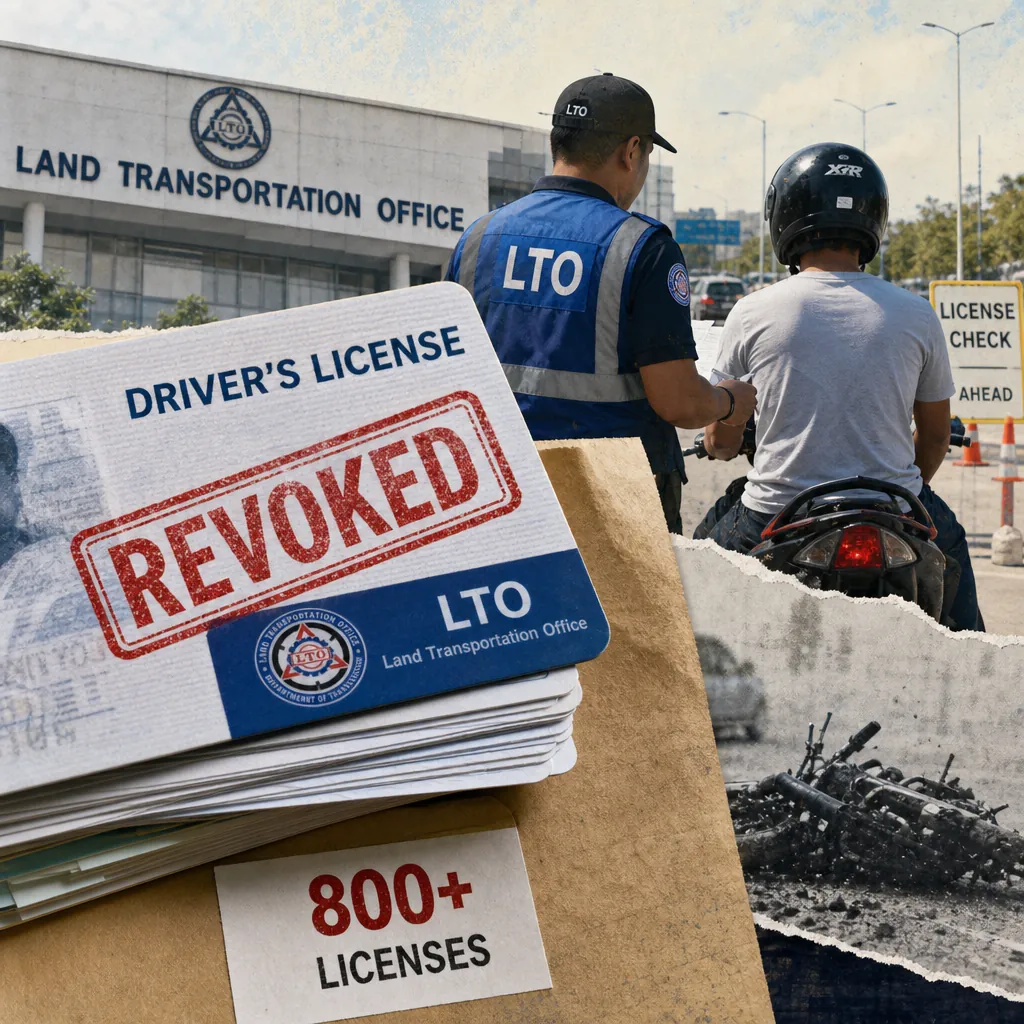
The Philippine automotive conversation on June 12-13, 2026, was dominated by a regulatory crackdown and a series of deadly road incidents, shifting the focus from industry events like [the Philippine International Motor Show (PIMS)](https://media-meter.com/report-library/pims-2026-opens-amid-consumer-trust-concerns-over-byd-reliability "Pims 2026 opens amid consumer trust concerns over byd reliability") to urgent questions about road safety, enforcement, and accountability. The Land Transportation Office (LTO) announced it had revoked or suspended over 800 driver's licenses since October 2025, a move that signals a significant intensification of traffic law enforcement. This announcement was quickly followed by reports of multiple fatal motorcycle accidents across the country, including a rider who died after sliding under an armored van in Manila, a motorcycle colliding with a concrete barrier in Pasig, and a crash on the Cebu South Coastal Road that killed two people. A separate incident involving a National Police Commission (NAPOLCOM) employee who allegedly brandished a gun at a transport network vehicle service (TNVS) driver after a minor collision added a layer of public concern about the conduct of law enforcement personnel on the road. These events collectively created a conversation centered on the fragility of road safety and the need for stricter enforcement and accountability for all road users.
Conversation snapshot. The LTO's announcement of over 800 license revocations and suspensions was the most widely covered regulatory story, appearing across multiple news outlets including the Inquirer, SunStar, and Remate Online, with each post generating modest engagement (typically under 100 views or reactions) but significant reach through syndication. The fatal motorcycle accidents drew the highest emotional engagement: the story of a rider dying under an armored van in Manila, reported by Abante-Online, had 17 views and no comments, while the Pasig barrier crash reported by GMA News Online had 2,662 views and 25 comments. The Cebu crash, covered by the Inquirer and SunStar, generated 11 comments and 6 likes respectively. The NAPOLCOM road rage incident was widely reported, with GMA News Online's post receiving 6 likes, 3 haha reactions, and 1 love reaction, while Remate Online's version had 6 likes and 1 comment. On Reddit, a user's post about a dealer forgetting to replace an engine oil cap after service received 4 upvotes and 8 comments, highlighting a persistent consumer trust issue with authorized dealerships.
Key themes
- LTO's intensified license crackdown – The LTO's announcement that it had revoked 434 licenses and suspended 396 since October 2025 was the dominant regulatory narrative. The agency framed this as a campaign to improve road discipline and public safety, with penalties ranging from one-month suspensions to permanent revocation.
- Fatal motorcycle accidents – Multiple deadly crashes involving motorcycles were reported, including a rider sliding under an armored van in Manila, a motorcycle hitting a concrete barrier in Pasig, and a collision with a pickup truck on the Cebu South Coastal Road. These incidents underscored the vulnerability of motorcyclists on Philippine roads.
- Road rage and law enforcement accountability – The arrest of a NAPOLCOM employee for allegedly brandishing a gun at a TNVS driver after a traffic collision raised questions about the conduct of law enforcement personnel. The incident was widely covered, with the suspect claiming to be from NAPOLCOM and the victim reporting that the suspect was using a cellphone while driving.
- Dealer service quality concerns – A Reddit post about a dealership forgetting to replace an engine oil cap after routine maintenance sparked a discussion about long-term engine damage and trust in authorized service centers. The thread reflected a broader anxiety among car owners about the quality of after-sales service.
- Motorcycle theft and crime – Reports of motorcycle theft, including a student's motorcycle stolen in Caloocan and a riding-in-tandem robbery in Binangonan, Rizal, highlighted the ongoing security challenges faced by motorcycle owners.
- LTFRB's crackdown on PUVs – The Land Transportation Franchising and Regulatory Board (LTFRB) summoned a public utility vehicle (PUV) operator after its driver refused to convey passengers, including LTFRB Chairman Vigor Mendoza II. The agency also warned operators of dirty and smelly taxis, emphasizing that passengers can file complaints.
- EV and industry developments – Despite the focus on accidents and enforcement, positive industry news continued, including the deployment of 20 BYD Sealion 5 DM-i units as the first taxi fleet in the Cordillera region, and the expansion of Jetour's premium GAIA network with new dealerships in Bonifacio Global City.
How the narratives stack
Dominant narrative – The dominant narrative is that Philippine roads are increasingly dangerous, particularly for motorcyclists, and that authorities are responding with stricter enforcement. The LTO's license crackdown and the multiple fatal accidents together paint a picture of a system under strain, where both drivers and riders are failing to follow rules, and the consequences are often deadly. This narrative is reinforced by the NAPOLCOM road rage incident, which suggests that even those tasked with enforcing the law are part of the problem.
Counter-narrative – A counter-narrative, though less prominent, is that the industry is making progress on safety and sustainability. The BYD taxi fleet deployment in the Cordillera region and the expansion of Jetour's premium network signal that the automotive sector is investing in cleaner, safer, and more upscale mobility options. These stories offer a more optimistic view of the future, but they struggle to gain traction against the daily drumbeat of accidents and enforcement actions.
Emerging narrative – An emerging narrative centers on consumer rights and accountability in the after-sales service experience. The Reddit post about the missing oil cap, combined with the LTFRB's crackdown on dirty taxis and refusal to convey passengers, suggests that consumers are increasingly vocal about their expectations for quality service from both dealers and public transport operators. This narrative could grow as more consumers share their experiences online.
Suppressed narrative – A suppressed narrative is the role of infrastructure in road safety. While the accidents are reported, there is little discussion of the specific road conditions, lighting, or design features that may have contributed to the crashes. The Pasig barrier crash, for example, occurred at a dimly lit intersection, but the conversation focused on the rider's alleged intoxication rather than the adequacy of the barrier or signage. Similarly, the Cebu crash involved a U-turn at an intersection, but the design of that intersection was not questioned. This gap suggests that infrastructure improvements are not yet a central part of the public conversation on road safety.
Platform insights
Reddit – Reddit served as the primary platform for peer-to-peer problem-solving and consumer advocacy. The post about the missing oil cap generated 8 comments, with users offering advice on potential engine damage and how to deal with the dealership. This platform is where car owners seek practical, community-driven solutions to service issues, and it remains a key channel for brands to monitor and engage with consumer concerns.
Facebook – Facebook was the main platform for news dissemination, with posts from major news outlets (Inquirer, GMA News, ABS-CBN) generating the bulk of engagement on accident and enforcement stories. The NAPOLCOM road rage post on GMA News Online received 6 likes, 3 haha reactions, and 1 love reaction, indicating a mix of amusement and concern. The LTO announcement on Remate Online had 1 like and 0 comments, suggesting that regulatory news is consumed passively.
YouTube – YouTube hosted video reports of accidents, such as the Pasig barrier crash on ABS-CBN News, which had 2,662 views and 25 comments. These videos serve as a primary source of visual evidence and emotional impact, driving discussion in the comments section. However, the engagement is often reactive and focused on assigning blame rather than systemic solutions.
Twitter – Twitter was used for official announcements, such as the LTO's show cause order against an SUV driver for an illegal U-turn on NLEX, but these posts generated minimal engagement (100 views, no comments). Twitter's role in the automotive conversation appears limited to broadcasting official statements rather than fostering discussion.
Key voices and communities
Land Transportation Office (LTO) – The LTO, led by Assistant Secretary Markus Lacanilao, is the primary regulatory voice, framing the license crackdown as a necessary step for road discipline. Their statements are widely reported by news outlets, giving them significant influence over the public narrative on enforcement.
Motorcycle riders and safety advocates – This community is highly active on Reddit and Facebook, sharing personal experiences of accidents, theft, and near-misses. The fatal accident reports have galvanized this group, with commenters often calling for stricter enforcement of helmet laws and motorcycle lane discipline. Their voices are amplified by news coverage of each incident.
Affected car owners – A small but vocal group on Reddit, these users share detailed accounts of dealership negligence, such as the missing oil cap incident. Their posts serve as cautionary tales and rallying points for others who have had similar experiences, and they represent a key audience for brands looking to improve after-sales service.
Law enforcement and government agencies – The Philippine National Police (PNP) and NAPOLCOM are central to the road rage narrative, with the NAPOLCOM employee's arrest drawing attention to the conduct of law enforcement personnel. The PNP's Highway Patrol Group is also involved in accident investigations, and their statements are frequently cited in news reports.
Automotive media and industry groups – Outlets like the Daily Tribune, AutoIndustriya, and 2nd Opinion continue to cover industry developments such as the BYD taxi fleet and Jetour's expansion. These voices provide a counterbalance to the negative news, but their reach is often limited to industry insiders and enthusiasts.
Narrative streams
LTO's license crackdown: A new era of enforcement?
The LTO's announcement that it had revoked or suspended over 800 driver's licenses since October 2025 marks a significant escalation in traffic law enforcement. Of the 434 revoked licenses, 325 were canceled for two years, 15 for four years, and 94 were permanently revoked. The 396 suspensions ranged from one month to one year. LTO chief Markus Lacanilao stated that the crackdown aims to "improve road discipline, prevent accidents, and ensure public safety," and that it is "part of our responsibilities to enforce traffic laws." This message was echoed across multiple news outlets, suggesting a coordinated communications effort by the agency. The announcement comes amid a series of high-profile accidents and enforcement actions, including the LTO's show cause order against an SUV driver for an illegal U-turn on NLEX. For the average driver, this means that the risk of losing their license for violations like reckless driving, drunk driving, or illegal U-turns is now more tangible. The LTO's campaign could lead to increased demand for defensive driving courses and greater awareness of traffic rules, but it also raises questions about due process and the capacity of the agency to handle appeals.
Fatal motorcycle accidents: A public health crisis
Between June 12 and 13, at least three fatal motorcycle accidents were reported in the Philippines. In Manila, a rider died after sliding under an armored van on Nakpil Street. In Pasig, a motorcycle crashed into a concrete barrier at the intersection of Ortigas and Meralco Avenue, killing the rider; the passenger reported that they had been drinking and that the rider was speeding. In Cebu, a motorcycle making a U-turn on the Cebu South Coastal Road collided with a Ford Raptor pickup, killing both the rider and his passenger. These incidents highlight the extreme vulnerability of motorcyclists, who account for a disproportionate share of road fatalities in the Philippines. The narratives around these accidents often focus on individual behavior—speeding, drunk driving, reckless maneuvers—rather than systemic factors like road design, lighting, or enforcement of motorcycle lane rules. The Pasig crash, for example, occurred at a dimly lit intersection, but the discussion centered on the rider's alcohol consumption. This framing can obscure the need for infrastructure improvements, such as better lighting, clearer signage, and physical barriers to prevent collisions.
NAPOLCOM road rage: Trust in law enforcement shaken
A 59-year-old man who identified himself as an employee of the National Police Commission (NAPOLCOM) was arrested after allegedly brandishing a gun at a TNVS driver following a minor traffic collision on EDSA in Mandaluyong City. The victim reported that the suspect was using a cellphone while driving and refused to give way, leading to the collision. When the victim got out of his vehicle, the suspect allegedly pointed a gun at him and said, "I will knock you down here." The suspect was arrested by responding police officers, and a 9mm firearm and a NAPOLCOM ID were confiscated. This incident is particularly damaging because it involves a person who is supposed to oversee the conduct of police officers. It undermines public trust in law enforcement and reinforces the perception that even those in authority are not above the law. The story was widely covered, with many commenters expressing outrage and calling for the suspect to be held accountable. For the automotive sector, this incident adds to the narrative of road rage and aggression, which can influence public attitudes toward driving and safety.
Dealer service failures: The missing oil cap
A Reddit user posted that after having their car serviced at an authorized dealership ("casa"), they discovered that the service center had forgotten to replace the engine oil cap. The user drove for a few kilometers before noticing the issue and asked whether this could cause long-term engine damage. The post received 4 upvotes and 8 comments, with users offering advice on potential damage and how to deal with the dealership. This incident is a microcosm of a broader trust issue between car owners and dealerships. Many Filipino car owners rely on authorized service centers for maintenance, but stories of negligence, hidden charges, and poor workmanship are common in online forums. The missing oil cap is a relatively minor error, but it can lead to significant engine damage if not caught in time. The thread reflects a demand for greater transparency and accountability from dealerships, and it suggests that brands that can demonstrate reliable, high-quality service can differentiate themselves in a competitive market.
Conversation trajectory
The conversation is likely to continue focusing on road safety and enforcement in the near term. The LTO's license crackdown will probably generate more stories of individual drivers facing penalties, which could fuel debate about the fairness and effectiveness of the campaign. The fatal motorcycle accidents will keep the spotlight on rider safety, and any new incidents will be quickly amplified by news outlets. The NAPOLCOM road rage case may lead to broader discussions about the conduct of law enforcement personnel and the need for stricter oversight. Over the next 4-6 weeks, expect to see more coverage of LTO enforcement actions, possibly including data on the number of licenses revoked or suspended. The conversation could shift if the LTO announces new initiatives, such as stricter penalties for specific violations or a public education campaign. A key trigger event would be a high-profile accident involving a public figure or a large number of casualties, which could galvanize calls for systemic changes to road infrastructure or traffic laws. Another trigger would be a major policy announcement from the Department of Transportation (DOTr) or the LTO, such as a new motorcycle lane requirement or a crackdown on drunk driving. The suppressed narrative around infrastructure may gain traction if a prominent voice—such as a senator or a road safety advocate—publicly links the accidents to poor road design.
Response guidance
For communicators in the automotive sector, the current conversation demands a focus on safety and accountability. Brands should avoid being drawn into debates about individual accidents or enforcement actions, but they can position themselves as part of the solution by promoting safety initiatives, such as defensive driving courses, helmet awareness campaigns, or partnerships with the LTO on road safety education. On platforms like Reddit, brands should monitor threads about dealer service and respond empathetically, offering to investigate complaints and provide solutions. This can help rebuild trust and demonstrate a commitment to customer satisfaction. On Facebook and Twitter, brands should share content that reinforces safe driving practices, such as tips on maintaining proper following distance or the importance of regular vehicle maintenance. They should also be prepared to respond to comments on news posts about accidents, but only with general safety messages, not by commenting on the specifics of the incident. The NAPOLCOM road rage incident is a sensitive topic; brands should avoid any commentary that could be seen as taking sides or criticizing law enforcement. Instead, they can use the incident to reinforce the importance of de-escalation and reporting aggressive behavior to authorities. Overall, the key is to be a constructive voice in a conversation that is currently dominated by tragedy and enforcement, by emphasizing proactive safety measures and customer care.
See the full picture behind today's signals.
This report draws from Media Meter's MediaWatch, our real-time monitoring engine tracking 2,470+ Philippine sources across print, broadcast, digital, and social. Explore how the platform turns raw coverage into decision-grade intelligence, then see how it's configured for teams like yours — whether you're in PR agencies, corporate comms, government, or marketing.
Want more? Browse our Report Library for sector and crisis intelligence, or request a demo and we'll have your brand set up before the call.
Want this kind of intelligence on your brand?
This brief is built on the same MediaWatch methodology that runs continuously across every brand we monitor. See your competitive landscape, Impact Score, and narrative trajectory in a 30-minute demo.